
Social Capital and Disaster Recovery Case Study The
- Slides: 16
“Social Capital” and “Disaster Recovery” Case Study: The 2004 Indian Ocean Tsunami in Sri Lanka Learning Module: Long-Term Recovery from the 2004 Indian Ocean Tsunami—a Comparison of Two Communities in Batticaloa, Sri Lanka SECTION 2: “Social Capital” and “Disaster Recovery” Case Study: The 2004 Indian Ocean Tsunami in Sri Lanka Created by: Elizabeth Bittel for the American Institute for Sri Lankan Studies In partial fulfillment of the Curriculum Development Grant; Fall 2017
Key Concepts and Topics: • What is “social capital”? – Linking Social Capital – Bonding Social Capital – Bridging Social Capital • How do comparative studies of different communities help us to better understand “social capital’? • The relationship between religious institutions and community-level social capital • What is “cultural competence”? • What are some ethical issues that arise in the discussion/investigation of “disaster recovery as development”?
Learning Objectives: • Evaluate: – Students should be able to critique an example of “disaster recovery” as culturally competent or not culturally competent
What is “Disaster Recovery”? • Sustainable disaster recovery – “Building back better” • Recovery is: – Social – Economic – Infrastructural – A matter of Risk Reduction • Focus for this section: Social Capital (and “community involvement”)
Social Capital • Social capital: social networks and positions that yield various benefits for their members; social capital is all about connections. – This includes elements of both “trust” and “reciprocity” • “Social capital” is a major function of how a community prepares for (or does not) experiences, and recovers from disasters
3 Forms of Social Capital • Bonding Social Capital – the connections between families and neighbors along with demographic characteristics that bind people together • Bridging Social Capital – the ties between different groups of people which cross economic and political divisions • Linking Social Capital – the ties between community members, business leaders, and political leaders (Nakagawa and Shaw 2004; Aldrich 2012)
3 Forms of Social Capital: Focus on two communities in Batticaloa • Comparing: – Village in Kallady: mixed religious, majority Hindu – Village in Kattankudy: 100% Muslim • Bonding social capital: – How do community members in majority Hindu versus Muslim communities negotiate their familial and neighborly social ties within the context of recovery from a natural disaster and civil war? • Bridging social capital: – In what ways do local groups negotiate economic and political boundaries and coalitions as they recover in the context of a civil war? • Linking social capital: – How do community members negotiate relations with business and political leaders in order to recover in the context of a complex humanitarian emergency?
The Utility of Comparative Studies on this Topic • India vs. Sri Lanka when we look at the role of the caste system (Aldrich 2012) • The Sri Lankan Civil War (1983 – 2009) – Sinhala Government vs. Tamil Liberation Movement – Tamil/Hindu communities and the LTTE – The position of Muslim communities • The role of wealth and religious institutions
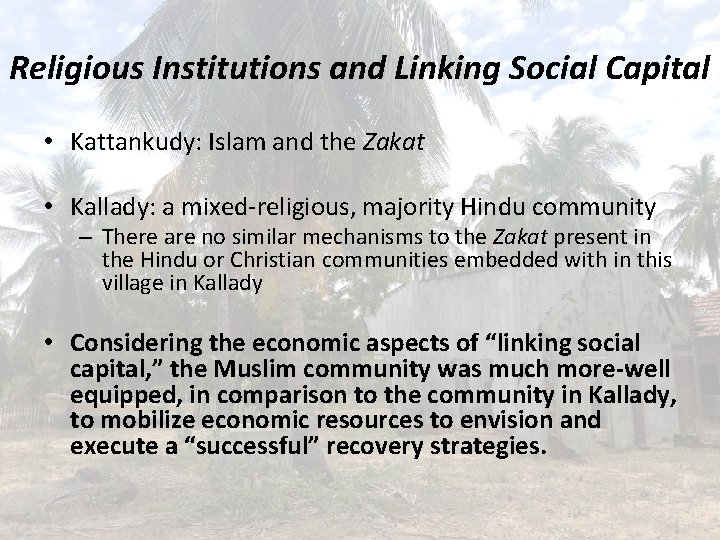
Religious Institutions and Linking Social Capital • Kattankudy: Islam and the Zakat • Kallady: a mixed-religious, majority Hindu community – There are no similar mechanisms to the Zakat present in the Hindu or Christian communities embedded with in this village in Kallady • Considering the economic aspects of “linking social capital, ” the Muslim community was much more-well equipped, in comparison to the community in Kallady, to mobilize economic resources to envision and execute a “successful” recovery strategies.
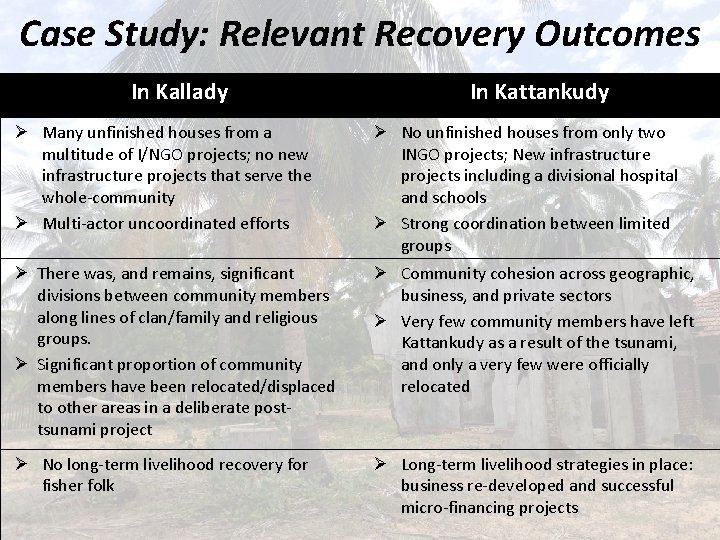
Case Study: Relevant Recovery Outcomes In Kallady In Kattankudy Ø Many unfinished houses from a multitude of I/NGO projects; no new infrastructure projects that serve the whole-community Ø Multi-actor uncoordinated efforts Ø No unfinished houses from only two INGO projects; New infrastructure projects including a divisional hospital and schools Ø Strong coordination between limited groups Ø There was, and remains, significant divisions between community members along lines of clan/family and religious groups. Ø Significant proportion of community members have been relocated/displaced to other areas in a deliberate posttsunami project Ø Community cohesion across geographic, business, and private sectors Ø Very few community members have left Kattankudy as a result of the tsunami, and only a very few were officially relocated Ø No long-term livelihood recovery for fisher folk Ø Long-term livelihood strategies in place: business re-developed and successful micro-financing projects
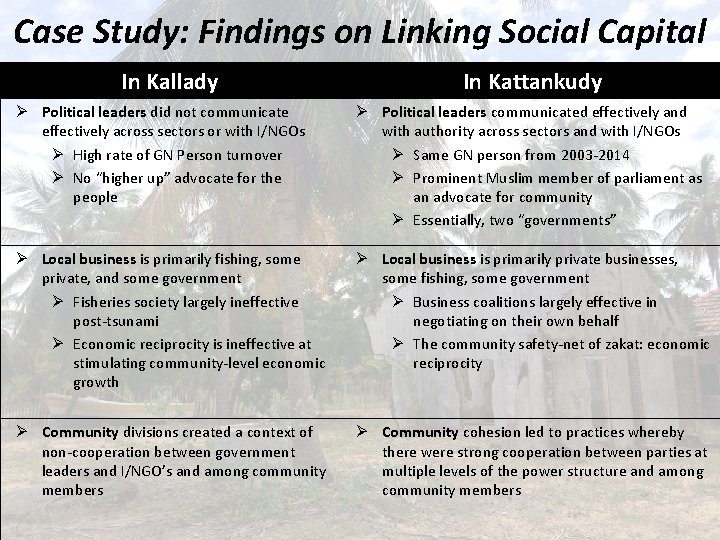
Case Study: Findings on Linking Social Capital In Kallady In Kattankudy Ø Political leaders did not communicate effectively across sectors or with I/NGOs Ø High rate of GN Person turnover Ø No “higher up” advocate for the people Ø Political leaders communicated effectively and with authority across sectors and with I/NGOs Ø Same GN person from 2003 -2014 Ø Prominent Muslim member of parliament as an advocate for community Ø Essentially, two “governments” Ø Local business is primarily fishing, some private, and some government Ø Fisheries society largely ineffective post-tsunami Ø Economic reciprocity is ineffective at stimulating community-level economic growth Ø Local business is primarily private businesses, some fishing, some government Ø Business coalitions largely effective in negotiating on their own behalf Ø The community safety-net of zakat: economic reciprocity Ø Community divisions created a context of non-cooperation between government leaders and I/NGO’s and among community members Ø Community cohesion led to practices whereby there were strong cooperation between parties at multiple levels of the power structure and among community members
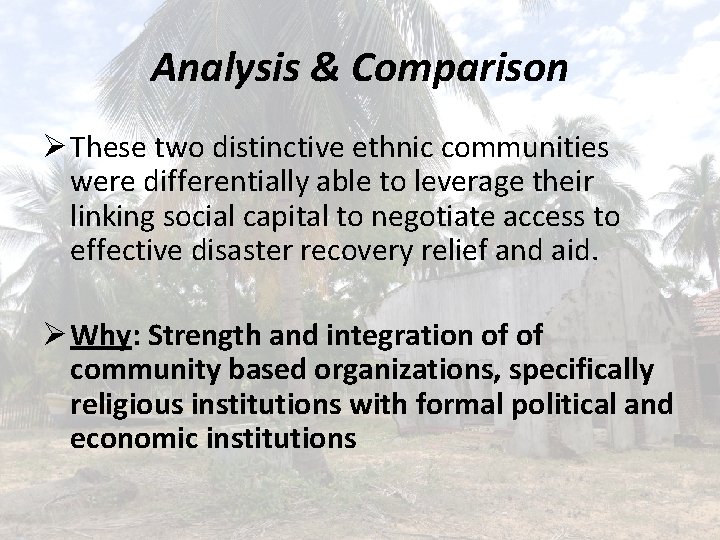
Analysis & Comparison Ø These two distinctive ethnic communities were differentially able to leverage their linking social capital to negotiate access to effective disaster recovery relief and aid. Ø Why: Strength and integration of of community based organizations, specifically religious institutions with formal political and economic institutions
Disasters and Development: Cultural Competence • A strong level of cultural competence, is evident when foreign entities to engage with, hear from, and work with local people to get the relief and recovery projects up and running. • Following the 2004 tsunami, a great many international players came into Sri Lanka (and other nations) to help the affected communities, and sometimes they were more or less culturally competent. – Examples from the two communities
Disasters and Development: Ethical Issues • Ethical issues with the “disaster recovery as development paradigm” Development: ‘an economic, social, and political process, which results in a cumulative rise in the perceived standard of living for an increasing proportion of the population. But this supposes a benign physical environment, allowing a cumulative rise in the standards of living… ‘if there could be such a thing as sustainable development, disasters would represent a major thread to it, or a sign of its failure’ highlights the ability of natural disasters to set back development. ” (Pelling 2003; 4)
Disasters and Development: Ethical Issues • Disasters affect communities in a variety of ways, which is why we must look at “recovery” from disasters from an equally dynamic perspective – Social – Economic – Infrastructure – Risk Reduction • Recovery projects for communities vs. recovery projects with communities
Review of Key Concepts and Topics: • What is “social capital”? – Linking Social Capital – Bonding Social Capital – Bridging Social Capital • How do comparative studies of different communities help us to better understand “social capital’? • The relationship between religious institutions and community-level social capital • What is “cultural competence”? • What are some ethical issues that arise in the discussion/investigation of “disaster recovery as development”?