
Social Assumptions People Perception Attribution Theory Some guy
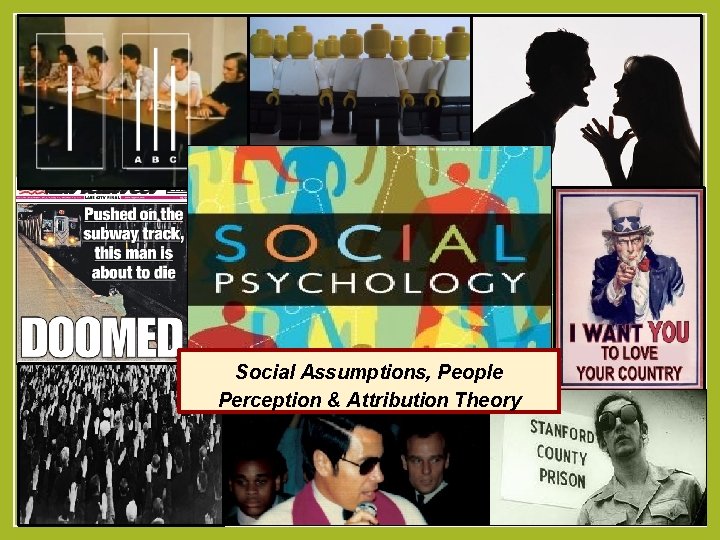
Social Assumptions, People Perception & Attribution Theory
-Some guy
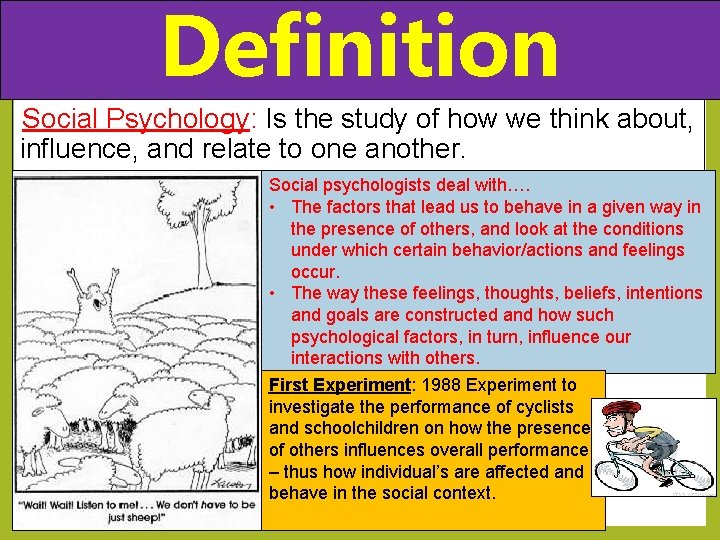
Definition Social Psychology: Is the study of how we think about, influence, and relate to one another. Social psychologists deal with…. • The factors that lead us to behave in a given way in the presence of others, and look at the conditions under which certain behavior/actions and feelings occur. • The way these feelings, thoughts, beliefs, intentions and goals are constructed and how such psychological factors, in turn, influence our interactions with others. First Experiment: 1988 Experiment to investigate the performance of cyclists and schoolchildren on how the presence of others influences overall performance – thus how individual’s are affected and behave in the social context.
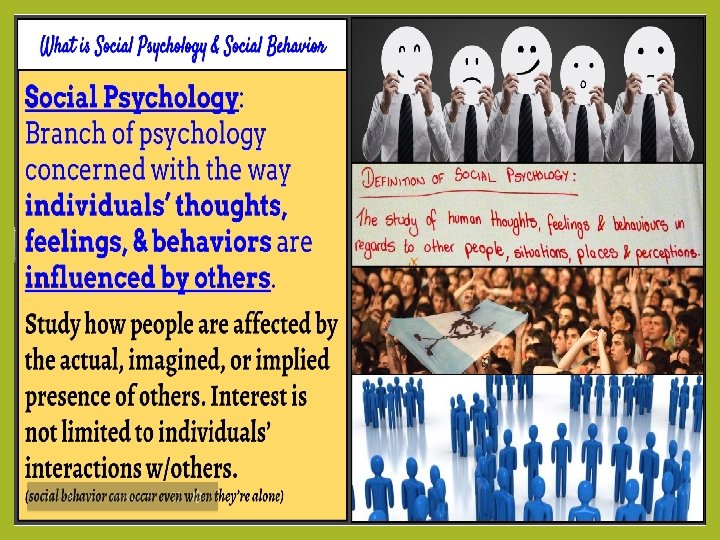
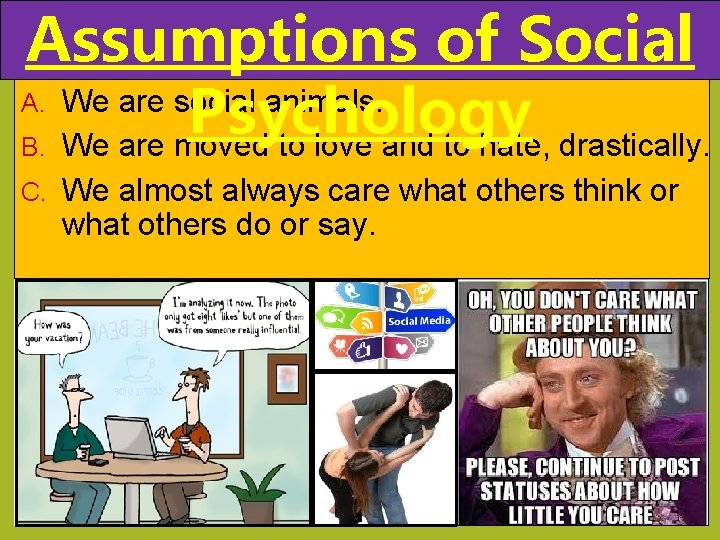
Assumptions of Social A. We are social animals. Psychology B. We are moved to love and to hate, drastically. C. We almost always care what others think or what others do or say.
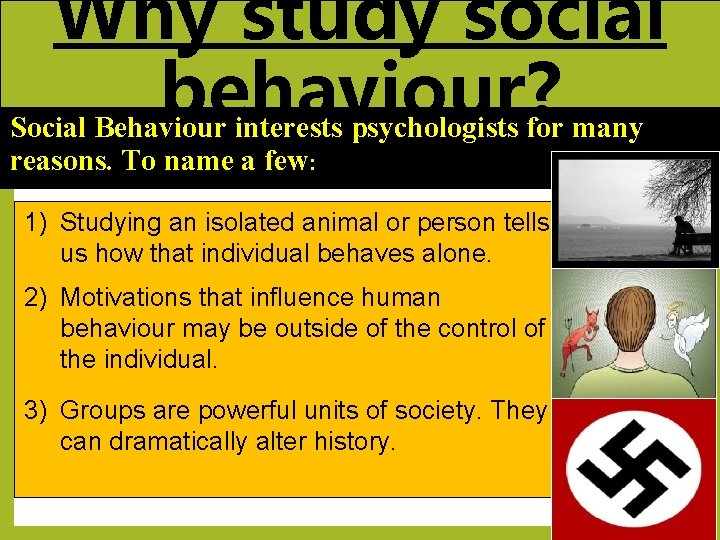
Why study social behaviour? Social Behaviour interests psychologists for many reasons. To name a few: 1) Studying an isolated animal or person tells us how that individual behaves alone. 2) Motivations that influence human behaviour may be outside of the control of the individual. 3) Groups are powerful units of society. They can dramatically alter history.
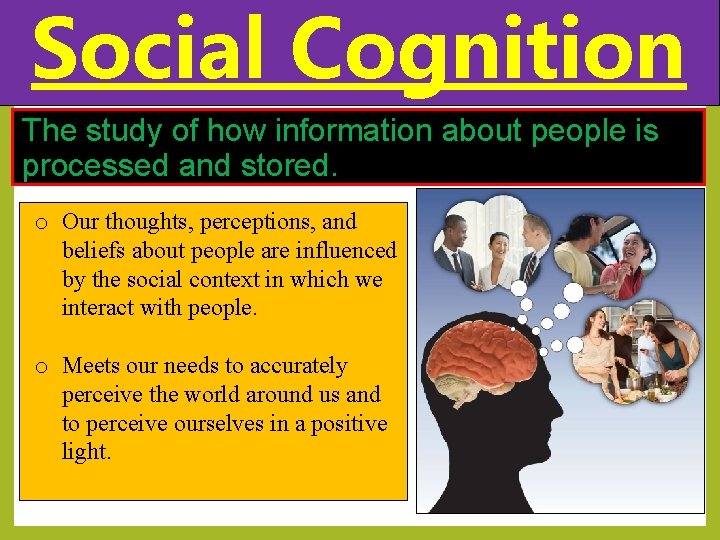
Social Cognition The study of how information about people is processed and stored. o Our thoughts, perceptions, and beliefs about people are influenced by the social context in which we interact with people. o Meets our needs to accurately perceive the world around us and to perceive ourselves in a positive light.
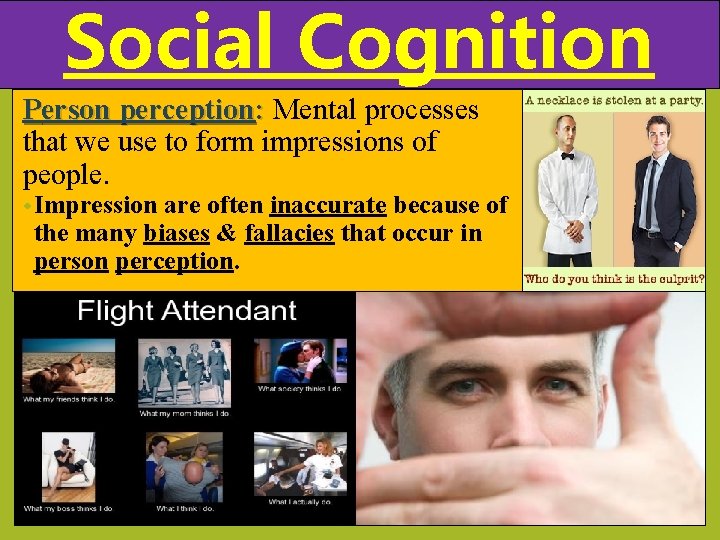
Social Cognition Person perception: Mental processes that we use to form impressions of people. • Impression are often inaccurate because of the many biases & fallacies that occur in person perception.
Social Thinking When the unexpected occurs, we analyze why people act as they do. • • • Does her warmth reflect romantic interest, or is that how she relates to everyone? Does his absenteeism signify illness? Laziness? A stressful work atmosphere? Was the horror of 9/11 the work of crazed evil people, or of ordinary people corrupted by life events?
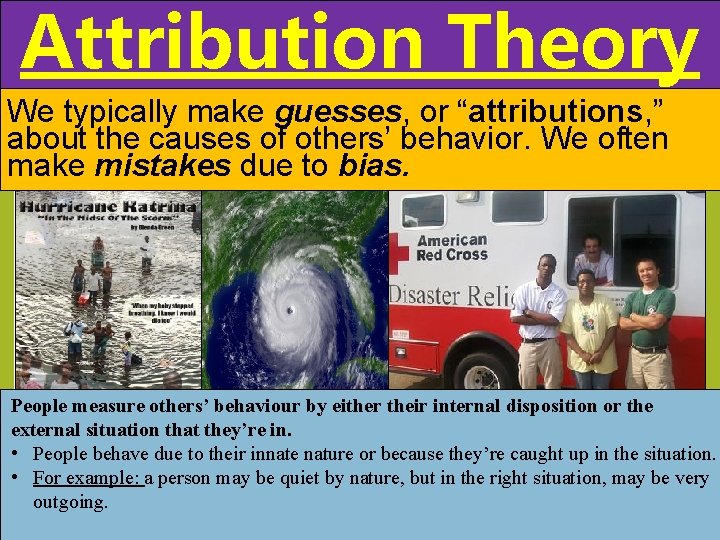
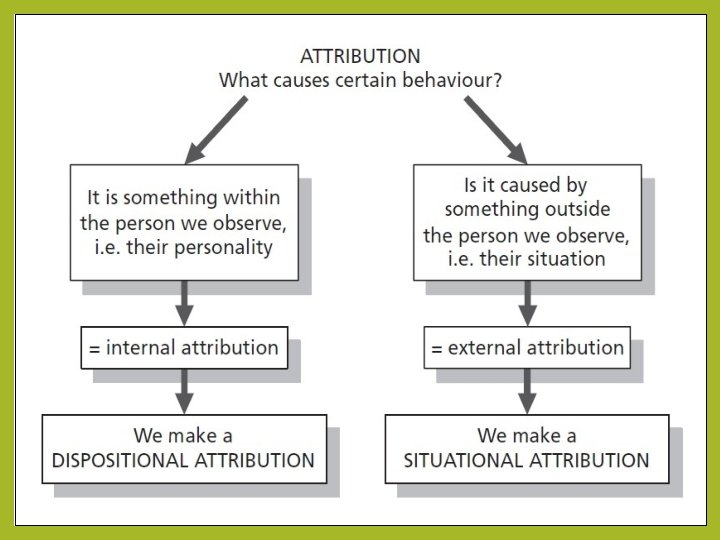
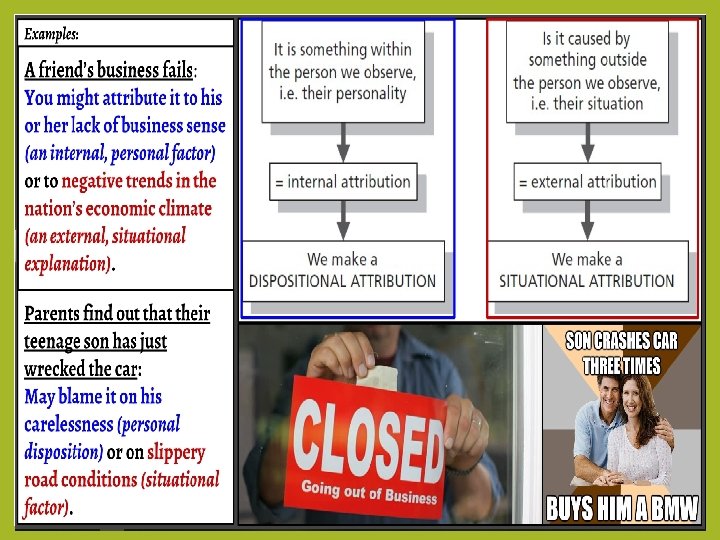
Attribution Theory We typically make guesses, or “attributions, ” about the causes of others’ behavior. We often make mistakes due to bias. People measure others’ behaviour by either their internal disposition or the external situation that they’re in. • People behave due to their innate nature or because they’re caught up in the situation. • For example: a person may be quiet by nature, but in the right situation, may be very outgoing.
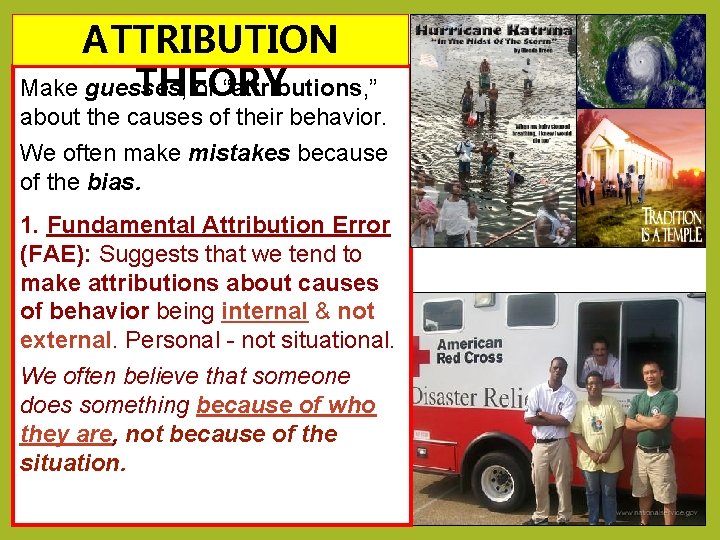
ATTRIBUTION Make guesses, or “attributions, ” THEORY about the causes of their behavior. We often make mistakes because of the bias. 1. Fundamental Attribution Error (FAE): Suggests that we tend to make attributions about causes of behavior being internal & not external. Personal - not situational. We often believe that someone does something because of who they are, not because of the situation.
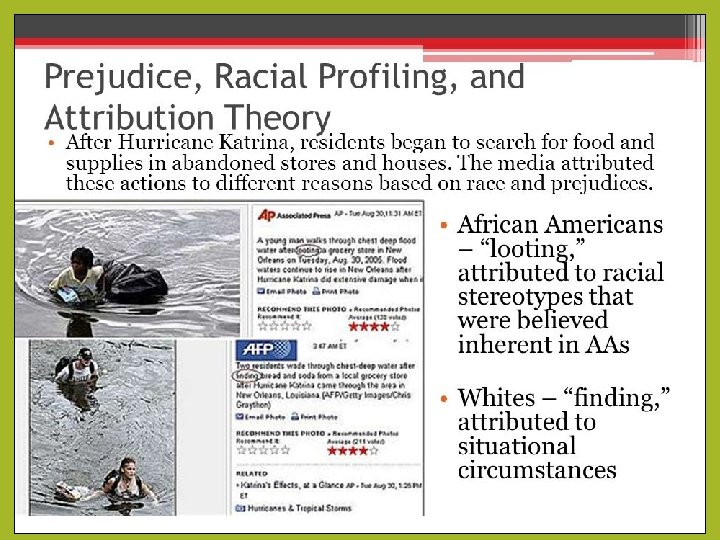
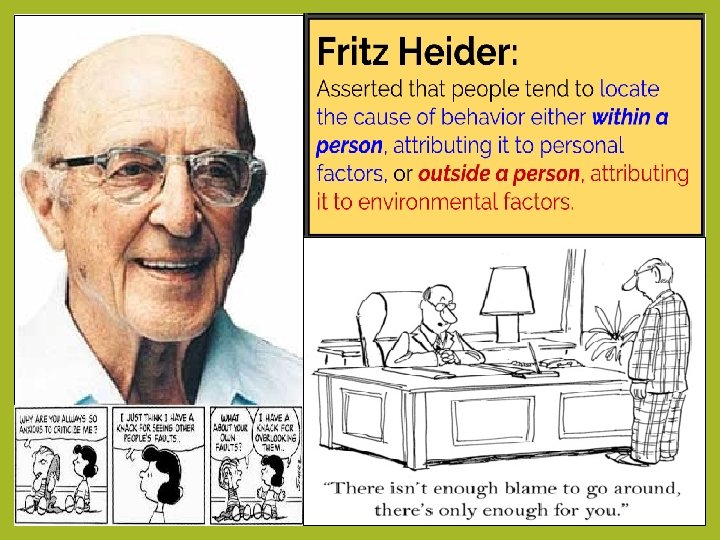
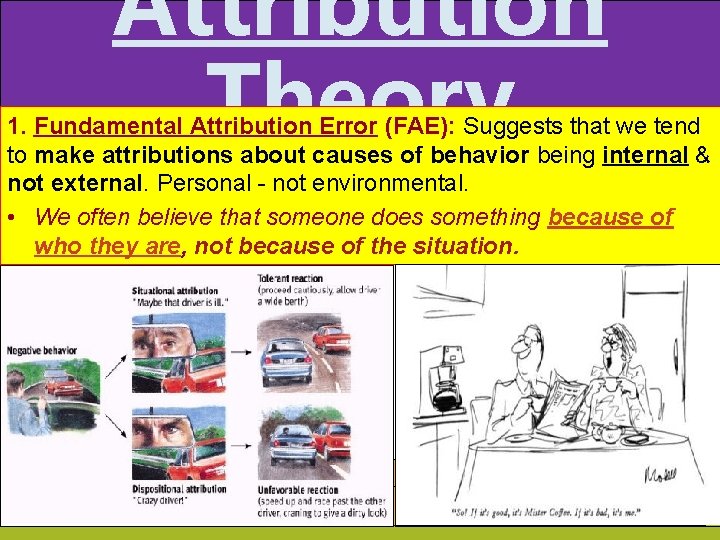
Attribution Theory 1. Fundamental Attribution Error (FAE): Suggests that we tend to make attributions about causes of behavior being internal & not external. Personal - not environmental. • We often believe that someone does something because of who they are, not because of the situation. We tend to overestimate a person’s natural personality and underestimate the position that they’re in.
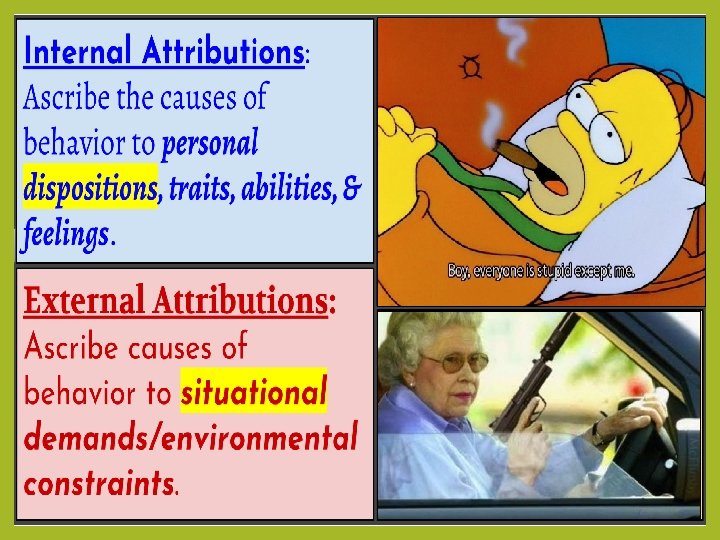
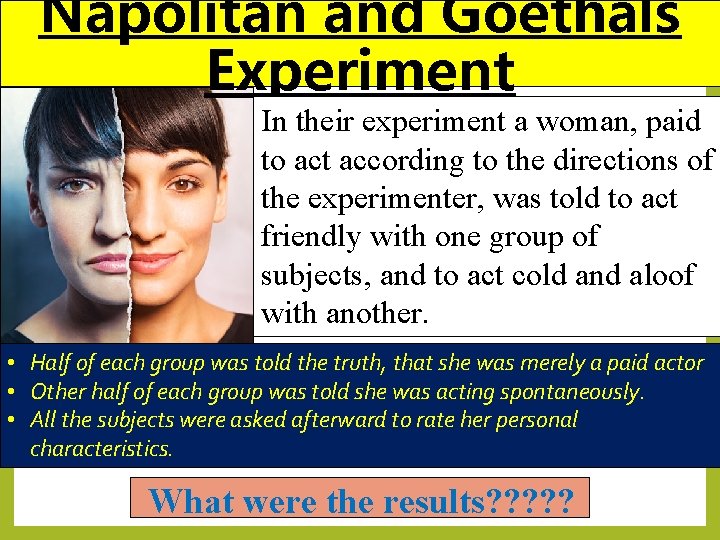
Napolitan and Goethals Experiment In their experiment a woman, paid to act according to the directions of the experimenter, was told to act friendly with one group of subjects, and to act cold and aloof with another. • Half of each group was told the truth, that she was merely a paid actor • Other half of each group was told she was acting spontaneously. • All the subjects were asked afterward to rate her personal characteristics. What were the results? ? ?

THERE WAS NO EFFECT!!!! The students disregarded the information. That is, they attributed her behavior to her disposition and rated her personal characteristics as being consistent with how she had acted toward them. Friendly Woman = Warm person Unfriendly Woman = Cold person
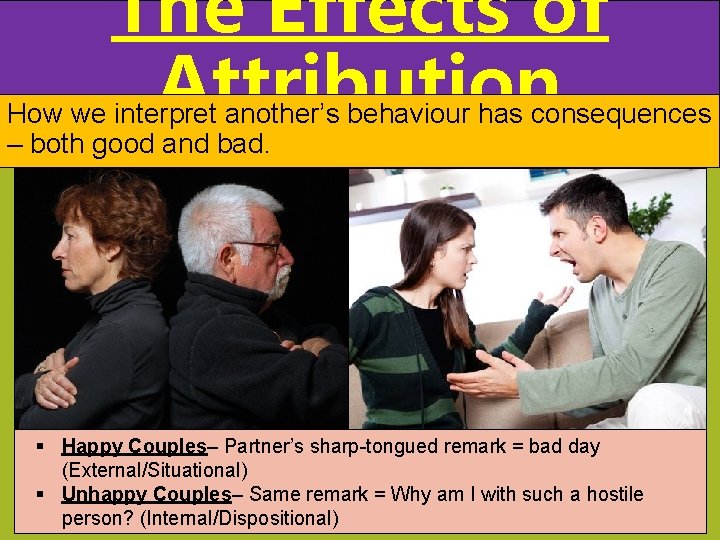
The Effects of Attribution How we interpret another’s behaviour has consequences – both good and bad. § Happy Couples– Partner’s sharp-tongued remark = bad day (External/Situational) § Unhappy Couples– Same remark = Why am I with such a hostile person? (Internal/Dispositional)
The Wife and The Highwayman Once upon a time, a husband a wife lived together in a part of the city separated by a river from the places of employment, shopping, and entertainment. The husband had to work nights. Each evening he left his wife and took the ferry to work, returning home in the morning. The wife soon tired of this arrangement. Restless and lonely, she would take the next ferry into town and develop relationships with a series of lovers. Anxious to preserve her marriage, she always returned home before her husband. In fact, her relationships were always limited. When they threatened to become too intense, she would precipitate a quarrel with her current lover and begin a new relationship. One night she caused such a quarrel with a man we will call Lover 1. He slammed the door in her face, and she started back to the ferry. Suddenly, she realized that she had forgotten to bring money for her return fare. She swallowed her pride and returned to Lover 1’s apartment. But Lover 1 was vindictive and angry because of the quarrel. He slammed the door on his former lover, leaving her with no money. She remembered that a previous lover, whom we shall call Lover 2, lived just a few doors away. Surely he would give her the ferry fare. However, Lover 2 was still so hurt from their old quarrel that he, too, refused her the money.
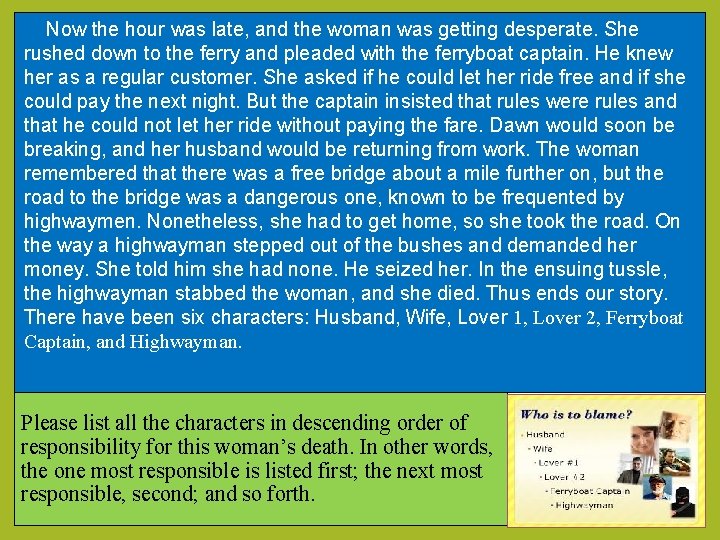
Now the hour was late, and the woman was getting desperate. She rushed down to the ferry and pleaded with the ferryboat captain. He knew her as a regular customer. She asked if he could let her ride free and if she could pay the next night. But the captain insisted that rules were rules and that he could not let her ride without paying the fare. Dawn would soon be breaking, and her husband would be returning from work. The woman remembered that there was a free bridge about a mile further on, but the road to the bridge was a dangerous one, known to be frequented by highwaymen. Nonetheless, she had to get home, so she took the road. On the way a highwayman stepped out of the bushes and demanded her money. She told him she had none. He seized her. In the ensuing tussle, the highwayman stabbed the woman, and she died. Thus ends our story. There have been six characters: Husband, Wife, Lover 1, Lover 2, Ferryboat Captain, and Highwayman. Please list all the characters in descending order of responsibility for this woman’s death. In other words, the one most responsible is listed first; the next most responsible, second; and so forth.
The Psychology Of The Wife and the Highwayman Bloyd’s research found that Half will typically choose the wife first and half will list the highwayman first. Average Explanation: “She deserved it” o “She was asking for trouble” o “She should have known better” o (Note): A simple change in the story can dramatically reverse these results • Wife becomes a widow who works at night to make money to support her children and has “to get home before the babysitter leaves” = the highwayman, and not the wife, is blamed more often. However, the highwayman’s behavior has not changed.
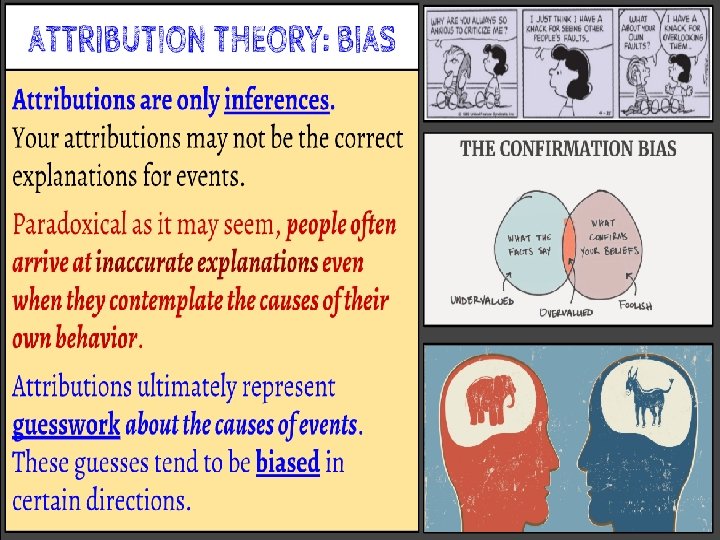
Cognitive-Confirmation Bias & Self-Fulfilling Prophecy Cognitive-confirmation bias: Participants are more likely to search for information that confirms a previously learned bias than to seek information that contradicts the bias. Self-fulfilling prophecy: If you hear something good or bad about a person, you will perceive that skill in the person more than if you had not previously heard that information.
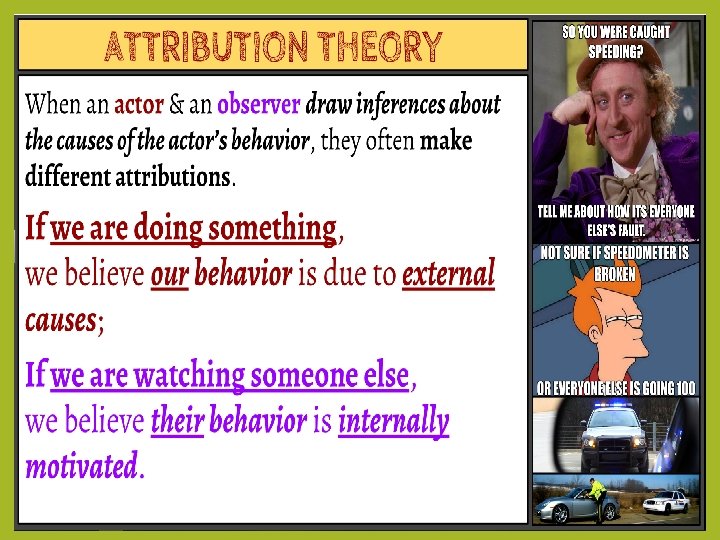
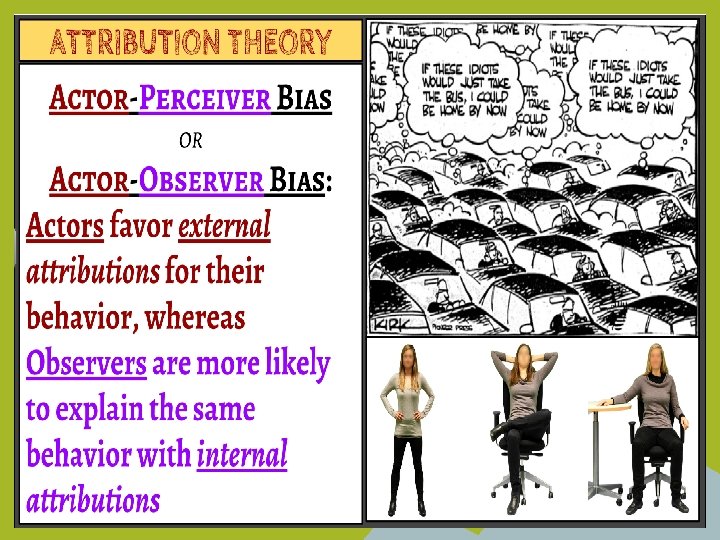
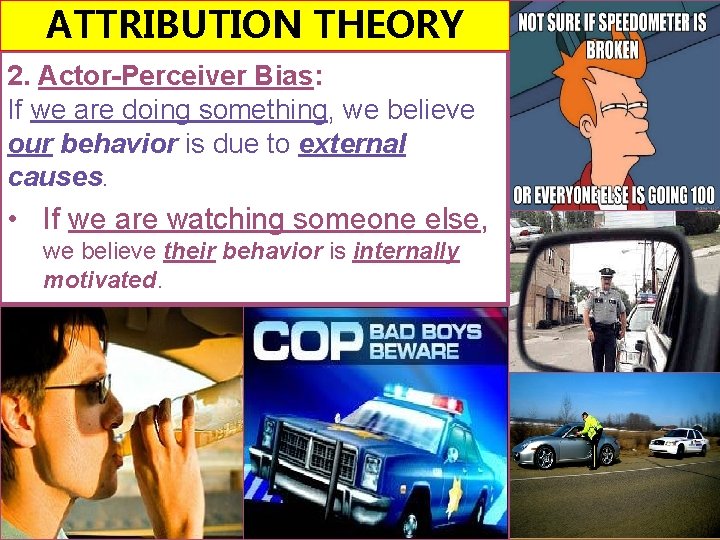
ATTRIBUTION THEORY 2. Actor-Perceiver Bias: If we are doing something, we believe our behavior is due to external causes. • If we are watching someone else, we believe their behavior is internally motivated.
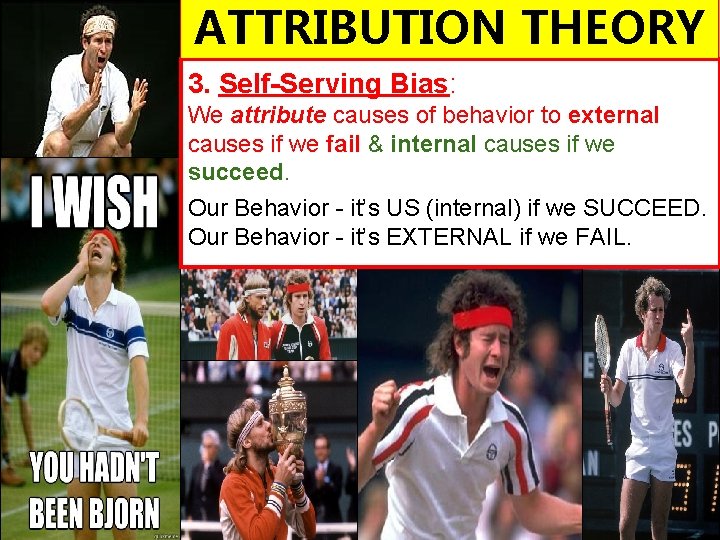
ATTRIBUTION THEORY 3. Self-Serving Bias: We attribute causes of behavior to external causes if we fail & internal causes if we succeed. Our Behavior - it’s US (internal) if we SUCCEED. Our Behavior - it’s EXTERNAL if we FAIL.

Youtube Video Link: John Mc. Enroe's Famous Outburst. Classic Example of "Self. Serving Bias. " We attribute our success to our own performance. We attribute our failure to the failure of others.
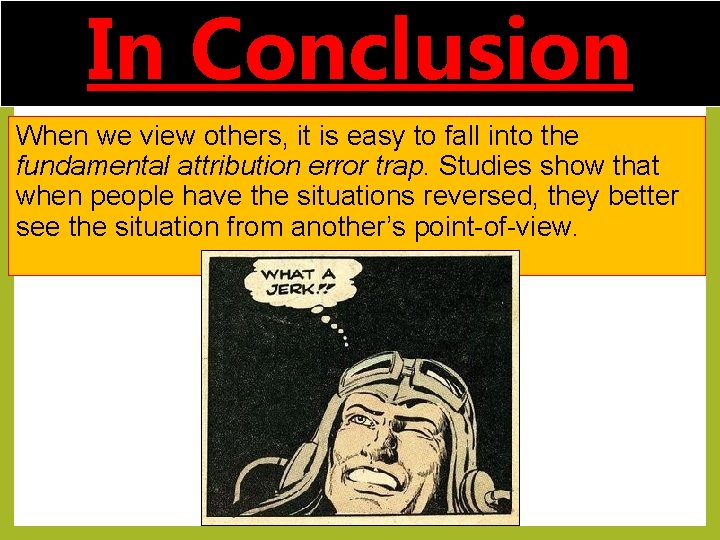
In Conclusion When we view others, it is easy to fall into the fundamental attribution error trap. Studies show that when people have the situations reversed, they better see the situation from another’s point-of-view.
- Slides: 31