
Social Anxiety Image of girl surrounded by social
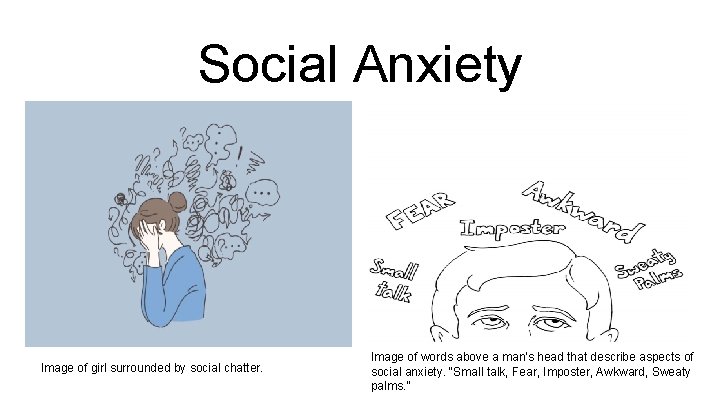
Social Anxiety Image of girl surrounded by social chatter. Image of words above a man's head that describe aspects of social anxiety. “Small talk, Fear, Imposter, Awkward, Sweaty palms. ”
Social Anxiety We all have moments when we occasionally become shy or anxious. Maybe you feel this way when you have to present a project for a class, or even during a job interview. Sometimes people develop a constant feeling of uneasiness, dread, or apprehension in regards to social interactions such as public speaking; though people can also experience it with a variety of social interactions. Here is a link for a You. Tube video that mentions a lot of the topics in this powerpoint. It also gives students’ perspectives and experiences with social anxiety. https: //www. youtube. com/watch? v=FSSWi. DT 91 z 4&feature=youtu. be
What is Social Anxiety? As previously mentioned, social anxiety is the feeling of uneasiness, dread, or apprehension in regards to social interaction. There is often the concern that one may be judged for feeling this way, even if that is not the case. Social anxiety can range from being mild and infrequent, to being a major deterrent in one’s everyday life. A person with social anxiety disorder has significant anxiety and discomfort about being embarrassed, humiliated, rejected or looked down on in social interactions. People with this disorder will try to avoid the situation or endure it with great anxiety. (American Psychiatric Association, 2020) Remember: Occasional shyness or anxiety is not the same as having social anxiety disorder. It is common to experience these feelings from time to time, but these occasional feelings typically do not hinder someone's normal functioning in the way social anxiety disorder does.
What are the components to social anxiety? Social anxiety is made up of three main components: ❖ Emotions and thoughts ❖ Physical symptoms ❖ Behavior Image of question marks shaped as clouds in the sky.
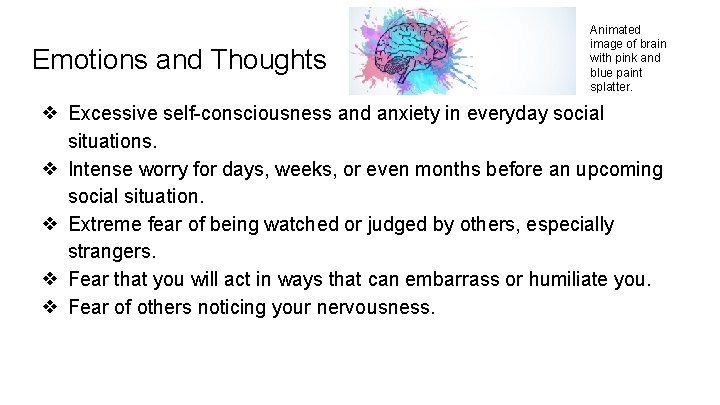
Emotions and Thoughts Animated image of brain with pink and blue paint splatter. ❖ Excessive self-consciousness and anxiety in everyday social situations. ❖ Intense worry for days, weeks, or even months before an upcoming social situation. ❖ Extreme fear of being watched or judged by others, especially strangers. ❖ Fear that you will act in ways that can embarrass or humiliate you. ❖ Fear of others noticing your nervousness.
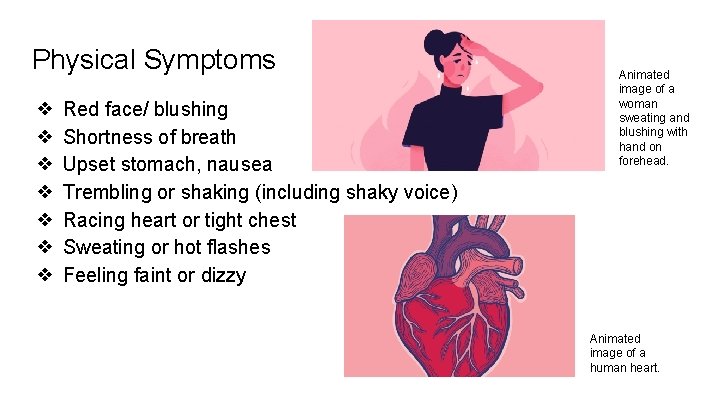
Physical Symptoms ❖ ❖ ❖ ❖ Red face/ blushing Shortness of breath Upset stomach, nausea Trembling or shaking (including shaky voice) Racing heart or tight chest Sweating or hot flashes Feeling faint or dizzy Animated image of a woman sweating and blushing with hand on forehead. Animated image of a human heart.

Behaviors ❖ Avoiding social situations to a degree that limits your activities or disrupts your life. ❖ Staying quiet or hiding in the background in order to avoid unwanted attention or being embarrassed ❖ A need to bring a friend when you go places ❖ Self-medicate to soothe nerves before social situations Animated image of a person with a brown paper bag over their head.
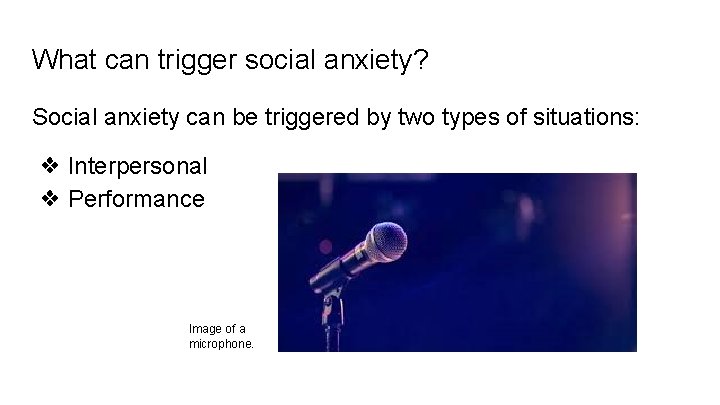
What can trigger social anxiety? Social anxiety can be triggered by two types of situations: ❖ Interpersonal ❖ Performance Image of a microphone.
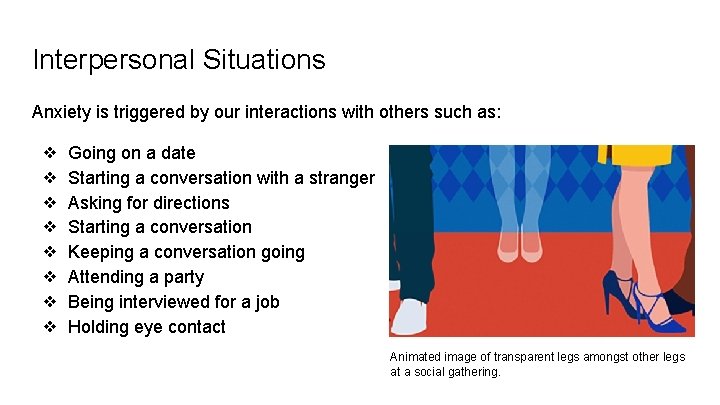
Interpersonal Situations Anxiety is triggered by our interactions with others such as: ❖ ❖ ❖ ❖ Going on a date Starting a conversation with a stranger Asking for directions Starting a conversation Keeping a conversation going Attending a party Being interviewed for a job Holding eye contact Animated image of transparent legs amongst other legs at a social gathering.
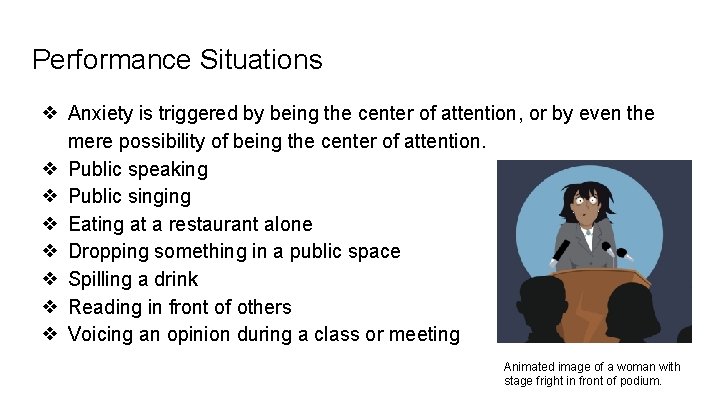
Performance Situations ❖ Anxiety is triggered by being the center of attention, or by even the mere possibility of being the center of attention. ❖ Public speaking ❖ Public singing ❖ Eating at a restaurant alone ❖ Dropping something in a public space ❖ Spilling a drink ❖ Reading in front of others ❖ Voicing an opinion during a class or meeting Animated image of a woman with stage fright in front of podium.
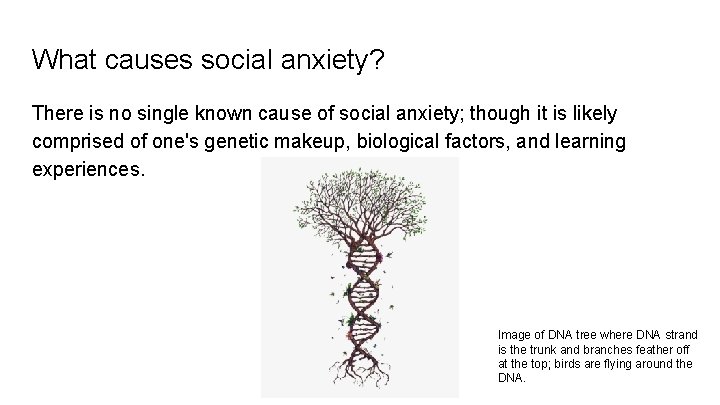
What causes social anxiety? There is no single known cause of social anxiety; though it is likely comprised of one's genetic makeup, biological factors, and learning experiences. Image of DNA tree where DNA strand is the trunk and branches feather off at the top; birds are flying around the DNA.
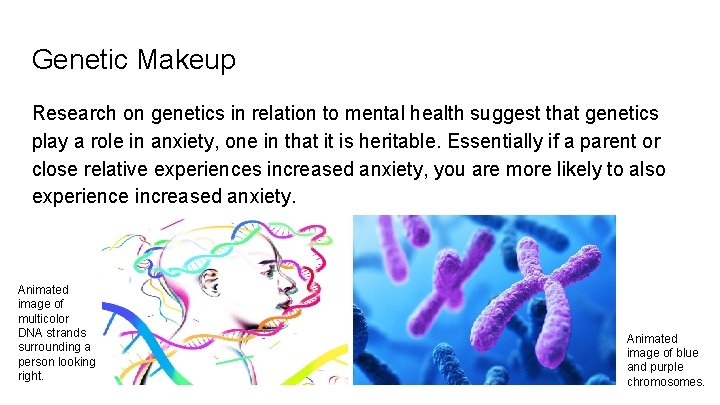
Genetic Makeup Research on genetics in relation to mental health suggest that genetics play a role in anxiety, one in that it is heritable. Essentially if a parent or close relative experiences increased anxiety, you are more likely to also experience increased anxiety. Animated image of multicolor DNA strands surrounding a person looking right. Animated image of blue and purple chromosomes.
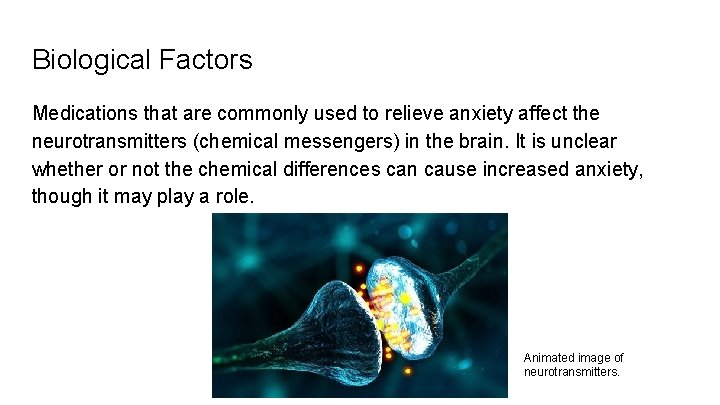
Biological Factors Medications that are commonly used to relieve anxiety affect the neurotransmitters (chemical messengers) in the brain. It is unclear whether or not the chemical differences can cause increased anxiety, though it may play a role. Animated image of neurotransmitters.
Learning experiences ❖ What we experience in our lives and how we react to these experiences can contribute to the development of anxiety. If one feels that they’re constantly in situations where they feel they are being judged or negatively singled out, it may cause someone to develop beliefs about themselves and the world around them that is consistent with social anxiety. ❖ As these experiences continue, one may pay closer attention to parts of the environment that reinforce the negative beliefs held. For example: a public speaker that notices a couple people in the audience bored, but may notice the vast majority that are paying attention and are interested. As these beliefs and filters are strengthened, one may start to act, feel, and think more anxiously and automatically. ❖ This may lead to a negative outlook on rather neutral situations and can cause avoidance of social interactions altogether. When one avoids social interactions, it does not allow you to challenge these negative beliefs to break the cycle; instead it strengthens the cycle.

How Common is Social Anxiety? Social anxiety is the most common anxiety disorder and the third most common mental disorder in the U. S. after depression and alcohol dependence. It is more common in women than in men. It often surfaces in adolescence or early adulthood, but can occur at any time; including early childhood. Animated image of person covering their face with eyes staring at them.
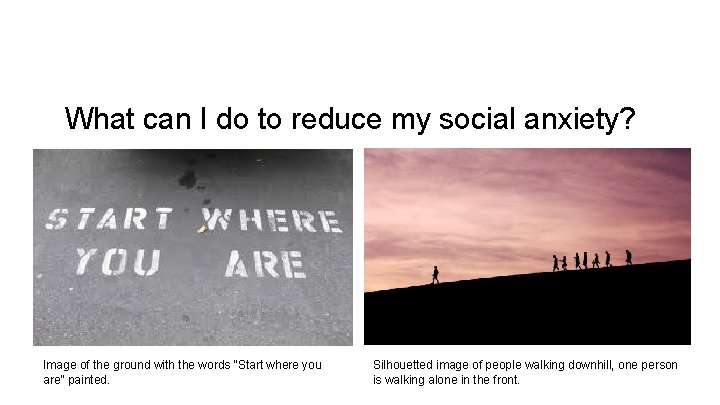
What can I do to reduce my social anxiety? Image of the ground with the words “Start where you are” painted. Silhouetted image of people walking downhill, one person is walking alone in the front.
Challenge Negative Thought Patterns Negative thoughts and beliefs contribute to social anxiety. One might think to themselves “I know I’m going to look dumb” or “People will think I’m stupid. ” The first step is identifying those automatic negative thoughts that underlie your social anxiety. For example, you may be worried about an upcoming interview and your negative underlying thought it “i’m going to blow it, then they’ll think I’m stupid. ” The next step is to analyze and challenge those negative thoughts. Analyzing these thoughts can consist of asking yourself questions such as “Do I really feel like I’m going to do bad in this interview? ” or “Even if I’m nervous, will people really think i’m stupid for it? ” Animated image of a pink thought bubble.
There are some unhelpful thinking styles you may be using. Read through and ask yourself if you are engaging in these type of thoughts: ❖ Mind Reading: Assuming you know what others are thinking or feeling, and that they feel the same way you do. ❖ Fortune telling: Predicting the future, usually assuming the worst will happen. This builds up anxiety before anything actually happens. ❖ Catastrophizing: Blowing things out of proportion. For example, if people notice you are nervous it will ruin the whole interview. ❖ Personalizing: Assuming all people are focused on you in a negative way, or what is going on with others has to do with you.
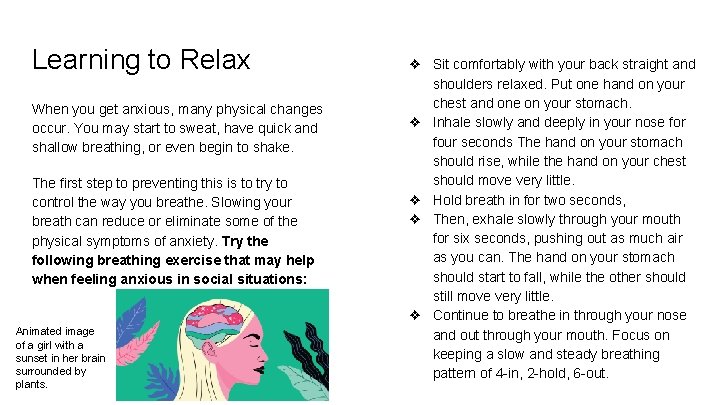
Learning to Relax When you get anxious, many physical changes occur. You may start to sweat, have quick and shallow breathing, or even begin to shake. The first step to preventing this is to try to control the way you breathe. Slowing your breath can reduce or eliminate some of the physical symptoms of anxiety. Try the following breathing exercise that may help when feeling anxious in social situations: Animated image of a girl with a sunset in her brain surrounded by plants. ❖ Sit comfortably with your back straight and shoulders relaxed. Put one hand on your chest and one on your stomach. ❖ Inhale slowly and deeply in your nose for four seconds The hand on your stomach should rise, while the hand on your chest should move very little. ❖ Hold breath in for two seconds, ❖ Then, exhale slowly through your mouth for six seconds, pushing out as much air as you can. The hand on your stomach should start to fall, while the other should still move very little. ❖ Continue to breathe in through your nose and out through your mouth. Focus on keeping a slow and steady breathing pattern of 4 -in, 2 -hold, 6 -out.
Additional Resource for Relaxation Techniques There are many other relaxation techniques that can help reduce overall anxiety levels. Click the link below for some useful resources for progressive muscle relaxation, body scan meditation, mindfulness, visualization meditation, yoga, and tai chi. https: //www. helpguide. org Animated image of woman meditating surrounded by plants.
Face Your Fears Avoidance of your fears fuels further anxiety. Although it may be instantly gratifying to avoid these social situations, it also prevents you from ever feeling more comfortable. It may even increase your fear over time. The key to facing your fears is to take small, manageable steps. You can start with a situation that provokes slight to moderate anxiety, and eventually work your way up. Click the link for a social anxiety self help guide, including worksheets that help decide where to start. https: //www. nhsinform. scot/illnesses-and-conditions/mental-health/mentalhealth-self-help-guides/social-anxiety-self-help-guide
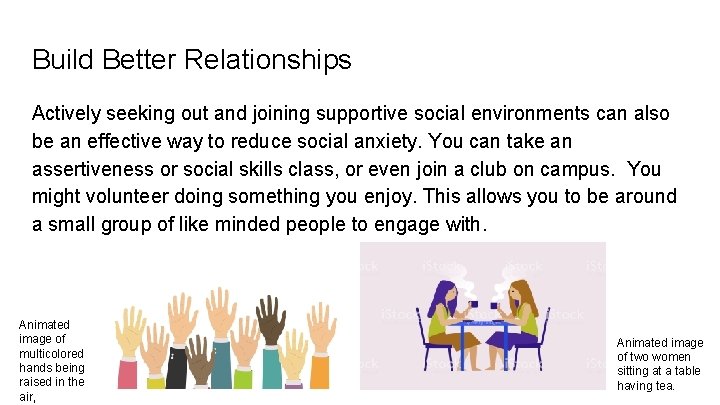
Build Better Relationships Actively seeking out and joining supportive social environments can also be an effective way to reduce social anxiety. You can take an assertiveness or social skills class, or even join a club on campus. You might volunteer doing something you enjoy. This allows you to be around a small group of like minded people to engage with. Animated image of multicolored hands being raised in the air, Animated image of two women sitting at a table having tea.
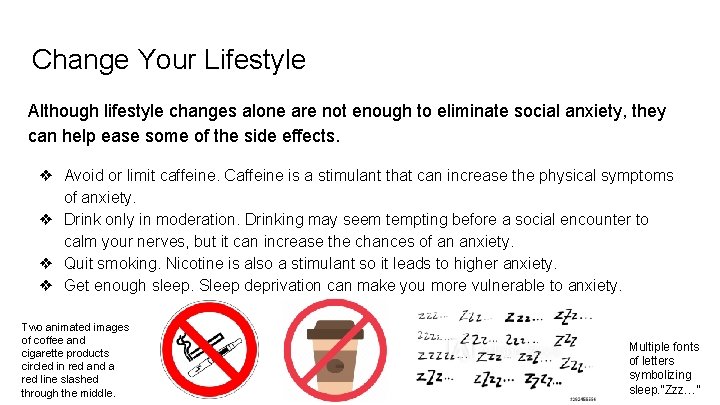
Change Your Lifestyle Although lifestyle changes alone are not enough to eliminate social anxiety, they can help ease some of the side effects. ❖ Avoid or limit caffeine. Caffeine is a stimulant that can increase the physical symptoms of anxiety. ❖ Drink only in moderation. Drinking may seem tempting before a social encounter to calm your nerves, but it can increase the chances of an anxiety. ❖ Quit smoking. Nicotine is also a stimulant so it leads to higher anxiety. ❖ Get enough sleep. Sleep deprivation can make you more vulnerable to anxiety. Two animated images of coffee and cigarette products circled in red and a red line slashed through the middle. Multiple fonts of letters symbolizing sleep. “Zzz…”
What if these steps don’t help? Everyone is different, and treatment needs vary between individuals. If self-help strategies are not working, you may want to consider individual or group therapy. You can call or stop by the Counseling and Psychological Services Department on the second floor of the Student Health Center to make an appointment. Counseling and Psychological Services (707) 826 -3236 https: //counseling. humboldt. edu
References American Psychiatric Association, 2020. What Are Anxiety Disorders? https: //www. psychiatry. org/patients-families/anxiety-disorders/what-are-anxietydisorders
- Slides: 25