
Social Anxiety and Its Treatment David M Clark



- Slides: 27
Social Anxiety and It’s Treatment David M Clark Institute of Psychiatry, Kings College London
Anxiety and Anxiety Disorders • Anxiety is a survival mechanism • Motivator and sometimes life saver with real dangers • Problematic when danger is imagined • Anxiety Disorder diagnosed when anxiety is out of proportion to the danger, is persistent, and disabling. One year prevalence: 17% Cost $42 billion per year (US, 1990 s).
Social Phobia (Social Anxiety Disorder) • Most common anxiety disorder (12 % prevalence) • Persistent fear of social or performance situations. Individual fears he/she will act in a way which will be humiliating or embarrassing. • Fear recognised as excessive or unreasonable • Feared situations are avoided or endured with intense distress
Characteristics and Consequences • Typically childhood onset (median 13 yrs). • Low natural recovery rate (Bruce et al 2005: 37% over 12 years). • Increased risk of suicide, alcohol & drug abuse, depression, other anxiety disorders. • Marked under-achievement • Low treatment seeking rates
Typical Thoughts What I say sounds stupid I’m boring I will make a fool of myself They don’t like me They’ll see I’m anxious I won’t have anything to say I’ll blush/shake/lose control
Existing Treatments Medication • MAOI (phenelzine) • SSRIs (paroxetine, sertraline, fluvoxamine, fluoxetine) (effective in short-term but problematic relapse ) Psychological • Exposure therapy • Group cognitive-behavior therapy (effective in short-term & gains well-maintained ) BUT less than 50% recover.
Clark & Wells (1995) SOCIAL PHOBIA PERSISTS DUE TO: • shift to internal focus of attention • use of internal information to infer how one appears to others • safety behaviors
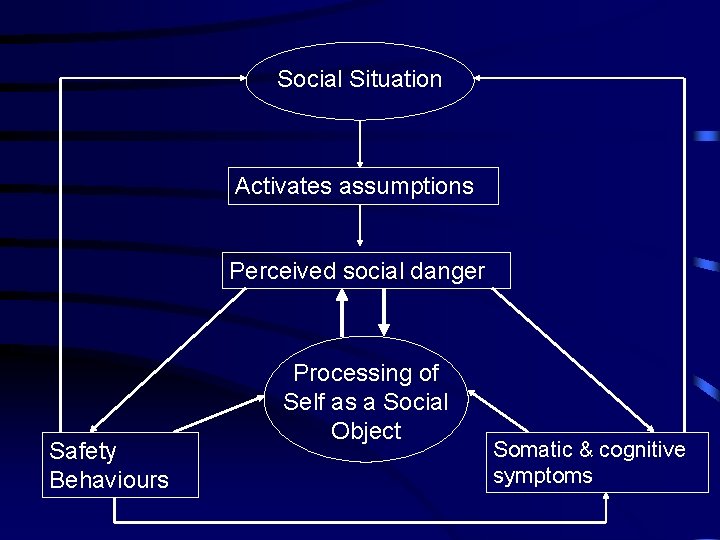
Social Situation Activates assumptions Perceived social danger Safety Behaviours Processing of Self as a Social Object Somatic & cognitive symptoms
Mansell, Clark & Ehlers (2003) Do high socially anxious individuals have an internal attentional bias? High vs Low Socially Anxious Students Detect external and internal probes Threat vs No Threat Source: Behaviour Research & Therapy, 41, 555 -572.
External vs Internal Focus of Attention
Hackmann, Surawy & Clark (1998) Do patients with social phobia experience negative, observer perspective images when anxious in social situations? Structured interview. Frequency, content & perspective of spontaneous imagery
% Negative, distorted, observer perspective images
Link between date of memory and onset of social phobia
Wells, Clark, Salkovskis et al (1995) Do safety behaviours prevent cognitive change? Exposure with safety behaviours VS Exposure without safety behaviours
Improvement
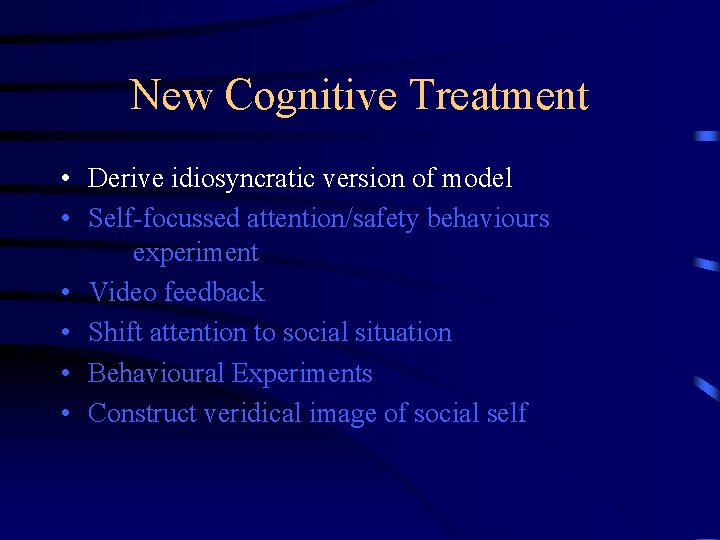
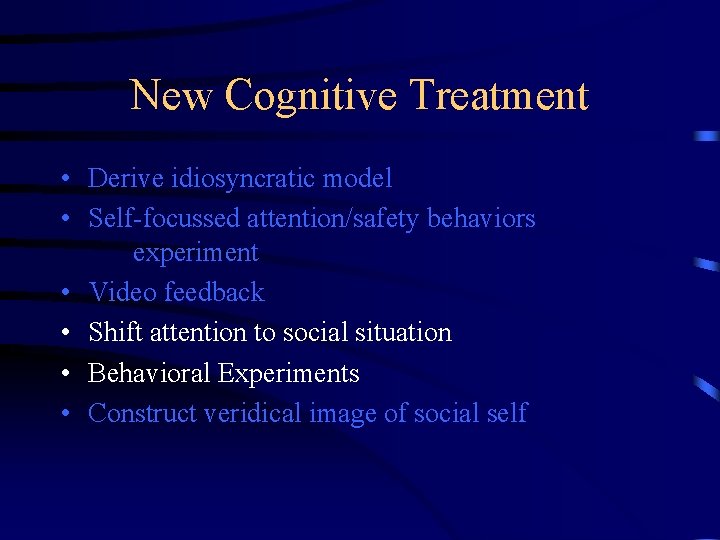
New Cognitive Treatment • Derive idiosyncratic version of model • Self-focussed attention/safety behaviours experiment • Video feedback • Shift attention to social situation • Behavioural Experiments • Construct veridical image of social self
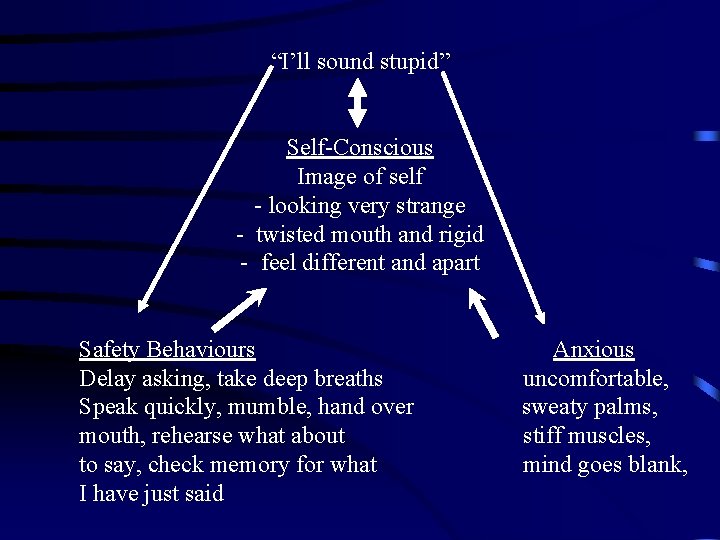
“I’ll sound stupid” Self-Conscious Image of self - looking very strange - twisted mouth and rigid - feel different and apart Safety Behaviours Delay asking, take deep breaths Speak quickly, mumble, hand over mouth, rehearse what about to say, check memory for what I have just said Anxious uncomfortable, sweaty palms, stiff muscles, mind goes blank,
New Cognitive Treatment • Derive idiosyncratic model • Self-focussed attention/safety behaviours experiment • Video feedback • Shift attention to social situation • Behavioural Experiments • Construct veridical image of social self
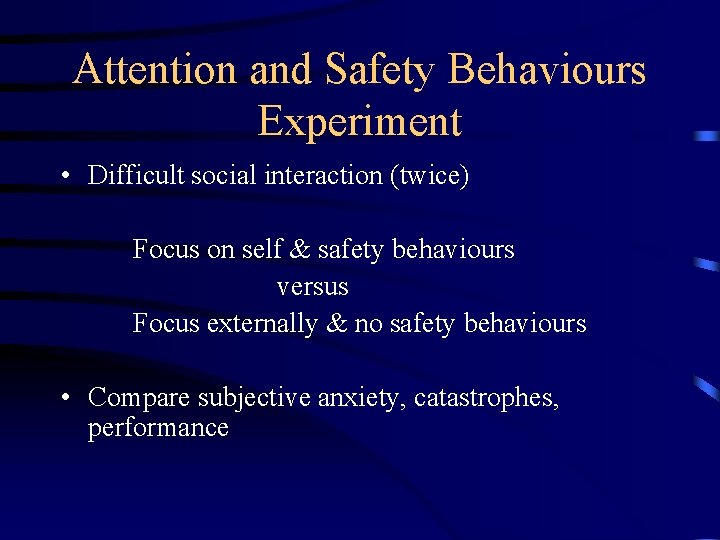
Attention and Safety Behaviours Experiment • Difficult social interaction (twice) Focus on self & safety behaviours versus Focus externally & no safety behaviours • Compare subjective anxiety, catastrophes, performance
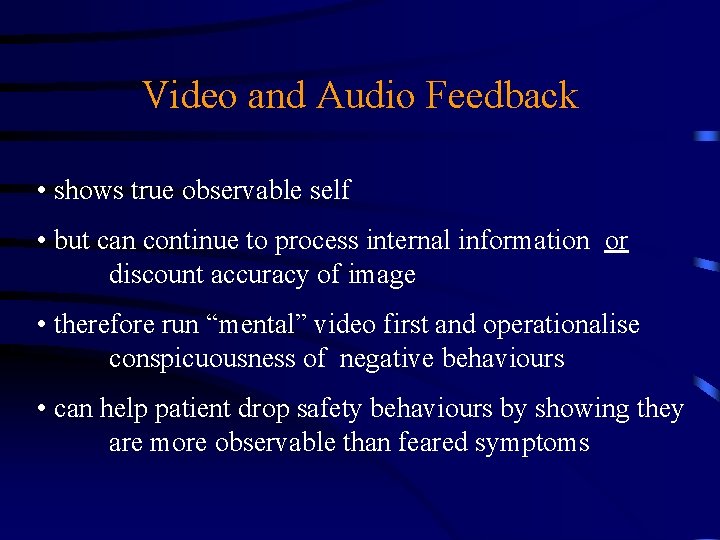
Video and Audio Feedback • shows true observable self • but can continue to process internal information or discount accuracy of image • therefore run “mental” video first and operationalise conspicuousness of negative behaviours • can help patient drop safety behaviours by showing they are more observable than feared symptoms
New Cognitive Treatment • Derive idiosyncratic model • Self-focussed attention/safety behaviors experiment • Video feedback • Shift attention to social situation • Behavioral Experiments • Construct veridical image of social self
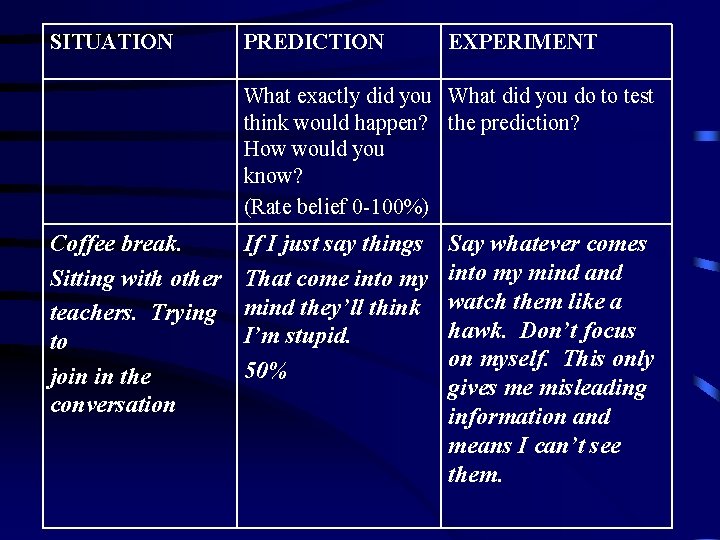
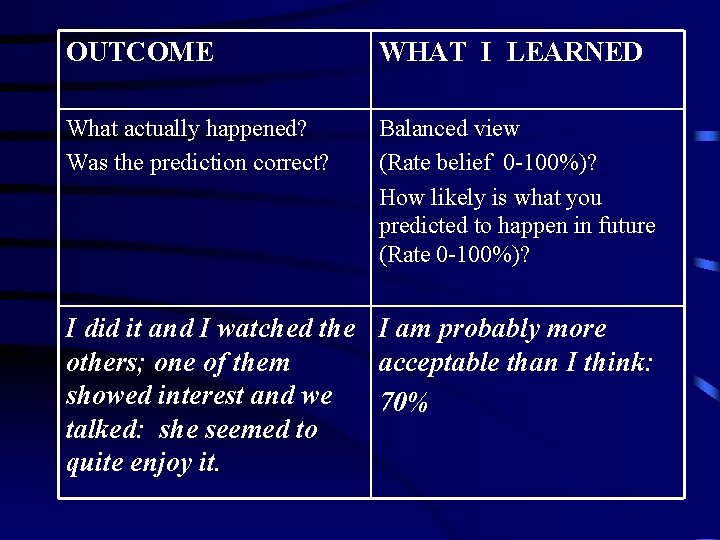
SITUATION PREDICTION EXPERIMENT What exactly did you What did you do to test think would happen? the prediction? How would you know? (Rate belief 0 -100%) Coffee break. Sitting with other teachers. Trying to join in the conversation If I just say things That come into my mind they’ll think I’m stupid. 50% Say whatever comes into my mind and watch them like a hawk. Don’t focus on myself. This only gives me misleading information and means I can’t see them.
OUTCOME WHAT I LEARNED What actually happened? Was the prediction correct? Balanced view (Rate belief 0 -100%)? How likely is what you predicted to happen in future (Rate 0 -100%)? I did it and I watched the I am probably more others; one of them acceptable than I think: showed interest and we 70% talked: she seemed to quite enjoy it.
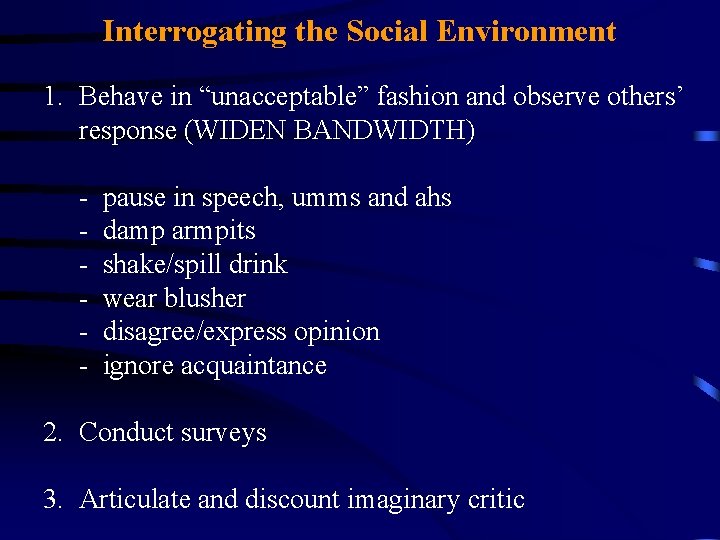
Interrogating the Social Environment 1. Behave in “unacceptable” fashion and observe others’ response (WIDEN BANDWIDTH) - pause in speech, umms and ahs damp armpits shake/spill drink wear blusher disagree/express opinion ignore acquaintance 2. Conduct surveys 3. Articulate and discount imaginary critic
Social Phobia Trial 1 (Clark, Ehlers et al, J. Consult. Clin. Psychol. 2003, 71, 1058 -1067)
Social Phobia Trial 2 (Clark, Ehlers et al. in press)
Trial 3 (Mortberg, Clark et al. in press) Stockholm