
Social and Personality Development in Middle Adulthood Chapter





- Slides: 77
Social and Personality Development in Middle Adulthood Chapter 16 Robert S. Feldman Copyright © 2011 Pearson Education, Inc. All rights reserved.
SOCIAL AND PERSONLITY DEVELOPMENT IN MIDDLE ADULTHOOD
Looking Ahead In what ways does personality develop during middle adulthood? Is there continuity in personality development during adulthood? What are typical patterns of marriage and divorce in middle adulthood? What changing family situations do middle-aged adults face?
Looking Ahead What are the causes and characteristics of family violence in the United States? What are the characteristics of work and career in middle adulthood?
PERSONALITY DEVELOPMENT
How does personality development occur in middle adulthood?
Two Perspectives on Adult Personality Development Normative-Crisis Versus Life Events Views personality development in terms of fairly universal stages, tied to a sequence of agerelated crises
Two Perspectives on Adult Personality Development Normative-Crisis Versus Life Events Revenna Helson Suggest that timing of particular events in adult's life, rather than age per se, determine course of personality development
Other Views Erikson Critics argue that normative-crisis models are outdated Model came from time when gender roles were more rigid
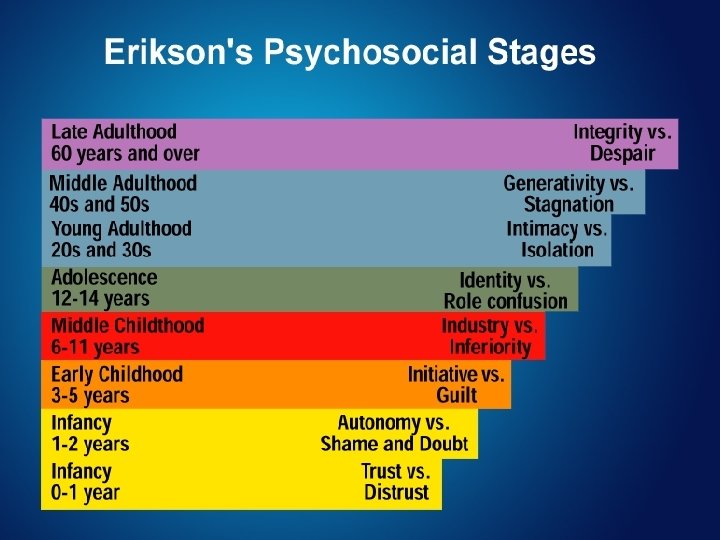
Erikson GENERATIVITY VERSUS STAGNATION People consider their contributions to family, community, work, and society. Generativity = looking beyond oneself to continuation of one's life through others Stagnation = focusing on the triviality of their life
Building on Erikson’s Views: Gould, Vaillant, and Levinson
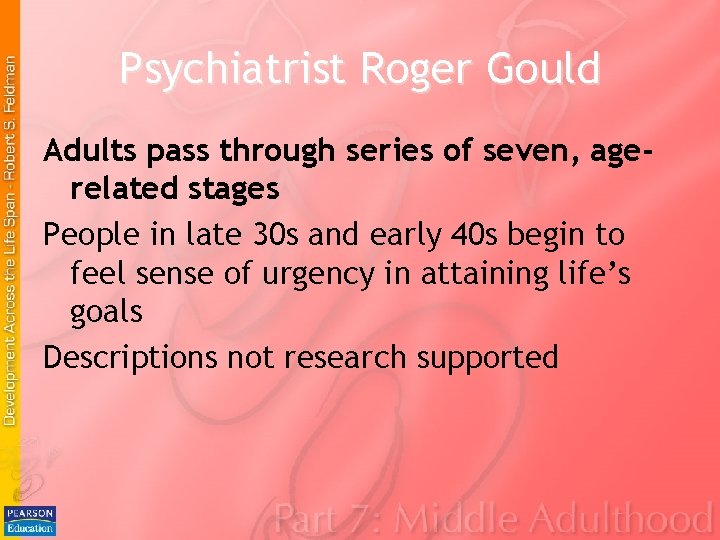
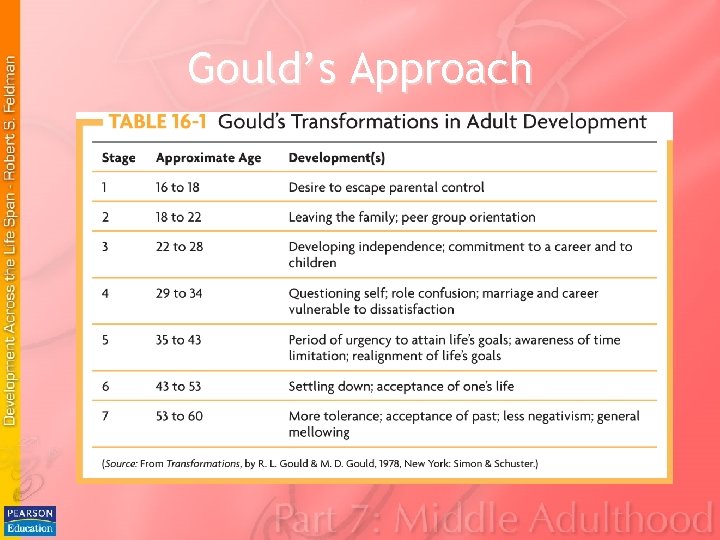
Psychiatrist Roger Gould Adults pass through series of seven, agerelated stages People in late 30 s and early 40 s begin to feel sense of urgency in attaining life’s goals Descriptions not research supported
Gould’s Approach
George Valliant Keeping meaning versus rigidity Occurs between the ages of 45 and 55 Adults seek to extract meaning from their lives by accepting strengths and weaknesses of others Those who are rigid become increasingly isolated from others
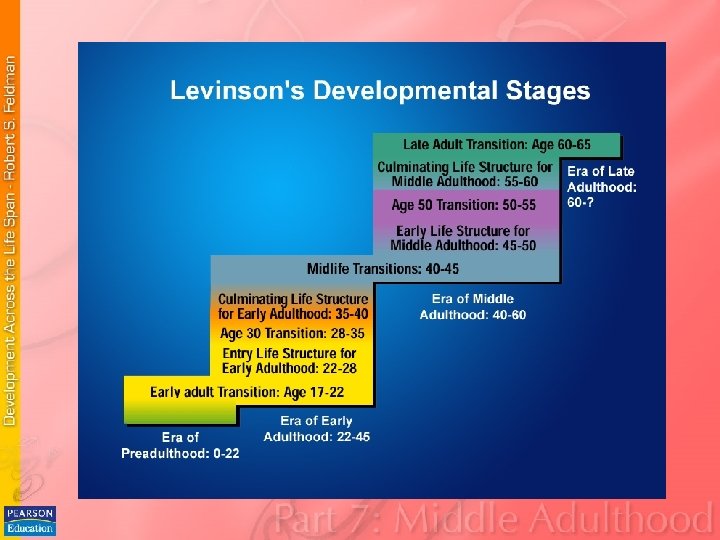
Levinson Seasons of Life Theory Most people are susceptible to fairly profound midlife crisis Late 30 s Early 40 s Between 40 and 45
Midlife Crisis Stage of uncertainty and indecision brought about by realization that life is finite Gender differences Despite widespread acceptance, evidence for midlife crisis does not exist
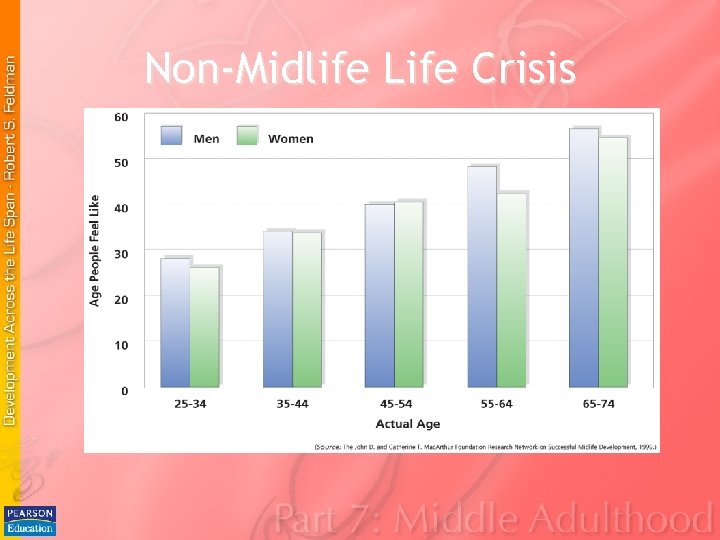
Non-Midlife Life Crisis For majority of people, transition is smooth and rewarding Many middle-aged people find their careers have blossomed They feel younger than they actually are
Non-Midlife Life Crisis
Developmental Diversity Middle Age: In Some Cultures It Doesn’t Exist Model of aging of Oriyan women High caste Hindu women Life course based on nature of one’s social responsibility, family management issues, and moral sense at given time not on basis of chronological age Domestic work is highly respected and valued
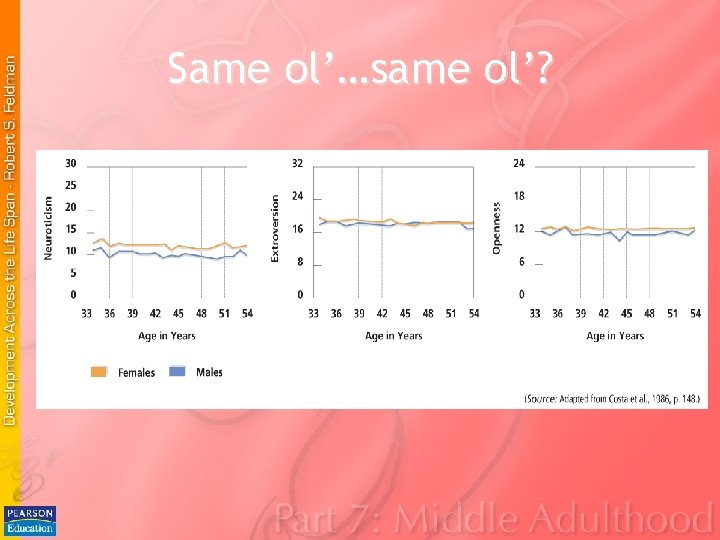
PERSONALITY DEVELOPMENT Does personality change or remains stable over course of development? Erikson and Levinson = substantial change Paul Costa and Robert Mc. Crae = stability in traits across development
Same ol’…same ol’?
Stability and Change in the Big Five Personality Traits Big Five traits are relatively stable past age 30 with some variations in specific traits Neuroticism, extraversion, and openness to experience decline somewhat from early adulthood through middle adulthood Agreeableness and conscientiousness increase to a degree Findings are consistent across cultures
What makes you happy?
If You’re Happy and You Know It… Sense of subjective well-being or general happiness remains stable over life span Most people general “set point” for happiness Regardless of where they stand economically, residents of countries across the world have similar levels of happiness
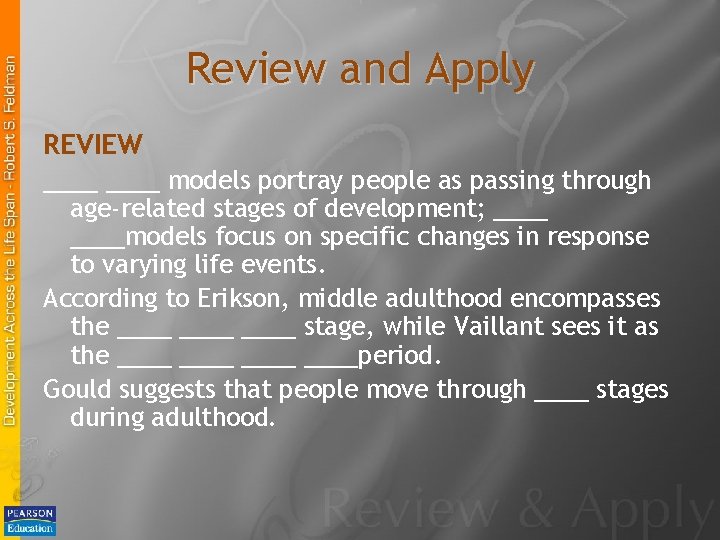
Review and Apply REVIEW ____ models portray people as passing through age-related stages of development; ____models focus on specific changes in response to varying life events. According to Erikson, middle adulthood encompasses the ____ stage, while Vaillant sees it as the ____period. Gould suggests that people move through ____ stages during adulthood.
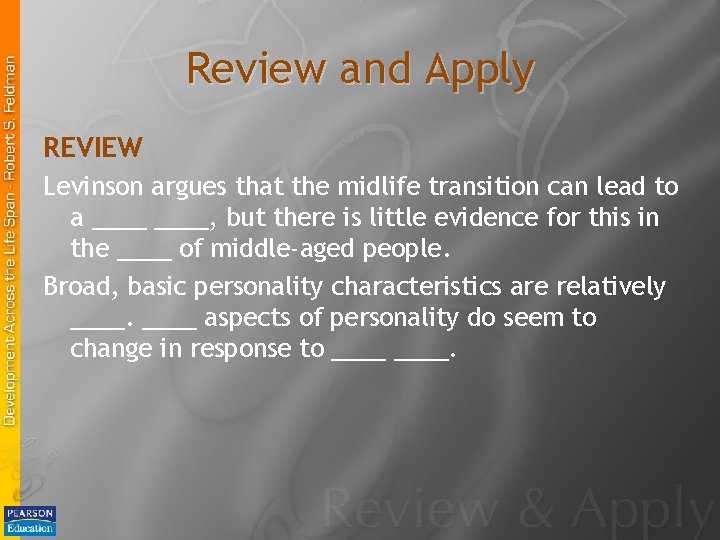
Review and Apply REVIEW Levinson argues that the midlife transition can lead to a ____, but there is little evidence for this in the ____ of middle-aged people. Broad, basic personality characteristics are relatively ____ aspects of personality do seem to change in response to ____.
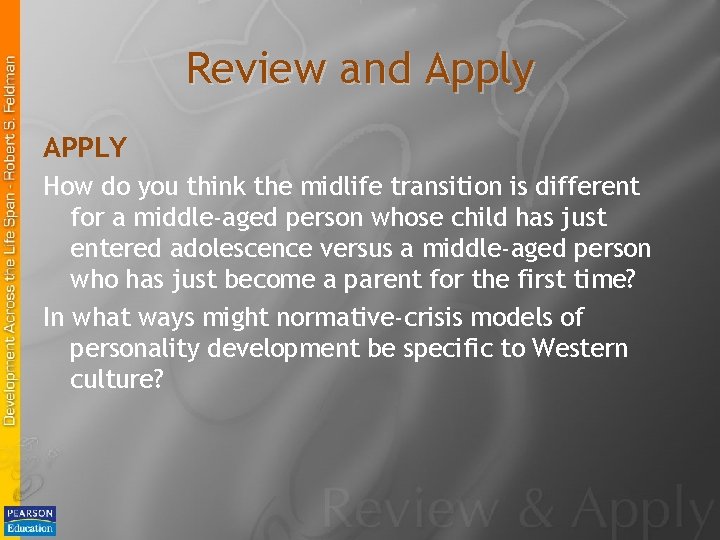
Review and Apply APPLY How do you think the midlife transition is different for a middle-aged person whose child has just entered adolescence versus a middle-aged person who has just become a parent for the first time? In what ways might normative-crisis models of personality development be specific to Western culture?
RELATIONSHIPS: FAMILY IN MIDDLE AGE
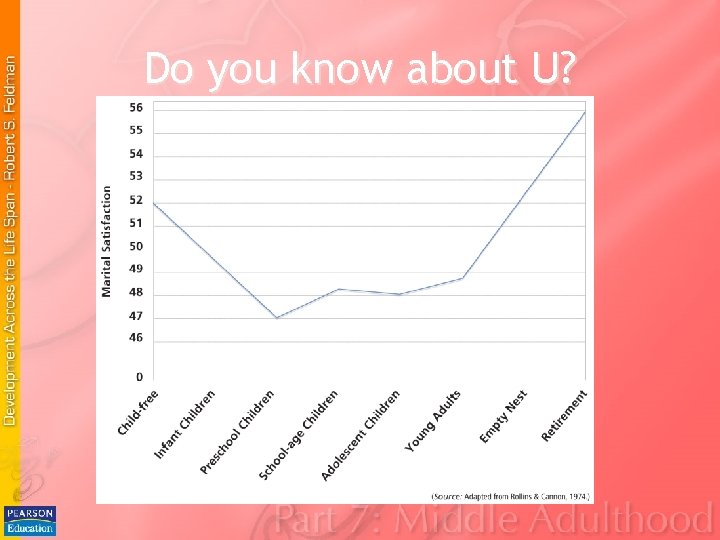
Middle Age Marriages Most frequent pattern of marital satisfaction is Ushaped Marital satisfaction begins to decline after marriage and falls to its lowest point following the birth of children Marital satisfaction begins to grow after children leave adolescence and reaches its highest point when kids leave home
Do you know about U?
From Research to Practice After the Vows: Changes in Marital Satisfaction Over Time Older research establishing U-shaped pattern used crosssectional research, surveying different people at different points in their marriages Current research employed longitudinal methods confirmed marital satisfaction decline but failed to find evidence of a subsequent upswing after the childbearing years Over time, marriage quality continues to decline over course of marriage
What do the newer findings suggest? Unhappy marriages tend to terminate so earlier cross-sectional methods not representative Long-married couples were older and were married during when marriage was more highly valued Different couples have different levels of marital satisfaction even at outset
And so… Why might couples who have children tend to experience better marital satisfaction later in life than do childless couples? Given these findings, how might you advise a newlywed couple on what to expect as their years of marriage progress?
Good Marriages • Many couples state that their spouse is their “best friend” • They also view marriage as a long-term commitment • They believe their spouse has grown more interesting over the years • Most feel their sex lives (although frequency goes down) are satisfying
Struggling Marriages About 1 woman in 8 will get divorced after 40 People are more individual, spending less time together Many feel concerned with their own personal happiness and leave an unhappy marriage Divorce is more socially acceptable Feelings of romantic, passionate love may subside over time
Divorce can be especially hard for traditional women over 40 who stayed home with kids and never worked outside the home 75 percent to 80 percent of divorced people eventually remarry It's harder for a middle-aged woman to remarry. 90 percent of women under 25 remarry While 75 percent of white women remarry, less than half of African American women remarry Less than 33 percent over the age of 40 remarry
Marriage Gradient The marriage gradient pushes men to marry younger women Older women are victims of the harsh societal standards regarding physical attractiveness A major reason many remarry is that being divorced carries a stigma
Second Time Around • Older couples are more mature and realistic • Roles are more flexible • Couple looks at marriage less romantically and is more cautious • Divorce rate is higher for second marriages • More stress especially with blended families • Once divorce experienced it is easier to walk away a second time
Family Evolutions: From Full House to Empty Nest When parents experience feelings of unhappiness, worry, loneliness, and depression resulting from their children's departure from home More myth than reality
When children leave home… Parents can work harder More time alone House stays cleaner Phone doesn't ring as often
Boomerang Children: Refilling the Empty Nest Young adults who come back to live in homes of their middle-aged parents Men are more likely to do it than women Parents tend to give sons more freedom than daughters Unable to find a job Difficulty making ends meet
Sandwich Generation Fulfill needs of both their children and their aging parents Couples are marrying and having children later Parents are living longer
Caring for Aging Parents Care of aging parents can be psychologically tricky Significant degree of role reversal Range of care varies Financial Managing household Providing direct care Influenced by cultural norms and expectations
Becoming a Grandparent: Who, Me? Involved Companionate Remote
Are all grannies the same? Marked gender differences in ways people enjoy grandparenthood Grandmothers are more interested and experience greater satisfaction than grandfathers African American grandparents are more apt to be involved
Family Violence: The Hidden Epidemic Prevalence Characteristics of abuser and abused
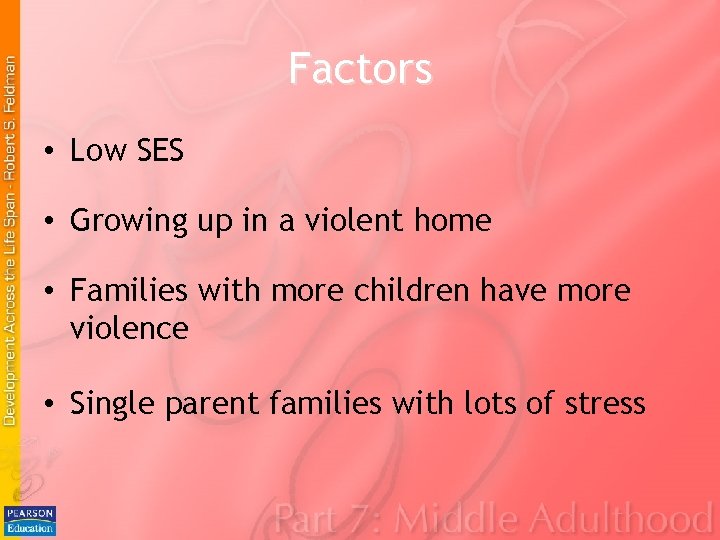
Factors • Low SES • Growing up in a violent home • Families with more children have more violence • Single parent families with lots of stress
Neil Jacobson and John Gottman Husbands who abuse fall into two categories: “Pit bulls” confine violence to those they love and strike out against their wives when they feel jealous or when they fear being abandoned “Cobras” are likely to be aggressive to everyone, are more likely to use weapons, and are more calculating, showing little emotion or arousal
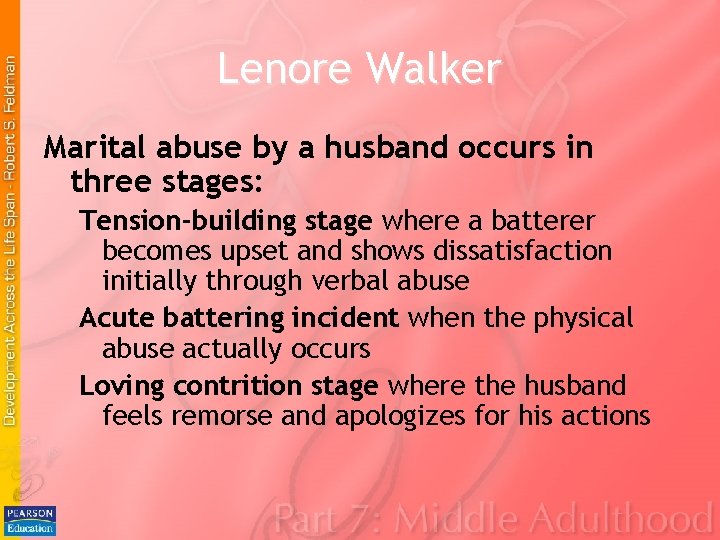
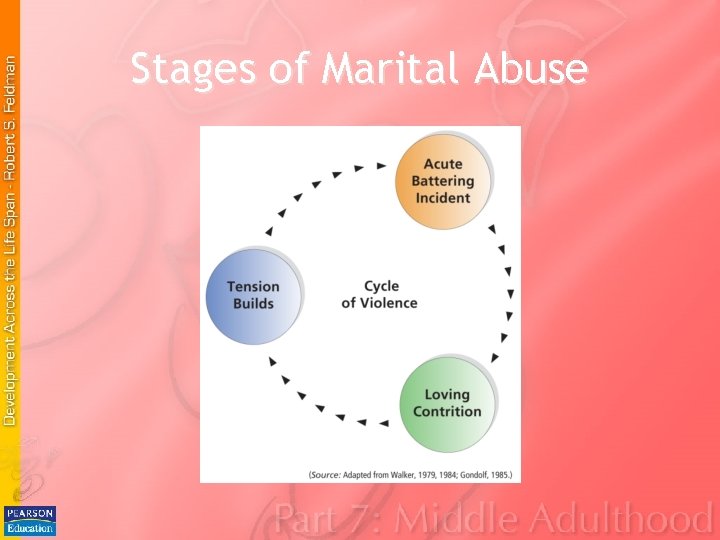
Lenore Walker Marital abuse by a husband occurs in three stages: Tension-building stage where a batterer becomes upset and shows dissatisfaction initially through verbal abuse Acute battering incident when the physical abuse actually occurs Loving contrition stage where the husband feels remorse and apologizes for his actions
Stages of Marital Abuse
Why Women Stay Wife feels somewhat at fault This explains why women stay in abusive relationships Some stay out of fear
Cycle of Violence Hypothesis Abuse and neglect of children leads them to be predisposed to abusiveness as adults About one-third of people who were abused or neglected as children abuse their own children Two-thirds of abusers were not abused as children
Cultural Differences Cultural correlates Status Low status they = easy targets High status = threat to husbands
Becoming an Informed Consumer of Development Dealing with Spousal Abuse Teach both wives and husbands that physical violence is NEVER acceptable Call the police Understand that the remorse shown by a spouse, no matter how heartfelt, may have no bearing on the possibility of future violence If you are the victim of abuse, seek a safe haven If you feel in danger from an abusive partner, seek a restraining order Call the National Domestic Violence Hotline at 1 -800 -7997233 for immediate advice.
Spousal Abuse and Society Cultural Roots of Violence Others cultures have traditions in which violence is regarded as acceptable Some experts suggest traditional power structure under which women and men function is root cause of abuse
Review and Apply REVIEW For most couples, ____rises during middle adulthood. Family changes in middle adulthood include the departure of children. In recent years, the phenomenon of returning adult child known as “____ children” has emerged. Middle-aged adults often have increasing responsibilities for their ____.
Review and Apply REVIEW A further change is grandparenthood. Typically, grandparents may be ____, or ____. Marital violence tends to pass through three stages: ____ building, an acute ____ incident, and ____. The incidence of family violence is highest in families of lower ____ status. A ____affords a partial explanation. Cultural norms may also play a role.
Review and Apply APPLY Are the phenomena of the empty nest, boomerang children, the sandwich generation, and grandparenting culturally dependent? Why might such phenomena be different in societies where multigenerational families are the norm? From the perspective of a healthcare provider: What can be done to end the cycle of violence, in which people who were abused as children grow up to be abusers of others?
WORK AND LEISURE
Jobs at Midlife Productivity Job satisfaction Worker characteristics and attitudes
Challenges of Work: On-the-Job Dissatisfaction What is the greatest underlying cause of burnout?
Burnout When highly trained professionals experience dissatisfaction, disillusionment, frustration, and weariness from their jobs For many workers, unemployment is a hard reality of life and the implications are more psychological than economic. Middle-aged adults tend to stay unemployed longer than do young workers.
Unemployment: The Dashing of the Dream Causes economic and psychological consequences Feeling anxious, depressed, and irritable Self-confidence and concentration may plummet Sometimes depression and/or suicide
Seeking Work After Job Loss in Middle Age Employers may discriminate because of age and not hire older applicants Research shows that older workers have less absenteeism, hold their jobs longer, are more reliable, and more willing to learn new skills
If you had a choice… Would you choose an older or younger person with which to work?
Switching—and Starting—Careers at Midlife Some people change or seek jobs voluntarily in middle adulthood Old job gave little satisfaction Mastery of the old job's challenges achieved No longer enjoy what they do Need employment after raising children, divorce, or death of spouse
When Mom Goes to Work…Hey, What Do You Think She Has Been Doing At Home All Those Years? 65 percent of women between ages of 50 and 60 (80 percent of those who graduated from college) are now in the workforce Three-quarters are in full-time jobs
Immigrants on the Job: Making It in America Demographics Contributions Prejudice
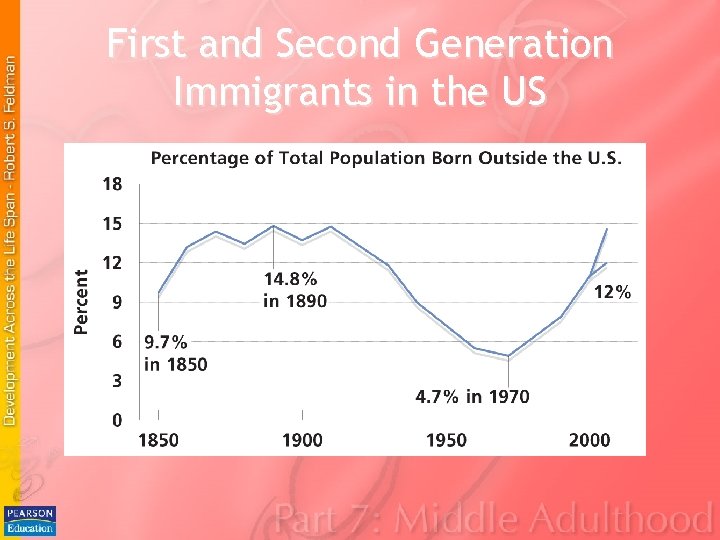
First and Second Generation Immigrants in the US
Leisure time Leisure activities Average number of hours Nature of activities Pace of life differs across countries
Review and Apply REVIEW People in middle age look at their jobs differently than before, placing more emphasis on ____ factors and less on ____. Job satisfaction tends to be ____ for most middleaged people, but some are dissatisfied because of ____ with their accomplishments and for other reasons. Burnout is a factor, especially for people in the ____ professions. ____ in midlife can have negative economic, psychological, and physical effects.
Review and Apply REVIEW Midlife career changes are becoming more prevalent, motivated usually by ____, the need for more ____ or ____, or the desire to return to the workforce after ____. People in middle adulthood usually have more ____ than previously. Often they use it to become more involved outside the home in ____ and ____ activities.
Review and Apply APPLY Why might striving for occupational success be less appealing in middle age than before? What cognitive and personality changes might contribute to this phenomenon? From the perspective of a social worker: Why do you think immigrants’ ambition and achievements are widely underestimated? Does the occurrence of conspicuous negative examples play a role (as it does in perceptions of the midlife crisis and stormy adolescence)?
EPILOGUE Before turning to the next chapter, recall the prologue to this one, about Mirandi Babitz’s career journey. Using your knowledge of the midlife period, consider these questions. Do Mirandi Babitz’sreasons for changing careers in midlife seem typical or unusual? Does it seem that dissatisfaction played an important role in his particular career trajectory? Does Babitz’s experience seem to fit best with Erikson’s, Vaillant’s, or Levinson’s view on midlife? Why do you think so? Does Babitz display any of the signs of a midlife crisis? Why or why not?
EPILOGUE Can you interpret Babitz’s’s life more accurately in terms of a normative-crisis model of personality development or a life events model? Why?