
Social and Emotional Needs of Gifted Learners What





- Slides: 35
Social and Emotional Needs of Gifted Learners: What are they and what to do? Hunter College Campus Schools HCHS PTA Elissa Brown, Ph. D Director, Hunter College Center for Gifted Studies & Education Elissa. brown@hunter. cuny. edu March 2016
What comes to mind when you think about the socialemotional development of gifted learners?
Agenda Definition Characteristics Areas of Psychological Vulnerability Recommendations/Strategies Resources
Creatively gifted children and adults are emotionally intense and have rich inner lives…Emotional intensity is one of the personality concomitants of giftedness. It is strongly correlated with high intelligence. Unfortunately, we live in a culture that does not view heightened emotionality in a very positive way. The main lesson students learn in school is how to control, repress, deny their emotions, as part of the socialization process. We are in greater danger of emotional mediocrity than of intellectual mediocrity. -Silverman
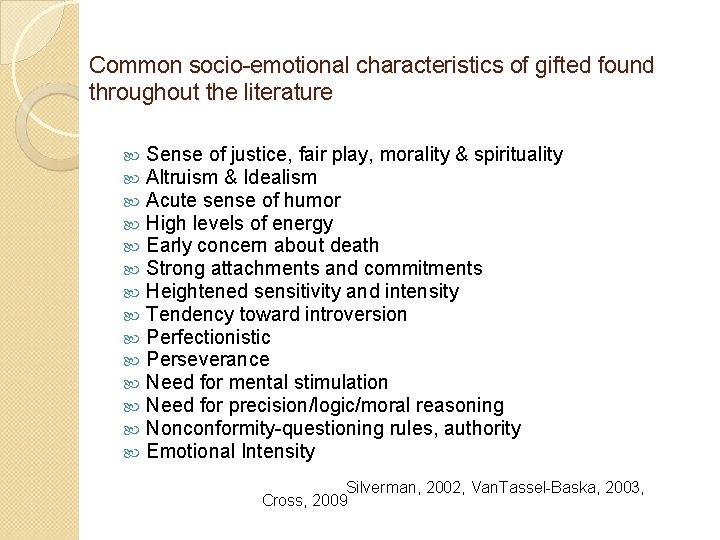
Common socio-emotional characteristics of gifted found throughout the literature Sense of justice, fair play, morality & spirituality Altruism & Idealism Acute sense of humor High levels of energy Early concern about death Strong attachments and commitments Heightened sensitivity and intensity Tendency toward introversion Perfectionistic Perseverance Need for mental stimulation Need for precision/logic/moral reasoning Nonconformity-questioning rules, authority Emotional Intensity Silverman, 2002, Van. Tassel-Baska, 2003, Cross, 2009
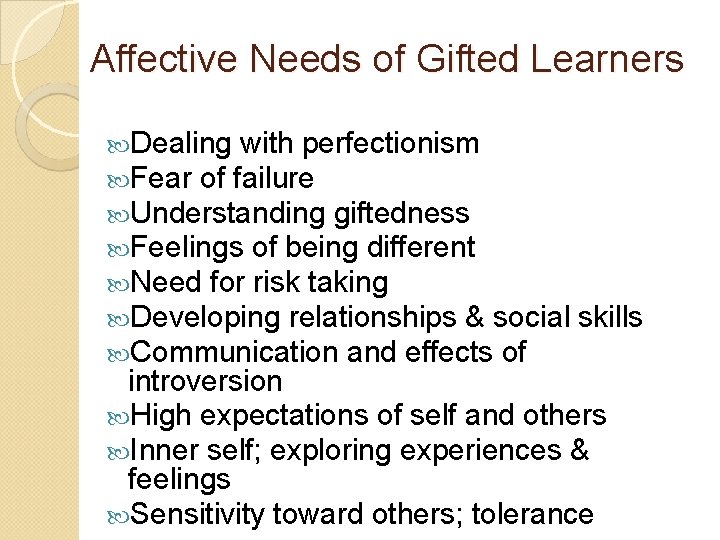
Affective Needs of Gifted Learners Dealing with perfectionism Fear of failure Understanding giftedness Feelings of being different Need for risk taking Developing relationships & social Communication and effects of skills introversion High expectations of self and others Inner self; exploring experiences & feelings Sensitivity toward others; tolerance 6
Aspects of Giftedness Cultural Values Leadership Latino: Collaborative, rather than competitive Emotional depth and intensity Emphasize on family first Unusual sensitivity to expectations and feelings of others Native American Indians: Collective self-the tribe; Traditions, beliefs, heritage Creative in endeavors High expectations of self Perfectionism Asian Americans: Confucianist ethic-people can be improved through proper effort and instruction; Respect and obedience to authority Persistent, goal-directed behavior African-American: Resourceful, people-oriented; Accelerated pace of thought processes Rich imagery of language and oral history
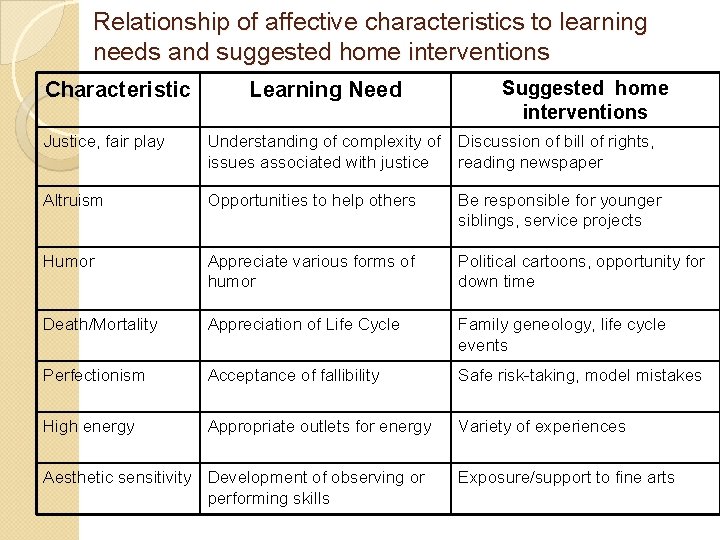
Relationship of affective characteristics to learning needs and suggested home interventions Characteristic Learning Need Suggested home interventions Justice, fair play Understanding of complexity of issues associated with justice Discussion of bill of rights, reading newspaper Altruism Opportunities to help others Be responsible for younger siblings, service projects Humor Appreciate various forms of humor Political cartoons, opportunity for down time Death/Mortality Appreciation of Life Cycle Family geneology, life cycle events Perfectionism Acceptance of fallibility Safe risk-taking, model mistakes High energy Appropriate outlets for energy Variety of experiences Aesthetic sensitivity Development of observing or performing skills Exposure/support to fine arts
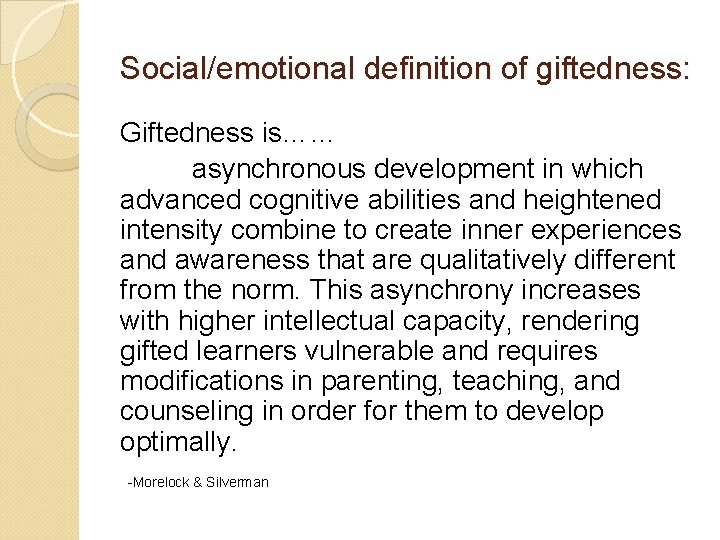
Social/emotional definition of giftedness: Giftedness is…… asynchronous development in which advanced cognitive abilities and heightened intensity combine to create inner experiences and awareness that are qualitatively different from the norm. This asynchrony increases with higher intellectual capacity, rendering gifted learners vulnerable and requires modifications in parenting, teaching, and counseling in order for them to develop optimally. -Morelock & Silverman
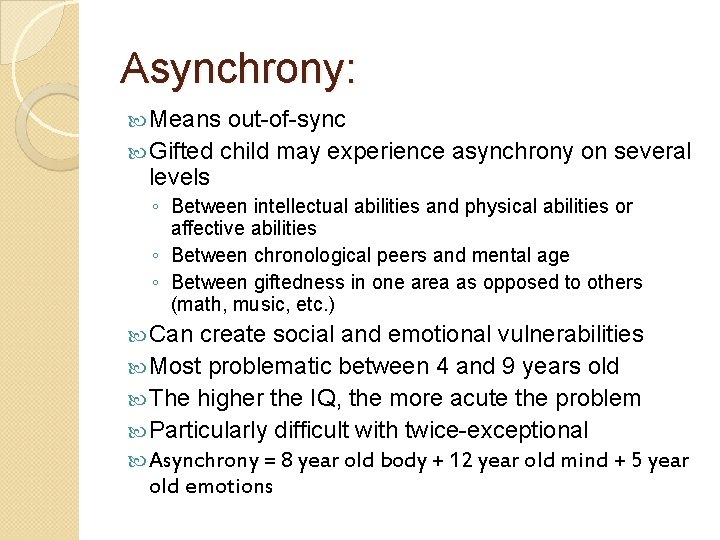
Asynchrony: Means out-of-sync Gifted child may experience asynchrony on several levels ◦ Between intellectual abilities and physical abilities or affective abilities ◦ Between chronological peers and mental age ◦ Between giftedness in one area as opposed to others (math, music, etc. ) Can create social and emotional vulnerabilities Most problematic between 4 and 9 years old The higher the IQ, the more acute the problem Particularly difficult with twice-exceptional Asynchrony = 8 year old body + 12 year old mind + 5 year old emotions
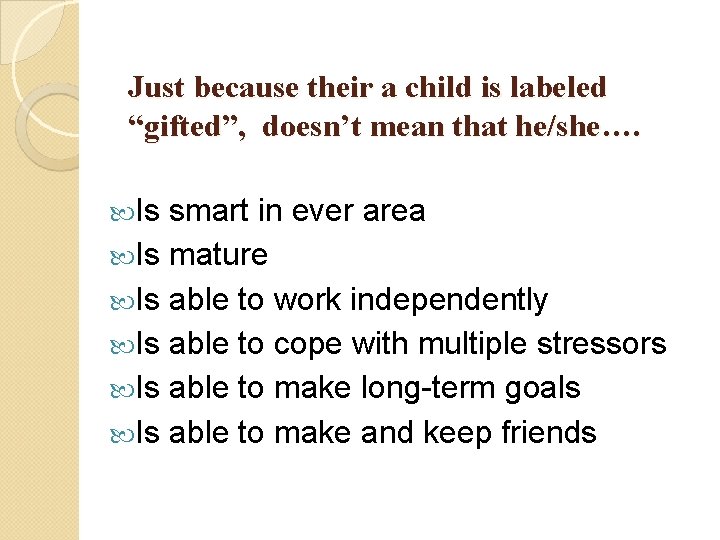
Just because their a child is labeled “gifted”, doesn’t mean that he/she…. Is smart in ever area Is mature Is able to work independently Is able to cope with multiple stressors Is able to make long-term goals Is able to make and keep friends
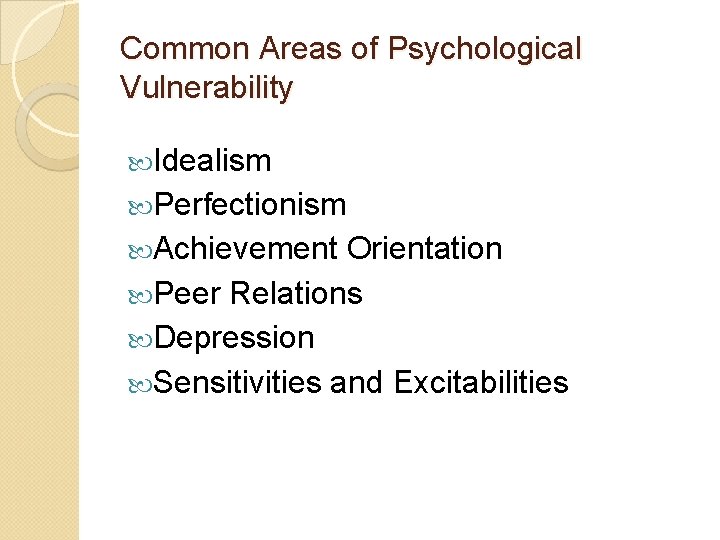
Common Areas of Psychological Vulnerability Idealism Perfectionism Achievement Orientation Peer Relations Depression Sensitivities and Excitabilities
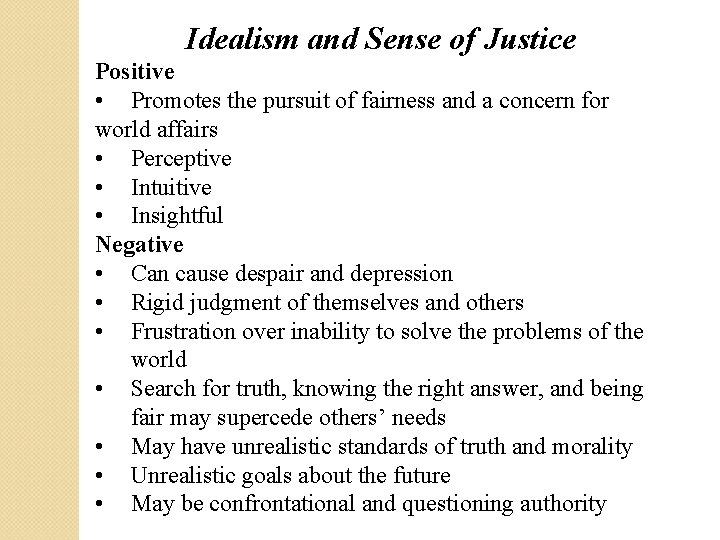
Idealism and Sense of Justice Positive • Promotes the pursuit of fairness and a concern for world affairs • Perceptive • Intuitive • Insightful Negative • Can cause despair and depression • Rigid judgment of themselves and others • Frustration over inability to solve the problems of the world • Search for truth, knowing the right answer, and being fair may supercede others’ needs • May have unrealistic standards of truth and morality • Unrealistic goals about the future • May be confrontational and questioning authority
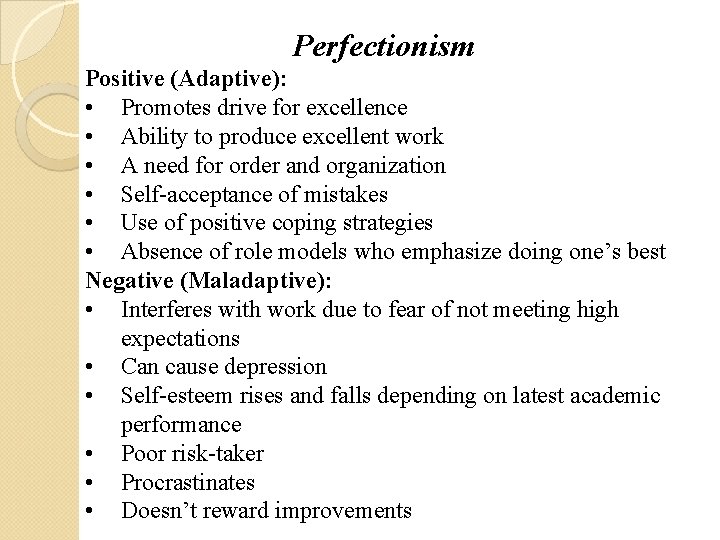
Perfectionism Positive (Adaptive): • Promotes drive for excellence • Ability to produce excellent work • A need for order and organization • Self-acceptance of mistakes • Use of positive coping strategies • Absence of role models who emphasize doing one’s best Negative (Maladaptive): • Interferes with work due to fear of not meeting high expectations • Can cause depression • Self-esteem rises and falls depending on latest academic performance • Poor risk-taker • Procrastinates • Doesn’t reward improvements
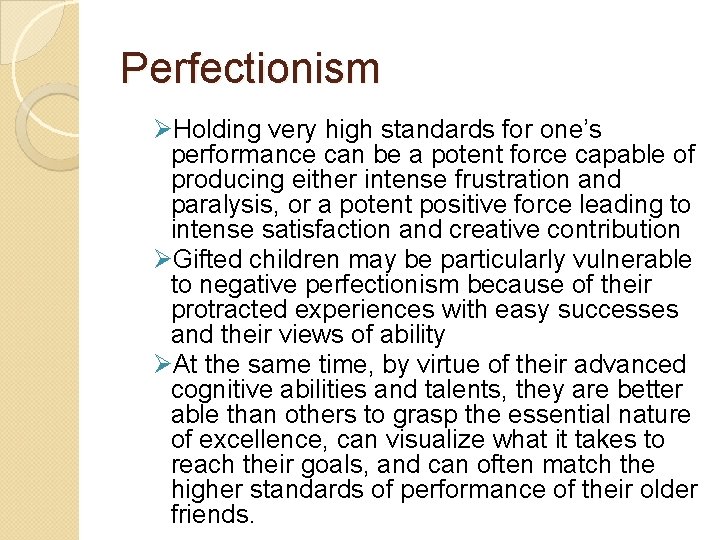
Perfectionism ØHolding very high standards for one’s performance can be a potent force capable of producing either intense frustration and paralysis, or a potent positive force leading to intense satisfaction and creative contribution ØGifted children may be particularly vulnerable to negative perfectionism because of their protracted experiences with easy successes and their views of ability ØAt the same time, by virtue of their advanced cognitive abilities and talents, they are better able than others to grasp the essential nature of excellence, can visualize what it takes to reach their goals, and can often match the higher standards of performance of their older friends.
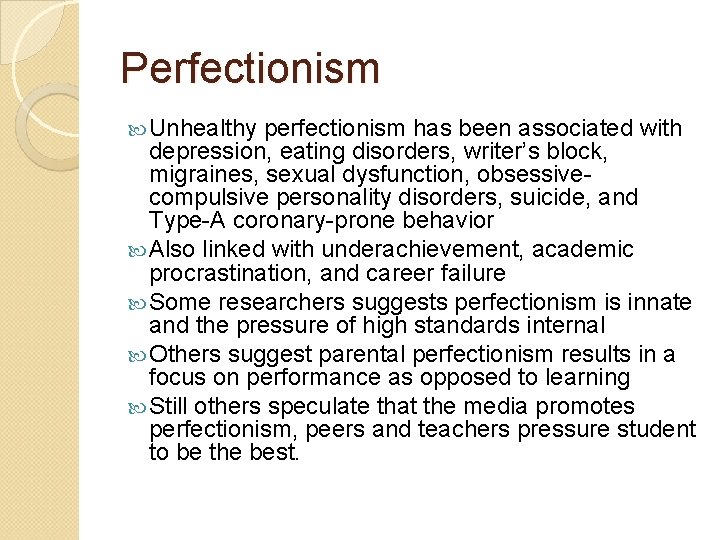
Perfectionism Unhealthy perfectionism has been associated with depression, eating disorders, writer’s block, migraines, sexual dysfunction, obsessivecompulsive personality disorders, suicide, and Type-A coronary-prone behavior Also linked with underachievement, academic procrastination, and career failure Some researchers suggests perfectionism is innate and the pressure of high standards internal Others suggest parental perfectionism results in a focus on performance as opposed to learning Still others speculate that the media promotes perfectionism, peers and teachers pressure student to be the best.
Recommendations Help parents and students understand that wanting to achieve and having a drive to excel is not in and of itself unhealthy Help gifted students take pleasure in accomplishments See setbacks as learning opportunities Praise students’ efforts and determination as opposed to their being “smart” or “talented” Encourage them to challenge their efforts into their passion as opposed to trying to do everything well Help them set priorities and value relaxation
Peer Relationships Research indicates gifted children are wellliked and popular with peers until around age 13 Gifted adolescents often value their giftedness but understand it can result in social pressures In studies of popularity, gifted boys ranked most popular, nongifted boys and nongifted girls second most popular, and gifted girls least popular However, profoundly gifted have great difficulty finding true peers unless they are radically accelerated – social acceptability much greater problem for them
Recommendations Maintaining a positive family environment helps gifted adolescents deal with anti-intellectual environment Parents should be careful not to stress popularity and social success Parents should support child’s talent but not add to pressures Point out that competitive forms of friendships end at graduation for most people – point out awards ahead Arrange for gifted children to spend time with likeminded peer – assemble a gifted cohort (Saturday and summer programs, special classes, debate teams, intellectual and creataive teams and giftedpeer discussion groups) Schools provide counselors and school
Sensitivities and Excitabilities Feeling everything more deeply than others Emotionally intense gifted children often experience intense inner conflict, self-criticism, anxiety, and feelings of inferiority due to not living up to self or others expectation levels
Risk Factors for Depression in the Gifted Asynchronous development – at risk for existential depression (struggling with meaning of life) Perfectionism – is associated in the clinical literature with depression and suicide ◦ Perceived pressures with feelings of inadequacy may contribute to fear of failure and negative self-evaluation Social isolation – associated with depressed mood ◦ Has been noted among highly gifted who are not radically accelerated ◦ Important to distinguish between loneliness and solitude (only loneliness correlates with depression) Sensitivity – speculated to increase suffering from social injustices, personal losses, slights, and perceived rejection ◦ No studies have confirmed this
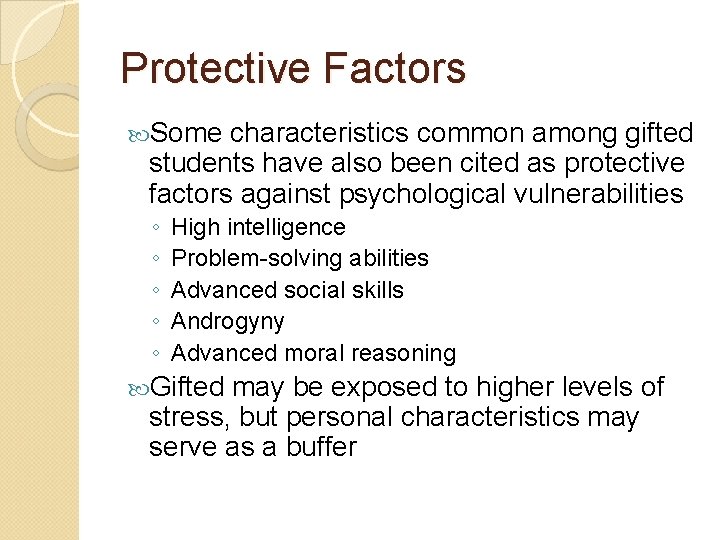
Protective Factors Some characteristics common among gifted students have also been cited as protective factors against psychological vulnerabilities ◦ ◦ ◦ High intelligence Problem-solving abilities Advanced social skills Androgyny Advanced moral reasoning Gifted may be exposed to higher levels of stress, but personal characteristics may serve as a buffer
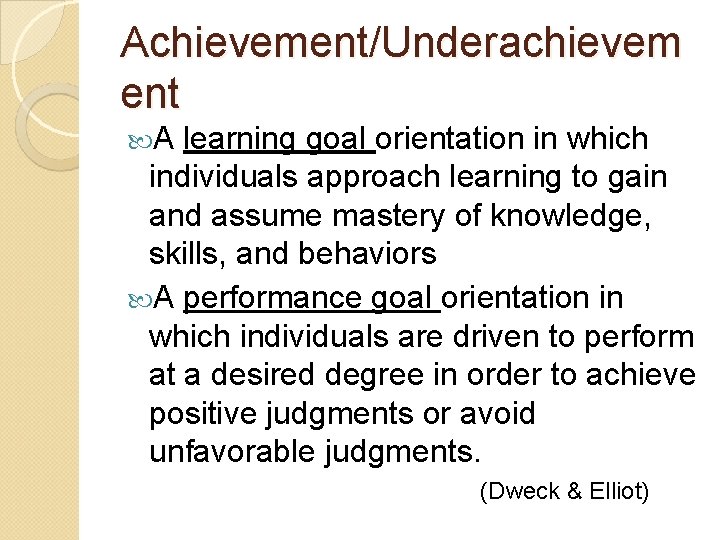
Achievement/Underachievem ent A learning goal orientation in which individuals approach learning to gain and assume mastery of knowledge, skills, and behaviors A performance goal orientation in which individuals are driven to perform at a desired degree in order to achieve positive judgments or avoid unfavorable judgments. (Dweck & Elliot)
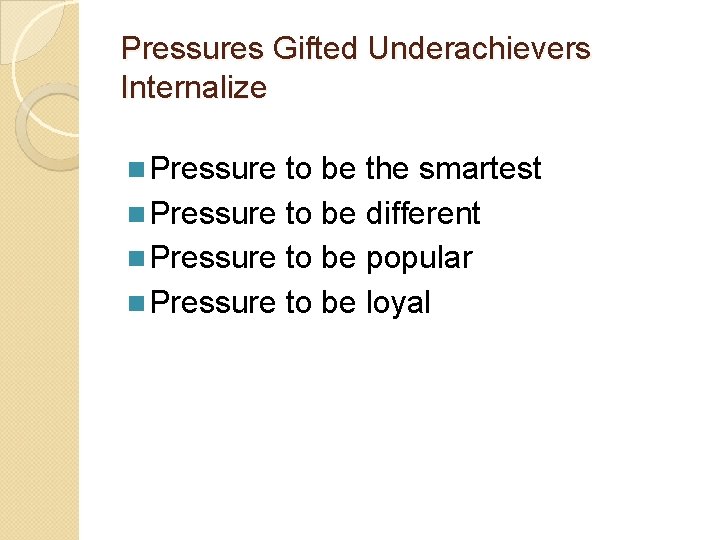
Pressures Gifted Underachievers Internalize n Pressure to be the smartest n Pressure to be different n Pressure to be popular n Pressure to be loyal
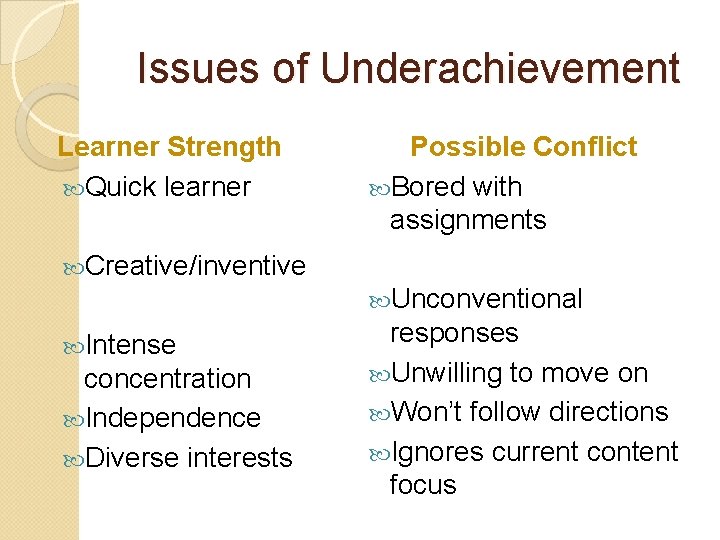
Issues of Underachievement Learner Strength Quick learner Possible Conflict Bored with assignments Creative/inventive Unconventional Intense concentration Independence Diverse interests responses Unwilling to move on Won’t follow directions Ignores current content focus
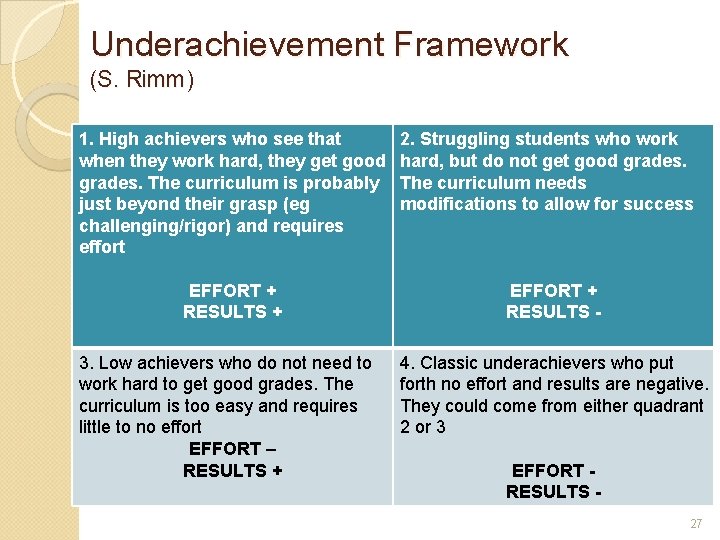
Underachievement Framework (S. Rimm) 1. High achievers who see that when they work hard, they get good grades. The curriculum is probably just beyond their grasp (eg challenging/rigor) and requires effort EFFORT + RESULTS + 3. Low achievers who do not need to work hard to get good grades. The curriculum is too easy and requires little to no effort EFFORT – RESULTS + 2. Struggling students who work hard, but do not get good grades. The curriculum needs modifications to allow for success EFFORT + RESULTS 4. Classic underachievers who put forth no effort and results are negative. They could come from either quadrant 2 or 3 EFFORT RESULTS 27
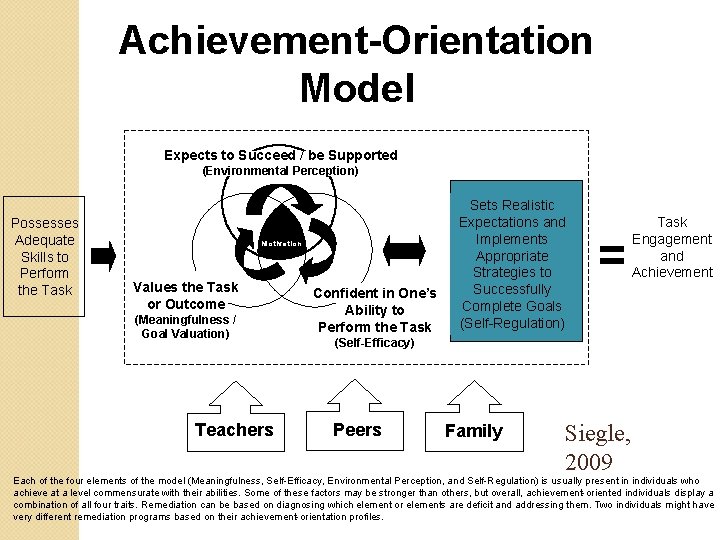
Achievement-Orientation Model Expects to Succeed / be Supported (Environmental Perception) Possesses Adequate Skills to Perform the Task Motivation Values the Task or Outcome (Meaningfulness / Goal Valuation) Teachers Confident in One’s Ability to Perform the Task Sets Realistic Expectations and Implements Appropriate Strategies to Successfully Complete Goals (Self-Regulation) Task Engagement and Achievement (Self-Efficacy) Peers Family Siegle, 2009 Each of the four elements of the model (Meaningfulness, Self-Efficacy, Environmental Perception, and Self-Regulation) is usually present in individuals who achieve at a level commensurate with their abilities. Some of these factors may be stronger than others, but overall, achievement-oriented individuals display a combination of all four traits. Remediation can be based on diagnosing which element or elements are deficit and addressing them. Two individuals might have very different remediation programs based on their achievement-orientation profiles.
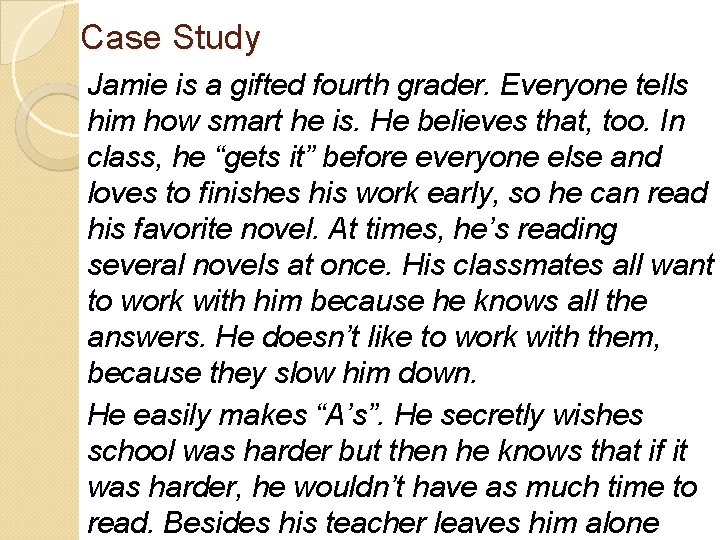
Case Study Jamie is a gifted fourth grader. Everyone tells him how smart he is. He believes that, too. In class, he “gets it” before everyone else and loves to finishes his work early, so he can read his favorite novel. At times, he’s reading several novels at once. His classmates all want to work with him because he knows all the answers. He doesn’t like to work with them, because they slow him down. He easily makes “A’s”. He secretly wishes school was harder but then he knows that if it was harder, he wouldn’t have as much time to read. Besides his teacher leaves him alone
I find the harder I work, the more luck I seem to have. -Thomas Jefferson
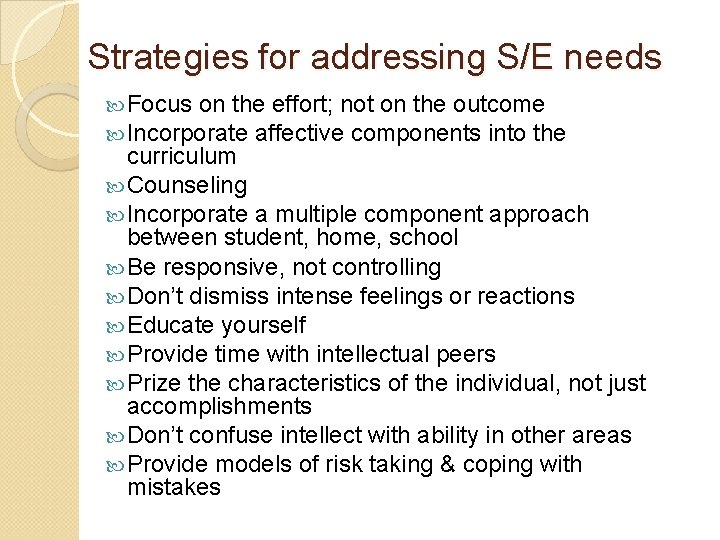
Strategies for addressing S/E needs Focus on the effort; not on the outcome Incorporate affective components into the curriculum Counseling Incorporate a multiple component approach between student, home, school Be responsive, not controlling Don’t dismiss intense feelings or reactions Educate yourself Provide time with intellectual peers Prize the characteristics of the individual, not just accomplishments Don’t confuse intellect with ability in other areas Provide models of risk taking & coping with mistakes
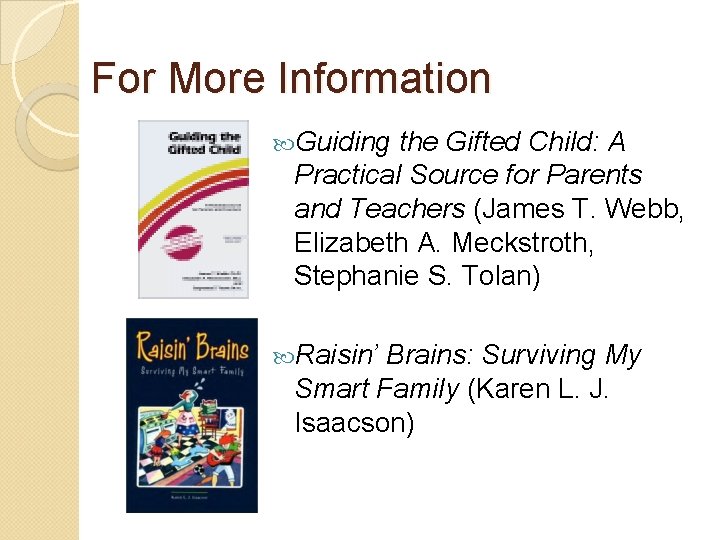
For More Information Guiding the Gifted Child: A Practical Source for Parents and Teachers (James T. Webb, Elizabeth A. Meckstroth, Stephanie S. Tolan) Raisin’ Brains: Surviving My Smart Family (Karen L. J. Isaacson)
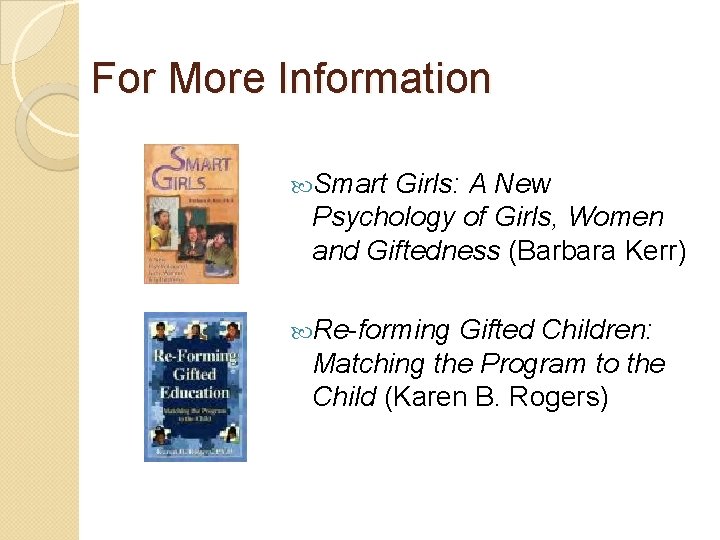
For More Information Smart Girls: A New Psychology of Girls, Women and Giftedness (Barbara Kerr) Re-forming Gifted Children: Matching the Program to the Child (Karen B. Rogers)
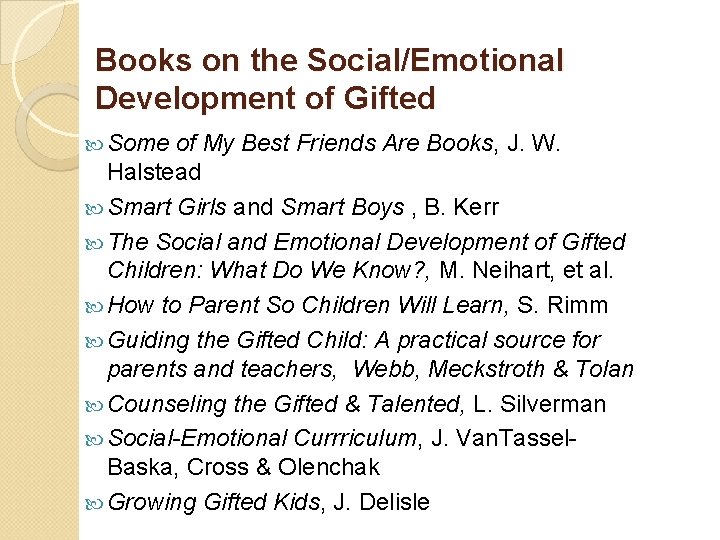
Books on the Social/Emotional Development of Gifted Some of My Best Friends Are Books, J. W. Halstead Smart Girls and Smart Boys , B. Kerr The Social and Emotional Development of Gifted Children: What Do We Know? , M. Neihart, et al. How to Parent So Children Will Learn, S. Rimm Guiding the Gifted Child: A practical source for parents and teachers, Webb, Meckstroth & Tolan Counseling the Gifted & Talented, L. Silverman Social-Emotional Currriculum, J. Van. Tassel. Baska, Cross & Olenchak Growing Gifted Kids, J. Delisle
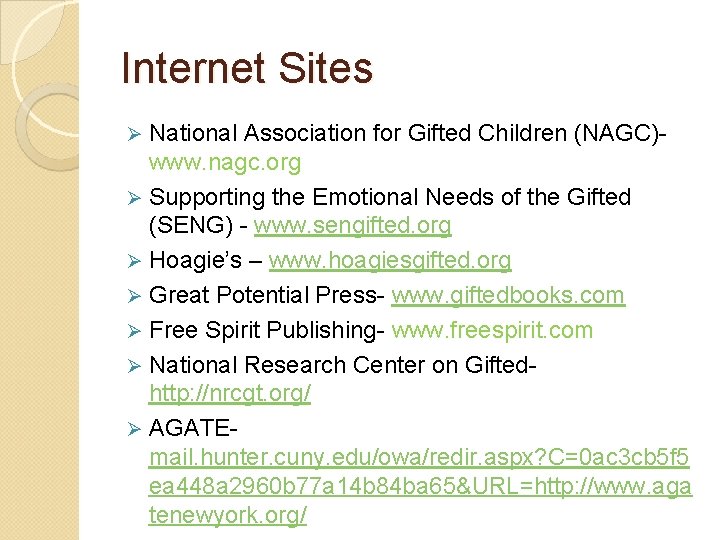
Internet Sites National Association for Gifted Children (NAGC)www. nagc. org Ø Supporting the Emotional Needs of the Gifted (SENG) - www. sengifted. org Ø Hoagie’s – www. hoagiesgifted. org Ø Great Potential Press- www. giftedbooks. com Ø Free Spirit Publishing- www. freespirit. com Ø National Research Center on Giftedhttp: //nrcgt. org/ Ø AGATEmail. hunter. cuny. edu/owa/redir. aspx? C=0 ac 3 cb 5 f 5 ea 448 a 2960 b 77 a 14 b 84 ba 65&URL=http: //www. aga tenewyork. org/ Ø