
Social and Emotional Development from Preschool Through High

![Temperament � Temperament defined � Structure [(Thomas & Chess, 1977) and Rothbart (2003)] ◦](https://slidetodoc.com/presentation_image_h/11c41588d203d768997d8aa3a7885a6a/image-27.jpg "Temperament � Temperament defined � Structure [(Thomas & Chess, 1977) and Rothbart (2003)] ◦")
- Slides: 63
Social and Emotional Development from Preschool Through High School 1
Theories 2
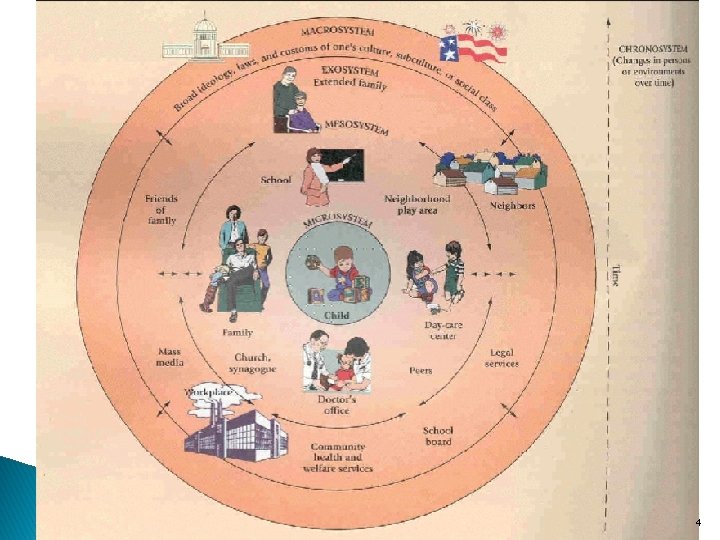
Bioecological System Theory � Urie Bronfenbrenner � Examines the biological make-up of the child and the effects of environment on development � Five environmental systems ranging from ◦ direct interactions between child and other social mediators to ◦ effects of culture and time 3
4
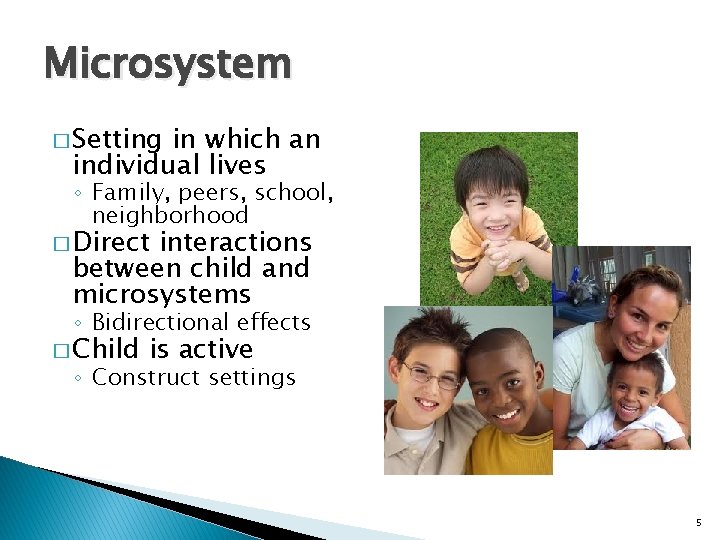
Microsystem � Setting in which an individual lives ◦ Family, peers, school, neighborhood � Direct interactions between child and microsystems ◦ Bidirectional effects � Child is active ◦ Construct settings 5
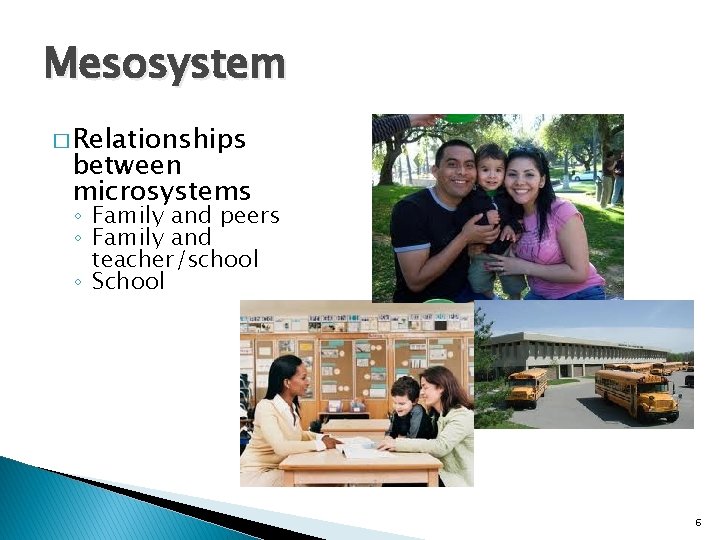
Mesosystem � Relationships between microsystems ◦ Family and peers ◦ Family and teacher/school ◦ School 6
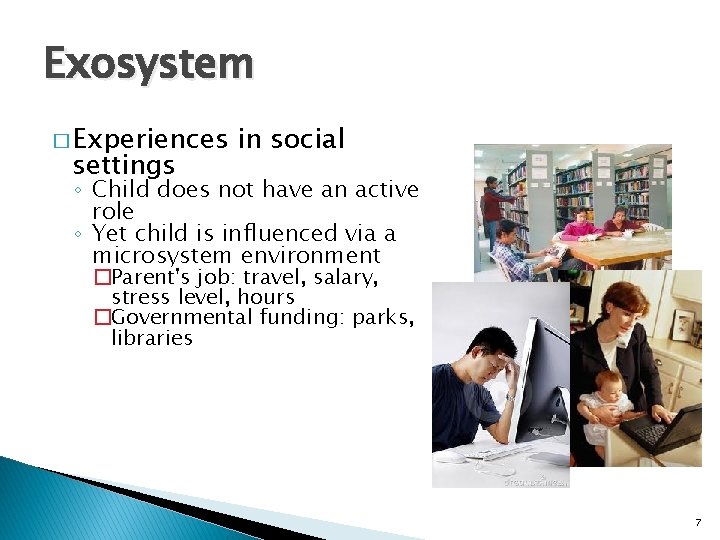
Exosystem � Experiences settings in social ◦ Child does not have an active role ◦ Yet child is influenced via a microsystem environment �Parent's job: travel, salary, stress level, hours �Governmental funding: parks, libraries 7
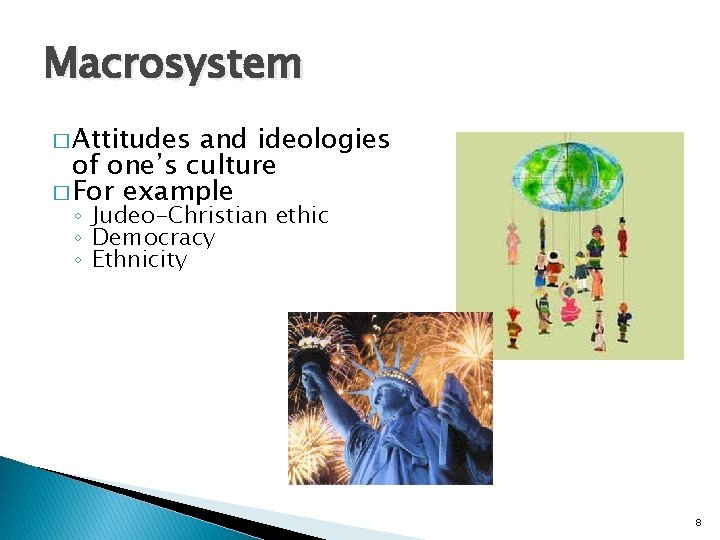
Macrosystem � Attitudes and ideologies of one’s culture � For example ◦ Judeo-Christian ethic ◦ Democracy ◦ Ethnicity 8
Chronosystem � Environmental course events that occur over the life ◦ Example: disruptive effects of divorce peak one year after the divorce ◦ Example: sociohistorical conditions 9
Application of Bronfenbrenner’s Theory to Education � Teachers provide stable relationships for students. show students that they care about them. welcome family members into the classroom. foster relationships with students’ parents and extended family (e. g. , grandparents). ◦ work cooperatively with parents to support children’s education. ◦ encourage and foster open communication between parents, students, and the school. ◦ ◦ 10
Review and Discuss � Describe the major components of Bronfenbrenner’s systems: micro-, meso-, macro-, and chrono-systems. � With a partner discuss specific issues from each system and how they can affect an individual child. How can issues from within each system affect learning in school? 11
Psychosocial Development � Erikson � Psychosocial theory of development ◦ Developmental crisis ◦ Eight stages 12
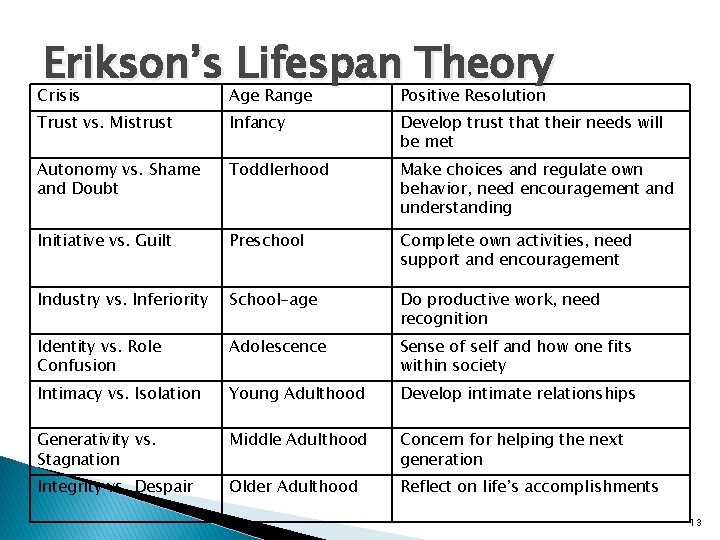
Erikson’s Lifespan Theory Crisis Age Range Positive Resolution Trust vs. Mistrust Infancy Develop trust that their needs will be met Autonomy vs. Shame and Doubt Toddlerhood Make choices and regulate own behavior, need encouragement and understanding Initiative vs. Guilt Preschool Complete own activities, need support and encouragement Industry vs. Inferiority School-age Do productive work, need recognition Identity vs. Role Confusion Adolescence Sense of self and how one fits within society Intimacy vs. Isolation Young Adulthood Develop intimate relationships Generativity vs. Stagnation Middle Adulthood Concern for helping the next generation Integrity vs. Despair Older Adulthood Reflect on life’s accomplishments 13
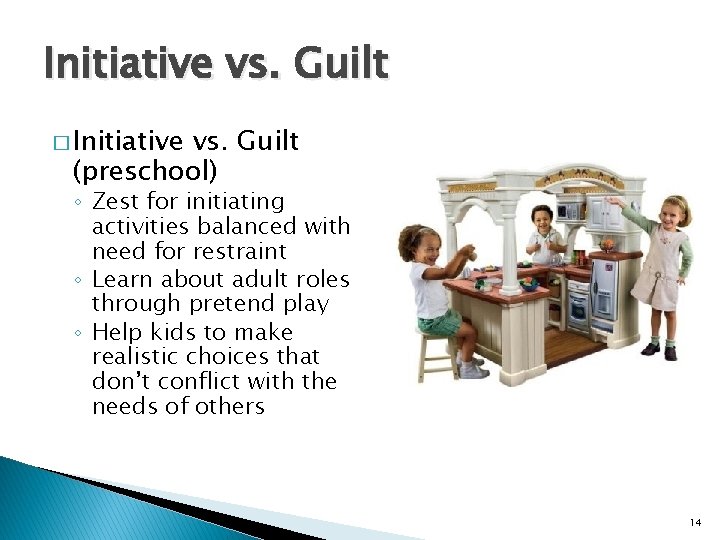
Initiative vs. Guilt � Initiative vs. Guilt (preschool) ◦ Zest for initiating activities balanced with need for restraint ◦ Learn about adult roles through pretend play ◦ Help kids to make realistic choices that don’t conflict with the needs of others 14
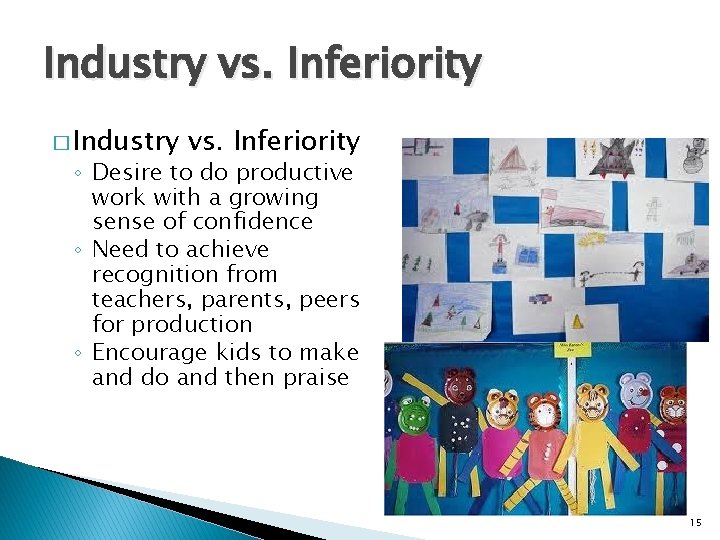
Industry vs. Inferiority � Industry vs. Inferiority ◦ Desire to do productive work with a growing sense of confidence ◦ Need to achieve recognition from teachers, parents, peers for production ◦ Encourage kids to make and do and then praise 15
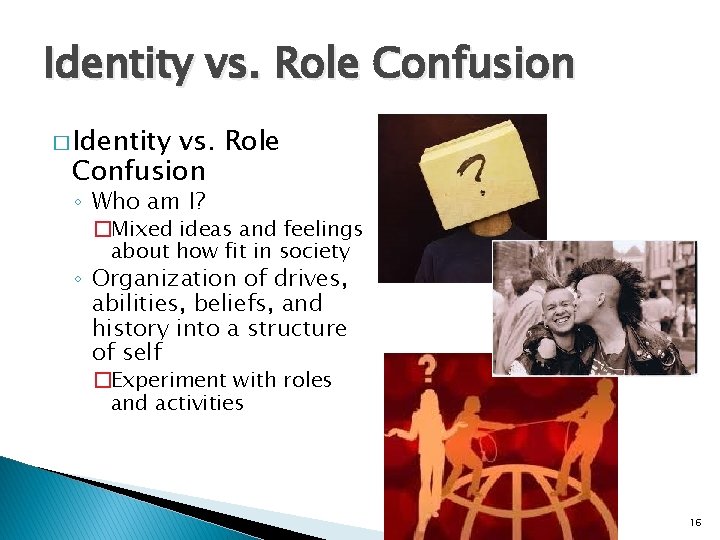
Identity vs. Role Confusion � Identity vs. Role Confusion ◦ Who am I? �Mixed ideas and feelings about how fit in society ◦ Organization of drives, abilities, beliefs, and history into a structure of self �Experiment with roles and activities 16
Application of Erikson’s Theory to Education � Children tasks experience success at challenging ◦ Independent tasks on students’ academic level; group tasks beyond students’ level � Set realistic goals ◦ Regulate behavior to reach goals ◦ Provide encouragement during the process and praise work and effort � Provide students with role models � Foster students interests in a variety of activities and areas 17
Review and Discuss � Describe the impact of both positive and negative resolutions for each stage on the experiences of school age children. � For your intended teaching position, how can you utilize Erikson’s theory to maximize learning? 18
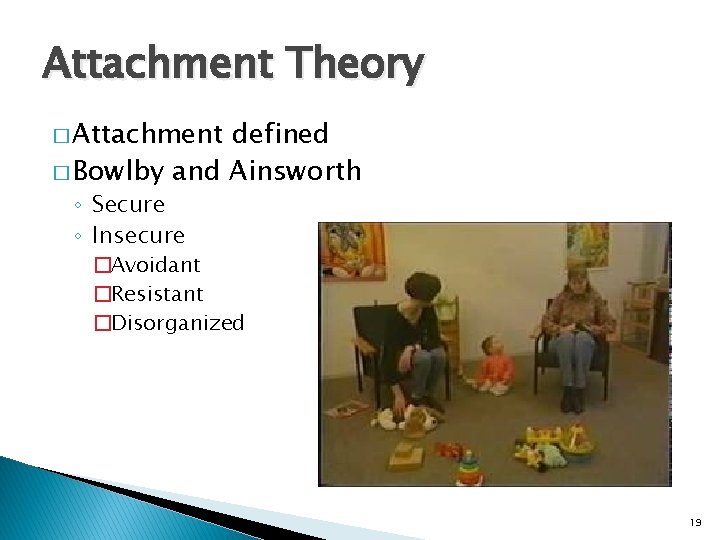
Attachment Theory � Attachment defined � Bowlby and Ainsworth ◦ Secure ◦ Insecure �Avoidant �Resistant �Disorganized 19
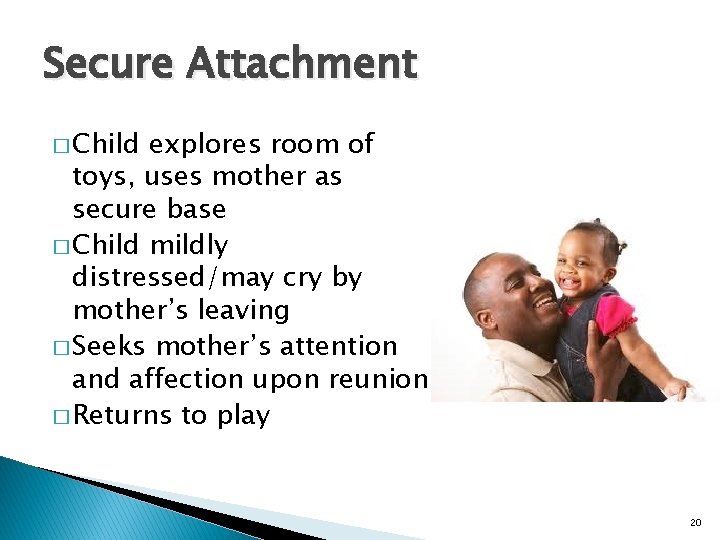
Secure Attachment � Child explores room of toys, uses mother as secure base � Child mildly distressed/may cry by mother’s leaving � Seeks mother’s attention and affection upon reunion � Returns to play 20
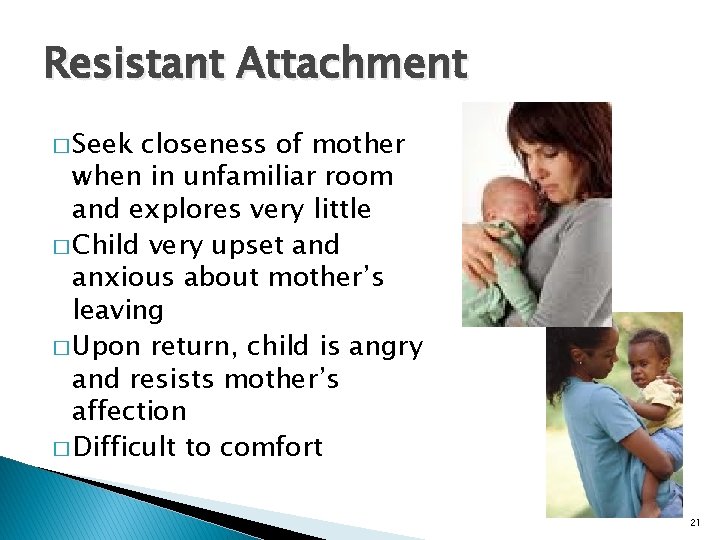
Resistant Attachment � Seek closeness of mother when in unfamiliar room and explores very little � Child very upset and anxious about mother’s leaving � Upon return, child is angry and resists mother’s affection � Difficult to comfort 21
Avoidant Attachment � Children ignore mother when entering the room and playing � No response when mother leaves � Avoid mother upon return and/or slow to greet her 22
Disorganized Attachment � Most insecure � Upon reunion do not look at mother � May appear to be confused and/or exhibit flat emotion 23
Long Term Effects of Attachment � Internal working model � Predicts relationship quality ◦ Schemas for social relationships ◦ Level of peer popularity and social anxiety during school years � Loving relationships as adults 24
Review and Discuss � Describe the four attachment types. � How can knowledge of attachment styles affect your interactions with students? � How might students’ attachment styles affect classroom behavior? 25
Self contexts 26
Temperament � Temperament defined � Structure [(Thomas & Chess, 1977) and Rothbart (2003)] ◦ ◦ Easy Difficult Slow-to-warm-up Effortful control � Stability 27
Self-concept � Self-concept ◦ Cognitive structure ◦ Ideas, feelings, and attitudes about oneself � Hierarchical ◦ Secondary concepts ◦ Third level—more specific concepts ◦ Strongest during adolescence � More situation specific in adults 28
Self-esteem � Self-esteem ◦ Affective ◦ Evaluation of self-concept ◦ Extent to which one believes self to be capable and worthy � Hierarchical ◦ Secondary concepts: Academic, social, and physical competence and physical appearance 29
Self-efficacy � Belief in one’s ability to learn and perform a behavior � Subject specific � Sources: ◦ ◦ Mastery experiences Vicarious experiences Verbal persuasion Physiological states 30
Review and Discuss � Differentiate between self-concept, selfesteem, and self-efficacy. � How will these concepts affect students’ learning? 31
Identity Statuses � James Marcia � Involves crisis emergence and level of commitment to decision � Identity statuses ◦ ◦ Identity foreclosure Identity diffusion Moratorium Identity achievement 32
Vocational Development � Super’s developmental theory ◦ Ages and stages ◦ Roles ◦ Personal and situational determinants � Gottfredson’s developmental theory ◦ Developmental processes ◦ Ages and stages 33
Super’s Career Stages � Life ◦ ◦ ◦ Span Career Stages Growth: (birth-13 years) Exploration: (14 -24 years) Establishment (25 -44 years) Maintenance (45 -65 years) Disengagement (over 65 years) 34
Gottfredson’s Stages � Orientation to Size and Power (3 -5 years old) � Orientation to Sex Roles (6 -8 years old) � Orientation to Social Valuation (9 -13 years old) � Orientation to the Internal Unique Self (begins at age 14 and continues until a career is selected) 35
Review and Discuss � How can teachers promote children’s career development? � How might career exploration be affected by self-esteem, self-concept, and self-efficacy? 36
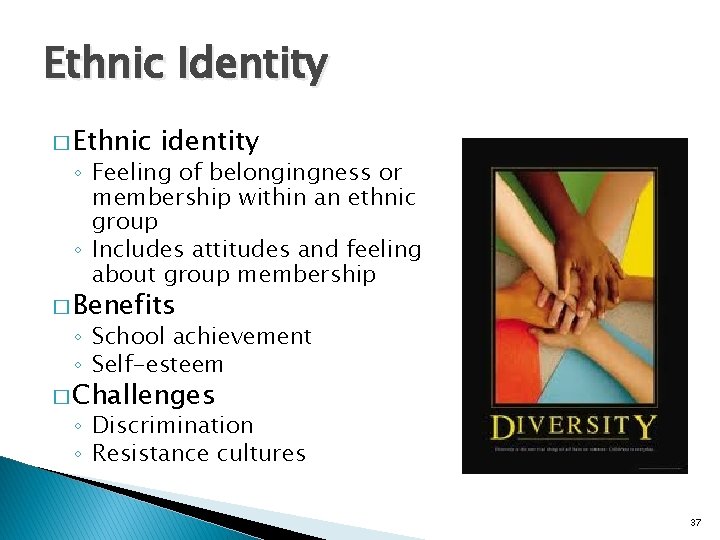
Ethnic Identity � Ethnic identity ◦ Feeling of belongingness or membership within an ethnic group ◦ Includes attitudes and feeling about group membership � Benefits ◦ School achievement ◦ Self-esteem � Challenges ◦ Discrimination ◦ Resistance cultures 37
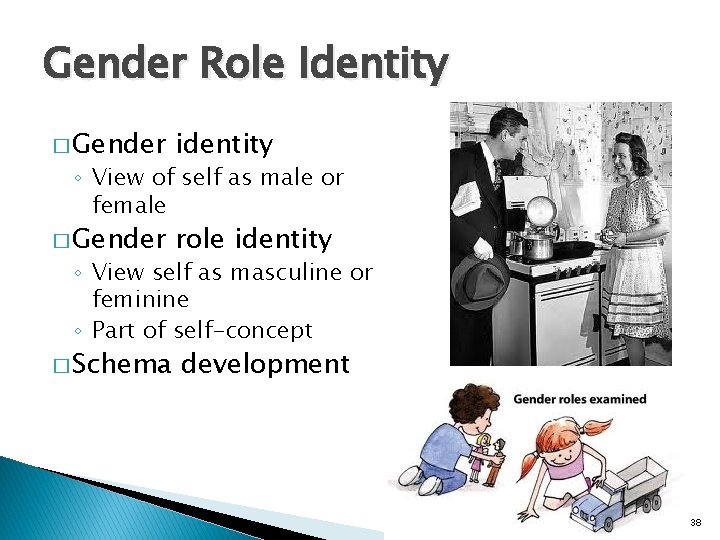
Gender Role Identity � Gender identity � Gender role identity ◦ View of self as male or female ◦ View self as masculine or feminine ◦ Part of self-concept � Schema development 38
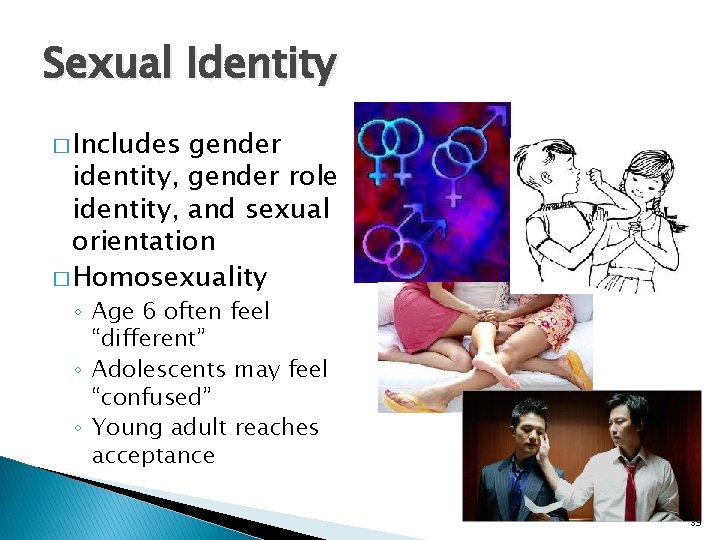
Sexual Identity � Includes gender identity, gender role identity, and sexual orientation � Homosexuality ◦ Age 6 often feel “different” ◦ Adolescents may feel “confused” ◦ Young adult reaches acceptance 39
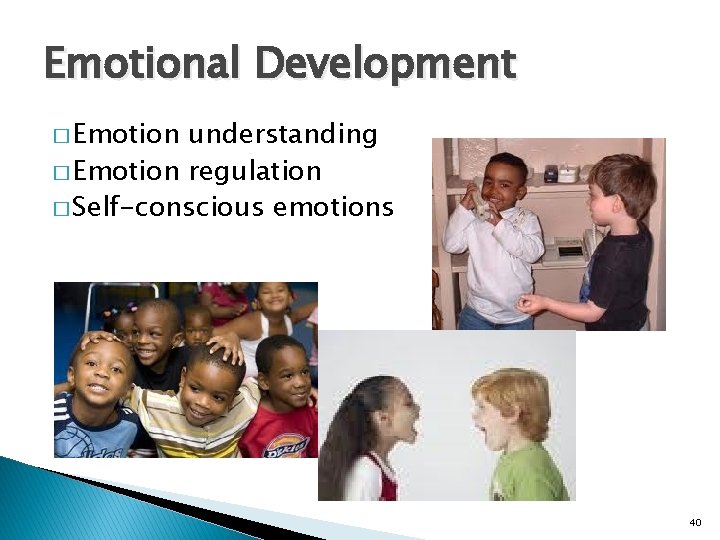
Emotional Development � Emotion understanding � Emotion regulation � Self-conscious emotions 40
Review and Discuss � Describe ethnic, gender, and sexual identity. � How might these identities manifest themselves in the classroom? ◦ What behaviors would you expect to see in your students? ◦ How might these identity processes and the resulting behaviors impact learning? 41
Social contexts 42
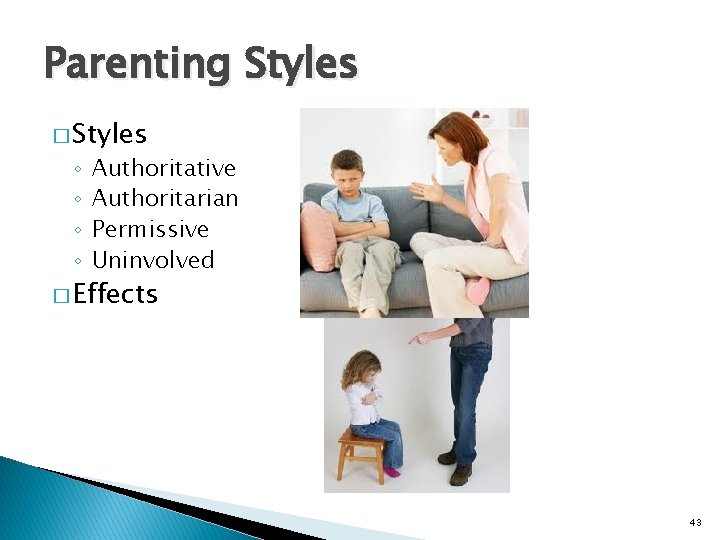
Parenting Styles � Styles ◦ ◦ Authoritative Authoritarian Permissive Uninvolved � Effects 43
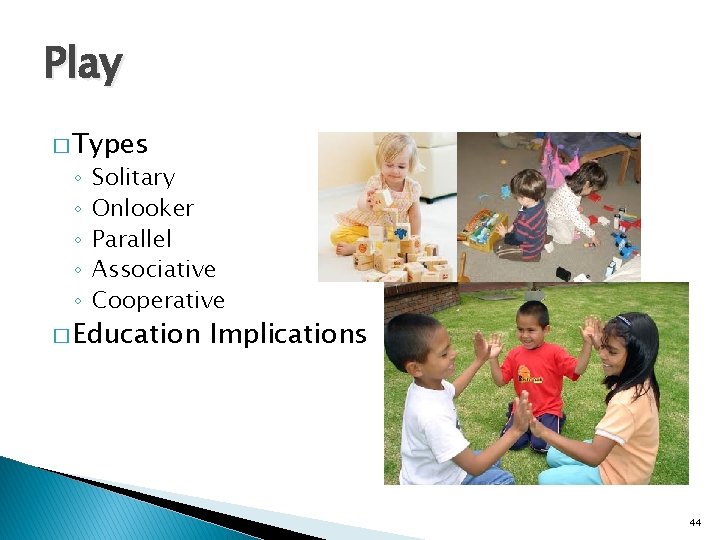
Play � Types ◦ ◦ ◦ Solitary Onlooker Parallel Associative Cooperative � Education Implications 44
Peers � Peer ◦ ◦ acceptance Popular Rejected Controversial Neglected 45
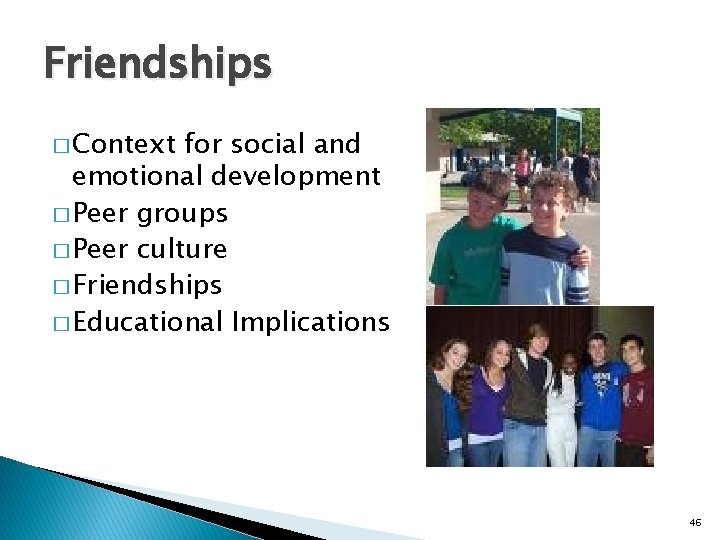
Friendships � Context for social and emotional development � Peer groups � Peer culture � Friendships � Educational Implications 46
Prosocial Behavior � Prosocial � Empathy behavior defined � Sympathy 47
Interpersonal Reasoning � Perspective taking ◦ Preschoolers ◦ School age ◦ Adolescents 48
Review and Discuss � Describe the different parenting styles and their effects on children. � How can parenting styles affect children's interactions at school? � Differentiate between friendship and peer acceptance. Why is it important for children to have friends? � Contrast prosocial and antisocial behavior. How can you promote prosocial behavior? 49
Moral development 50
Theories � Piaget � Kohlberg � Gilligan 51
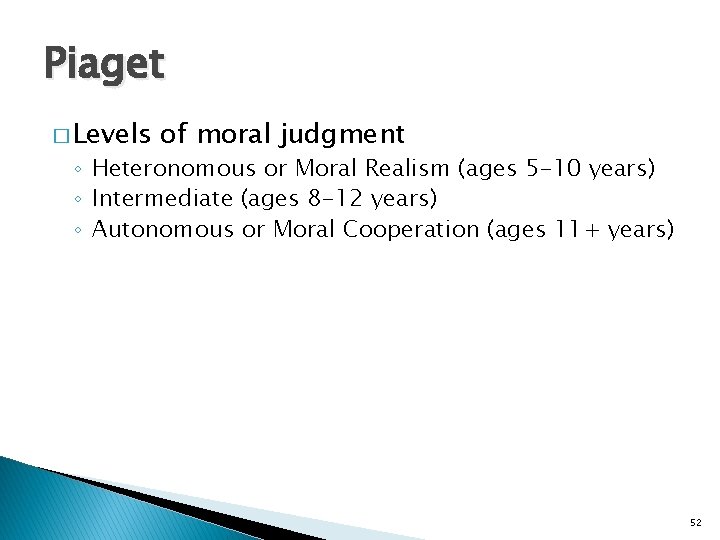
Piaget � Levels of moral judgment ◦ Heteronomous or Moral Realism (ages 5 -10 years) ◦ Intermediate (ages 8 -12 years) ◦ Autonomous or Moral Cooperation (ages 11+ years) 52
Implications of Piaget’s Theory in Education � Emphasize cooperative social interactions for decision making and problem solving � Provide opportunities for personal discovery of morality and definitions of right/wrong and fairness 53
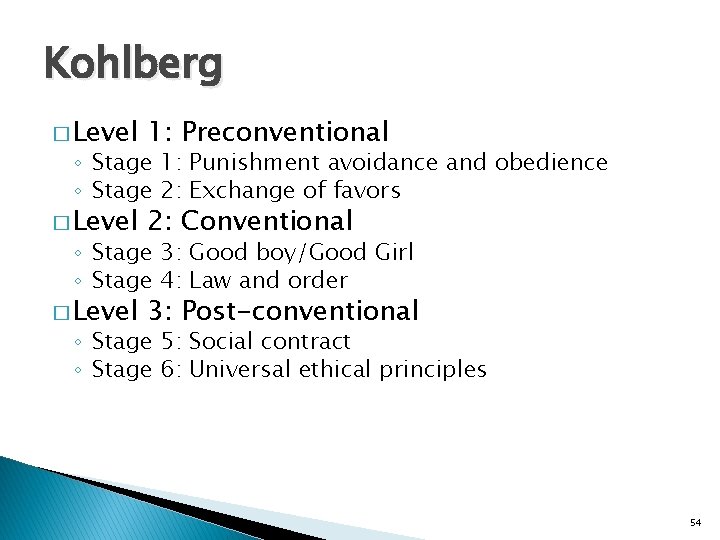
Kohlberg � Level 1: Preconventional � Level 2: Conventional � Level 3: Post-conventional ◦ Stage 1: Punishment avoidance and obedience ◦ Stage 2: Exchange of favors ◦ Stage 3: Good boy/Good Girl ◦ Stage 4: Law and order ◦ Stage 5: Social contract ◦ Stage 6: Universal ethical principles 54
Gilligan � Care perspective ◦ Emphasis on human relationships, connections with each other, and communication 55
Implications of Kohlberg’s Theory in Education � Provide experiences for students to encounter moral issues ◦ Students need to act as members of a community not individuals ◦ Encourage democratic interactions where students must come to consensus on decisions 56
Moral Education � Piaget—opportunities for problem solving which lead to discovery of fair solutions � Kohlberg—encourage students to move to the next level of moral reasoning by providing time for individual reflection as well as social interactions 57
Moral Education � Hidden Curriculum � Character Education � Values Clarification � Cognitive Moral Education 58
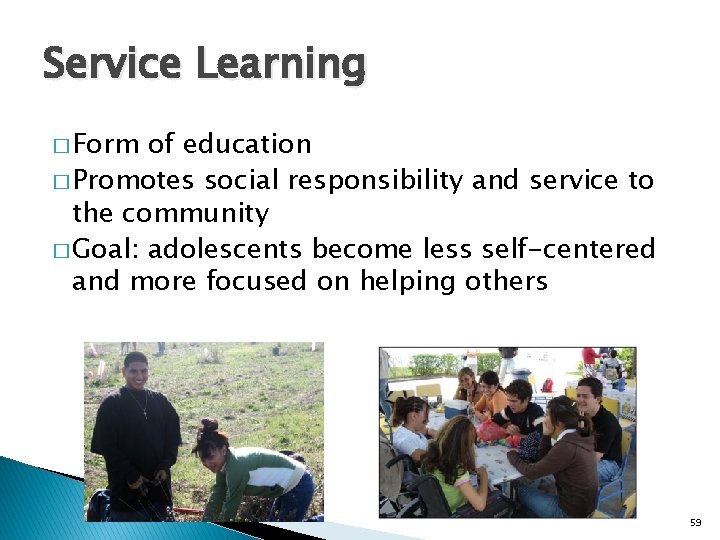
Service Learning � Form of education � Promotes social responsibility and service to the community � Goal: adolescents become less self-centered and more focused on helping others 59
Aggression � Aggression, defined ◦ Versus Assertiveness � Types of aggression ◦ Instrumental ◦ Hostile �Overt �Relational 60
Review and Discuss � Compare and contrast Piaget’s and Kohlberg’s moral development theories. � How can teachers foster the care perspective described by Gilligan significantly earlier than during adulthood? � How can teachers dissuade students from cheating? � Is it possible for behavior to always reflect moral reasoning? Explain your response. 61
Review and Discuss (cont. ) � Compare and contrast the different types of moral education programs. � Explore your level of comfort in using the different types of programs. ◦ Can your feelings dictate your behavior in this instance? Explain your response. � How can teachers foster assertion in students and minimize aggression? 62
The end 63