
Social and economic inequality limits Sustainable Development a
Social and economic inequality limits Sustainable Development: a gender inequality perspective of Bangladesh Nasrin Jahan Jinia, Research, SUDE-VET and Equ. Just, The Faculty of Education and Culture, Tampere University, Finland. SM Shafiqul Alam, Associate Professor, Department of public Administration, Islamic University & Research, SUDE-VET and Equ. Just, The Faculty of Education and Culture, Tampere University, Finland
Why Gender equality in Sustainable Development? • • • “Equality: the cornerstone of every democratic society that aspires to social justice and human rights. ” (UN 2002) Gender equality: “men and women have equal conditions for realizing their full human rights and for contributing to, or benefiting from, economic, social, cultural, and political development (ILO, 2000). For achieving SDGs: gender equality is very important for its moral, ethical and consequential imperatives; • • sustainable future cannot ignore the rights, dignity and capabilities of half the world’s population (UN-Women, 2014). SD cannot be achieved without women’s involvement because; they are likely to be susceptible to environmental vulnerabilities for their poor social and economic position. For reducing gender inequality: education and skills development are key determinants (World Bank, 2013; Hossain et al. , 2012). What we need to address the issue? • More research for emphasizing and explaining conceptual and contextual scenarios in connection with sustainable development (Academia) • Focusing on contextual policy, strategy and plan of action (policy maker)

Social & economic inequality and Sustainable Development: Bangladesh perspective Social inequality & Economic inequality • • Sustainable development Gender disparity in social system • Inequalities of access to social and economic opportunities • Poverty Low income and low wage • • Physical and structural focus on development Still as agenda at the government level for policy, strategy and plan Very few research on conceptual issues and less focused from environmental perspective by Academia People and society still do not aware enough Scenarios in Bangladesh • • • Women are struggling 85 percent women labor force remains outside of the labor market (ADB, 2015). Labor market is in a skills shortage. Female enrollment in basic education is in progress. However, half of the female students drop out after SSC (World bank, 2015). Women’s participation in VET is strikingly low (ILO, 2013):
Gender disparity in VET in Bangladesh: a barrier for sustainable development • • • Low educational qualifications, unskilled labor force and high informal employment are general characters of labor market. 40% labor forces have no formal education in Bangladesh. Only one-third with education at primary level and beyond (SFYP, 2011). Women labor force participation remains still very low average (public and private) 24% only The female workforce over-representation in informal sector jobs, with little or no education or skills training due to the stereotyped social perceptions of female roles in society (BBS, 2013) Joining labor force a challenge for women due to the double burden of patriarchy and poverty. women faces difficulties in exploring the job opportunities; women do not have as good access as men do, women lacks relevant information on vocational courses and related job opportunities; due to an unfriendly environment, women feels forced to leave; and sometimes give up trying for a job.
Stereotypes reasons behind gender disparity in VET in Bangladesh • • • Socially, technical and vocational education has been viewed as training for male students. The negative attitude towards diploma education is further spurred by a common perception that technical education is meant for academically weak students. There are inadequate promotional and awareness-building activities in technical education for prospective female students and their families Unlike their male counterparts, social norms and limited mobility disadvantage female diploma students in networking outside or even within the institutions. Family awareness and support is another crucial factor for successful completion of vocational education.
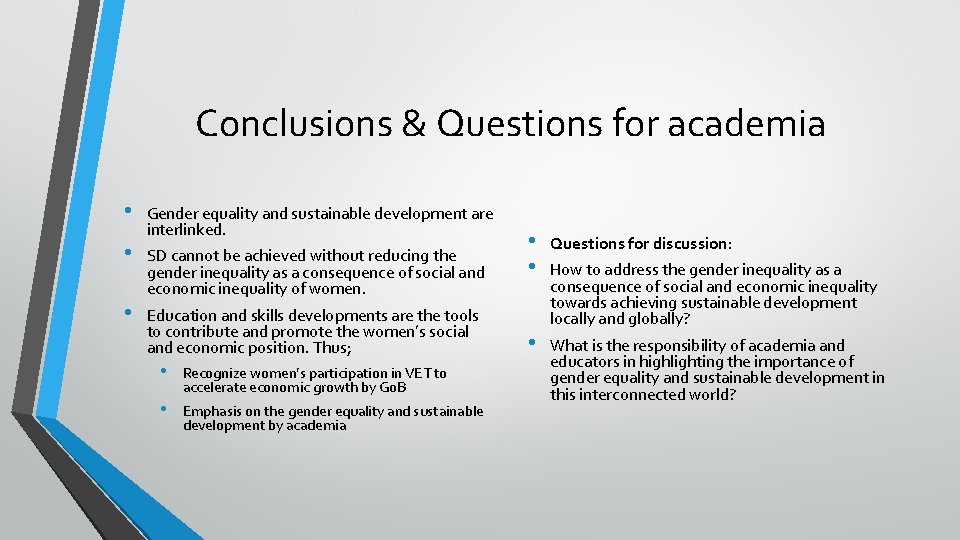
Conclusions & Questions for academia • • • Gender equality and sustainable development are interlinked. SD cannot be achieved without reducing the gender inequality as a consequence of social and economic inequality of women. Education and skills developments are the tools to contribute and promote the women’s social and economic position. Thus; • • Recognize women’s participation in VET to accelerate economic growth by Go. B Emphasis on the gender equality and sustainable development by academia • • Questions for discussion: • What is the responsibility of academia and educators in highlighting the importance of gender equality and sustainable development in this interconnected world? How to address the gender inequality as a consequence of social and economic inequality towards achieving sustainable development locally and globally?
- Slides: 6