
Social and Cultural Environments Global Marketing Chapter 4
Social and Cultural Environments Global Marketing Chapter 4 1
Introduction This chapter includes: • Society, Culture, and Consumer Culture • Ethnocentricity and Self-Reference Criterion • Hall’s Theory • Hofstede’s Cultural Typology • Diffusion Theory 4 -2 © 2011 Pearson Education, Inc. publishing as Prentice Hall
Task of Global Marketers • Study and understand the cultures of countries in which they will be doing business • Understand how an unconscious reference to their own cultural values, or self-reference criterion, may influence their perception of the market • Incorporate this understanding into the marketing planning process 4 -3 © 2011 Pearson Education, Inc. publishing as Prentice Hall
Culture • A basic definition -- Culture is the total accumulation of an identifiable group's beliefs, norms, activities, institutions, and communication patterns. • Values, attitudes, standards and beliefs are all embedded in culture © 2011 Pearson Education, Inc. publishing as Prentice Hall
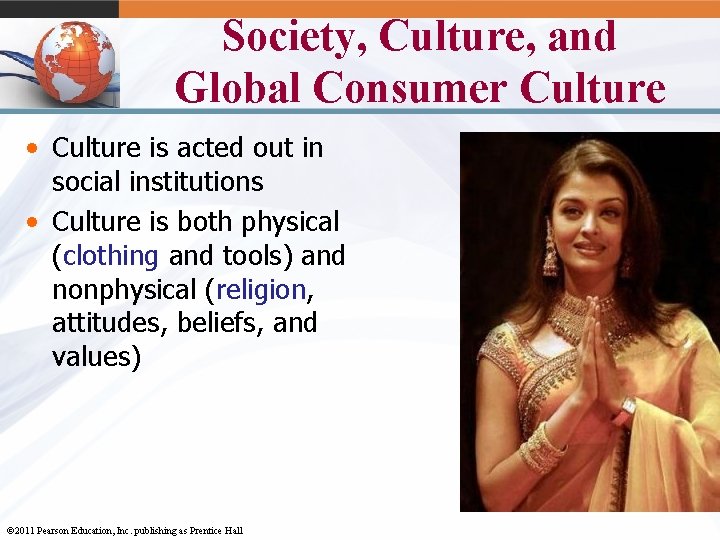
Society, Culture, and Global Consumer Culture • Culture is acted out in social institutions • Culture is both physical (clothing and tools) and nonphysical (religion, attitudes, beliefs, and values) 4 -5 © 2011 Pearson Education, Inc. publishing as Prentice Hall

Social Institutions • Family • Education • Religion • Government • Business These institutions function to reinforce cultural norms 4 -6 © 2011 Pearson Education, Inc. publishing as Prentice Hall
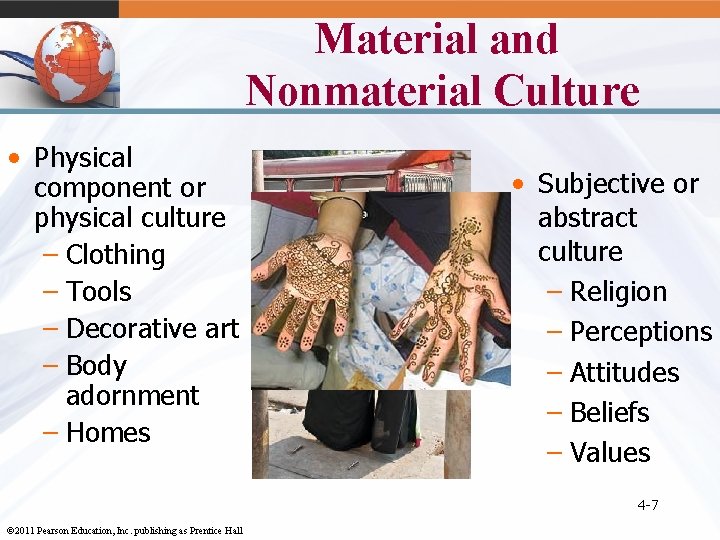
Material and Nonmaterial Culture • Physical component or physical culture – Clothing – Tools – Decorative art – Body adornment – Homes • Subjective or abstract culture – Religion – Perceptions – Attitudes – Beliefs – Values 4 -7 © 2011 Pearson Education, Inc. publishing as Prentice Hall
Society, Culture, and Global Consumer Culture “Culture is the collective programming of the mind that distinguishes the members of one category of people from those of another. ” Geert Hofstede • A nation, an ethic group, a gender group, an organization, or a family may be considered as a category. 4 -8 © 2011 Pearson Education, Inc. publishing as Prentice Hall
Society, Culture, and Global Consumer Culture • Global consumer cultures are emerging – Persons who share meaningful sets of consumptionrelated symbols – Pub culture, coffee culture, fast-food culture, credit card culture • Primarily the product of a technologically interconnected world – Internet – Satellite TV – Cell phones 4 -9 © 2011 Pearson Education, Inc. publishing as Prentice Hall
Attitudes, Beliefs, and Values • Attitude–learned tendency to respond in a consistent way to a given object or entity • Belief–an organized pattern of knowledge that an individual holds to be true about the world • Value–enduring belief or feeling that a specific mode of conduct is personally or socially preferable to another mode of conduct 4 -10 © 2011 Pearson Education, Inc. publishing as Prentice Hall
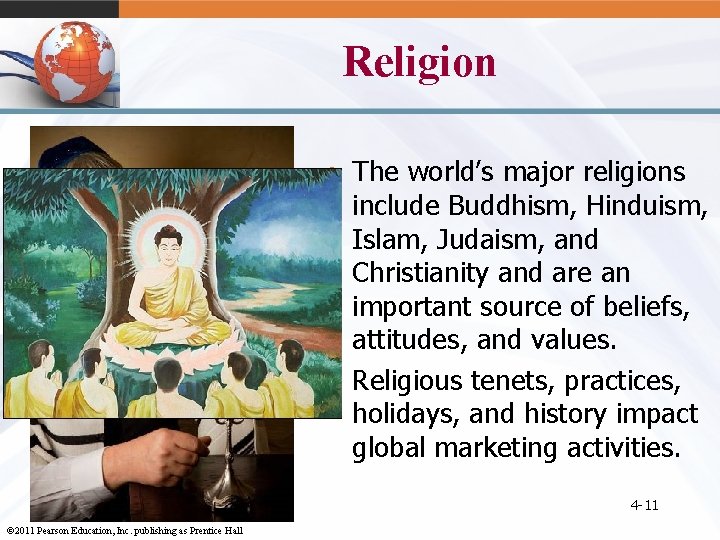
Religion • The world’s major religions include Buddhism, Hinduism, Islam, Judaism, and Christianity and are an important source of beliefs, attitudes, and values. • Religious tenets, practices, holidays, and history impact global marketing activities. 4 -11 © 2011 Pearson Education, Inc. publishing as Prentice Hall
Aesthetics • Visual–embodied in • The sense of what is the color or shape of beautiful and what is not a product, label, or beautiful package • What represents good • Styles–various taste as opposed to degrees of tastelessness or even complexity, for obscenity example, are perceived differently around the world 4 -12 © 2011 Pearson Education, Inc. publishing as Prentice Hall
Aesthetics and Color • Red–associated with blood, wine-making, activity, heat, and vibrancy in many countries but is poorly received in some African countries. White–identified with purity and cleanliness in the West, with death in parts of Asia. Gray–means inexpensive in Japan and China, but high quality and expensive in the U. S. 4 -13 © 2011 Pearson Education, Inc. publishing as Prentice Hall

The Meaning of Color Red signifies good luck and celebration in China © 2011 Pearson Education, Inc. publishing as Prentice Hall Red is associated with “active, ” “hot” and “vibrant” 4 -14
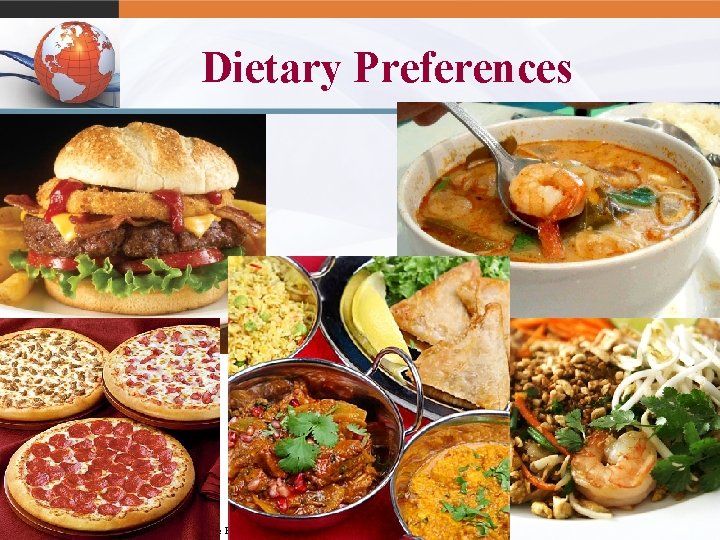
Dietary Preferences 4 -15 © 2011 Pearson Education, Inc. publishing as Prentice Hall
Language and Communication • Speaking English around the Globe – There are more people who speak English as a foreign language than native speakers – 85% of European teens study English – Sony, Nokia, Matsushita require managers to speak English © 2011 Pearson Education, Inc. publishing as Prentice Hall • Nonverbal Communication – Westerners tend to be verbal; Asians value nonverbal communication – In Japan, bowing has many nuances – In the Mideast, Westerners should not show the soles of shoes or pass documents with the left hand 4 -16
Marketing’s Impact on Culture • Universal aspects of the cultural environment represent opportunities to standardize elements of a marketing program • Increasing travel and improved communications have contributed to a convergence of tastes and preferences in a number of product categories 4 -17 © 2011 Pearson Education, Inc. publishing as Prentice Hall
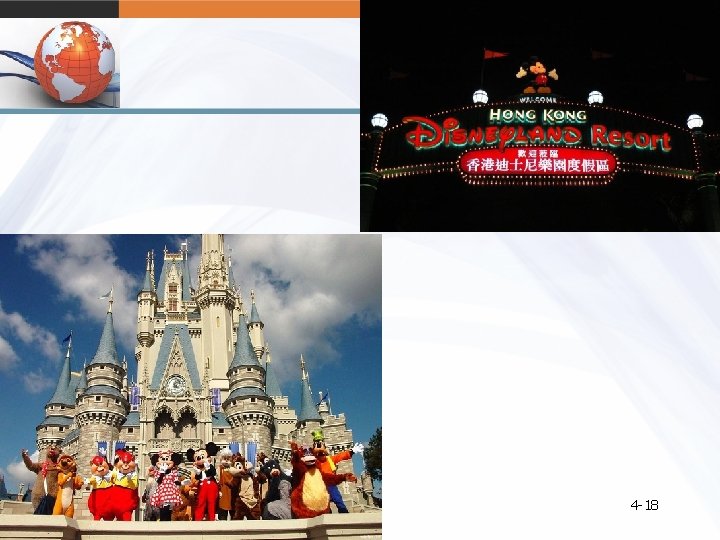
4 -18 © 2011 Pearson Education, Inc. publishing as Prentice Hall
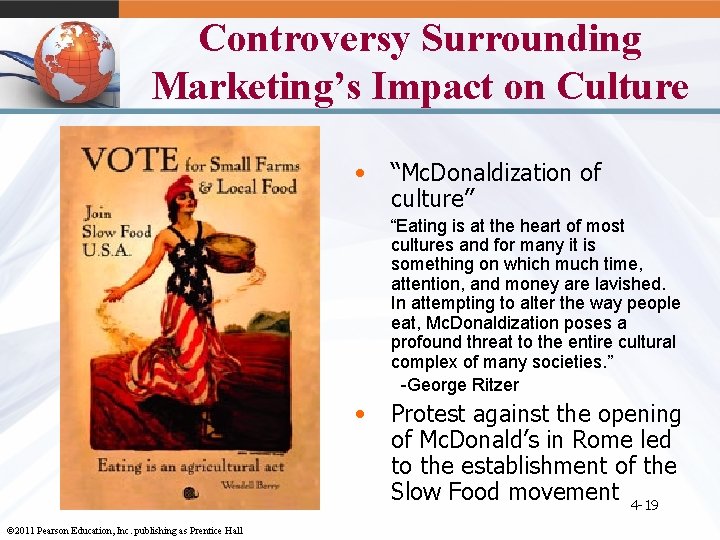
Controversy Surrounding Marketing’s Impact on Culture • “Mc. Donaldization of culture” “Eating is at the heart of most cultures and for many it is something on which much time, attention, and money are lavished. In attempting to alter the way people eat, Mc. Donaldization poses a profound threat to the entire cultural complex of many societies. ” -George Ritzer • © 2011 Pearson Education, Inc. publishing as Prentice Hall Protest against the opening of Mc. Donald’s in Rome led to the establishment of the Slow Food movement 4 -19
Theoretical perspectives • Halls High- Low context culture • Hofstede’s Cultural Typology • Diffusion Theory 4 -20 © 2011 Pearson Education, Inc. publishing as Prentice Hall
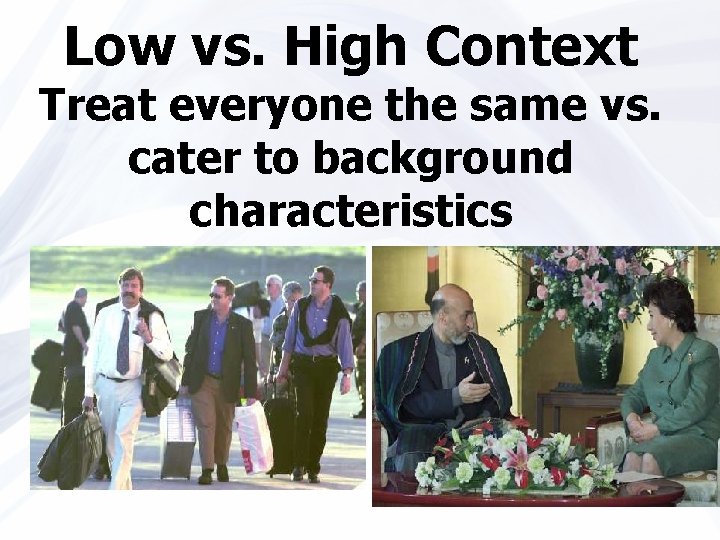
Low vs. High Context Treat everyone the same vs. cater to background characteristics
High- and Low-Context Cultures • High Context – Information resides in context – Emphasis on background, basic values, societal status – Less emphasis on legal paperwork – Focus on personal reputation • Saudi Arabia, Japan © 2011 Pearson Education, Inc. publishing as Prentice Hall • Low Context – Messages are explicit and specific – Words carry all information – Reliance on legal paperwork – Focus on nonpersonal documentation of credibility • Switzerland, U. S. , Germany 4 -22
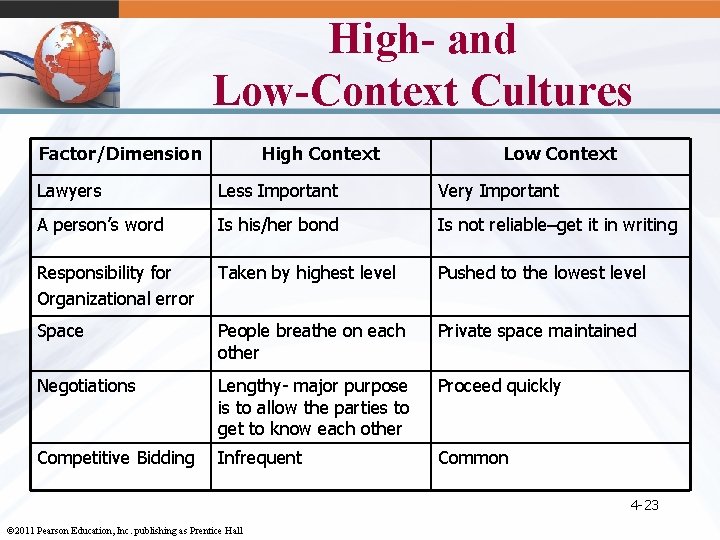
High- and Low-Context Cultures Factor/Dimension High Context Low Context Lawyers Less Important Very Important A person’s word Is his/her bond Is not reliable–get it in writing Responsibility for Organizational error Taken by highest level Pushed to the lowest level Space People breathe on each other Private space maintained Negotiations Lengthy- major purpose is to allow the parties to get to know each other Proceed quickly Competitive Bidding Infrequent Common 4 -23 © 2011 Pearson Education, Inc. publishing as Prentice Hall
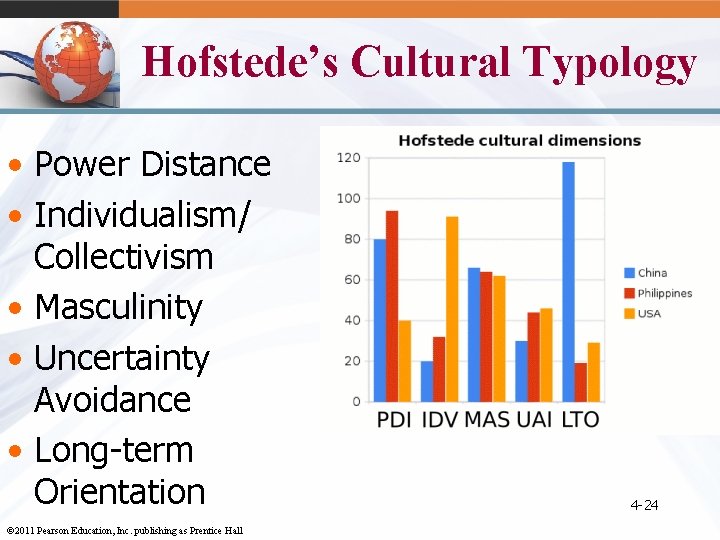
Hofstede’s Cultural Typology • Power Distance • Individualism/ Collectivism • Masculinity • Uncertainty Avoidance • Long-term Orientation © 2011 Pearson Education, Inc. publishing as Prentice Hall 4 -24
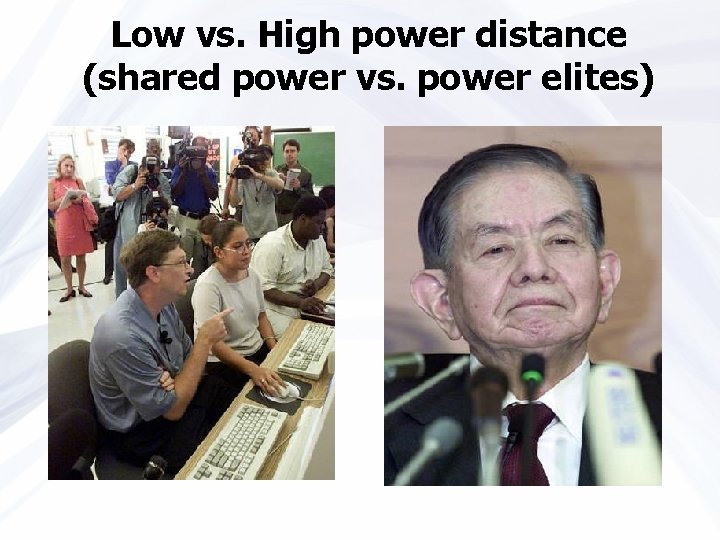
Low vs. High power distance (shared power vs. power elites)
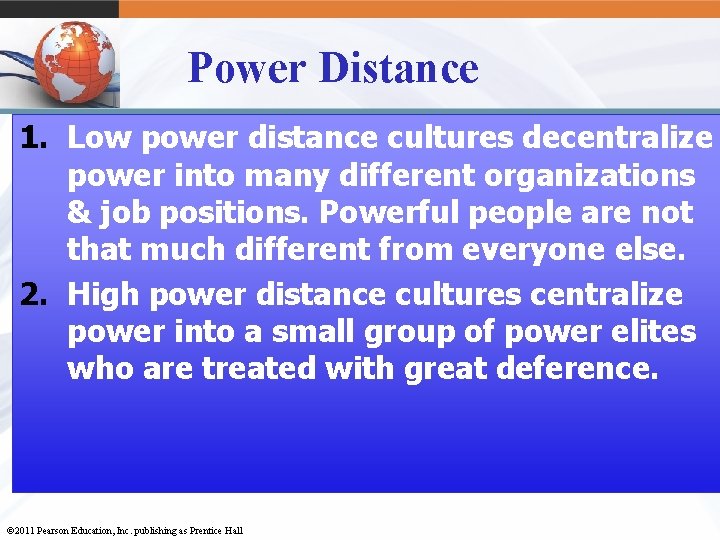
Power Distance 1. Low power distance cultures decentralize power into many different organizations & job positions. Powerful people are not that much different from everyone else. 2. High power distance cultures centralize power into a small group of power elites who are treated with great deference. © 2011 Pearson Education, Inc. publishing as Prentice Hall
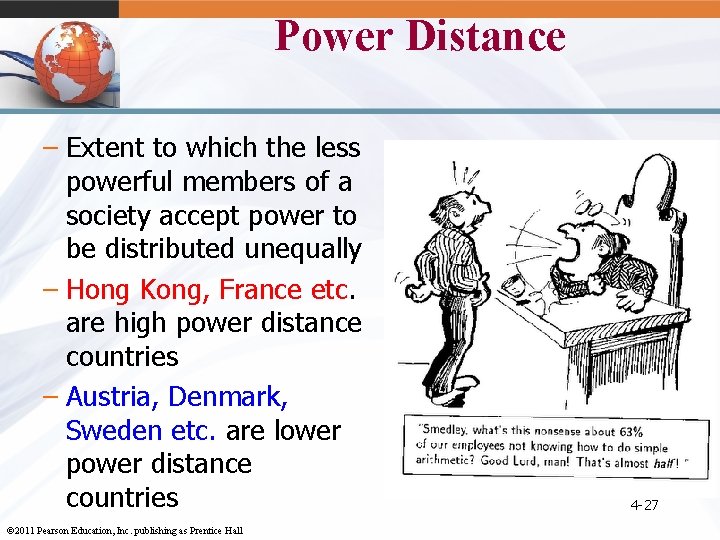
Power Distance – Extent to which the less powerful members of a society accept power to be distributed unequally – Hong Kong, France etc. are high power distance countries – Austria, Denmark, Sweden etc. are lower power distance countries © 2011 Pearson Education, Inc. publishing as Prentice Hall 4 -27
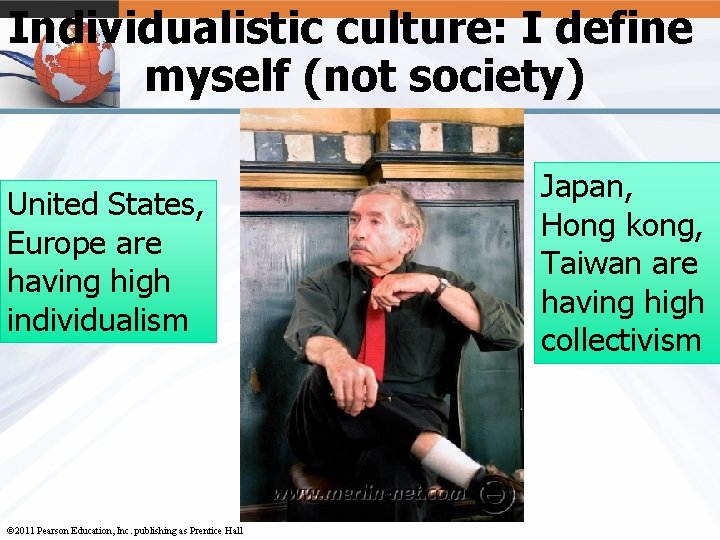
Individualistic culture: I define myself (not society) United States, Europe are having high individualism © 2011 Pearson Education, Inc. publishing as Prentice Hall Japan, Hong kong, Taiwan are having high collectivism
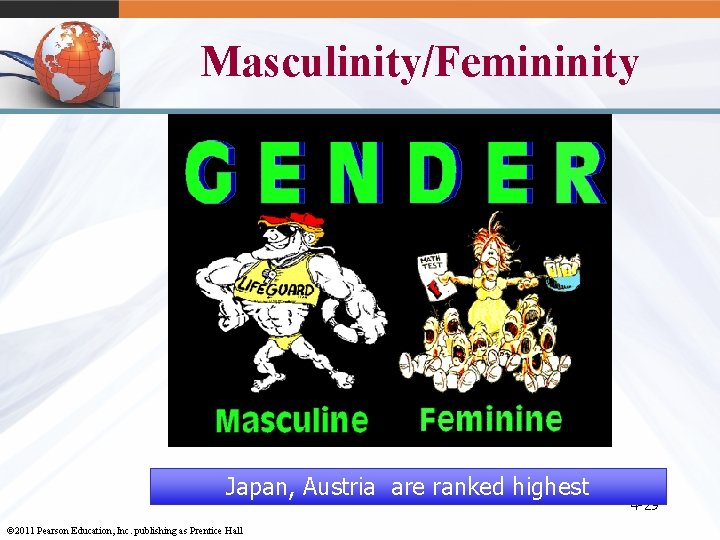
Masculinity/Femininity Japan, Austria are ranked highest © 2011 Pearson Education, Inc. publishing as Prentice Hall 4 -29
Uncertainty Avoidance • Preparedness of the people to face any uncertainties in society. • Members of the uncertainty avoiding cultures may be more aggressive, emotional and have intolerant behavior. • Greece, Portugal etc. are outrank others • Denmark, Sweden, Ireland, US are uncertainty accepting countries. 4 -30 © 2011 Pearson Education, Inc. publishing as Prentice Hall
Long term orientation • The extent to which a society encourages and rewards future oriented behaviors such as planning, investing in the future etc. • Most of the Asian countries such as Japan, Hong Kong, Taiwan are examples. 4 -31 © 2011 Pearson Education, Inc. publishing as Prentice Hall
Self-Reference Criterion and Perception • Unconscious reference to one’s own cultural values; creates cultural myopia • How to Reduce Cultural Myopia: – Define the problem or goal in terms of home country cultural traits – Define the problem in terms of host-country cultural traits; make no value judgments – Isolate the SRC influence and examine it – Redefine the problem without the SRC influence and solve for the host country situation 4 -32 © 2011 Pearson Education, Inc. publishing as Prentice Hall
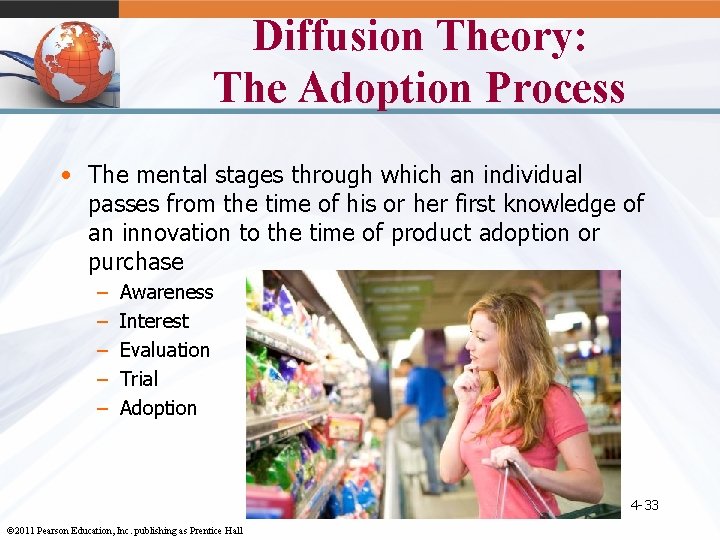
Diffusion Theory: The Adoption Process • The mental stages through which an individual passes from the time of his or her first knowledge of an innovation to the time of product adoption or purchase – – – Awareness Interest Evaluation Trial Adoption 4 -33 © 2011 Pearson Education, Inc. publishing as Prentice Hall
Diffusion Theory: Characteristics of Innovations • Innovation is something new; five factors that affect the rate at which innovations are adopted include: – Relative advantage – Compatibility – Complexity – Divisibility – Communicability 4 -34 © 2011 Pearson Education, Inc. publishing as Prentice Hall
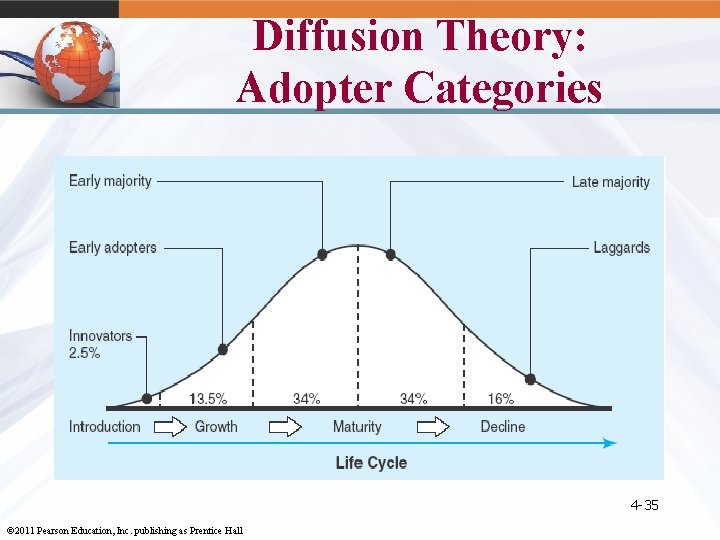
Diffusion Theory: Adopter Categories 4 -35 © 2011 Pearson Education, Inc. publishing as Prentice Hall
Marketing Implications • Cultural factors must be considered when marketing consumer and industrial products • Environmental sensitivity reflects the extent to which products must be adapted to the culture-specific needs of different national markets 4 -36 © 2011 Pearson Education, Inc. publishing as Prentice Hall
Looking Ahead to Chapter 5 • The Political, Legal, and Regulatory Environments of Marketing 4 -37 © 2011 Pearson Education, Inc. publishing as Prentice Hall
All rights reserved. No part of this publication may be reproduced, stored in a retrieval system, or transmitted, in any form or by any means, electronic, mechanical, photocopying, recording, or otherwise, without the prior written permission of the publisher. Printed in the United States of America. Copyright © 2011 Pearson Education, Inc. Publishing as Prentice Hall 4 -38 © 2011 Pearson Education, Inc. publishing as Prentice Hall
- Slides: 38