
Social and Cultural Environment Chapter 3 Global Marketing
Social and Cultural Environment Chapter 3 Global Marketing Keegan and Green, Chapter 4
Tasks of the Global Marketers • Study and understand the country cultures in which they will be doing business • Incorporate this understanding into the marketing planning process Keegan and Green, Chapter 4 2
Conceptual Frameworks • • • Hall’s high and low context cultures Maslow’s hierarchy Hofstede’s cultural typology Self-reference criterion Diffusion theory Keegan and Green, Chapter 4 3
Culture • Ways of living, built up by a group of human beings, transmitted from one generation to another • Social institutions – Family – Education – Religion – Government – Business Keegan and Green, Chapter 4 4
Material vs. Nonmaterial Culture • Physical components of culture – Objects – Artifacts • Clothing • Tools • Pictures • Homes Keegan and Green, Chapter 4 • Subjective or abstract culture – Religion – Perceptions – Attitudes – Beliefs – Values 5
Cultural Universals • • • Athletics Body adornment Cooking Courtship Decorative arts Education Ethics Property rights Religious rituals Keegan and Green, Chapter 4 • • • Etiquette Family feasting Food taboos Language Marriage Mealtime Mourning Music Status differentiation 6
Attitudes, Beliefs, Values • Attitudes - learned tendency to respond in a consistent way to a given object or entity • Belief - an organized pattern of knowledge that an individual holds to be true about the world • Value - enduring belief or feeling that a specific mode of conduct is personally or socially preferable to another mode of conduct Keegan and Green, Chapter 4 7
Aesthetics and Color • What do you associate with Red? • With white? • Active, hot, vibrant • Weddings in some Asian cultures • Poorly received in African countries • Purity, cleanliness • Death in parts of Asia Keegan and Green, Chapter 4 8
Dietary Preferences • Would you eat…. . – Reindeer (Finland) – Rabbit (France) – Rice, soup, and grilled fish for breakfast (Japan) – Kimchi - Korea – Blood sausage (Germany) Keegan and Green, Chapter 4 9
Language and Communication • Verbal Cues • Nonverbal cues or body language Keegan and Green, Chapter 4 10
Language and Communication • Linguistic Category – Syntax – Semantics – Phonology – Morphology Keegan and Green, Chapter 4 • Language Example – English has fixed word order; Russian has free word order – Japanese words convey nuances of feeling – Japanese does not distinguish between the sounds l and r; English and Russian have both l and r sounds – Russian is highly inflected compared to English 11
High and Low Context Cultures • High Context – Information resides in context – Emphasis on background, basic values – Less emphasis on legal paperwork – Focus on personal reputation • Saudi Arabia, Japan Keegan and Green, Chapter 4 • Low Context – Messages are explicit and specific – Words carry all information – Reliance on legal paperwork – Focus on non-personal documentation of credibility • Switzerland, US, Germany 12
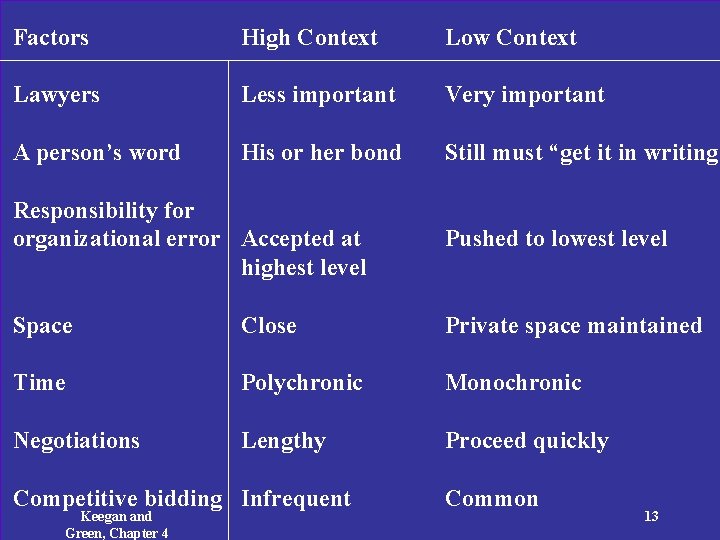
Factors High Context Low Context Lawyers Less important Very important A person’s word His or her bond Still must “get it in writing” Responsibility for organizational error Accepted at highest level Pushed to lowest level Space Close Private space maintained Time Polychronic Monochronic Negotiations Lengthy Proceed quickly Competitive bidding Infrequent Keegan and Green, Chapter 4 Common 13
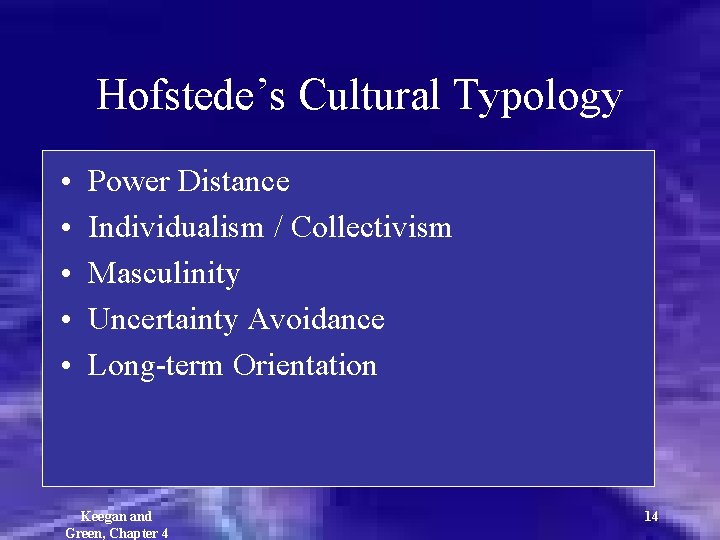
Hofstede’s Cultural Typology • • • Power Distance Individualism / Collectivism Masculinity Uncertainty Avoidance Long-term Orientation Keegan and Green, Chapter 4 14
- Slides: 14