
Social and Behavior Change Communication SBCC for addressing
Social and Behavior Change Communication (SBCC) for addressing Sexual Reproductive Health (SRH) issues: The experience of the Integrated Family Health Program (IFHP) in Ethiopia Solomon Abebe(BA, MA), Mengistu Asnake (MD, MPH)
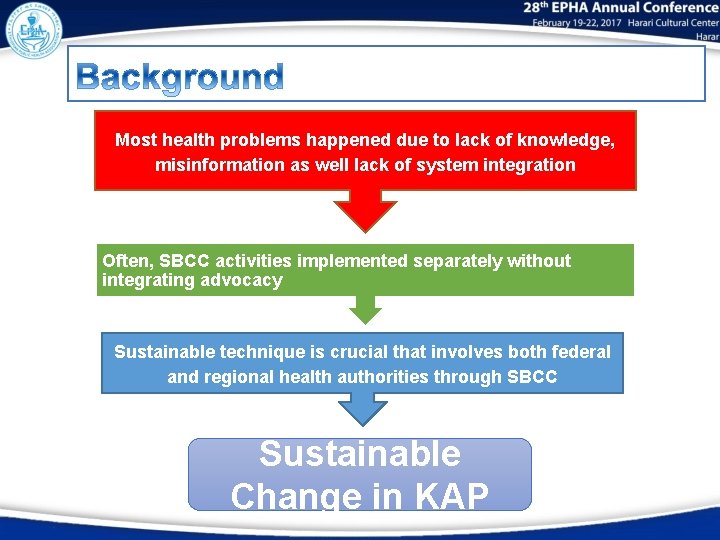
Most health problems happened due to lack of knowledge, • Most health problems happened of knowledge, misinformation as well due lacktooflack system integration well lack of system integration Most health problems happened due to lack of knowledge, misinformation as well lack of system integration • separately without Often, SBCC activities implemented integrating advocacy Sustainable technique is crucial that involves both federal and regional health authorities through SBCC Sustainable Change in KAP
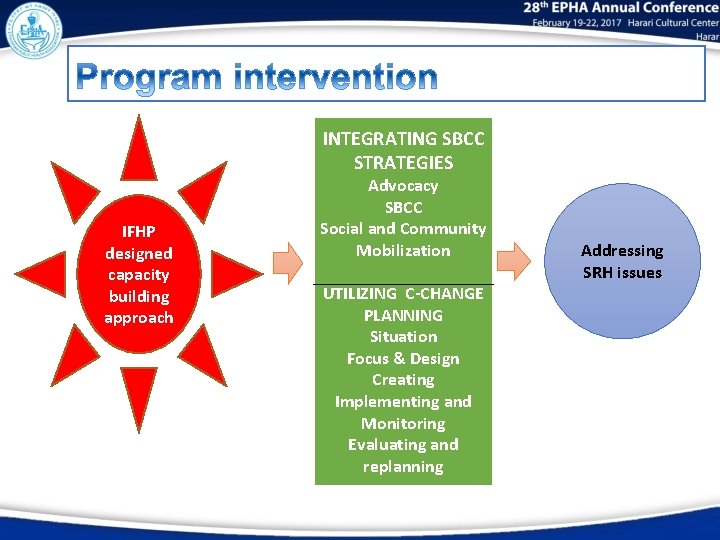
INTEGRATING SBCC STRATEGIES IFHP designed capacity building approach Advocacy SBCC Social and Community Mobilization UTILIZING C-CHANGE PLANNING Situation Focus & Design Creating Implementing and Monitoring Evaluating and replanning Addressing SRH issues
• IFHP in consultation with the FMOH and RHB reached a consensus to conduct a series of training in its intervention areas focusing on integrating SBCC with advocacy for senior communication managers and experts working at the regional and zonal level of Amhara, Oromia, Tigray and SNNP regional states • IFHP targeted regional levels decision makers to get support for implementing SBCC for addressing Sexual Reproductive Health (SRH) issues
• In collaboration with FMOH and RHB training participants were identified and a training package was developed and tested to make the training specific and impactful • The training focused on understanding the SRH situation in Ethiopia, focusing and designing SRH issues, creating SRH communication strategies and audience friendly materials, implementing SRH activities and monitoring, evaluating impacts of SRH intervention and re-planning • The training package contains the training program, copy of the presentations, discussion points, reference materials, and pre and post evaluation forms
• A total of 200 communication managers and experts were trained • In addition they have acquired intensive skills and knowledge on benefit of socio ecological model. • After the training IFHP conducted a series of follow-up supportive supervision visits
• To understand the impact of the training IFHP collected RHB reports and conducted key informant interview with head of RHB and program implementers at the grass root level • Purposeful sampling was employed to select Interviewees. • Before the interview, interview guidelines were prepared and reviewed by IFHP senior program advisors and government program coordinators. • Accordingly, IFHP conducted a content analysis on reports and interview results
• After the training, regions have started to give due attention on implementing SBCC activities for addressing SRH issues • All trained health communicators started to utilize SBCC tool. • Most of health communicators are using socioecological model as an important role in guiding the SRH intervention process. • All communicators affirmed that currently they are using SBCC in a way that help people to weigh up the benefits and barriers of change and expect positive outcomes from new behaviors, build skills and confidence, create a supportive environment for change, Increase access to services and modeling. • Furthermore, regional health communication heads cascaded SBCC training at zonal and woreda level.

• Using SBCC is crucial in bringing a relatively sustainable change. • Bundling and integrating SBCC strategies may help to promote health equity and address the needs of individuals and communities in a more holistic, influential, and cost-effective way.

- Slides: 10