
SOC 3322 a INTERVIEWING What is interviewing why
- Slides: 14
SOC 3322 a INTERVIEWING
What is interviewing, why do it? • In qualitative research, interviewing, especially in -depth & open-ended, is a common and preferred method. • In general, the goal of an interview is to explore the participant’s point of view, feelings, everyday experiences as interpreted by him/herself. • Unlike regular conversation, interviewing has a specific purpose: to gather important and relevant information to analyze.
Standardized Interviews • • Also called structured, formal interviews. Very formally structured. No deviation from established order allowed. Exact wordings to be followed. Can’t ask for any clarification, elaboration. Interviewee can’t ask any questions. Can’t add questions. Assumption that researcher knows the topic well, knows what information needed and there is shared meanings about topic, event, concepts.
In Depth or Unstandardized Interviews • • • Also known as open-ended, informal, unstructured. No list of pre-determined questions. No set order, wording can change. Interviewee can ask questions, clarification. No assumption that researcher knows what exact information needed; questions are formulated during process of interview, adapting to what is said. • Very flexible, allows for interviewee to guide, direct interview.
In Depth (cont. ) n n n Goal is to seek understanding and interpretation. Use of a conversational style – your primary role is that of an active listener. Record what is said and record your feelings about what you learned throughout the interview.
Semistandardized interviews • Also known as semistructured. • Some structure but questions can be reordered during interview and/or wording changed. • Can add, delete questions, ask for elaboration, clarification. • This type of interview usually has a set of preestablished themes, guidelines, set of questions, but researcher not strictly bound to it. • Each interview different so must adapt depending on situation, but have in front of you something to go on to guide you and focus you.
Interview Schedule • If using standardized method, then you must have formulated ahead of time a list of all questions to ask in exact wording, order. • If using semistandardized, you will prepare a list of questions, themes that you anticipate to focus on, but list does not have to be as definite and specific. • Unstandardized – may have list of themes, but interviewee guides interview • A schedule allows you to think ahead of time carefully about the topic, to know what is that you want to get from interview.
Developing Schedule • Time consuming, so prepare well ahead of time! • Have a clear idea of information you might need. Even when doing unstandardized, you must have some themes to guide you: “what is about this person, and her experience with relation to the research that I need to know more about? ” • Need demographic questions. • A list of questions that relate very directly to topic. • Some questions that loosely relate. • Some questions worded slightly differently. • Throw-away questions and probes.
Different roles of the interviewer • Interviews are not typical conversations and you have a role to adopt • Equal relationships are not totally possible. • Must establish good rapport and trust. • Roles: – Actor • Recite scripted lines (interview questions), remain nonjudgmental – Director • Perform lines and assess the performance – Choreographer • Control the interview process
Repertoire Techniques n Uncomfortable Silence ¨ Create a long silent pause after a question n Echoing ¨ “that happened to me too, “ or “I know what you mean” n Letting People Talk ¨ Avoid unintentional interruptions Copyright © Allyn & Bacon 2010
Questions to avoid: • Affectively worded ones: avoid inducing negative emotional response. Make questions as neutral as possible. • Avoid asking “why? ” directly. • Double-barrelled questions: only 1 issue, topic per question. • Overly complex questions. Try to speak at same level, be clear, know the cultural background of the person to ensure you don’t offend • Do some prior study of the group, be culturally sensitive and respectful of traditions and culture
Using a Dramaturgical Approach n Building Rapport ¨Establish common ground ¨Appearance and demeanor n Social Interpretations ¨Nonverbal channels: body gestures, signs, phonemic sounds Copyright © Allyn & Bacon 2010
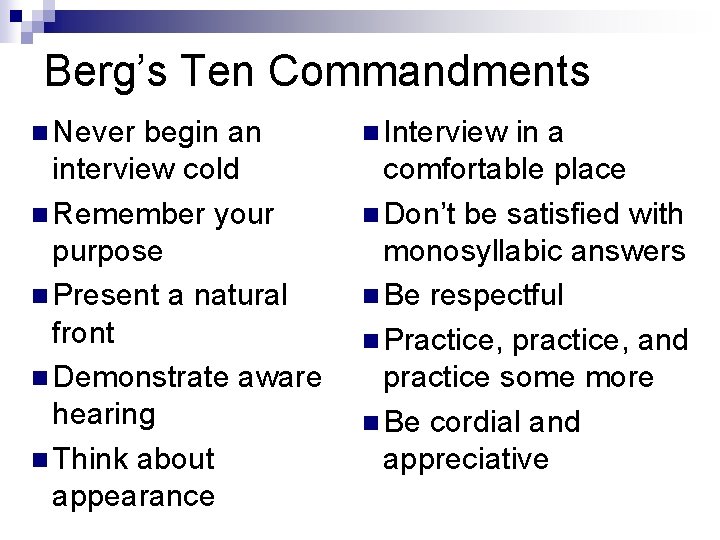
Berg’s Ten Commandments n Never begin an interview cold n Remember your purpose n Present a natural front n Demonstrate aware hearing n Think about appearance n Interview in a comfortable place n Don’t be satisfied with monosyllabic answers n Be respectful n Practice, practice, and practice some more n Be cordial and appreciative Copyright © Allyn & Bacon 2010
Practice: • In groups of 3 people, prepare a brief interview schedule, for a standardized interview and one for a semistandardized interview. Prepare a list of themes for an unstandardized interview. • Topic of interview: vegetarianism. • Give each group member one of the schedules and choose someone from another group to interview. • Record the answers and your reflections. • Now get back with your original group and compare the responses you received. Discuss the differences, similarities, and quality and quantity of information that was gathered. Report your “findings” to the class.