
Soaps and Biodiesel and C A L O
Soaps, and Biodiesel and C. A L. O. -know some uses of esters, including natural esters, soaps and biodiesel -recognise carboxylic acids as weak acids and know their reaction with carbonates - know the esterification reaction and the hydrolysis reaction, recognise these as equilibria and determine appropriate conditions using equilibrium considerations - know some uses of esters, including natural esters, soaps and biodiesel - recognise acid chlorides and acid anhydrides - know their reactions and understand their importance in organic synthesis - recognise acylation and its uses - know and be able to use the mechanism of acylation reactions - understand the role of acylation in the manufacture of aspirin
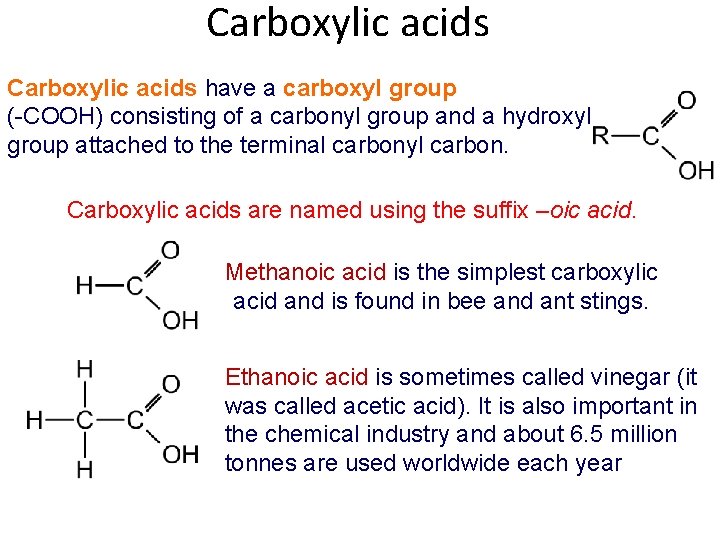
Carboxylic acids have a carboxyl group (-COOH) consisting of a carbonyl group and a hydroxyl group attached to the terminal carbonyl carbon. Carboxylic acids are named using the suffix –oic acid. Methanoic acid is the simplest carboxylic acid and is found in bee and ant stings. Ethanoic acid is sometimes called vinegar (it was called acetic acid). It is also important in the chemical industry and about 6. 5 million tonnes are used worldwide each year
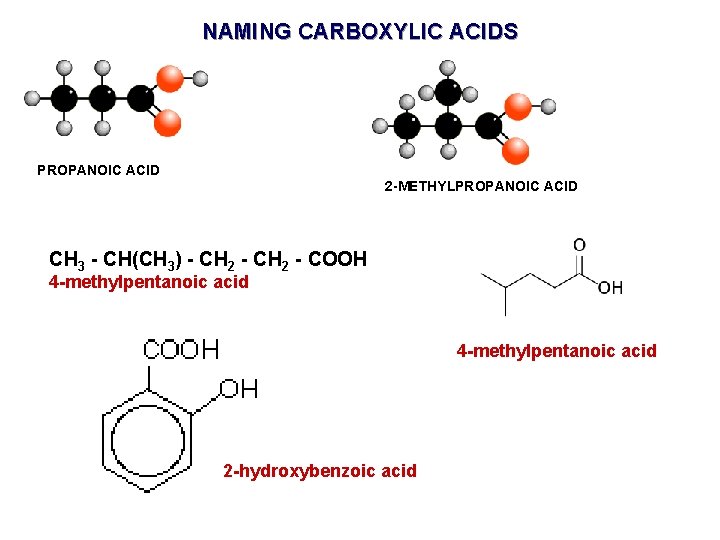
NAMING CARBOXYLIC ACIDS PROPANOIC ACID 2 -METHYLPROPANOIC ACID CH 3 - CH(CH 3) - CH 2 - COOH 4 -methylpentanoic acid 2 -hydroxybenzoic acid
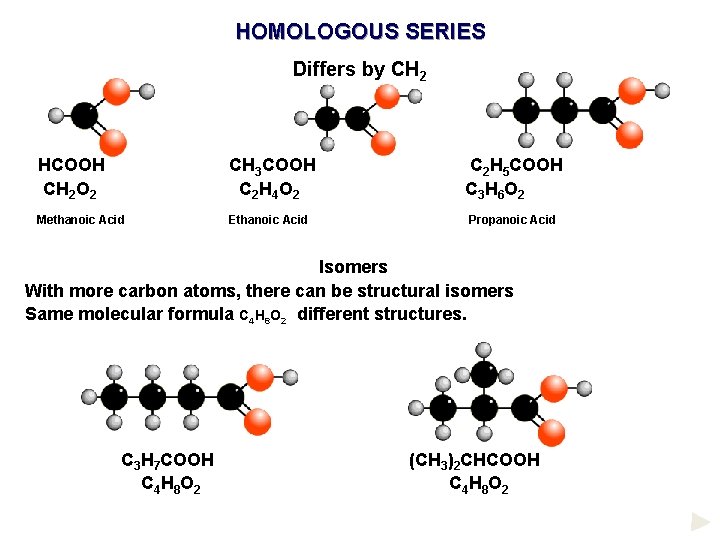
HOMOLOGOUS SERIES Differs by CH 2 HCOOH CH 2 O 2 CH 3 COOH C 2 H 4 O 2 Methanoic Acid Ethanoic Acid C 2 H 5 COOH C 3 H 6 O 2 Propanoic Acid Isomers With more carbon atoms, there can be structural isomers Same molecular formula C 4 H 8 O 2 different structures. C 3 H 7 COOH C 4 H 8 O 2 (CH 3)2 CHCOOH C 4 H 8 O 2
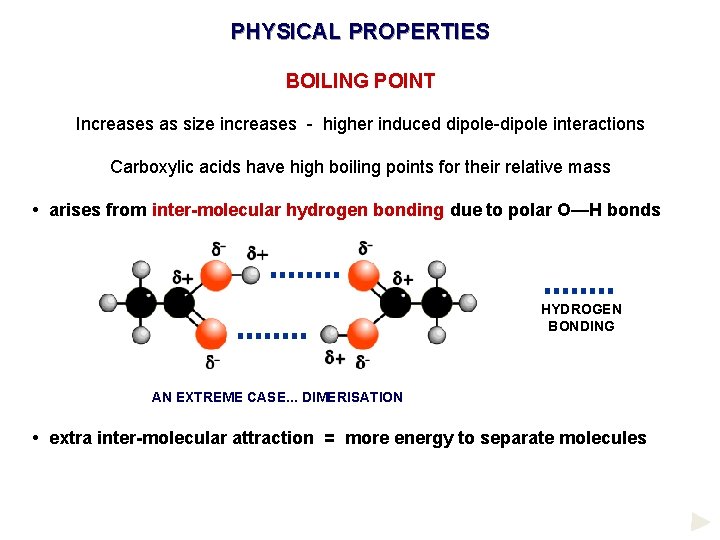
PHYSICAL PROPERTIES BOILING POINT Increases as size increases - higher induced dipole-dipole interactions Carboxylic acids have high boiling points for their relative mass • arises from inter-molecular hydrogen bonding due to polar O—H bonds HYDROGEN BONDING AN EXTREME CASE. . . DIMERISATION • extra inter-molecular attraction = more energy to separate molecules
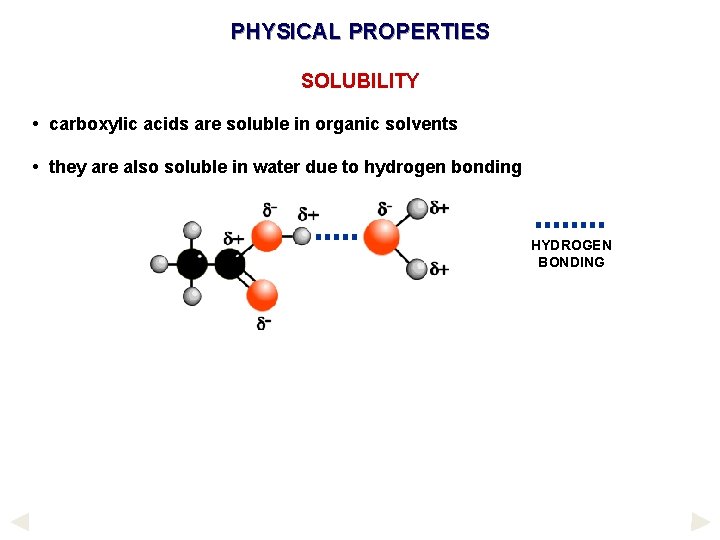
PHYSICAL PROPERTIES SOLUBILITY • carboxylic acids are soluble in organic solvents • they are also soluble in water due to hydrogen bonding HYDROGEN BONDING
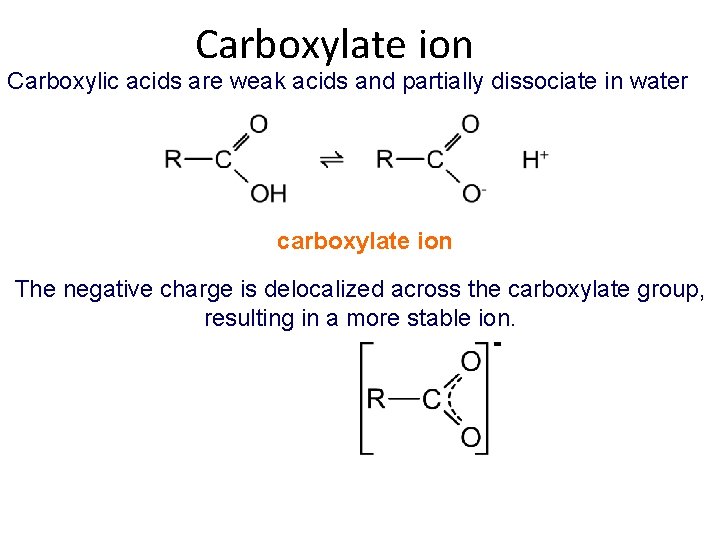
Carboxylate ion Carboxylic acids are weak acids and partially dissociate in water carboxylate ion The negative charge is delocalized across the carboxylate group, resulting in a more stable ion.
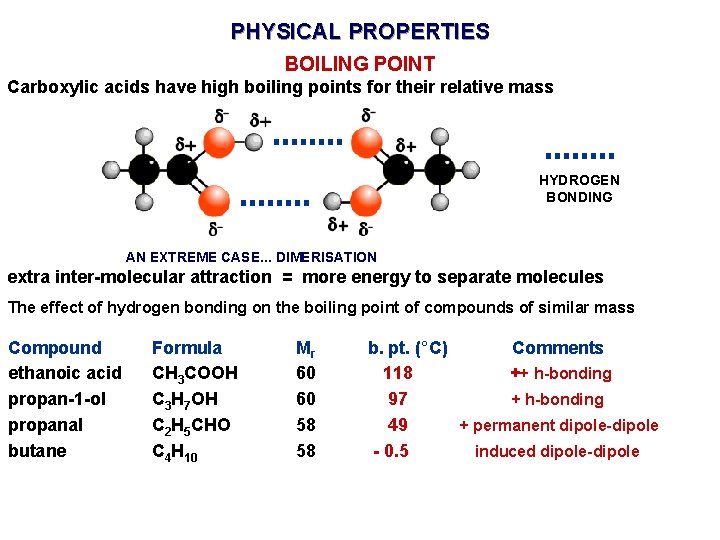
PHYSICAL PROPERTIES BOILING POINT Carboxylic acids have high boiling points for their relative mass HYDROGEN BONDING AN EXTREME CASE. . . DIMERISATION extra inter-molecular attraction = more energy to separate molecules The effect of hydrogen bonding on the boiling point of compounds of similar mass Compound ethanoic acid propan-1 -ol propanal butane Formula CH 3 COOH C 3 H 7 OH C 2 H 5 CHO C 4 H 10 Mr 60 60 58 58 b. pt. (°C) Comments 118 ++ h-bonding 97 + h-bonding 49 + permanent dipole-dipole - 0. 5 induced dipole-dipole
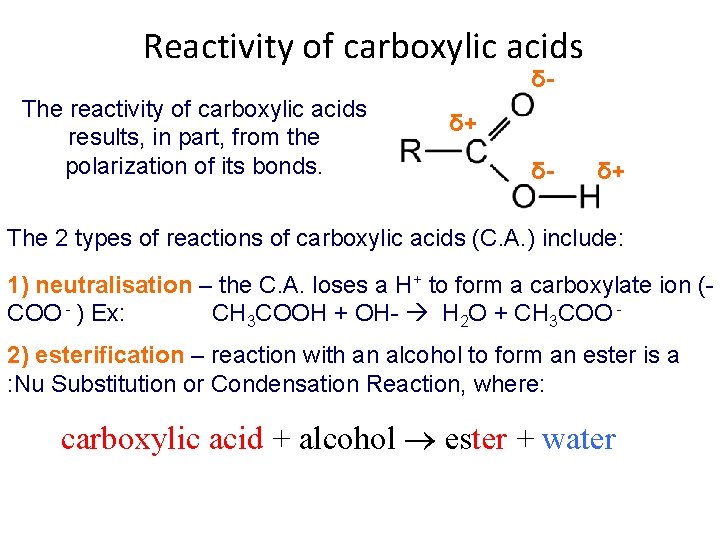
Reactivity of carboxylic acids δ- The reactivity of carboxylic acids results, in part, from the polarization of its bonds. δ+ δ- δ+ The 2 types of reactions of carboxylic acids (C. A. ) include: 1) neutralisation – the C. A. loses a H+ to form a carboxylate ion (COO - ) Ex: CH 3 COOH + OH- H 2 O + CH 3 COO 2) esterification – reaction with an alcohol to form an ester is a : Nu Substitution or Condensation Reaction, where: carboxylic acid + alcohol ester + water
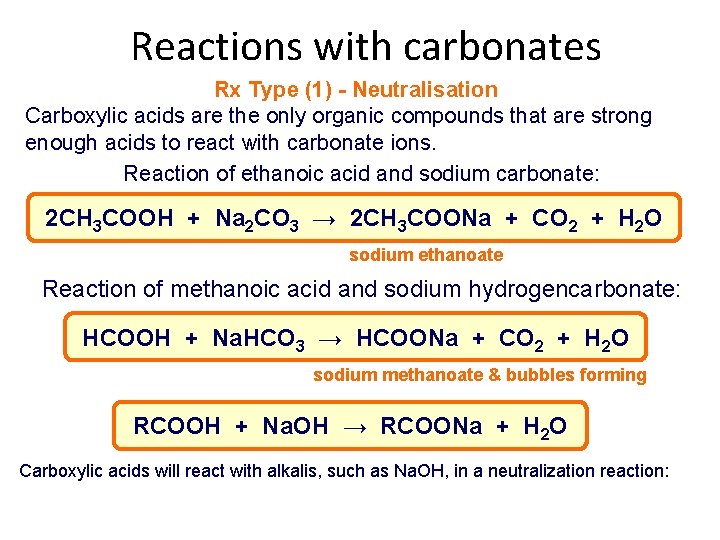
Reactions with carbonates Rx Type (1) - Neutralisation Carboxylic acids are the only organic compounds that are strong enough acids to react with carbonate ions. Reaction of ethanoic acid and sodium carbonate: 2 CH 3 COOH + Na 2 CO 3 → 2 CH 3 COONa + CO 2 + H 2 O sodium ethanoate Reaction of methanoic acid and sodium hydrogencarbonate: HCOOH + Na. HCO 3 → HCOONa + CO 2 + H 2 O sodium methanoate & bubbles forming RCOOH + Na. OH → RCOONa + H 2 O Carboxylic acids will react with alkalis, such as Na. OH, in a neutralization reaction:
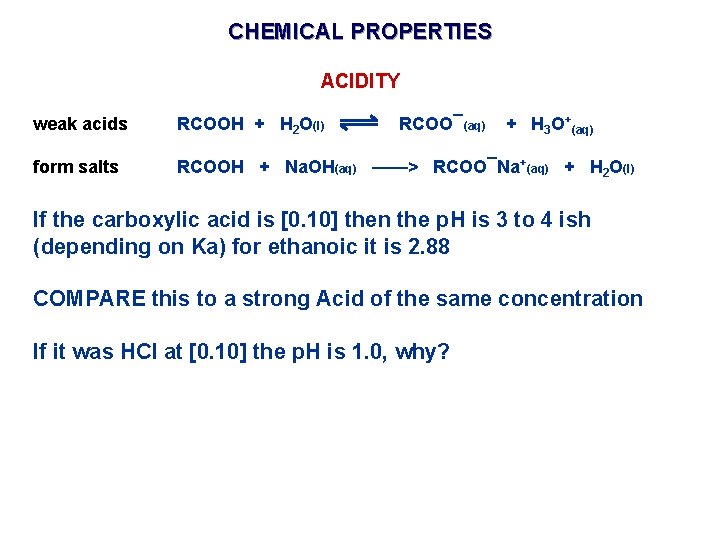
CHEMICAL PROPERTIES ACIDITY weak acids RCOOH + H 2 O(l) RCOO¯(aq) + H 3 O+(aq) form salts RCOOH + Na. OH(aq) ——> RCOO¯Na+(aq) + H 2 O(l) If the carboxylic acid is [0. 10] then the p. H is 3 to 4 ish (depending on Ka) for ethanoic it is 2. 88 COMPARE this to a strong Acid of the same concentration If it was HCl at [0. 10] the p. H is 1. 0, why?
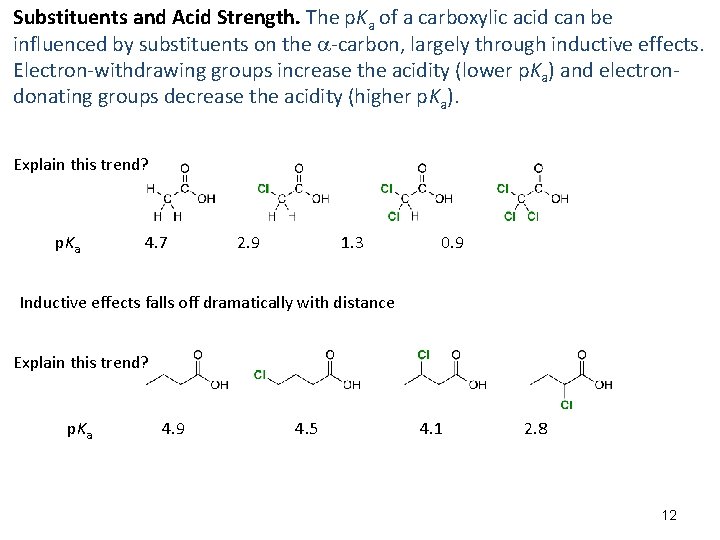
Substituents and Acid Strength. The p. Ka of a carboxylic acid can be influenced by substituents on the -carbon, largely through inductive effects. Electron-withdrawing groups increase the acidity (lower p. Ka) and electrondonating groups decrease the acidity (higher p. Ka). Explain this trend? p. Ka 4. 7 2. 9 1. 3 0. 9 Inductive effects falls off dramatically with distance Explain this trend? p. Ka 4. 9 4. 5 4. 1 2. 8 12
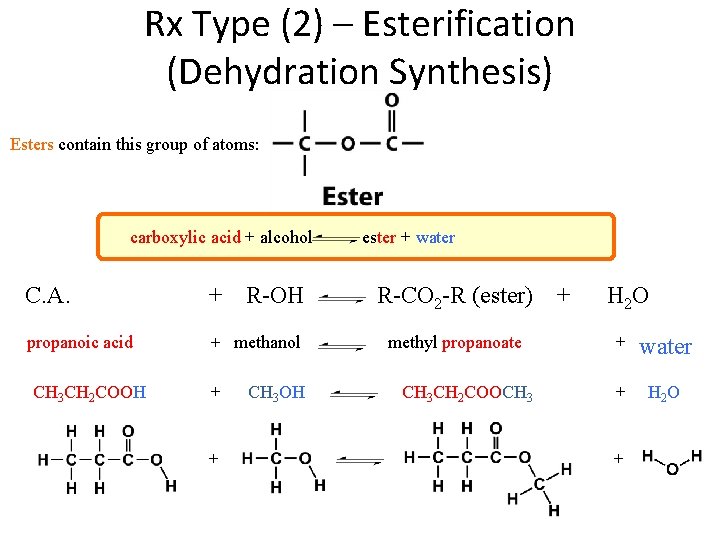
Rx Type (2) – Esterification (Dehydration Synthesis) Esters contain this group of atoms: carboxylic acid + alcohol ester + water C. A. + R-OH R-CO 2 -R (ester) + H 2 O propanoic acid CH 3 CH 2 COOH + methanol + + CH 3 OH methyl propanoate CH 3 CH 2 COOCH 3 + water + H 2 O +
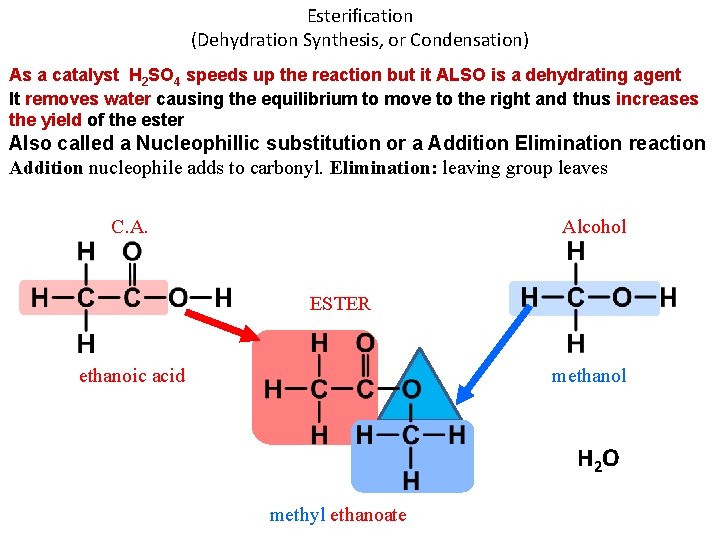
Esterification (Dehydration Synthesis, or Condensation) As a catalyst H 2 SO 4 speeds up the reaction but it ALSO is a dehydrating agent It removes water causing the equilibrium to move to the right and thus increases the yield of the ester Also called a Nucleophillic substitution or a Addition Elimination reaction Addition nucleophile adds to carbonyl. Elimination: leaving group leaves C. A. Alcohol ESTER ethanoic acid methanol H 2 O methyl ethanoate
: Nu Substitution or Addition Elimination or Condensation? A condensation reaction is one in which two molecules join together to make a bigger one, and in the process shed a little molecule. Since the initial attack is by a nucleophile, and the overall result is substitution, it would seem reasonable to describe the reaction as nucleophilic substitution. However, the reaction happens in two distinct stages. The first involves an addition reaction, which is followed by an elimination reaction where HCl is produced. So the mechanism is also known as nucleophilic addition / elimination So it is ALL 3 things : 1) A Condensation reaction (water is lost) 2) An Esterification reaction (ester made) 3) A : Nu addition elimination reaction
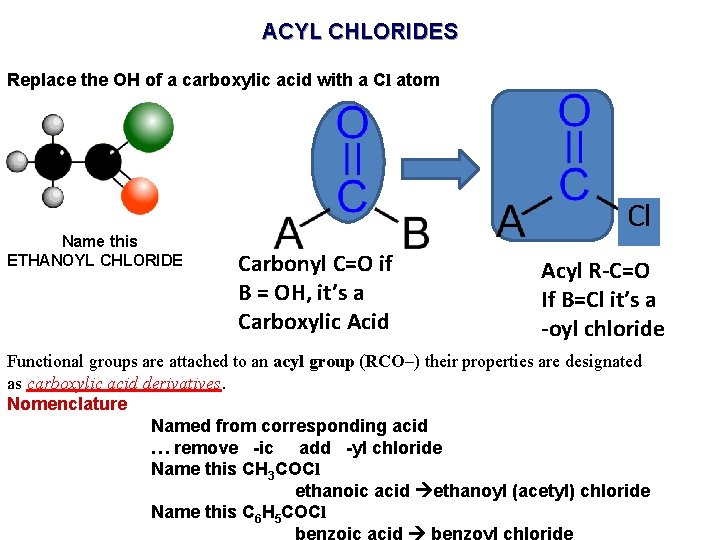
ACYL CHLORIDES Replace the OH of a carboxylic acid with a Cl atom Name this ETHANOYL CHLORIDE Cl Carbonyl C=O if B = OH, it’s a Carboxylic Acid Acyl R-C=O If B=Cl it’s a -oyl chloride Functional groups are attached to an acyl group (RCO–) their properties are designated as carboxylic acid derivatives. Nomenclature Named from corresponding acid … remove -ic add -yl chloride Name this CH 3 COCl ethanoic acid ethanoyl (acetyl) chloride Name this C 6 H 5 COCl
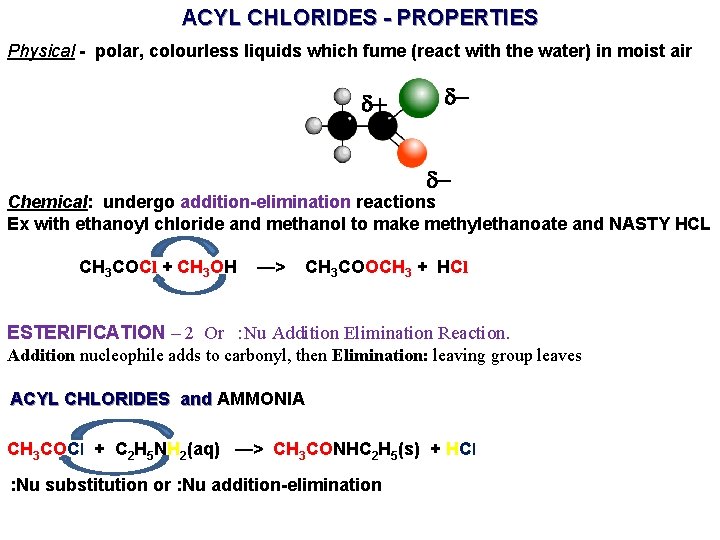
ACYL CHLORIDES - PROPERTIES Physical - polar, colourless liquids which fume (react with the water) in moist air d+ dd- Chemical: undergo addition-elimination reactions Ex with ethanoyl chloride and methanol to make methylethanoate and NASTY HCL CH 3 COCl + CH 3 OH —> CH 3 COOCH 3 + HCl ESTERIFICATION – 2 Or : Nu Addition Elimination Reaction. Addition nucleophile adds to carbonyl, then Elimination: leaving group leaves ACYL CHLORIDES and AMMONIA CH 3 COCl + C 2 H 5 NH 2(aq) —> CH 3 CONHC 2 H 5(s) + HCl : Nu substitution or : Nu addition-elimination
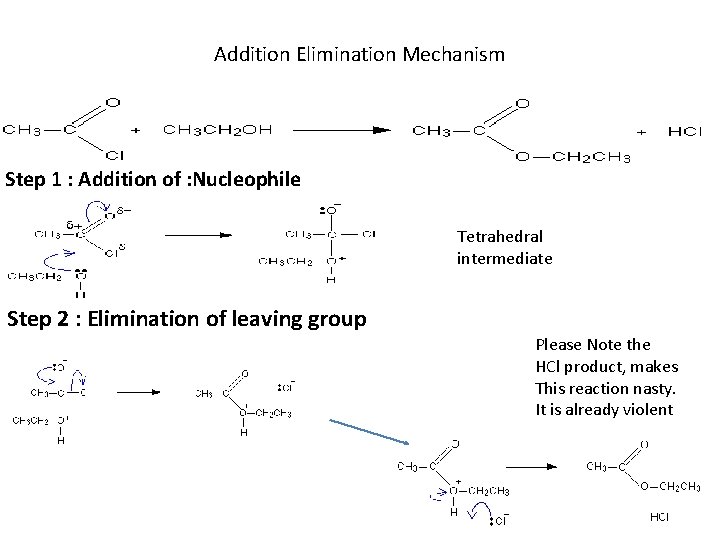
Addition Elimination Mechanism Step 1 : Addition of : Nucleophile Tetrahedral intermediate Step 2 : Elimination of leaving group Please Note the HCl product, makes This reaction nasty. It is already violent
Acyl Chloride reaction (5 min) https: //www. youtube. com/watch? v=Csaczjeoblc
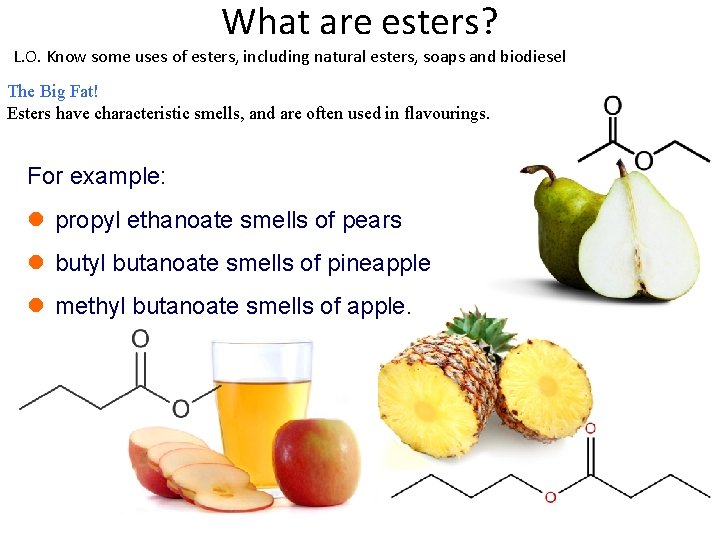
What are esters? L. O. Know some uses of esters, including natural esters, soaps and biodiesel The Big Fat! Esters have characteristic smells, and are often used in flavourings. For example: l propyl ethanoate smells of pears l butyl butanoate smells of pineapple l methyl butanoate smells of apple.
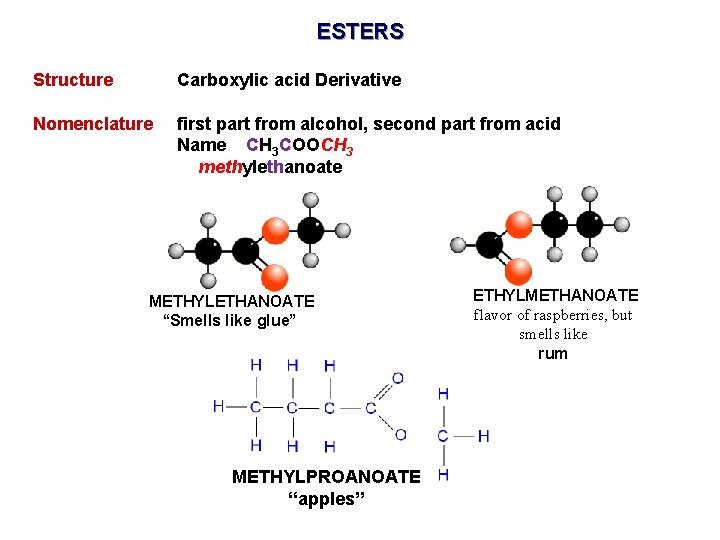
ESTERS Structure Carboxylic acid Derivative Nomenclature first part from alcohol, second part from acid Name CH 3 COOCH 3 methylethanoate METHYLETHANOATE “Smells like glue” METHYLPROANOATE “apples” ETHYLMETHANOATE flavor of raspberries, but smells like rum
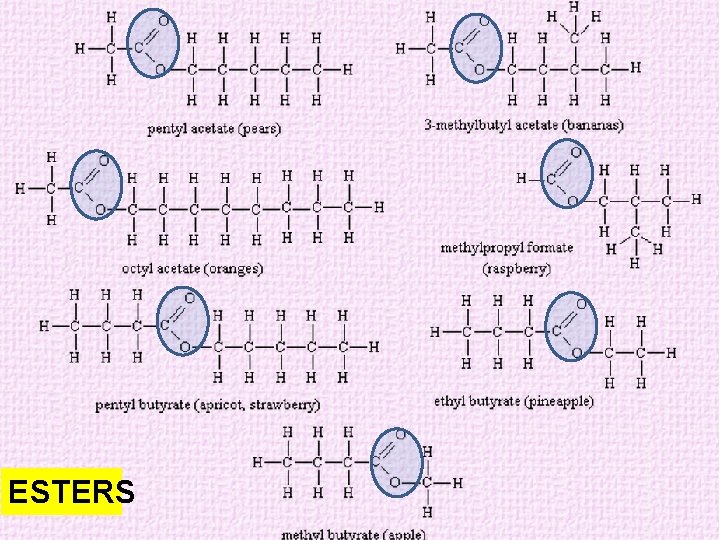
ESTERS
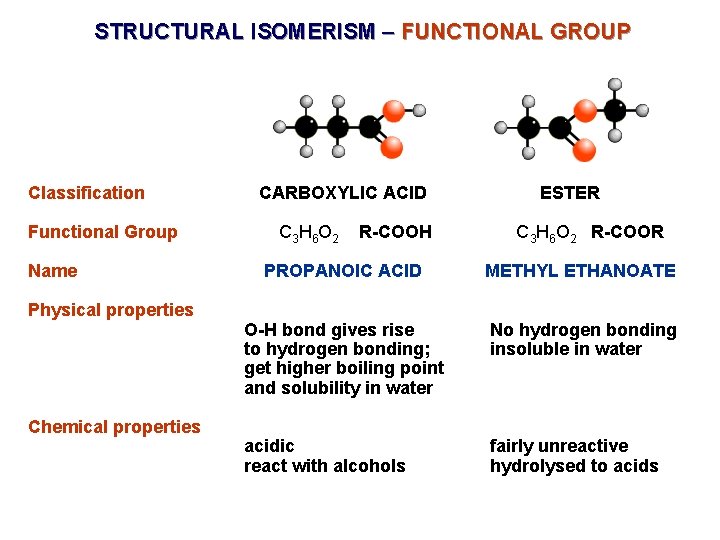
STRUCTURAL ISOMERISM – FUNCTIONAL GROUP Classification Functional Group Name Physical properties Chemical properties CARBOXYLIC ACID C 3 H 6 O 2 R-COOH ESTER C 3 H 6 O 2 R-COOR PROPANOIC ACID METHYL ETHANOATE O-H bond gives rise to hydrogen bonding; get higher boiling point and solubility in water No hydrogen bonding insoluble in water acidic react with alcohols fairly unreactive hydrolysed to acids
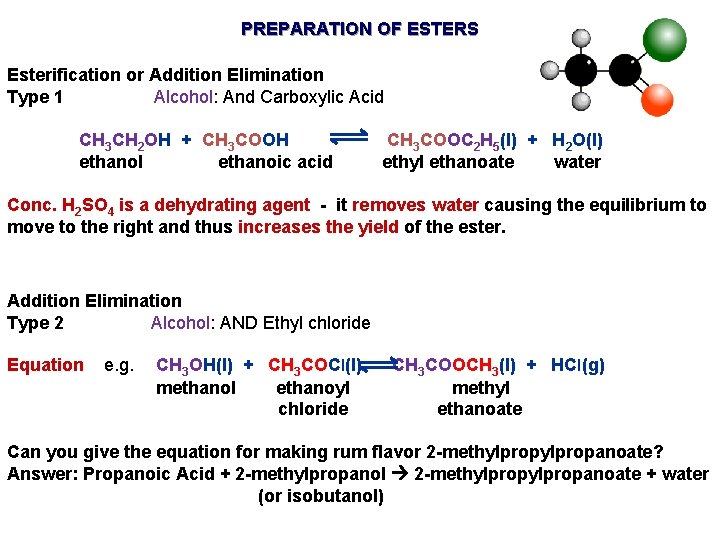
PREPARATION OF ESTERS Esterification or Addition Elimination Type 1 Alcohol: And Carboxylic Acid CH 3 CH 2 OH + CH 3 COOH ethanol ethanoic acid CH 3 COOC 2 H 5(l) + H 2 O(l) ethyl ethanoate water Conc. H 2 SO 4 is a dehydrating agent - it removes water causing the equilibrium to move to the right and thus increases the yield of the ester. Addition Elimination Type 2 Alcohol: AND Ethyl chloride Equation e. g. CH 3 OH(l) + CH 3 COCl(l) methanol ethanoyl chloride CH 3 COOCH 3(l) + HCl(g) methyl ethanoate Can you give the equation for making rum flavor 2 -methylpropanoate? Answer: Propanoic Acid + 2 -methylpropanol 2 -methylpropanoate + water (or isobutanol)
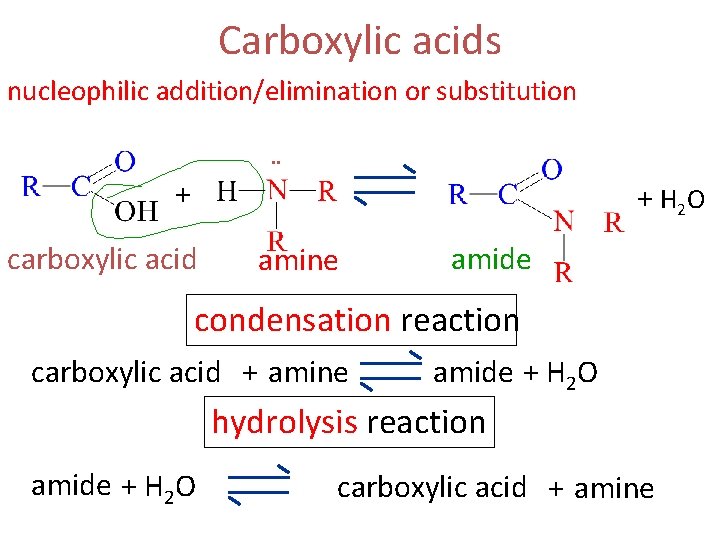
Carboxylic acids nucleophilic addition/elimination or substitution. . + + H 2 O carboxylic acid amine amide condensation reaction carboxylic acid + amine amide + H 2 O hydrolysis reaction amide + H 2 O carboxylic acid + amine
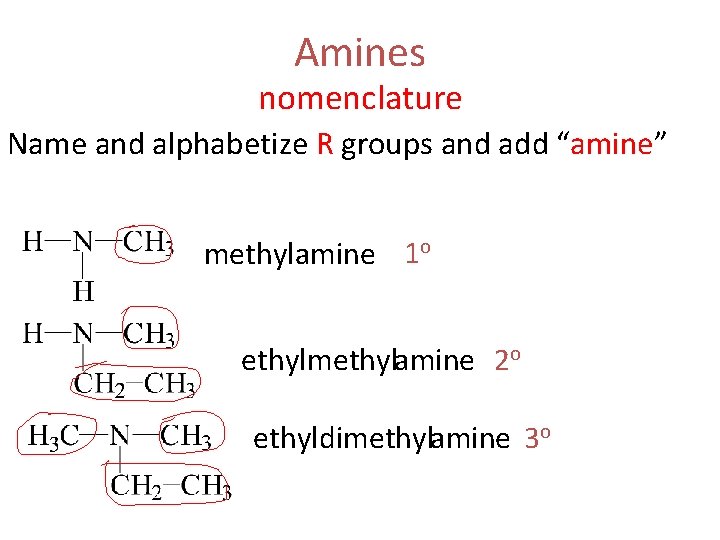
Amines nomenclature Name and alphabetize R groups and add “amine” methylamine 1 o ethylmethylamine 2 o ethyldimethylamine 3 o
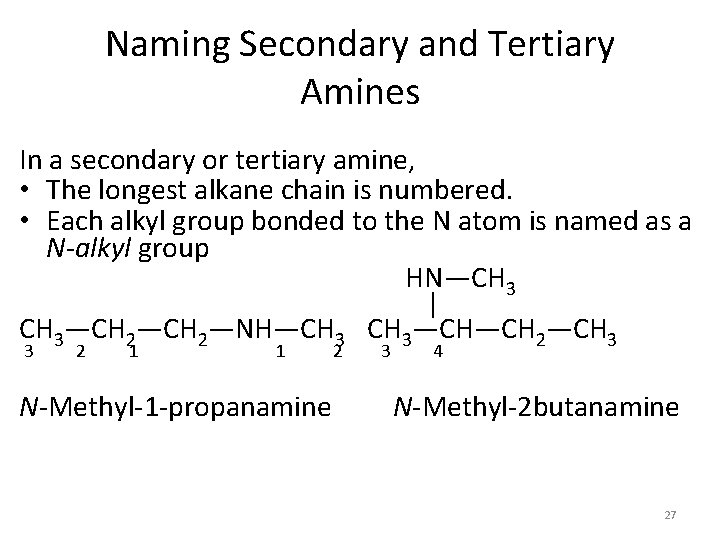
Naming Secondary and Tertiary Amines In a secondary or tertiary amine, • The longest alkane chain is numbered. • Each alkyl group bonded to the N atom is named as a N-alkyl group HN—CH 3 | CH 3—CH 2—NH—CH 3—CH—CH 2—CH 3 3 2 1 1 N-Methyl-1 -propanamine 2 3 4 N-Methyl-2 butanamine 27
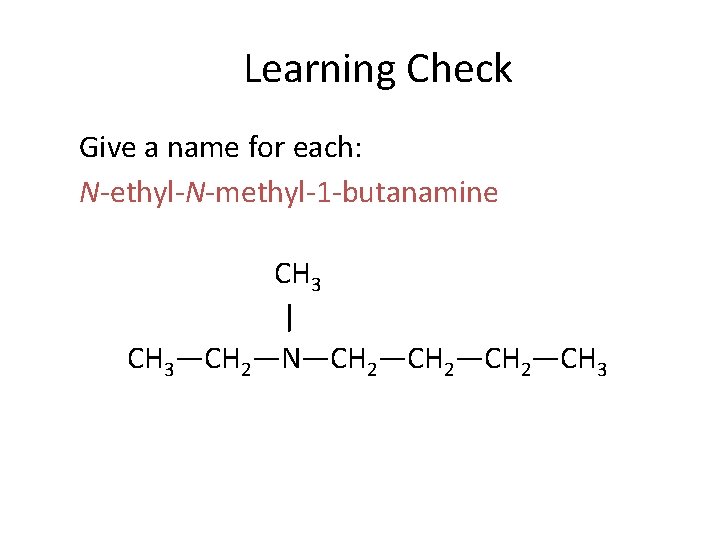
Learning Check Give a name for each: N-ethyl-N-methyl-1 -butanamine CH 3 | CH 3—CH 2—N—CH 2—CH 3
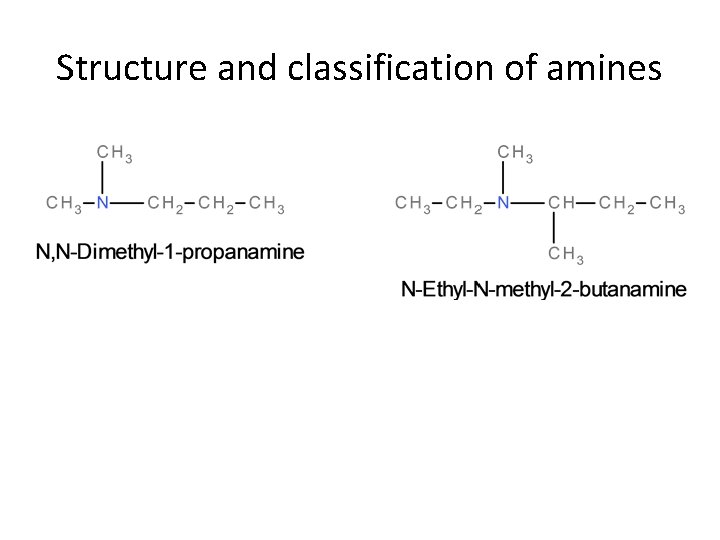
Structure and classification of amines
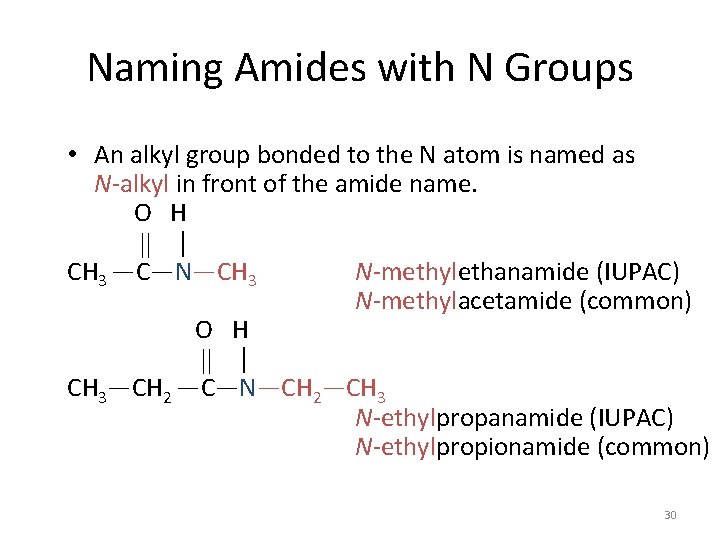
Naming Amides with N Groups • An alkyl group bonded to the N atom is named as N-alkyl in front of the amide name. O H │ CH 3 —C—N—CH 3 N-methylethanamide (IUPAC) N-methylacetamide (common) O H │ CH 3—CH 2 —C—N—CH 2—CH 3 N-ethylpropanamide (IUPAC) N-ethylpropionamide (common) 30
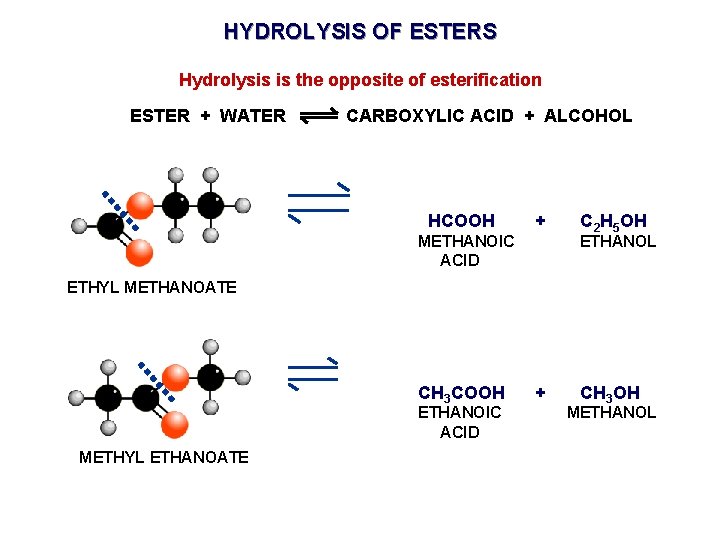
HYDROLYSIS OF ESTERS Hydrolysis is the opposite of esterification ESTER + WATER CARBOXYLIC ACID + ALCOHOL HCOOH + METHANOIC ACID C 2 H 5 OH ETHANOL ETHYL METHANOATE CH 3 COOH ETHANOIC ACID METHYL ETHANOATE + CH 3 OH METHANOL

Name A. O CH 3–CH 2–C–NH 2 OH │ B. CH 3–C–N–CH 2–CH 3 32
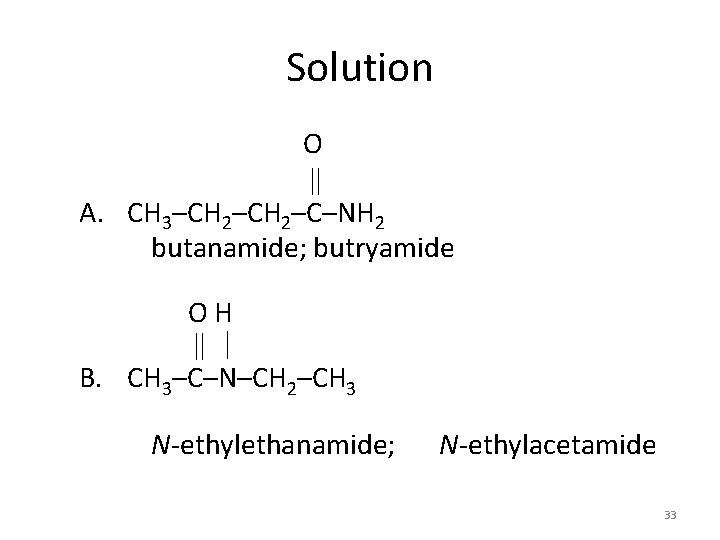
Solution O A. CH 3–CH 2–C–NH 2 butanamide; butryamide OH │ B. CH 3–C–N–CH 2–CH 3 N-ethylethanamide; N-ethylacetamide 33
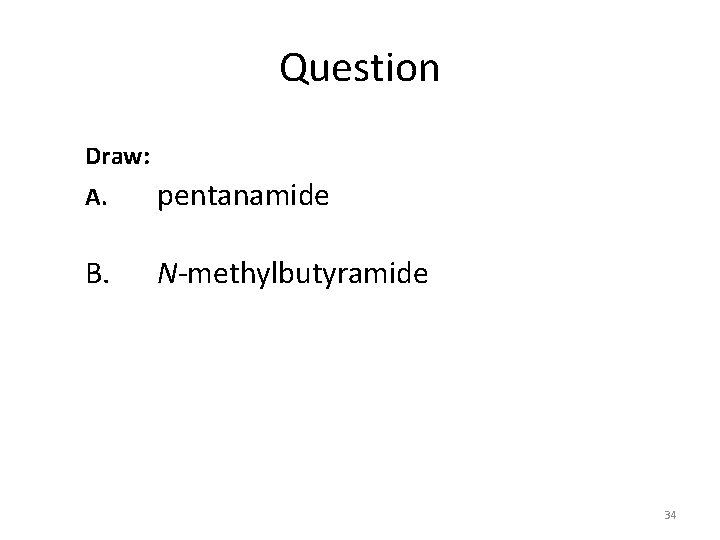
Question Draw: A. pentanamide B. N-methylbutyramide 34
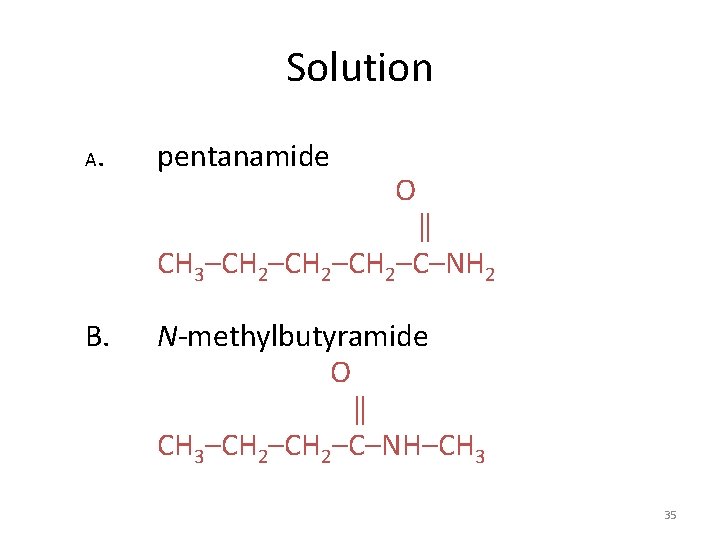
Solution A . pentanamide O CH 3–CH 2–CH 2–C–NH 2 B. N-methylbutyramide O CH 3–CH 2–C–NH–CH 3 35
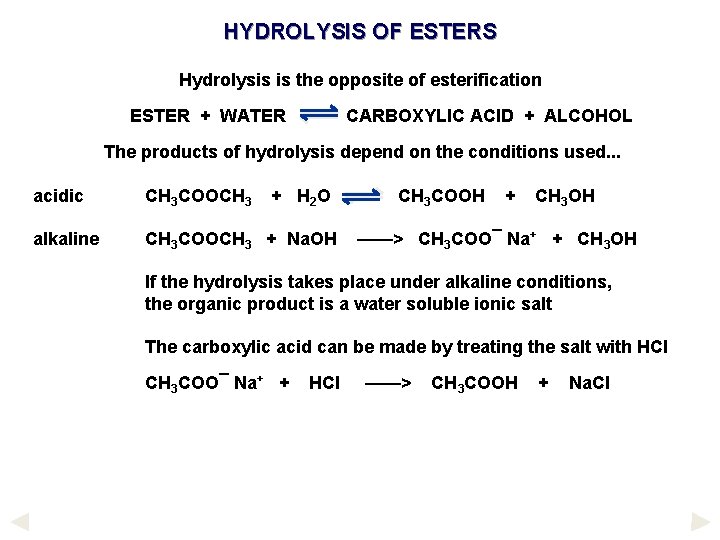
HYDROLYSIS OF ESTERS Hydrolysis is the opposite of esterification ESTER + WATER CARBOXYLIC ACID + ALCOHOL The products of hydrolysis depend on the conditions used. . . acidic CH 3 COOCH 3 + H 2 O alkaline CH 3 COOCH 3 + Na. OH CH 3 COOH + CH 3 OH ——> CH 3 COO¯ Na+ + CH 3 OH If the hydrolysis takes place under alkaline conditions, the organic product is a water soluble ionic salt The carboxylic acid can be made by treating the salt with HCl CH 3 COO¯ Na+ + HCl ——> CH 3 COOH + Na. Cl
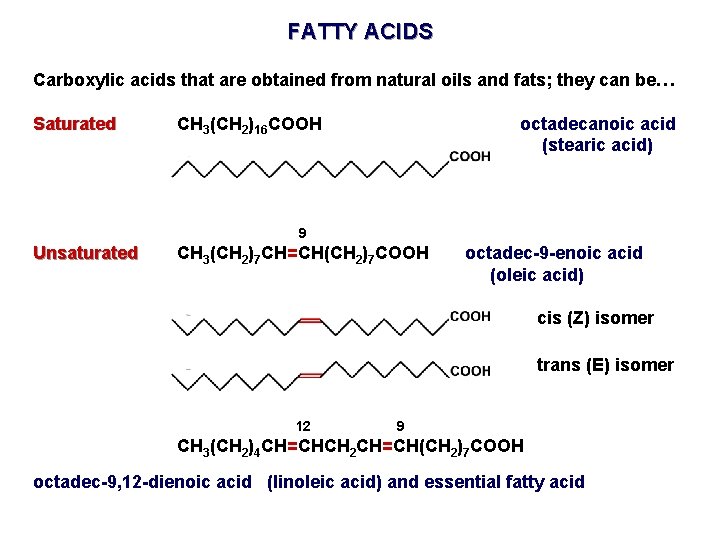
FATTY ACIDS Carboxylic acids that are obtained from natural oils and fats; they can be… Saturated CH 3(CH 2)16 COOH octadecanoic acid (stearic acid) 9 Unsaturated CH 3(CH 2)7 CH=CH(CH 2)7 COOH octadec-9 -enoic acid (oleic acid) cis (Z) isomer trans (E) isomer 12 9 CH 3(CH 2)4 CH=CHCH 2 CH=CH(CH 2)7 COOH octadec-9, 12 -dienoic acid (linoleic acid) and essential fatty acid
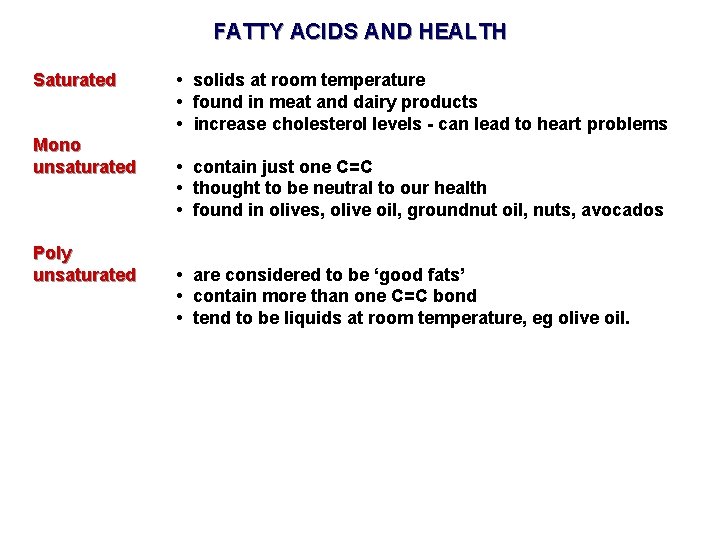
FATTY ACIDS AND HEALTH Saturated Mono unsaturated Poly unsaturated • solids at room temperature • found in meat and dairy products • increase cholesterol levels - can lead to heart problems • contain just one C=C • thought to be neutral to our health • found in olives, olive oil, groundnut oil, nuts, avocados • are considered to be ‘good fats’ • contain more than one C=C bond • tend to be liquids at room temperature, eg olive oil.
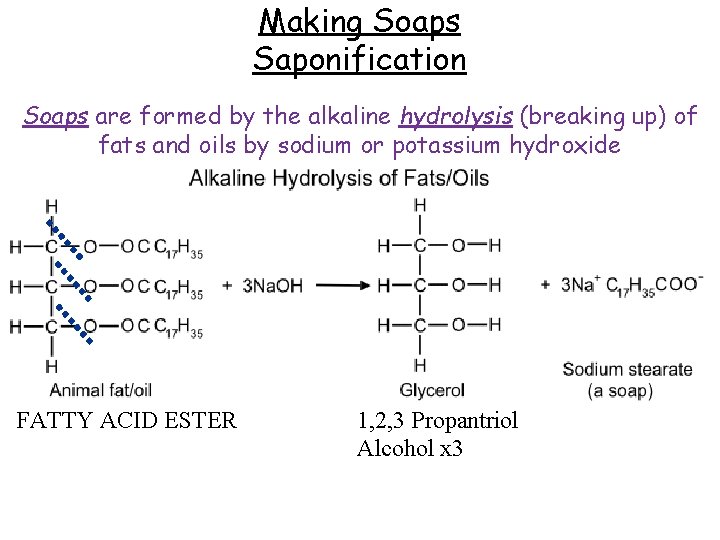
Making Soaps Saponification Soaps are formed by the alkaline hydrolysis (breaking up) of fats and oils by sodium or potassium hydroxide FATTY ACID ESTER 1, 2, 3 Propantriol Alcohol x 3
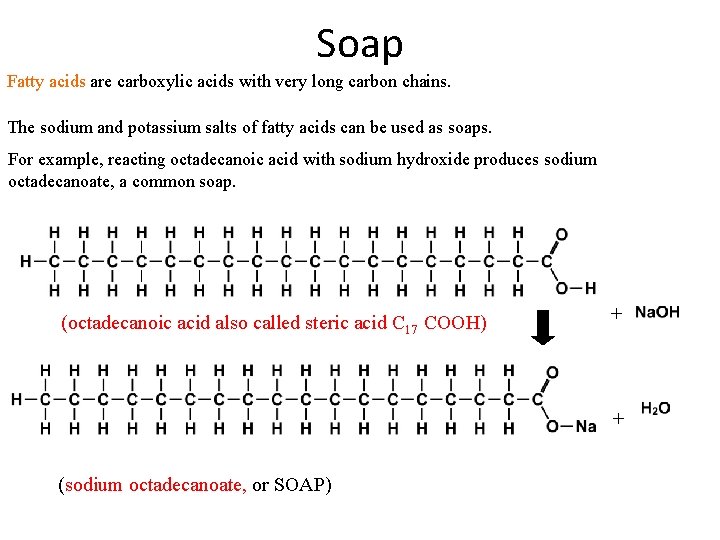
Soap Fatty acids are carboxylic acids with very long carbon chains. The sodium and potassium salts of fatty acids can be used as soaps. For example, reacting octadecanoic acid with sodium hydroxide produces sodium octadecanoate, a common soap. (octadecanoic acid also called steric acid C 17 COOH) + + (sodium octadecanoate, or SOAP)
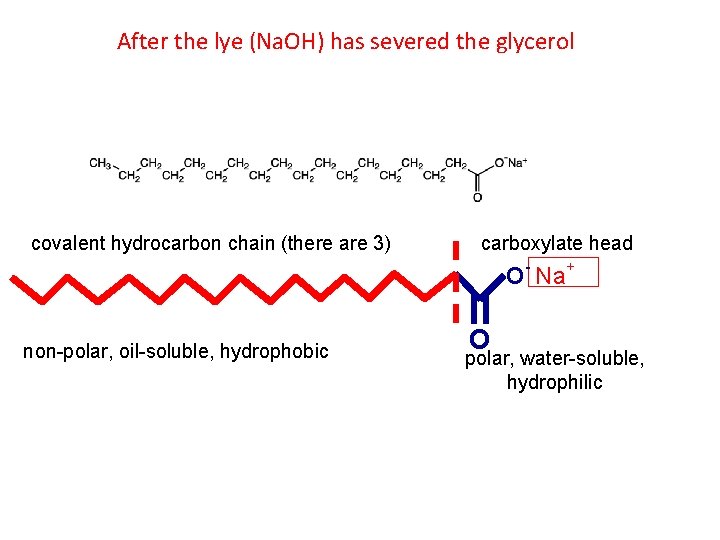
After the lye (Na. OH) has severed the glycerol covalent hydrocarbon chain (there are 3) carboxylate head O- Na+ non-polar, oil-soluble, hydrophobic O polar, water-soluble, hydrophilic
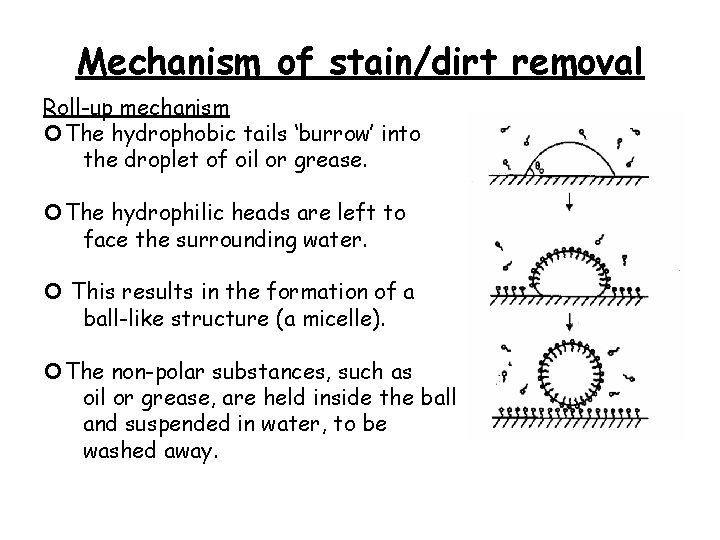
Mechanism of stain/dirt removal Roll-up mechanism The hydrophobic tails ‘burrow’ into the droplet of oil or grease. The hydrophilic heads are left to face the surrounding water. This results in the formation of a ball-like structure (a micelle). The non-polar substances, such as oil or grease, are held inside the ball and suspended in water, to be washed away.
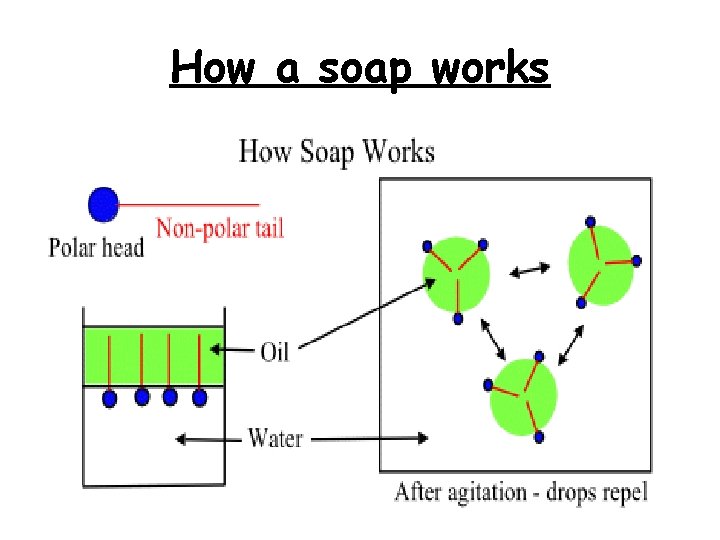
How a soap works
Soapless detergents When soap is used in hard water, a white solid precipitate we call scum forms. This is because charged calcium and magnesium ions present in the hard water react with soap to form an insoluble substance. Detergent molecules simply replace the head of the soap -COO - carboxylate group to -SO 3 - called sulphonate, it is now detergent, not soap. The calcium ions will not ppt with the -SO 3 -
Emulsions Soap for food • Ok, yuck, not a soap like in the shower soap, but it has the same ACTION • An emulsion contains small droplets of one liquid dispersed in another liquid. • Emulsions in Food – Emulsions in food are mixtures of oil and water. To prevent oil and water components separating into layers, a soap-like molecule known as an emulsifier is added.
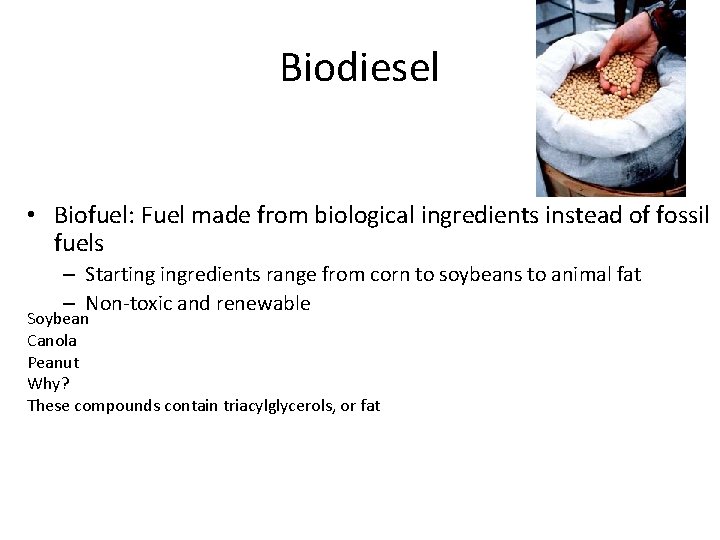
Biodiesel • Biofuel: Fuel made from biological ingredients instead of fossil fuels – Starting ingredients range from corn to soybeans to animal fat – Non-toxic and renewable Soybean Canola Peanut Why? These compounds contain triacylglycerols, or fat
Abbreviated process • Transesterification – one ester is made from another – Fat is reacted with an alcohol, usually methanol. So the glycerol is swapped with the alcohol. – Alcohol for Alcohol (swap) – Sodium or potassium hydroxide is used as a catalyst
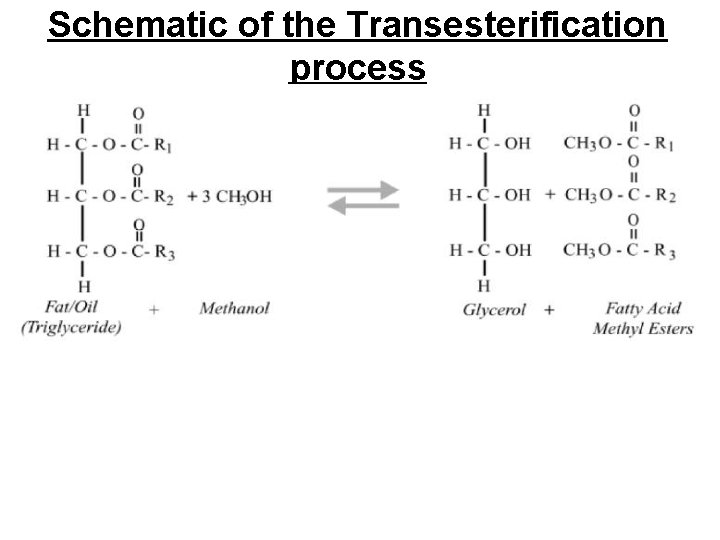
Schematic of the Transesterification process
Glycerin Uses (the By-Product of Transesterification Uses) • • Soaps Nitration: produces nitroglycerin Heart disease drug: 0. 6 mg Cosmetics
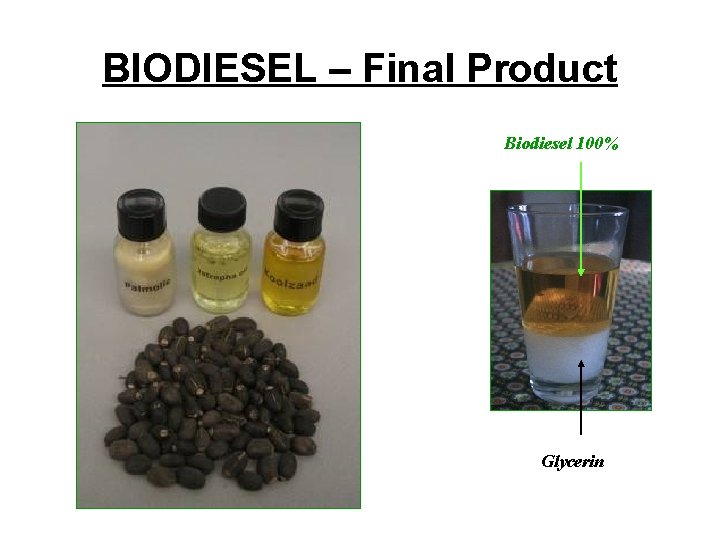
BIODIESEL – Final Product Biodiesel 100% Glycerin
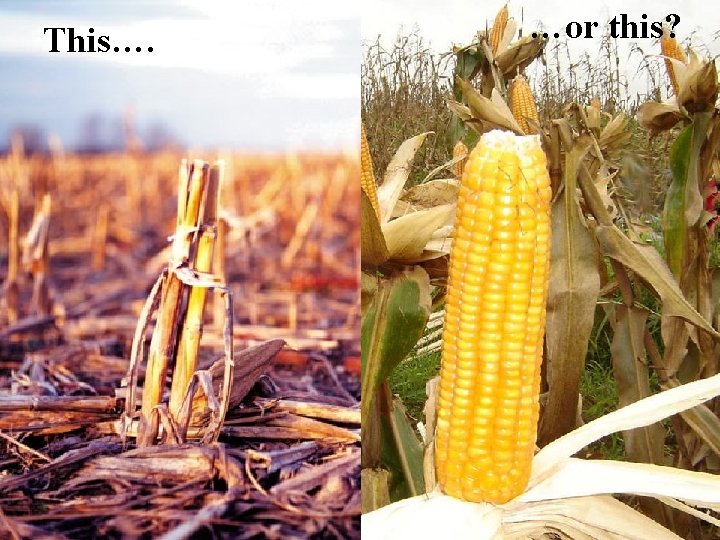
This…. …or this?
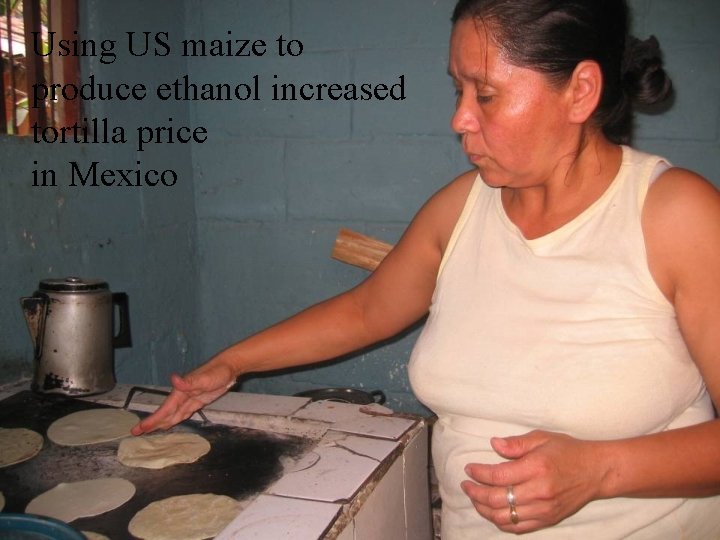
Using US maize to produce ethanol increased tortilla price in Mexico
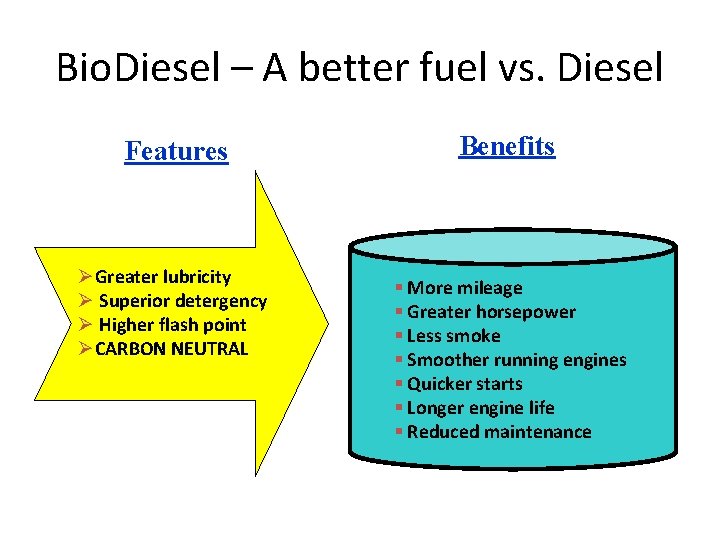
Bio. Diesel – A better fuel vs. Diesel Features ØGreater lubricity Ø Superior detergency Ø Higher flash point ØCARBON NEUTRAL Benefits § More mileage § Greater horsepower § Less smoke § Smoother running engines § Quicker starts § Longer engine life § Reduced maintenance
Reduced emissions for Biodiesel Problem with Biofuels Degrades at rate of four times faster than standard diesel fuel And produces more NOx Biodiesel can gel when it gets cold. Solution: Blend with standard diesel for better cold flow properties
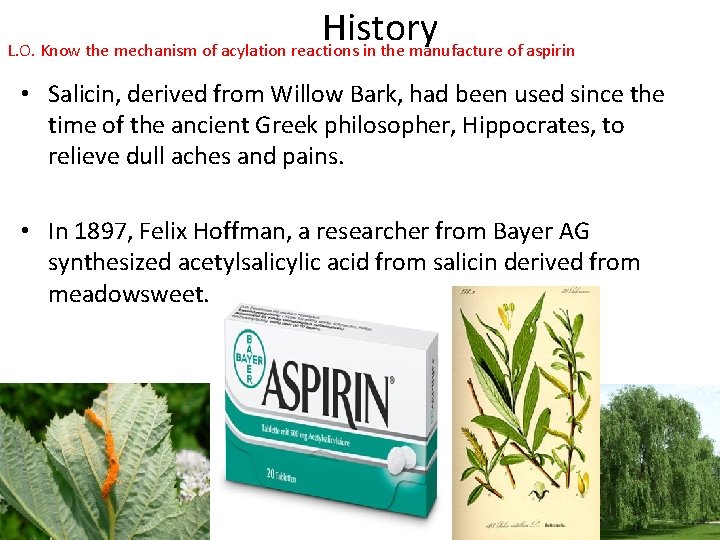
History L. O. Know the mechanism of acylation reactions in the manufacture of aspirin • Salicin, derived from Willow Bark, had been used since the time of the ancient Greek philosopher, Hippocrates, to relieve dull aches and pains. • In 1897, Felix Hoffman, a researcher from Bayer AG synthesized acetylsalicylic acid from salicin derived from meadowsweet.
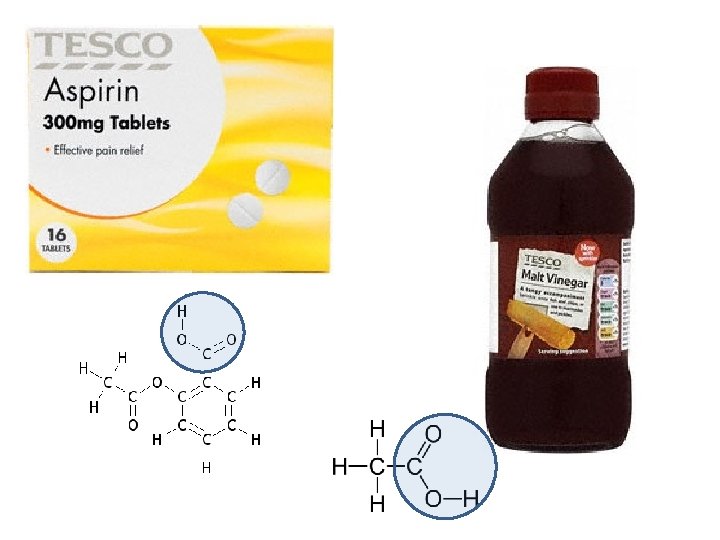
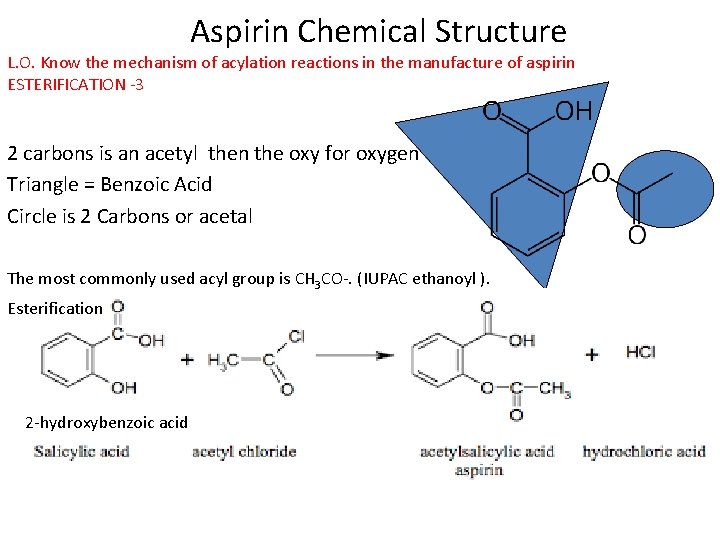
Aspirin Chemical Structure L. O. Know the mechanism of acylation reactions in the manufacture of aspirin ESTERIFICATION -3 2 carbons is an acetyl then the oxy for oxygen Triangle = Benzoic Acid Circle is 2 Carbons or acetal The most commonly used acyl group is CH 3 CO-. (IUPAC ethanoyl ). Esterification 2 -hydroxybenzoic acid
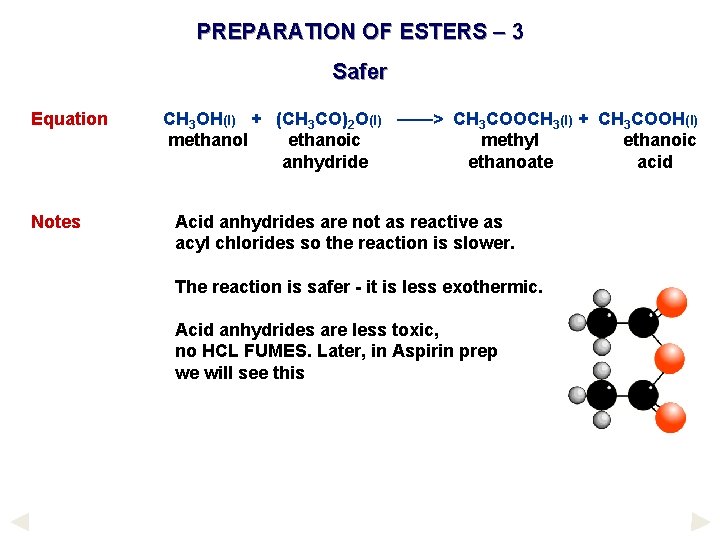
PREPARATION OF ESTERS – 3 Safer Equation Notes CH 3 OH(l) + (CH 3 CO)2 O(l) ——> CH 3 COOCH 3(l) + CH 3 COOH(l) methanol ethanoic methyl ethanoic anhydride ethanoate acid Acid anhydrides are not as reactive as acyl chlorides so the reaction is slower. The reaction is safer - it is less exothermic. Acid anhydrides are less toxic, no HCL FUMES. Later, in Aspirin prep we will see this
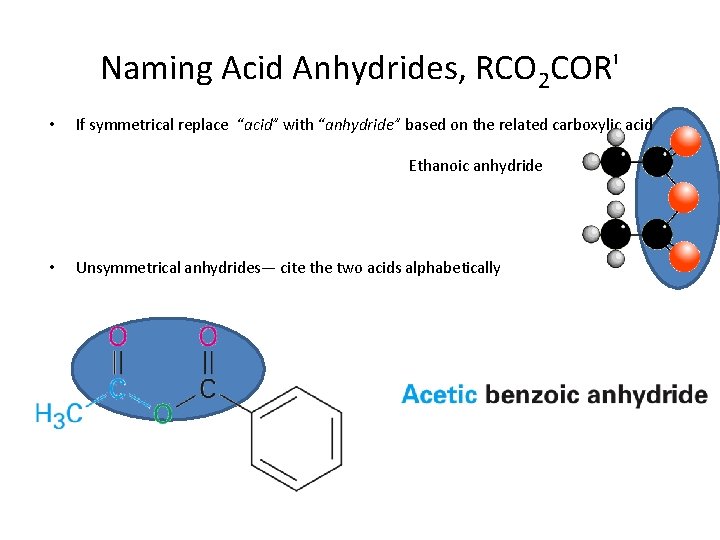
Naming Acid Anhydrides, RCO 2 COR' • If symmetrical replace “acid” with “anhydride” based on the related carboxylic acid Ethanoic anhydride • Unsymmetrical anhydrides— cite the two acids alphabetically
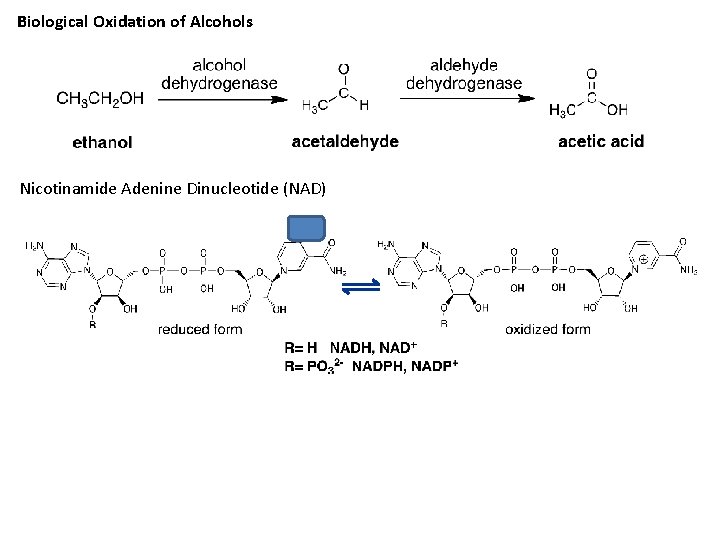
Biological Oxidation of Alcohols Nicotinamide Adenine Dinucleotide (NAD)
- Slides: 61