
Soa ML standard and example Slides by Arne
Soa. ML standard and example Slides by Arne Jørgen Berre, Cory Casanave, Ståle Walderhaug, Erlend Stav, Babak Farshchian, OMG, et al. (see references page at the end)


The Soa. ML submission team Submitters • Supporters • – – 88 Solutions Adaptive EDS Model Driven Solutions – – Everware-CBDI General Services Administration Inherit Mega – – – – – Capgemini Fujitsu Fundacion European Software Institute Hewlett-Packard International Business Machines MEGA International MID Gmb. H Rhysome Softeam Telelogic AB – – – – – BAE Systems DERI – University of Innsbruck DFKI France Telecom R&D NKUA – University of Athens Oslo Software SINTEF THALES Group University of Augsburg Wilton Consulting Group
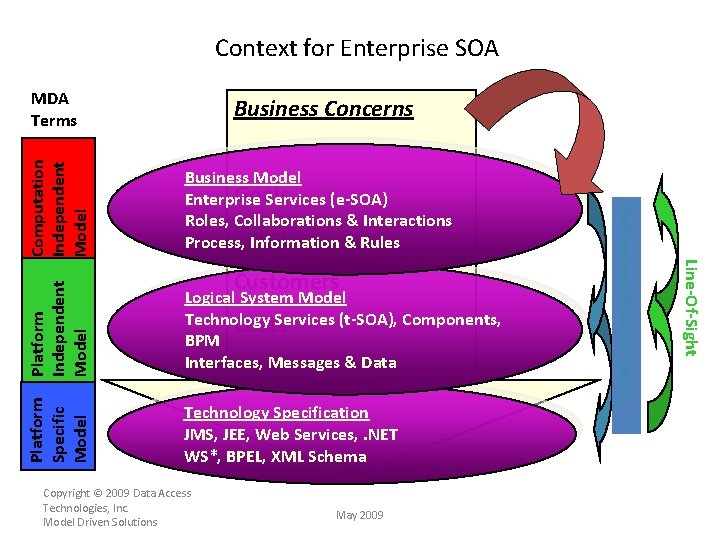
Context for Enterprise SOA Computation Independent Model Technology Specification JMS, JEE, Web Services, . NET WS*, BPEL, XML Schema Customers Copyright © 2009 Data Access Technologies, Inc. Model Driven Solutions May 2009 Line-Of-Sight Logical System Model Technology Services (t-SOA), Components, Costs BPM Interfaces, Messages & Data Agility Refinement & Automation Business Model Goals Enterprise Services (e-SOA) Roles, Collaborations & Interactions Policy Process, Information & Rules Platform Independent Model Business Concerns Platform Specific Model MDA Terms
Soa. ML Example – The “Dealer Network” The dealer network models an “industry community” of dealers, shippers and manufacturers. The community defines the SOA architecture by which they all work together. Note – This example is presented top-down, integrating both the business and technology viewpoints. Soa. ML can be used top-down, bottom up or middle out. It can be focused on the business and/or the technology based on the users needs.
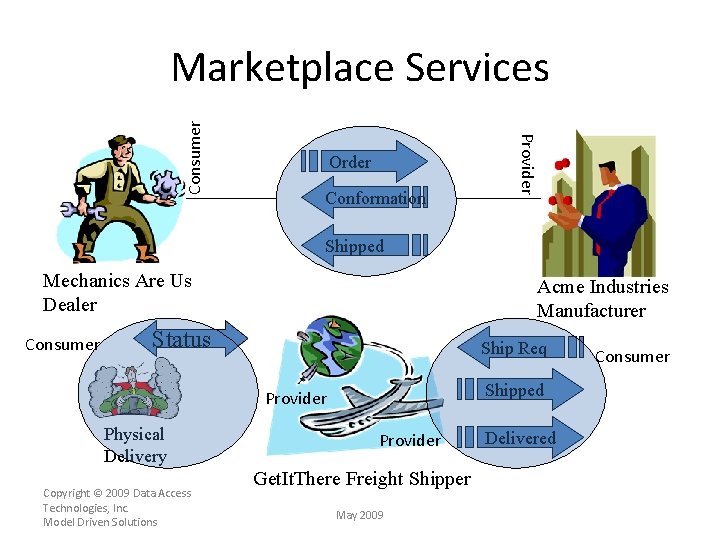
Order Conformation Provider Consumer Marketplace Services Shipped Mechanics Are Us Dealer Consumer Acme Industries Manufacturer Status Ship Req Shipped Provider Physical Delivery Copyright © 2009 Data Access Technologies, Inc. Model Driven Solutions Provider Get. It. There Freight Shipper May 2009 Delivered Consumer
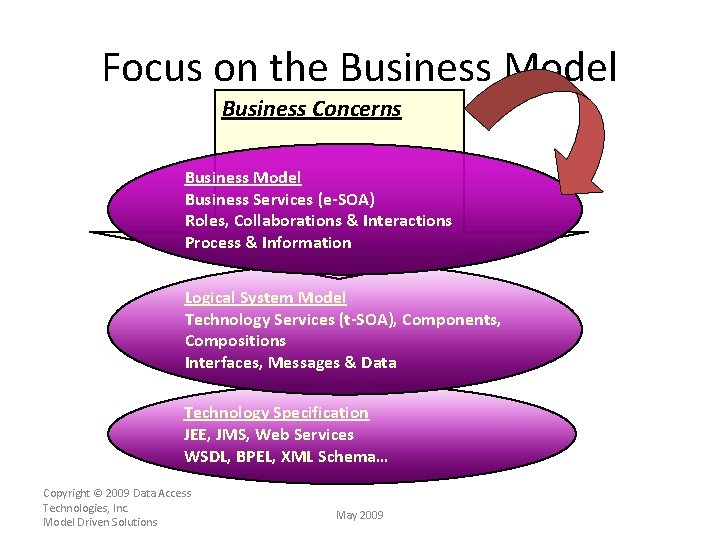
Focus on the Business Model Business Concerns Business Model Business Services (e-SOA) Roles, Collaborations & Interactions Process & Information Logical System Model Technology Services (t-SOA), Components, Compositions Interfaces, Messages & Data Technology Specification JEE, JMS, Web Services WSDL, BPEL, XML Schema… Copyright © 2009 Data Access Technologies, Inc. Model Driven Solutions May 2009

Service. Capability realised by Participants Service. Capabilities represent the services or capabilities of some system or architecture. These Service. Capabilities may then be linked to the Participants that actually provide the capabilities through UML 2 Realizations
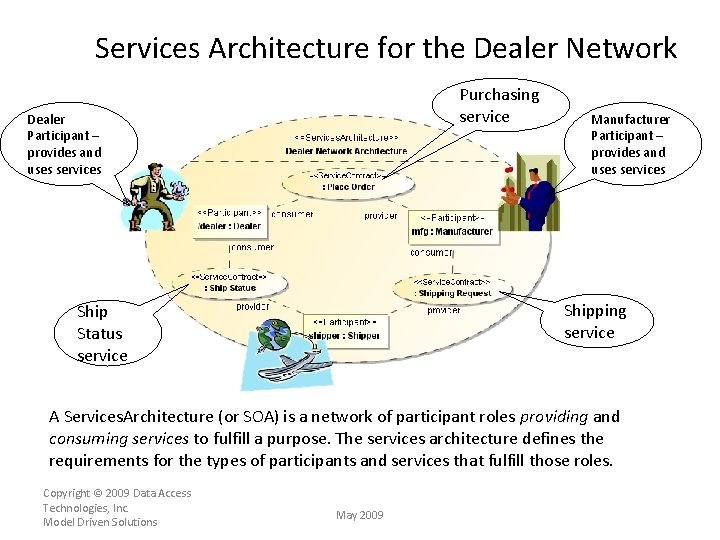
Services Architecture for the Dealer Network Purchasing service Dealer Participant – provides and uses services Manufacturer Participant – provides and uses services Shipping service Ship Status service A Services. Architecture (or SOA) is a network of participant roles providing and consuming services to fulfill a purpose. The services architecture defines the requirements for the types of participants and services that fulfill those roles. Copyright © 2009 Data Access Technologies, Inc. Model Driven Solutions May 2009
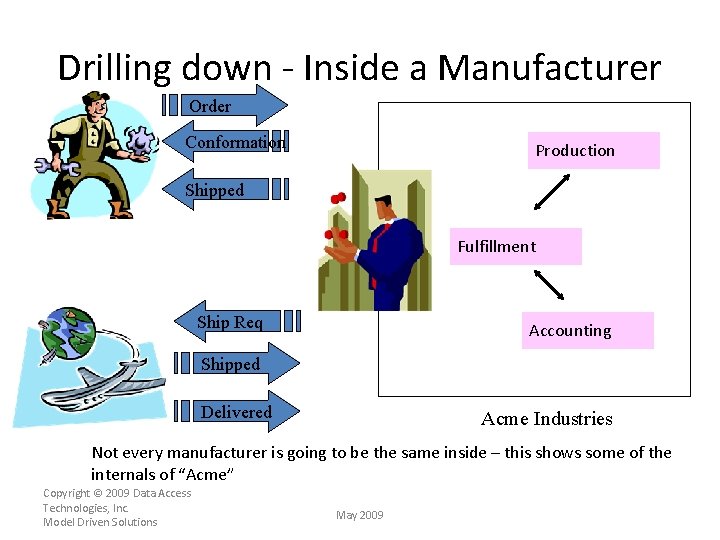
Drilling down - Inside a Manufacturer Order Conformation Production Shipped Fulfillment Ship Req Accounting Shipped Delivered Acme Industries Not every manufacturer is going to be the same inside – this shows some of the internals of “Acme” Copyright © 2009 Data Access Technologies, Inc. Model Driven Solutions May 2009
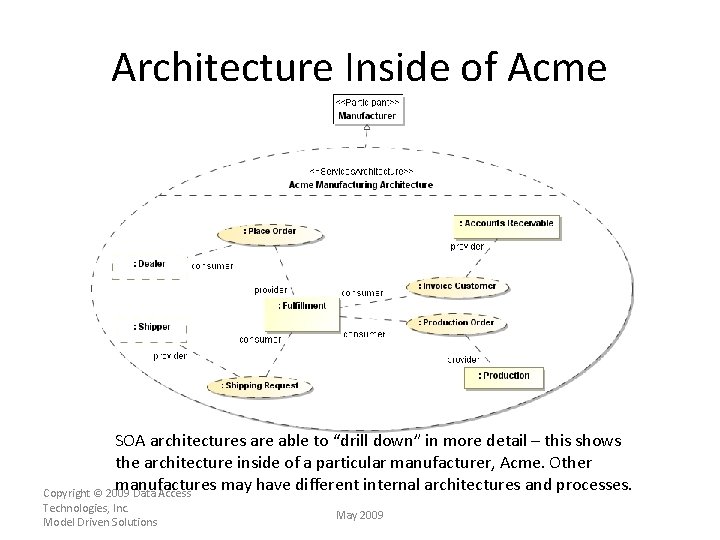
Architecture Inside of Acme SOA architectures are able to “drill down” in more detail – this shows the architecture inside of a particular manufacturer, Acme. Other manufactures may have different internal architectures and processes. Copyright © 2009 Data Access Technologies, Inc. Model Driven Solutions May 2009
Specifying Services • Specification of services includes – The roles each participant plays in the service, such as provider and consumer – The message types that go between the participants when the service is enacted – The interfaces provided and used by each participant for the service – The choreography of the interactions between the participants while enacting the service – Placeholders are provided for service policies and motivation • Modeling services – Services are modeled using “Service Contracts” and “Service Interfaces” in Soa. ML. These use UML interfaces, classes and behaviors. Copyright © 2009 Data Access Technologies, Inc. Model Driven Solutions May 2009
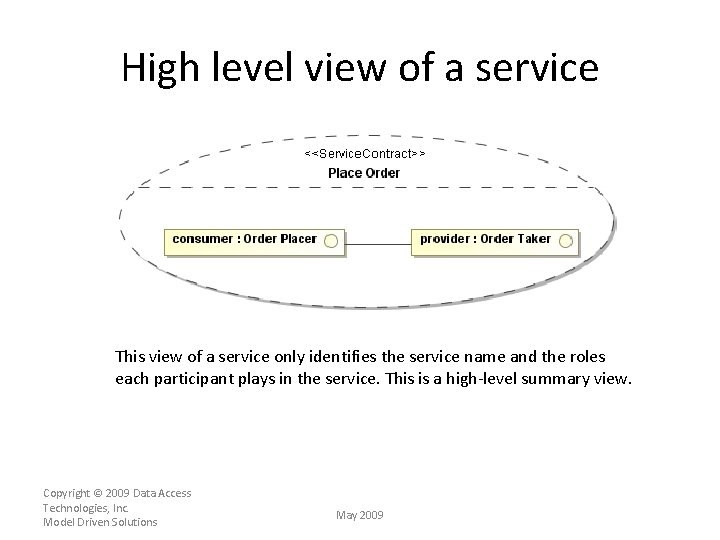
High level view of a service This view of a service only identifies the service name and the roles each participant plays in the service. This is a high-level summary view. Copyright © 2009 Data Access Technologies, Inc. Model Driven Solutions May 2009
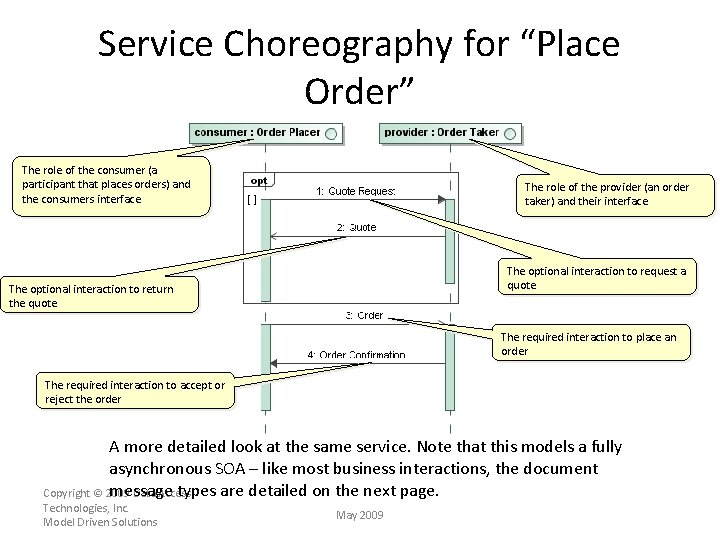
Service Choreography for “Place Order” The role of the consumer (a participant that places orders) and the consumers interface The role of the provider (an order taker) and their interface The optional interaction to request a quote The optional interaction to return the quote The required interaction to place an order The required interaction to accept or reject the order A more detailed look at the same service. Note that this models a fully asynchronous SOA – like most business interactions, the document message types are detailed on the next page. Copyright © 2009 Data Access Technologies, Inc. Model Driven Solutions May 2009
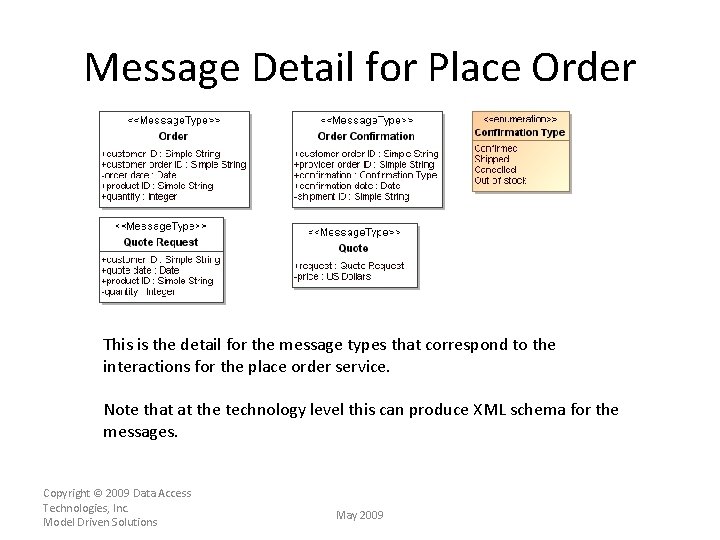
Message Detail for Place Order This is the detail for the message types that correspond to the interactions for the place order service. Note that at the technology level this can produce XML schema for the messages. Copyright © 2009 Data Access Technologies, Inc. Model Driven Solutions May 2009
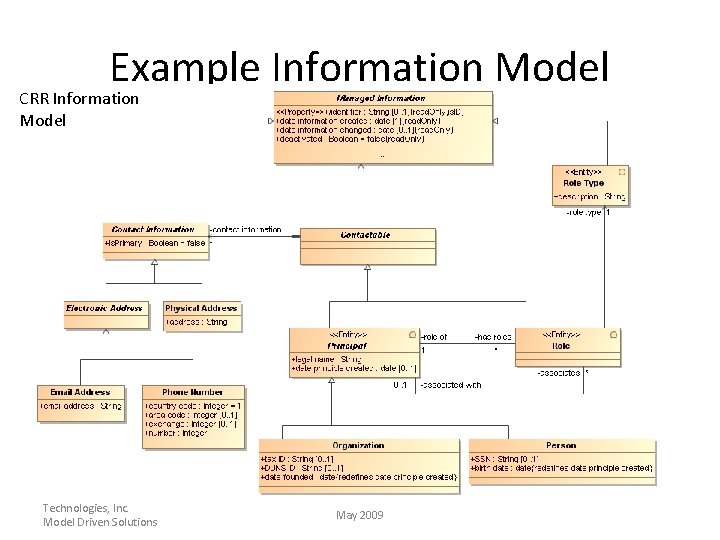
Example Information Model CRR Information Model Copyright © 2009 Data Access Technologies, Inc. Model Driven Solutions May 2009
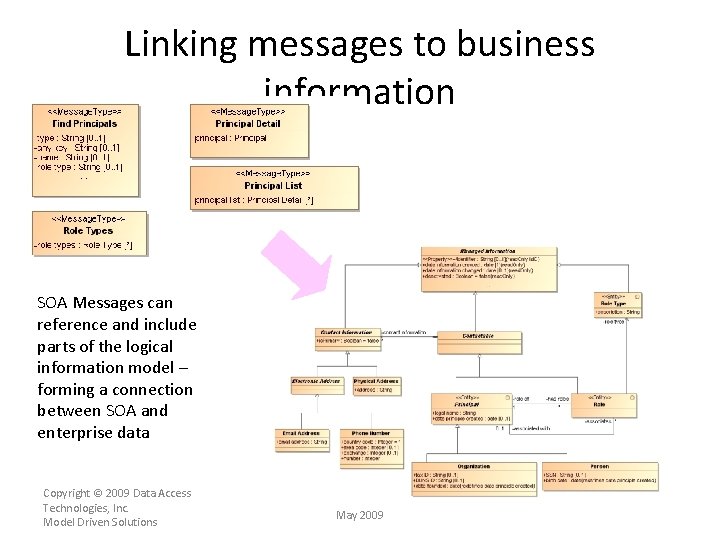
Linking messages to business information SOA Messages can reference and include parts of the logical information model – forming a connection between SOA and enterprise data Copyright © 2009 Data Access Technologies, Inc. Model Driven Solutions May 2009
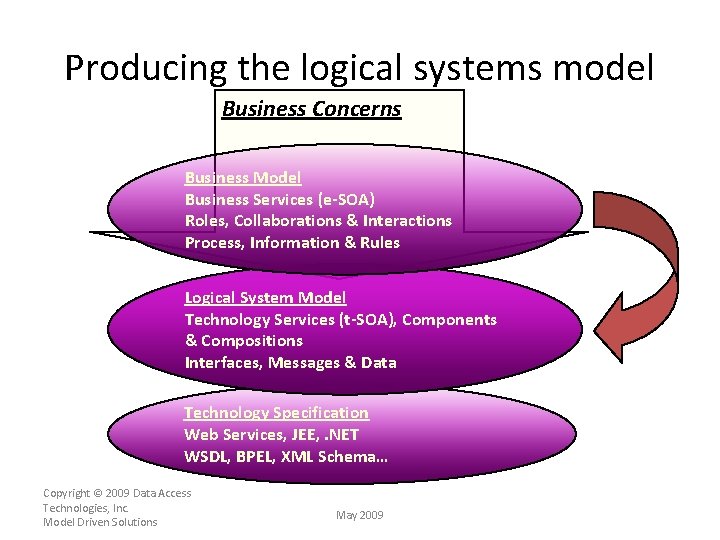
Producing the logical systems model Business Concerns Business Model Business Services (e-SOA) Roles, Collaborations & Interactions Process, Information & Rules Logical System Model Technology Services (t-SOA), Components & Compositions Interfaces, Messages & Data Technology Specification Web Services, JEE, . NET WSDL, BPEL, XML Schema… Copyright © 2009 Data Access Technologies, Inc. Model Driven Solutions May 2009
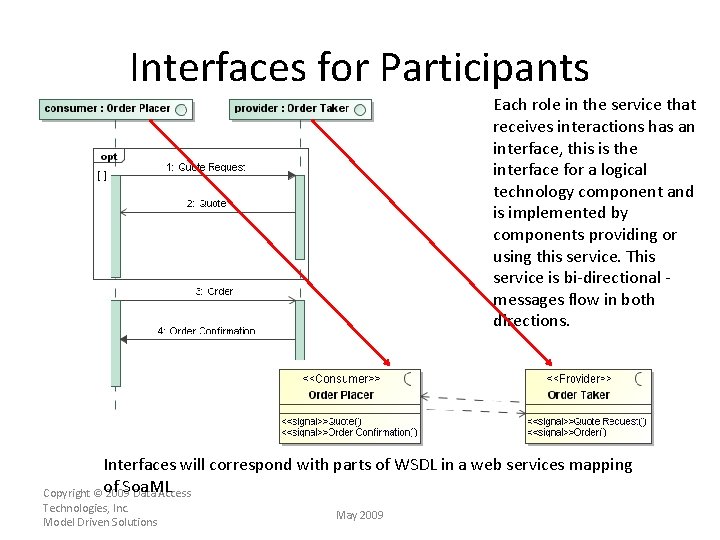
Interfaces for Participants Each role in the service that receives interactions has an interface, this is the interface for a logical technology component and is implemented by components providing or using this service. This service is bi-directional messages flow in both directions. Interfaces will correspond with parts of WSDL in a web services mapping Soa. ML Copyright ©of 2009 Data Access Technologies, Inc. Model Driven Solutions May 2009
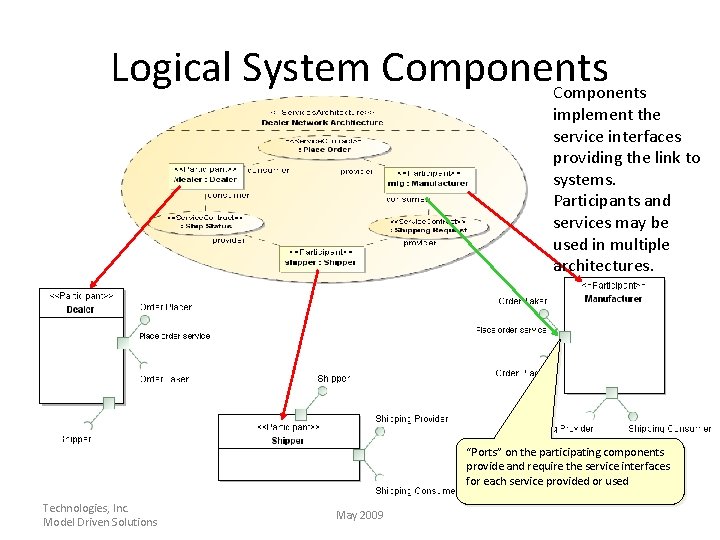
Logical System Components implement the service interfaces providing the link to systems. Participants and services may be used in multiple architectures. Copyright © 2009 Data Access Technologies, Inc. Model Driven Solutions “Ports” on the participating components provide and require the service interfaces for each service provided or used May 2009
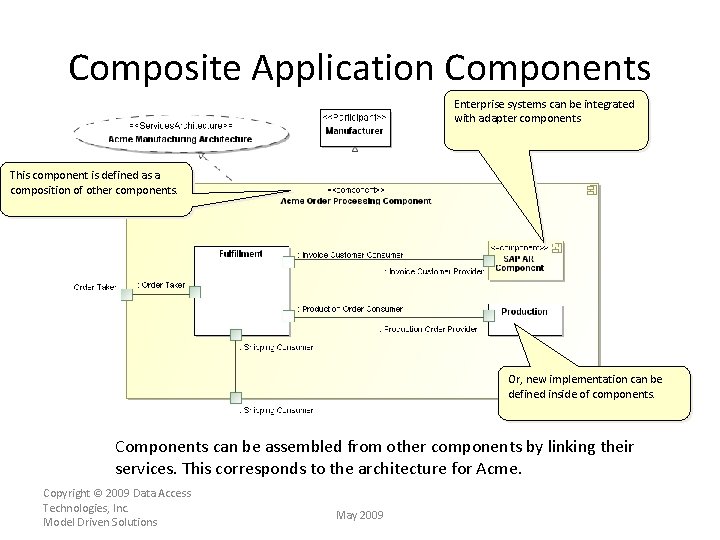
Composite Application Components Enterprise systems can be integrated with adapter components This component is defined as a composition of other components. Or, new implementation can be defined inside of components. Components can be assembled from other components by linking their services. This corresponds to the architecture for Acme. Copyright © 2009 Data Access Technologies, Inc. Model Driven Solutions May 2009
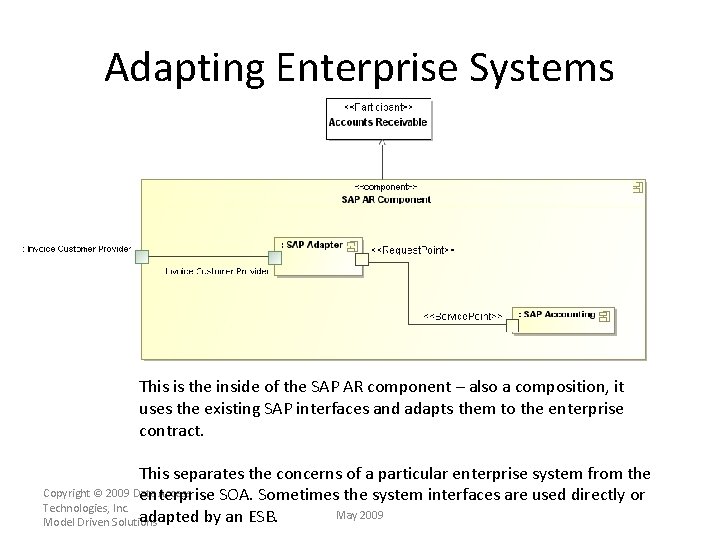
Adapting Enterprise Systems This is the inside of the SAP AR component – also a composition, it uses the existing SAP interfaces and adapts them to the enterprise contract. This separates the concerns of a particular enterprise system from the Copyright © 2009 Data Access enterprise SOA. Sometimes the system interfaces are used directly or Technologies, Inc. May 2009 adapted by an ESB. Model Driven Solutions
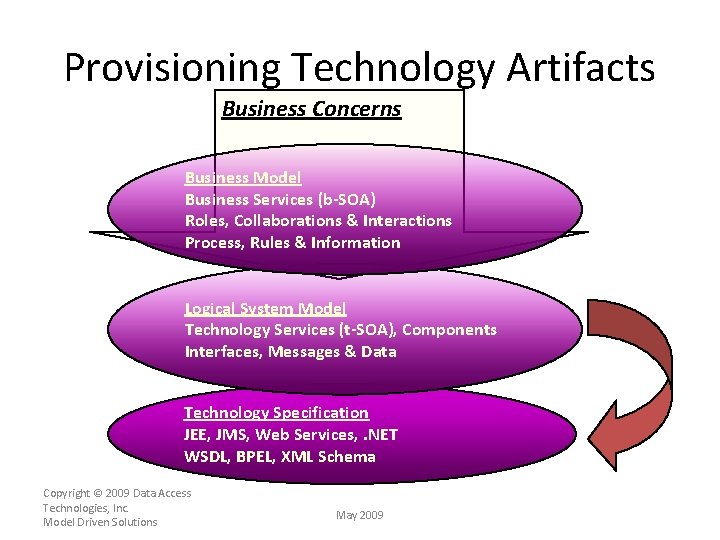
Provisioning Technology Artifacts Business Concerns Business Model Business Services (b-SOA) Roles, Collaborations & Interactions Process, Rules & Information Logical System Model Technology Services (t-SOA), Components Interfaces, Messages & Data Technology Specification JEE, JMS, Web Services, . NET WSDL, BPEL, XML Schema Copyright © 2009 Data Access Technologies, Inc. Model Driven Solutions May 2009
Realizing the Model • How do we use I. T. to realize our processes and services? – Direct execution frameworks • The “no code” approach where the process and services execute directly from the model • May use other standards, such as BPEL – Wrapping and adapting existing capabilities • Automatic or manual creation of “adapter components” that use legacy systems, information or services to create the architected enterprise services – Creation of new application components and services • Build new capabilities by creating new components and creating composite applications • May be visual and declarative or code oriented • Under the Soa. ML framework, all of these options can coexist as a system of systems linked by services Copyright © 2009 Data Access Technologies, Inc. Model Driven Solutions May 2009
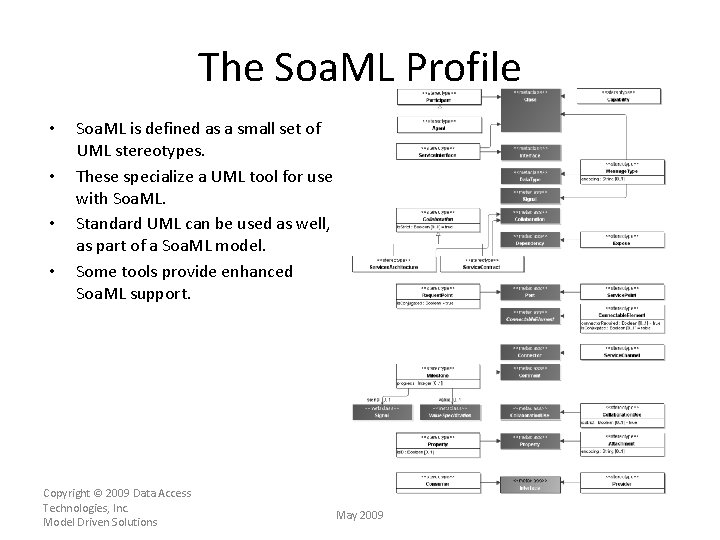
The Soa. ML Profile • • Soa. ML is defined as a small set of UML stereotypes. These specialize a UML tool for use with Soa. ML. Standard UML can be used as well, as part of a Soa. ML model. Some tools provide enhanced Soa. ML support. Copyright © 2009 Data Access Technologies, Inc. Model Driven Solutions May 2009
What you need beyond Soa. ML • • Soa. ML is a profile of UML, it needs a UML tool in which to be used – some tools may offer additional support to make creating a SOA easier MDA provisioning requires additional tooling which goes beyond the standard. E. G. Model. Pro (Model. Driven. org) and RSA (IBM) Some SOA execution framework and/or ESB (I. E. “The Platform”) Optional, but highly desirable – – – – Support for policies Business process execution Information modeling and implementation Business rules Requirements & motivation modeling Security modeling and infrastructure An IDE for elements that are not model driven Application server and/or ESB Copyright © 2009 Data Access Technologies, Inc. Model Driven Solutions May 2009
Current Soa. ML Support • OMG Web site – Soa. ML Wiki: http: //www. Soa. ML. org – Specification: http: //www. omgwiki. org/Soa. ML/doku. php? id=sp ecification • Known Soa. ML Tooling – – – Cameo SOA+ (No. Magic) UML with Soa. ML Modeling and Provisioning Model. Pro (Model. Driven. org) Open Source MDA provisioning for Soa. ML Enterprise Architect (Sparx) Soa. ML Profile for UML tool Objecteering (Softeam) Soa. ML Profile for UML Tool RSA (IBM) UML tool with Soa. ML & code generation [Not yet released] Copyright © 2009 Data Access Technologies, Inc. Model Driven Solutions May 2009
- Slides: 27