
So You Want To Perform Internal Benchmarking Presentation
So You Want To Perform Internal Benchmarking Presentation Series: The Effective Use of Workload and Productivity Systems in Health-System Pharmacy

Prepared for ASHP members by the Section of Pharmacy Practice Managers Advisory Group on Pharmacy Business Management
Objective • The objective of this presentation is to create a list of actions for a pharmacy director to perform to implement or improve an internal benchmarking system
Goals • To be able to define what internal benchmarking is, and what advantages can be derived from performing this function • To be able to develop the data sources necessary • To be able to use the data to develop operational information, to track and trend workload • To be able to communicate the outcomes of internal benchmarking to senior leadership
Step 1 – What is Internal Benchmarking? • Internal benchmarking is best defined as the process of measuring your current performance against your historical performance – Provides a measure of self-comparison over time • Internal benchmarking can be done against – Quality measures – Workload measures – Financial measures
Step 2 – Why Internal Benchmarking? • This is the ONLY process that compares your performance to a known entity – you! • Minimizes the variables • Allows for control of some of the variables • Allows measurement of issues unique to you and your shop • Allows you to measure the impact of changes over time thus allowing for the elimination of changes that failed to product the desired level of change
Step 3 - Barriers • Requires commitment and work – Acquisition of data – baseline and ongoing – Development of a consistent set of measurements • You must determine – What you MUST measure – What you CAN measure – How to deal with variables • You must develop a framework within which to – – – Store the data Assess and analyze the data Make decisions based on the data Implement changes to drive the data in desired directions How to communicate identified trends or issues to your department, and to senior leadership
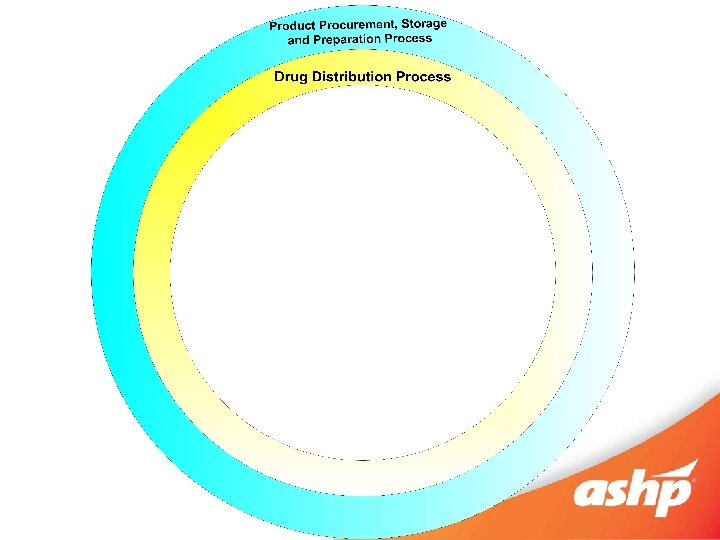
Step 4 – A Recommended Framework • Consider measures that address the Four Core Processes on a hospital pharmacy – – Product Procurement, Storage and Preparation Process Drug Distribution Order Management Clinical Involvement • Know the processes and how to measure the various components of each
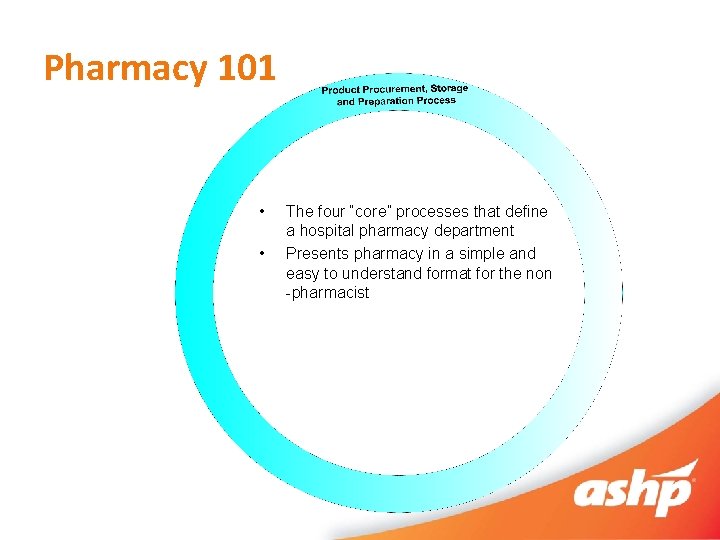
Pharmacy 101 • • The four “core” processes that define a hospital pharmacy department Presents pharmacy in a simple and easy to understand format for the non -pharmacist
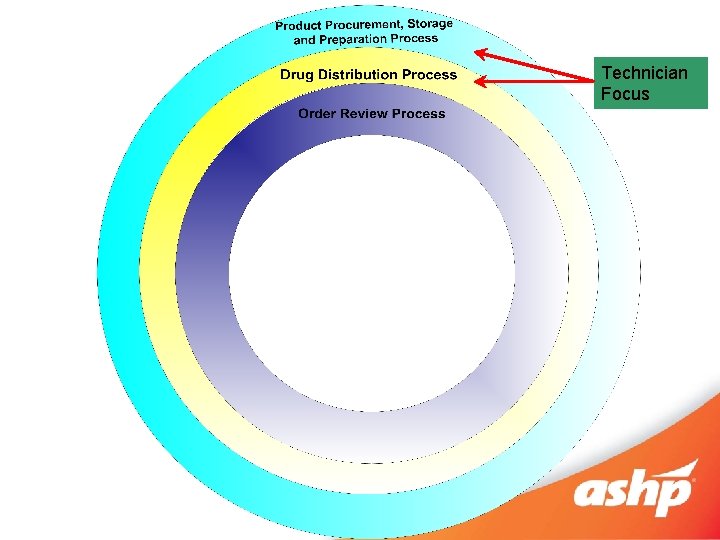
Technician Focus
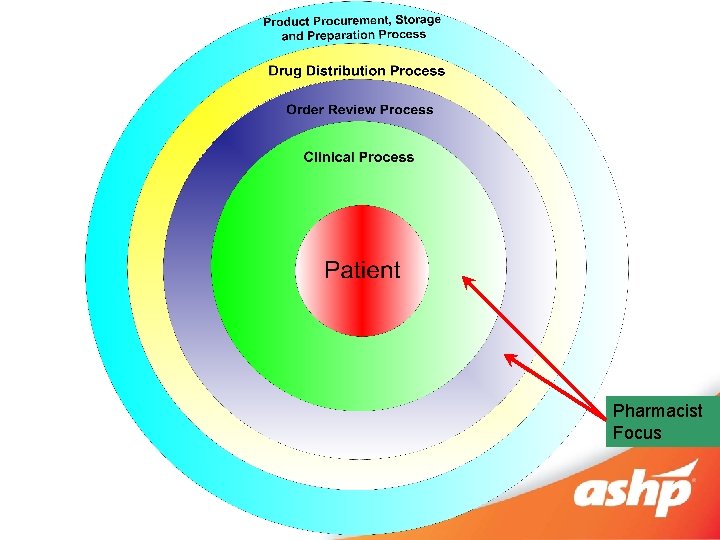
Pharmacist Focus
Step 5 – What to Measure • Your core processes… – Product procurement, storage, retrieval and preparation • • Orders placed Line items ordered Line items shorted IV Admixtures – Drug Distribution • • Locations served Pyxis loads, unloads, refills Pyxis turnaround time Carousel activity
Step 5 – What to Measure • Order Management – – Total orders entered Average order turnaround time Order scan volume Orders by hour • Clinical Involvement – – Clinical interventions Medication reconciliations performed Clinical trigger events (clinical rules) Pharmacoeconomics projects
Step 5 – What to Measure • You can measure the – – – Work done The time the work takes Work NOT done The savings generated by the work done The opportunity cost of the work NOT done • The ways to utilize the data is limited more by your imagination than anything else
Step 6 – Acquiring Data • Avoid manual data collection as much as possible – Time consuming – Error prone – Must be manually entered into data tool and data storage • Use automated (pre-existing) data collection wherever possible – More accurate – Easier
Step 6 – Data Acquisition • • Financial System – Discharges – Patient Days – Adjusted Discharges – Various expenses and revenue data Purchasing system (wholesaler) – Detailed purchases data • Includes orders generated • Invoices processed • Line Items ordered / handled • Doses received / handled • Cost data • AHFS data
Step 6 – Data Acquisition • Carousel Data / Automated Dispensing Cabinet Data – Transactions generated – Individual involved – Work intensity by hour of the day • Order Scanning System (Pyxis Connect) – – Order sheets processed Order sheet turn-around time Workload intensity by hour of the day Productivity data per individual
Step 6 – Data Acquisition • Pharmacy Information System – – – Orders processed Active orders New orders Who did what when (individual productivity) Clinical opportunities identified • Clinical intervention system – Total interventions performed – Separated by various categories
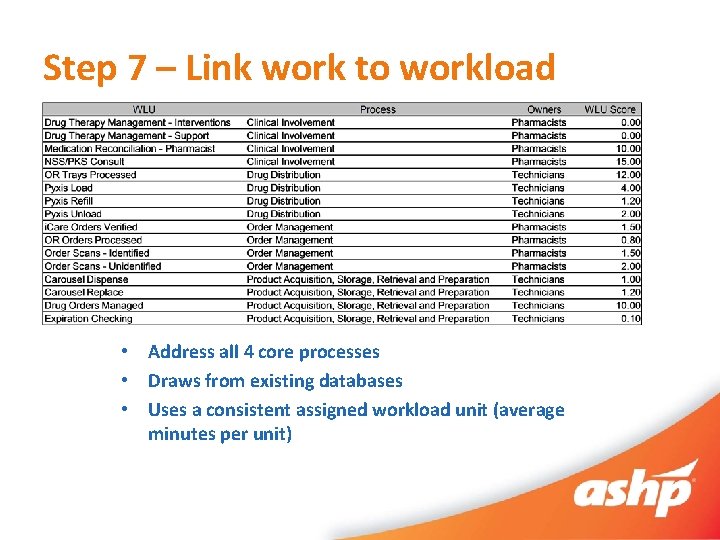
Step 7 – Link work to workload • Address all 4 core processes • Draws from existing databases • Uses a consistent assigned workload unit (average minutes per unit)
Step 8 – What does the data say • Measured over time what story does the data tell – Is the amount of work increasing? – Is it increasing faster than the resources to perform it has increased? – What is being done? – What is NOT being done? – What is the benefit of what is done? – What is the opportunity cost of what does not get gone? • Do resources need to be re-allocated
Step 9 - Communicate • The point of any data collection should be to eventually share the data • Determine what the message of the data analysis is • Use the results of the data analysis to – Improve processes that need to be improved – Tell the success stories uncovered – Identify areas for action • If needed action requires a re-allocation of resources, then do so • If needed action required additional resources, then share the data
Step 10 – Senior Leadership • At some point, you will eventually uncover a need for additional resources • This will require the involvement of senior leadership • Use your data and the results of your data analysis to – Show that you understand the issue – Detail the magnitude of the issue – Show what options were considered • Resource re-allocation • Capitol options (automation / renovation) • Additional Manpower
Step 10 – Senior Leadership • Present the selected option • Use the data to make your point • Know your audience – Executive summary approach – Less is more – Deal with biases • Cover the opportunity costs of NOT doing something • Know how to counter the “data” that may be mentioned about external benchmarking processes • Be able to completely explain the working of your internal benchmarking process
Summary • Be familiar with the AHSP White Paper “The Effective Use of Workload and Productivity Systems in Health. System Pharmacy” • Understand how external and internal benchmarking works, the advantages and disadvantages of each • Understand how to collect, analyze and share data / information • Keep your leadership “in the loop”!
- Slides: 25