
So far Main search strategy Natural deduction Sequents








- Slides: 49
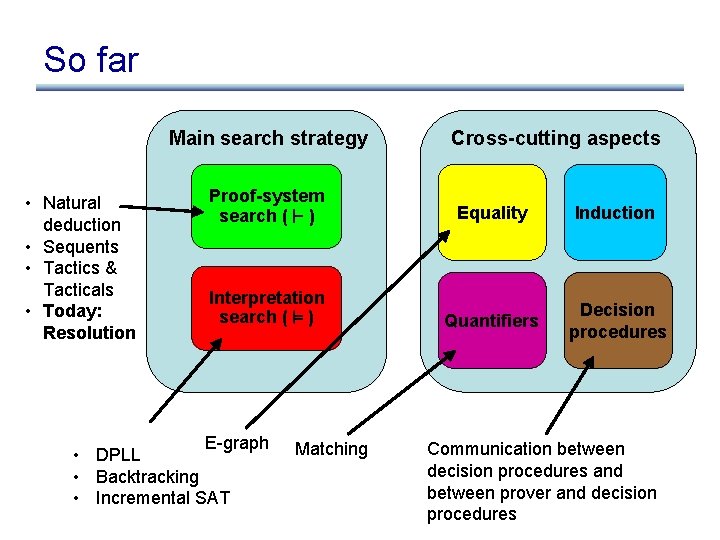
So far Main search strategy • Natural deduction • Sequents • Tactics & Tacticals • Today: Resolution Cross-cutting aspects Proof-system search ( ` ) Equality Induction Interpretation search ( ² ) Quantifiers Decision procedures E-graph • DPLL • Backtracking • Incremental SAT Matching Communication between decision procedures and between prover and decision procedures
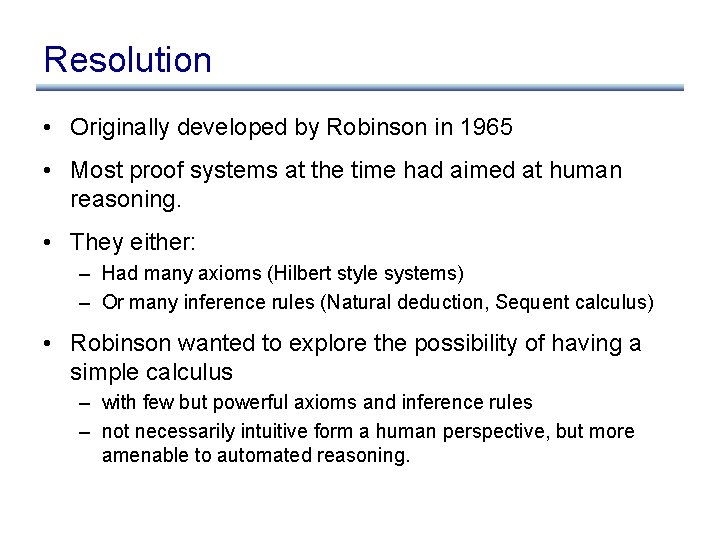
Resolution • Originally developed by Robinson in 1965 • Most proof systems at the time had aimed at human reasoning. • They either: – Had many axioms (Hilbert style systems) – Or many inference rules (Natural deduction, Sequent calculus) • Robinson wanted to explore the possibility of having a simple calculus – with few but powerful axioms and inference rules – not necessarily intuitive form a human perspective, but more amenable to automated reasoning.
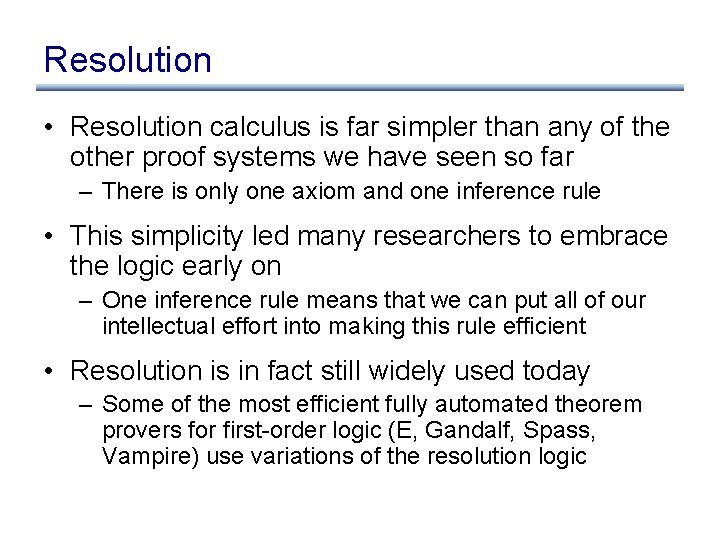
Resolution • Resolution calculus is far simpler than any of the other proof systems we have seen so far – There is only one axiom and one inference rule • This simplicity led many researchers to embrace the logic early on – One inference rule means that we can put all of our intellectual effort into making this rule efficient • Resolution is in fact still widely used today – Some of the most efficient fully automated theorem provers for first-order logic (E, Gandalf, Spass, Vampire) use variations of the resolution logic
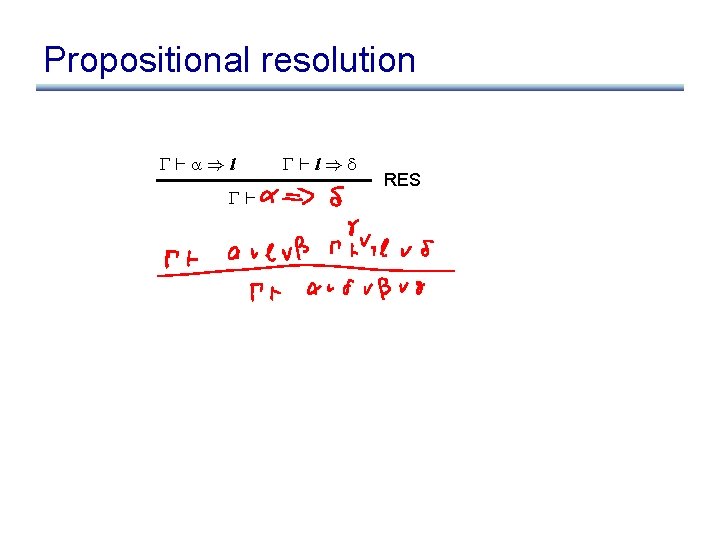
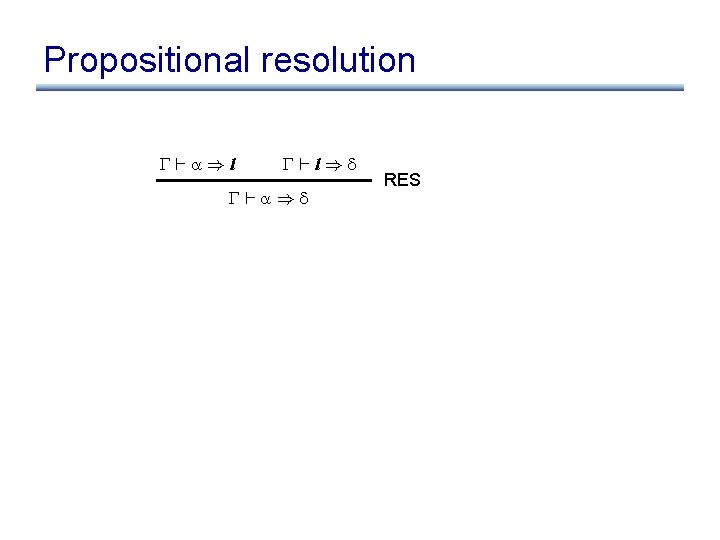
Propositional resolution ` )l ` `l) RES
Propositional resolution ` )l `l) ` ) RES
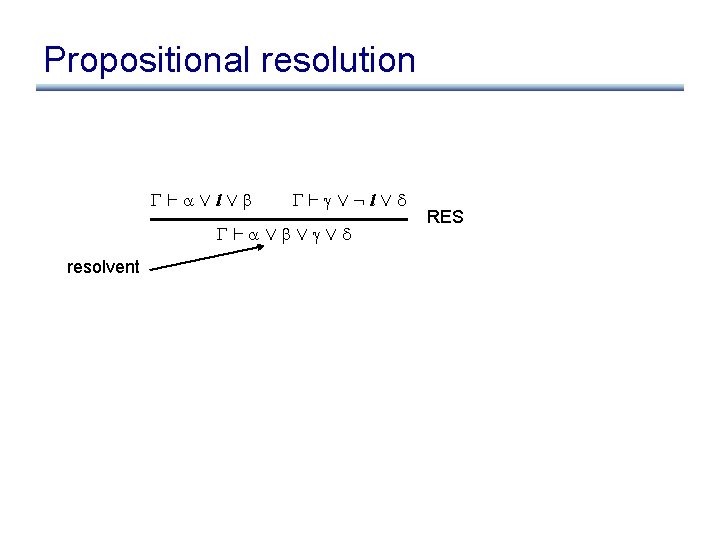
Propositional resolution ` )l `l) `: Çl `: lÇ `: Ç ` Çl `: lÇ ` ÇlÇ RES Generalize RES ` Ç: lÇ ` Ç Ç Ç Expand ) RES Generalize even more
Propositional resolution ` ÇlÇ ` Ç: lÇ ` Ç Ç Ç resolvent RES
Propositional resolution ` ÇlÇ ` Ç: lÇ ` Ç Ç Ç resolvent RES Which direction should we apply this rule in?
Propositional resolution ` ÇlÇ ` Ç: lÇ ` Ç Ç Ç Assume , , ` RES
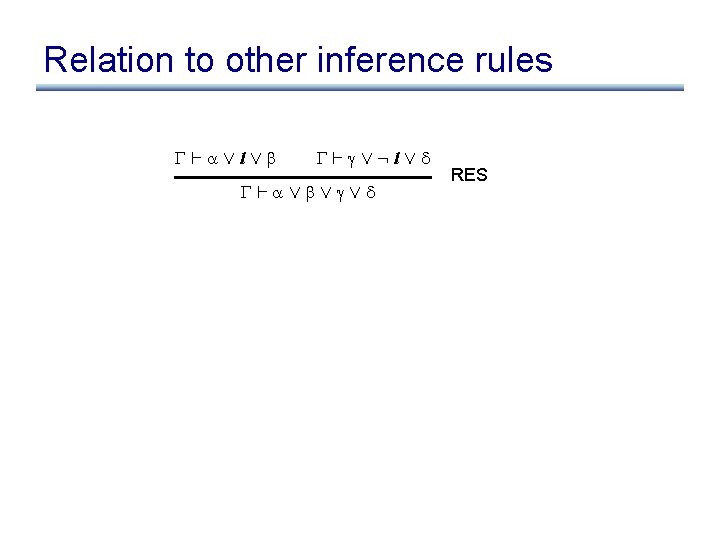
Relation to other inference rules ` ÇlÇ ` Ç: lÇ ` Ç Ç Ç RES
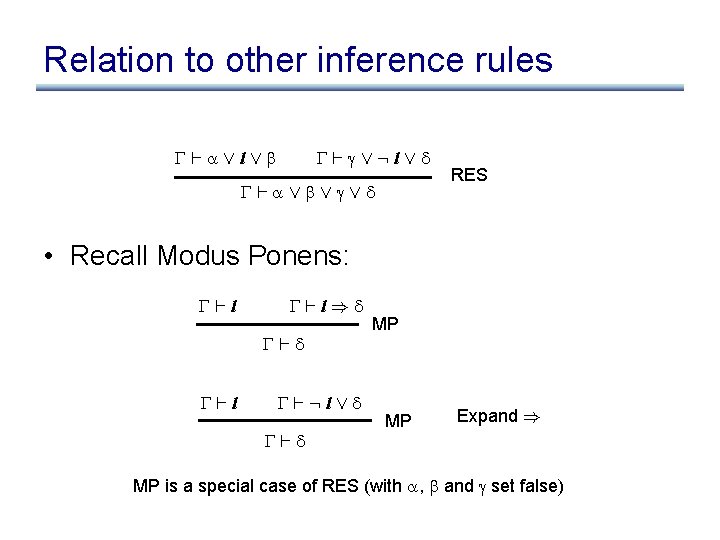
Relation to other inference rules ` ÇlÇ ` Ç: lÇ ` Ç Ç Ç RES • Recall Modus Ponens: `l) ` `l `: lÇ ` MP MP Expand ) MP is a special case of RES (with , and set false)
Relation to other inference rules ` ÇlÇ ` Ç: lÇ ` Ç Ç Ç RES
Relation to other inference rules ` ÇlÇ ` Ç: lÇ ` Ç Ç Ç RES • Recall cut rule: ` , l l, ` , Resolution rule embodies the same idea as the cut rule from Sequents ` , l ` , : l , ` , ` Çl CUT ` Ç: l , ` Ç Throw l to the other side “Expand” definition of sequents
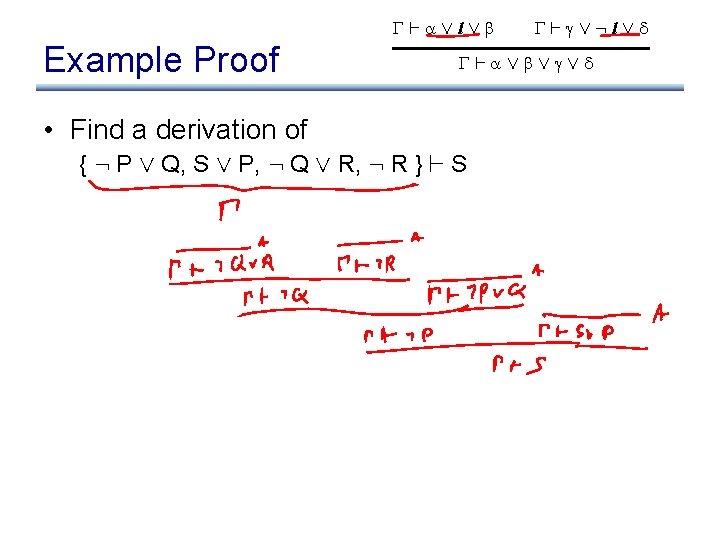
` ÇlÇ Example Proof ` Ç: lÇ ` Ç Ç Ç • Find a derivation of { : P Ç Q, S Ç P, : Q Ç R, : R } ` S
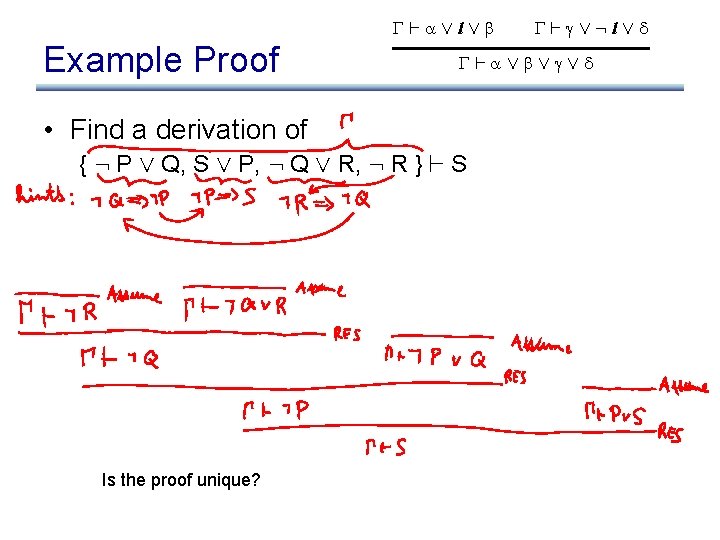
` ÇlÇ Example Proof ` Ç Ç Ç • Find a derivation of { : P Ç Q, S Ç P, : Q Ç R, : R } ` S Is the proof unique? ` Ç: lÇ
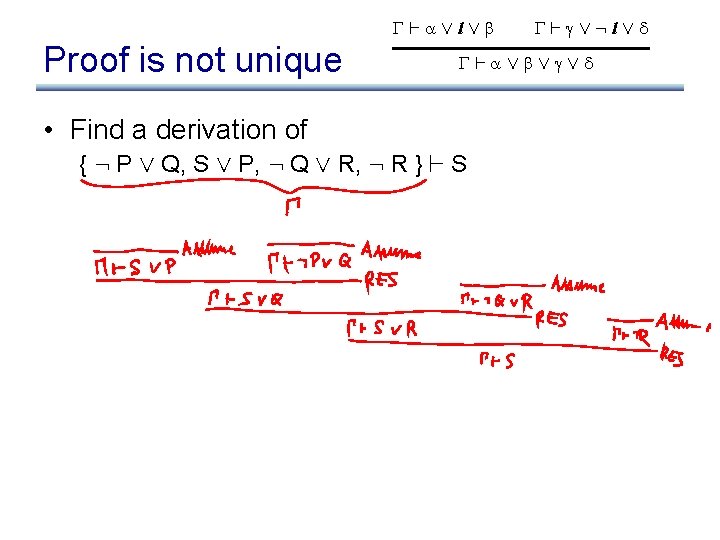
` ÇlÇ Proof is not unique ` Ç: lÇ ` Ç Ç Ç • Find a derivation of { : P Ç Q, S Ç P, : Q Ç R, : R } ` S
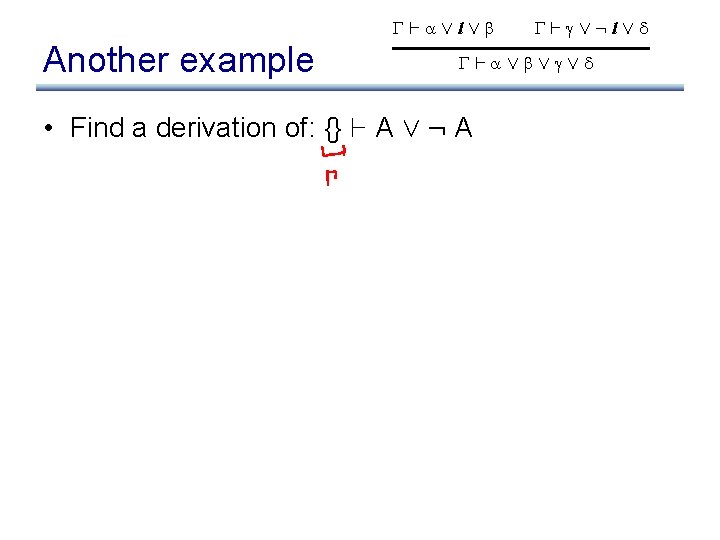
` ÇlÇ Another example ` Ç: lÇ ` Ç Ç Ç • Find a derivation of: {} ` A Ç : A
` ÇlÇ Another example ` Ç: lÇ ` Ç Ç Ç • Find a derivation of: {} ` A Ç : A • Can’t find a derivation – There are no clauses to resolve! • We made the calculus very simple (with only one axiom, and one inference rule) – but we also made it incomplete • What should we do?
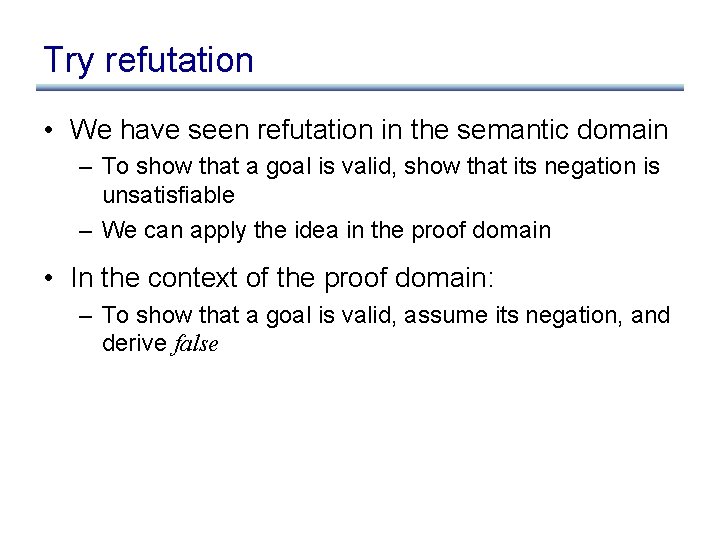
Try refutation • We have seen refutation in the semantic domain – To show that a goal is valid, show that its negation is unsatisfiable – We can apply the idea in the proof domain • In the context of the proof domain: – To show that a goal is valid, assume its negation, and derive false
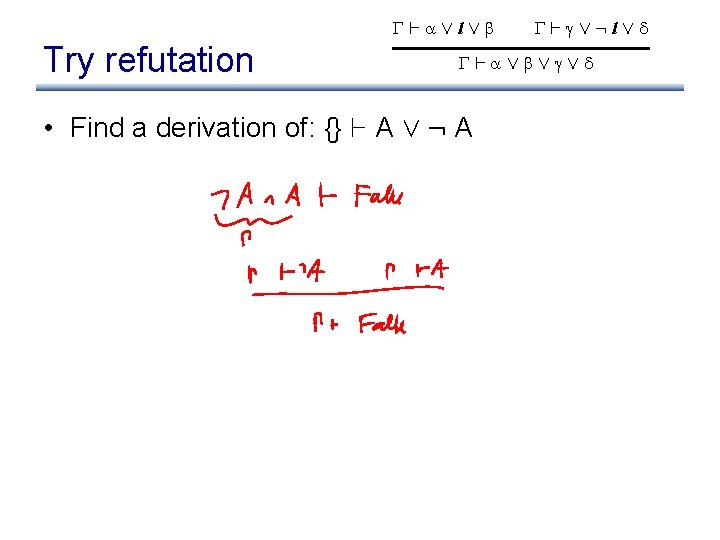
` ÇlÇ Try refutation ` Ç: lÇ ` Ç Ç Ç • Find a derivation of: {} ` A Ç : A
` ÇlÇ Try refutation ` Ç: lÇ ` Ç Ç Ç • Find a derivation of: {} ` A Ç : A • Refutation worked in this case • Q: Would it always work if the formula is valid?
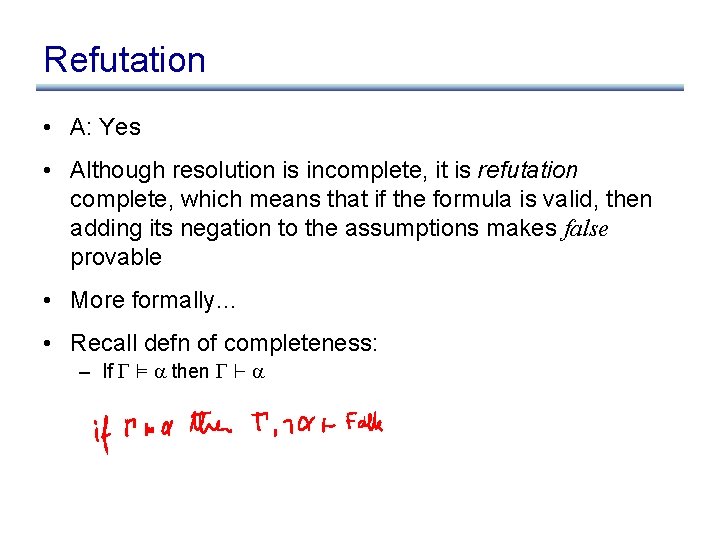
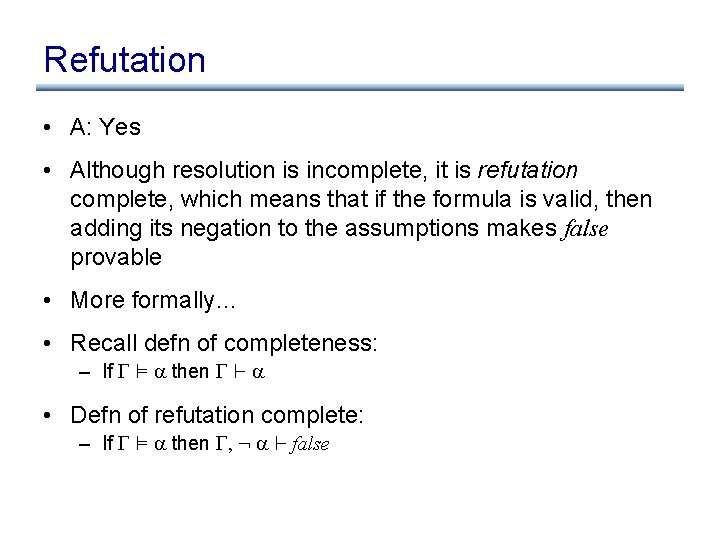
Refutation • A: Yes • Although resolution is incomplete, it is refutation complete, which means that if the formula is valid, then adding its negation to the assumptions makes false provable • More formally… • Recall defn of completeness: – If ² then `
Refutation • A: Yes • Although resolution is incomplete, it is refutation complete, which means that if the formula is valid, then adding its negation to the assumptions makes false provable • More formally… • Recall defn of completeness: – If ² then ` • Defn of refutation complete: – If ² then , : ` false
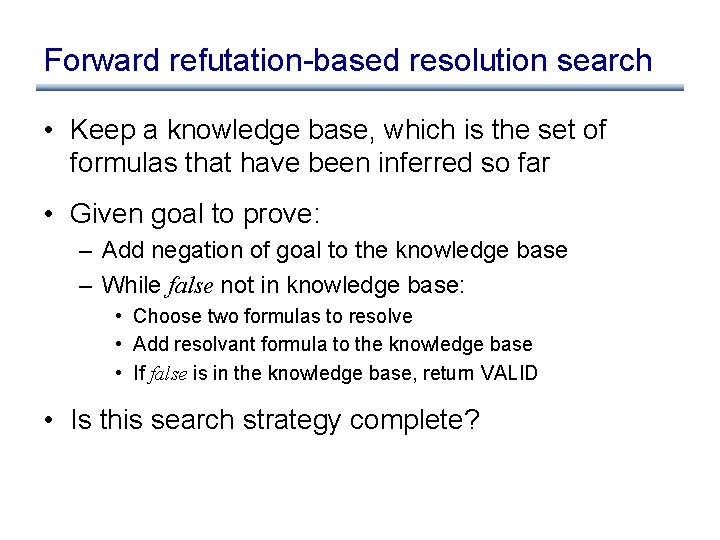
Forward refutation-based resolution search • Keep a knowledge base, which is the set of formulas that have been inferred so far • Given goal to prove: – Add negation of goal to the knowledge base – While false not in knowledge base: • Choose two formulas to resolve • Add resolvant formula to the knowledge base • If false is in the knowledge base, return VALID • Is this search strategy complete?
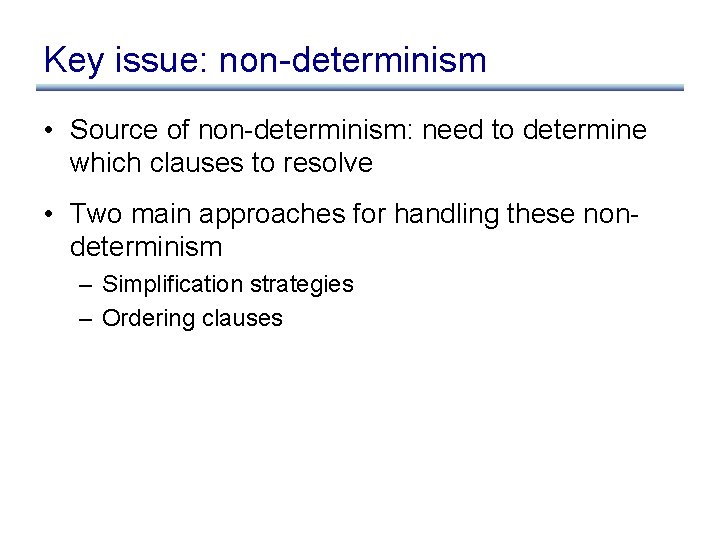
Key issue: non-determinism • Source of non-determinism: need to determine which clauses to resolve • Two main approaches for handling these nondeterminism – Simplification strategies – Ordering clauses
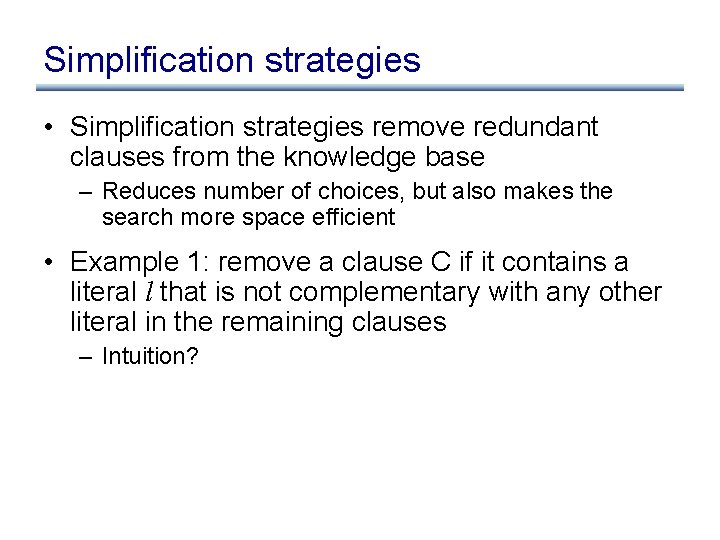
Simplification strategies • Simplification strategies remove redundant clauses from the knowledge base – Reduces number of choices, but also makes the search more space efficient • Example 1: remove a clause C if it contains a literal l that is not complementary with any other literal in the remaining clauses – Intuition?
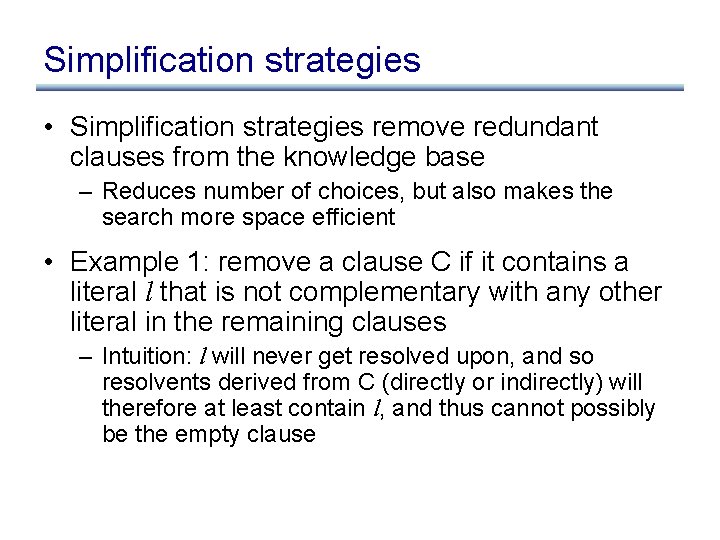
Simplification strategies • Simplification strategies remove redundant clauses from the knowledge base – Reduces number of choices, but also makes the search more space efficient • Example 1: remove a clause C if it contains a literal l that is not complementary with any other literal in the remaining clauses – Intuition: l will never get resolved upon, and so resolvents derived from C (directly or indirectly) will therefore at least contain l, and thus cannot possibly be the empty clause
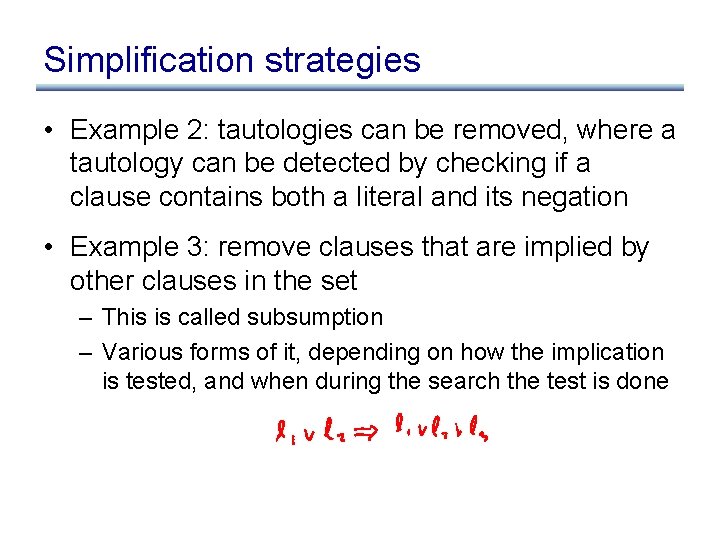
Simplification strategies • Example 2: tautologies can be removed, where a tautology can be detected by checking if a clause contains both a literal and its negation • Example 3: remove clauses that are implied by other clauses in the set – This is called subsumption – Various forms of it, depending on how the implication is tested, and when during the search the test is done
Ordering (clause selection) strategies • A good clause selection strategy is critical for finding proofs efficiently • Many ways to order clauses… • Just the E theorem prover (which won various automated theorem proving competitions) implements over 60 predefined clause selection schemes
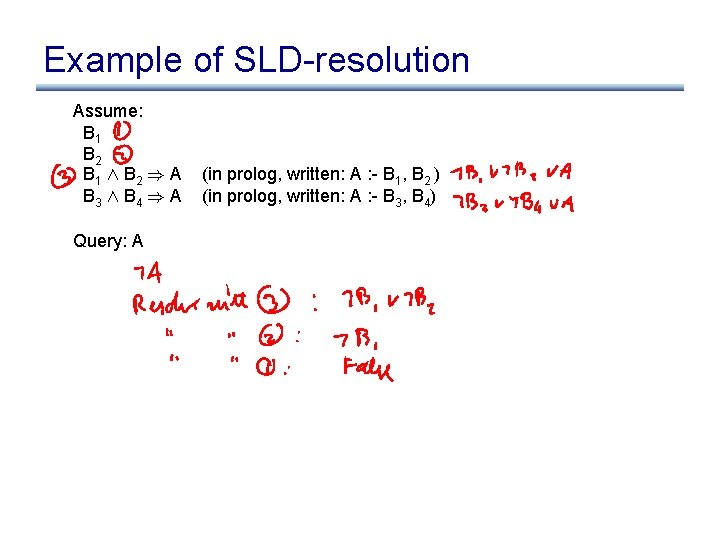
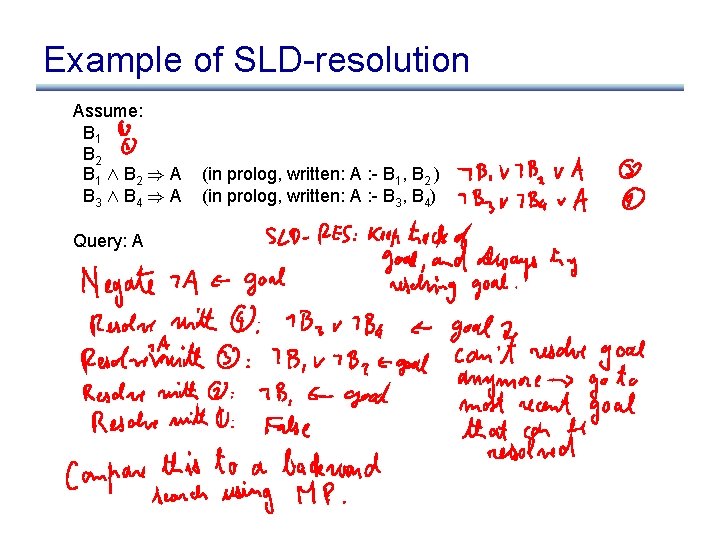
Ordering (clause selection) strategies • Favor small clauses first, an instance of which is the idea of favoring one-literal clauses (unit resolution) • Favor old clauses – Corresponds to a FIFO order and leads to a breadth first ordering • Opposite strategy: always resolve the newest resolvent, which leads to a depth first search – Such strategies are called linear strategies because they create a linear chain of resolvents, each produced from the previous one – One such strategy, called SLD-resolution is at the core of Prolog
Example of SLD-resolution Assume: B 1 B 2 B 1 Æ B 2 ) A B 3 Æ B 4 ) A Query: A (in prolog, written: A : - B 1, B 2 ) (in prolog, written: A : - B 3, B 4)
Example of SLD-resolution Assume: B 1 B 2 B 1 Æ B 2 ) A B 3 Æ B 4 ) A Query: A (in prolog, written: A : - B 1, B 2 ) (in prolog, written: A : - B 3, B 4)
Another issue: finding complementary lits • Efficient data structures have been devised for efficiently finding complementary terms • Graph based data structure of Kowalski – Complementary literals connected with graph edges – When a resolvent is added, use existing edges in the graph to add the appropriate new edges • Indexing is another technique for efficiently determining which clauses to resolve – For example, answer queries such as: given a literal l, return all clauses that contain literals that unify with : l
First-order resolution • So far, we’ve seen propositional resolution • Now we’ll take look at the first-order case • However, before we do that, let’s take a detour to see a new technique for handling universal quantifiers in axioms: unification
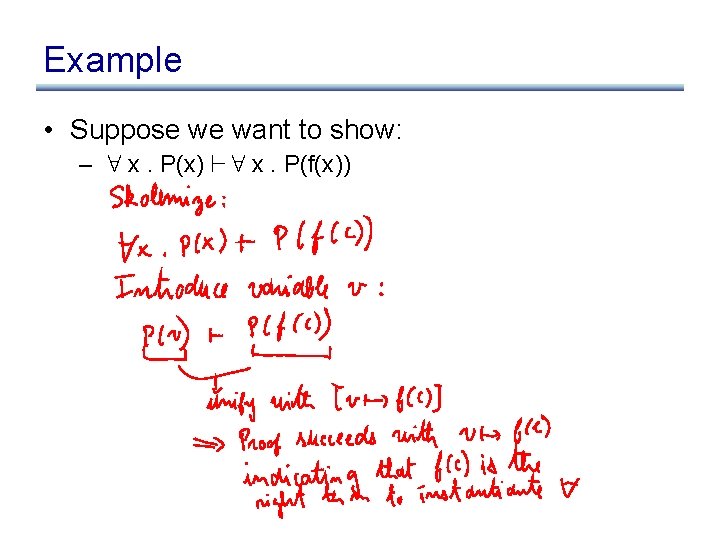
Universals with unification • Given a universal axiom, our goal is to instantiate the universal with the right term t • Key idea – Instead of determining immediately what term to instantiate the universal, introduce a new fresh variable v which stands for the term t – At later stages in the proof, the variable v is gradually constrained until either its value is known, in which case the proof succeeds, or the system determines that no value for v is appropriate, in which case the proof fails – The constraints arise from unification
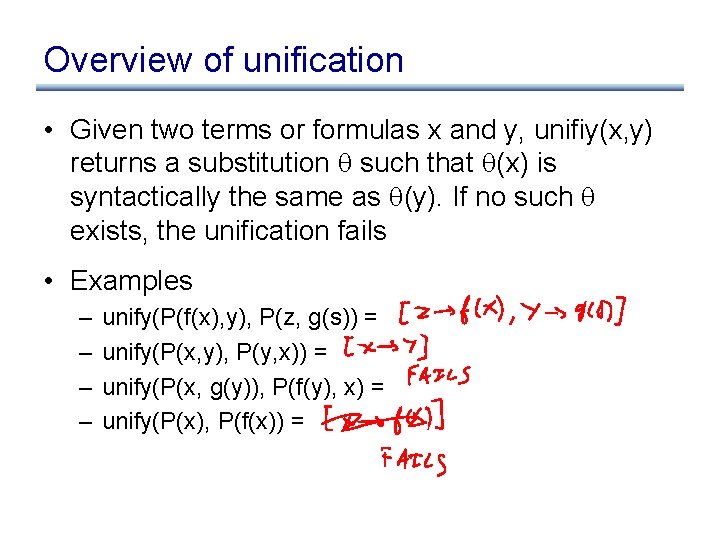
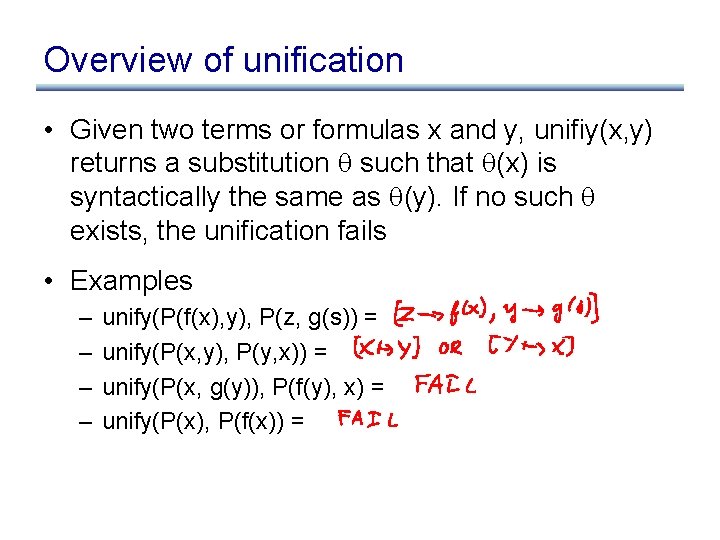
Overview of unification • Given two terms or formulas x and y, unifiy(x, y) returns a substitution such that (x) is syntactically the same as (y). If no such exists, the unification fails • Examples – – unify(P(f(x), y), P(z, g(s)) = unify(P(x, y), P(y, x)) = unify(P(x, g(y)), P(f(y), x) = unify(P(x), P(f(x)) =
Overview of unification • Given two terms or formulas x and y, unifiy(x, y) returns a substitution such that (x) is syntactically the same as (y). If no such exists, the unification fails • Examples – – unify(P(f(x), y), P(z, g(s)) = unify(P(x, y), P(y, x)) = unify(P(x, g(y)), P(f(y), x) = unify(P(x), P(f(x)) =
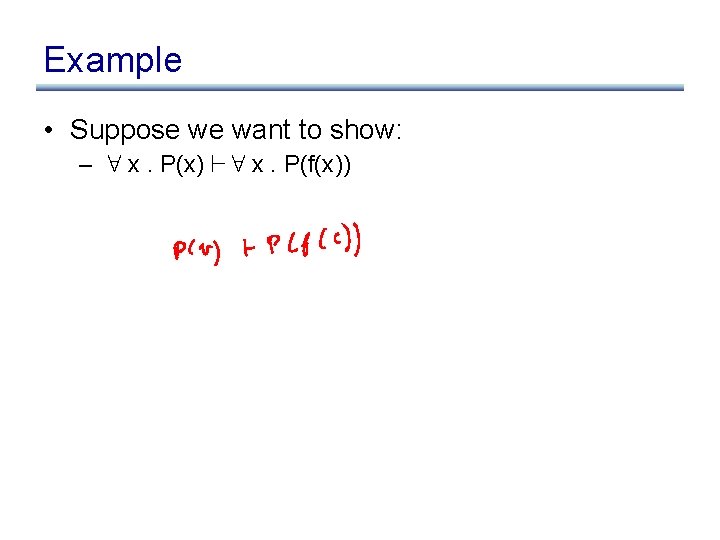
Example • Suppose we want to show: – 8 x. P(x) ` 8 x. P(f(x))
Example • Suppose we want to show: – 8 x. P(x) ` 8 x. P(f(x))
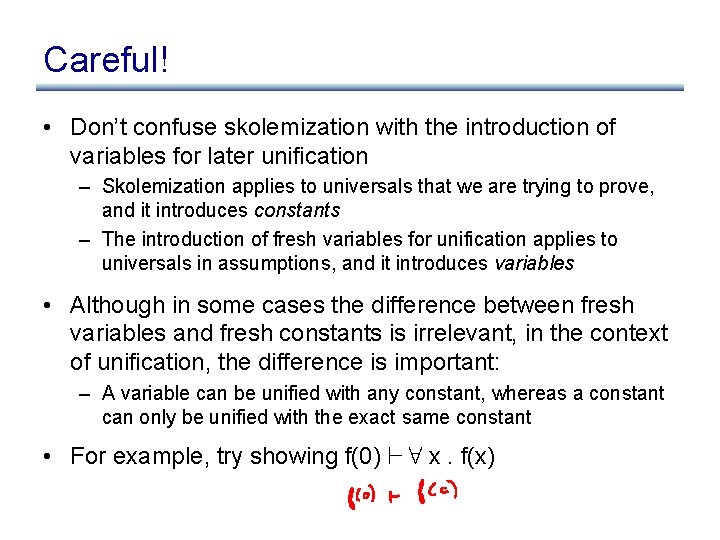
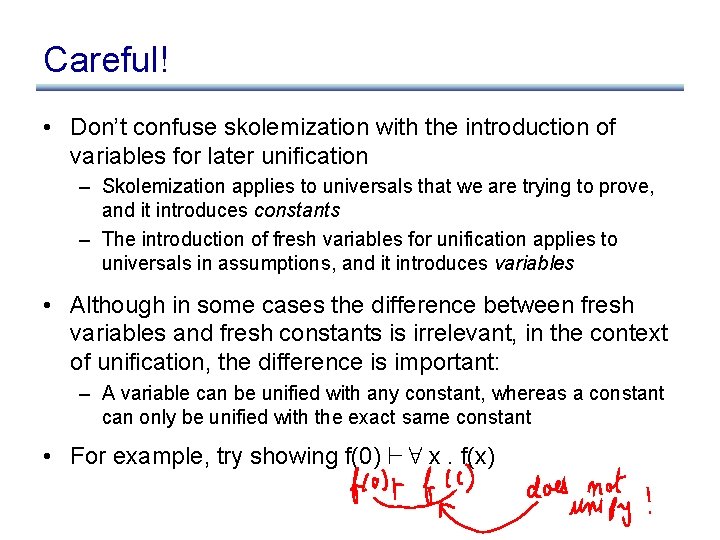
Careful! • Don’t confuse skolemization with the introduction of variables for later unification – Skolemization applies to universals that we are trying to prove, and it introduces constants – The introduction of fresh variables for unification applies to universals in assumptions, and it introduces variables • Although in some cases the difference between fresh variables and fresh constants is irrelevant, in the context of unification, the difference is important: – A variable can be unified with any constant, whereas a constant can only be unified with the exact same constant • For example, try showing f(0) ` 8 x. f(x)
Careful! • Don’t confuse skolemization with the introduction of variables for later unification – Skolemization applies to universals that we are trying to prove, and it introduces constants – The introduction of fresh variables for unification applies to universals in assumptions, and it introduces variables • Although in some cases the difference between fresh variables and fresh constants is irrelevant, in the context of unification, the difference is important: – A variable can be unified with any constant, whereas a constant can only be unified with the exact same constant • For example, try showing f(0) ` 8 x. f(x)
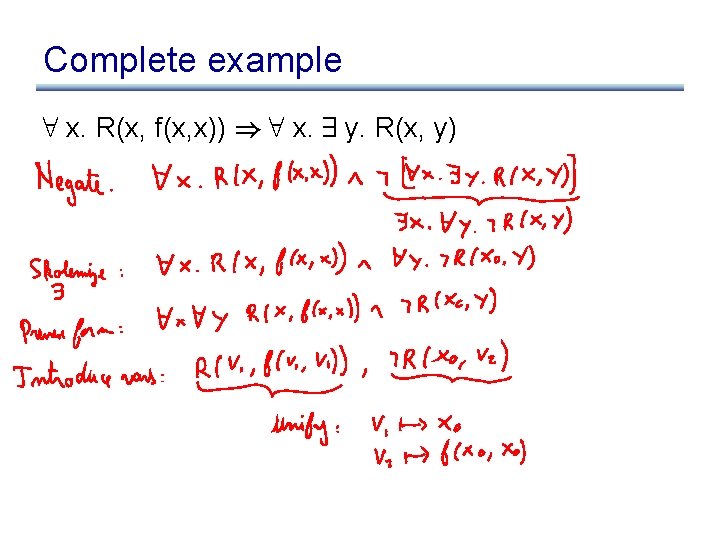
First-order resolution • We take the goal, negate it, and then: – We place the formula in prenex normal form, where quantifiers are on the outside – We remove existentials with skolemization (assumed existentials can be skolemized) • We are only left with universals, for which we introduce fresh variables, in the hope of doing unification later on
First-order resolution ` ÇlÇ ` Ç: lÇ ` Ç Ç Ç RES
First-order resolution ` ÇlÇ ` Ç: lÇ ` Ç Ç Ç = unify(l 1 , l 2 ) ` Ç l 1 Ç RES ` Ç : l 2 Ç Ç l 1 Ç and Ç : l 2 Ç have no common vars ` ( Ç Ç Ç ) GEN-RES
Simple example • P(a, b) Ç : Q(a, b, c) , : P(s, t) Ç R(s)
Simple example • P(a, b) Ç : Q(a, b, c) , : P(s, t) Ç R(s)
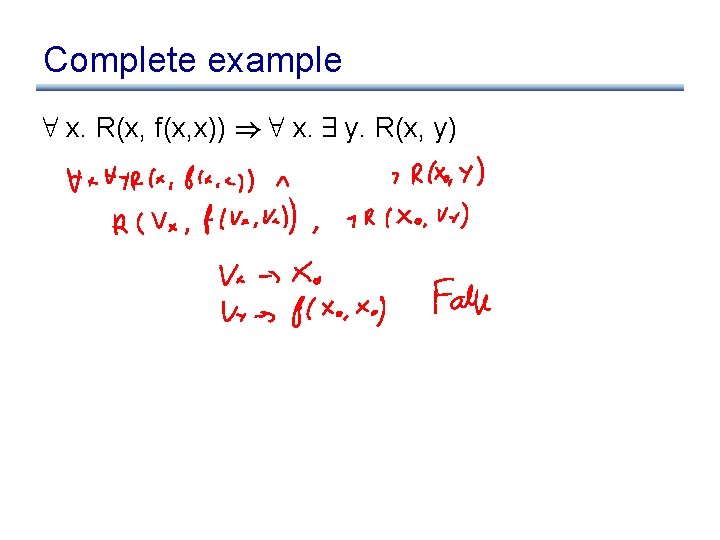
Complete example 8 x. R(x, f(x, x)) ) 8 x. 9 y. R(x, y)
Complete example 8 x. R(x, f(x, x)) ) 8 x. 9 y. R(x, y)
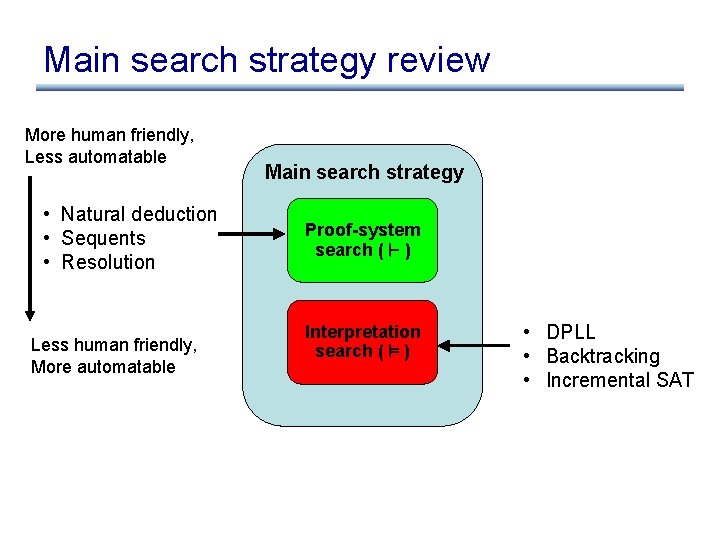
Main search strategy review More human friendly, Less automatable • Natural deduction • Sequents • Resolution Less human friendly, More automatable Main search strategy Proof-system search ( ` ) Interpretation search ( ² ) • DPLL • Backtracking • Incremental SAT