
Snowmass overview of Instrumentation Frontier Ulrich Heintz Brown
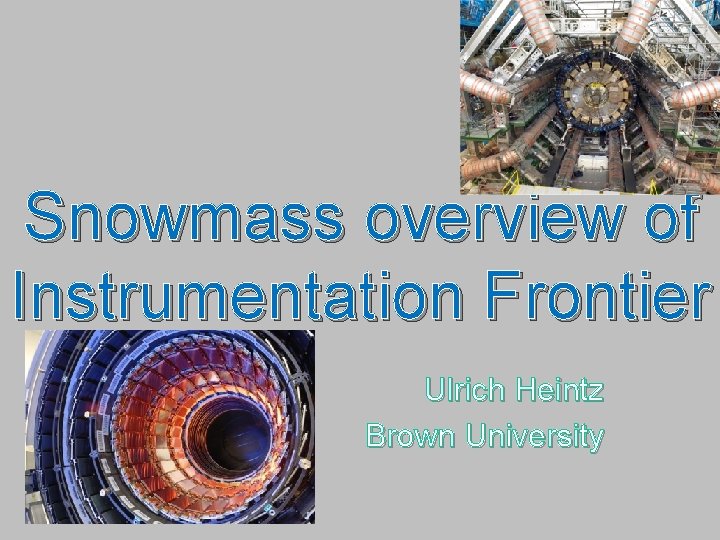
Snowmass overview of Instrumentation Frontier Ulrich Heintz Brown University
CPAD/Instrumentation Frontier • APS recognized that to continue our success at the energy frontier we need to make technical and scientific innovation a priority as a field – created the Coordinating Panel for Advanced Detectors (CPAD) to study strategic issues in instrumentation – included the “Instrumentation Frontier” as one of the central thrusts of the 2013 Snowmass process • Instrumentation Frontier meetings: – Argonne https: //indico. fnal. gov/conference. Time. Table. py? conf. Id=6050 – Boulder – 1/31/2014 https: //indico. fnal. gov/conference. Time. Table. py? conf. Id=6280 Minneapolis http: //www. hep. umn. edu/css 2013/ Ulrich Heintz - LPC 100 Te. V meeting 2
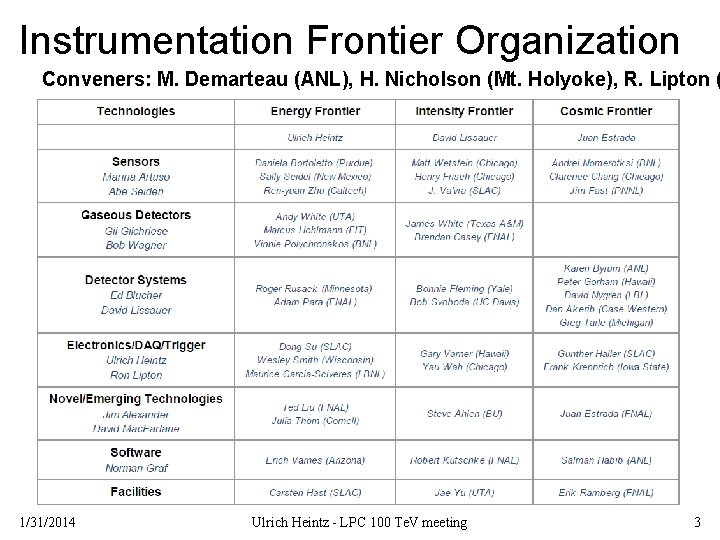
Instrumentation Frontier Organization Conveners: M. Demarteau (ANL), H. Nicholson (Mt. Holyoke), R. Lipton ( 1/31/2014 Ulrich Heintz - LPC 100 Te. V meeting 3
Instrumentation Frontier Goals • collected white papers (1 pagers) http: //www. snowmass 2013. org/tikiindex. php? page=Instrumentation+Frontier+Whitepapers • summary white papers covering – energy, intensity, and cosmic frontiers – each instrumentation topic • final report http: //inspirehep. net/record/1264617/ – identify R&D themes that transcend the frontiers – connect R&D to physics needs – in which areas can the US play a lead role? – how do we best exploit the facilities and resources we have? 1/31/2014 Ulrich Heintz - LPC 100 Te. V meeting 4
physics at the energy frontier • as beam energy increases, we are still looking at ewk scale phenomena involving W and Z bosons and their decay products • maintain acceptance to relatively soft particles • maintain large angular acceptance to minimize theoretical uncertainties and retain sensitivity to distinguish between different models should we find something new • superior spatial and time resolution for pattern recognition in high occupancy environment 1/31/2014 Ulrich Heintz - LPC 100 Te. V meeting 5
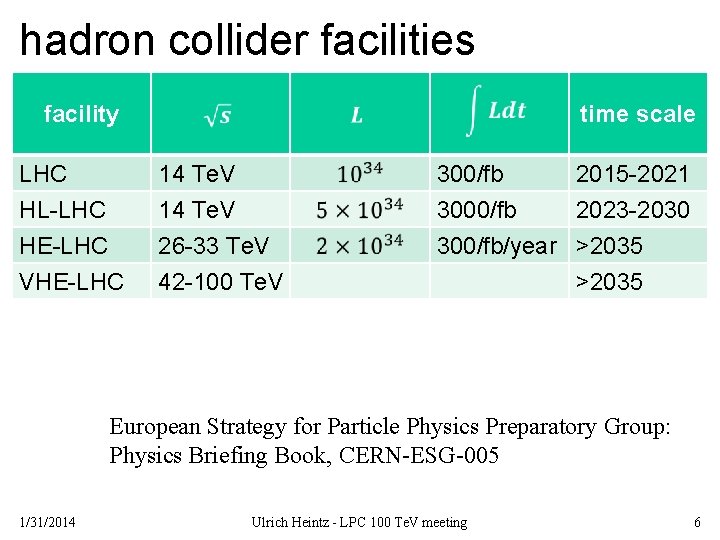
hadron collider facilities facility time scale LHC HL-LHC 14 Te. V 300/fb 3000/fb 2015 -2021 2023 -2030 HE-LHC VHE-LHC 26 -33 Te. V 42 -100 Te. V 300/fb/year >2035 European Strategy for Particle Physics Preparatory Group: Physics Briefing Book, CERN-ESG-005 1/31/2014 Ulrich Heintz - LPC 100 Te. V meeting 6
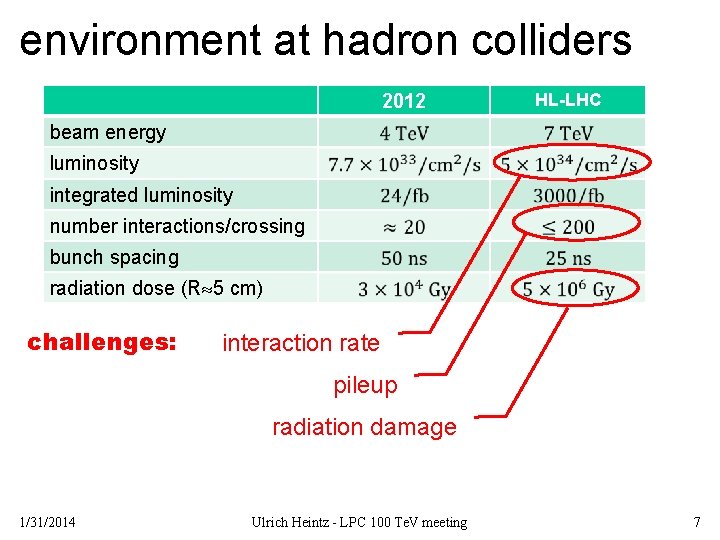
environment at hadron colliders 2012 HL-LHC beam energy luminosity integrated luminosity number interactions/crossing bunch spacing radiation dose (R 5 cm) challenges: interaction rate pileup radiation damage 1/31/2014 Ulrich Heintz - LPC 100 Te. V meeting 7
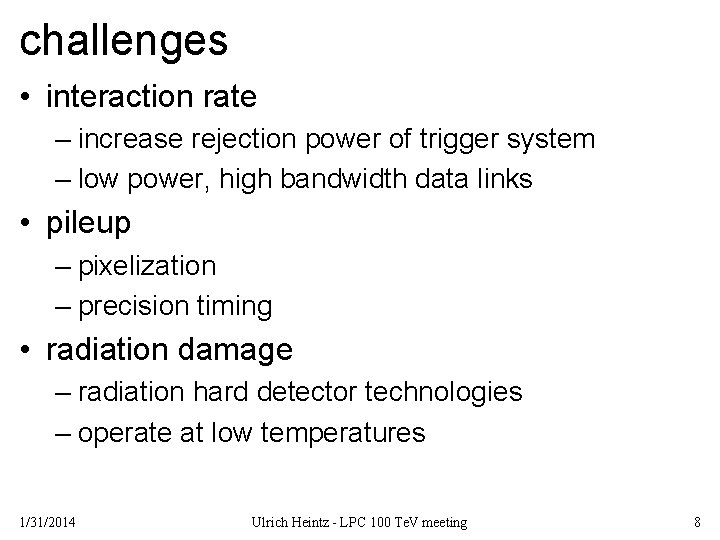
challenges • interaction rate – increase rejection power of trigger system – low power, high bandwidth data links • pileup – pixelization – precision timing • radiation damage – radiation hard detector technologies – operate at low temperatures 1/31/2014 Ulrich Heintz - LPC 100 Te. V meeting 8
next generation tracker features • high resolution in high rate environment – thin, highly pixelated sensors • time measurement (for pileup reduction) – thin, low capacitance sensors • radiation hard (LHC fluence 2 x 1016 cm-2) – operate at low temperature – small depletion depth – materials other than silicon • low mass – thin sensors • power for increased channel count and speed – multipurpose support structure – more efficient cooling 1/31/2014 Ulrich Heintz - LPC 100 Te. V meeting 9
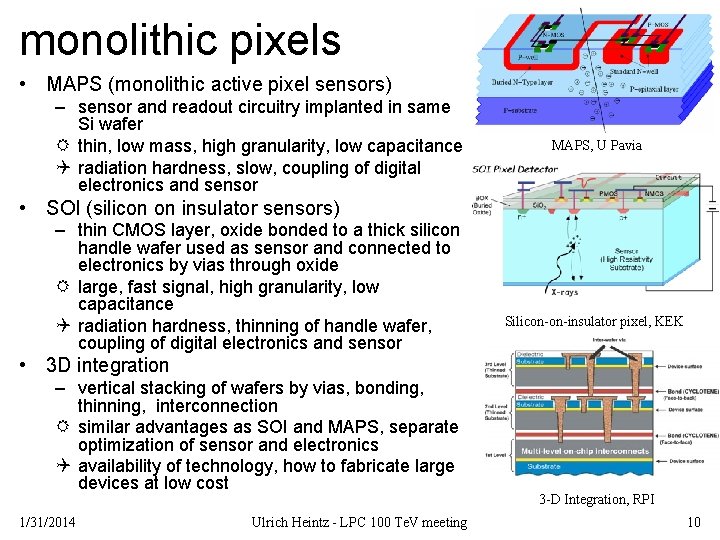
monolithic pixels • MAPS (monolithic active pixel sensors) – sensor and readout circuitry implanted in same Si wafer thin, low mass, high granularity, low capacitance radiation hardness, slow, coupling of digital electronics and sensor MAPS, U Pavia • SOI (silicon on insulator sensors) – thin CMOS layer, oxide bonded to a thick silicon handle wafer used as sensor and connected to electronics by vias through oxide large, fast signal, high granularity, low capacitance radiation hardness, thinning of handle wafer, coupling of digital electronics and sensor Silicon-on-insulator pixel, KEK • 3 D integration – vertical stacking of wafers by vias, bonding, thinning, interconnection similar advantages as SOI and MAPS, separate optimization of sensor and electronics availability of technology, how to fabricate large devices at low cost 1/31/2014 Ulrich Heintz - LPC 100 Te. V meeting 3 -D Integration, RPI 10
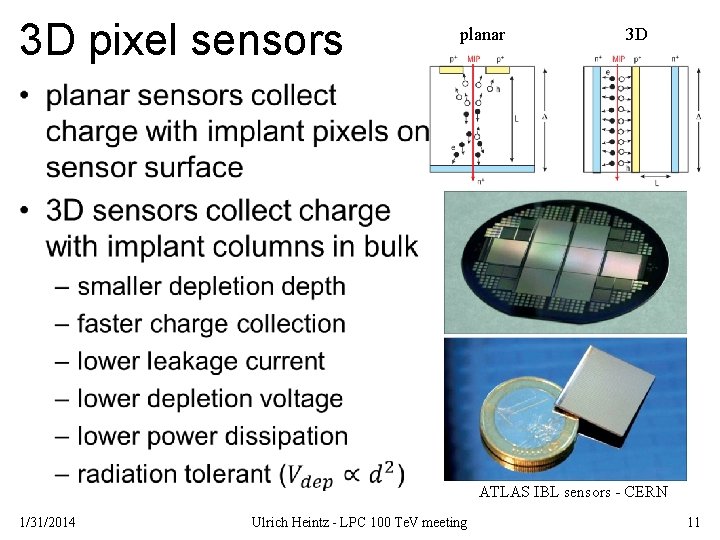
3 D pixel sensors planar 3 D • ATLAS IBL sensors - CERN 1/31/2014 Ulrich Heintz - LPC 100 Te. V meeting 11
diamond sensors • chemical vapor deposition (CVD) diamond – band gap 5. 5 e. V (silicon: 1. 1 e. V) – displacement energy 42 e. V/atom (silicon: 15 e. V) – only 60% as many charge carriers as silicon – radiation tolerant – low Z – do not require extensive cooling • issues – availability • currently two viable industrial suppliers – small signal – reduced charge collection after irradiation 1/31/2014 Ulrich Heintz - LPC 100 Te. V meeting 12
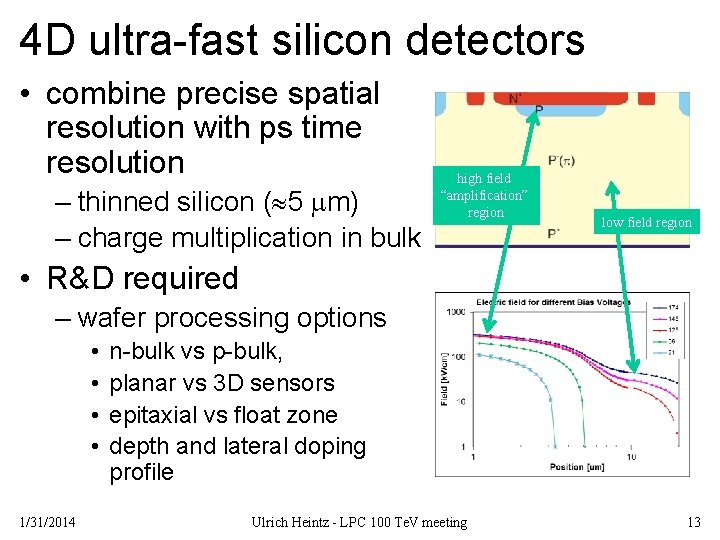
4 D ultra-fast silicon detectors • combine precise spatial resolution with ps time resolution – thinned silicon ( 5 m) – charge multiplication in bulk high field “amplification” region low field region • R&D required – wafer processing options • • 1/31/2014 n-bulk vs p-bulk, planar vs 3 D sensors epitaxial vs float zone depth and lateral doping profile Ulrich Heintz - LPC 100 Te. V meeting 13
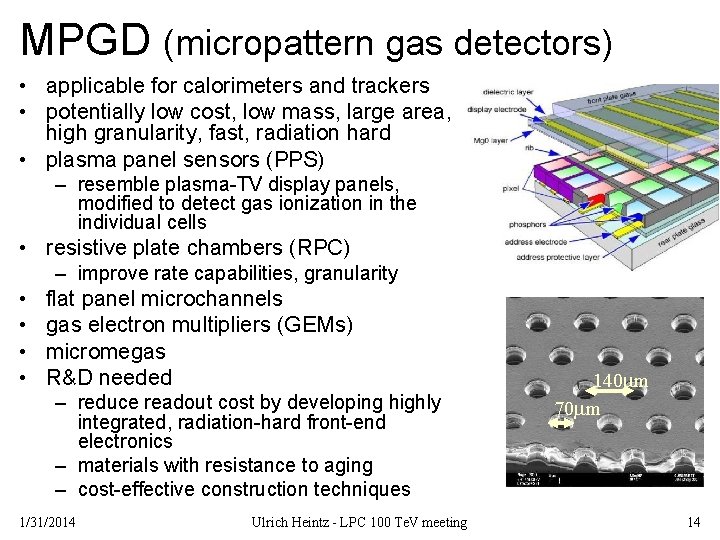
MPGD (micropattern gas detectors) • applicable for calorimeters and trackers • potentially low cost, low mass, large area, high granularity, fast, radiation hard • plasma panel sensors (PPS) – resemble plasma-TV display panels, modified to detect gas ionization in the individual cells • resistive plate chambers (RPC) – improve rate capabilities, granularity • • flat panel microchannels gas electron multipliers (GEMs) micromegas R&D needed – reduce readout cost by developing highly integrated, radiation-hard front-end electronics – materials with resistance to aging – cost-effective construction techniques 1/31/2014 Ulrich Heintz - LPC 100 Te. V meeting 140 m 70 m 14
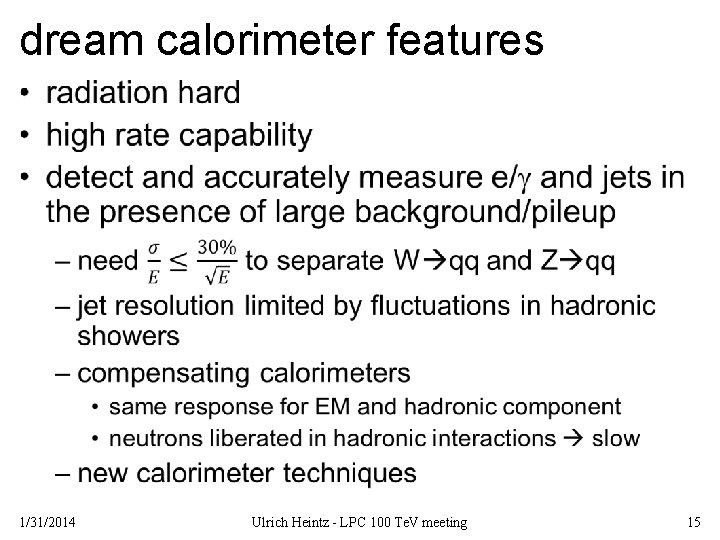
dream calorimeter features • 1/31/2014 Ulrich Heintz - LPC 100 Te. V meeting 15
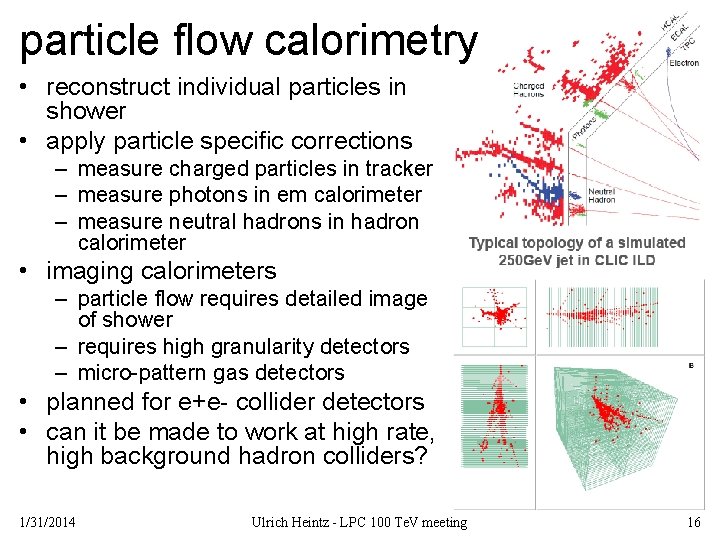
particle flow calorimetry • reconstruct individual particles in shower • apply particle specific corrections – measure charged particles in tracker – measure photons in em calorimeter – measure neutral hadrons in hadron calorimeter • imaging calorimeters – particle flow requires detailed image of shower – requires high granularity detectors – micro-pattern gas detectors • planned for e+e- collider detectors • can it be made to work at high rate, high background hadron colliders? 1/31/2014 Ulrich Heintz - LPC 100 Te. V meeting 16
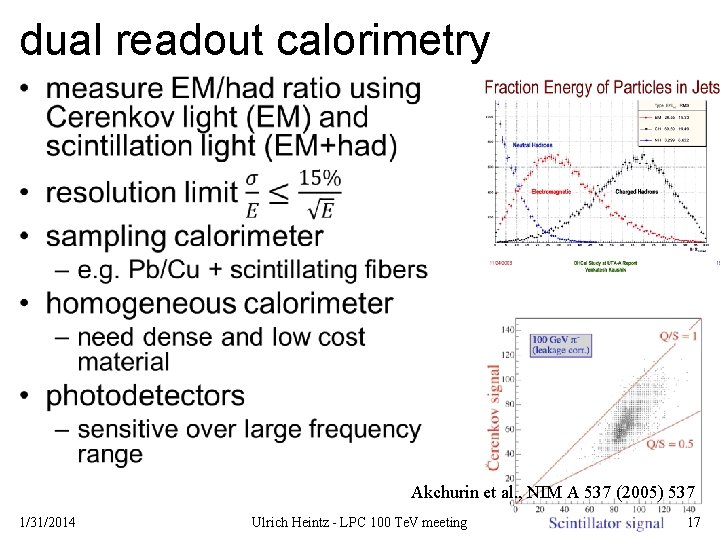
dual readout calorimetry • Akchurin et al. , NIM A 537 (2005) 537 1/31/2014 Ulrich Heintz - LPC 100 Te. V meeting 17
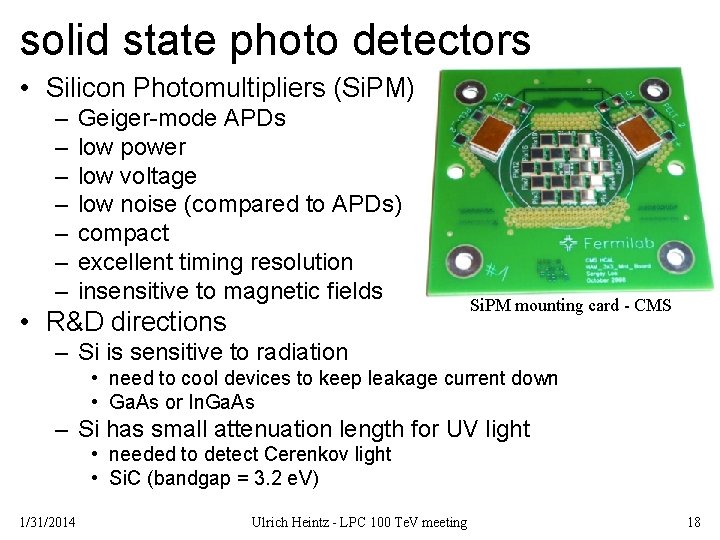
solid state photo detectors • Silicon Photomultipliers (Si. PM) – – – – Geiger-mode APDs low power low voltage low noise (compared to APDs) compact excellent timing resolution insensitive to magnetic fields • R&D directions Si. PM mounting card - CMS – Si is sensitive to radiation • need to cool devices to keep leakage current down • Ga. As or In. Ga. As – Si has small attenuation length for UV light • needed to detect Cerenkov light • Si. C (bandgap = 3. 2 e. V) 1/31/2014 Ulrich Heintz - LPC 100 Te. V meeting 18
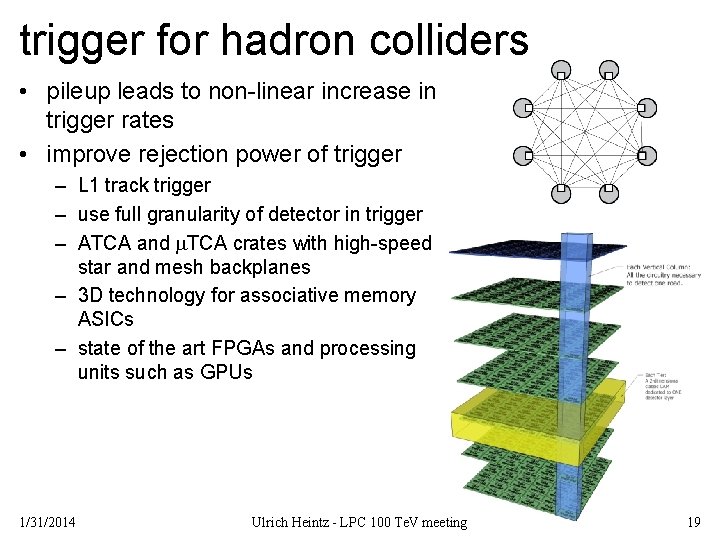
trigger for hadron colliders • pileup leads to non-linear increase in trigger rates • improve rejection power of trigger – L 1 track trigger – use full granularity of detector in trigger – ATCA and TCA crates with high-speed star and mesh backplanes – 3 D technology for associative memory ASICs – state of the art FPGAs and processing units such as GPUs 1/31/2014 Ulrich Heintz - LPC 100 Te. V meeting 19
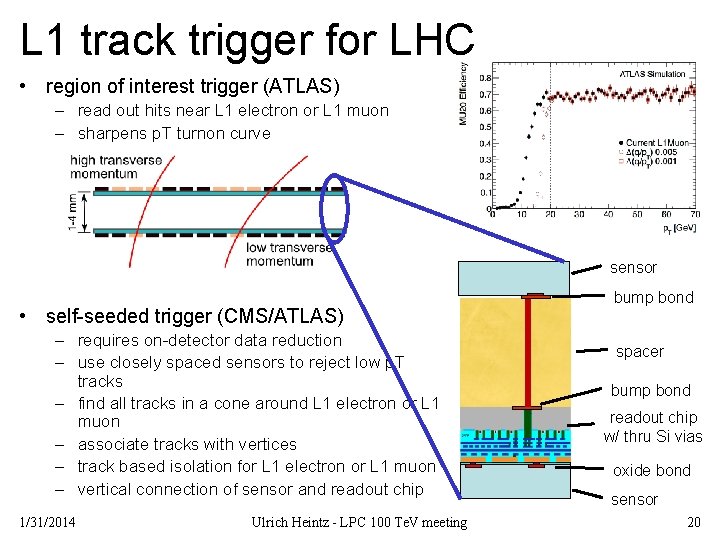
L 1 track trigger for LHC • region of interest trigger (ATLAS) – read out hits near L 1 electron or L 1 muon – sharpens p. T turnon curve sensor • self-seeded trigger (CMS/ATLAS) – requires on-detector data reduction – use closely spaced sensors to reject low p. T tracks – find all tracks in a cone around L 1 electron or L 1 muon – associate tracks with vertices – track based isolation for L 1 electron or L 1 muon – vertical connection of sensor and readout chip 1/31/2014 Ulrich Heintz - LPC 100 Te. V meeting bump bond spacer bump bond readout chip w/ thru Si vias oxide bond sensor 20
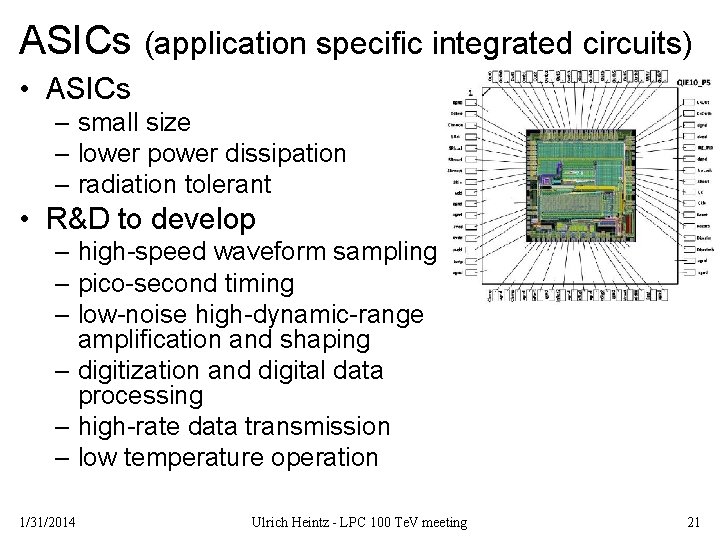
ASICs (application specific integrated circuits) • ASICs – small size – lower power dissipation – radiation tolerant • R&D to develop – high-speed waveform sampling – pico-second timing – low-noise high-dynamic-range amplification and shaping – digitization and digital data processing – high-rate data transmission – low temperature operation 1/31/2014 Ulrich Heintz - LPC 100 Te. V meeting 21
emerging technologies • graphene – high e mobility at room temperature – high thermal conductivity – strength and rigidity at low mass – applications: integrated circuits, switching optical devices (modulators) • silicene – similar to graphene – based on silicon • amorphous nanocrystalline thin-film silicon – radiation hard – low cost – incorporate nanocrystalls of crystalline silicon to achieve detector grade properties 1/31/2014 Ulrich Heintz - LPC 100 Te. V meeting 22
conclusion • in order to realize our physics goals, we need to invest in technology R&D • the challenges at energy frontier facilities will be substantial • there are many ideas for instrumentation that can address these challenges • we need put in place a funding structure that enables detector R&D 1/31/2014 Ulrich Heintz - LPC 100 Te. V meeting 23
- Slides: 23