
Snowed Up Who is the Author Feminine Desire
- Slides: 20
“Snowed Up”: Who is the Author? Feminine Desire vs. Patriarchal and Class Relations
Outline--“Snowed Up” Ü General Introduction Ü Questions Ü Author (1): The Snow: its Influences on the Others and Edith Ü Author (2): Characters in Binary Opposition -The Issues of Class Ü Patriarchal Control Ü Author (3): Edith’s Position and Desire Ü Author (4): Historical Backgrounds Ü Summary Ü Reference
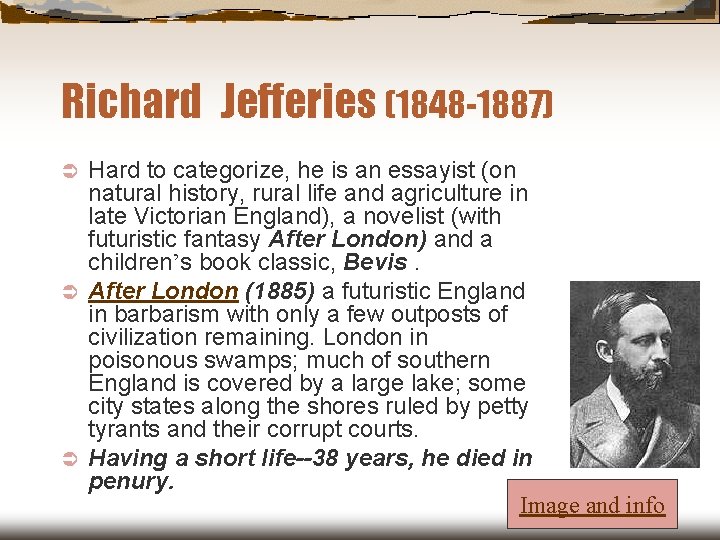
Richard Jefferies (1848 -1887) Hard to categorize, he is an essayist (on natural history, rural life and agriculture in late Victorian England), a novelist (with futuristic fantasy After London) and a children’s book classic, Bevis. Ü After London (1885) a futuristic England in barbarism with only a few outposts of civilization remaining. London in poisonous swamps; much of southern England is covered by a large lake; some city states along the shores ruled by petty tyrants and their corrupt courts. Ü Having a short life--38 years, he died in penury. Image and info Ü
Snowed Up Ü The story was sent to ”London Society” once for publication but was rejected. Ü The manuscript was ’probably’ purchased by Sir Hugh Walpole at Sotheby’s, or from a bookseller, during 1920 or early 1930 s. It has, since Walpole’s generous donation, remained in the Walpole’s collection at King’s school. Ü With inconsistencies and gaps—reasons unknown (intended or due to health)
“Snowed Up” Who is the author, the snow, Edie, Richard Jeffries or … ? What gets "snowed up" in the story? 2. What are the binary opposites in the story? 3. Edie’s subject position: 1. • • How is Edie related to the men around her? What do you think about the ending? Is
Author I: The Snow -- Disturbing Social Hierarch and Testing Humanity The Characters’ Views, its Influences and Implications
The Minor Characters: The Helpless and Helpful 1) Lord B: rich aristocrat 1/5 -- courting E. with his "poor shivering ancient body“; the snow as his best friend to imprison him with her (22); half silly with fright (23) 1/14 – completely helpless 2) Papa, cynical—poor landed gentry 1/5 a judgment on human venture to the North Pole 3) Mr. Thrigg – the newly rich 1/5 -- "I shall perish with an angel!“; Not good at using metaphors; 1/6 – in despair, afraid of losing his business; regret how he could have made a fortune 1/14 – helping in the kitchen (23 -24) There’s some good in him.
The Other People: Physical Force vs. Courage Mostly helpless: 1/14 -- All the servants left but the maid, papa an invalid, Bilberton helpless; Thrigg trapped in snow; 1/17 -- Papa and the Alderman may die. Brutal Force and Basic Survival: 1/14 -- the arrival of Phillip and his brutal threat (25) Ü 1/15 -- eat the cat (“the gentlemen dined on my Persian cat. ”) Courage: Philip is the only one active to get food.
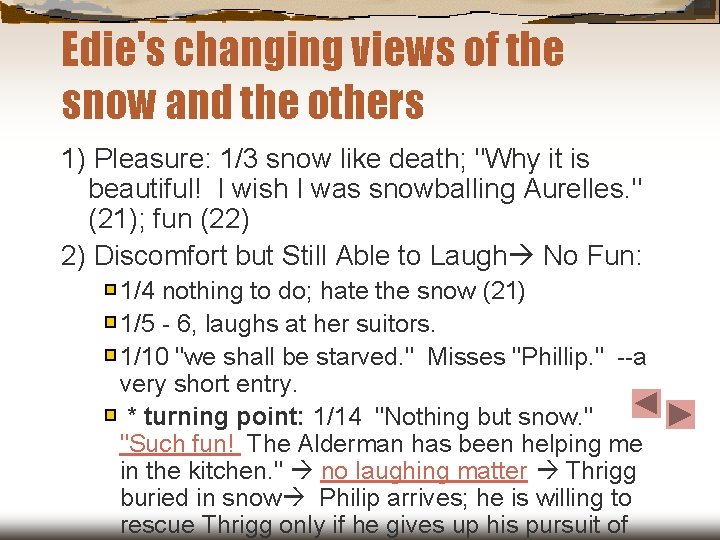
Edie's changing views of the snow and the others 1) Pleasure: 1/3 snow like death; "Why it is beautiful! I wish I was snowballing Aurelles. " (21); fun (22) 2) Discomfort but Still Able to Laugh No Fun: 1/4 nothing to do; hate the snow (21) 1/5 - 6, laughs at her suitors. 1/10 "we shall be starved. " Misses "Phillip. " --a very short entry. * turning point: 1/14 "Nothing but snow. " "Such fun! The Alderman has been helping me in the kitchen. " no laughing matter Thrigg buried in snow Philip arrives; he is willing to rescue Thrigg only if he gives up his pursuit of
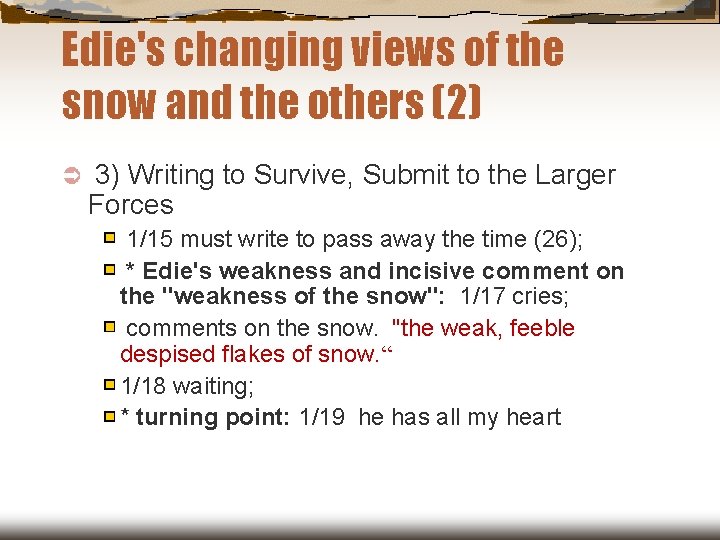
Edie's changing views of the snow and the others (2) Writing to Survive, Submit to the Larger Forces Ü 3) 1/15 must write to pass away the time (26); * Edie's weakness and incisive comment on the "weakness of the snow": 1/17 cries; comments on the snow. "the weak, feeble despised flakes of snow. “ 1/18 waiting; * turning point: 1/19 he has all my heart
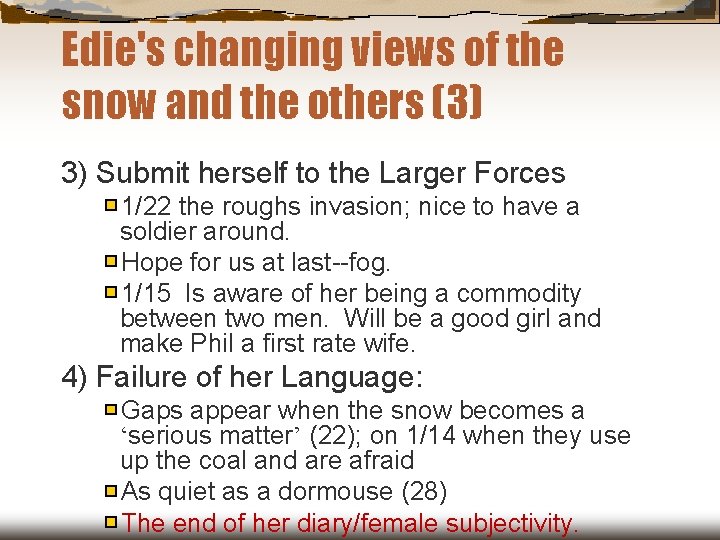
Edie's changing views of the snow and the others (3) 3) Submit herself to the Larger Forces 1/22 the roughs invasion; nice to have a soldier around. Hope for us at last--fog. 1/15 Is aware of her being a commodity between two men. Will be a good girl and make Phil a first rate wife. 4) Failure of her Language: Gaps appear when the snow becomes a ‘serious matter’ (22); on 1/14 when they use up the coal and are afraid As quiet as a dormouse (28) The end of her diary/female subjectivity.
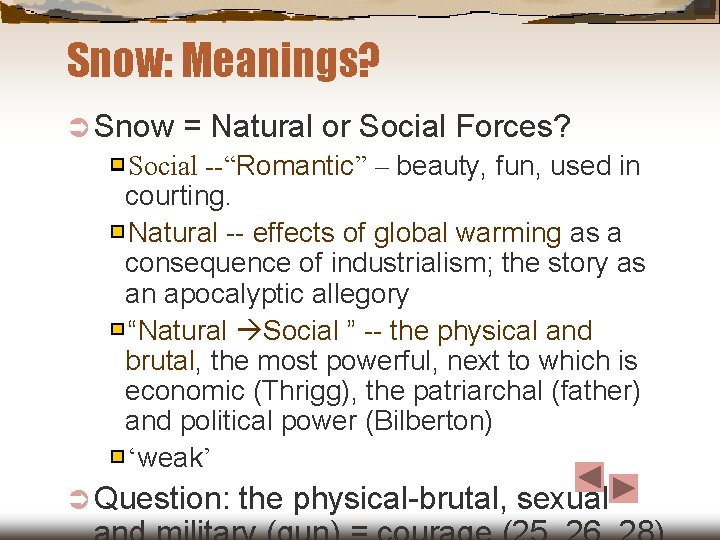
Snow: Meanings? Ü Snow = Natural or Social Forces? Social --“Romantic” – beauty, fun, used in courting. Natural -- effects of global warming as a consequence of industrialism; the story as an apocalyptic allegory “Natural Social ” -- the physical and brutal, the most powerful, next to which is economic (Thrigg), the patriarchal (father) and political power (Bilberton) ‘weak’ Ü Question: the physical-brutal, sexual
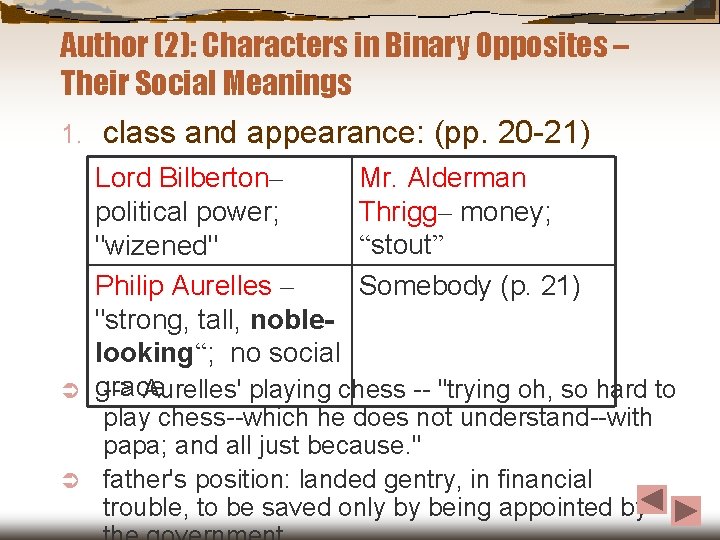
Author (2): Characters in Binary Opposites – Their Social Meanings 1. class and appearance: (pp. 20 -21) Ü Lord Bilberton– Mr. Alderman Thrigg– money; political power; “stout” "wizened" Philip Aurelles – Somebody (p. 21) "strong, tall, noblelooking“; no social grace --> Aurelles' playing chess -- "trying oh, so hard to play chess--which he does not understand--with papa; and all just because. " Ü father's position: landed gentry, in financial trouble, to be saved only by being appointed by
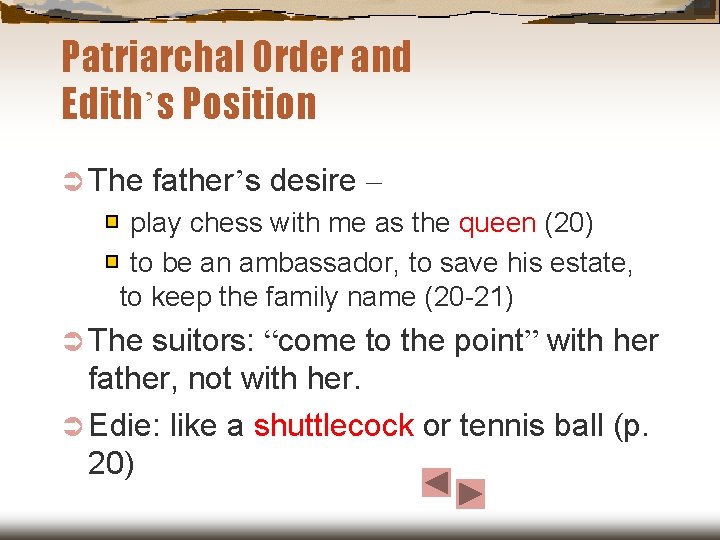
Patriarchal Order and Edith’s Position Ü The father’s desire – play chess with me as the queen (20) to be an ambassador, to save his estate, to keep the family name (20 -21) Ü The suitors: “come to the point” with her father, not with her. Ü Edie: like a shuttlecock or tennis ball (p. 20)
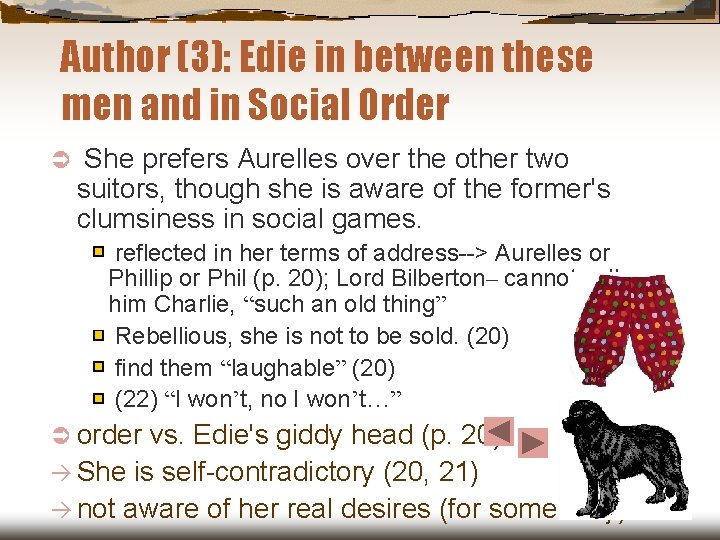
Author (3): Edie in between these men and in Social Order Ü She prefers Aurelles over the other two suitors, though she is aware of the former's clumsiness in social games. reflected in her terms of address--> Aurelles or Phillip or Phil (p. 20); Lord Bilberton– cannot call him Charlie, “such an old thing” Rebellious, she is not to be sold. (20) find them “laughable” (20) (22) “I won’t, no I won’t…” Ü order vs. Edie's giddy head (p. 20) She is self-contradictory (20, 21) not aware of her real desires (for somebody)
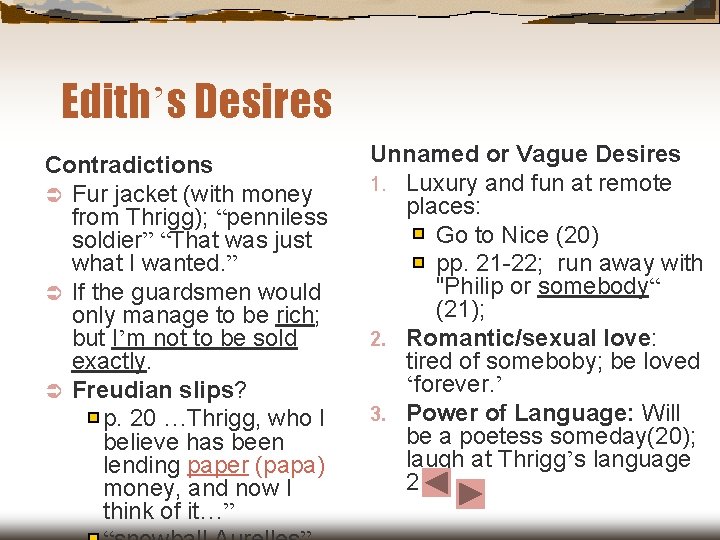
Edith’s Desires Contradictions Ü Fur jacket (with money from Thrigg); “penniless soldier” “That was just what I wanted. ” Ü If the guardsmen would only manage to be rich; but I’m not to be sold exactly. Ü Freudian slips? p. 20 …Thrigg, who I believe has been lending paper (papa) money, and now I think of it…” Unnamed or Vague Desires 1. Luxury and fun at remote places: Go to Nice (20) pp. 21 -22; run away with "Philip or somebody“ (21); 2. Romantic/sexual love: tired of someboby; be loved ‘forever. ’ 3. Power of Language: Will be a poetess someday(20); laugh at Thrigg’s language 21
Author (4): Historical Backgrounds Jeffries –tries to get “Disraeli’s endorsement”; wins public attention through becoming an authority on agricultural economy (though he is not really equipped with the knowledge). (textbook p. 33) Ü Expresses anti-Darwinism and theories of social degeneration (in the tradition of Hardy, Wells, Forster and Woolf—Lawrence, too). (34) Ü around 1870’s –national pride and fears Ü 1875年時, 埃及蘇丹破產, 拋售埃及所持有的Suez Canal 運河股 權; 英國首相狄斯累利(Disraeli)將它買下 “the absent presence of national anxieties” in 1870's: over the wars, the end of protected market which opened Britain to the import of foreign goods, over whether the nation can still dominate the world market
“Snowed Up”: Contradictions Embodied in Phillip and Edie Ü Although Jeffries writes a cautionary take about what happens when society is deprived of technological support (e. g. transportation), there also appears to be an unarticulated desire for such a catastrophe to occur, a desire for devastation and for subversion. Ü [He expresses] liberal anxiety but also a reactionary 'back to nature' impulse. (Meynard 139) Ü Back to social patriarchal order
Summary: Theoretical Issues Ü Authors -- Factors influencing/forming our personalities: Childhood (development of sexuality, Oedipus complex, incest taboo) repression and re-channeling of desire (reactionary symptoms, neurosis, psychosis, sublimation, need-demanddesire) Unstable and insatiable desire Entry into the Imaginary order and then the Symbolic order; Sense of lack and splitting of identity
References Ü Maynard, Jessica. “A Marxist Reading of 'Snowed Up. ‘” Literary theories : a case study in critical performance. Eds. Julian Wolfreys and William Baker. London : Macmillan Press Ltd , 1996