
SNOW MONITORING USING GNSSR TECHNIQUES N RodriguezAlvarez A


- Slides: 16
SNOW MONITORING USING GNSS-R TECHNIQUES N. Rodriguez-Alvarez§, A. Aguasca§ , E. Valencia§, X. Bosch-Lluis§, I. Ramos-Perez§, H. Park §, A. Camps§∞, M. Vall-llossera§∞ §Remote Sensing Lab, Dept. TSC, Building D 3, Universitat Politècnica de Catalunya, Barcelona, Spain and IEEC CRAE/UPC ∞SMOS-Barcelona Expert Centre, Barcelona, Spain Tel. +34934054664, E-08034 Barcelona, Spain. E-mail: nereida@tsc. upc. edu IGARSS’ 11 – Vancouver, Canada, 24 th -29 th July 2011 FR 4. T 05: GNSS Remote Sensing in Atmosphere, Ocean and Hydrology II
SNOW MONITORING USING GNSS-R TECHNIQUES INDEX 1. INTRODUCTION 2. THE SMIGOL REFLECTOMETER 3. FUNDAMENTALS OF THE INTERFERENCE PATTERN TECHNIQUE 4. FIELD EXPERIMENT 5. RESULTS 6. CONCLUSIONS 7. ACKNOWLEDGEMENTS © R. S. Lab, UPC 2011. IGARSS 2011, Vancouver, Canada, 24 th-29 th July 2011 (1/14)
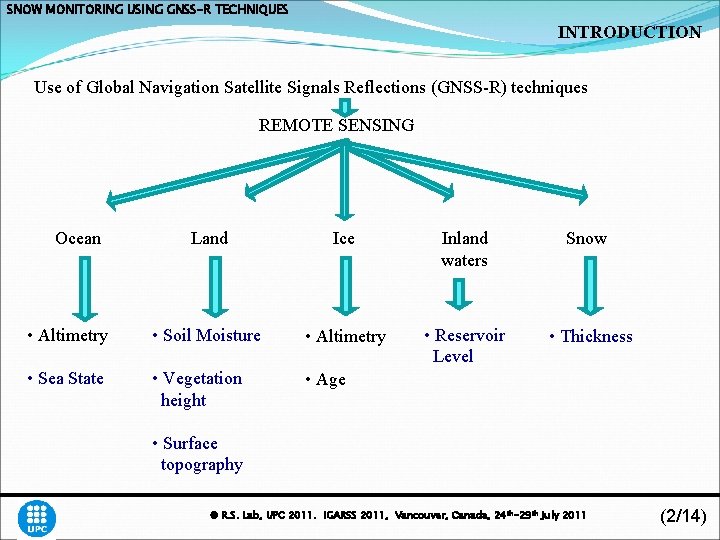
SNOW MONITORING USING GNSS-R TECHNIQUES INTRODUCTION Use of Global Navigation Satellite Signals Reflections (GNSS-R) techniques REMOTE SENSING Ocean Land Ice Inland waters Snow • Altimetry • Soil Moisture • Altimetry • Reservoir Level • Thickness • Sea State • Vegetation height • Age • Surface topography © R. S. Lab, UPC 2011. IGARSS 2011, Vancouver, Canada, 24 th-29 th July 2011 (2/14)
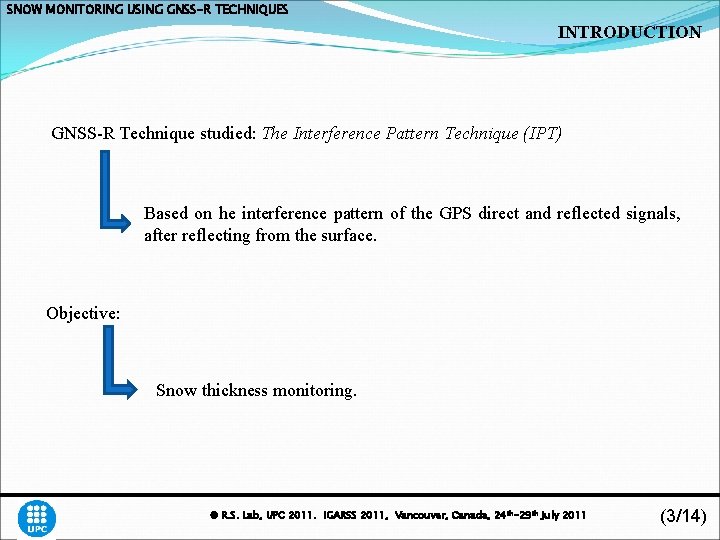
SNOW MONITORING USING GNSS-R TECHNIQUES INTRODUCTION GNSS-R Technique studied: The Interference Pattern Technique (IPT) Based on he interference pattern of the GPS direct and reflected signals, after reflecting from the surface. Objective: Snow thickness monitoring. © R. S. Lab, UPC 2011. IGARSS 2011, Vancouver, Canada, 24 th-29 th July 2011 (3/14)
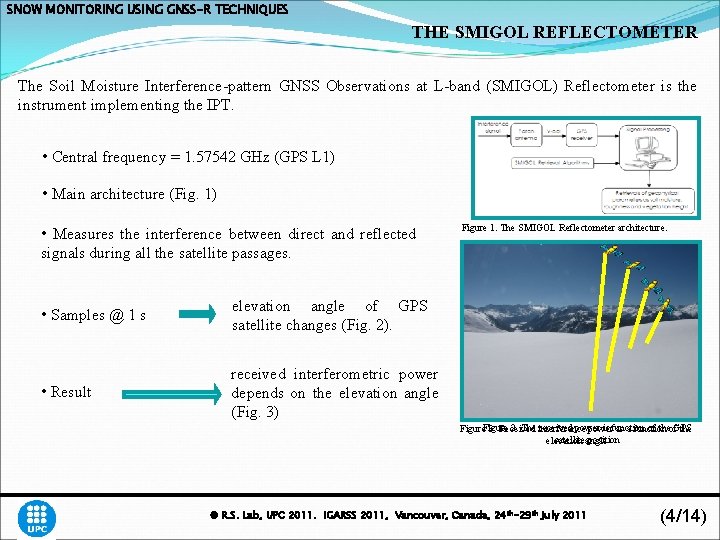
SNOW MONITORING USING GNSS-R TECHNIQUES THE SMIGOL REFLECTOMETER The Soil Moisture Interference-pattern GNSS Observations at L-band (SMIGOL) Reflectometer is the instrument implementing the IPT. • Central frequency = 1. 57542 GHz (GPS L 1) • Main architecture (Fig. 1) • Measures the interference between direct and reflected signals during all the satellite passages. • Samples @ 1 s elevation angle of GPS satellite changes (Fig. 2). • Result received interferometric power depends on the elevation angle (Fig. 3) Figure 1. The SMIGOL Reflectometer architecture. 2. The interference received power is function of theof. GPS Figure 3. Received power as a function the satelliteangle position elevation © R. S. Lab, UPC 2011. IGARSS 2011, Vancouver, Canada, 24 th-29 th July 2011 (4/14)
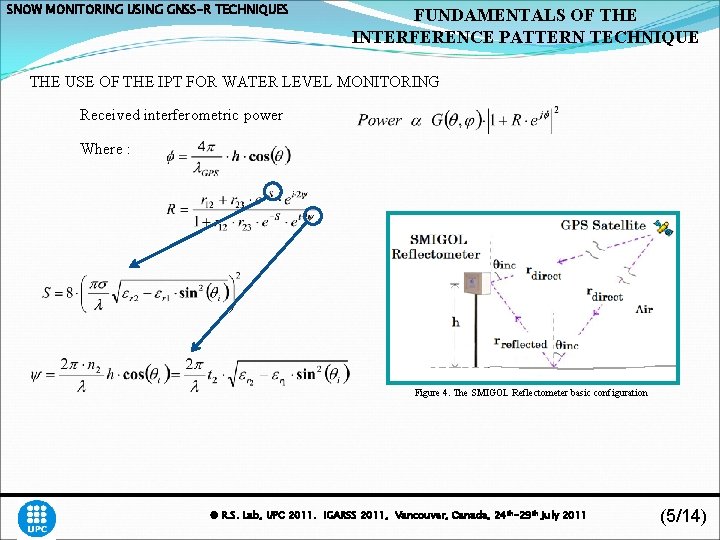
SNOW MONITORING USING GNSS-R TECHNIQUES FUNDAMENTALS OF THE INTERFERENCE PATTERN TECHNIQUE THE USE OF THE IPT FOR WATER LEVEL MONITORING Received interferometric power Where : Figure 4. The SMIGOL Reflectometer basic configuration © R. S. Lab, UPC 2011. IGARSS 2011, Vancouver, Canada, 24 th-29 th July 2011 (5/14)
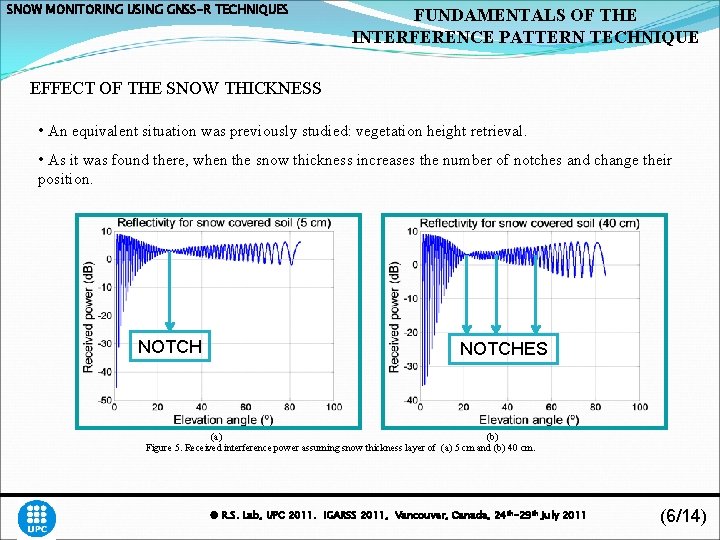
SNOW MONITORING USING GNSS-R TECHNIQUES FUNDAMENTALS OF THE INTERFERENCE PATTERN TECHNIQUE EFFECT OF THE SNOW THICKNESS • An equivalent situation was previously studied: vegetation height retrieval. • As it was found there, when the snow thickness increases the number of notches and change their position. NOTCHES (a) (b) Figure 5. Received interference power assuming snow thickness layer of (a) 5 cm and (b) 40 cm. © R. S. Lab, UPC 2011. IGARSS 2011, Vancouver, Canada, 24 th-29 th July 2011 (6/14)
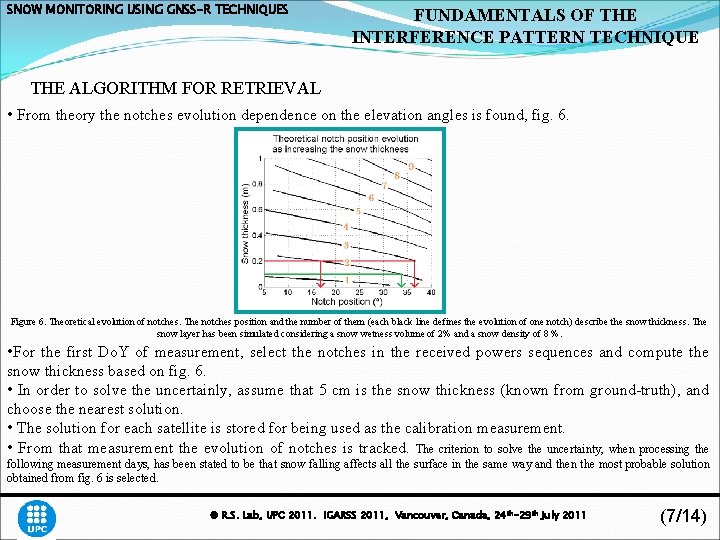
SNOW MONITORING USING GNSS-R TECHNIQUES FUNDAMENTALS OF THE INTERFERENCE PATTERN TECHNIQUE THE ALGORITHM FOR RETRIEVAL • From theory the notches evolution dependence on the elevation angles is found, fig. 6. Figure 6. Theoretical evolution of notches. The notches position and the number of them (each black line defines the evolution of one notch) describe the snow thickness. The snow layer has been simulated considering a snow wetness volume of 2% and a snow density of 8 %. • For the first Do. Y of measurement, select the notches in the received powers sequences and compute the snow thickness based on fig. 6. • In order to solve the uncertainly, assume that 5 cm is the snow thickness (known from ground-truth), and choose the nearest solution. • The solution for each satellite is stored for being used as the calibration measurement. • From that measurement the evolution of notches is tracked. The criterion to solve the uncertainty, when processing the following measurement days, has been stated to be that snow falling affects all the surface in the same way and then the most probable solution obtained from fig. 6 is selected. © R. S. Lab, UPC 2011. IGARSS 2011, Vancouver, Canada, 24 th-29 th July 2011 (7/14)
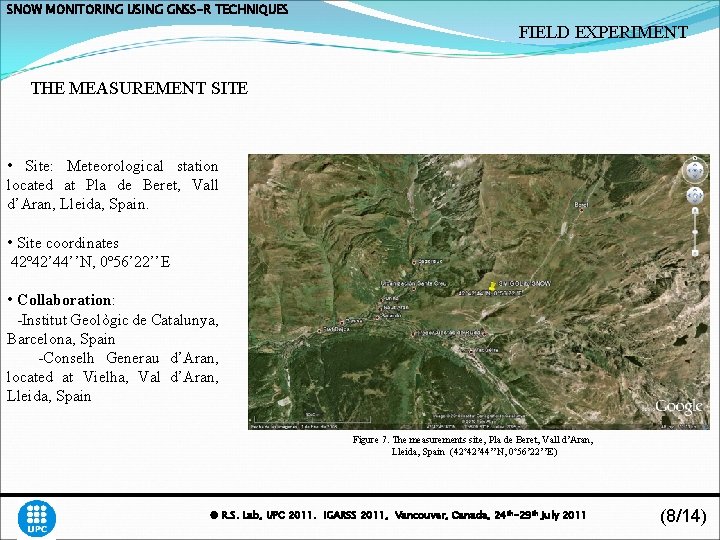
SNOW MONITORING USING GNSS-R TECHNIQUES FIELD EXPERIMENT THE MEASUREMENT SITE • Site: Meteorological station located at Pla de Beret, Vall d’Aran, Lleida, Spain. • Site coordinates 42º 42’ 44’’N, 0º 56’ 22’’E • Collaboration: -Institut Geològic de Catalunya, Barcelona, Spain -Conselh Generau d’Aran, located at Vielha, Val d’Aran, Lleida, Spain Figure 7. The measurements site, Pla de Beret, Vall d’Aran, Lleida, Spain (42º 42’ 44’’N, 0º 56’ 22’’E) © R. S. Lab, UPC 2011. IGARSS 2011, Vancouver, Canada, 24 th-29 th July 2011 (8/14)
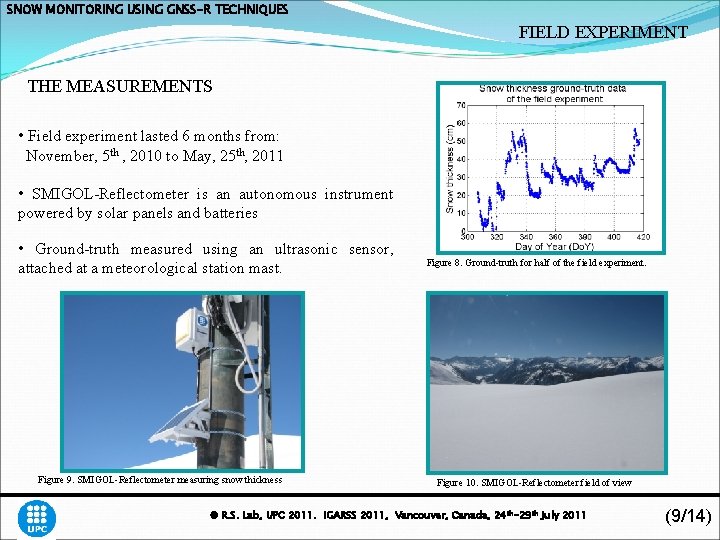
SNOW MONITORING USING GNSS-R TECHNIQUES FIELD EXPERIMENT THE MEASUREMENTS • Field experiment lasted 6 months from: November, 5 th , 2010 to May, 25 th, 2011 • SMIGOL-Reflectometer is an autonomous instrument powered by solar panels and batteries • Ground-truth measured using an ultrasonic sensor, attached at a meteorological station mast. Figure 9. SMIGOL-Reflectometer measuring snow thickness Figure 8. Ground-truth for half of the field experiment. Figure 10. SMIGOL-Reflectometer field of view © R. S. Lab, UPC 2011. IGARSS 2011, Vancouver, Canada, 24 th-29 th July 2011 (9/14)
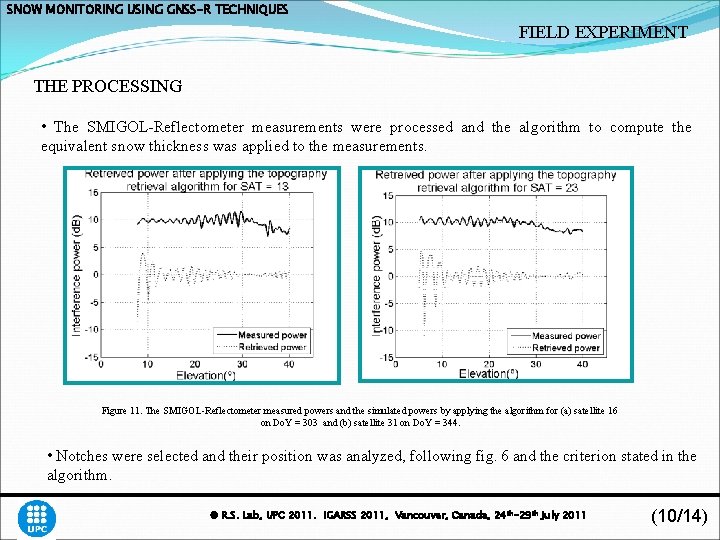
SNOW MONITORING USING GNSS-R TECHNIQUES FIELD EXPERIMENT THE PROCESSING • The SMIGOL-Reflectometer measurements were processed and the algorithm to compute the equivalent snow thickness was applied to the measurements. Figure 11. The SMIGOL-Reflectometer measured powers and the simulated powers by applying the algorithm for (a) satellite 16 on Do. Y = 303 and (b) satellite 31 on Do. Y = 344. • Notches were selected and their position was analyzed, following fig. 6 and the criterion stated in the algorithm. © R. S. Lab, UPC 2011. IGARSS 2011, Vancouver, Canada, 24 th-29 th July 2011 (10/14)
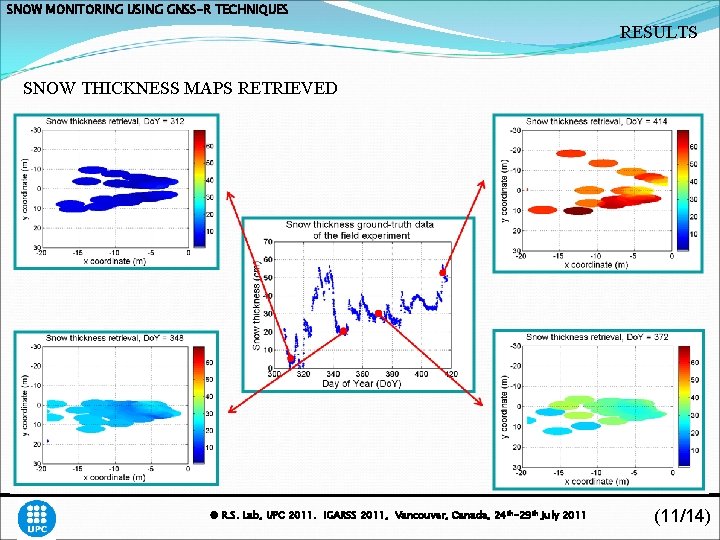
SNOW MONITORING USING GNSS-R TECHNIQUES RESULTS SNOW THICKNESS MAPS RETRIEVED © R. S. Lab, UPC 2011. IGARSS 2011, Vancouver, Canada, 24 th-29 th July 2011 (11/14)
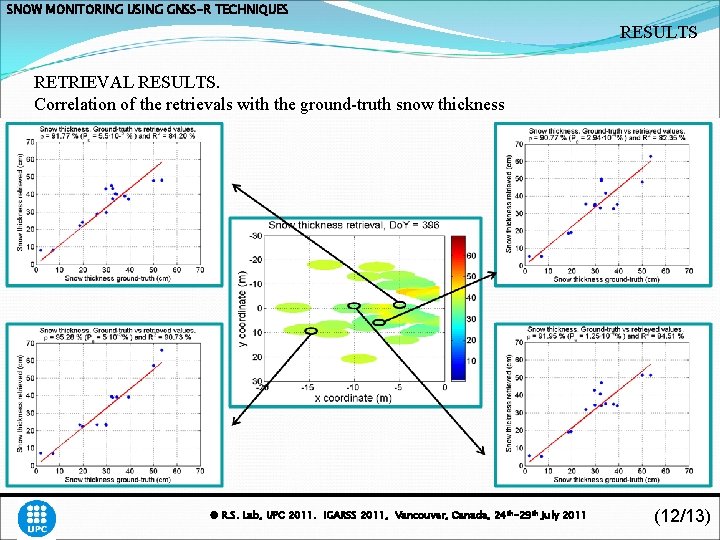
SNOW MONITORING USING GNSS-R TECHNIQUES RESULTS RETRIEVAL RESULTS. Correlation of the retrievals with the ground-truth snow thickness © R. S. Lab, UPC 2011. IGARSS 2011, Vancouver, Canada, 24 th-29 th July 2011 (12/13)
SNOW MONITORING USING GNSS-R TECHNIQUES CONCLUSIONS • The Interference Pattern Technique and the SMIGOL-Reflectometer are able to monitor the snow thickness variations. • The retrieval algorithm developed is based on the position of notches, plus a tracking function that daily analyzes the movement of that notches in the received power plots. • The correlation values of the measurements with the ground-truth in different points of the surface show that the technique can monitor changes in the snow thickness. © R. S. Lab, UPC 2011. IGARSS 2011, Vancouver, Canada, 24 th-29 th July 2011 (13/14)
SNOW MONITORING USING GNSS-R TECHNIQUES ACKNOWLEDGEMENTS This work has been sponsored with funds from the Plan Nacional del Espacio of the Spanish Ministry in the frame of the project with reference ESP 2007 -65567 -C 04 -02 and also by funds from the project with reference AYA 2008 -05906 -C 0201/ESP and the project AYA 2010 -22062 -C 05 -05/ESP. © R. S. Lab, UPC 2011. IGARSS 2011, Vancouver, Canada, 24 th-29 th July 2011 (14/14)
THANK YOU