
SNOMED CT awareness for clinical coders Presented by
SNOMED CT awareness for clinical coders Presented by Copyright © 2020 Health and Social Care Information Centre Terminology and Classifications Delivery Service 1
This presentation provides a basic overview of ……. • The differences between SNOMED CT and the ICD-10 and OPCS-4 classifications • The content and structure of SNOMED CT • The link between SNOMED CT and the classifications • The purpose of the classification maps • The different types of classification map 2
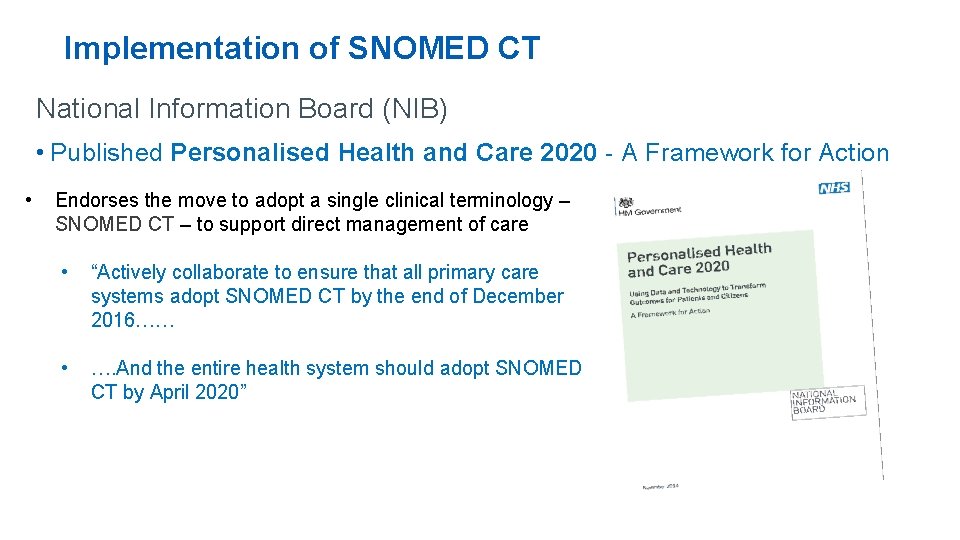
Implementation of SNOMED CT National Information Board (NIB) • Published Personalised Health and Care 2020 - A Framework for Action • Endorses the move to adopt a single clinical terminology – SNOMED CT – to support direct management of care • “Actively collaborate to ensure that all primary care systems adopt SNOMED CT by the end of December 2016…… • …. And the entire health system should adopt SNOMED CT by April 2020”
SNOMED CT and clinical coding • Implementation in secondary care should mean that ICD-10 and OPCS-4 classification coded data will become a by-product of information recorded by the clinician using SNOMED CT in the electronic patient record (EPR) • It is important that clinical coders have an understanding of how the implementation of SNOMED CT in the EPR could inform the classifications data collected in their Trust Patient Administration Systems (PAS) 4

SNOMED CT and the ICD-10 and OPCS-4 classifications • SNOMED CT, ICD-10 and OPCS-4 are all NHS Information Standards • SNOMED CT, ICD-10 and OPCS-4 are complementary, but serve different purposes SNOMED CT terminology ICD-10 and OPCS-4 classifications • A structured clinical vocabulary used by clinicians to record information in patient’s Electronic Patient Record (EPR) at the point of care • Alphanumeric classification used by clinical coders to enter retrospective data into the Patient Administration System (PAS) • Enables the recording of granular clinical information in the EPR, including content not required of the classifications • Provides a summary of a hospital Consultant Episode of patient care • Facilitates direct care and management of the patient and sharing patient information within and across all healthcare settings • Supports statistical and epidemiological analysis of population health, organisational planning and reimbursement 5
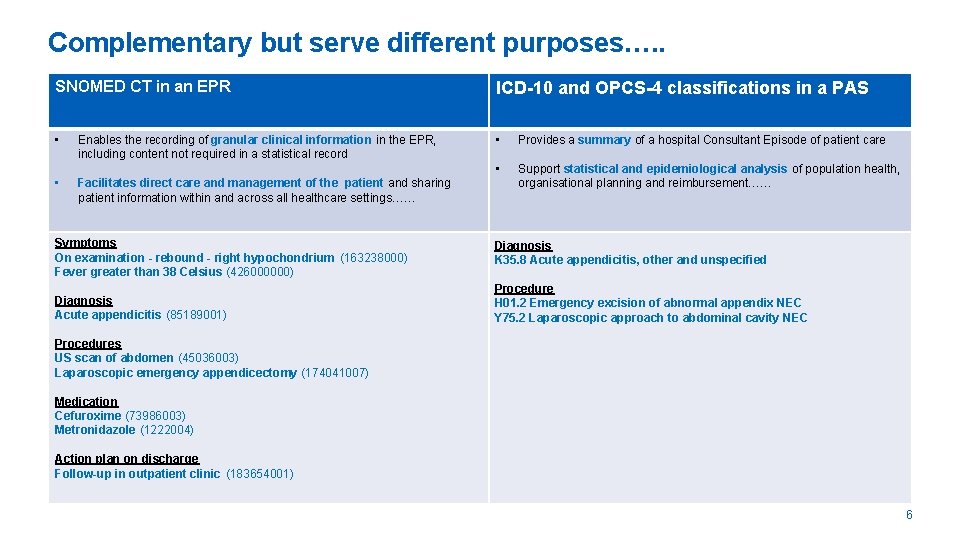
Complementary but serve different purposes…. . SNOMED CT in an EPR ICD-10 and OPCS-4 classifications in a PAS • Enables the recording of granular clinical information in the EPR, including content not required in a statistical record • Provides a summary of a hospital Consultant Episode of patient care • • Facilitates direct care and management of the patient and sharing patient information within and across all healthcare settings…… Support statistical and epidemiological analysis of population health, organisational planning and reimbursement…… Symptoms On examination - rebound - right hypochondrium (163238000) Fever greater than 38 Celsius (426000000) Diagnosis K 35. 8 Acute appendicitis, other and unspecified Diagnosis Acute appendicitis (85189001) Procedure H 01. 2 Emergency excision of abnormal appendix NEC Y 75. 2 Laparoscopic approach to abdominal cavity NEC Procedures US scan of abdomen (45036003) Laparoscopic emergency appendicectomy (174041007) Medication Cefuroxime (73986003) Metronidazole (1222004) Action plan on discharge Follow-up in outpatient clinic (183654001) 6
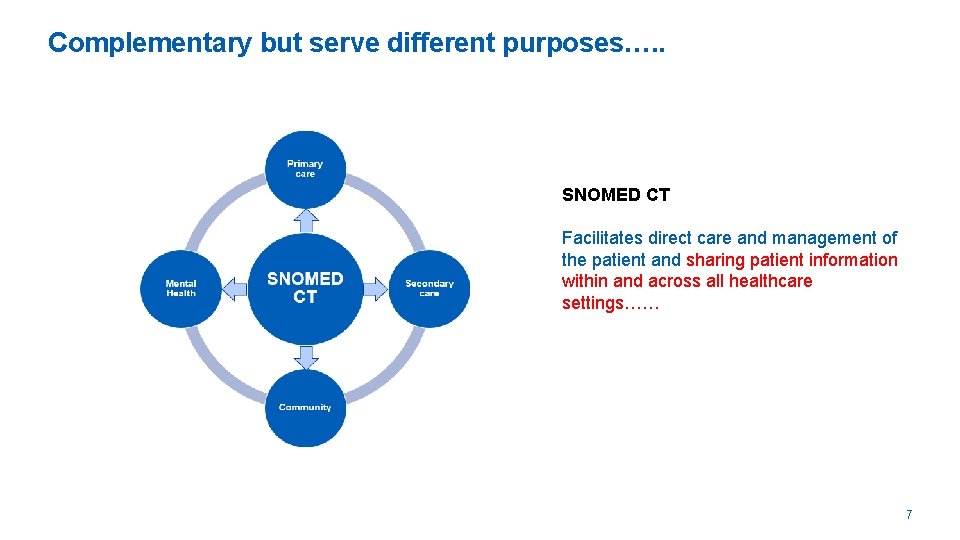
Complementary but serve different purposes…. . SNOMED CT Facilitates direct care and management of the patient and sharing patient information within and across all healthcare settings…… 7

ICD-10 and OPCS-4 classification structure ICD-10 and OPCS-4: • Alphanumeric classifications that applies principles and rules (in book and browser format) • Comprise mainly of anatomically based chapters, along with some special chapters (e. g. ‘ Chapter II Neoplasms’, Chapter X Miscellaneous operations etc) • Chapters are divided into three character categories, which further sub-divide into four character codes (additional fifth characters are also applied in some chapters in ICD-10) …… 8
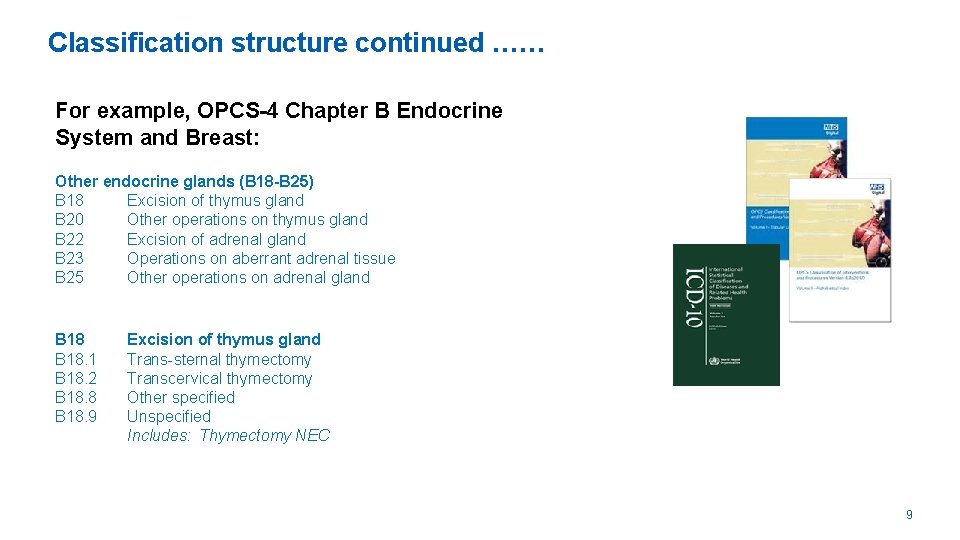
Classification structure continued …… For example, OPCS-4 Chapter B Endocrine System and Breast: Other endocrine glands (B 18 -B 25) B 18 Excision of thymus gland B 20 Other operations on thymus gland B 22 Excision of adrenal gland B 23 Operations on aberrant adrenal tissue B 25 Other operations on adrenal gland B 18. 1 B 18. 2 B 18. 8 B 18. 9 Excision of thymus gland Trans-sternal thymectomy Transcervical thymectomy Other specified Unspecified Includes: Thymectomy NEC 9
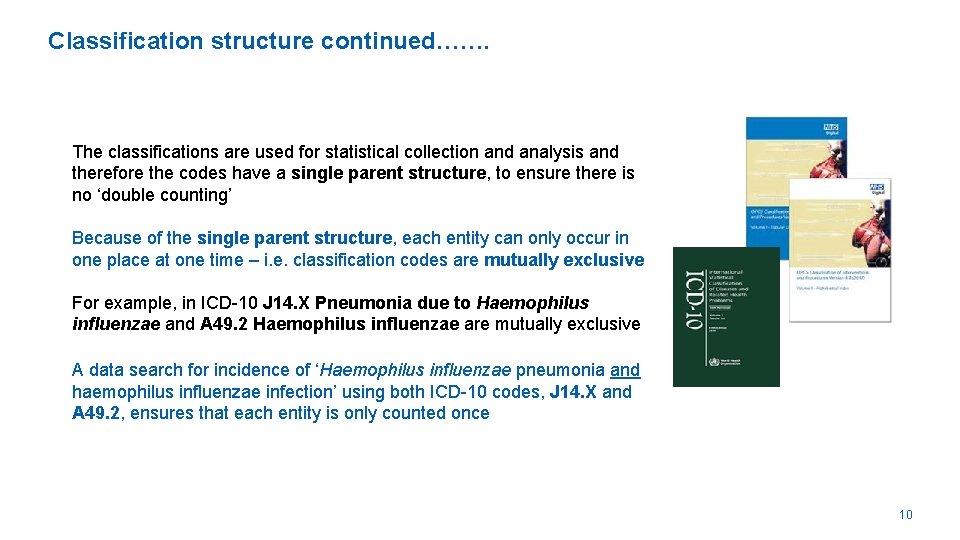
Classification structure continued……. The classifications are used for statistical collection and analysis and therefore the codes have a single parent structure, to ensure there is no ‘double counting’ Because of the single parent structure, each entity can only occur in one place at one time – i. e. classification codes are mutually exclusive For example, in ICD-10 J 14. X Pneumonia due to Haemophilus influenzae and A 49. 2 Haemophilus influenzae are mutually exclusive A data search for incidence of ‘Haemophilus influenzae pneumonia and haemophilus influenzae infection’ using both ICD-10 codes, J 14. X and A 49. 2, ensures that each entity is only counted once 10
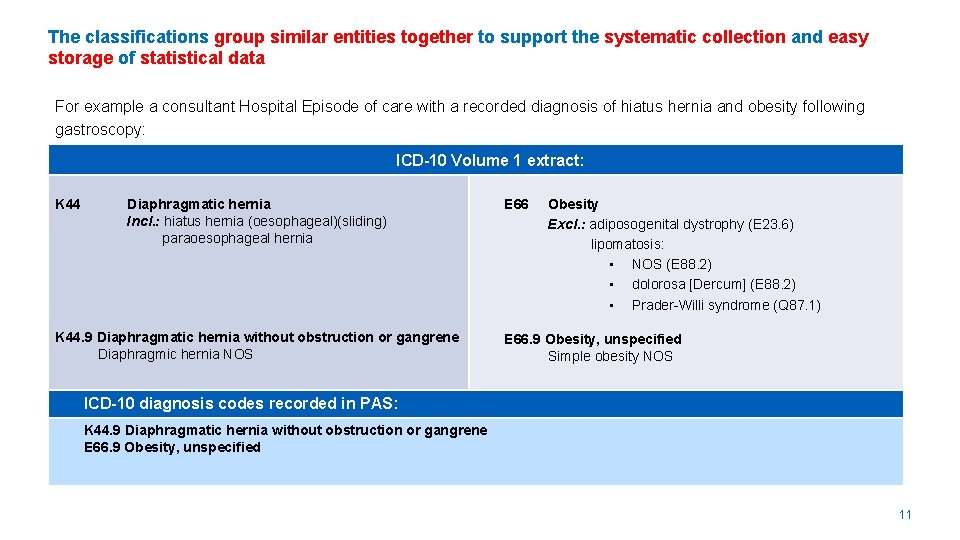
The classifications group similar entities together to support the systematic collection and easy storage of statistical data For example a consultant Hospital Episode of care with a recorded diagnosis of hiatus hernia and obesity following gastroscopy: ICD-10 Volume 1 extract: K 44 Diaphragmatic hernia Incl. : hiatus hernia (oesophageal)(sliding) paraoesophageal hernia K 44. 9 Diaphragmatic hernia without obstruction or gangrene Diaphragmic hernia NOS E 66 Obesity Excl. : adiposogenital dystrophy (E 23. 6) lipomatosis: • NOS (E 88. 2) • dolorosa [Dercum] (E 88. 2) • Prader-Willi syndrome (Q 87. 1) E 66. 9 Obesity, unspecified Simple obesity NOS ICD-10 diagnosis codes recorded in PAS: K 44. 9 Diaphragmatic hernia without obstruction or gangrene E 66. 9 Obesity, unspecified 11
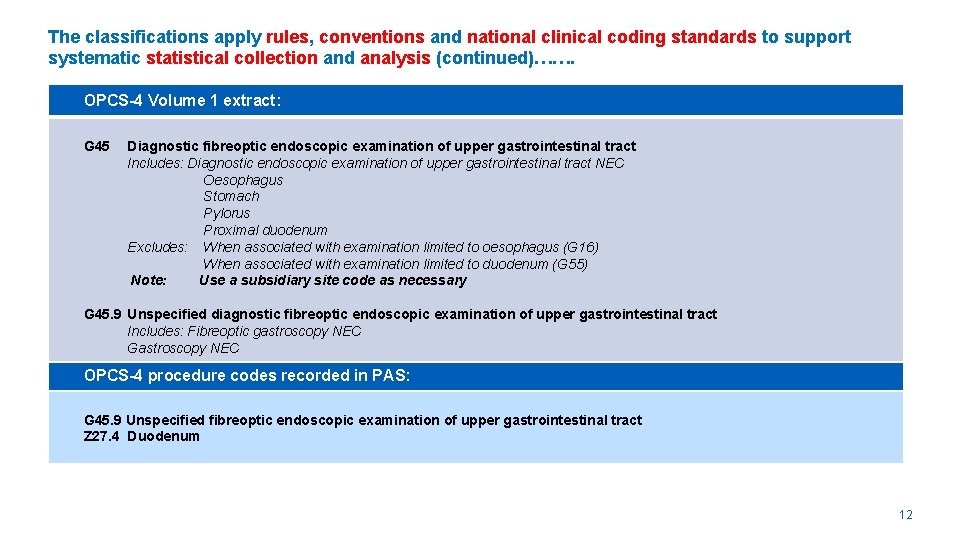
The classifications apply rules, conventions and national clinical coding standards to support systematic statistical collection and analysis (continued)……. OPCS-4 Volume 1 extract: G 45 Diagnostic fibreoptic endoscopic examination of upper gastrointestinal tract Includes: Diagnostic endoscopic examination of upper gastrointestinal tract NEC Oesophagus Stomach Pylorus Proximal duodenum Excludes: When associated with examination limited to oesophagus (G 16) When associated with examination limited to duodenum (G 55) Note: Use a subsidiary site code as necessary G 45. 9 Unspecified diagnostic fibreoptic endoscopic examination of upper gastrointestinal tract Includes: Fibreoptic gastroscopy NEC Gastroscopy NEC OPCS-4 procedure codes recorded in PAS: G 45. 9 Unspecified fibreoptic endoscopic examination of upper gastrointestinal tract Z 27. 4 Duodenum 12
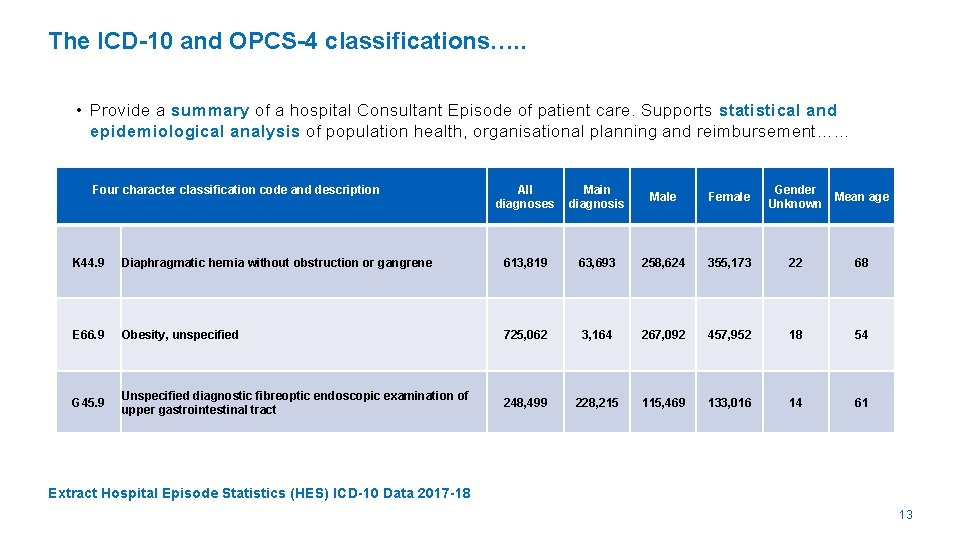
The ICD-10 and OPCS-4 classifications…. . • Provide a summary of a hospital Consultant Episode of patient care. Supports statistical and epidemiological analysis of population health, organisational planning and reimbursement…… Four character classification code and description All diagnoses Main diagnosis Male Female Gender Mean age Unknown K 44. 9 Diaphragmatic hernia without obstruction or gangrene 613, 819 63, 693 258, 624 355, 173 22 68 E 66. 9 Obesity, unspecified 725, 062 3, 164 267, 092 457, 952 18 54 G 45. 9 Unspecified diagnostic fibreoptic endoscopic examination of upper gastrointestinal tract 248, 499 228, 215 115, 469 133, 016 14 61 Extract Hospital Episode Statistics (HES) ICD-10 Data 2017 -18 13
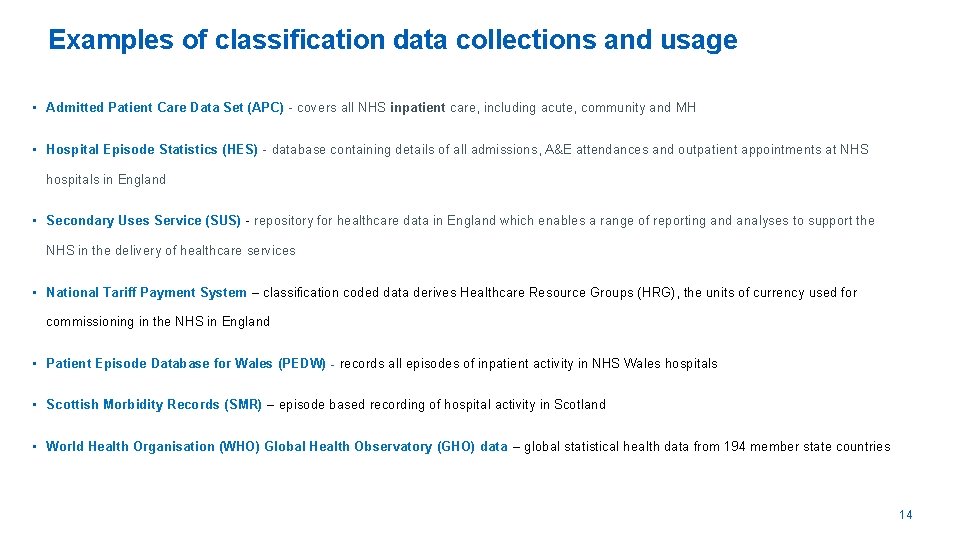
Examples of classification data collections and usage • Admitted Patient Care Data Set (APC) - covers all NHS inpatient care, including acute, community and MH • Hospital Episode Statistics (HES) - database containing details of all admissions, A&E attendances and outpatient appointments at NHS hospitals in England • Secondary Uses Service (SUS) - repository for healthcare data in England which enables a range of reporting and analyses to support the NHS in the delivery of healthcare services • National Tariff Payment System – classification coded data derives Healthcare Resource Groups (HRG), the units of currency used for commissioning in the NHS in England • Patient Episode Database for Wales (PEDW) - records all episodes of inpatient activity in NHS Wales hospitals • Scottish Morbidity Records (SMR) – episode based recording of hospital activity in Scotland • World Health Organisation (WHO) Global Health Observatory (GHO) data – global statistical health data from 194 member state countries 14
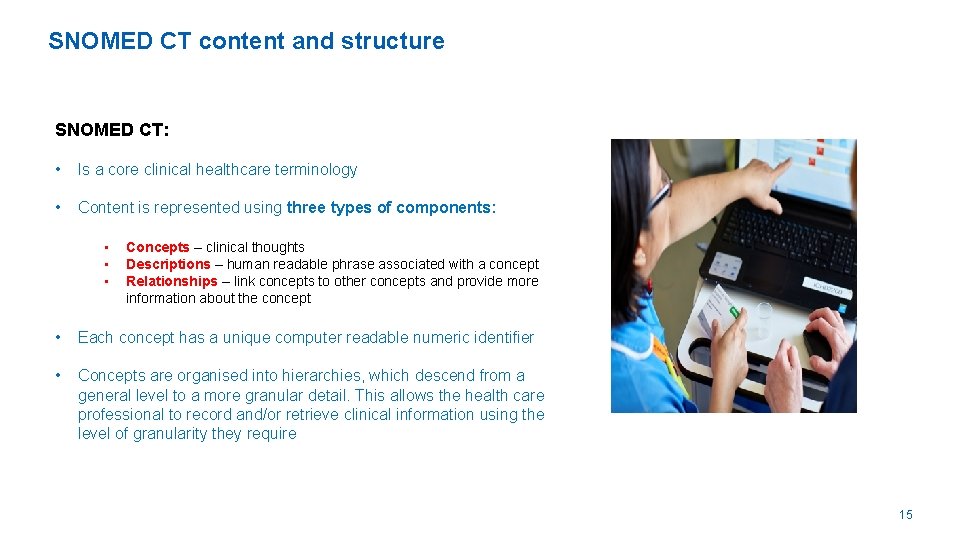
SNOMED CT content and structure SNOMED CT: • Is a core clinical healthcare terminology • Content is represented using three types of components: • • • Concepts – clinical thoughts Descriptions – human readable phrase associated with a concept Relationships – link concepts to other concepts and provide more information about the concept • Each concept has a unique computer readable numeric identifier • Concepts are organised into hierarchies, which descend from a general level to a more granular detail. This allows the health care professional to record and/or retrieve clinical information using the level of granularity they require 15

Differences between SNOMED CT and the ICD-10 and OPCS-4 classifications • The differences between SNOMED CT and classification content and structure supports their different uses • Because of this SNOMED CT, which is designed for the direct management and care of patients, is necessarily more granular • For example, there are twenty four different SNOMED CT concepts representing ‘upper abdominal pain’, but only one ICD-10 code: SNOMED CT: ICD-10: 16
SNOMED CT - supports the sharing of granular, structured clinical information between healthcare professionals across settings for the direct care of the patient For example, the transmission of an electronic GP patient referral to an acute hospital Trust…. Referral for gastroscopy (306730008) Epigastric pain (79922009) Acid reflux (698065002) Obesity (414916001) Or the transmission of an electronic discharge letter from gastroenterologist to a GP and referral to a dietician…. Simple hiatus hernia (309754004) Upper GI endoscopy (76009000) BMI 30+ - obesity (162864005) Referral to community dietician (306353006) 17
Examples of SNOMED CT data returns • Yellow Card Scheme – used to report suspected adverse drug reactions to the Medicines and Healthcare products Regulatory Agency (MHRA) • Mental Health Services Data Set (MHSDS) – record-level information covering all MH settings, including outpatients and community • Emergency Care Data Set (ECDS) – supports planning, decision making and improvement in emergency care • Community Services Data Set (CSDS) – allows service providers and commissioners to view local and national community service information, to improve patient care • Quality and Outcomes Framework (QOF) – voluntary reward and incentive programme for GP practices 18
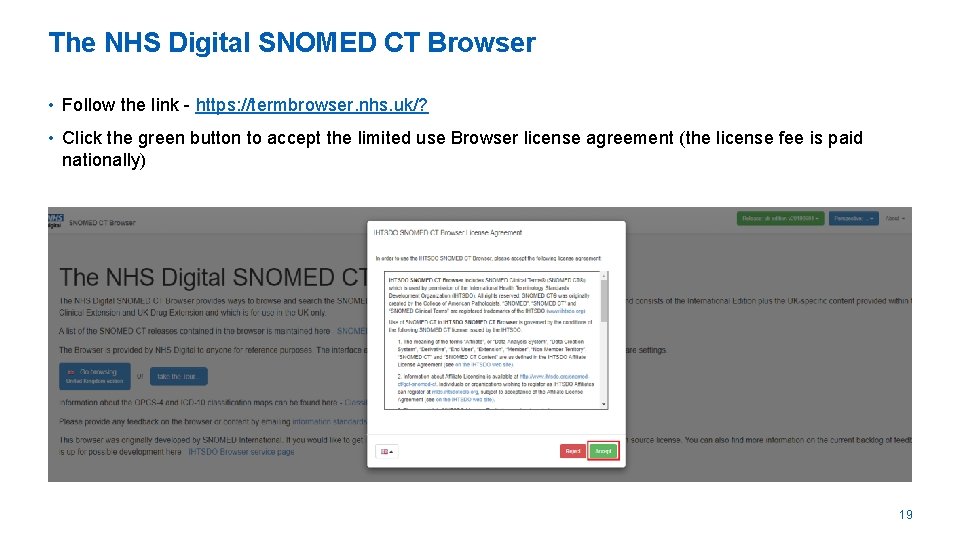
The NHS Digital SNOMED CT Browser • Follow the link - https: //termbrowser. nhs. uk/? • Click the green button to accept the limited use Browser license agreement (the license fee is paid nationally) 19
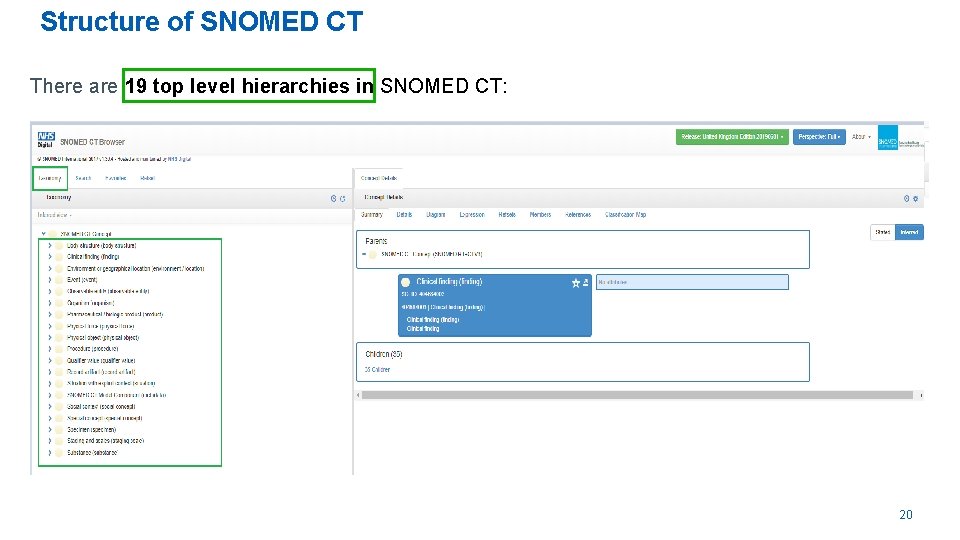
Structure of SNOMED CT There are 19 top level hierarchies in SNOMED CT: 20
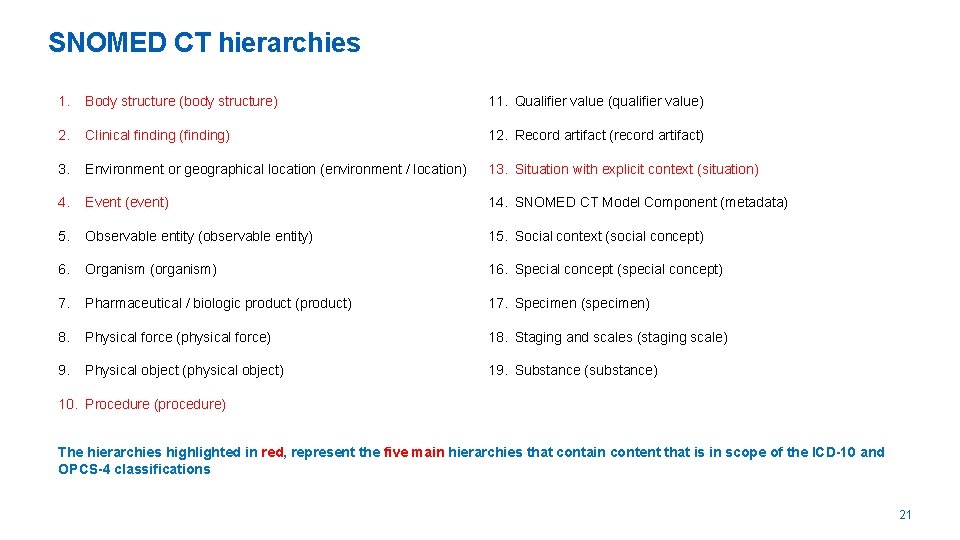
SNOMED CT hierarchies 1. Body structure (body structure) 11. Qualifier value (qualifier value) 2. Clinical finding (finding) 12. Record artifact (record artifact) 3. Environment or geographical location (environment / location) 13. Situation with explicit context (situation) 4. Event (event) 14. SNOMED CT Model Component (metadata) 5. Observable entity (observable entity) 15. Social context (social concept) 6. Organism (organism) 16. Special concept (special concept) 7. Pharmaceutical / biologic product (product) 17. Specimen (specimen) 8. Physical force (physical force) 18. Staging and scales (staging scale) 9. Physical object (physical object) 19. Substance (substance) 10. Procedure (procedure) The hierarchies highlighted in red, represent the five main hierarchies that contain content that is in scope of the ICD-10 and OPCS-4 classifications 21
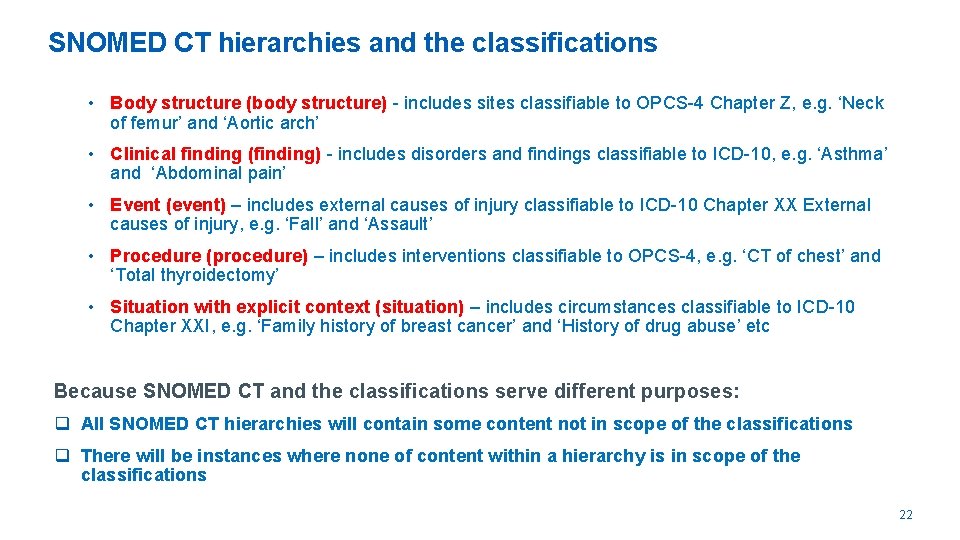
SNOMED CT hierarchies and the classifications • Body structure (body structure) - includes sites classifiable to OPCS-4 Chapter Z, e. g. ‘Neck of femur’ and ‘Aortic arch’ • Clinical finding (finding) - includes disorders and findings classifiable to ICD-10, e. g. ‘Asthma’ and ‘Abdominal pain’ • Event (event) – includes external causes of injury classifiable to ICD-10 Chapter XX External causes of injury, e. g. ‘Fall’ and ‘Assault’ • Procedure (procedure) – includes interventions classifiable to OPCS-4, e. g. ‘CT of chest’ and ‘Total thyroidectomy’ • Situation with explicit context (situation) – includes circumstances classifiable to ICD-10 Chapter XXI, e. g. ‘Family history of breast cancer’ and ‘History of drug abuse’ etc Because SNOMED CT and the classifications serve different purposes: q All SNOMED CT hierarchies will contain some content not in scope of the classifications q There will be instances where none of content within a hierarchy is in scope of the classifications 22
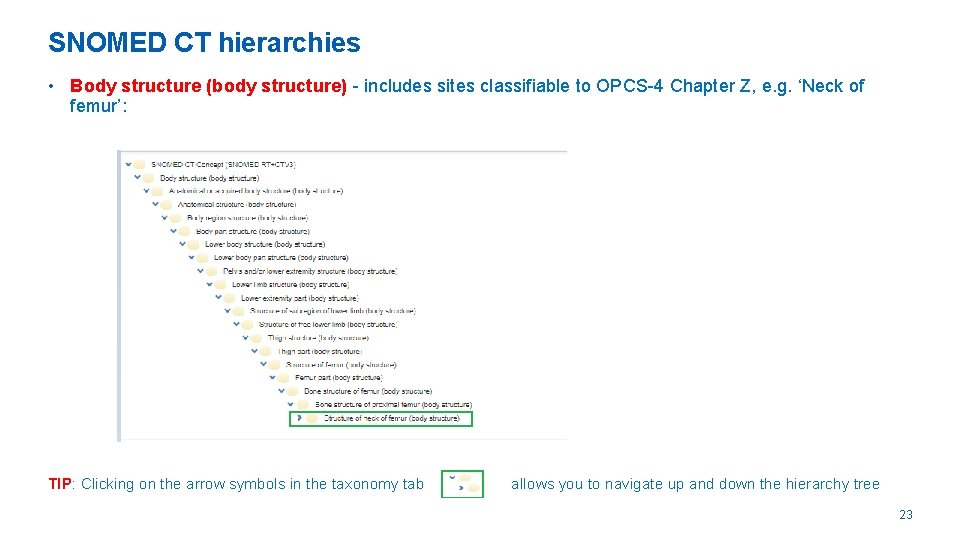
SNOMED CT hierarchies • Body structure (body structure) - includes sites classifiable to OPCS-4 Chapter Z, e. g. ‘Neck of femur’: TIP: Clicking on the arrow symbols in the taxonomy tab allows you to navigate up and down the hierarchy tree 23
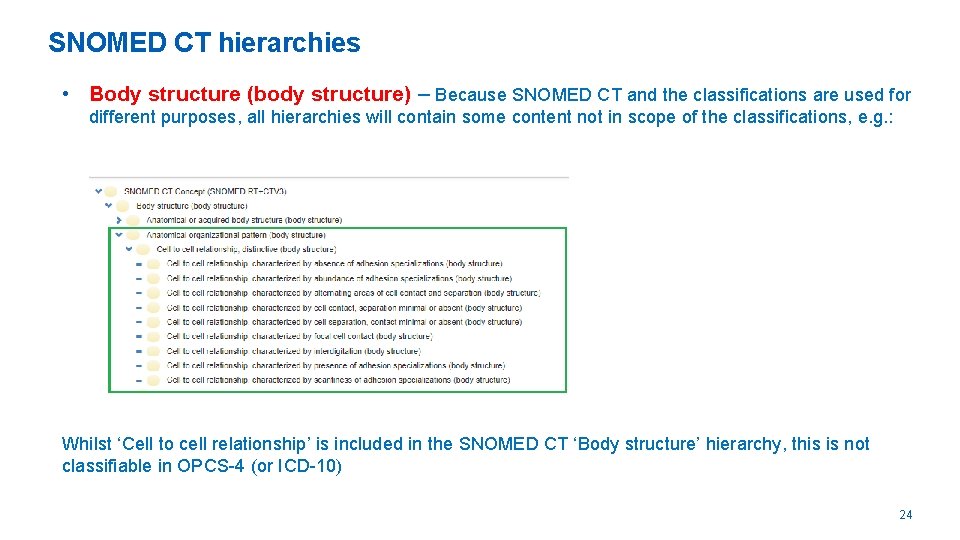
SNOMED CT hierarchies • Body structure (body structure) – Because SNOMED CT and the classifications are used for different purposes, all hierarchies will contain some content not in scope of the classifications, e. g. : Whilst ‘Cell to cell relationship’ is included in the SNOMED CT ‘Body structure’ hierarchy, this is not classifiable in OPCS-4 (or ICD-10) 24
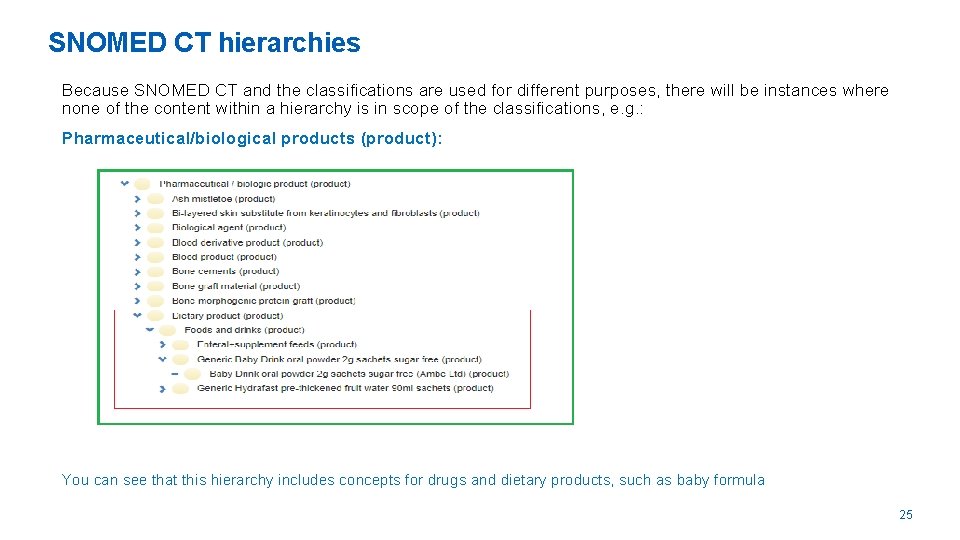
SNOMED CT hierarchies Because SNOMED CT and the classifications are used for different purposes, there will be instances where none of the content within a hierarchy is in scope of the classifications, e. g. : Pharmaceutical/biological products (product): You can see that this hierarchy includes concepts for drugs and dietary products, such as baby formula 25
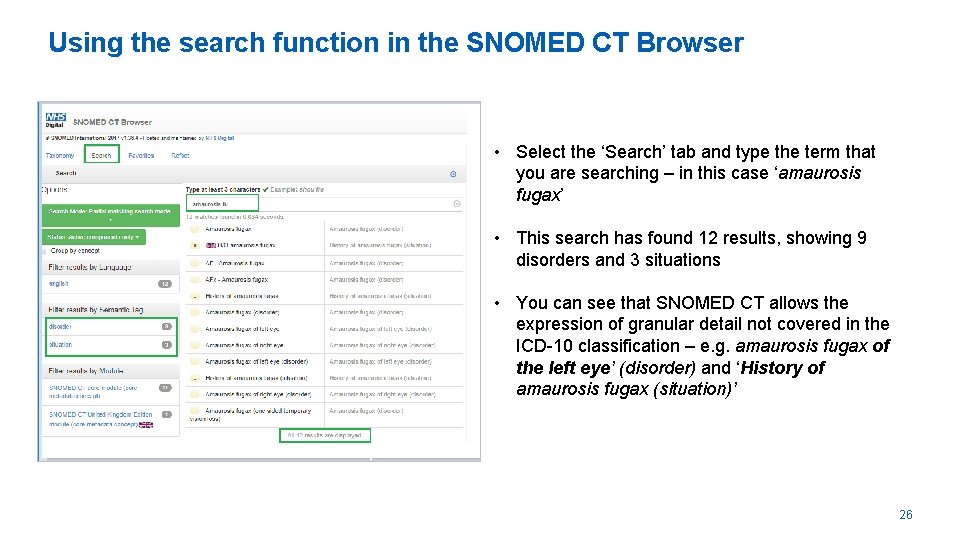
Using the search function in the SNOMED CT Browser • Select the ‘Search’ tab and type the term that you are searching – in this case ‘amaurosis fugax’ • This search has found 12 results, showing 9 disorders and 3 situations • You can see that SNOMED CT allows the expression of granular detail not covered in the ICD-10 classification – e. g. amaurosis fugax of the left eye’ (disorder) and ‘History of amaurosis fugax (situation)’ 26
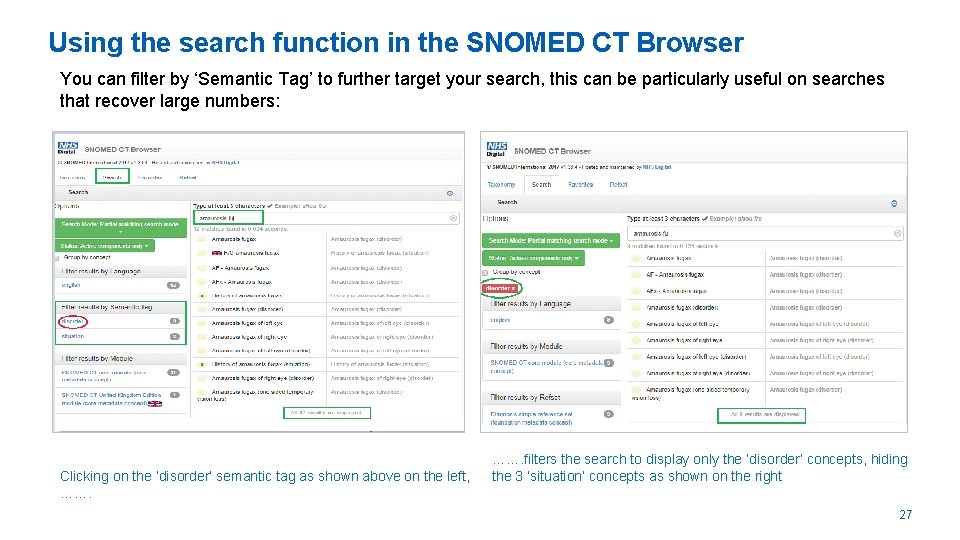
Using the search function in the SNOMED CT Browser You can filter by ‘Semantic Tag’ to further target your search, this can be particularly useful on searches that recover large numbers: Clicking on the ‘disorder’ semantic tag as shown above on the left, ……. filters the search to display only the ‘disorder’ concepts, hiding the 3 ‘situation’ concepts as shown on the right 27
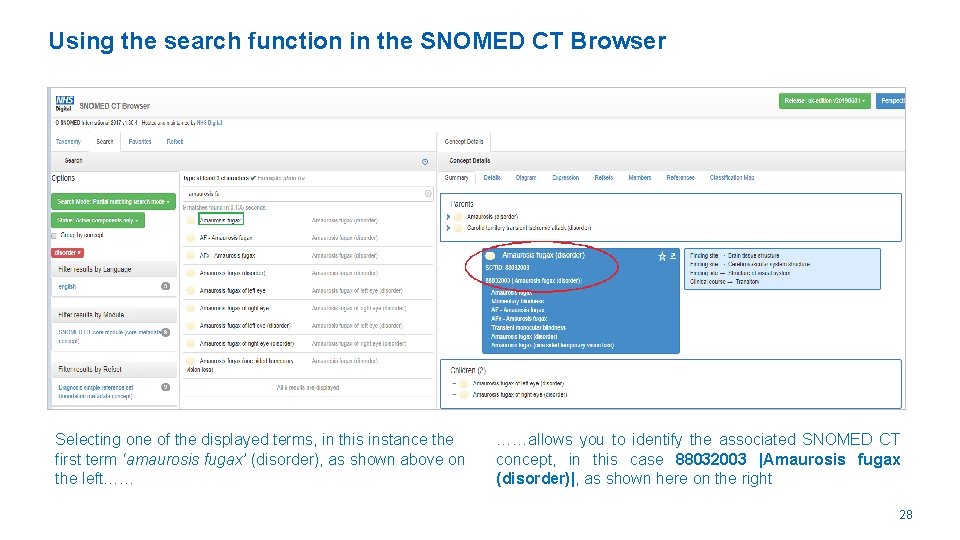
Using the search function in the SNOMED CT Browser Selecting one of the displayed terms, in this instance the first term ‘amaurosis fugax’ (disorder), as shown above on the left…… ……allows you to identify the associated SNOMED CT concept, in this case 88032003 |Amaurosis fugax (disorder)|, as shown here on the right 28
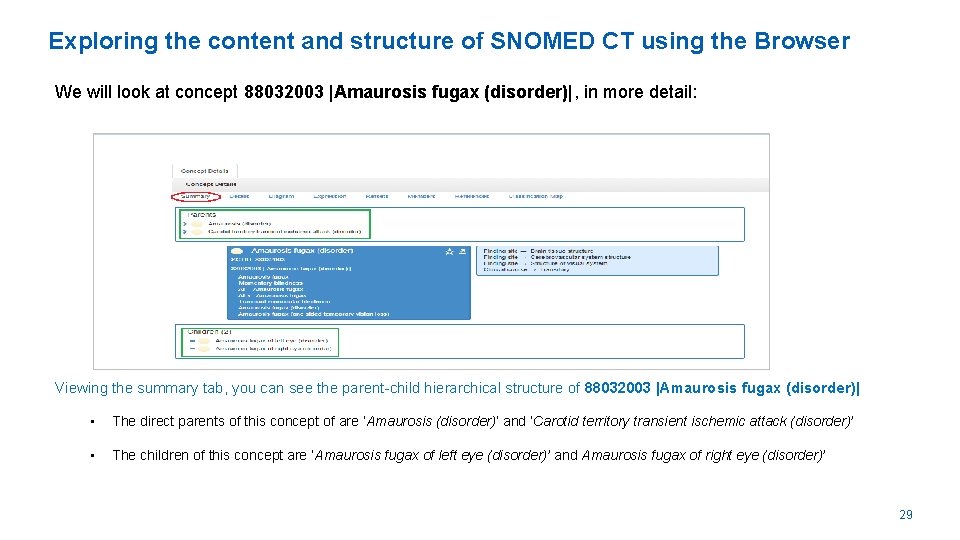
Exploring the content and structure of SNOMED CT using the Browser We will look at concept 88032003 |Amaurosis fugax (disorder)|, in more detail: Viewing the summary tab, you can see the parent-child hierarchical structure of 88032003 |Amaurosis fugax (disorder)| • The direct parents of this concept of are ‘Amaurosis (disorder)’ and ‘Carotid territory transient ischemic attack (disorder)’ • The children of this concept are ‘Amaurosis fugax of left eye (disorder)’ and Amaurosis fugax of right eye (disorder)’ 29
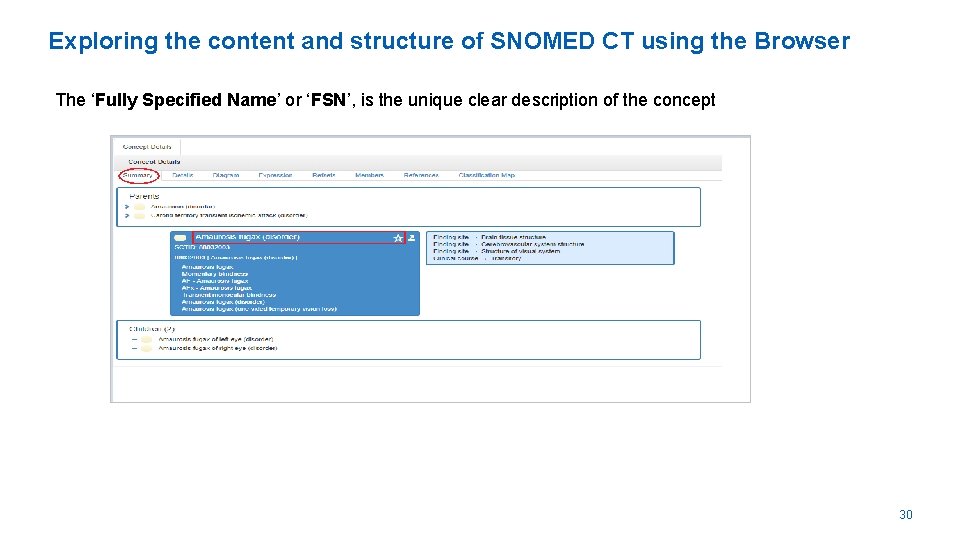
Exploring the content and structure of SNOMED CT using the Browser The ‘Fully Specified Name’ or ‘FSN’, is the unique clear description of the concept 30
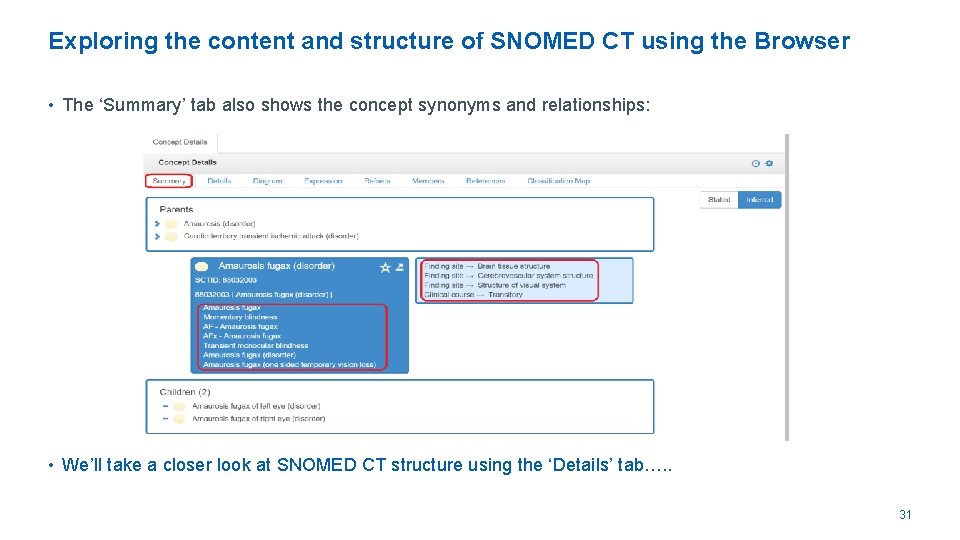
Exploring the content and structure of SNOMED CT using the Browser • The ‘Summary’ tab also shows the concept synonyms and relationships: • We’ll take a closer look at SNOMED CT structure using the ‘Details’ tab…. . 31
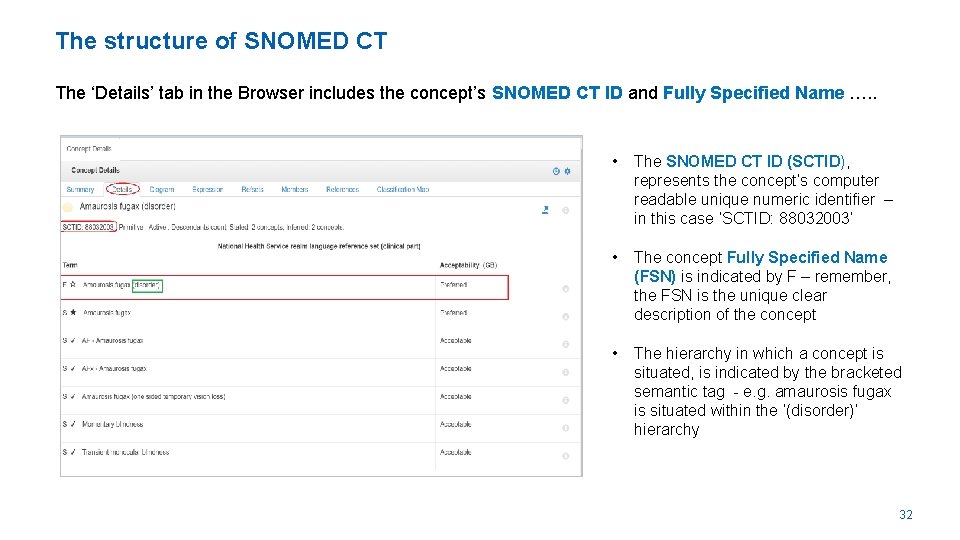
The structure of SNOMED CT The ‘Details’ tab in the Browser includes the concept’s SNOMED CT ID and Fully Specified Name …. . • The SNOMED CT ID (SCTID), represents the concept’s computer readable unique numeric identifier – in this case ‘SCTID: 88032003’ • The concept Fully Specified Name (FSN) is indicated by F – remember, the FSN is the unique clear description of the concept • The hierarchy in which a concept is situated, is indicated by the bracketed semantic tag - e. g. amaurosis fugax is situated within the ‘(disorder)’ hierarchy 32
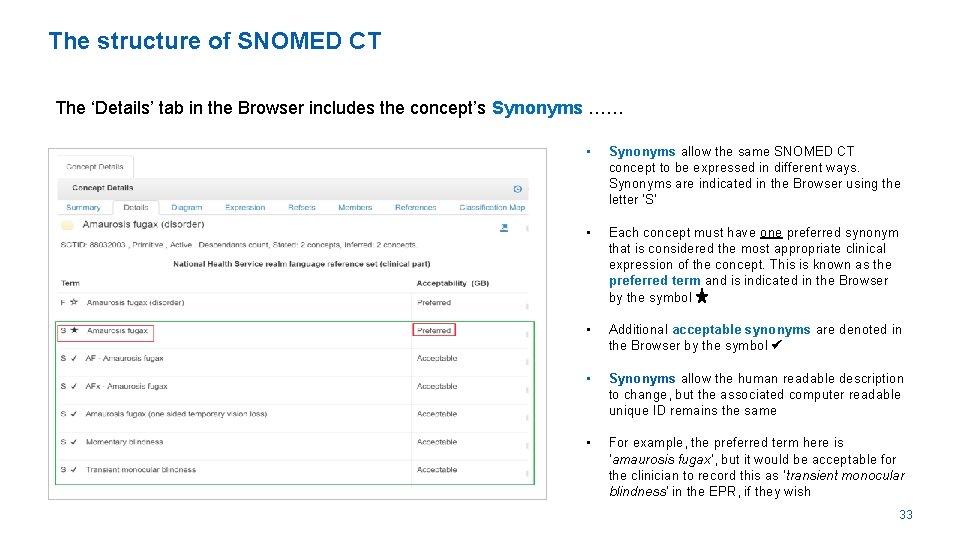
The structure of SNOMED CT The ‘Details’ tab in the Browser includes the concept’s Synonyms …… • Synonyms allow the same SNOMED CT concept to be expressed in different ways. Synonyms are indicated in the Browser using the letter ‘S’ • Each concept must have one preferred synonym that is considered the most appropriate clinical expression of the concept. This is known as the preferred term and is indicated in the Browser by the symbol • Additional acceptable synonyms are denoted in the Browser by the symbol • Synonyms allow the human readable description to change, but the associated computer readable unique ID remains the same • For example, the preferred term here is ‘amaurosis fugax’, but it would be acceptable for the clinician to record this as ‘transient monocular blindness’ in the EPR, if they wish 33
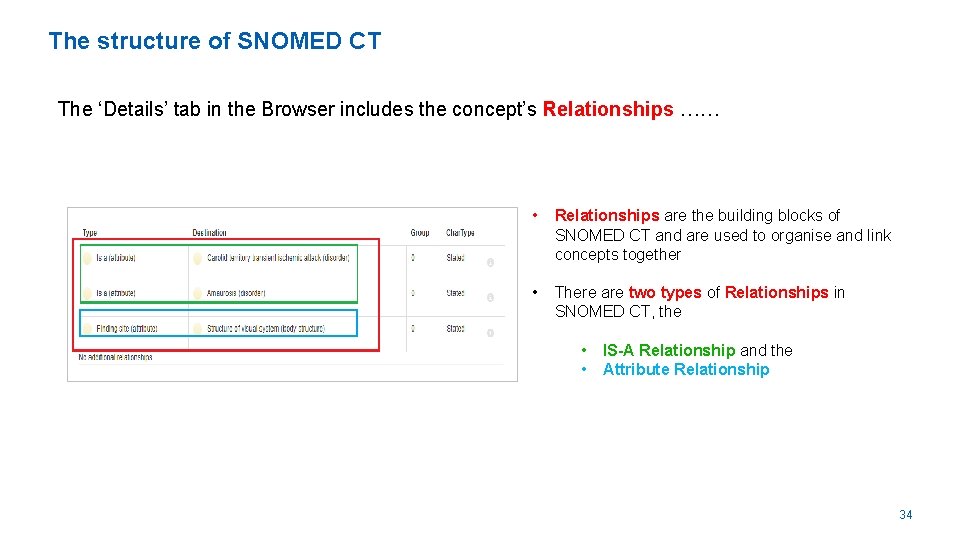
The structure of SNOMED CT The ‘Details’ tab in the Browser includes the concept’s Relationships …… • Relationships are the building blocks of SNOMED CT and are used to organise and link concepts together • There are two types of Relationships in SNOMED CT, the • • IS-A Relationship and the Attribute Relationship 34
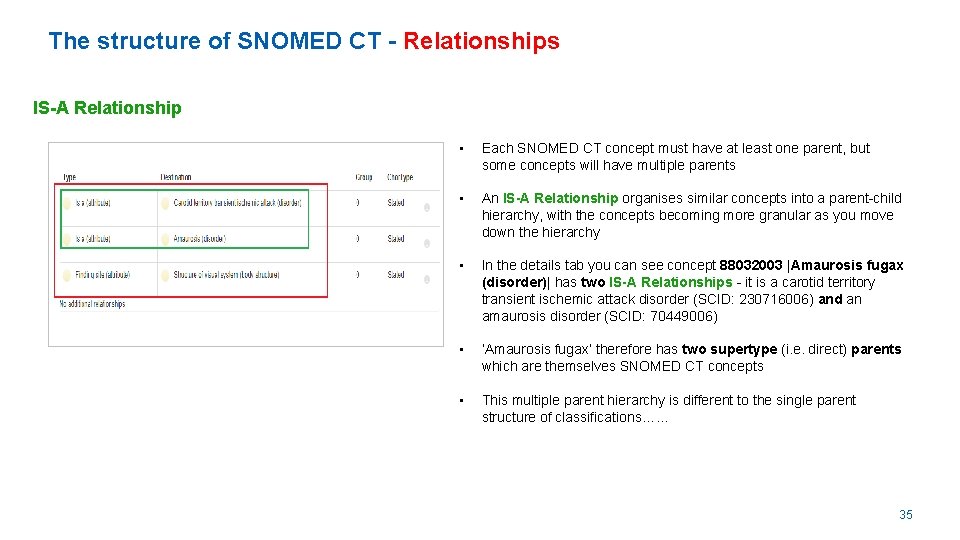
The structure of SNOMED CT - Relationships IS-A Relationship • Each SNOMED CT concept must have at least one parent, but some concepts will have multiple parents • An IS-A Relationship organises similar concepts into a parent-child hierarchy, with the concepts becoming more granular as you move down the hierarchy • In the details tab you can see concept 88032003 |Amaurosis fugax (disorder)| has two IS-A Relationships - it is a carotid territory transient ischemic attack disorder (SCID: 230716006) and an amaurosis disorder (SCID: 70449006) • ‘Amaurosis fugax’ therefore has two supertype (i. e. direct) parents which are themselves SNOMED CT concepts • This multiple parent hierarchy is different to the single parent structure of classifications…… 35
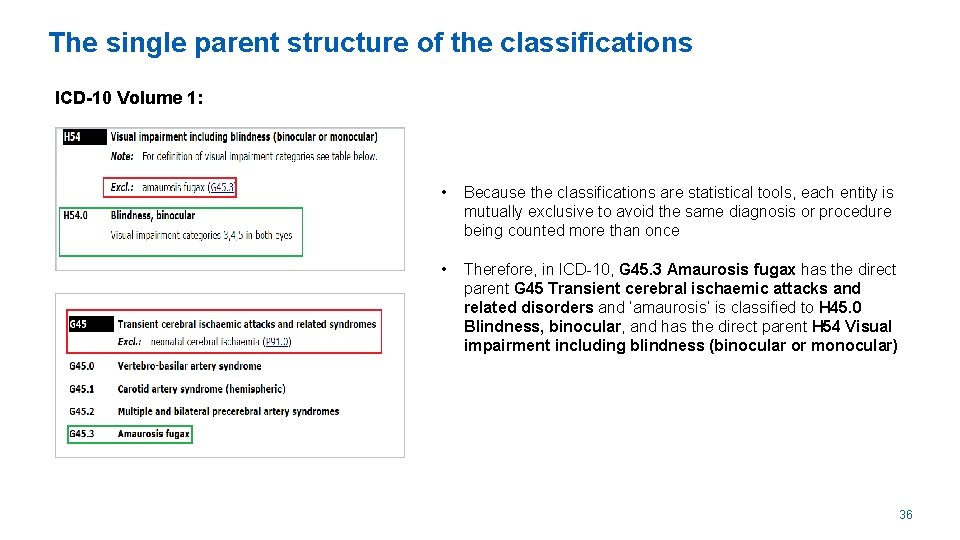
The single parent structure of the classifications ICD-10 Volume 1: • Because the classifications are statistical tools, each entity is mutually exclusive to avoid the same diagnosis or procedure being counted more than once • Therefore, in ICD-10, G 45. 3 Amaurosis fugax has the direct parent G 45 Transient cerebral ischaemic attacks and related disorders and ‘amaurosis’ is classified to H 45. 0 Blindness, binocular, and has the direct parent H 54 Visual impairment including blindness (binocular or monocular) 36
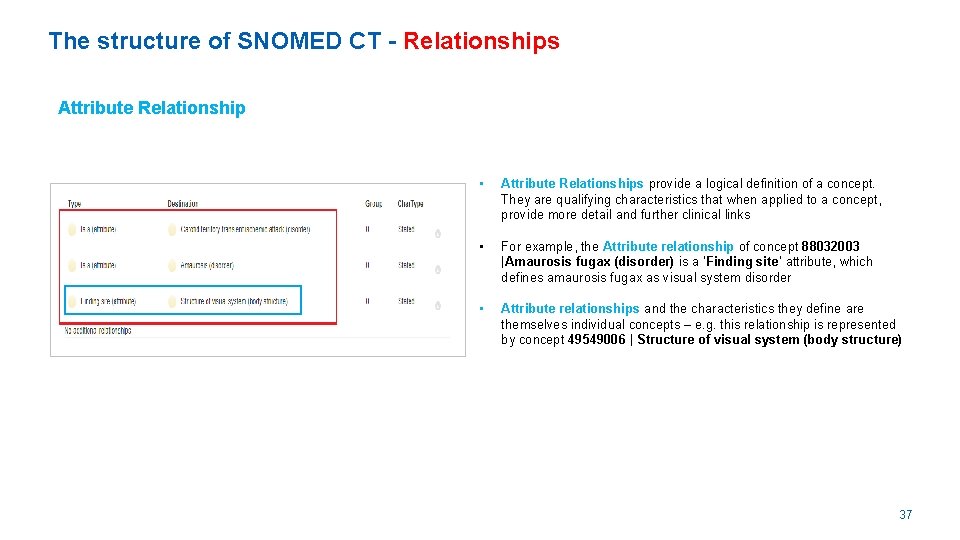
The structure of SNOMED CT - Relationships Attribute Relationship • Attribute Relationships provide a logical definition of a concept. They are qualifying characteristics that when applied to a concept, provide more detail and further clinical links • For example, the Attribute relationship of concept 88032003 |Amaurosis fugax (disorder) is a ‘Finding site’ attribute, which defines amaurosis fugax as visual system disorder • Attribute relationships and the characteristics they define are themselves individual concepts – e. g. this relationship is represented by concept 49549006 | Structure of visual system (body structure) 37
The maps from SNOMED CT to the ICD-10 and OPCS-4 classifications • The classification maps provide a one directional link from SNOMED CT to the ICD-10 and OPCS-4 classifications • The maps are designed to assist coders in the accurate and timely assignment of classification codes in the Patient Administration System (PAS), using structured clinical information recorded in the Electronic Patient Record (EPR) by the clinician using SNOMED CT • The maps are produced in line with the classification rules, principles and national coding standards • The maps are incorporated into system software which presents the coder with a classification code (or codes), derived from the SNOMED CT concept recorded in the EPR by the clinician • The maps support the “record once, use many times” principle to reduce the burden of manual coding by allowing clinical coders to concentrate efforts on the coding of more complex cases • Although the maps apply classification rules, principles and coding standards, their use in PAS still requires expert knowledge of the classifications to ensure appropriate code selection and compliance with the Three Dimensions of Coding Accuracy (individual codes, totality of codes and sequencing of codes) 38
The maps from SNOMED CT to the ICD-10 and OPCS-4 classifications Four different map types are provided to accommodate the different circumstances that may influence classification code assignment: • Map type 1 – a simple 1 to 1 map • Map type 2 – a simple 1 to many map • Map types 3 and Map type 4 – are more complex maps, that require input from a classification expert to ensure the appropriate code is selected We’ll look at an example of each of these map types using the Browser…… 39
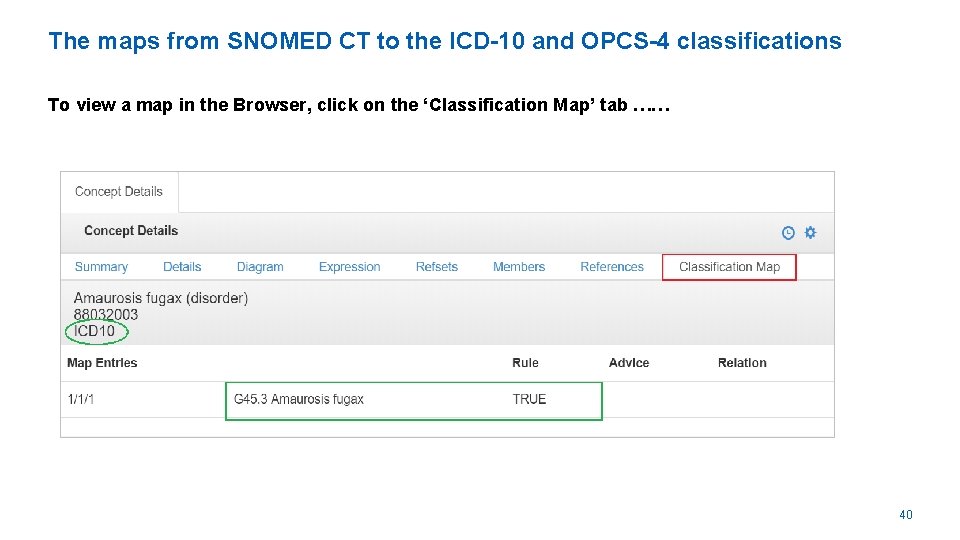
The maps from SNOMED CT to the ICD-10 and OPCS-4 classifications To view a map in the Browser, click on the ‘Classification Map’ tab …… 40
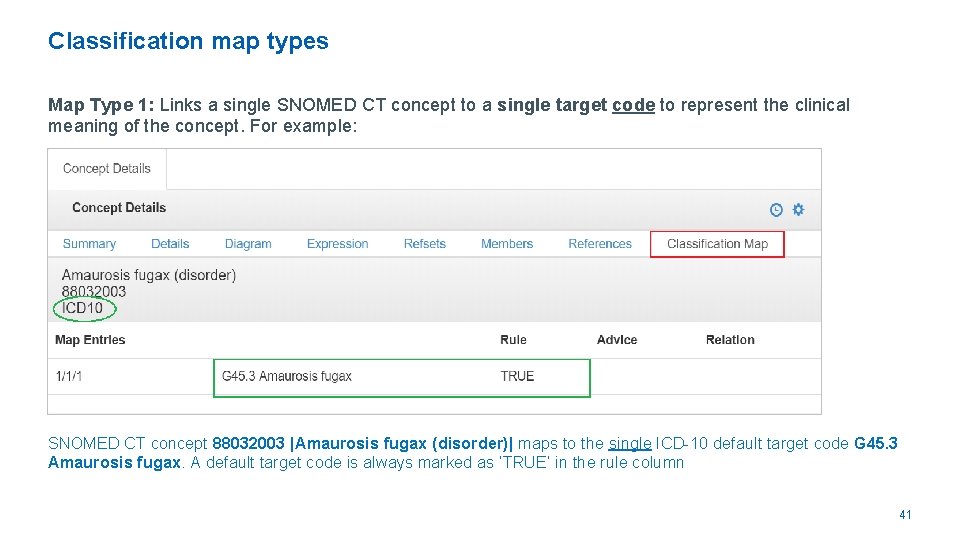
Classification map types Map Type 1: Links a single SNOMED CT concept to a single target code to represent the clinical meaning of the concept. For example: SNOMED CT concept 88032003 |Amaurosis fugax (disorder)| maps to the single ICD-10 default target code G 45. 3 Amaurosis fugax. A default target code is always marked as ‘TRUE’ in the rule column 41
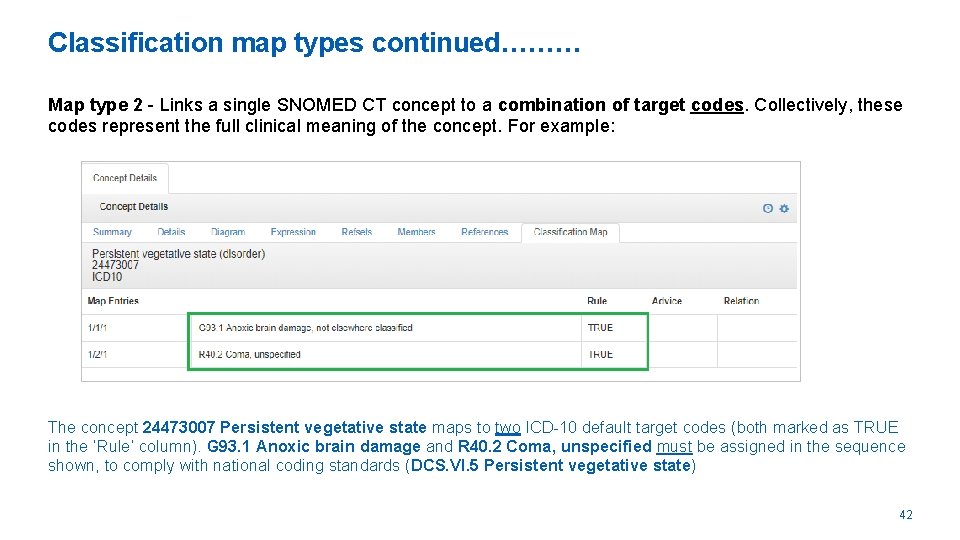
Classification map types continued……… Map type 2 - Links a single SNOMED CT concept to a combination of target codes. Collectively, these codes represent the full clinical meaning of the concept. For example: The concept 24473007 Persistent vegetative state maps to two ICD-10 default target codes (both marked as TRUE in the ‘Rule’ column). G 93. 1 Anoxic brain damage and R 40. 2 Coma, unspecified must be assigned in the sequence shown, to comply with national coding standards (DCS. VI. 5 Persistent vegetative state) 42
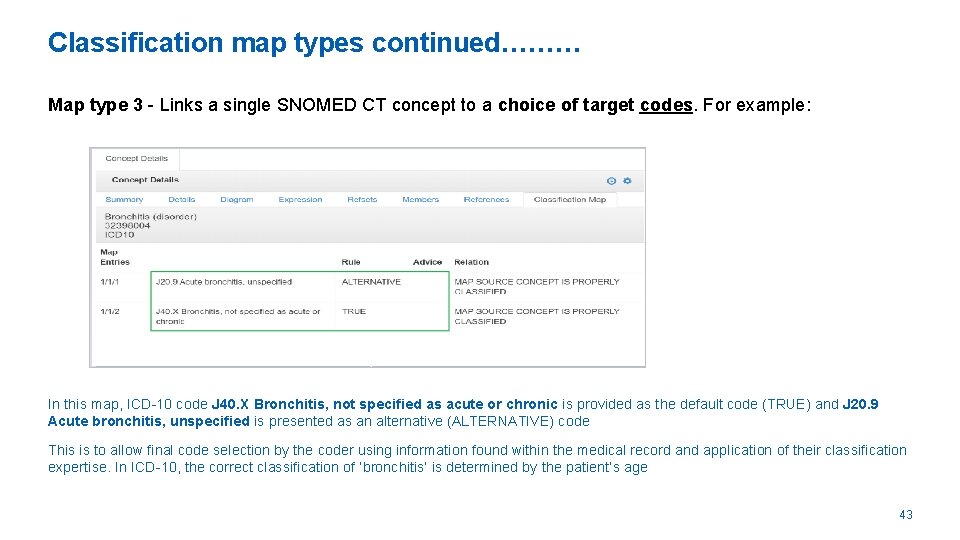
Classification map types continued……… Map type 3 - Links a single SNOMED CT concept to a choice of target codes. For example: In this map, ICD-10 code J 40. X Bronchitis, not specified as acute or chronic is provided as the default code (TRUE) and J 20. 9 Acute bronchitis, unspecified is presented as an alternative (ALTERNATIVE) code This is to allow final code selection by the coder using information found within the medical record and application of their classification expertise. In ICD-10, the correct classification of ‘bronchitis’ is determined by the patient’s age 43
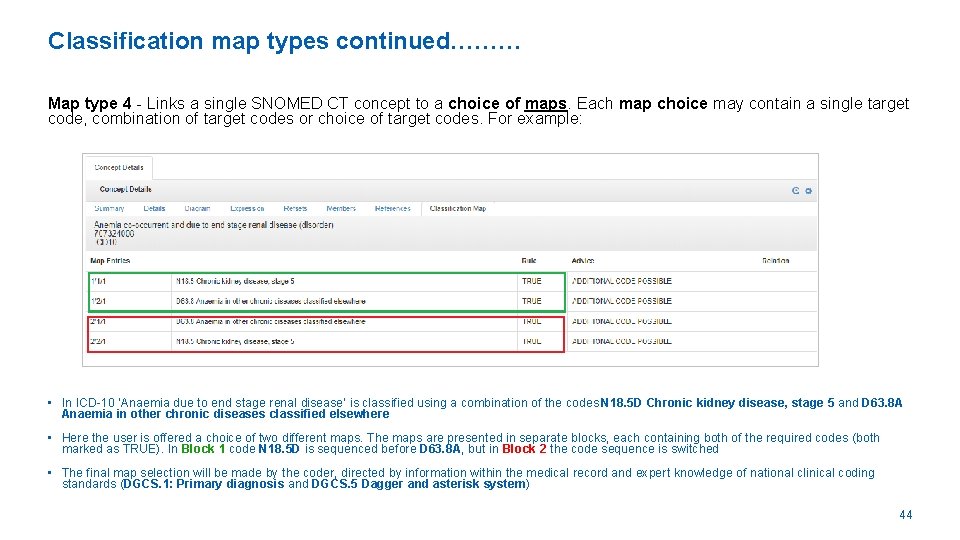
Classification map types continued……… Map type 4 - Links a single SNOMED CT concept to a choice of maps. Each map choice may contain a single target code, combination of target codes or choice of target codes. For example: • In ICD-10 ‘Anaemia due to end stage renal disease’ is classified using a combination of the codes N 18. 5 D Chronic kidney disease, stage 5 and D 63. 8 A Anaemia in other chronic diseases classified elsewhere • Here the user is offered a choice of two different maps. The maps are presented in separate blocks, each containing both of the required codes (both marked as TRUE). In Block 1 code N 18. 5 D is sequenced before D 63. 8 A, but in Block 2 the code sequence is switched • The final map selection will be made by the coder, directed by information within the medical record and expert knowledge of national clinical coding standards (DGCS. 1: Primary diagnosis and DGCS. 5 Dagger and asterisk system) 44
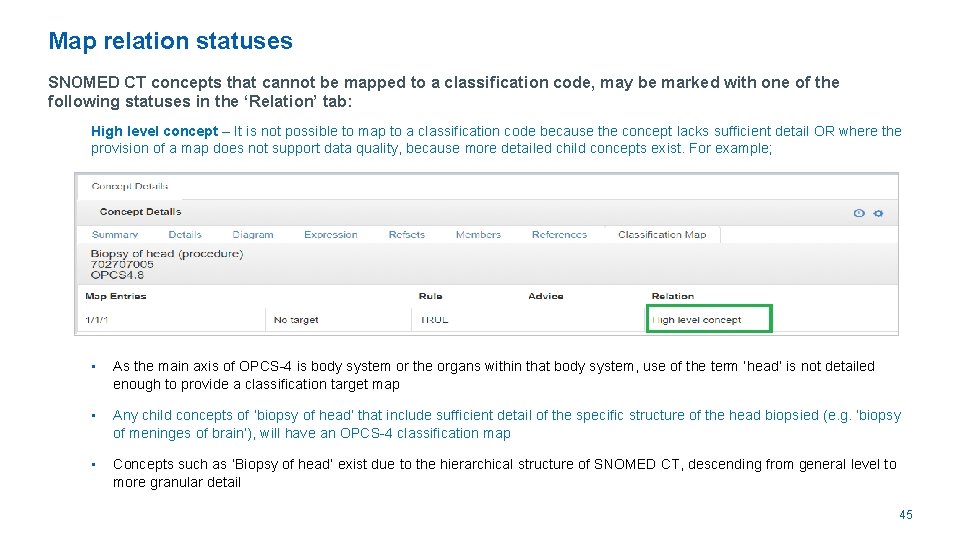
Map relation statuses SNOMED CT concepts that cannot be mapped to a classification code, may be marked with one of the following statuses in the ‘Relation’ tab: High level concept – It is not possible to map to a classification code because the concept lacks sufficient detail OR where the provision of a map does not support data quality, because more detailed child concepts exist. For example; • As the main axis of OPCS-4 is body system or the organs within that body system, use of the term ‘head’ is not detailed enough to provide a classification target map • Any child concepts of ‘biopsy of head’ that include sufficient detail of the specific structure of the head biopsied (e. g. ‘biopsy of meninges of brain’), will have an OPCS-4 classification map • Concepts such as ‘Biopsy of head’ exist due to the hierarchical structure of SNOMED CT, descending from general level to more granular detail 45
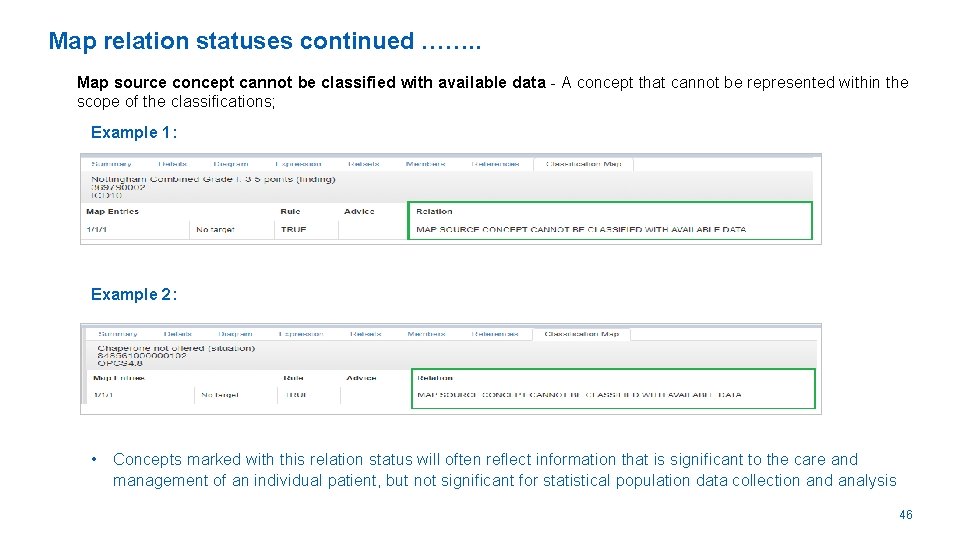
Map relation statuses continued ……. . Map source concept cannot be classified with available data - A concept that cannot be represented within the scope of the classifications; Example 1: Example 2: • Concepts marked with this relation status will often reflect information that is significant to the care and management of an individual patient, but not significant for statistical population data collection and analysis 46
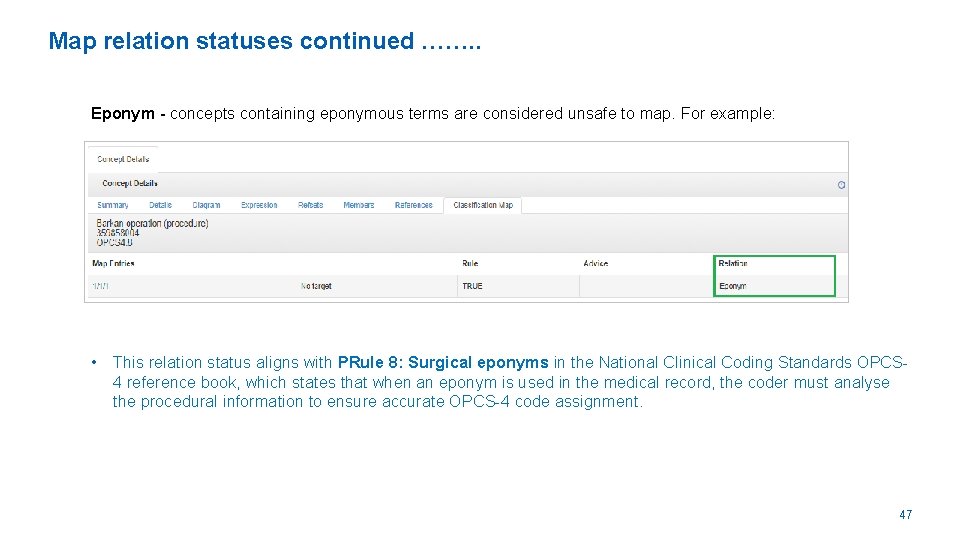
Map relation statuses continued ……. . Eponym - concepts containing eponymous terms are considered unsafe to map. For example: • This relation status aligns with PRule 8: Surgical eponyms in the National Clinical Coding Standards OPCS 4 reference book, which states that when an eponym is used in the medical record, the coder must analyse the procedural information to ensure accurate OPCS-4 code assignment. 47

In summary • SNOMED CT and ICD-10 and OPCS-4 classifications fulfil different purposes • SNOMED CT is a structured clinical vocabulary used by clinicians to record information in patient’s Electronic Patient Record (EPR) at the point of care • The ICD-10 and OPCS-4 classifications are used retrospectively by coders in Patient Administration Systems (PAS) to provide a summary of a hospital Consultant Episode of patient care for statistical analysis • The classification maps can provide a semi-automated link from structured clinical information recorded in the EPR by the clinician using SNOMED CT to ICD-10 and OPCS-4 codes in order to satisfy mandatory PAS data collections • Final classification code assignment will require expert knowledge in the rules and standards of the ICD 10 and OPCS-4 48
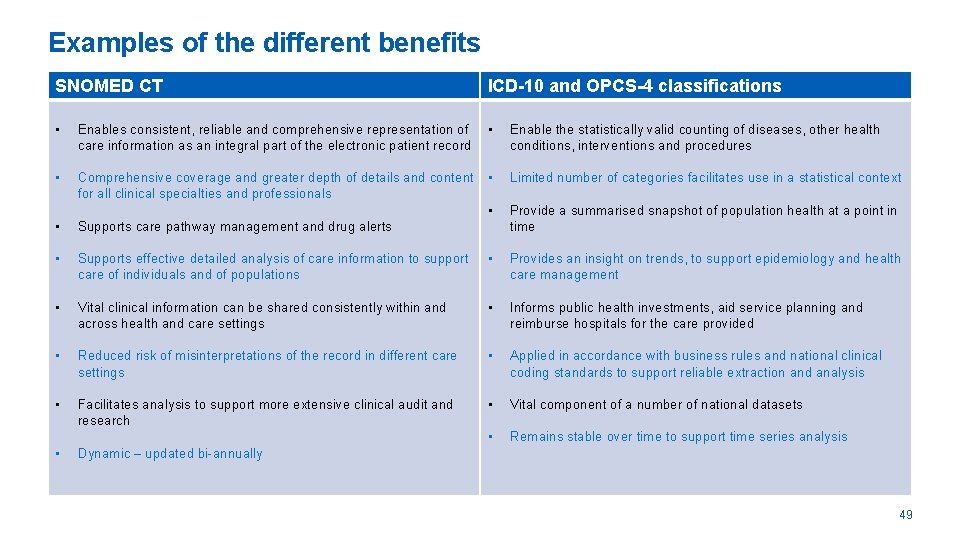
Examples of the different benefits SNOMED CT ICD-10 and OPCS-4 classifications • Enables consistent, reliable and comprehensive representation of care information as an integral part of the electronic patient record • • Comprehensive coverage and greater depth of details and content • for all clinical specialties and professionals • Supports care pathway management and drug alerts Limited number of categories facilitates use in a statistical context • Enable the statistically valid counting of diseases, other health conditions, interventions and procedures Provide a summarised snapshot of population health at a point in time • Supports effective detailed analysis of care information to support care of individuals and of populations • Provides an insight on trends, to support epidemiology and health care management • Vital clinical information can be shared consistently within and across health and care settings • Informs public health investments, aid service planning and reimburse hospitals for the care provided • Reduced risk of misinterpretations of the record in different care settings • Applied in accordance with business rules and national clinical coding standards to support reliable extraction and analysis • Facilitates analysis to support more extensive clinical audit and research • Vital component of a number of national datasets • Remains stable over time to support time series analysis • Dynamic – updated bi-annually 49
Further information • Additional information about the UK classification maps in NHS Digital Browser can be found here: https: //hscic. kahootz. com/gf 2. ti/f/762498/34522309. 2/PDF//UK_Classification_Maps_in_the_NHS_Digital_SNOMED_CT_Browser 1. 0. pdf • If you would like to learn more about SNOMED CT, additional e-Learning and webinars materials can be found in the Education &Training area of Delen: https: //hscic. kahootz. com/connect. ti/t_c_home/grouphome • SNOMED International also provides on-line courses and tutorials: https: //www. snomed. org/snomed-ct/education 50

Connect with us @nhsdigital company/nhs-digital www. digital. nhs. uk 51
- Slides: 51