
Sniper Localization System Marko Gasic Sandeep Brar Ehsan

Sniper Localization System Marko Gasic Sandeep Brar Ehsan Dallalzadeh Balraj Mattu
Overview o o o o o Introduction Vision System Description Test Results Obstacles Encountered Project Finances Production Cost Conclusion Questions?
Introduction o o Snipers are a serious threat in urban warfare environment. Civilian threat in cases such as Washington DC sniper. Snipers are very effective at harassing and impeding military operations. Acoustic. Shield Designs system enables identification of direction of origin of a sniper shot within seconds of the event.
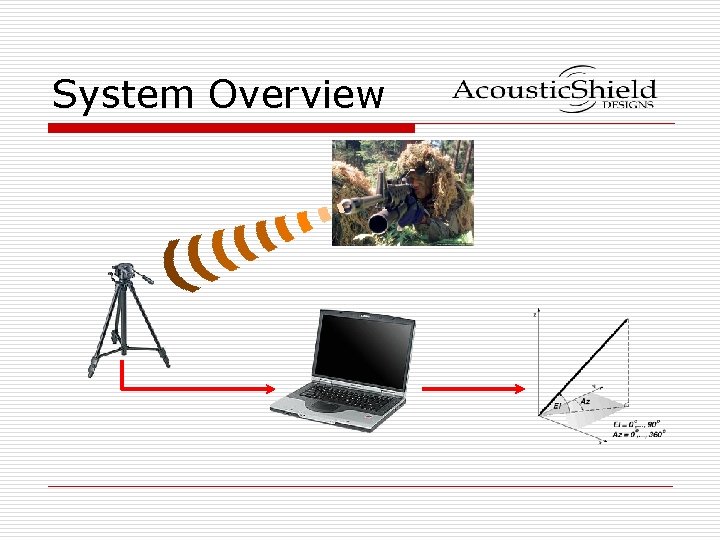
System Overview
Vision o Existing Products • • o Above $15, 000 US Available only to elite military divisions and not standard equipment to regular units or police forces Acoustic Shield System • • System cost around $2000 Low cost enables local police departments and regular military units to purchase system
System Description o Principle of Operation • • o Sound waves reach 4 speakers at different times Using these delays we can calculate the origin of sound Functional Breakdown • • • Signal Acquisition Gunshot Recognition Delay Detection 3 -D Triangulation Human-Machine Interface (H. M. I)
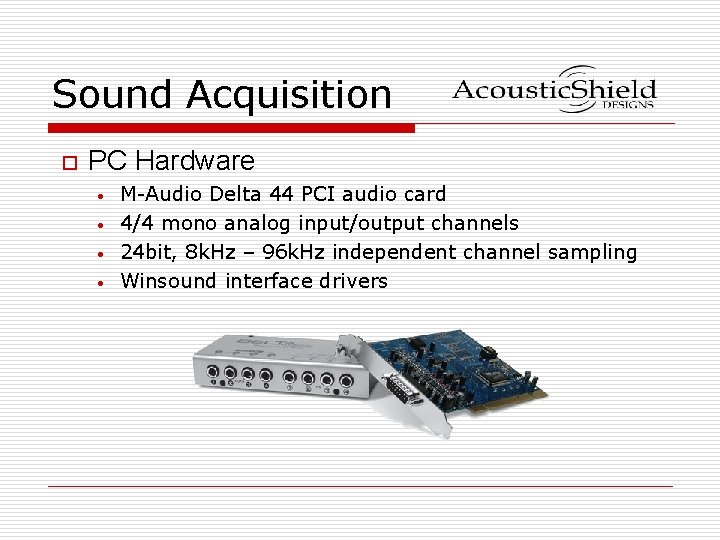
Sound Acquisition o PC Hardware • • M-Audio Delta 44 PCI audio card 4/4 mono analog input/output channels 24 bit, 8 k. Hz – 96 k. Hz independent channel sampling Winsound interface drivers
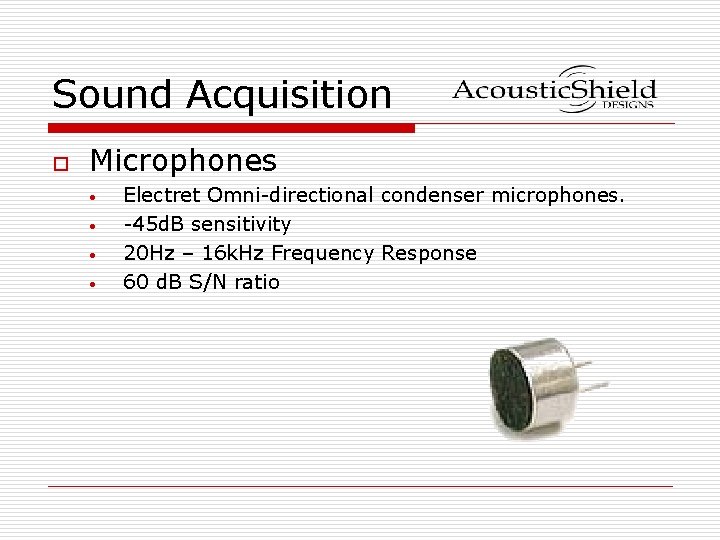
Sound Acquisition o Microphones • • Electret Omni-directional condenser microphones. -45 d. B sensitivity 20 Hz – 16 k. Hz Frequency Response 60 d. B S/N ratio
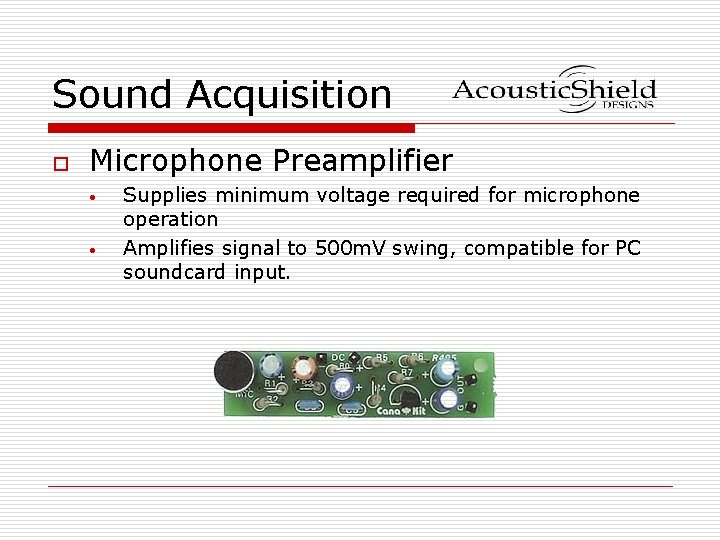
Sound Acquisition o Microphone Preamplifier • • Supplies minimum voltage required for microphone operation Amplifies signal to 500 m. V swing, compatible for PC soundcard input.
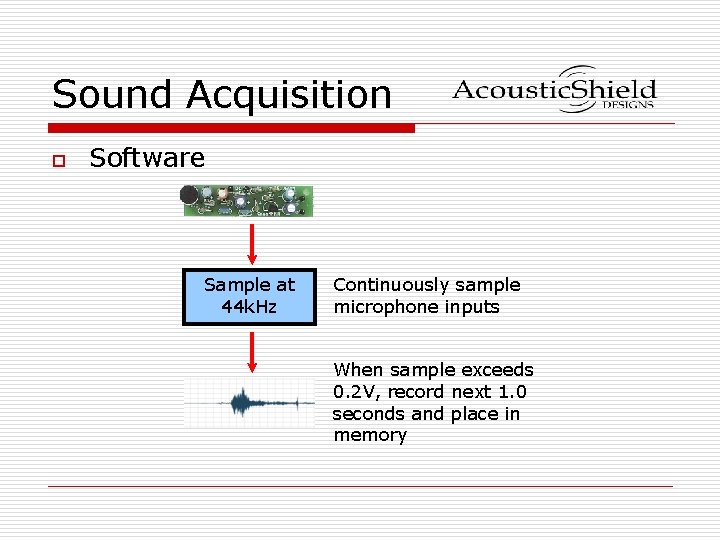
Sound Acquisition o Software Sample at 44 k. Hz Continuously sample microphone inputs When sample exceeds 0. 2 V, record next 1. 0 seconds and place in memory
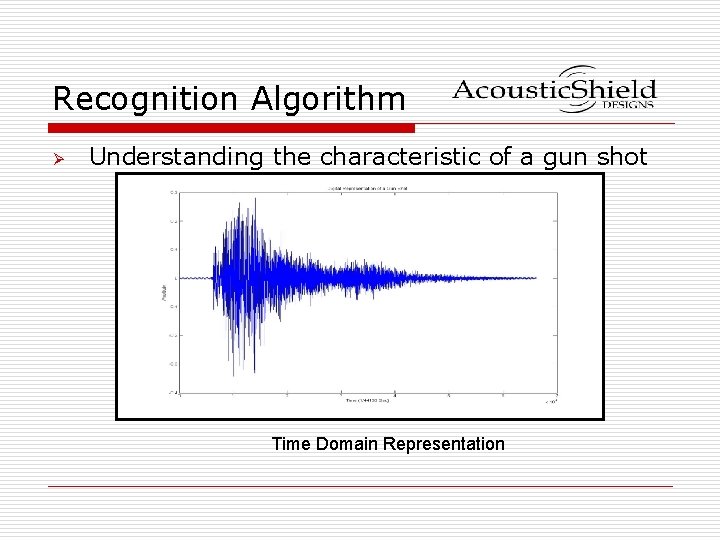
Recognition Algorithm Ø Understanding the characteristic of a gun shot Time Domain Representation
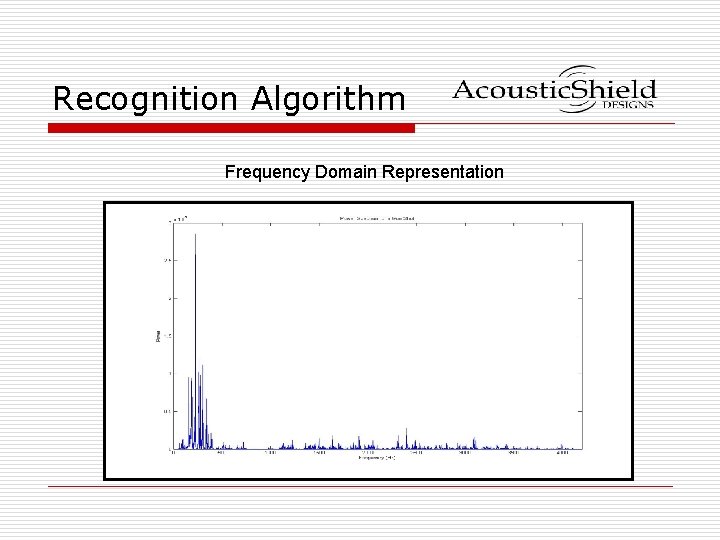
Recognition Algorithm Frequency Domain Representation
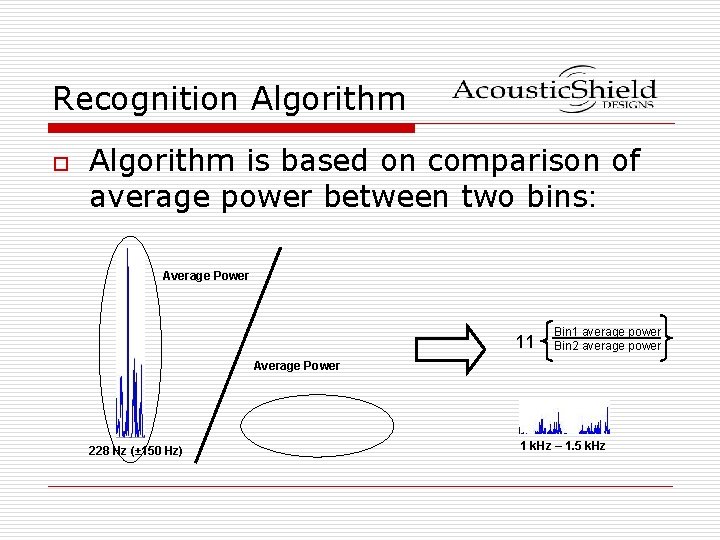
Recognition Algorithm o Algorithm is based on comparison of average power between two bins: Average Power 11 Bin 1 average power Bin 2 average power Average Power 228 Hz (± 150 Hz) 1 k. Hz – 1. 5 k. Hz
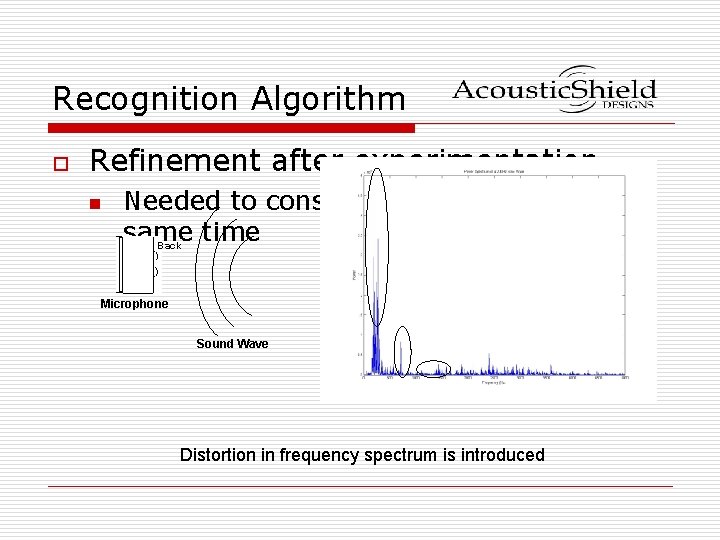
Recognition Algorithm o Refinement after experimentation n Needed to consider all 4 input at the same time Back Microphone Sound Wave Distortion in frequency spectrum is introduced
Recognition Algorithm o Simple Solution o Analyze all four microphones o Accuracy is demonstrated in Test Results section
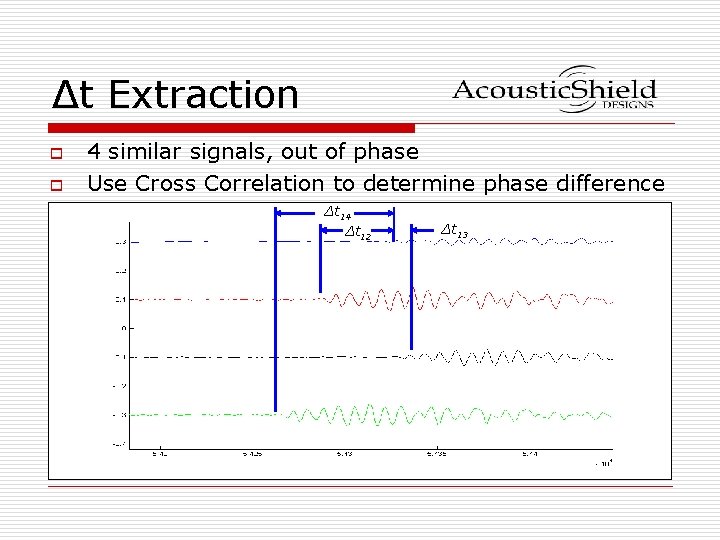
Δt Extraction o o 4 similar signals, out of phase Use Cross Correlation to determine phase difference Δt 14 Δt 12 Δt 13
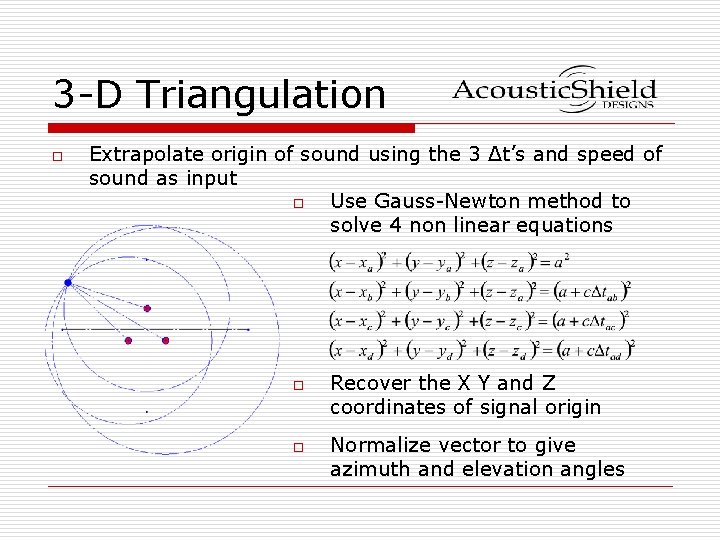
3 -D Triangulation o Extrapolate origin of sound using the 3 Δt’s and speed of sound as input o Use Gauss-Newton method to solve 4 non linear equations o o Recover the X Y and Z coordinates of signal origin Normalize vector to give azimuth and elevation angles
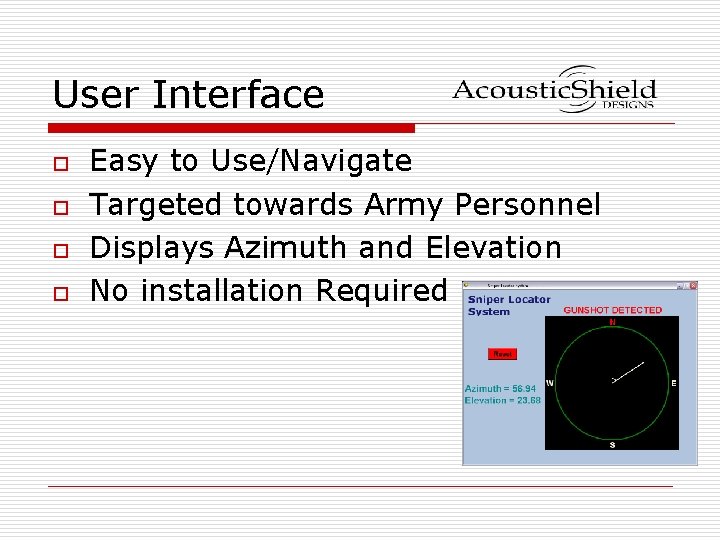
User Interface o o Easy to Use/Navigate Targeted towards Army Personnel Displays Azimuth and Elevation No installation Required
Testing o The testing was done in 2 phases: • • o Testing for the detection in 2 -D (X, Y) Testing for detection of the elevation Procedure A: • • • The system was setup The software was running Located the tripod at the center of a large circle Drew a 2 -D coordinate system about the center of the tripod Marked the imaginary circle around the center of the tripod with points each about 30 degrees apart Ran the sound sample of the gunshot twice at each point
Testing • Recorded the Average, Trigger, X and Y values Took a string from the sound source(speaker) to the center of the tripod Chose a point on the string and recorded its X and Y components. At the end, had pairs of vectors in 2 -D • Comparison Stage…… • • Wrote a C++ code to input each pair of vectors to calculate the angle between the actual vector and the result vector from the system in Degrees
Observations o On average, the angle difference was about 2. 78 Degrees o The accuracy was almost the same for all the points in the surrounding
Testing cntd. o Procedure B (Elevation): • • The system was setup The software was running Located the tripod at the center of a large circle From points 90 Degrees apart, got samples At each point, tried 3 different elevations: 1) above the center plane 2) at the same plane 3) below the center plane Recorded the elevation that the program gave for each trial For each point, measured the elevation angle compared to the center of the tripod (+ if above the center, (-) if below the center)
Observations o On average, elevation difference was 3. 15 Degrees o Functional Specifications stated maximum allowable error of 10 degrees
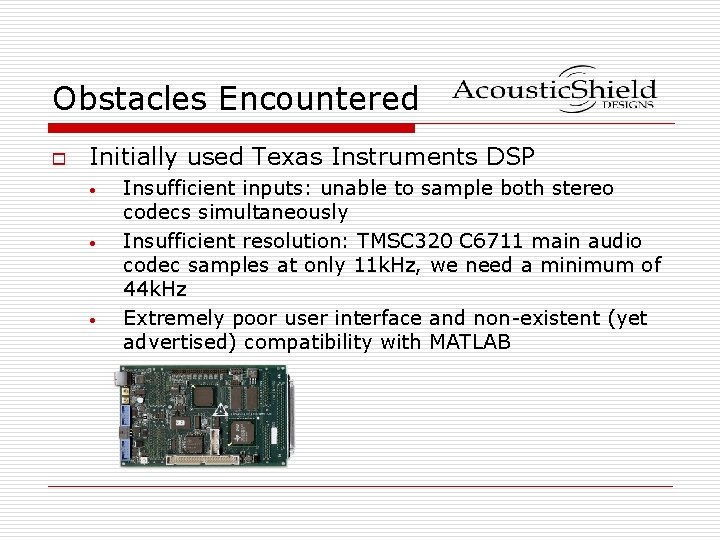
Obstacles Encountered o Initially used Texas Instruments DSP • • • Insufficient inputs: unable to sample both stereo codecs simultaneously Insufficient resolution: TMSC 320 C 6711 main audio codec samples at only 11 k. Hz, we need a minimum of 44 k. Hz Extremely poor user interface and non-existent (yet advertised) compatibility with MATLAB
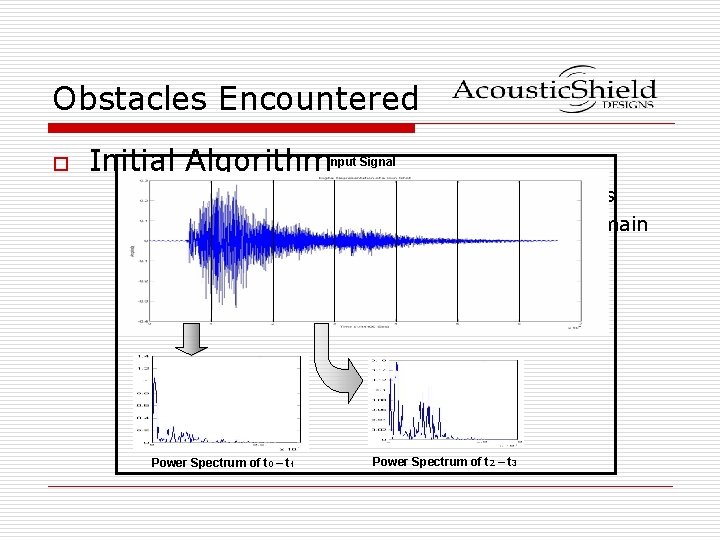
Obstacles Encountered o Initial Algorithm Input Signal n n Divide sampled input into smaller intervals Analyze smaller intervals in frequency domain Power Spectrum of t 0 – t 1 Power Spectrum of t 2 – t 3
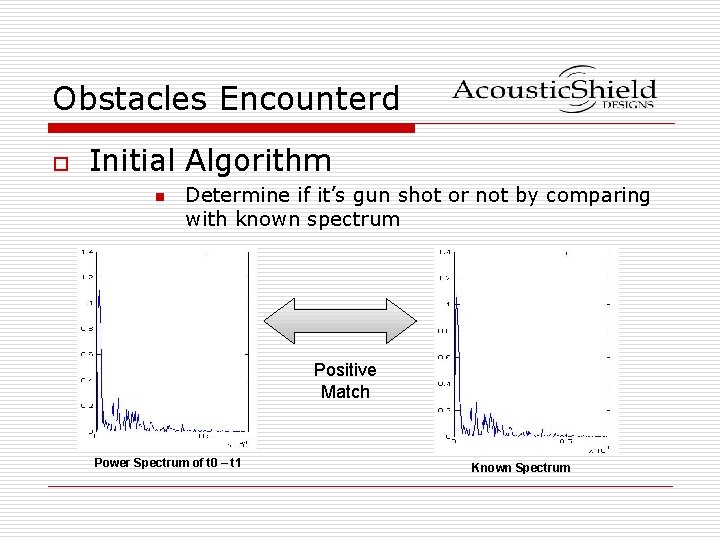
Obstacles Encounterd o Initial Algorithm n Determine if it’s gun shot or not by comparing with known spectrum Positive Match Power Spectrum of t 0 – t 1 Known Spectrum
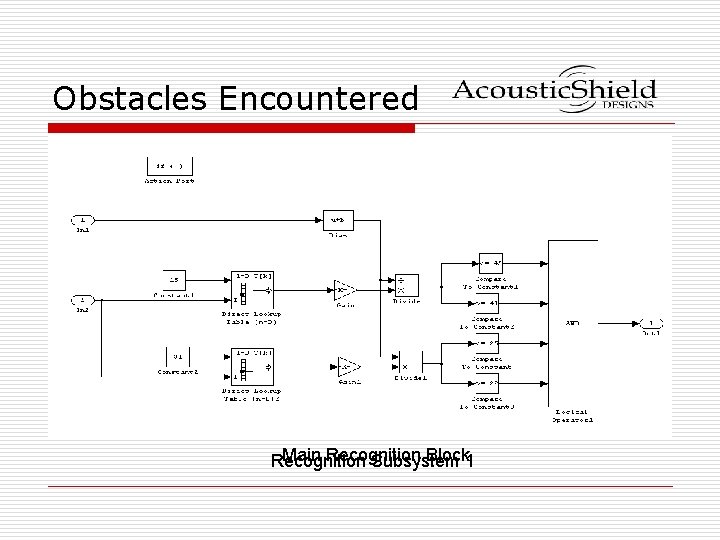
Obstacles Encountered o Algorithm was implemented in Matlab and Simulink Main Recognition Block 1 Recognition Subsystem
Obstacle Encountered o Problems o o Unable to achieve desired speed Didn’t do well when tried with real input (instead of a wave file)
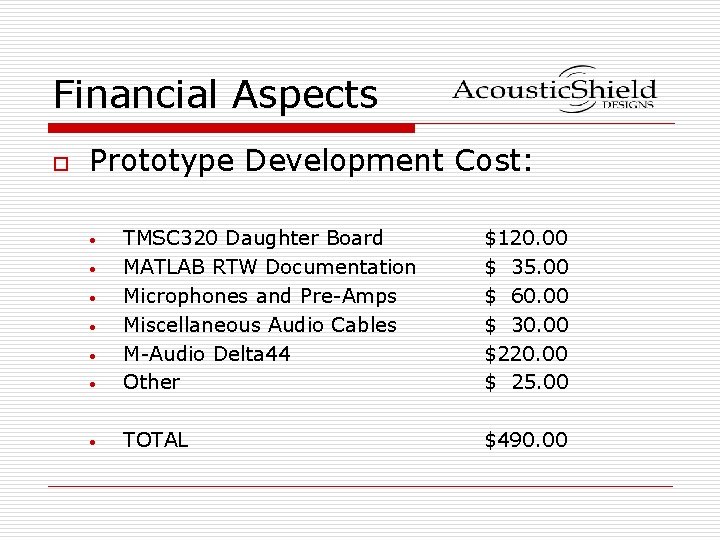
Financial Aspects o Prototype Development Cost: • TMSC 320 Daughter Board MATLAB RTW Documentation Microphones and Pre-Amps Miscellaneous Audio Cables M-Audio Delta 44 Other $120. 00 $ 35. 00 $ 60. 00 $ 30. 00 $220. 00 $ 25. 00 • TOTAL $490. 00 • • •
Budget Estimate o o o Initial cost estimate $2260. 00 Actual cost $490. 00 Significantly lower cost due to change in platform Savings with no loss in performance We were able to borrow the tripod, saving ~$100
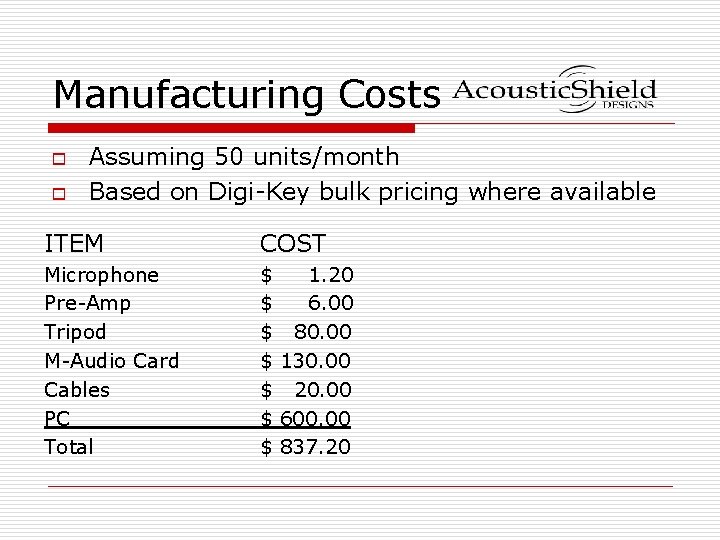
Manufacturing Costs o o Assuming 50 units/month Based on Digi-Key bulk pricing where available ITEM COST Microphone Pre-Amp Tripod M-Audio Card Cables PC Total $ 1. 20 $ 6. 00 $ 80. 00 $ 130. 00 $ 20. 00 $ 600. 00 $ 837. 20
Conclusion o o Successfully Demonstrated Functional Concept Demonstrated market value and ability to produce at reduced cost Encountered problems and chose alternate solutions Stayed within budget and timeline considerations
Thank You Questions?
- Slides: 33