
SNC 1 P PHYSICS ELECTRICAL APPLICATIONS Grounding P

- Slides: 28
SNC 1 P PHYSICS ELECTRICAL APPLICATIONS � Grounding (P. 476)
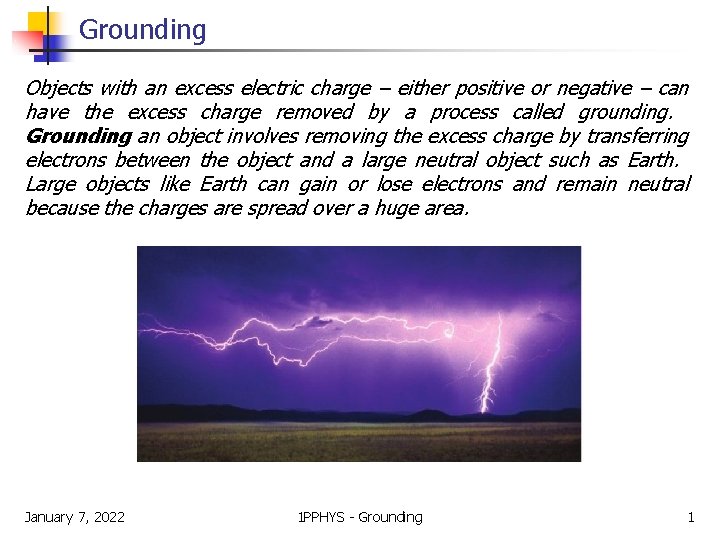
Grounding Objects with an excess electric charge – either positive or negative – can have the excess charge removed by a process called grounding. Grounding an object involves removing the excess charge by transferring electrons between the object and a large neutral object such as Earth. Large objects like Earth can gain or lose electrons and remain neutral because the charges are spread over a huge area. January 7, 2022 1 PPHYS - Grounding 1
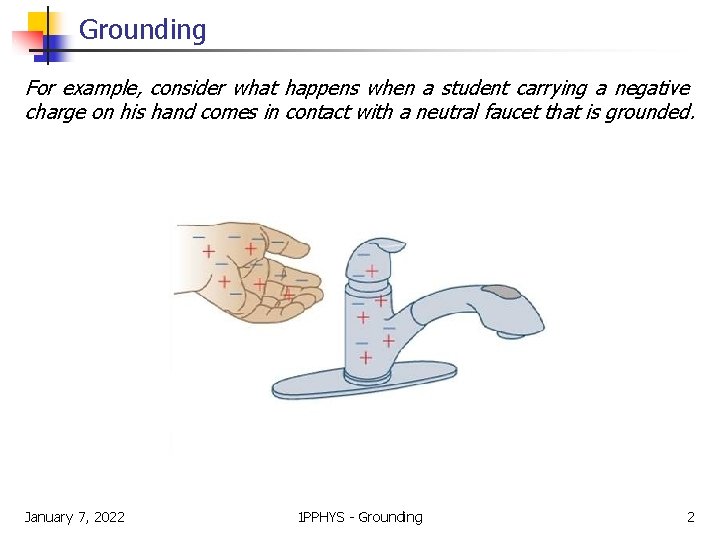
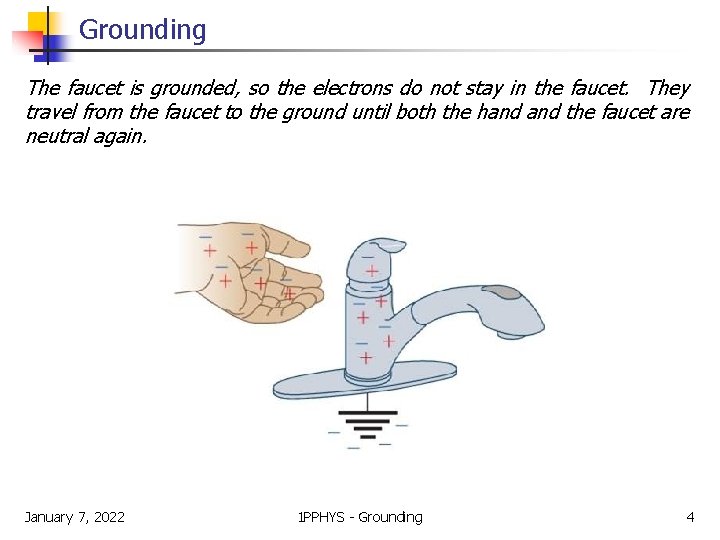
Grounding For example, consider what happens when a student carrying a negative charge on his hand comes in contact with a neutral faucet that is grounded. January 7, 2022 1 PPHYS - Grounding 2
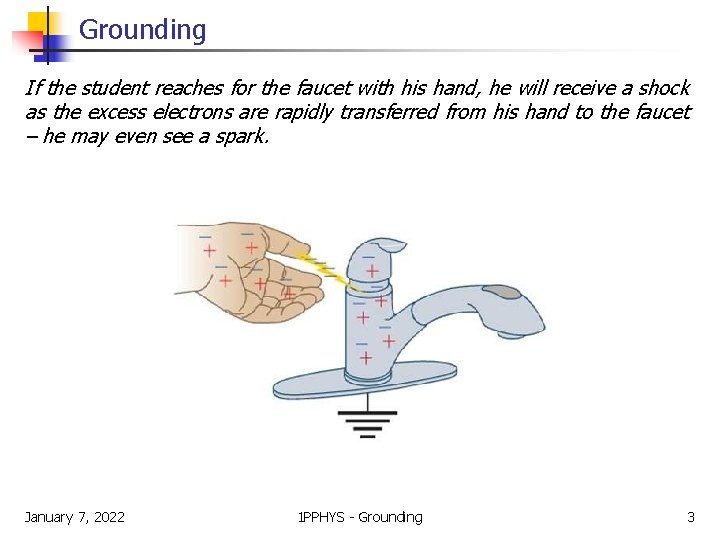
Grounding If the student reaches for the faucet with his hand, he will receive a shock as the excess electrons are rapidly transferred from his hand to the faucet – he may even see a spark. January 7, 2022 1 PPHYS - Grounding 3
Grounding The faucet is grounded, so the electrons do not stay in the faucet. They travel from the faucet to the ground until both the hand the faucet are neutral again. January 7, 2022 1 PPHYS - Grounding 4
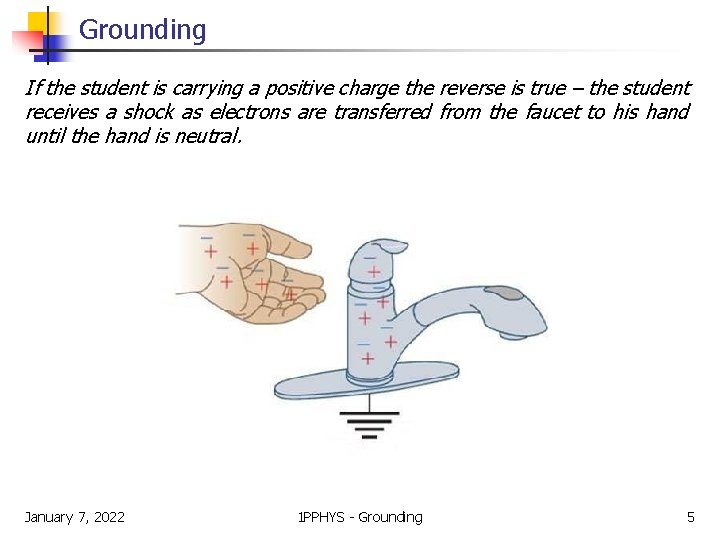
Grounding If the student is carrying a positive charge the reverse is true – the student receives a shock as electrons are transferred from the faucet to his hand until the hand is neutral. January 7, 2022 1 PPHYS - Grounding 5
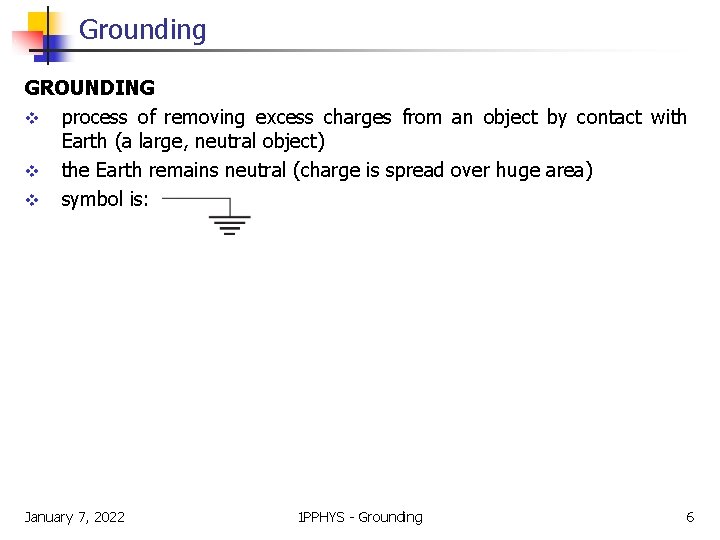
Grounding GROUNDING v process of removing excess charges from an object by contact with Earth (a large, neutral object) v the Earth remains neutral (charge is spread over huge area) v symbol is: January 7, 2022 1 PPHYS - Grounding 6
Grounding PRACTICE 1. Why does the Earth not become charged when many people in the world ground objects? the Earth can gain or lose electrons and remain neutral because the charges are spread over a huge area January 7, 2022 1 PPHYS - Grounding 7
Grounding PRACTICE 2. Explain what happens when the following are grounded: (a) a positively charged object (a) electrons from ground move into the positively charged object until the number of electrons is balanced by the number of protons January 7, 2022 1 PPHYS - Grounding 8
Grounding PRACTICE 2. Explain what happens when the following are grounded: (b) a negatively charged object (b) excess electrons in the negatively charged object move into ground until the number of electrons is balanced by the number of protons January 7, 2022 1 PPHYS - Grounding 9
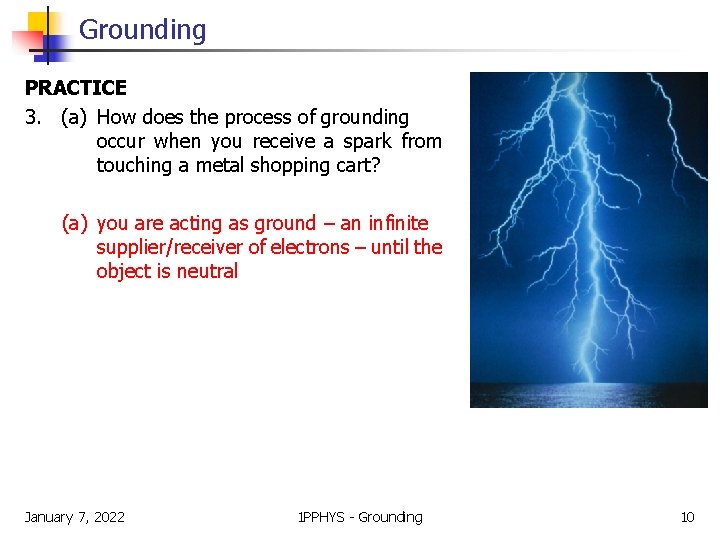
Grounding PRACTICE 3. (a) How does the process of grounding occur when you receive a spark from touching a metal shopping cart? (a) you are acting as ground – an infinite supplier/receiver of electrons – until the object is neutral January 7, 2022 1 PPHYS - Grounding 10
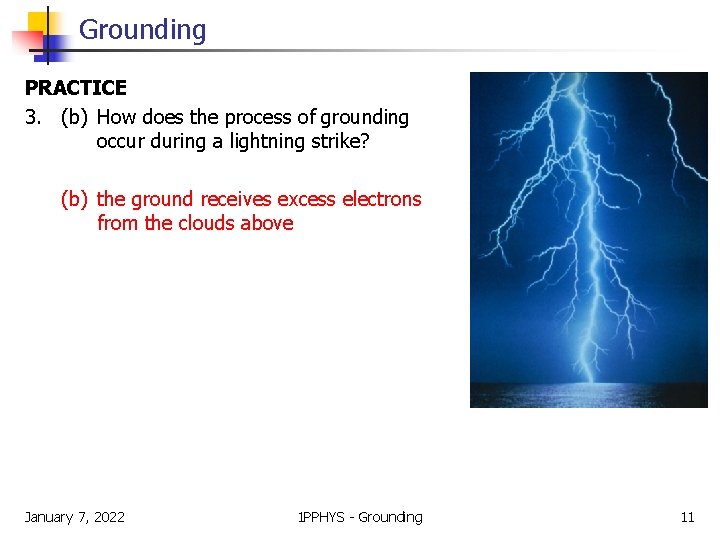
Grounding PRACTICE 3. (b) How does the process of grounding occur during a lightning strike? (b) the ground receives excess electrons from the clouds above January 7, 2022 1 PPHYS - Grounding 11
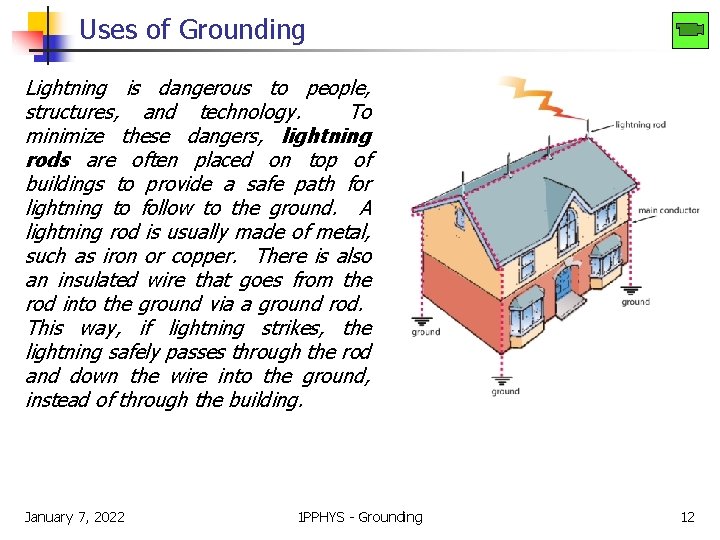
Uses of Grounding Lightning is dangerous to people, structures, and technology. To minimize these dangers, lightning rods are often placed on top of buildings to provide a safe path for lightning to follow to the ground. A lightning rod is usually made of metal, such as iron or copper. There is also an insulated wire that goes from the rod into the ground via a ground rod. This way, if lightning strikes, the lightning safely passes through the rod and down the wire into the ground, instead of through the building. January 7, 2022 1 PPHYS - Grounding 12
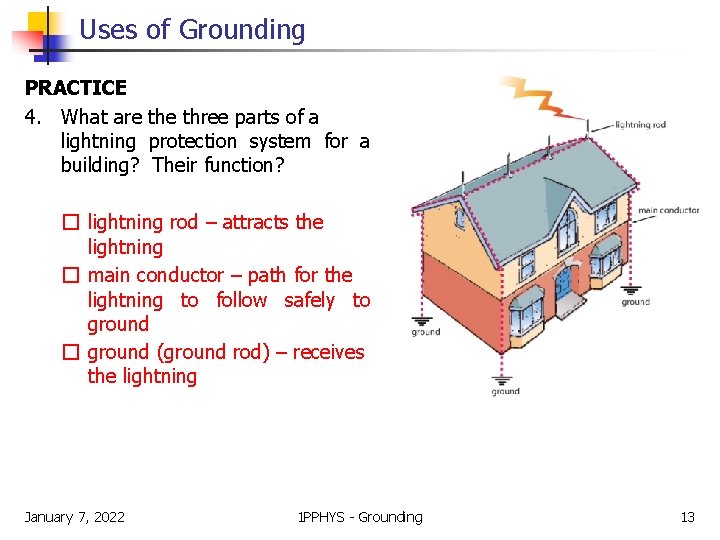
Uses of Grounding PRACTICE 4. What are three parts of a lightning protection system for a building? Their function? � lightning rod – attracts the lightning � main conductor – path for the lightning to follow safely to ground � ground (ground rod) – receives the lightning January 7, 2022 1 PPHYS - Grounding 13
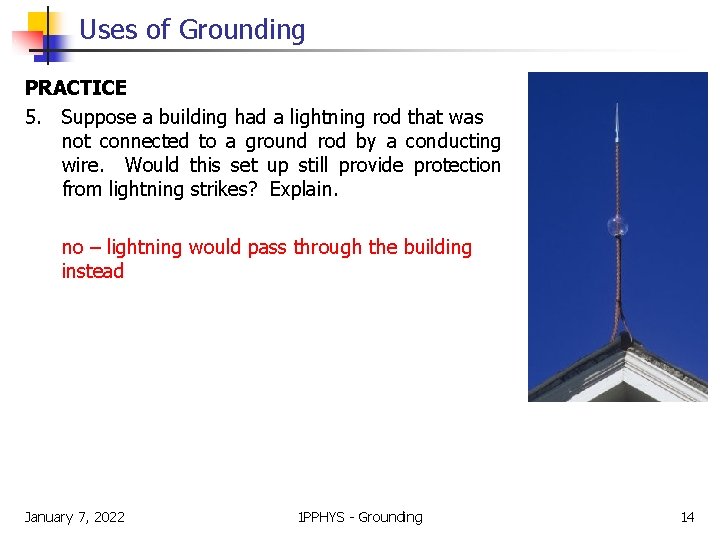
Uses of Grounding PRACTICE 5. Suppose a building had a lightning rod that was not connected to a ground rod by a conducting wire. Would this set up still provide protection from lightning strikes? Explain. no – lightning would pass through the building instead January 7, 2022 1 PPHYS - Grounding 14
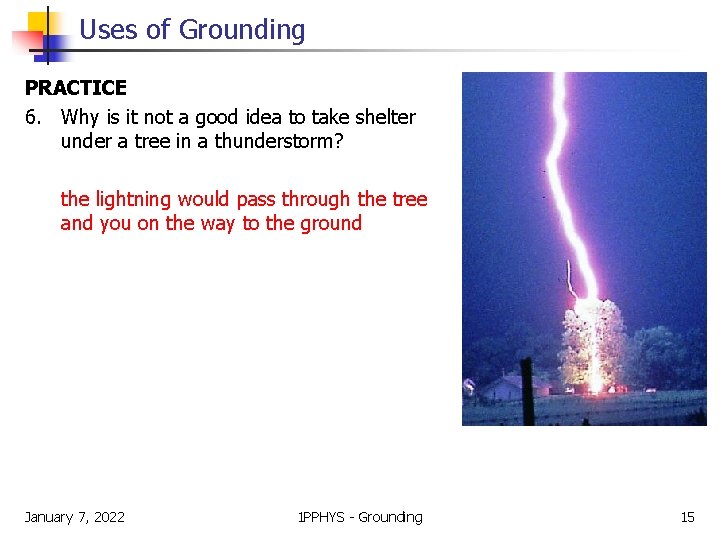
Uses of Grounding PRACTICE 6. Why is it not a good idea to take shelter under a tree in a thunderstorm? the lightning would pass through the tree and you on the way to the ground January 7, 2022 1 PPHYS - Grounding 15
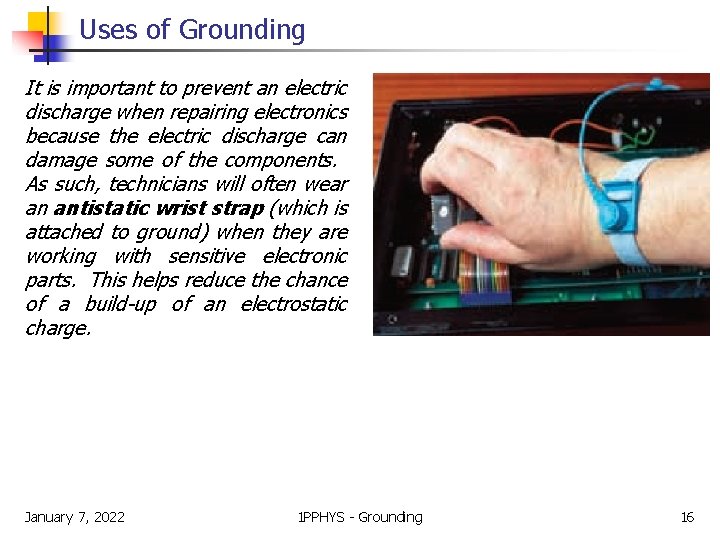
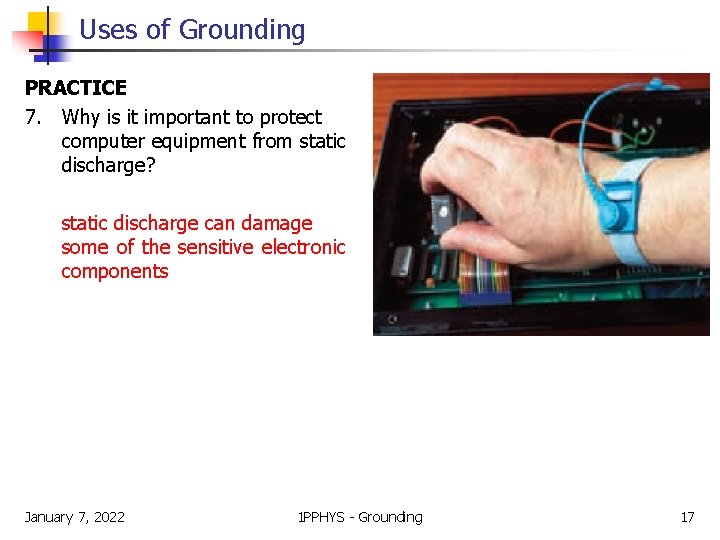
Uses of Grounding It is important to prevent an electric discharge when repairing electronics because the electric discharge can damage some of the components. As such, technicians will often wear an antistatic wrist strap (which is attached to ground) when they are working with sensitive electronic parts. This helps reduce the chance of a build-up of an electrostatic charge. January 7, 2022 1 PPHYS - Grounding 16
Uses of Grounding PRACTICE 7. Why is it important to protect computer equipment from static discharge? static discharge can damage some of the sensitive electronic components January 7, 2022 1 PPHYS - Grounding 17
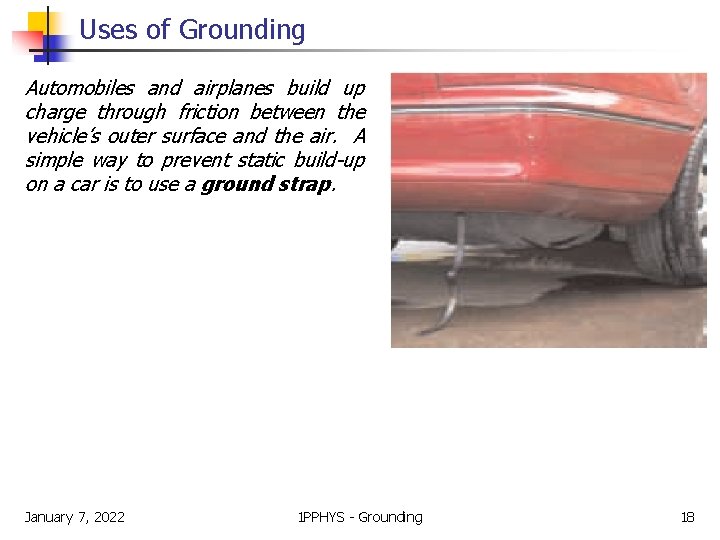
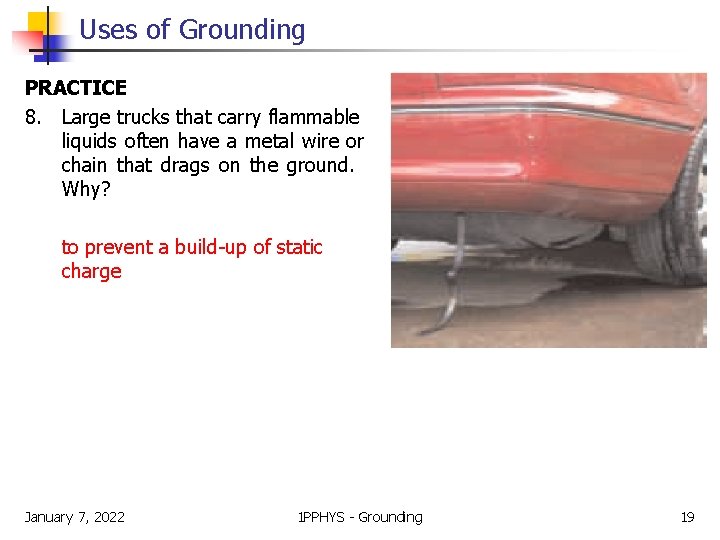
Uses of Grounding Automobiles and airplanes build up charge through friction between the vehicle’s outer surface and the air. A simple way to prevent static build-up on a car is to use a ground strap. January 7, 2022 1 PPHYS - Grounding 18
Uses of Grounding PRACTICE 8. Large trucks that carry flammable liquids often have a metal wire or chain that drags on the ground. Why? to prevent a build-up of static charge January 7, 2022 1 PPHYS - Grounding 19
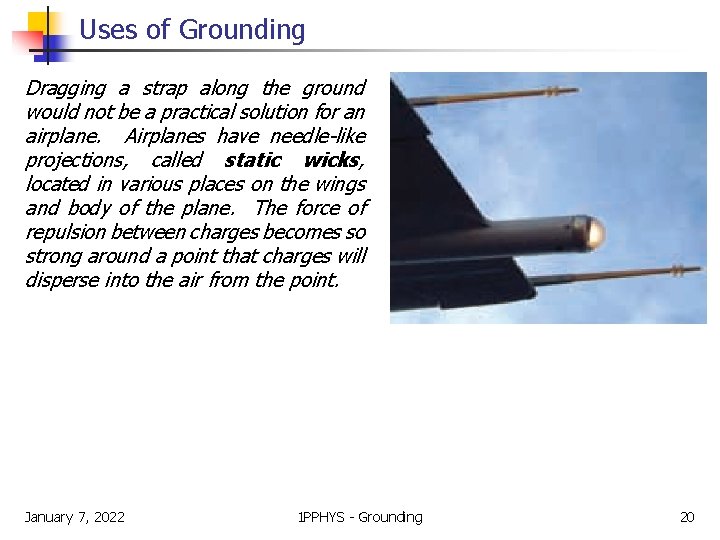
Uses of Grounding Dragging a strap along the ground would not be a practical solution for an airplane. Airplanes have needle-like projections, called static wicks, located in various places on the wings and body of the plane. The force of repulsion between charges becomes so strong around a point that charges will disperse into the air from the point. January 7, 2022 1 PPHYS - Grounding 20
Uses of Grounding Static charge build-up is particularly dangerous when using flammable materials. When airplanes are fuelled, the very explosive fuel moving through the nozzle creates a build-up of static charges. If the nozzle comes too close to the plane’s body, a spark could ignite the fuel. In order to prevent this, the nozzle and fuel truck are connected to ground. January 7, 2022 1 PPHYS - Grounding 21
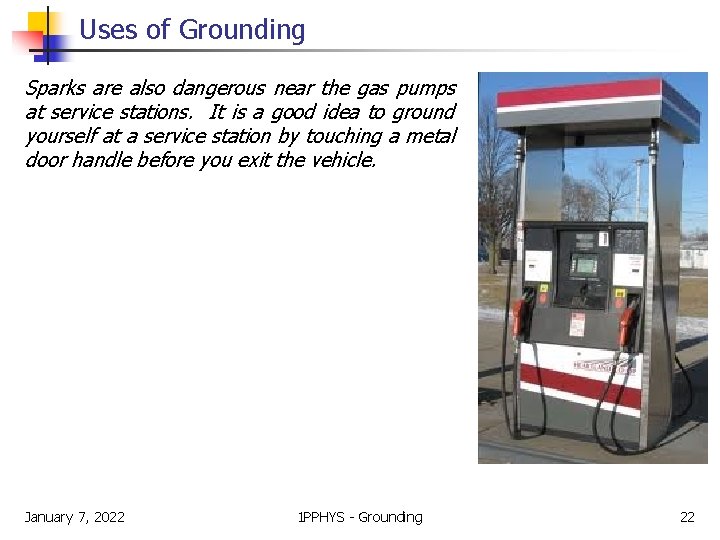
Uses of Grounding Sparks are also dangerous near the gas pumps at service stations. It is a good idea to ground yourself at a service station by touching a metal door handle before you exit the vehicle. January 7, 2022 1 PPHYS - Grounding 22
Uses of Grounding USES OF … v grounding is used in a variety of ways to protect us including: • lightning rods (and conducting wire and ground rod) • antistatic wrist straps • ground straps on vehicles • static wicks on airplanes • gas stations January 7, 2022 1 PPHYS - Grounding 23
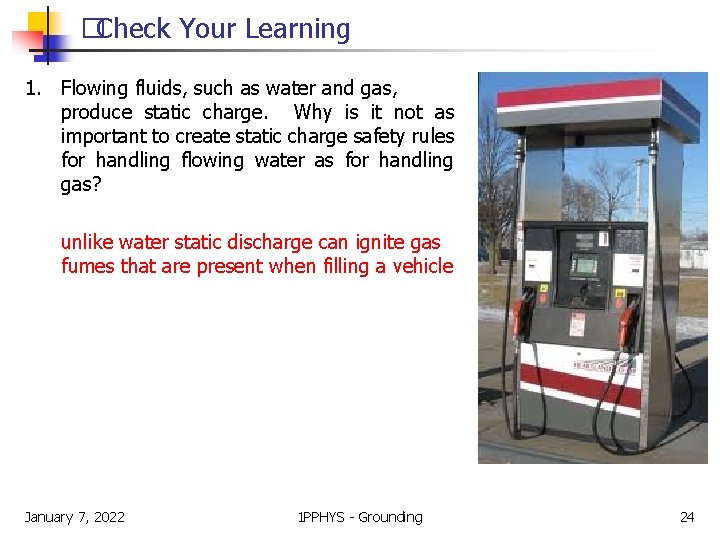
�Check Your Learning 1. Flowing fluids, such as water and gas, produce static charge. Why is it not as important to create static charge safety rules for handling flowing water as for handling gas? unlike water static discharge can ignite gas fumes that are present when filling a vehicle January 7, 2022 1 PPHYS - Grounding 24
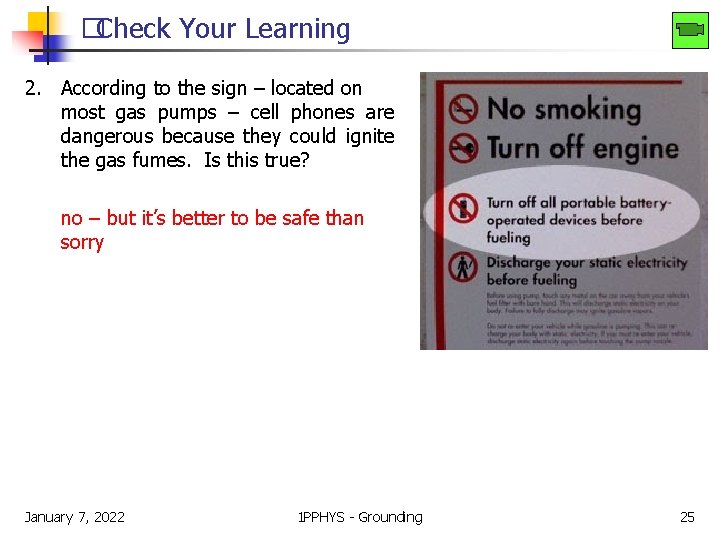
�Check Your Learning 2. According to the sign – located on most gas pumps – cell phones are dangerous because they could ignite the gas fumes. Is this true? no – but it’s better to be safe than sorry January 7, 2022 1 PPHYS - Grounding 25
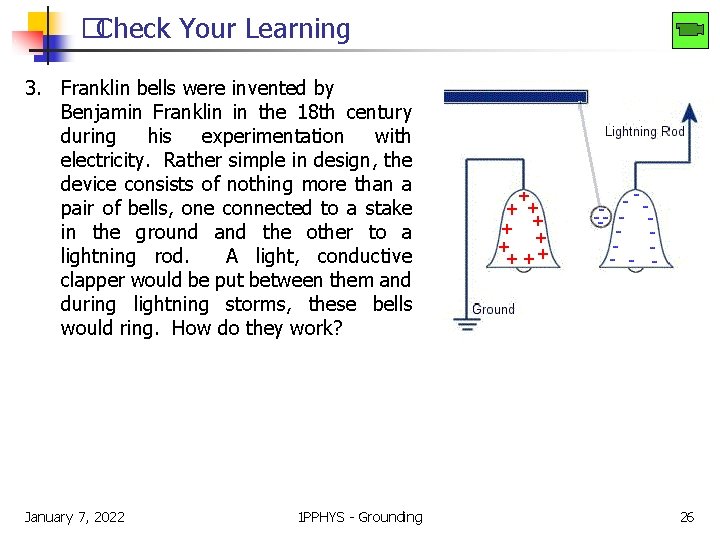
�Check Your Learning 3. Franklin bells were invented by Benjamin Franklin in the 18 th century during his experimentation with electricity. Rather simple in design, the device consists of nothing more than a pair of bells, one connected to a stake in the ground and the other to a lightning rod. A light, conductive clapper would be put between them and during lightning storms, these bells would ring. How do they work? January 7, 2022 1 PPHYS - Grounding 26
�Check Your Learning TEXTBOOK P. 479 Q. 4 January 7, 2022 1 PPHYS - Grounding 27