
SNC 1 P PHYSICS ELECTRICAL APPLICATIONS Charging by

SNC 1 P PHYSICS ELECTRICAL APPLICATIONS � Charging by Friction (P. 468 -469)
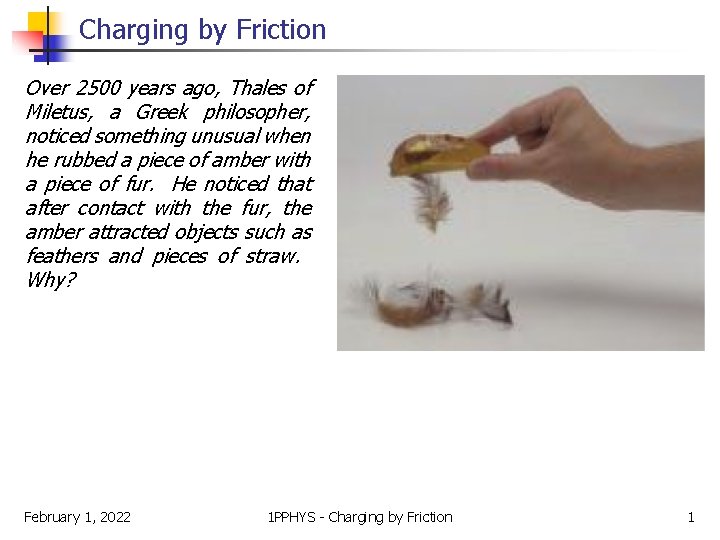
Charging by Friction Over 2500 years ago, Thales of Miletus, a Greek philosopher, noticed something unusual when he rubbed a piece of amber with a piece of fur. He noticed that after contact with the fur, the amber attracted objects such as feathers and pieces of straw. Why? February 1, 2022 1 PPHYS - Charging by Friction 1
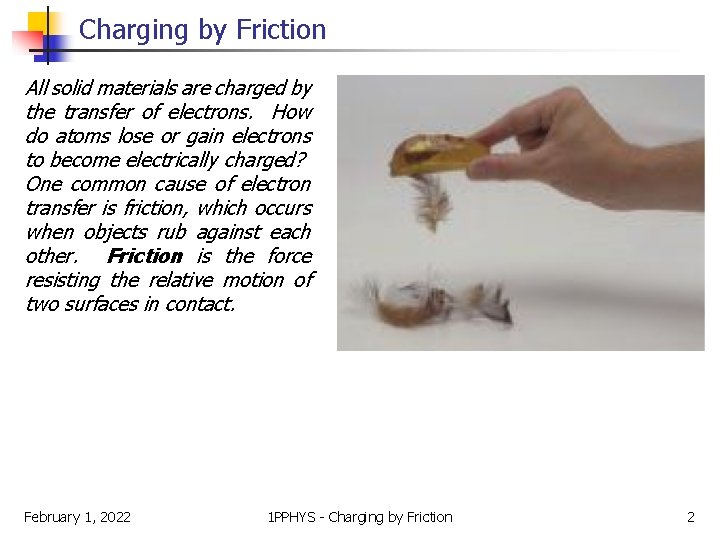
Charging by Friction All solid materials are charged by the transfer of electrons. How do atoms lose or gain electrons to become electrically charged? One common cause of electron transfer is friction, which occurs when objects rub against each other. Friction is the force resisting the relative motion of two surfaces in contact. February 1, 2022 1 PPHYS - Charging by Friction 2
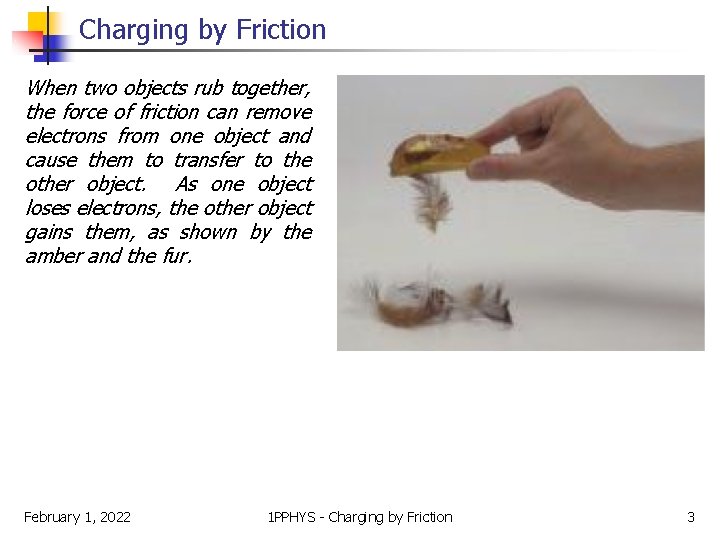
Charging by Friction When two objects rub together, the force of friction can remove electrons from one object and cause them to transfer to the other object. As one object loses electrons, the other object gains them, as shown by the amber and the fur. February 1, 2022 1 PPHYS - Charging by Friction 3
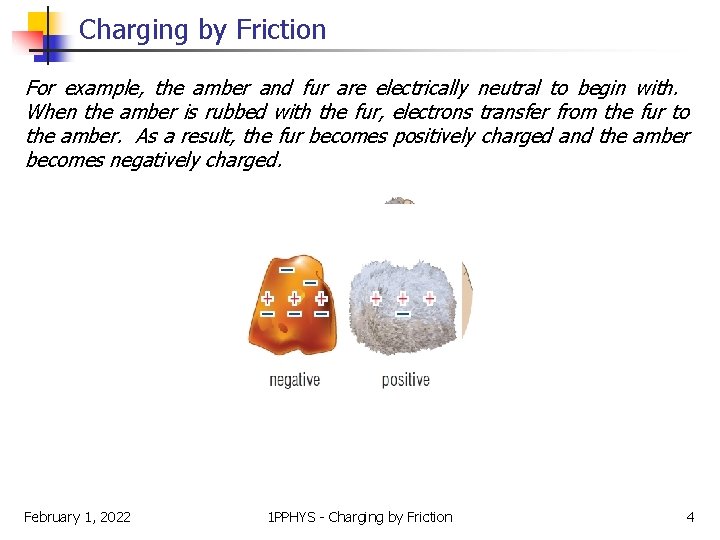
Charging by Friction For example, the amber and fur are electrically neutral to begin with. When the amber is rubbed with the fur, electrons transfer from the fur to the amber. As a result, the fur becomes positively charged and the amber becomes negatively charged. February 1, 2022 1 PPHYS - Charging by Friction 4
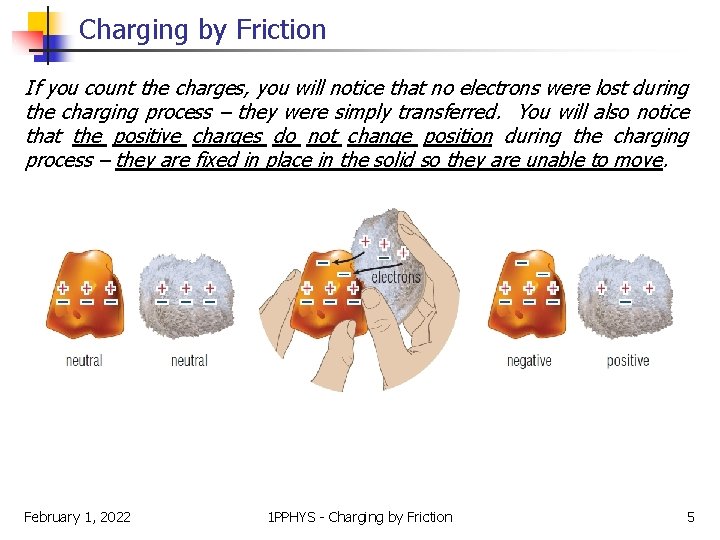
Charging by Friction If you count the charges, you will notice that no electrons were lost during the charging process – they were simply transferred. You will also notice that the positive charges do not change position during the charging process – they are fixed in place in the solid so they are unable to move. February 1, 2022 1 PPHYS - Charging by Friction 5
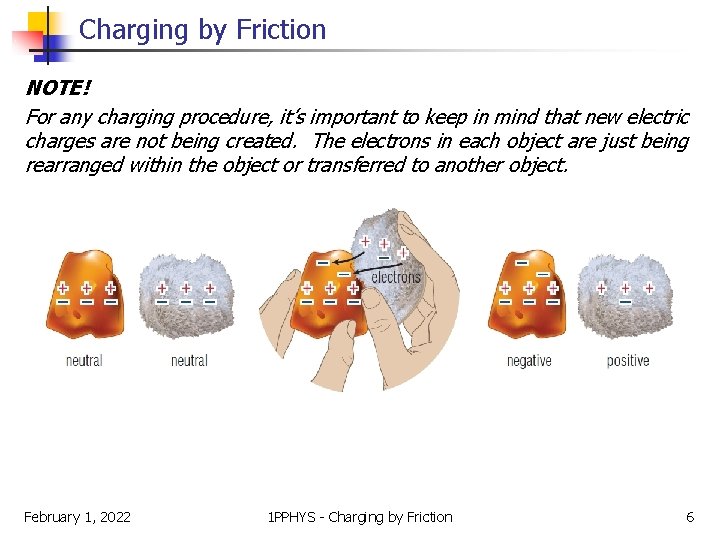
Charging by Friction NOTE! For any charging procedure, it’s important to keep in mind that new electric charges are not being created. The electrons in each object are just being rearranged within the object or transferred to another object. February 1, 2022 1 PPHYS - Charging by Friction 6
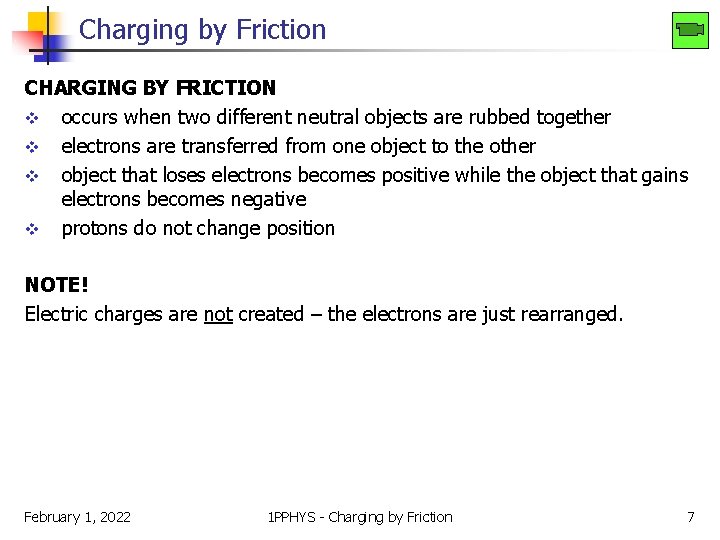
Charging by Friction CHARGING BY FRICTION v occurs when two different neutral objects are rubbed together v electrons are transferred from one object to the other v object that loses electrons becomes positive while the object that gains electrons becomes negative v protons do not change position NOTE! Electric charges are not created – the electrons are just rearranged. February 1, 2022 1 PPHYS - Charging by Friction 7
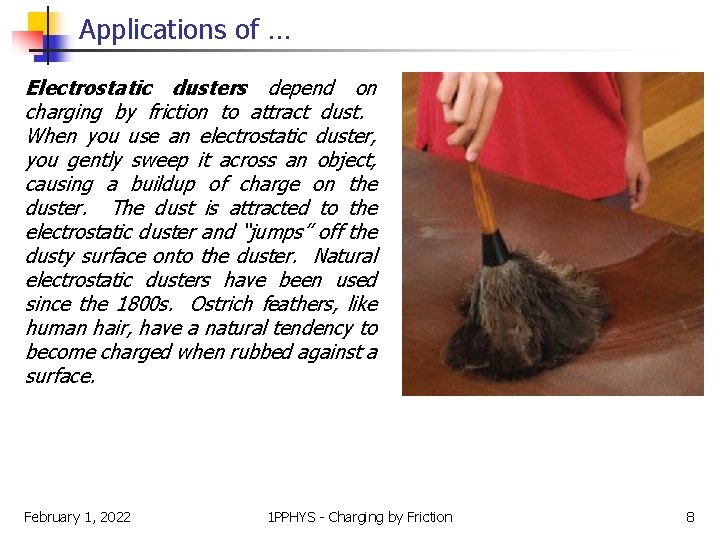
Applications of … Electrostatic dusters depend on charging by friction to attract dust. When you use an electrostatic duster, you gently sweep it across an object, causing a buildup of charge on the duster. The dust is attracted to the electrostatic duster and “jumps” off the dusty surface onto the duster. Natural electrostatic dusters have been used since the 1800 s. Ostrich feathers, like human hair, have a natural tendency to become charged when rubbed against a surface. February 1, 2022 1 PPHYS - Charging by Friction 8
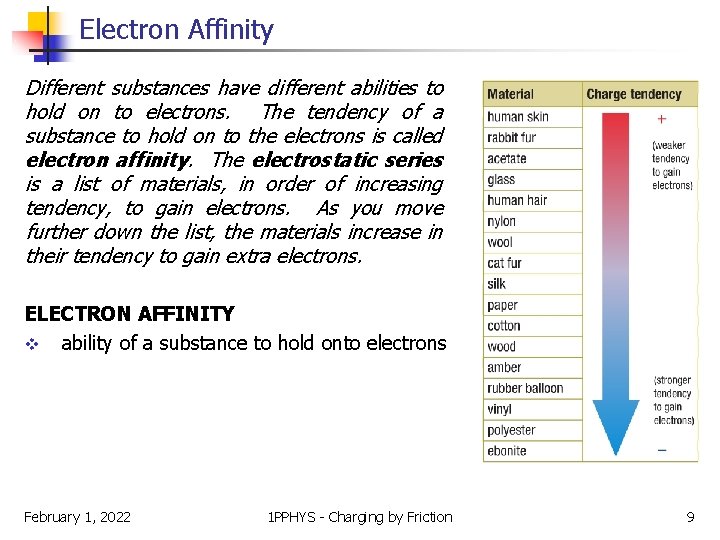
Electron Affinity Different substances have different abilities to hold on to electrons. The tendency of a substance to hold on to the electrons is called electron affinity. The electrostatic series is a list of materials, in order of increasing tendency, to gain electrons. As you move further down the list, the materials increase in their tendency to gain extra electrons. ELECTRON AFFINITY v ability of a substance to hold onto electrons February 1, 2022 1 PPHYS - Charging by Friction 9
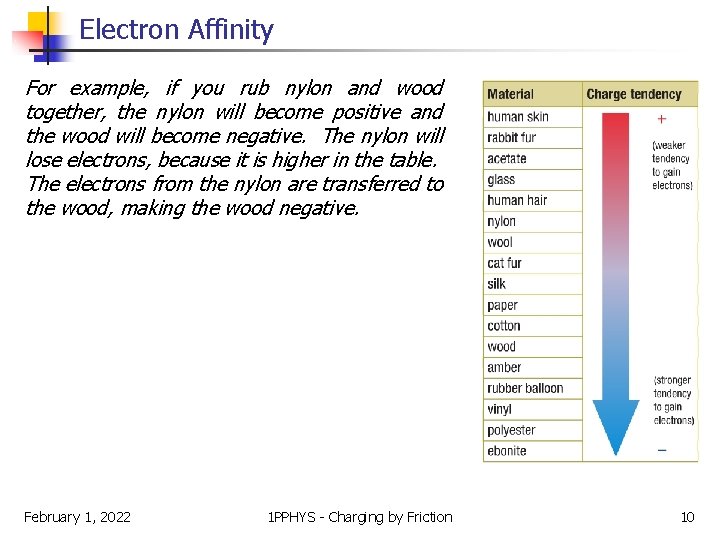
Electron Affinity For example, if you rub nylon and wood together, the nylon will become positive and the wood will become negative. The nylon will lose electrons, because it is higher in the table. The electrons from the nylon are transferred to the wood, making the wood negative. February 1, 2022 1 PPHYS - Charging by Friction 10
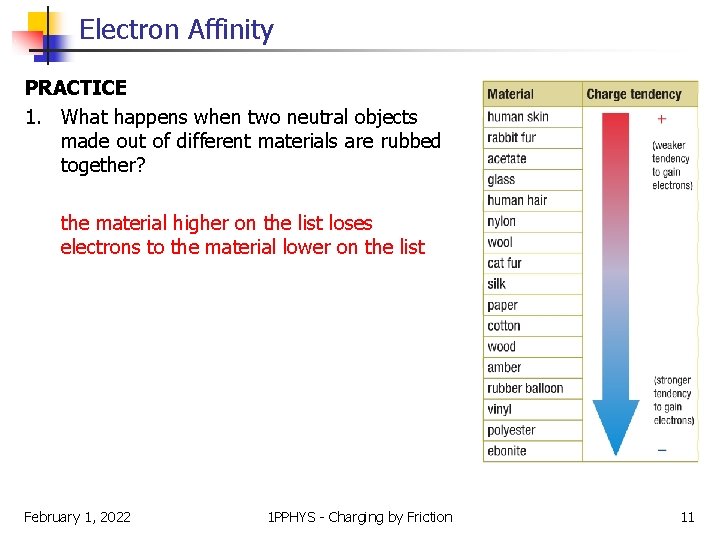
Electron Affinity PRACTICE 1. What happens when two neutral objects made out of different materials are rubbed together? the material higher on the list loses electrons to the material lower on the list February 1, 2022 1 PPHYS - Charging by Friction 11
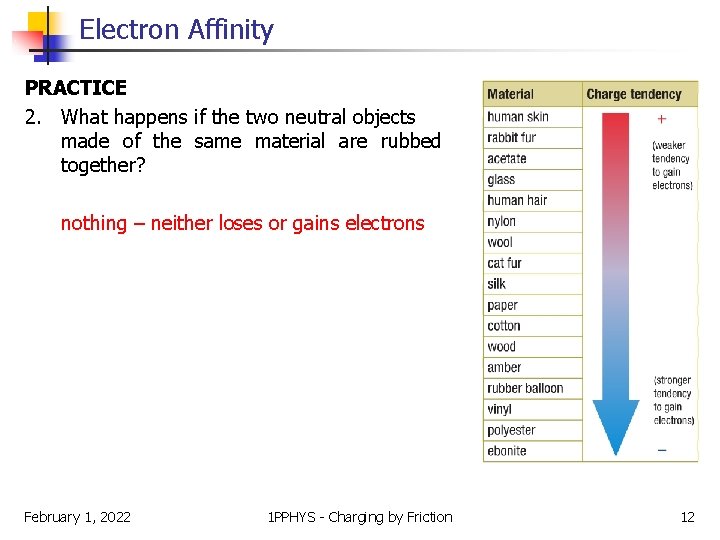
Electron Affinity PRACTICE 2. What happens if the two neutral objects made of the same material are rubbed together? nothing – neither loses or gains electrons February 1, 2022 1 PPHYS - Charging by Friction 12
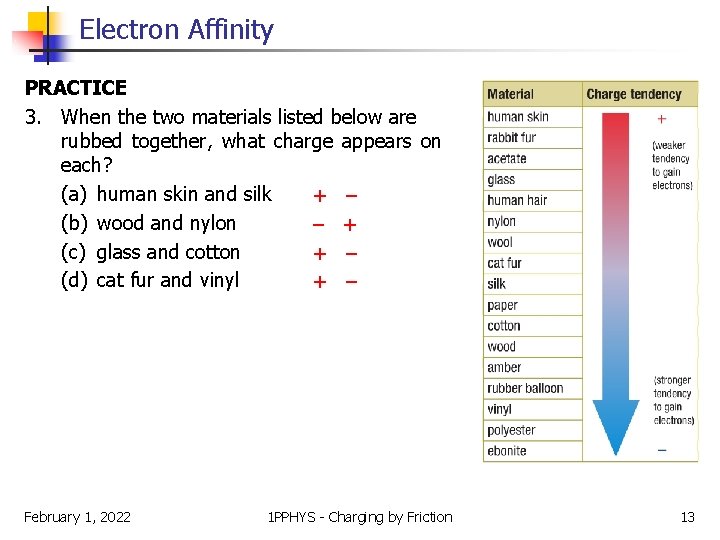
Electron Affinity PRACTICE 3. When the two materials listed below are rubbed together, what charge appears on each? (a) human skin and silk + – (b) wood and nylon – + (c) glass and cotton + – (d) cat fur and vinyl + – February 1, 2022 1 PPHYS - Charging by Friction 13
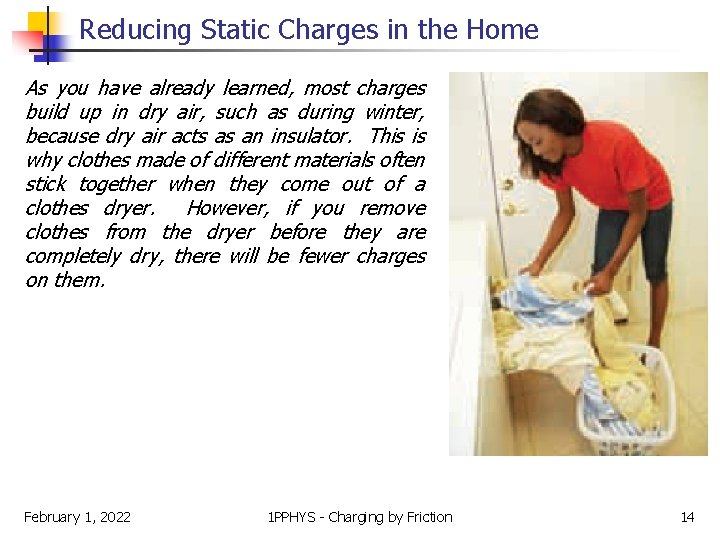
Reducing Static Charges in the Home As you have already learned, most charges build up in dry air, such as during winter, because dry air acts as an insulator. This is why clothes made of different materials often stick together when they come out of a clothes dryer. However, if you remove clothes from the dryer before they are completely dry, there will be fewer charges on them. February 1, 2022 1 PPHYS - Charging by Friction 14
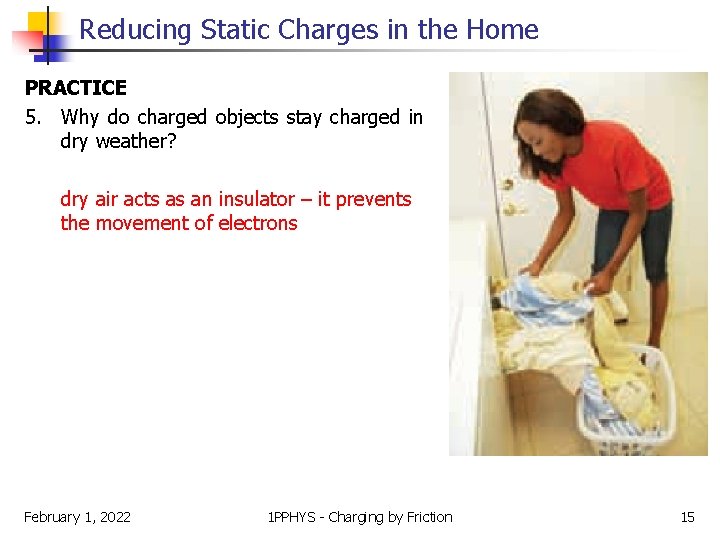
Reducing Static Charges in the Home PRACTICE 5. Why do charged objects stay charged in dry weather? dry air acts as an insulator – it prevents the movement of electrons February 1, 2022 1 PPHYS - Charging by Friction 15
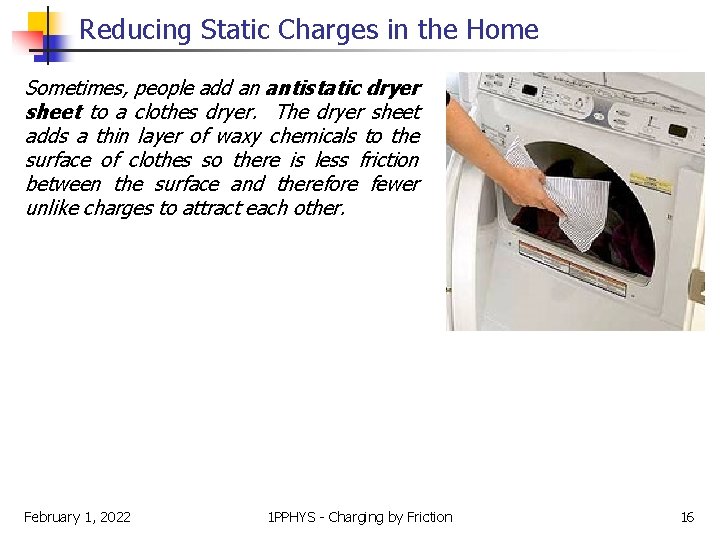
Reducing Static Charges in the Home Sometimes, people add an antistatic dryer sheet to a clothes dryer. The dryer sheet adds a thin layer of waxy chemicals to the surface of clothes so there is less friction between the surface and therefore fewer unlike charges to attract each other. February 1, 2022 1 PPHYS - Charging by Friction 16
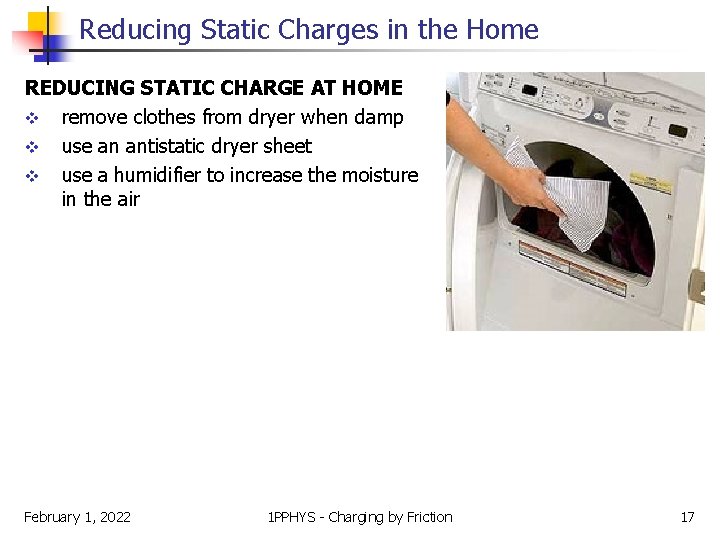
Reducing Static Charges in the Home REDUCING STATIC CHARGE AT HOME v remove clothes from dryer when damp v use an antistatic dryer sheet v use a humidifier to increase the moisture in the air February 1, 2022 1 PPHYS - Charging by Friction 17
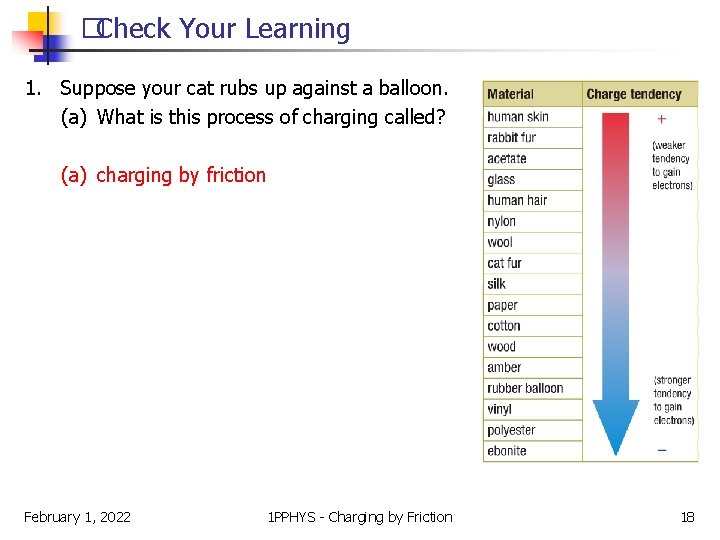
�Check Your Learning 1. Suppose your cat rubs up against a balloon. (a) What is this process of charging called? (a) charging by friction February 1, 2022 1 PPHYS - Charging by Friction 18
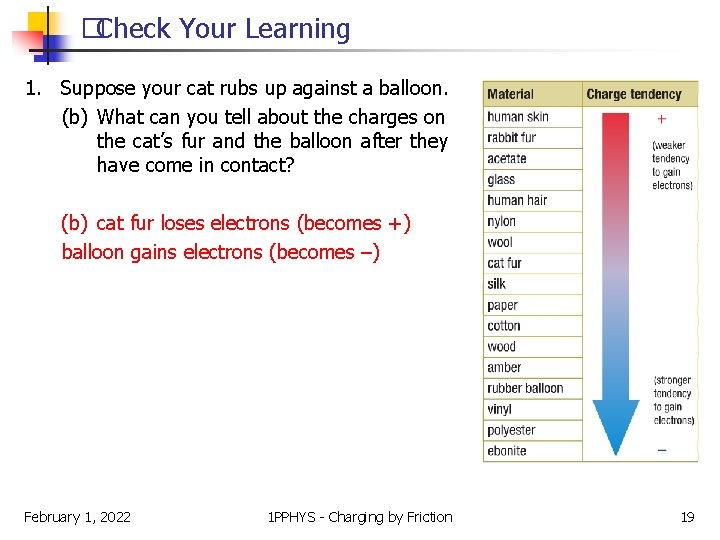
�Check Your Learning 1. Suppose your cat rubs up against a balloon. (b) What can you tell about the charges on the cat’s fur and the balloon after they have come in contact? (b) cat fur loses electrons (becomes +) balloon gains electrons (becomes –) February 1, 2022 1 PPHYS - Charging by Friction 19
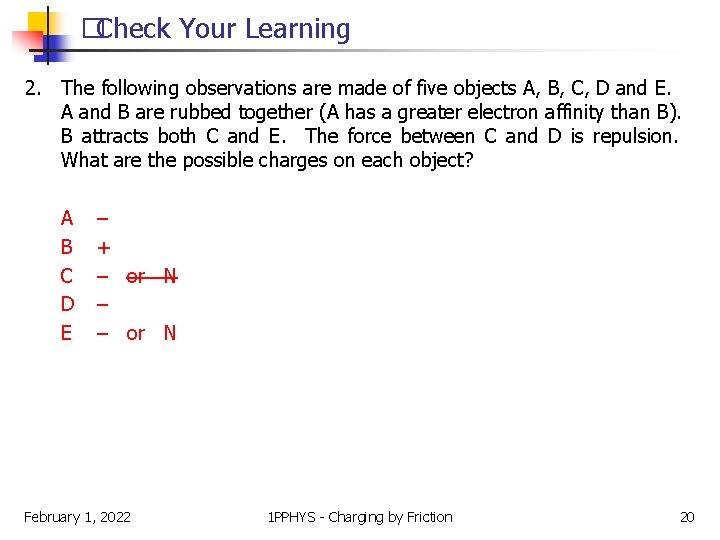
�Check Your Learning 2. The following observations are made of five objects A, B, C, D and E. A and B are rubbed together (A has a greater electron affinity than B). B attracts both C and E. The force between C and D is repulsion. What are the possible charges on each object? A B C D E – + – or N – – or N February 1, 2022 1 PPHYS - Charging by Friction 20
�Check Your Learning TEXTBOOK P. 471 Q. 1 February 1, 2022 1 PPHYS - Charging by Friction 21
- Slides: 22