
Snake River Fall Chinook Salmon Productivity and Hatchery
- Slides: 23
Snake River Fall Chinook Salmon Productivity and Hatchery Production
What do we mean by “Productivity” • Measure of a population’s ability to replace itself. – “Population growth rate” – “Trend in Abundance” is the manifestation of long-term population growth rate – Incorporates life stage specific survival, fecundity, age structure, and behavior
Presentation Outline • Trends in Abundance • Hatchery Production • Management Actions • Critical Uncertainties
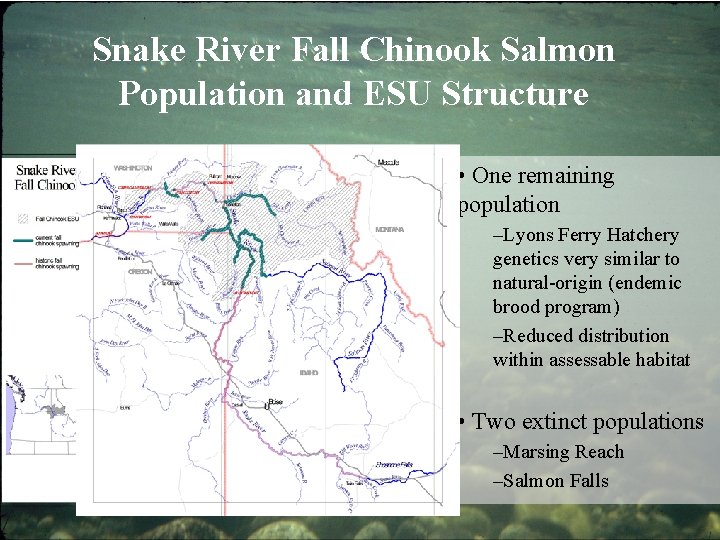
Snake River Fall Chinook Salmon Population and ESU Structure • One remaining population –Lyons Ferry Hatchery genetics very similar to natural-origin (endemic brood program) –Reduced distribution within assessable habitat • Two extinct populations –Marsing Reach –Salmon Falls
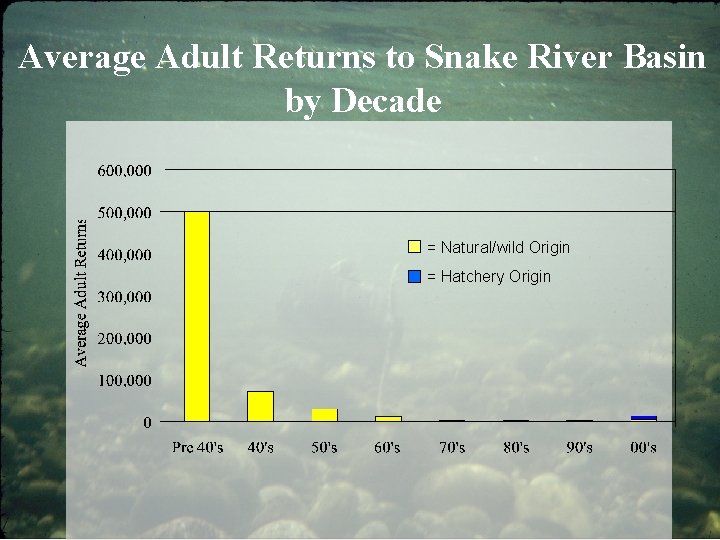
Average Adult Returns to Snake River Basin by Decade = Natural/wild Origin = Hatchery Origin
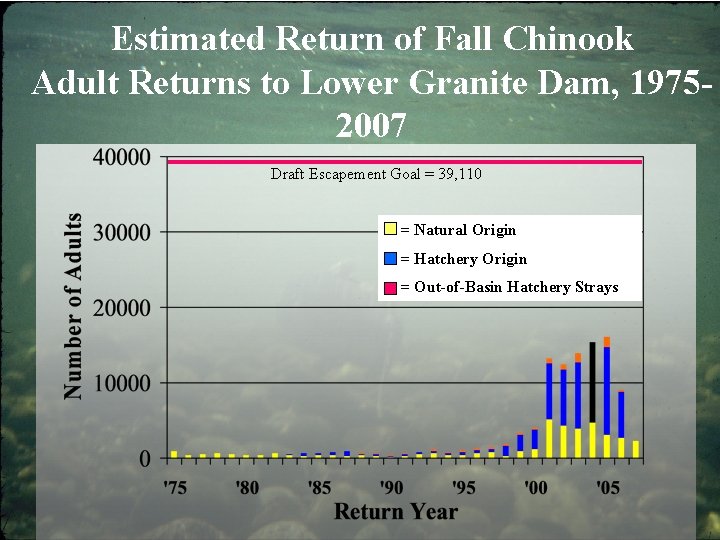
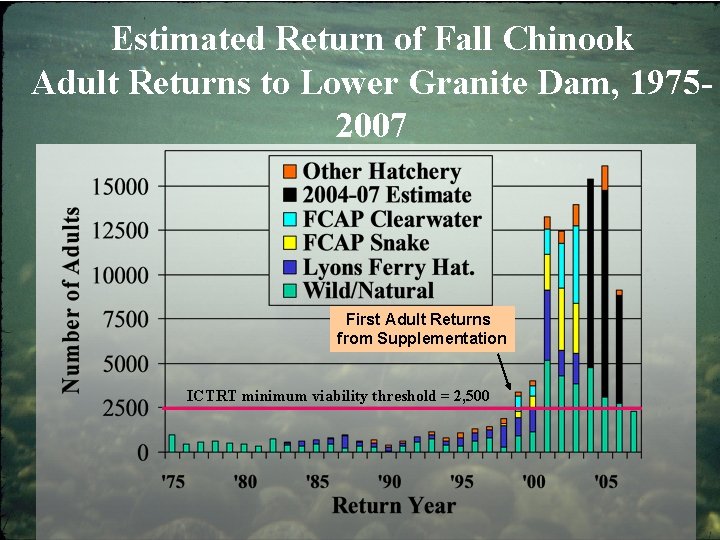
Estimated Return of Fall Chinook Adult Returns to Lower Granite Dam, 19752007 Draft Escapement Goal = 39, 110 = Natural Origin = Hatchery Origin = Out-of-Basin Hatchery Strays
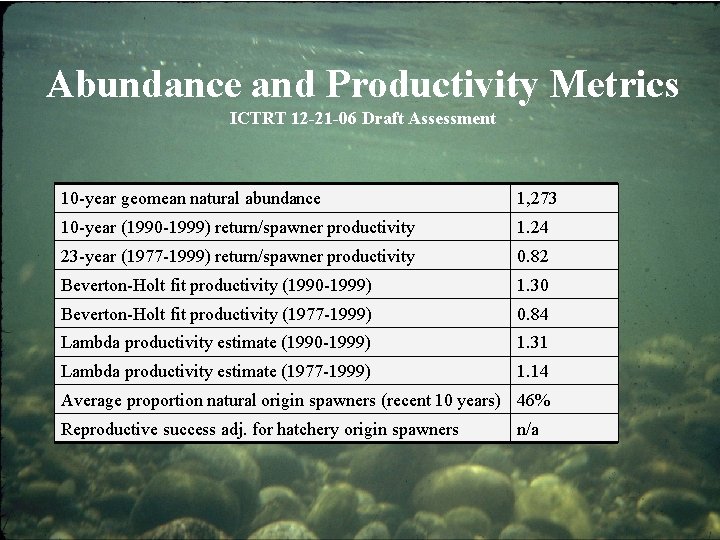
Abundance and Productivity Metrics ICTRT 12 -21 -06 Draft Assessment 10 -year geomean natural abundance 1, 273 10 -year (1990 -1999) return/spawner productivity 1. 24 23 -year (1977 -1999) return/spawner productivity 0. 82 Beverton-Holt fit productivity (1990 -1999) 1. 30 Beverton-Holt fit productivity (1977 -1999) 0. 84 Lambda productivity estimate (1990 -1999) 1. 31 Lambda productivity estimate (1977 -1999) 1. 14 Average proportion natural origin spawners (recent 10 years) 46% Reproductive success adj. for hatchery origin spawners n/a
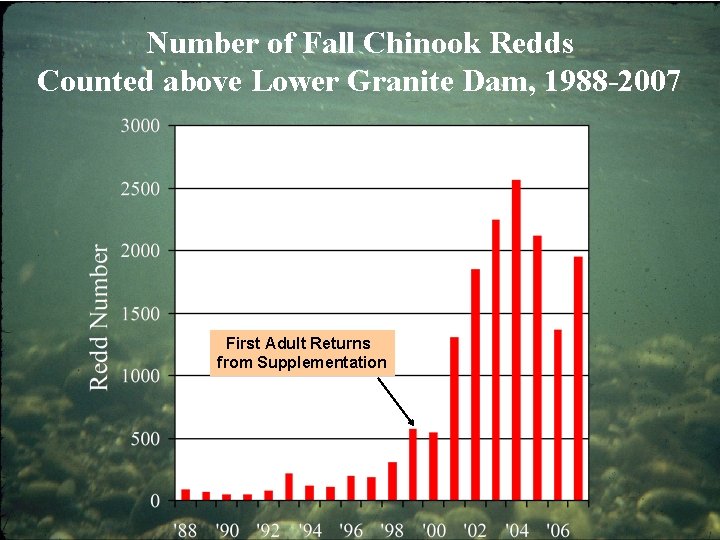
Number of Fall Chinook Redds Counted above Lower Granite Dam, 1988 -2007 First Adult Returns from Supplementation
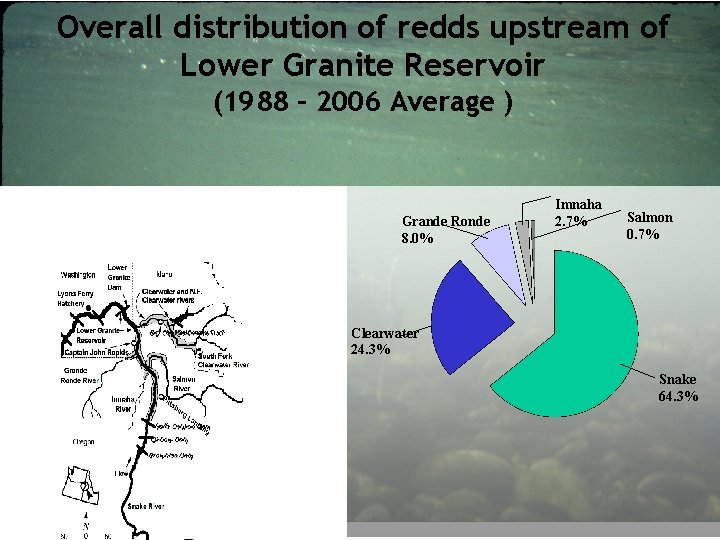
Overall distribution of redds upstream of Lower Granite Reservoir (1988 – 2006 Average ) Grande Ronde 8. 0% Imnaha 2. 7% Salmon 0. 7% Clearwater 24. 3% Snake 64. 3%
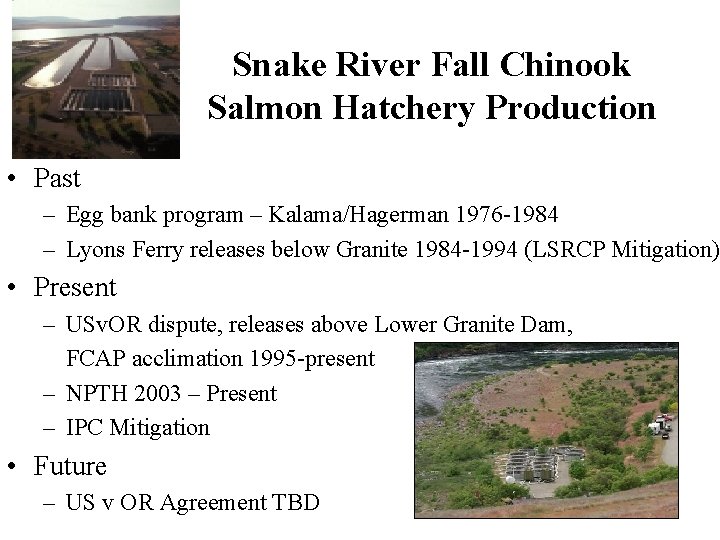
Snake River Fall Chinook Salmon Hatchery Production • Past – Egg bank program – Kalama/Hagerman 1976 -1984 – Lyons Ferry releases below Granite 1984 -1994 (LSRCP Mitigation) • Present – USv. OR dispute, releases above Lower Granite Dam, FCAP acclimation 1995 -present – NPTH 2003 – Present – IPC Mitigation • Future – US v OR Agreement TBD
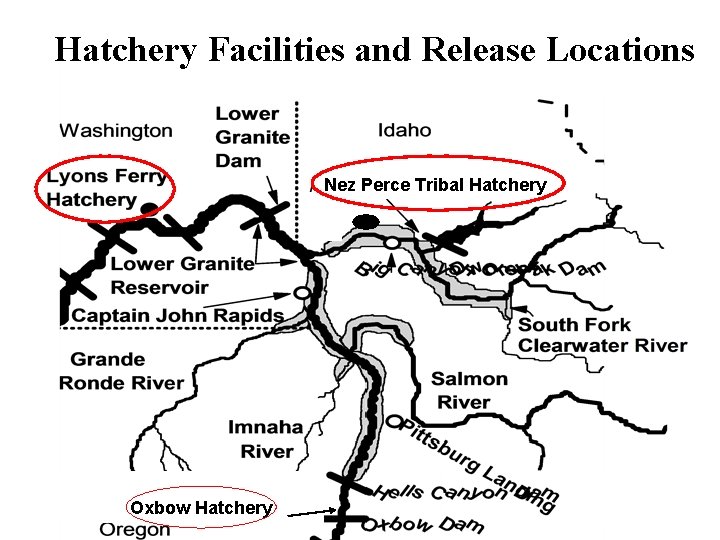
Hatchery Facilities and Release Locations Nez Perce Tribal Hatchery Oxbow Hatchery
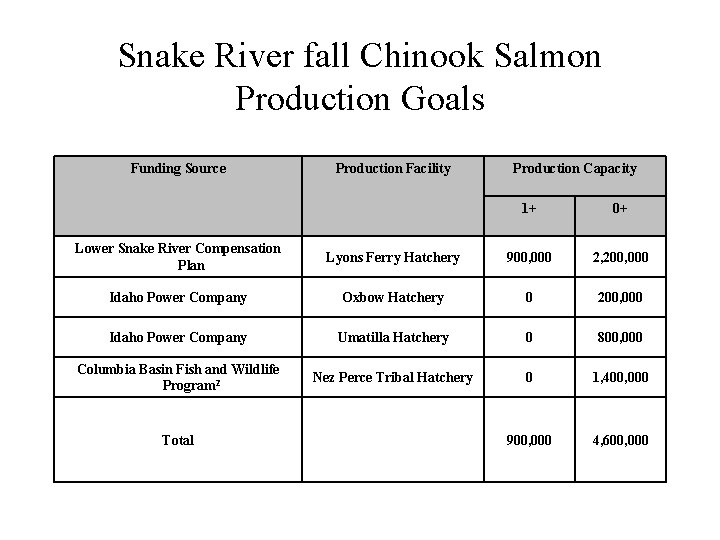
Snake River fall Chinook Salmon Production Goals Funding Source Production Facility Production Capacity 1+ 0+ Lower Snake River Compensation Plan Lyons Ferry Hatchery 900, 000 2, 200, 000 Idaho Power Company Oxbow Hatchery 0 200, 000 Idaho Power Company Umatilla Hatchery 0 800, 000 Columbia Basin Fish and Wildlife Program 2 Nez Perce Tribal Hatchery 0 1, 400, 000 900, 000 4, 600, 000 Total
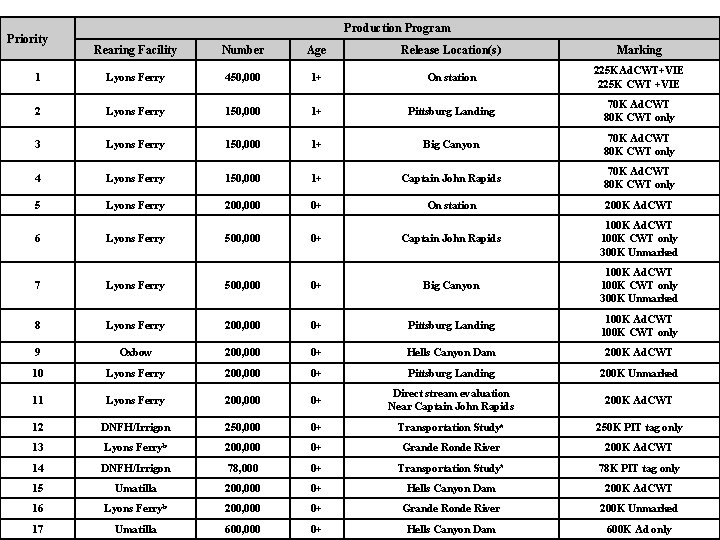
Priority Production Program Rearing Facility Number Age Release Location(s) Marking 1 Lyons Ferry 450, 000 1+ On station 225 KAd. CWT+VIE 225 K CWT +VIE 2 Lyons Ferry 150, 000 1+ Pittsburg Landing 70 K Ad. CWT 80 K CWT only 3 Lyons Ferry 150, 000 1+ Big Canyon 70 K Ad. CWT 80 K CWT only 4 Lyons Ferry 150, 000 1+ Captain John Rapids 70 K Ad. CWT 80 K CWT only 5 Lyons Ferry 200, 000 0+ On station 200 K Ad. CWT 6 Lyons Ferry 500, 000 0+ Captain John Rapids 100 K Ad. CWT 100 K CWT only 300 K Unmarked 7 Lyons Ferry 500, 000 0+ Big Canyon 100 K Ad. CWT 100 K CWT only 300 K Unmarked 8 Lyons Ferry 200, 000 0+ Pittsburg Landing 100 K Ad. CWT 100 K CWT only 9 Oxbow 200, 000 0+ Hells Canyon Dam 200 K Ad. CWT 10 Lyons Ferry 200, 000 0+ Pittsburg Landing 200 K Unmarked 11 Lyons Ferry 200, 000 0+ Direct stream evaluation Near Captain John Rapids 200 K Ad. CWT 12 DNFH/Irrigon 250, 000 0+ Transportation Studya 250 K PIT tag only 13 Lyons Ferryb 200, 000 0+ Grande Ronde River 200 K Ad. CWT 14 DNFH/Irrigon 78, 000 0+ Transportation Studya 78 K PIT tag only 15 Umatilla 200, 000 0+ Hells Canyon Dam 200 K Ad. CWT 16 Lyons Ferryb 200, 000 0+ Grande Ronde River 200 K Unmarked 17 Umatilla 600, 000 0+ Hells Canyon Dam 600 K Ad only
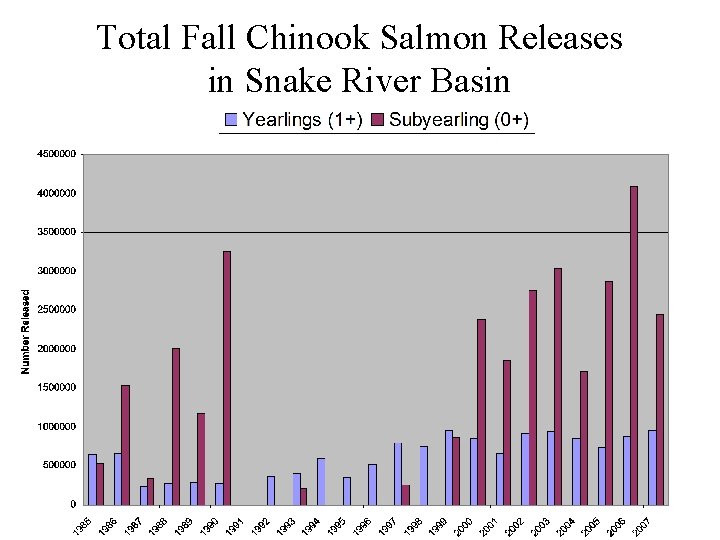
Total Fall Chinook Salmon Releases in Snake River Basin
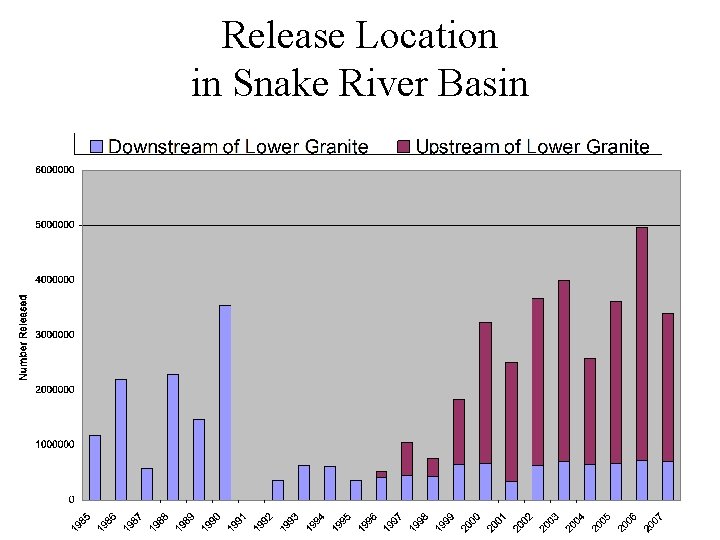
Release Location in Snake River Basin
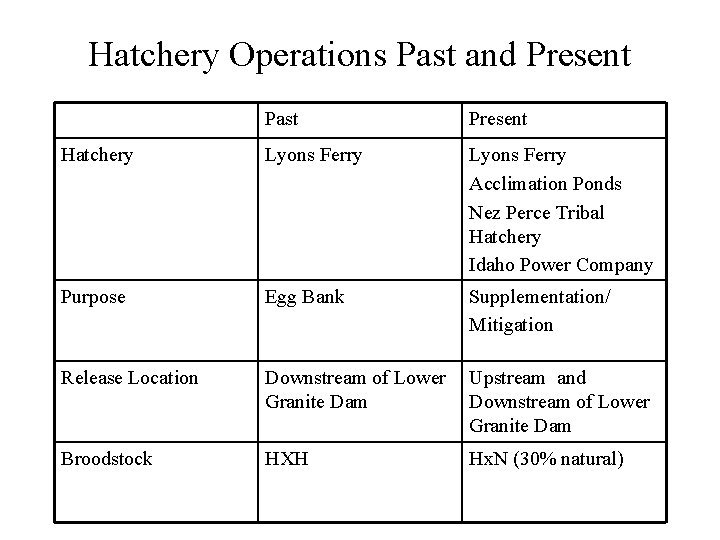
Hatchery Operations Past and Present Past Present Hatchery Lyons Ferry Acclimation Ponds Nez Perce Tribal Hatchery Idaho Power Company Purpose Egg Bank Supplementation/ Mitigation Release Location Downstream of Lower Granite Dam Upstream and Downstream of Lower Granite Dam Broodstock HXH Hx. N (30% natural)
Estimated Return of Fall Chinook Adult Returns to Lower Granite Dam, 19752007 First Adult Returns from Supplementation ICTRT minimum viability threshold = 2, 500
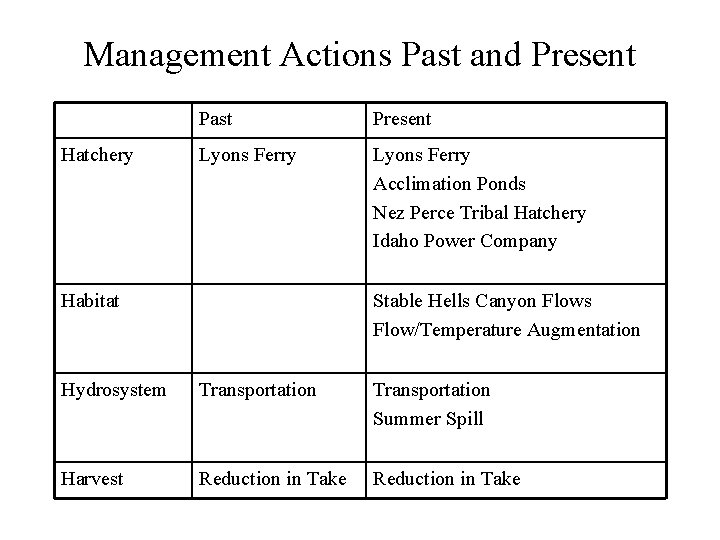
Management Actions Past and Present Hatchery Past Present Lyons Ferry Acclimation Ponds Nez Perce Tribal Hatchery Idaho Power Company Habitat Stable Hells Canyon Flows Flow/Temperature Augmentation Hydrosystem Transportation Summer Spill Harvest Reduction in Take
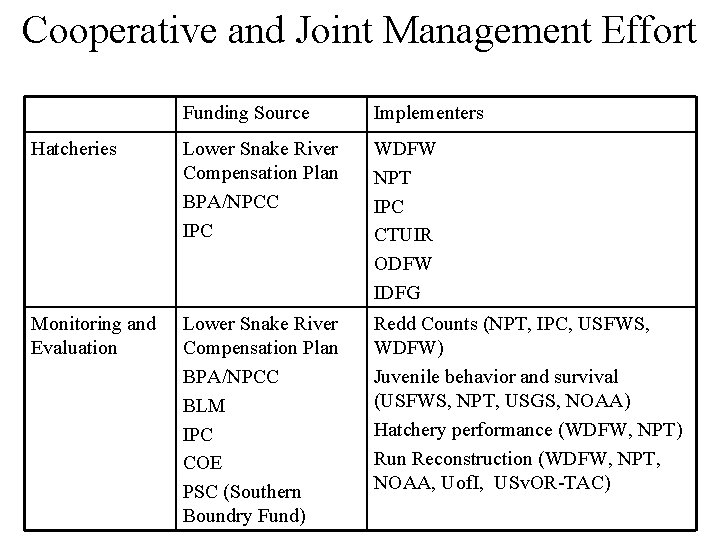
Cooperative and Joint Management Effort Funding Source Implementers Hatcheries Lower Snake River Compensation Plan BPA/NPCC IPC WDFW NPT IPC CTUIR ODFW IDFG Monitoring and Evaluation Lower Snake River Compensation Plan BPA/NPCC BLM IPC COE PSC (Southern Boundry Fund) Redd Counts (NPT, IPC, USFWS, WDFW) Juvenile behavior and survival (USFWS, NPT, USGS, NOAA) Hatchery performance (WDFW, NPT) Run Reconstruction (WDFW, NPT, NOAA, Uof. I, USv. OR-TAC)
What We Do Know • Increases in abundance and productivity have occurred, but the extent to which those improvements in overall life-cycle survival effects on fall Chinook salmon will be maintained and can be attributed to recent changes in management vs merely reflective of improvements in ocean productivity is uncertain. • Hatchery releases upstream of Lower Granite Dam have increased the abundance of spawners in natal habitat, with assumed contribution to increased production.
What We Do Know (cont. ) • Adult abundance via annual run-reconstruction of fish to Lower Granite Dam. – Natural-origin adult abundance near delisting criteria. – Total abundance is well below historic levels and current management goals. • Adult distribution via annual aerial redd counts. – 70/30 rule between Snake and Clearwater. • Mainstem state and tribal harvest via coded-wire tag recoveries and creel surveys.
Things We Don’t Know • Contribution/influence of hatchery fish on natural productivity. • Long-term viability of an ESU with only a single extant population spatial structure and diversity. • Extant and extirpated habitat carrying capacity. • Estimates of annual juvenile abundance / production. • Survival rates for hydrosystem passage routes or operational strategies. • Role of juvenile life history diversity.