
SNA training Level 6 Literacy The strategies that
- Slides: 41
SNA training Level 6 Literacy
• The strategies that we use when we read can be divided into four categories, which • are illustrated below. • Responsive • Semantic • Syntactic • Grapho-phonemic
• These are the four categories of engagement. • The above represents the reader, the text and the 4 types of relating which take place between the two. • These are called Categories of Engagement because they are pathways, which ‘engage’ or ‘connect’ • the reader in some way with the text.
Responsive engagement • This type of engagement is where the reader is responding to what they have read. • At the very early levels of reading this might include a toddler pointing to a picture and laughing. • At a more developed stage this could mean a child talking about why they do not like a certain character and predicting what is going to happen next. • Response is more than understanding because it brings to the text the reader’s own experience and individuality
2. Semantic engagement • This is the level at which the reader is making meaning from the text. • It is understanding what has been read. • • 3. Syntactic engagement The syntax of the text is the structure. Written English is built with specific systems, which have rules. Understanding these conventions helps us to decipher and understand the text. For example, full stops give us important information to help us make sense of what we read.
• 4. Grapho-phonemic engagement • The ‘graph’ part means visual and ‘phon’ means sound. • Quite simply, this aspect of reading is about seeing the shapes of the letters and transforming them into sounds, which make words. • This is often referred to as ‘decoding’ the text.
HOW SHOULD READING BE TAUGHT? • Over the years there have been many ‘fashionable’ ways of teaching reading. • These so called methods have tended to spring from research into the different strategies used by the reader.
1. The Phonic Method • relied on learning individual letters and sounds even before reading books are issued to children. 2. Traditional Reading Schemes • (e. g. Tara and Ben, Emma and Joe). These provide repetitive reinforcing texts, which introduce new words progressively within graded books. 3. The Look and Say Method. • This is based on theory that readers read whole word shapes and learn single words out of context.
4. The Language and Experience Method. • This uses much of children’s own talking and writing experiences as resources for reading (for example, ‘Our News’). 5. The Apprenticeship Approach. • This highlights the importance of using a wide variety of quality literature, which is meaningful and enjoyable to the child, along with adult support. Book talk between child and adult was identified as a significant factor in children’s reading development. • 6. New Reading Schemes (e. g. The Oxford Reading Tree). • New schemes now tend to include a range of text types (fiction, non-fiction, poetry, plays) by different authors.
7. Paired Reading. • This term was coined in the 1970’s and refers to a specific type of reading partnership. • It is a partnership in which the child reads to the adult, the adult reads to the child and sometimes the two read simultaneously. • The important feature is that the child is in control of this and can decide who reads and when. • This is usually signalled by nudging elbows or patting on the hand! • Putting the child in the driving seat like this can be extremely reassuring to children who lack confidence with their reading. • The adult is there to support as and when the child needs them.
8. Shared Reading. • This is a term applied to two people enjoying a book together. • This might mean 2 children of the same age, an older child and a younger child or achild an adult. • The reading can be shared as decided by the children, but the • central feature of shared reading is the book talk, which also takes place during that time. • Talking about books plays an important role in the development of readers. • Discussing the pictures, the characters, the action, the author’s style, predicting, explaining, questioning, empathising, comparing and so on all enrich children’s understanding of and responses to books.
9. Group Reading • In recent years group reading has enjoyed a revival. • It is particularly effective for older children who are starting to read independently, but benefit from the supported framework provided by reading in a group. • Each child has a copy of one text and they take turns reading aloud while the rest of the group follow the text in their own copy
10. Reading Games. • These are not only an enjoyable activity for children they are also a valuable resource for learning. • The many skills of reading can be placed within the context of a game to provide an opportunity to repeat, revisit and practise in ways, which are motivating and • meaningful. • There are many types of games, which are commercially available, but it is also • possible to make them. • Using stories as starting points for games has many benefits. • The game can be planned to introduce and use specific skills, but in addition there are golden opportunities for talking about the book, characters, plot, author etc. • Games relating to specific books encourage children to use the language of those books and contribute to the literacy environment.
• Guidelines, which are particularly helpful to the development of children’s language and literacy
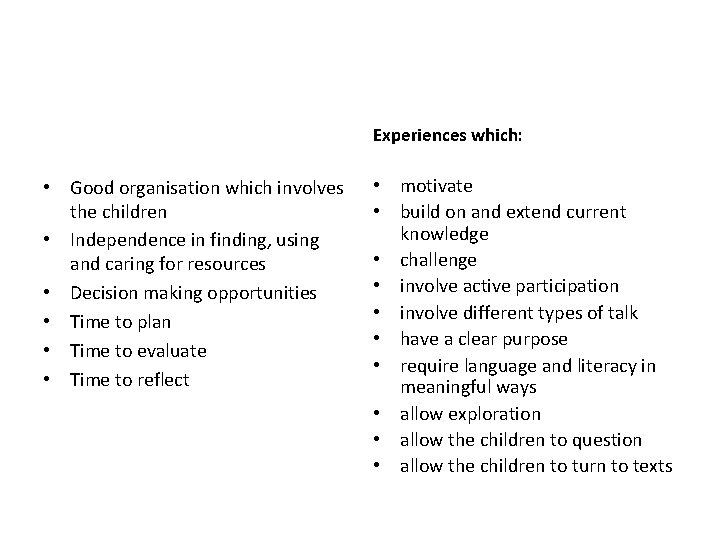
Experiences which: • Good organisation which involves the children • Independence in finding, using and caring for resources • Decision making opportunities • Time to plan • Time to evaluate • Time to reflect • motivate • build on and extend current knowledge • challenge • involve active participation • involve different types of talk • have a clear purpose • require language and literacy in meaningful ways • allow exploration • allow the children to question • allow the children to turn to texts
• Children need to value themselves as learners if they are to approach learning positively. • They need to be recognised for their achievements and helped to learn through their mistakes. • This type of environment cannot be created by displays and resources alone. • It is created through the attitudes and approaches of the adults in that environment, for it is they who can make such a remarkable difference to the quality of children’s experiences, learning, welfare and progress.
Shared Reading • Allow the child to choose her own book. • Discuss the book with her. • Read with the child, adjusting your reading speed to the child’s pace. • As the child gains fluency and confidence, gradually drop out. • The child will continue to read independently. • Rejoin the reading if the child is experiencing difficulties. • If the child encounters a problem, pronounce the word and encourage her to repeat it. • Discuss and make comments on the story at the end. • Praise the child.
• Remember… • The story does not have to be completed in one sitting. • Encourage shared reading with family members, especially older siblings. • …and… • Pause • Prompt • Praise! • • Source: “The Road to Reading” (Video and notes) Mary Immaculate College of Education CDU, Limerick 2000
How can adults support and extend children’s language? • Bend down and make eye contact • Show an interest in what the child has to say • Show respect for what the child knows • Encourage the child’s own ideas • Encourage the child to explain, describe and evaluate • Demonstrate good models of language • Correct through example rather than criticism • Encourage the child to experiment with language • Ask open-ended questions (i. e. which don’t just have one correct answer) • Don’t talk down to the child or patronise him • Listen well to the child • Draw attention to the texts • Read and tell stories • Talk about stories, books etc. • Play with rhymes
How does the educational environment influence children’s learning? • Children who attend school spend a large part of their time in that environment so it is important that it is stimulating and nurturing to children’s language, literacy and learning. • If children are going to talk they need something worthwhile to talk about. • If they are going to read they need interesting and appealing texts. • If they are going to learn to write they need opportunities to experiment and practise for real reasons. • All of these things need to take place in an environment, which is supportive and encouraging, so that children develop a confidence in their own abilities and actively seek to learn.
What is Phonics? • Phonics refers to “associating letters or letter groups with the sound they represent. • Mastery of phonics is an important tool for reading and pronouncing words”. • Phonics is a series of rules that children have to memorize and apply when they are sounding out new words. • Children are taught a rule, e. g. silent e’, and then they practise reading words with Silent e. • Then children do skill sheets at their desk highlighting the Silent e rule.
• Children must learn letter sounds to an automatic level - they must be able to see the letter(s) and say the sound immediately in order to become proficient readers. • Attached to this document are examples of some games which can bring interest to the child in order to help them become confident readers. • In most schools that you work in you will find that it is Jolly Phonics that is the most popular method of teaching reading/understanding.
• Phonics includes learning the irregular or ‘tricky’ words such as “said”. • Storybooks are a very good way for results to get involved in the child’s reading, for parental involvement and to keep the interest of the child on the topic. • Remember practice makes perfect and that everyone learns at a different rate.
• The five basic skills needed for reading and writing are: • 1. Learning the letter sounds • 2. Learning letter formation • 3. Blending • 4. Identifying sounds in words • 5. Spelling the tricky words
• In Jolly Phonics, 42 main sounds of English are taught, not just the alphabet. • Now you can see the complexities of learning through this model. • Remember to take the learning at the child’s pace.
• Each sound has an action which helps children remember the letter(s) that represent it. • As a child progresses you can point to the letters and see how quickly they can do the action and say the sound. • This method of learning brings together, auditory, visual and kinaesthetic learning. • As a child becomes more confident in saying the words, the actions are no longer necessary.
• Children should learn each letter by its sound, not its name, this is very important and has been recognised through research as a reason why many adults have failed to become fluent readers. • In the Jolly Phonics programme the letters are not • usually taught in alphabetical order. • The first group (s, a, t, i, p, n) has been chosen because they make more simple three-letter words and even at this early stage of learning the child can read words given. • The letters b and d are introduced in different groups to • avoid confusion
• Because the English language is so complex, there are many phonics rules. • Knowing the phonics rules that apply most often can be a major aid to identifying words and improving comprehension in the child’s reading. • But keep in mind there are some words that don’t follow the rules. • You will just have to watch out for these exceptions.
WORD ATTACK SKILLS/STRATEGIES • Developing word attack skills is necessary to help beginning your child become a fluent reader and writer. • From time to time as an SNA you will work with children with different difficulties with reading. How can you help this child? • Here are some steps to help a child with difficulties identifying a word. • Each step tells one thing you should do when a child comes to a word he cannot identify. • Continue to • follow the steps until he has identified the word.
• 1. LOOK AGAIN at the word. As the child looks at the word again , get him to say each letter in the word. This will get him to look more carefully at the word. Often, when he looks at a word a second or third time, he will identify the word as a word he knows. • 2. READ THE SENTENCE containing the word to see if the child can determine what the word means by how it is used in the sentence. Sometimes, knowing the meaning of a word will help him identify the word
• • • 3. LOOK at the beginning of the word. Try to get the child to identify the start of the word (break it down for the child) prepaid, unheard, rerun. 4. LOOK at the end of the word. Try to get him to identify the end of the word (again breaking the word up for the child is important) lovely, tallest, spelling. 5. BLEND AND SAY THE WORD. Blend together the prefix if there is one, the stem, and the suffix if there is one to say the entire word. For example: un+help+ful = unhelpful.
BLENDING • Blending is the process of saying the individual sounds in a word and then running them together to make the word. For example, sounding out d-o-g and making dog. • It is a technique every child will need to learn, and it improves with practice. • To start with you should sound out the word and see if a child can hear it, giving the answer if necessary. • Some children take longer than others to hear this. The sounds must be said quickly to hear the word. • It is easier if the first sound is said slightly louder. • Try little and often with words like b-u-s, t-o-p, c-a-t and h-e-n.
• Some difficulties with this are that not all words follow the same rule, not every sound in a word is pronounced. • An example would be (sh)- makes one sound. • With practice you can help your child with this. • Can you think of any other words which do not have eachletter sounded out in a word? • In order to help reading fluency you need to help the child with the “sounding out” of the words. • Thus when sounding out a blend get the child to say Sh-o-u-t rather than sounding out each letter individually s-h-o-u-t. • As stated this will help the child with reading fluency. • It is only with fluency that understanding of text • occurs.
• Compare mishap (where both the s and h are sounded) and midship (which has the quite separate sh sound). • When sounding out a blend, encourage children to say the two sounds as one unit, so fl-a-g not f-l-a-g. • This will lead to greater fluency when reading. • Some words in English have an irregular spelling and cannot be read by blending, such as ‘said’, ‘was’ and ‘one’. • Unfortunately, many of these are common words. • The irregular parts have to be remembered. • These are called the ‘tricky’ words.
Useful Spelling Rules • Correct spelling is very difficult for many students because the spellings of many words do not follow rules. • According to research I am currently undertaking English is a much more difficult language to master than Irish with those with dyslexia performing better when reading through Irish than English (this is based on research on the Gaelscoil system in Ireland). • Here are some rules which apply in English spelling
• There are many rules to be learned • Many of the rules are very complicated • Many of the rules apply to a small number of words • Almost every rule has exceptions • Still, there are some rules that apply to the spellings of words with few exceptions, and that are not difficult to learn and remember. • Learning and using these rules can improve • your spelling.
• Here are some spelling rules the child needs to learn in order to master the art of spelling. • A word that ends with the sound of “v” is spelled with the letters “ve” at its end. • *Examples: shave, above, effective • The letter “i” comes before “e” except after “c. ” • *Examples: believe, field, tried (but not receive) • When a word ends with “y” preceded by a consonant, form the plural of the word by changing the “y” to “i” and adding “es. ” • Examples: countries, daisies, ladies
• Drop the final silent “e” when adding a suffix that begins with a vowel. • *Examples: changing, notable, nervous • Keep the final silent “e” when adding a suffix that begins with a consonant. • *Examples: useful, lovely, hopeless • When a one-syllable word ends in a vowel followed by a consonant, double the • final consonant when adding a suffix. • *Examples: topped, swimmer, hitting • The letter “q” in a word is followed by “u. ” • *Examples: quick, antique, equation • Do not change the spelling of a word when adding a prefix to it. • *Examples: remove, triangle, misspell
SPELLING TRICKY WORDS • (Remember the Style Of Learning which suits your student best) • Look, Cover, Write and Check. Look at the word to see which bit is tricky. • Ask the child to try writing the word in the air saying the letters. • Cover the word over and see if the child can write it correctly. • Check to make sure. Say it as it sounds. Say the word so each sound is heard. For example, the word • Monday is said as ‘M-on-day’.
WRITING SKILLS • As stated above in the Jolly Phonics programme the child while learning the sound of the word is also learning the shape of the word. • This will transfer well when instructing the child in letter formation. • The first thing to consider is the pencil grip. • The pencil should be held in the ‘tripod’ grip between the thumb and first two fingers. • If a child’s hold starts incorrectly, it is very • difficult to correct later on. • A child needs to form each letter the correct way. • An important thing to remember is that no letter should be formed starting at the baseline. • The letter c is introduced in the early stages as this forms the basic shape of some other letters, such as d
• Particular Things to • look out for are: • the o (the pencil stroke must be anticlockwise, not clockwise), • • d (the pencil starts in the middle, not the top), • there must be an initial down stroke on letters such