
SMT solvers in Program Analysis and Verification Nikolaj
- Slides: 47
SMT solvers in Program Analysis and Verification Nikolaj Bjørner Microsoft Research Lecture 2
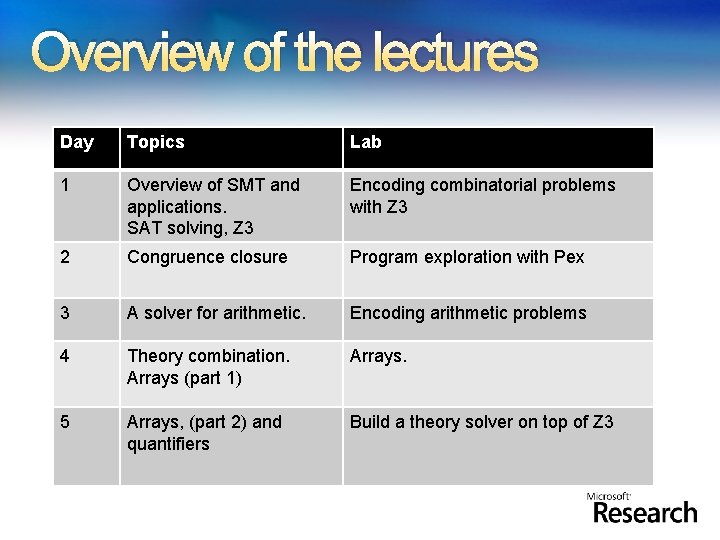
Overview of the lectures Day Topics Lab 1 Overview of SMT and applications. SAT solving, Z 3 Encoding combinatorial problems with Z 3 2 Congruence closure Program exploration with Pex 3 A solver for arithmetic. Encoding arithmetic problems 4 Theory combination. Arrays (part 1) Arrays. 5 Arrays, (part 2) and quantifiers Build a theory solver on top of Z 3
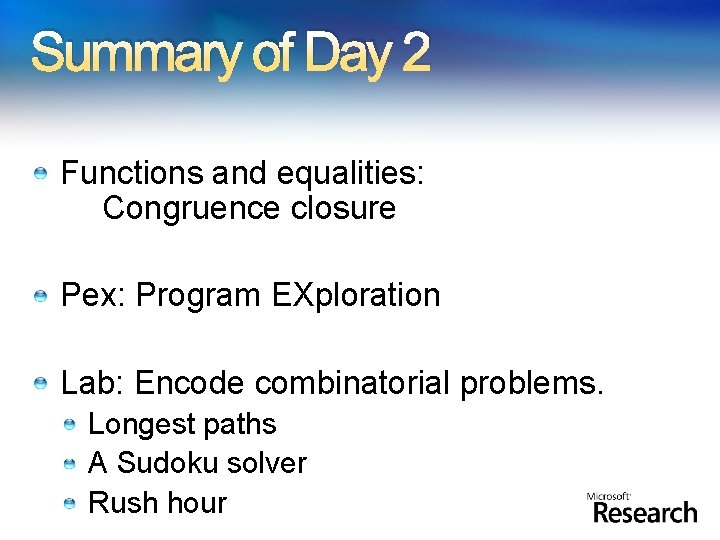
Summary of Day 2 Functions and equalities: Congruence closure Pex: Program EXploration Lab: Encode combinatorial problems. Longest paths A Sudoku solver Rush hour
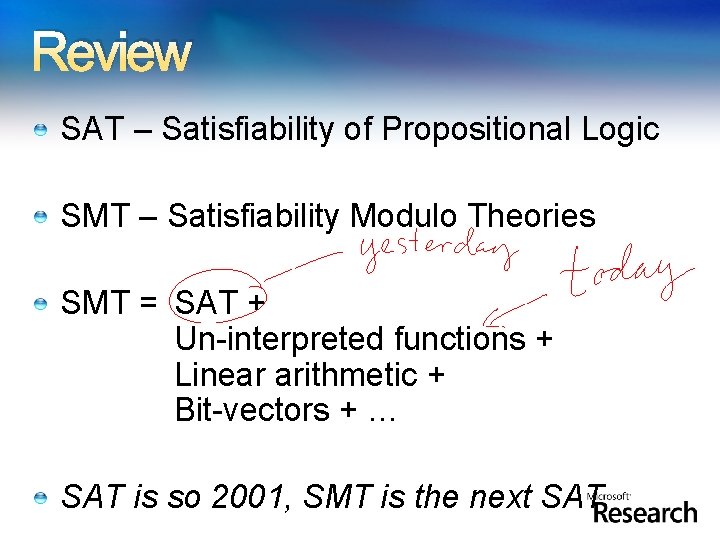
Review SAT – Satisfiability of Propositional Logic SMT – Satisfiability Modulo Theories SMT = SAT + Un-interpreted functions + Linear arithmetic + Bit-vectors + … SAT is so 2001, SMT is the next SAT
Functions and equalities Congruence closure Leibniz Bernoulli Sr Bernoulli Jr Euler Lagrange Poisson Chasles H. A. Newton Moore Veblen Franklen Perlis Manna Henzinger Rajamani
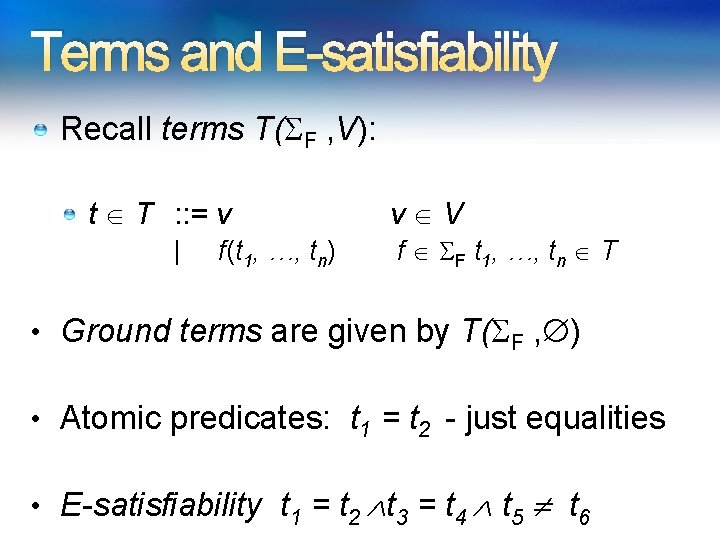
Terms and E-satisfiability Recall terms T( F , V): t T : : = v | f(t 1, …, tn) v V f F t 1, …, tn T • Ground terms are given by T( F , ) • Atomic predicates: t 1 = t 2 - just equalities • E-satisfiability t 1 = t 2 t 3 = t 4 t 5 t 6
Terminology E-satisfiability is more often called EUFsatisfiability EUF : Equality and Un-interpreted Functions. E is just shorter to say than EUF.
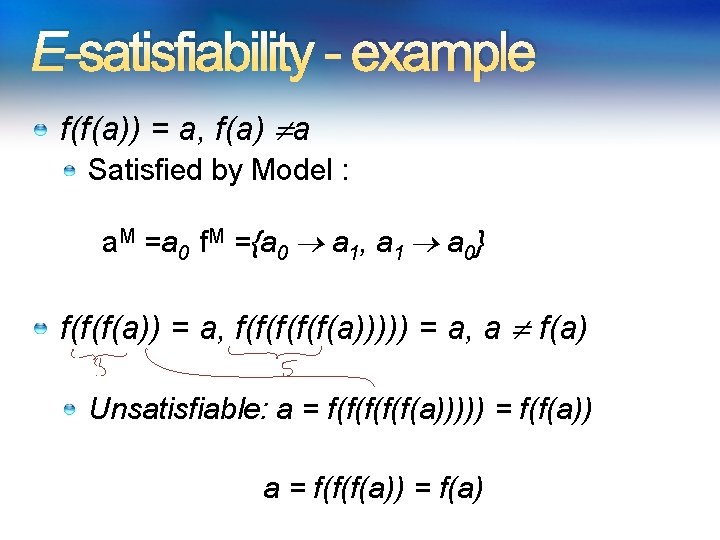
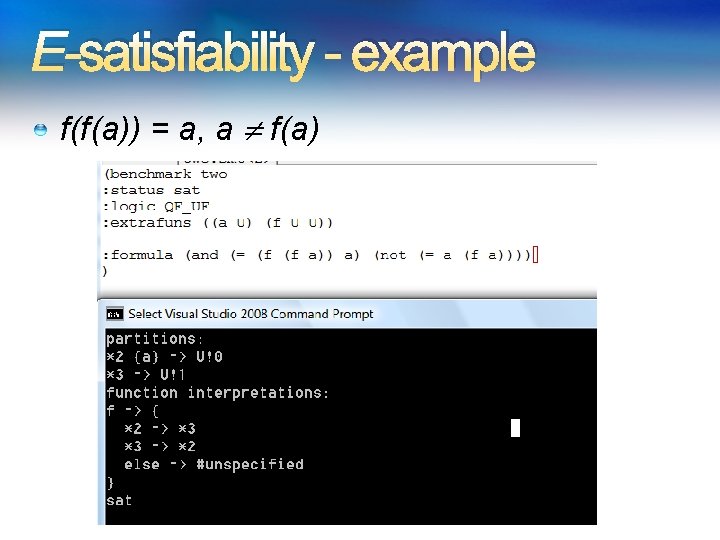
E-satisfiability - example f(f(a)) = a, f(a) a Satisfied by Model : a. M =a 0 f. M ={a 0 a 1, a 1 a 0} f(f(f(a)) = a, f(f(f(a))))) = a, a f(a) Unsatisfiable: a = f(f(f(a))))) = f(f(a)) a = f(f(f(a)) = f(a)
E-satisfiability - example f(f(a)) = a, a f(a)
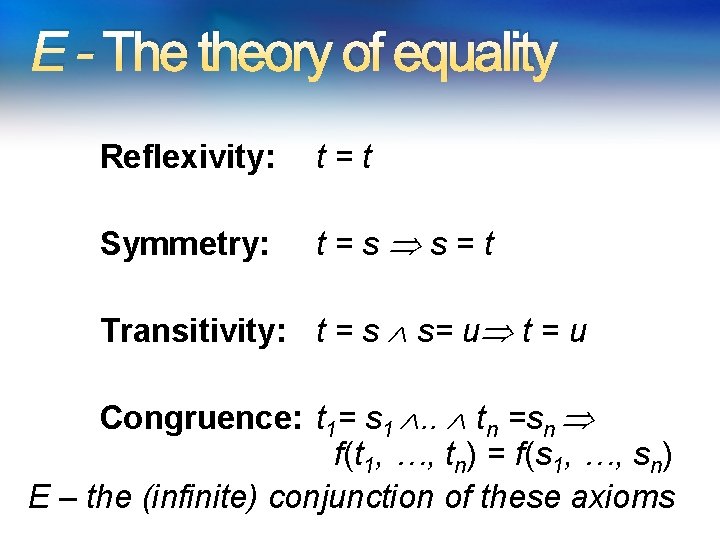
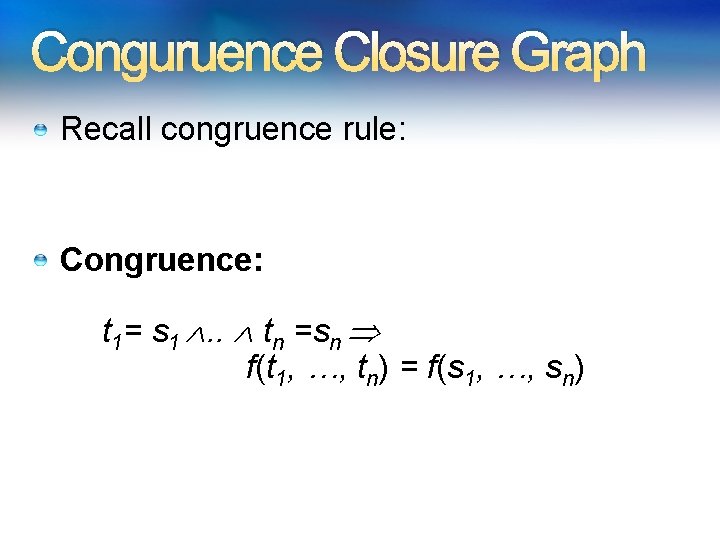
E - The theory of equality Reflexivity: t=t Symmetry: t=s s=t Transitivity: t = s s= u t = u Congruence: t 1= s 1 . . tn =sn f(t 1, …, tn) = f(s 1, …, sn) E – the (infinite) conjunction of these axioms
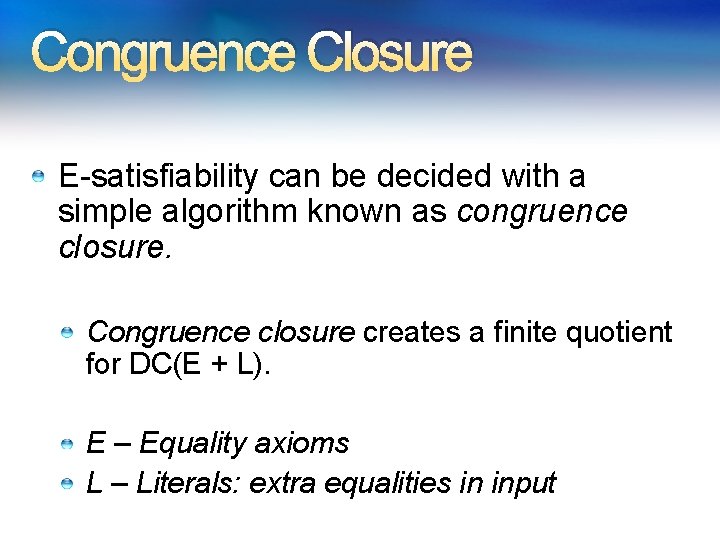
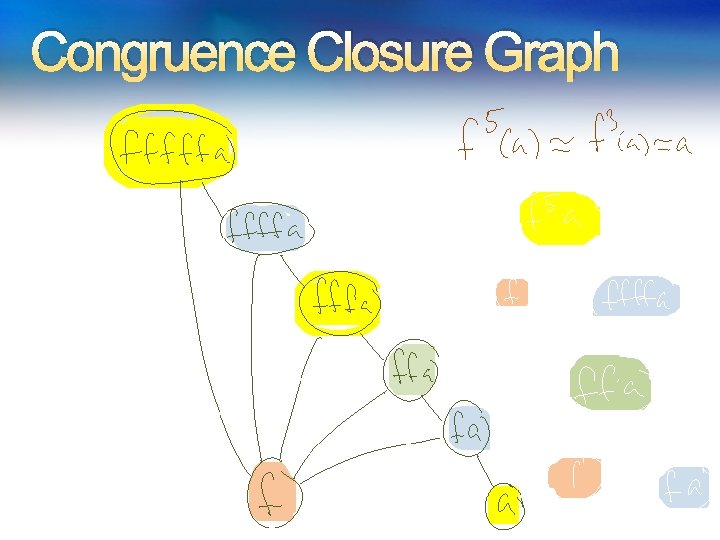
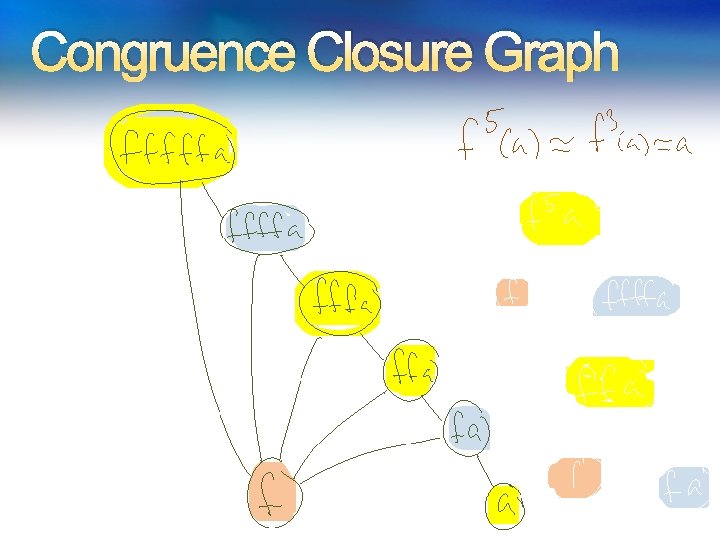
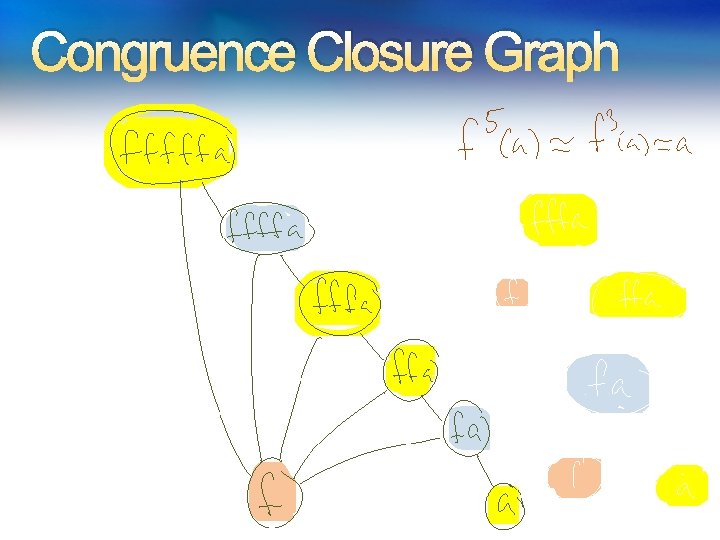
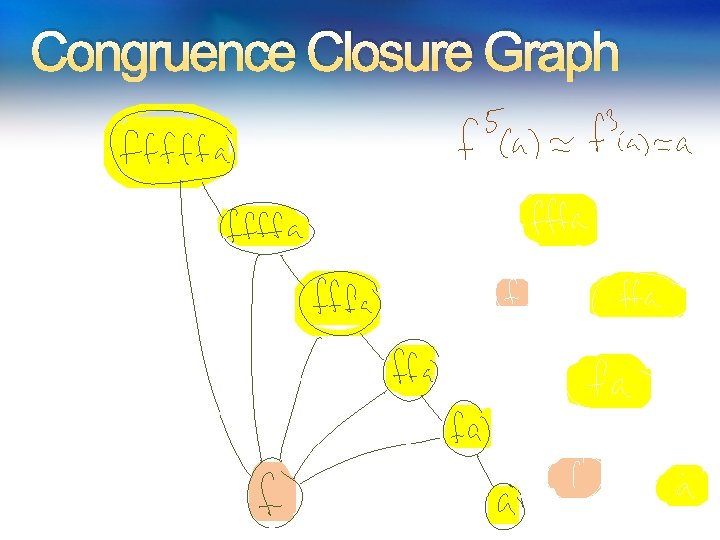
Congruence Closure E-satisfiability can be decided with a simple algorithm known as congruence closure. Congruence closure creates a finite quotient for DC(E + L). E – Equality axioms L – Literals: extra equalities in input
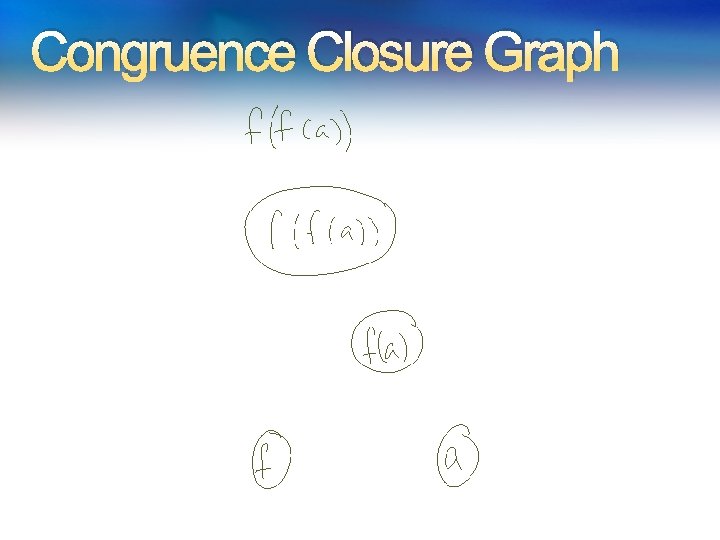
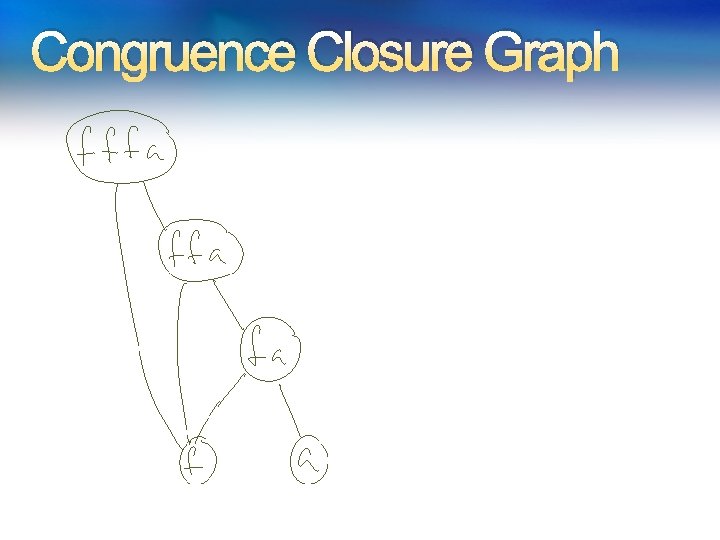
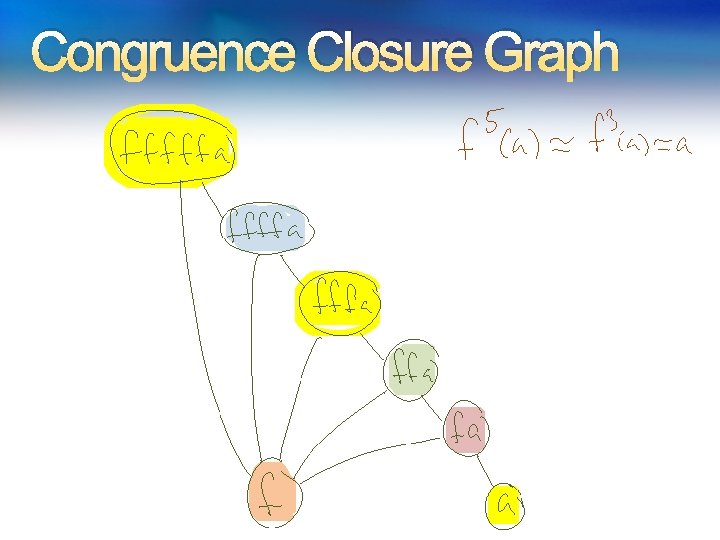
Congruence Closure Graph
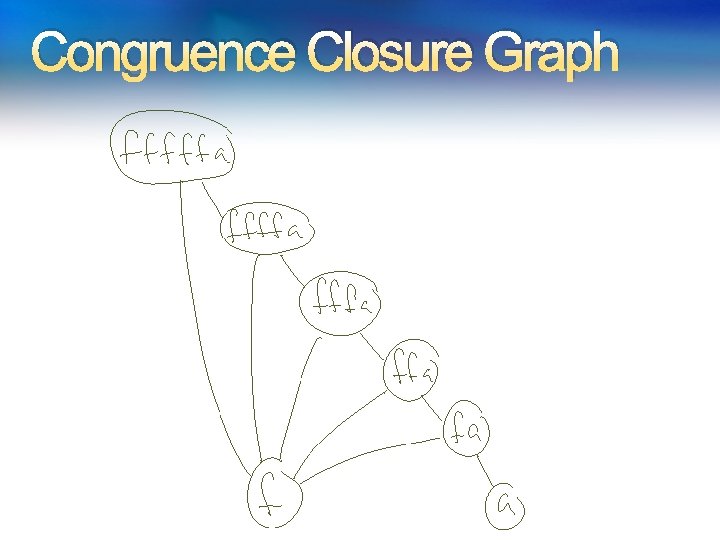
Congruence Closure Graph
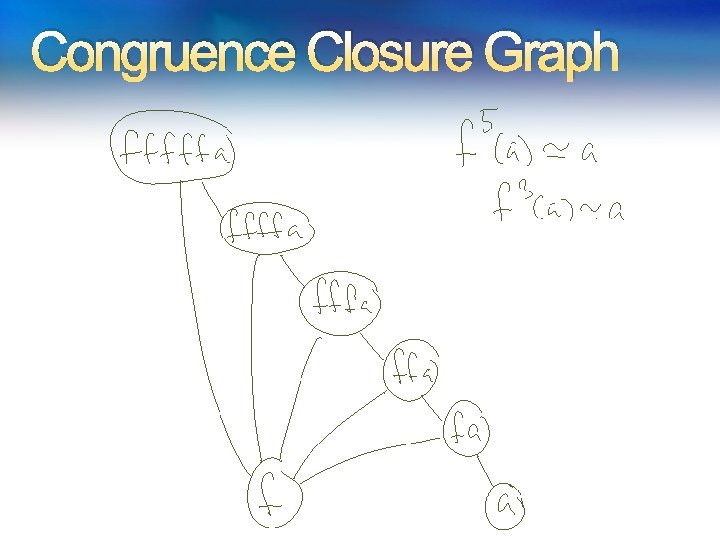
Congruence Closure Graph
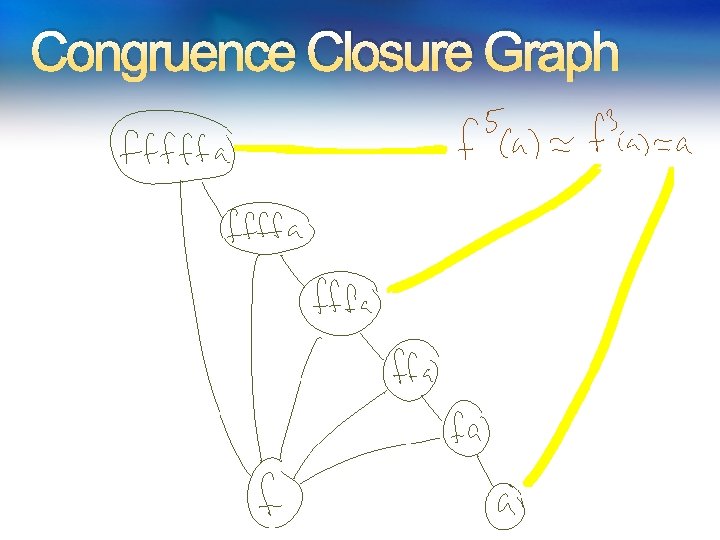
Congruence Closure Graph
Congruence Closure Graph
Congruence Closure Graph
Conguruence Closure Graph Recall congruence rule: Congruence: t 1= s 1 . . tn =sn f(t 1, …, tn) = f(s 1, …, sn)
Congruence Closure Graph
Congruence Closure Graph
Congruence Closure Graph
Congruence Closure Graph
Congruence Closure Graph
Congruence Closure Graph
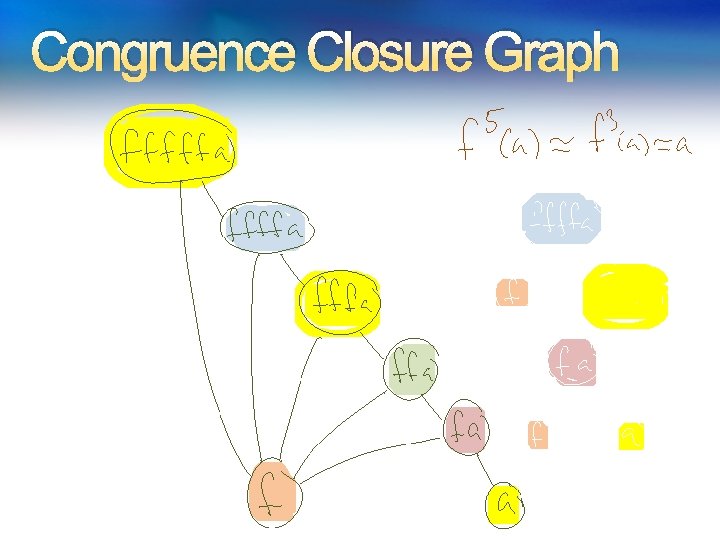
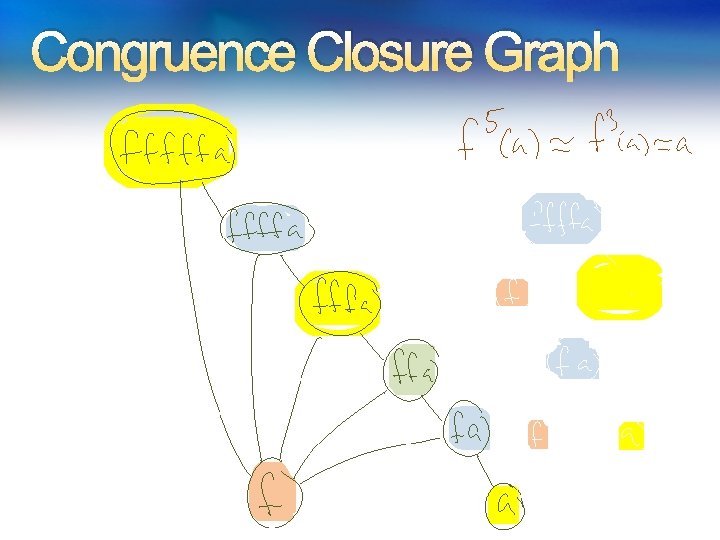
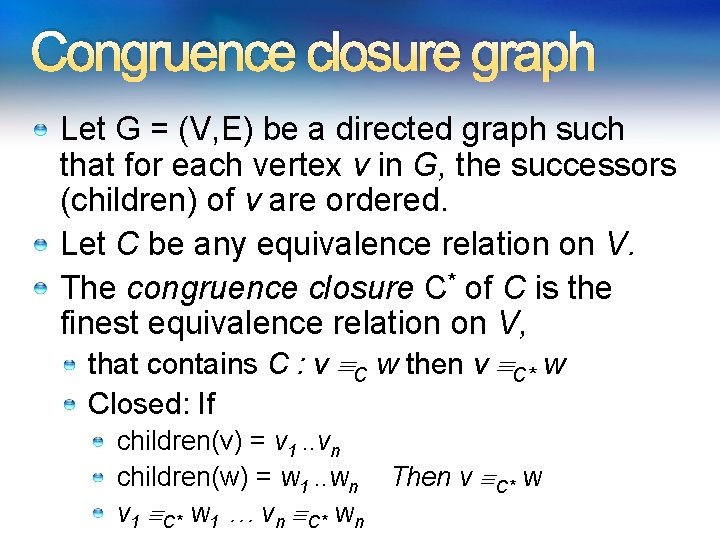
Congruence closure graph Let G = (V, E) be a directed graph such that for each vertex v in G, the successors (children) of v are ordered. Let C be any equivalence relation on V. The congruence closure C* of C is the finest equivalence relation on V, that contains C : v C w then v C* w Closed: If children(v) = v 1. . vn children(w) = w 1. . wn Then v C* w v 1 C* w 1 … vn C* wn
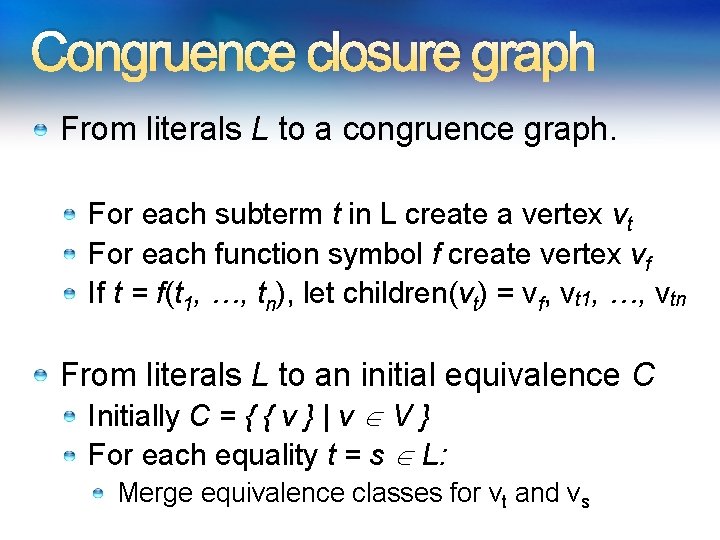
Congruence closure graph From literals L to a congruence graph. For each subterm t in L create a vertex vt For each function symbol f create vertex vf If t = f(t 1, …, tn), let children(vt) = vf, vt 1, …, vtn From literals L to an initial equivalence C Initially C = { { v } | v V } For each equality t = s L: Merge equivalence classes for vt and vs
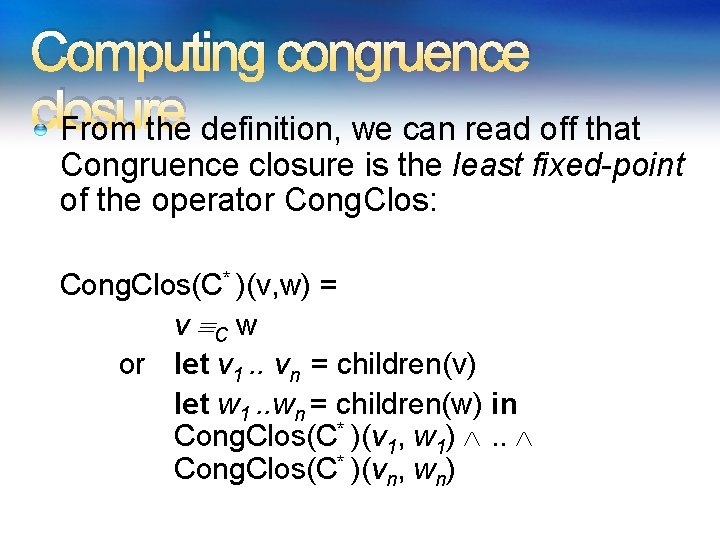
Computing congruence closure From the definition, we can read off that Congruence closure is the least fixed-point of the operator Cong. Clos: Cong. Clos(C* )(v, w) = v C w or let v 1. . vn = children(v) let w 1. . wn = children(w) in Cong. Clos(C* )(v 1, w 1) . . Cong. Clos(C* )(vn, wn)
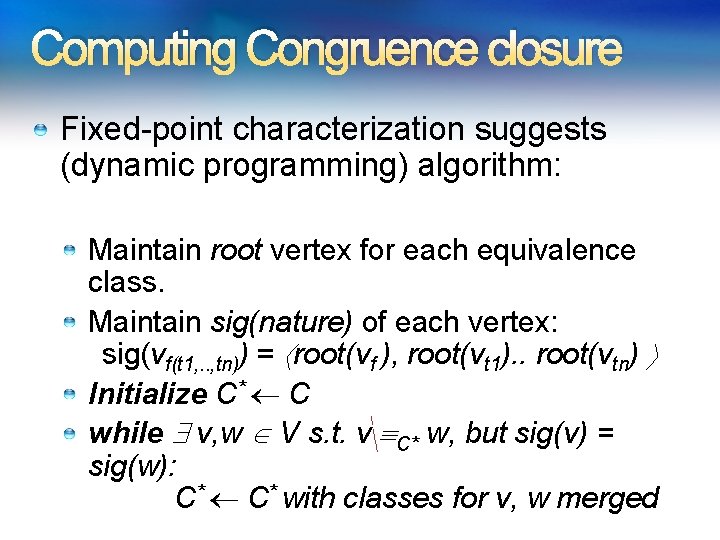
Computing Congruence closure Fixed-point characterization suggests (dynamic programming) algorithm: Maintain root vertex for each equivalence class. Maintain sig(nature) of each vertex: sig(vf(t 1, . . , tn)) = root(vf ), root(vt 1). . root(vtn) Initialize C* C while v, w V s. t. v C* w, but sig(v) = sig(w): C* with classes for v, w merged
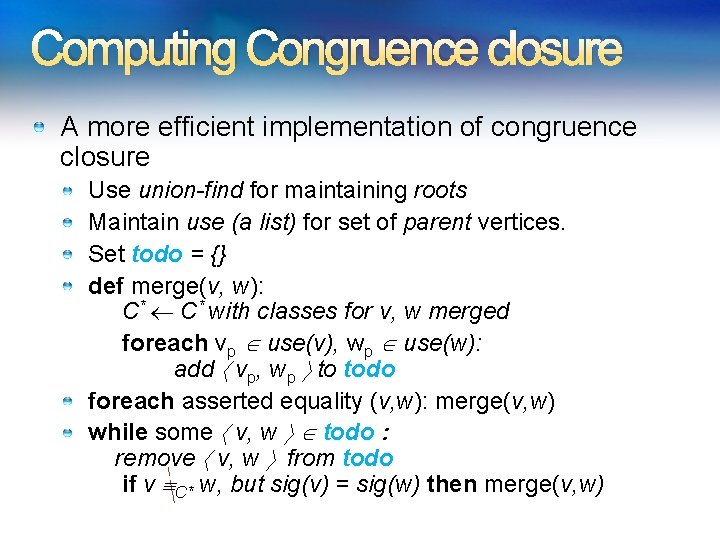
Computing Congruence closure A more efficient implementation of congruence closure Use union-find for maintaining roots Maintain use (a list) for set of parent vertices. Set todo = {} def merge(v, w): C* with classes for v, w merged foreach vp use(v), wp use(w): add vp, wp to todo foreach asserted equality (v, w): merge(v, w) while some v, w todo : remove v, w from todo if v C* w, but sig(v) = sig(w) then merge(v, w)
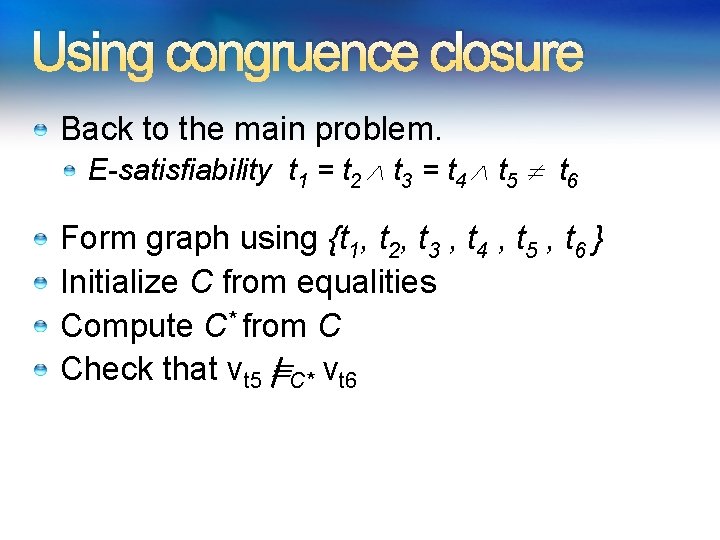
Using congruence closure Back to the main problem. E-satisfiability t 1 = t 2 t 3 = t 4 t 5 t 6 Form graph using {t 1, t 2, t 3 , t 4 , t 5 , t 6 } Initialize C from equalities Compute C* from C Check that vt 5 C* vt 6
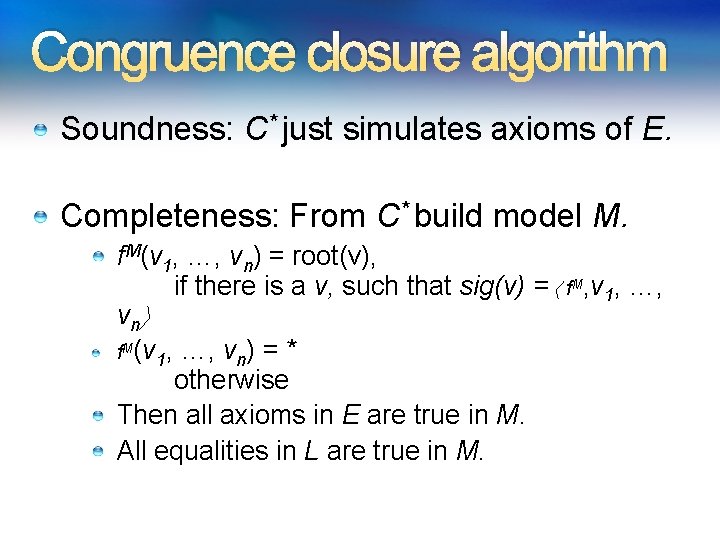
Congruence closure algorithm Soundness: C* just simulates axioms of E. Completeness: From C* build model M. f. M(v 1, …, vn) = root(v), if there is a v, such that sig(v) = f. M, v 1, …, vn f. M(v 1, …, vn) = * otherwise Then all axioms in E are true in M. All equalities in L are true in M.
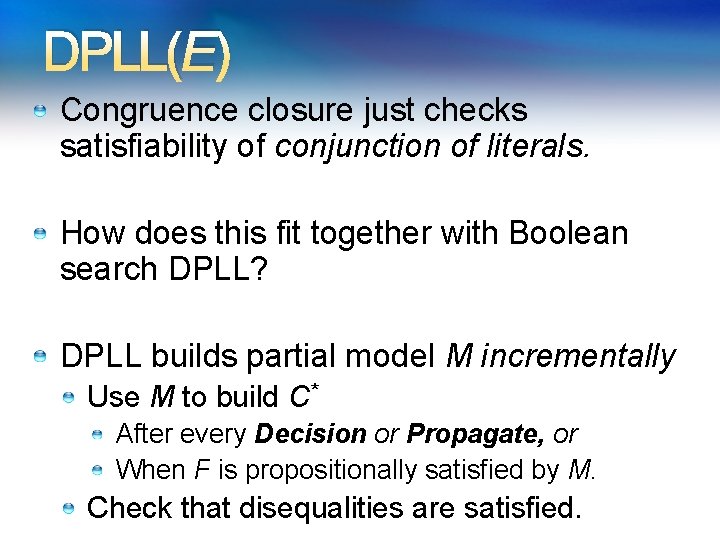
DPLL(E) Congruence closure just checks satisfiability of conjunction of literals. How does this fit together with Boolean search DPLL? DPLL builds partial model M incrementally Use M to build C* After every Decision or Propagate, or When F is propositionally satisfied by M. Check that disequalities are satisfied.
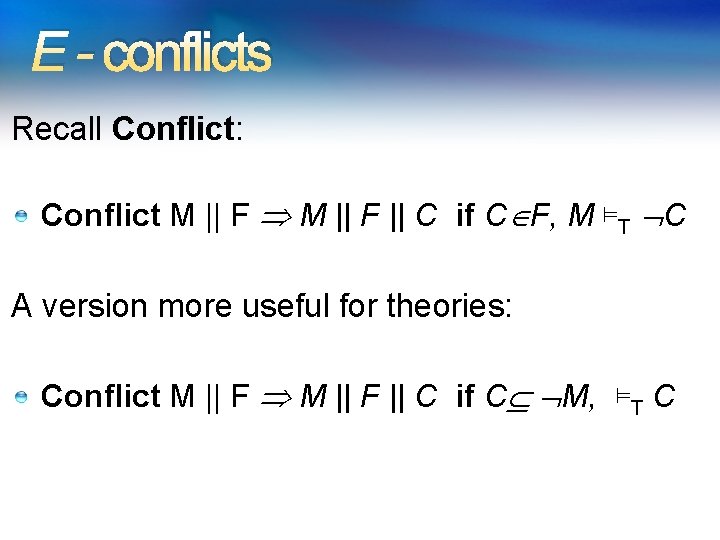
E - conflicts Recall Conflict: Conflict M || F || C if C F, M ⊨T C A version more useful for theories: Conflict M || F || C if C M, ⊨T C
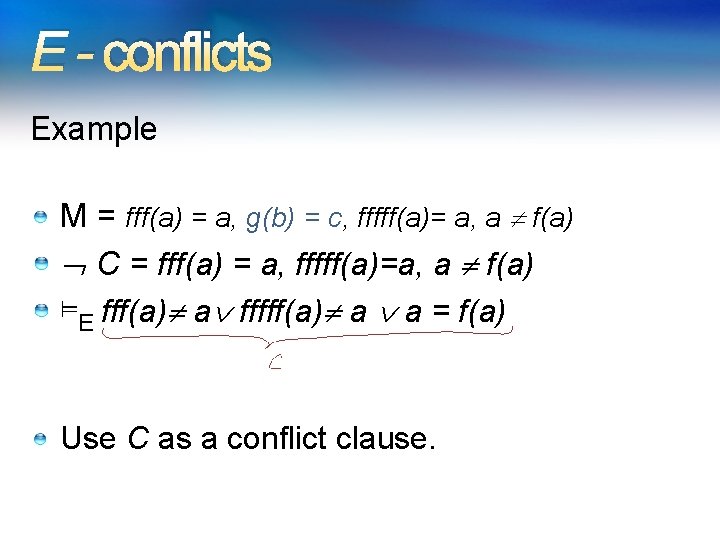
E - conflicts Example M = fff(a) = a, g(b) = c, fffff(a)= a, a f(a) C = fff(a) = a, fffff(a)=a, a f(a) ⊨E fff(a) a fffff(a) a a = f(a) Use C as a conflict clause.
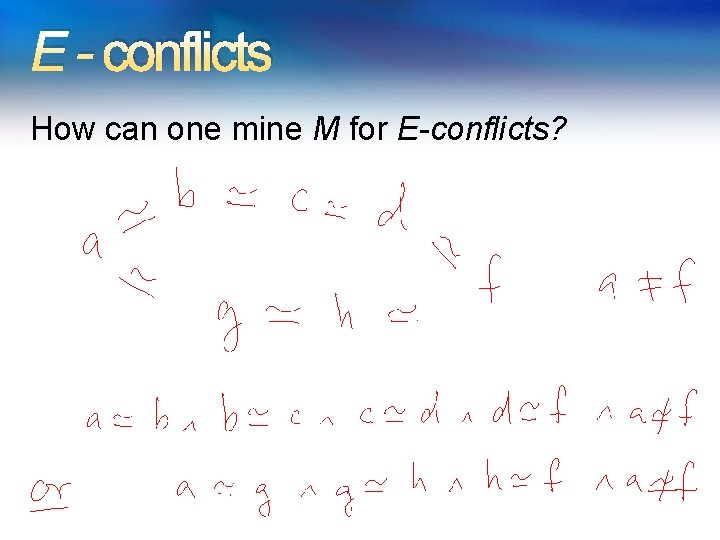
E - conflicts How can one mine M for E-conflicts?
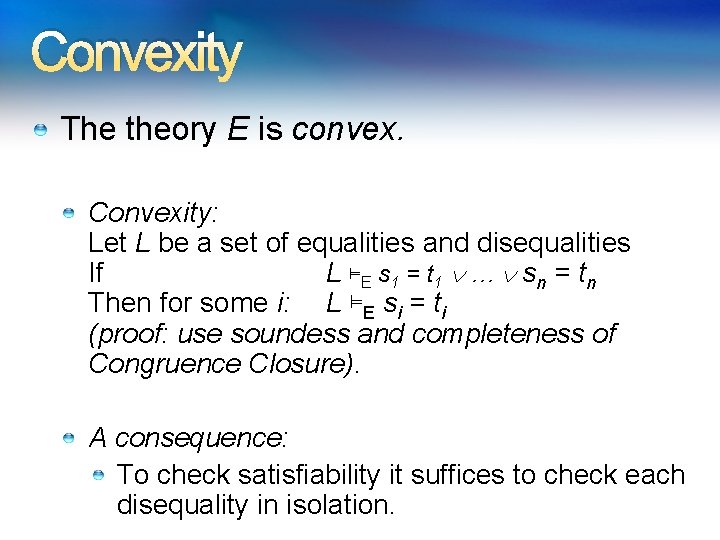
Convexity The theory E is convex. Convexity: Let L be a set of equalities and disequalities If L ⊨E s 1 = t 1 … sn = tn Then for some i: L ⊨E si = ti (proof: use soundess and completeness of Congruence Closure). A consequence: To check satisfiability it suffices to check each disequality in isolation.
Using equalities and uninterpreted functions
Abstraction Use E as the penultimate approximation: Let T be a theory with signature F. If L is E-unsatisfiable, where F is only axiomatized using E, then L is T-unsatisfiable.
Incremental abstraction Idea, roughly: Treat some operator occurrences as uninterpreted function symbols. Generate model M with mix of interpreted and un-interpreted modes. Check that M also satisfies T. If M violates T on some equality t = s, where t contains an abstracted function occurrence, Then expand interpretation of such occurrence. More in exercises
Program EXploration Application: Using decision procedures for generating test inputs Thanks to Nikolai Tillmann and Peli de Halleux
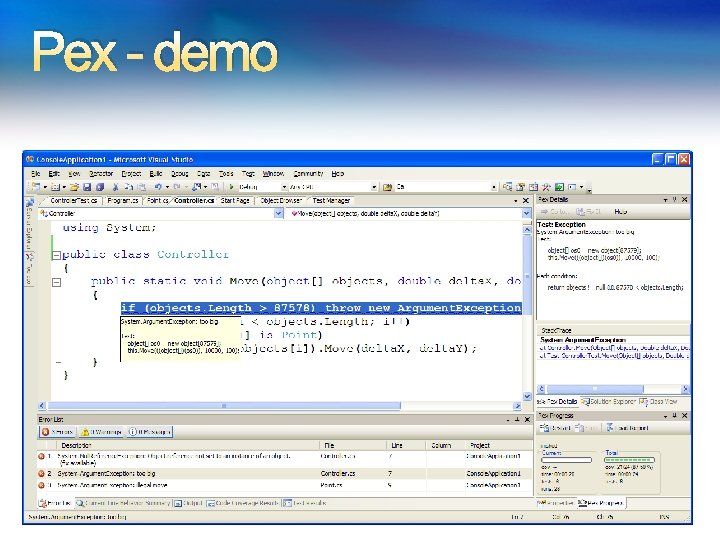
Pex - demo
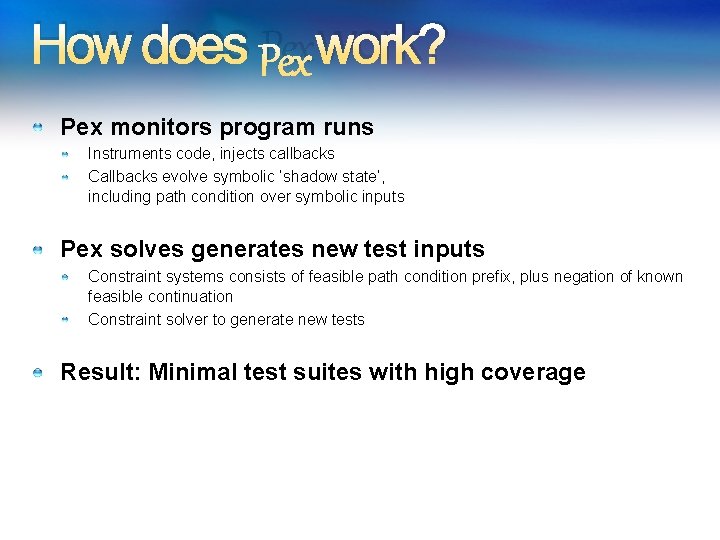
How does Pex work? Pex monitors program runs Instruments code, injects callbacks Callbacks evolve symbolic ‘shadow state’, including path condition over symbolic inputs Pex solves generates new test inputs Constraint systems consists of feasible path condition prefix, plus negation of known feasible continuation Constraint solver to generate new tests Result: Minimal test suites with high coverage 42
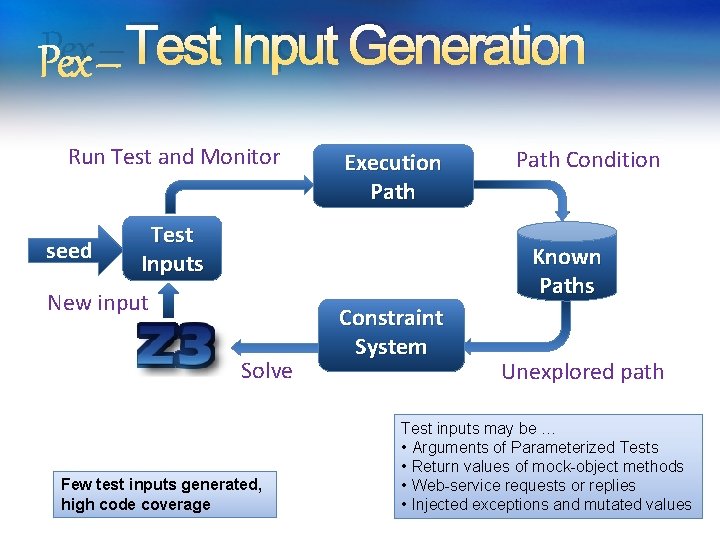
Pex – Test Input Generation Run Test and Monitor seed Execution Path Test Inputs Path Condition Known Paths New input Solve Few test inputs generated, high code coverage Constraint System Unexplored path Test inputs may be … • Arguments of Parameterized Tests • Return values of mock-object methods • Web-service requests or replies • Injected exceptions and mutated values
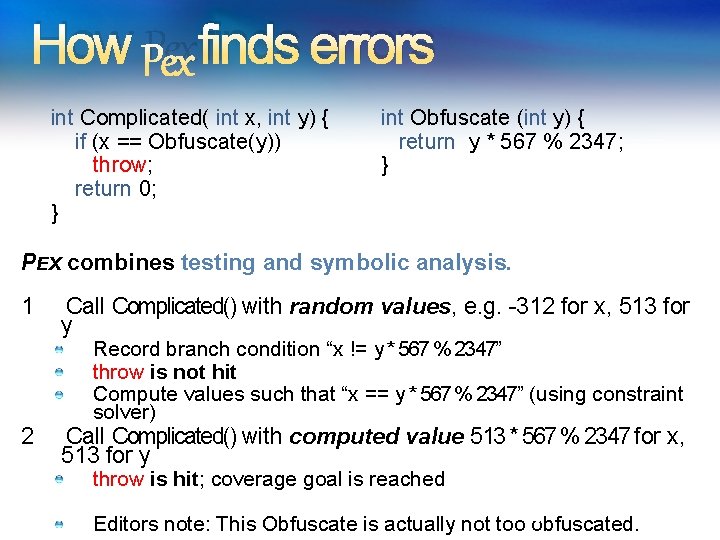
How Pex finds errors int Complicated( int x, int y) { if (x == Obfuscate(y)) throw; return 0; } int Obfuscate (int y) { return y * 567 % 2347; } PEX combines testing and symbolic analysis. 1 2 Call Complicated() with random values, e. g. -312 for x, 513 for y Record branch condition “x != y * 567 % 2347” throw is not hit Compute values such that “x == y * 567 % 2347” (using constraint solver) Call Complicated() with computed value 513 * 567 % 2347 for x, 513 for y throw is hit; coverage goal is reached Editors note: This Obfuscate is actually not too 45 obfuscated.
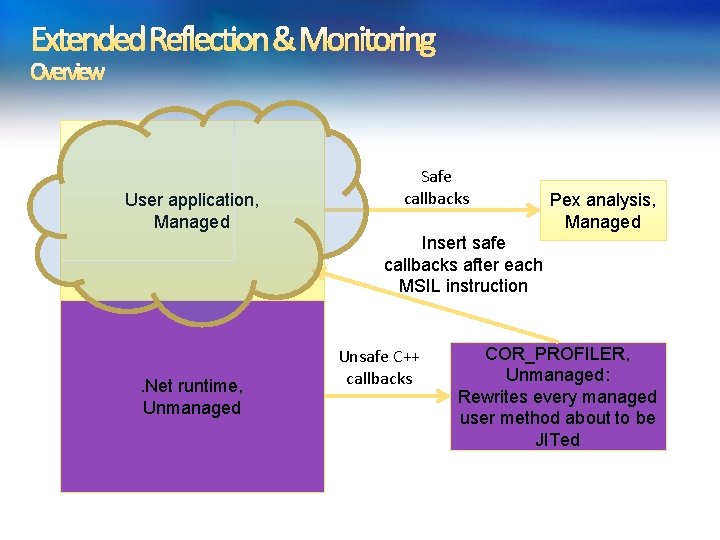
Extended Reflection & Monitoring Overview User application, Managed Safe callbacks Pex analysis, Managed Insert safe callbacks after each MSIL instruction . Net runtime, Unmanaged Unsafe C++ callbacks COR_PROFILER, Unmanaged: Rewrites every managed user method about to be JITed 46
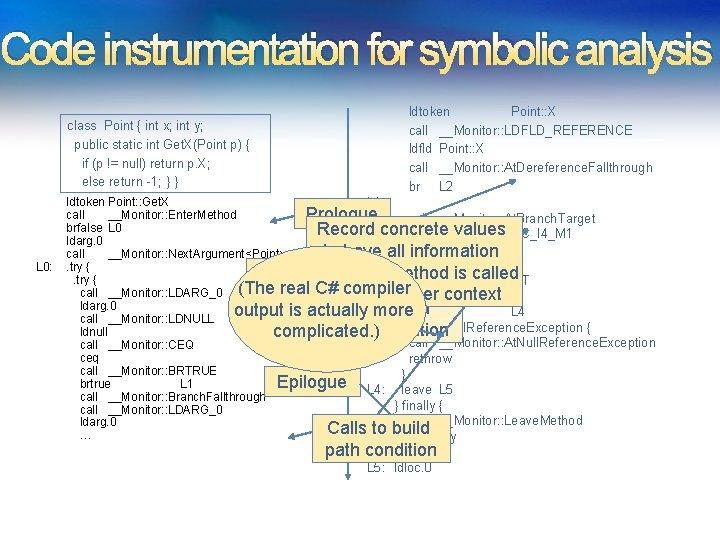
Code instrumentation for symbolic analysis class Point { int x; int y; public static int Get. X(Point p) { if (p != null) return p. X; else return -1; } } L 0: ldtoken Point: : X call __Monitor: : LDFLD_REFERENCE ldfld Point: : X call __Monitor: : At. Dereference. Fallthrough br L 2 ldtoken Point: : Get. X L 1: call __Monitor: : Enter. Method Prologue call __Monitor: : At. Branch. Target brfalse L 0 Record concrete values call __Monitor: : LDC_I 4_M 1 ldarg. 0 to have all ldc. i 4. m 1 information call __Monitor: : Next. Argument<Point> L 2: . try { Calls to buildthis method when is called. try { call __Monitor: : RET real C# compiler call __Monitor: : LDARG_0 (The path condition with no proper stloc. 0 context ldarg. 0 Calls will perform output is actually more leave L 4 call __Monitor: : LDNULL } catch Null. Reference. Exception { symbolic computation ldnull complicated. ) ‘ call __Monitor: : At. Null. Reference. Exception call __Monitor: : CEQ ceq rethrow call __Monitor: : BRTRUE } brtrue L 1 Epilogue L 4: leave L 5 call __Monitor: : Branch. Fallthrough } finally { call __Monitor: : LDARG_0 call __Monitor: : Leave. Method ldarg. 0 Calls to build … endfinally path condition } L 5: ldloc. 0 ret