
SMT Solvers for Testing Program Analysis and Verification



![Array. List: Add. Item Test class Array. List. Test { [Pex. Method] void Add.](https://slidetodoc.com/presentation_image_h/7f8faf24237124577a9240818b615bcb/image-20.jpg "Array. List: Add. Item Test class Array. List. Test { [Pex. Method] void Add.")
![Array. List: Starting Pex … class Array. List. Test { [Pex. Method] void Add.](https://slidetodoc.com/presentation_image_h/7f8faf24237124577a9240818b615bcb/image-21.jpg "Array. List: Starting Pex … class Array. List. Test { [Pex. Method] void Add.")
![Array. List: Run 1, (0, null) class Array. List. Test { [Pex. Method] void](https://slidetodoc.com/presentation_image_h/7f8faf24237124577a9240818b615bcb/image-22.jpg "Array. List: Run 1, (0, null) class Array. List. Test { [Pex. Method] void")
![Array. List: Run 1, (0, null) class Array. List. Test { [Pex. Method] void](https://slidetodoc.com/presentation_image_h/7f8faf24237124577a9240818b615bcb/image-23.jpg "Array. List: Run 1, (0, null) class Array. List. Test { [Pex. Method] void")
![Array. List: Run 1, (0, null) class Array. List. Test { [Pex. Method] void](https://slidetodoc.com/presentation_image_h/7f8faf24237124577a9240818b615bcb/image-24.jpg "Array. List: Run 1, (0, null) class Array. List. Test { [Pex. Method] void")
![Array. List: Run 1, (0, null) class Array. List. Test { Inputs [Pex. Method]](https://slidetodoc.com/presentation_image_h/7f8faf24237124577a9240818b615bcb/image-25.jpg "Array. List: Run 1, (0, null) class Array. List. Test { Inputs [Pex. Method]")
![Array. List: Solve constraints using SMT solver class Array. List. Test { [Pex. Method]](https://slidetodoc.com/presentation_image_h/7f8faf24237124577a9240818b615bcb/image-27.jpg "Array. List: Solve constraints using SMT solver class Array. List. Test { [Pex. Method]")
![Array. List: Run 2, (1, null) class Array. List. Test { [Pex. Method] void](https://slidetodoc.com/presentation_image_h/7f8faf24237124577a9240818b615bcb/image-28.jpg "Array. List: Run 2, (1, null) class Array. List. Test { [Pex. Method] void")
![Array. List: Pick new branch class Array. List. Test { [Pex. Method] void Add.](https://slidetodoc.com/presentation_image_h/7f8faf24237124577a9240818b615bcb/image-29.jpg "Array. List: Pick new branch class Array. List. Test { [Pex. Method] void Add.")
![Array. List: Run 3, (-1, null) class Array. List. Test { [Pex. Method] void](https://slidetodoc.com/presentation_image_h/7f8faf24237124577a9240818b615bcb/image-30.jpg "Array. List: Run 3, (-1, null) class Array. List. Test { [Pex. Method] void")
![Array. List: Run 3, (-1, null) class Array. List. Test { [Pex. Method] void](https://slidetodoc.com/presentation_image_h/7f8faf24237124577a9240818b615bcb/image-31.jpg "Array. List: Run 3, (-1, null) class Array. List. Test { [Pex. Method] void")
![Array. List: Run 3, (-1, null) class Array. List. Test { [Pex. Method] void](https://slidetodoc.com/presentation_image_h/7f8faf24237124577a9240818b615bcb/image-32.jpg "Array. List: Run 3, (-1, null) class Array. List. Test { [Pex. Method] void")
![Test Input Generation by Dynamic Symbolic Execution a[0] a[1] a[2] a[3] = = 206;](https://slidetodoc.com/presentation_image_h/7f8faf24237124577a9240818b615bcb/image-40.jpg "Test Input Generation by Dynamic Symbolic Execution a[0] a[1] a[2] a[3] = = 206;")
![Application: The Static Driver Verifier SLAM [Ball & Rajamani 2001] http: //www. microsoft. com/whdc/devtools/sdv.](https://slidetodoc.com/presentation_image_h/7f8faf24237124577a9240818b615bcb/image-44.jpg "Application: The Static Driver Verifier SLAM [Ball & Rajamani 2001] http: //www. microsoft. com/whdc/devtools/sdv.")
![Application: Bit-precise Scalable Static Analysis PREfix [Moy, B. , Sielaff 2009]](https://slidetodoc.com/presentation_image_h/7f8faf24237124577a9240818b615bcb/image-68.jpg "Application: Bit-precise Scalable Static Analysis PREfix [Moy, B. , Sielaff 2009]")
![What is wrong here? -INT_MIN= INT_MIN 3(INT_MAX+1)/4 + (INT_MAX+1)/4 int binary_search(int[] arr, int low,](https://slidetodoc.com/presentation_image_h/7f8faf24237124577a9240818b615bcb/image-69.jpg "What is wrong here? -INT_MIN= INT_MIN 3(INT_MAX+1)/4 + (INT_MAX+1)/4 int binary_search(int[] arr, int low,")

- Slides: 131
SMT Solvers for Testing, Program Analysis and Verification @ Microsoft Nikolaj Bjørner Microsoft Research FSE &
The Calculus of Computation* At the core of every software analysis engine is invariably a component using logical formulas for describing states and transformations between system states. *Title of Bradley & Manna’s book
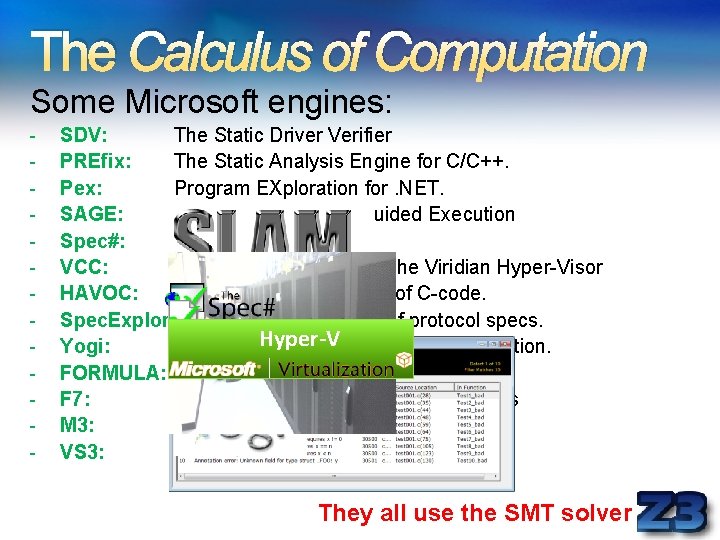
The Calculus of Computation Some Microsoft engines: - SDV: The Static Driver Verifier PREfix: The Static Analysis Engine for C/C++. Pex: Program EXploration for. NET. SAGE: Scalable Automated Guided Execution Spec#: C# + contracts VCC: Verifying C Compiler for the Viridian Hyper-Visor HAVOC: Heap-Aware Verification of C-code. Spec. Explorer: Model-based testing of protocol specs. Hyper-V Yogi: Dynamic symbolic execution + abstraction. FORMULA: Model-based Design F 7: Refinement types for security protocols M 3: Model Program Modeling VS 3: Abstract interpretation and Synthesis They all use the SMT solver
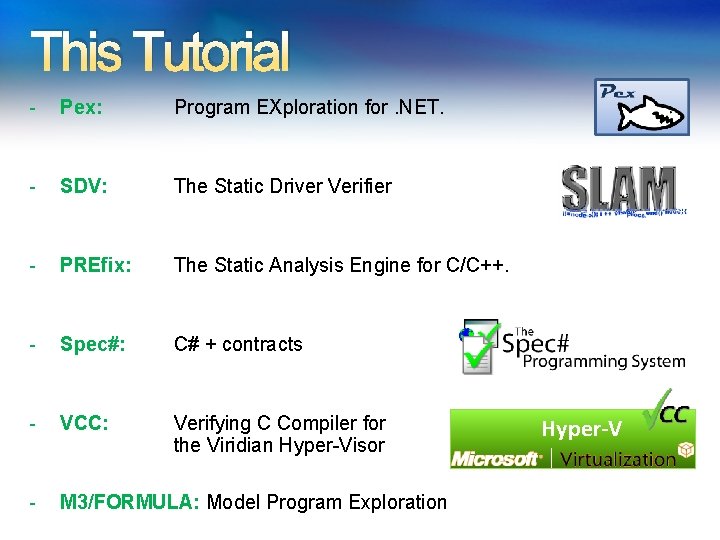
This Tutorial - Pex: Program EXploration for. NET. - SDV: The Static Driver Verifier - PREfix: The Static Analysis Engine for C/C++. - Spec#: C# + contracts - VCC: Verifying C Compiler for the Viridian Hyper-Visor - M 3/FORMULA: Model Program Exploration Hyper-V
The inner Research Market @ MSFT
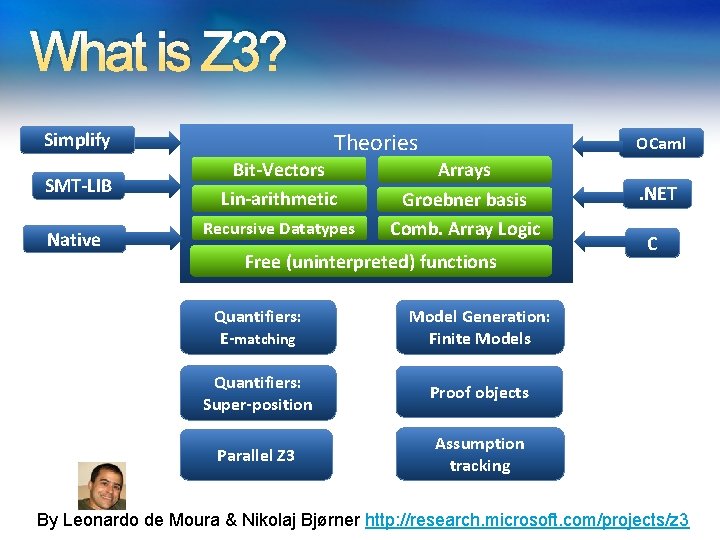
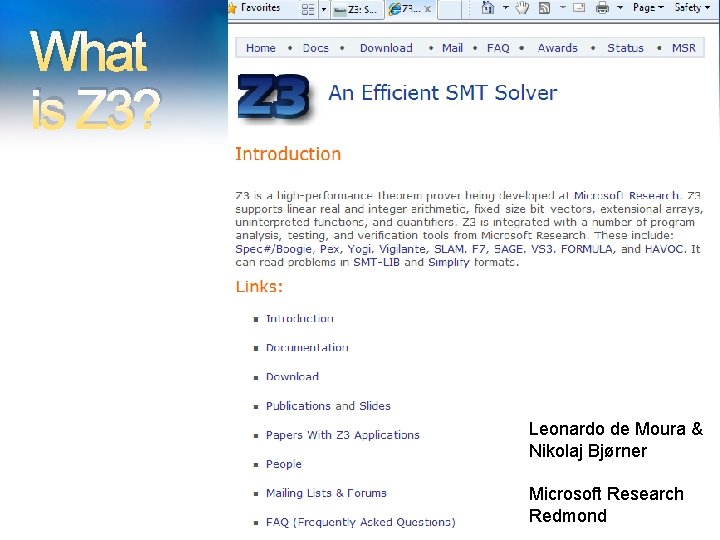
What is Z 3? Theories Simplify SMT-LIB Native Bit-Vectors Lin-arithmetic Recursive Datatypes OCaml Arrays Groebner basis Comb. Array Logic Free (uninterpreted) functions Quantifiers: E-matching Model Generation: Finite Models Quantifiers: Super-position Proof objects Parallel Z 3 Assumption tracking . NET C By Leonardo de Moura & Nikolaj Bjørner http: //research. microsoft. com/projects/z 3
What is Z 3? Leonardo de Moura & Nikolaj Bjørner Microsoft Research Redmond
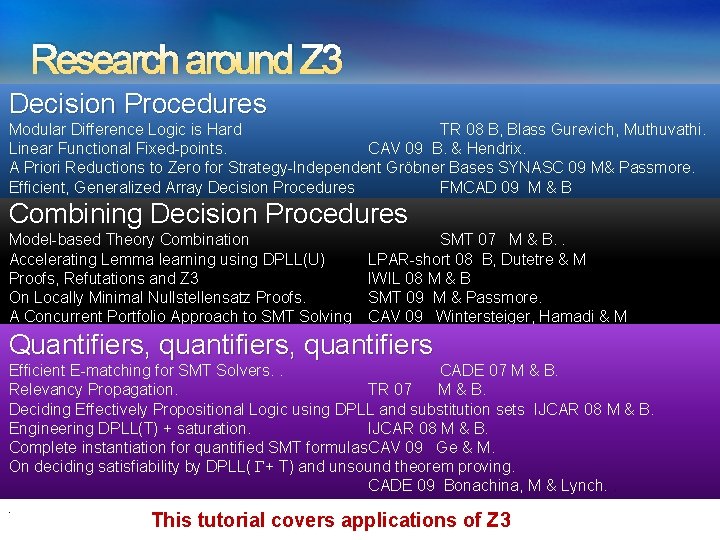
Research around Z 3 Decision Procedures Modular Difference Logic is Hard TR 08 B, Blass Gurevich, Muthuvathi. Linear Functional Fixed-points. CAV 09 B. & Hendrix. A Priori Reductions to Zero for Strategy-Independent Gröbner Bases SYNASC 09 M& Passmore. Efficient, Generalized Array Decision Procedures FMCAD 09 M & B Combining Decision Procedures Model-based Theory Combination Accelerating Lemma learning using DPLL(U) Proofs, Refutations and Z 3 On Locally Minimal Nullstellensatz Proofs. A Concurrent Portfolio Approach to SMT Solving SMT 07 M & B. . LPAR-short 08 B, Dutetre & M IWIL 08 M & B SMT 09 M & Passmore. CAV 09 Wintersteiger, Hamadi & M Quantifiers, quantifiers Efficient E-matching for SMT Solvers. . CADE 07 M & B. Relevancy Propagation. TR 07 M & B. Deciding Effectively Propositional Logic using DPLL and substitution sets IJCAR 08 M & B. Engineering DPLL(T) + saturation. IJCAR 08 M & B. . Complete instantiation for quantified SMT formulas. CAV 09 Ge & M. . On deciding satisfiability by DPLL( + T) and unsound theorem proving. CADE 09 Bonachina, M & Lynch. . . This tutorial covers applications of Z 3
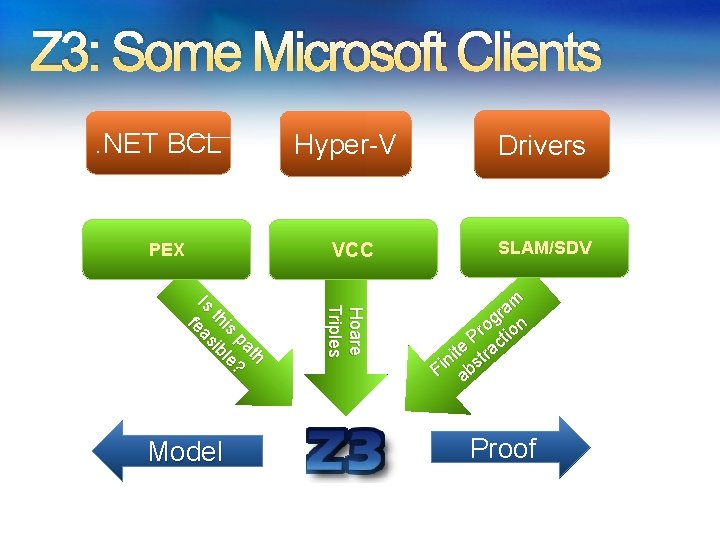
Z 3: Some Microsoft Clients. NET BCL PEX VCC Hoare Triples h at p ? is le th ib Is eas f Model Hyper-V Drivers SLAM/SDV m ra g o ion r P act e t ni str i F ab Proof
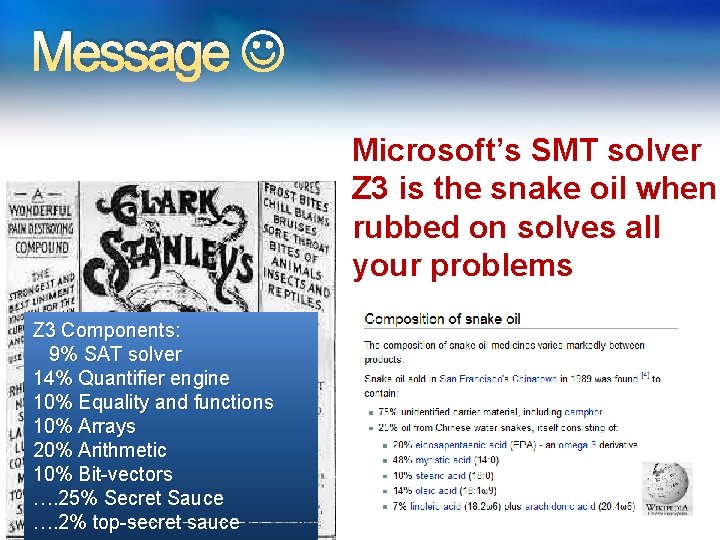
Message Microsoft’s SMT solver Z 3 is the snake oil when rubbed on solves all your problems Z 3 Components: 9% SAT solver 14% Quantifier engine 10% Equality and functions 10% Arrays 20% Arithmetic 10% Bit-vectors …. 25% Secret Sauce …. 2% top-secret sauce
Recap: what is SMT?
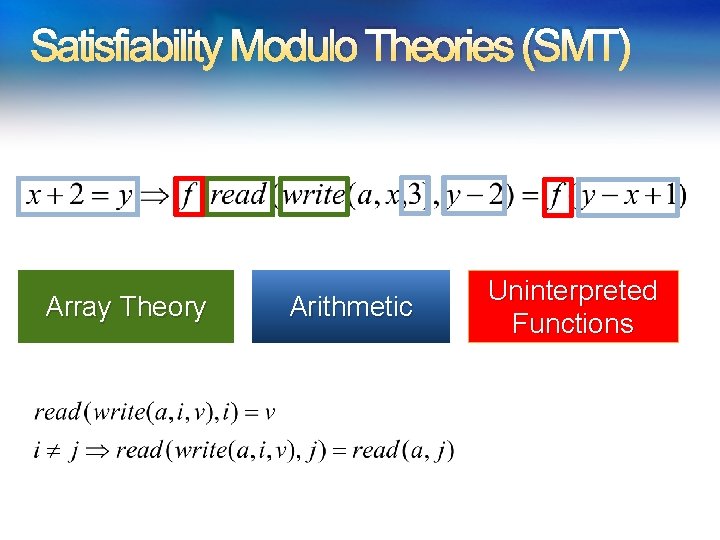
Satisfiability Modulo Theories (SMT) Array Theory Z 3: An Efficient SMT Arithmetic Uninterpreted Functions
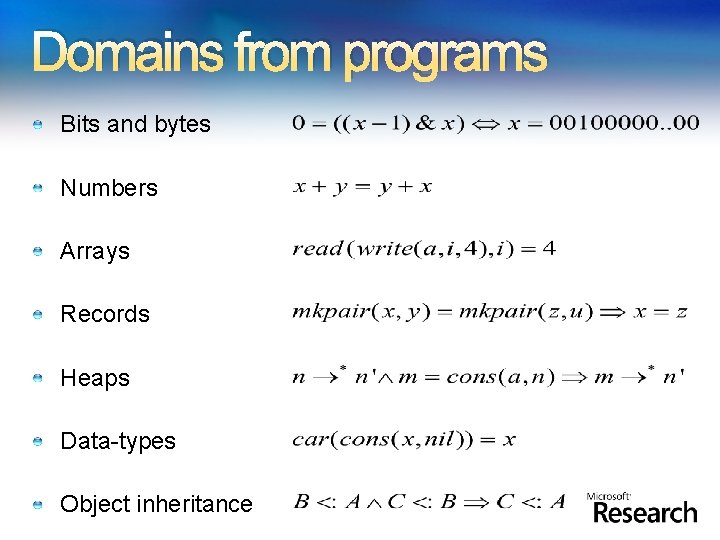
Domains from programs Bits and bytes Numbers Arrays Records Heaps Data-types Object inheritance
Demo: Z 3 & F#
Screenshot
Dynamic Application: Symbolic Execution - Pex, SAGE, Yogi, Vigilante http: //research. microsoft. com/pex
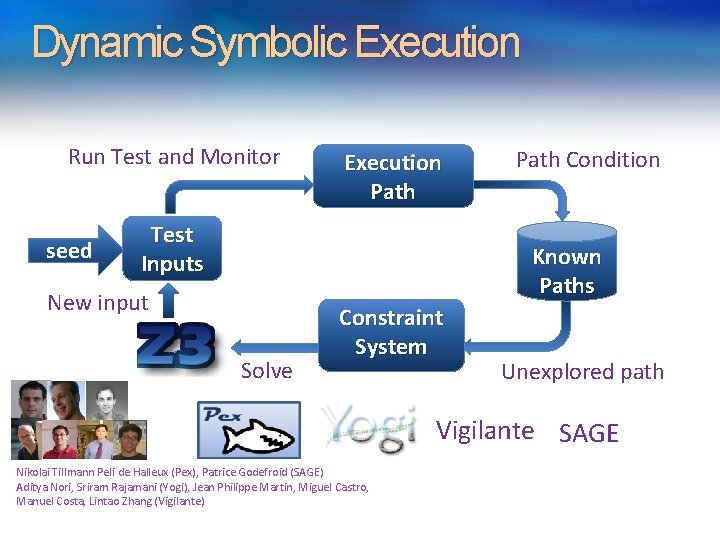
Dynamic Symbolic Execution Run Test and Monitor seed Execution Path Test Inputs Path Condition Known Paths New input Solve Constraint System Unexplored path Vigilante SAGE Nikolai Tillmann Peli de Halleux (Pex), Patrice Godefroid (SAGE) Aditya Nori, Sriram Rajamani (Yogi), Jean Philippe Martin, Miguel Castro, Manuel Costa, Lintao Zhang (Vigilante)
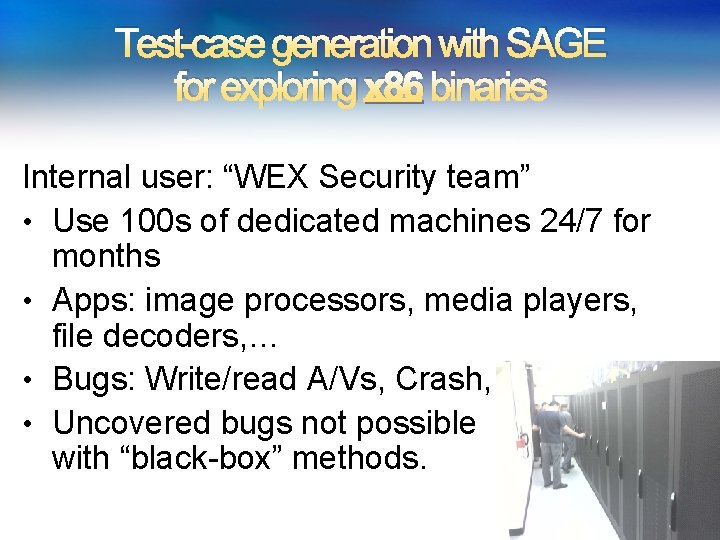
Test-case generation with SAGE for exploring x 86 binaries Internal user: “WEX Security team” • Use 100 s of dedicated machines 24/7 for months • Apps: image processors, media players, file decoders, … • Bugs: Write/read A/Vs, Crash, … • Uncovered bugs not possible with “black-box” methods.
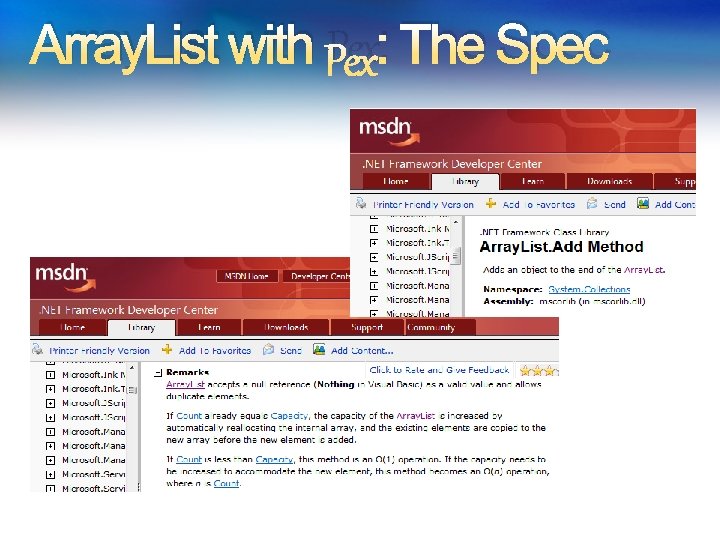
Array. List with Pex: The Spec
Array. List: Add. Item Test class Array. List. Test { [Pex. Method] void Add. Item(int c, object item) { var list = new Array. List(c); list. Add(item); Assert(list[0] == item); } } class Array. List { object[] items; int count; Array. List(int capacity) { if (capacity < 0) throw. . . ; items = new object[capacity]; } void Add(object item) { if (count == items. Length) Resize. Array(); items[this. count++] = item; }. . .
Array. List: Starting Pex … class Array. List. Test { [Pex. Method] void Add. Item(int c, object item) { var list = new Array. List(c); list. Add(item); Assert(list[0] == item); } } class Array. List { object[] items; int count; Array. List(int capacity) { if (capacity < 0) throw. . . ; items = new object[capacity]; } void Add(object item) { if (count == items. Length) Resize. Array(); items[this. count++] = item; }. . . Inputs
Array. List: Run 1, (0, null) class Array. List. Test { [Pex. Method] void Add. Item(int c, object item) { var list = new Array. List(c); list. Add(item); Assert(list[0] == item); } } class Array. List { object[] items; int count; Array. List(int capacity) { if (capacity < 0) throw. . . ; items = new object[capacity]; } void Add(object item) { if (count == items. Length) Resize. Array(); items[this. count++] = item; }. . . Inputs (0, null)
Array. List: Run 1, (0, null) class Array. List. Test { [Pex. Method] void Add. Item(int c, object item) { var list = new Array. List(c); list. Add(item); Assert(list[0] == item); } } class Array. List { object[] items; int count; Array. List(int capacity) { if (capacity < 0) throw. . . ; c < 0 false items = new object[capacity]; } void Add(object item) { if (count == items. Length) Resize. Array(); items[this. count++] = item; }. . . Inputs Observed Constraints (0, null) !(c<0)
Array. List: Run 1, (0, null) class Array. List. Test { [Pex. Method] void Add. Item(int c, object item) { var list = new Array. List(c); list. Add(item); Assert(list[0] == item); } } class Array. List { object[] items; int count; Array. List(int capacity) { if (capacity < 0) throw. . . ; items = new object[capacity]; } void Add(object item) { if (count == items. Length) 0 == c true Resize. Array(); items[this. count++] = item; }. . . Inputs Observed Constraints (0, null) !(c<0) && 0==c
Array. List: Run 1, (0, null) class Array. List. Test { Inputs [Pex. Method] void Add. Item(int c, object item) { (0, null) var list = new Array. List(c); list. Add(item); Assert(list[0] == item); } item == item true } class Array. List { object[] items; int count; Array. List(int capacity) { if (capacity < 0) throw. . . ; items = new object[capacity]; } void Add(object item) { if (count == items. Length) Resize. Array(); items[this. count++] = item; }. . . Observed Constraints !(c<0) && 0==c This is a tautology, i. e. a constraint that is always true, regardless of the chosen values. We can ignore such constraints.
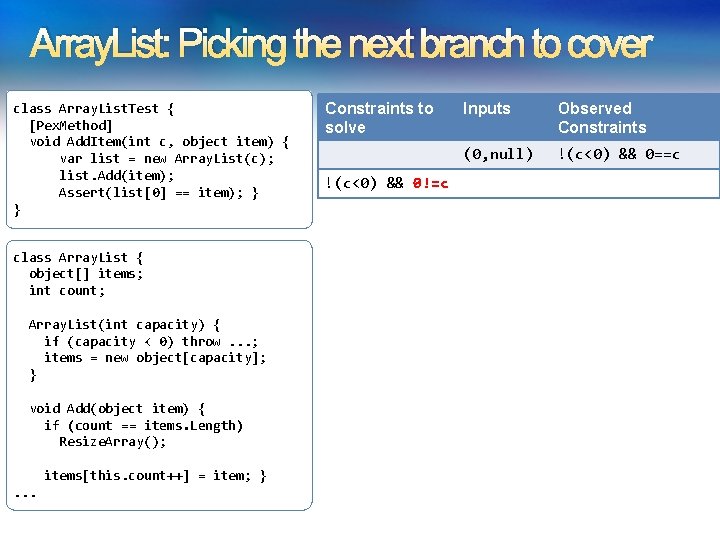
Array. List: Picking the next branch to cover class Array. List. Test { [Pex. Method] void Add. Item(int c, object item) { var list = new Array. List(c); list. Add(item); Assert(list[0] == item); } } class Array. List { object[] items; int count; Array. List(int capacity) { if (capacity < 0) throw. . . ; items = new object[capacity]; } void Add(object item) { if (count == items. Length) Resize. Array(); items[this. count++] = item; }. . . Constraints to solve !(c<0) && 0!=c Inputs Observed Constraints (0, null) !(c<0) && 0==c
Array. List: Solve constraints using SMT solver class Array. List. Test { [Pex. Method] void Add. Item(int c, object item) { var list = new Array. List(c); list. Add(item); Assert(list[0] == item); } } class Array. List { object[] items; int count; Array. List(int capacity) { if (capacity < 0) throw. . . ; items = new object[capacity]; } void Add(object item) { if (count == items. Length) Resize. Array(); items[this. count++] = item; }. . . Constraints to solve Inputs Observed Constraints (0, null) !(c<0) && 0==c !(c<0) && 0!=c (1, null) Z 3 Constraint solver Z 3 has decision procedures for - Arrays - Linear integer arithmetic - Bitvector arithmetic - … - (Everything but floating-point numbers)
Array. List: Run 2, (1, null) class Array. List. Test { [Pex. Method] void Add. Item(int c, object item) { var list = new Array. List(c); list. Add(item); Assert(list[0] == item); } } Constraints to solve Inputs Observed Constraints (0, null) !(c<0) && 0==c !(c<0) && 0!=c (1, null) !(c<0) && 0!=c class Array. List { object[] items; int count; Array. List(int capacity) { if (capacity < 0) throw. . . ; items = new object[capacity]; } void Add(object item) { if (count == items. Length) 0 == c false Resize. Array(); items[this. count++] = item; }. . .
Array. List: Pick new branch class Array. List. Test { [Pex. Method] void Add. Item(int c, object item) { var list = new Array. List(c); list. Add(item); Assert(list[0] == item); } } class Array. List { object[] items; int count; Array. List(int capacity) { if (capacity < 0) throw. . . ; items = new object[capacity]; } void Add(object item) { if (count == items. Length) Resize. Array(); items[this. count++] = item; }. . . Constraints to solve Inputs Observed Constraints (0, null) !(c<0) && 0==c !(c<0) && 0!=c (1, null) !(c<0) && 0!=c c<0
Array. List: Run 3, (-1, null) class Array. List. Test { [Pex. Method] void Add. Item(int c, object item) { var list = new Array. List(c); list. Add(item); Assert(list[0] == item); } } class Array. List { object[] items; int count; Array. List(int capacity) { if (capacity < 0) throw. . . ; items = new object[capacity]; } void Add(object item) { if (count == items. Length) Resize. Array(); items[this. count++] = item; }. . . Constraints to solve Inputs Observed Constraints (0, null) !(c<0) && 0==c !(c<0) && 0!=c (1, null) !(c<0) && 0!=c c<0 (-1, null)
Array. List: Run 3, (-1, null) class Array. List. Test { [Pex. Method] void Add. Item(int c, object item) { var list = new Array. List(c); list. Add(item); Assert(list[0] == item); } } Constraints to solve Inputs Observed Constraints (0, null) !(c<0) && 0==c !(c<0) && 0!=c (1, null) !(c<0) && 0!=c c<0 class Array. List { object[] items; int count; Array. List(int capacity) { if (capacity < 0) throw. . . ; c < 0 true items = new object[capacity]; } void Add(object item) { if (count == items. Length) Resize. Array(); items[this. count++] = item; }. . . (-1, null) c<0
Array. List: Run 3, (-1, null) class Array. List. Test { [Pex. Method] void Add. Item(int c, object item) { var list = new Array. List(c); list. Add(item); Assert(list[0] == item); } } class Array. List { object[] items; int count; Array. List(int capacity) { if (capacity < 0) throw. . . ; items = new object[capacity]; } void Add(object item) { if (count == items. Length) Resize. Array(); items[this. count++] = item; }. . . Constraints to solve Inputs Observed Constraints (0, null) !(c<0) && 0==c !(c<0) && 0!=c (1, null) !(c<0) && 0!=c c<0 (-1, null) c<0
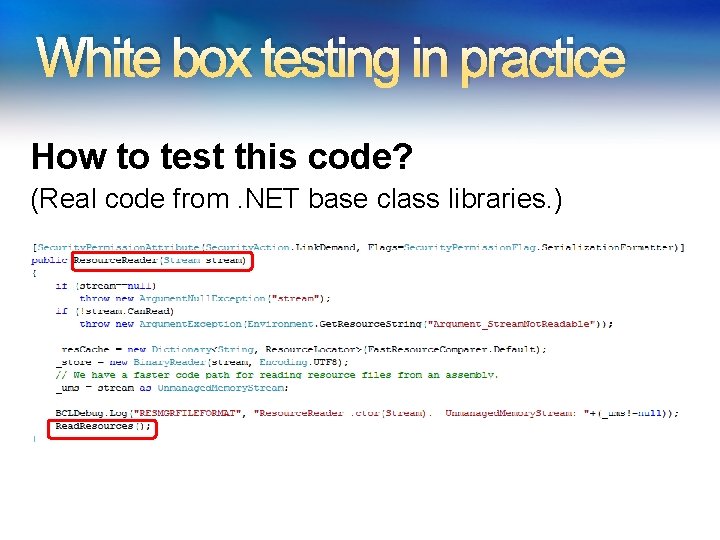
White box testing in practice How to test this code? (Real code from. NET base class libraries. ) 33
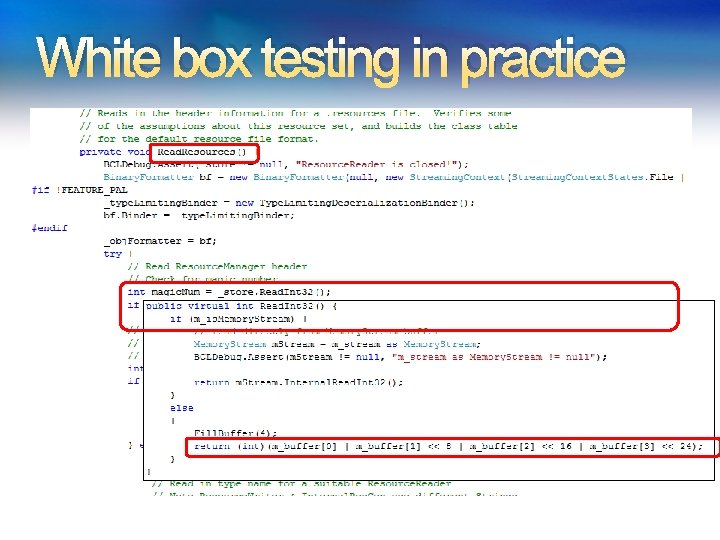
White box testing in practice 34
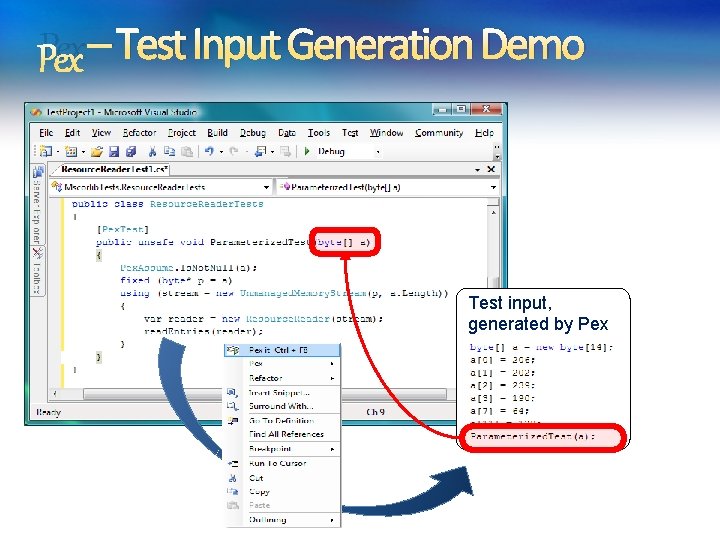
Pex – Test Input Generation Demo Test input, generated by Pex 35
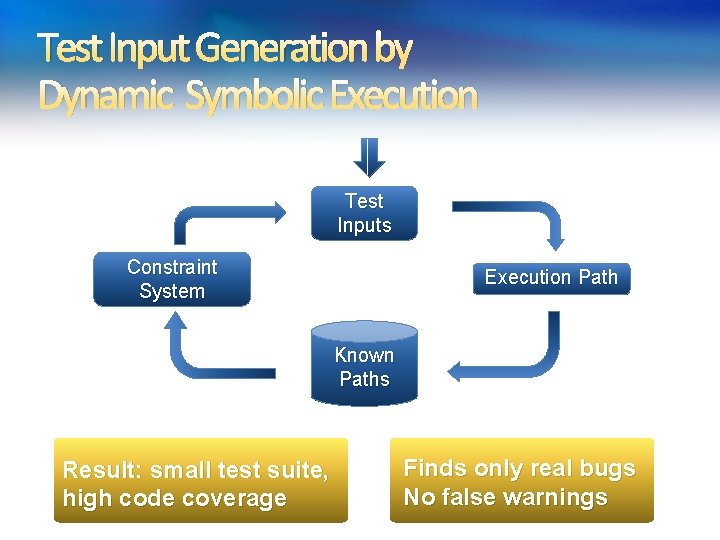
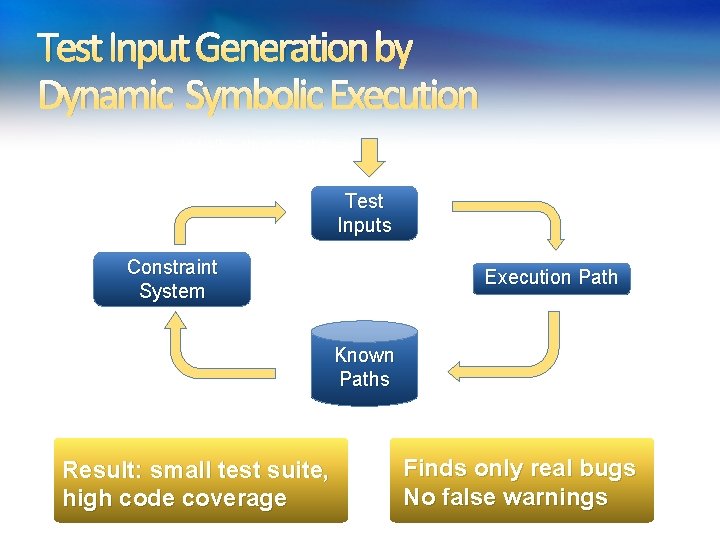
Test Input Generation by Dynamic Symbolic Execution Initially, choose Arbitrary Solve Test Inputs Constraint System Choose an Uncovered Path Result: small test suite, high code coverage Run Test and Monitor Execution Path Known Paths Record Path Condition Finds only real bugs No false warnings
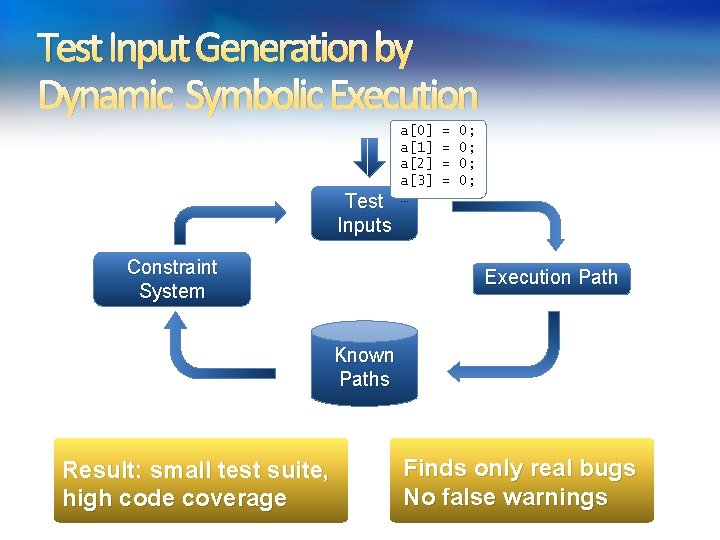
Test Input Generation by Dynamic Symbolic Execution Initially, choose Arbitrary Solve Test Inputs Constraint System Choose an Uncovered Path Result: small test suite, high code coverage a[0] a[1] a[2] a[3] … = = 0; 0; Run Test and Monitor Execution Path Known Paths Record Path Condition Finds only real bugs No false warnings
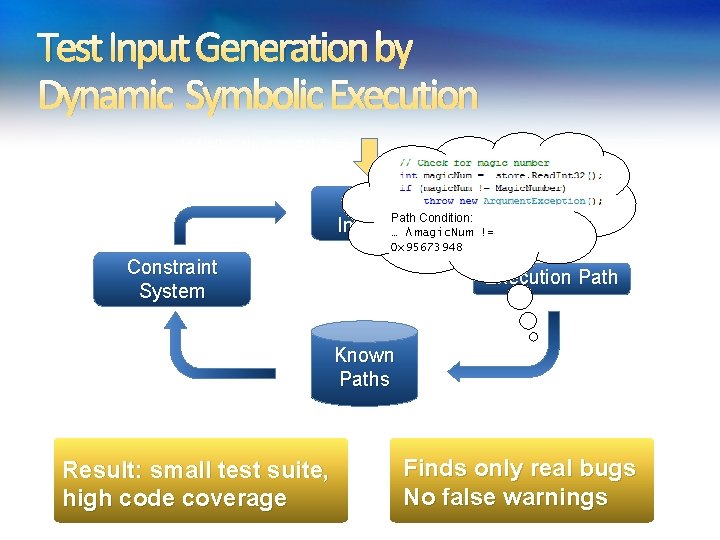
Test Input Generation by Dynamic Symbolic Execution Initially, choose Arbitrary Solve Test Inputs. Path Condition: … ⋀ magic. Num Run Test and Monitor != 0 x 95673948 Constraint System Choose an Uncovered Path Result: small test suite, high code coverage Execution Path Known Paths Record Path Condition Finds only real bugs No false warnings
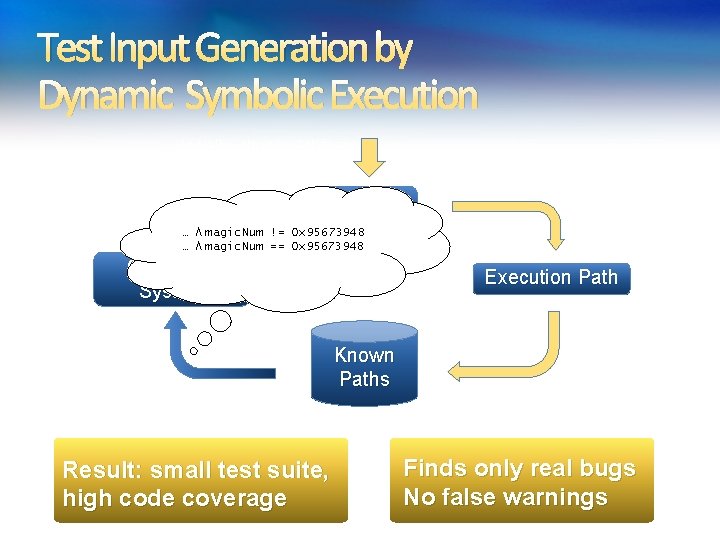
Test Input Generation by Dynamic Symbolic Execution Initially, choose Arbitrary Solve Test Inputs 0 x 95673948 Run Test and Monitor … ⋀ magic. Num != … ⋀ magic. Num == 0 x 95673948 Constraint System Choose an Uncovered Path Result: small test suite, high code coverage Execution Path Known Paths Record Path Condition Finds only real bugs No false warnings
Test Input Generation by Dynamic Symbolic Execution a[0] a[1] a[2] a[3] = = 206; 202; 239; 190; Initially, choose Arbitrary Solve Test Inputs Constraint System Choose an Uncovered Path Result: small test suite, high code coverage Run Test and Monitor Execution Path Known Paths Record Path Condition Finds only real bugs No false warnings
Test Input Generation by Dynamic Symbolic Execution Initially, choose Arbitrary Solve Test Inputs Constraint System Choose an Uncovered Path Result: small test suite, high code coverage Run Test and Monitor Execution Path Known Paths Record Path Condition Finds only real bugs No false warnings
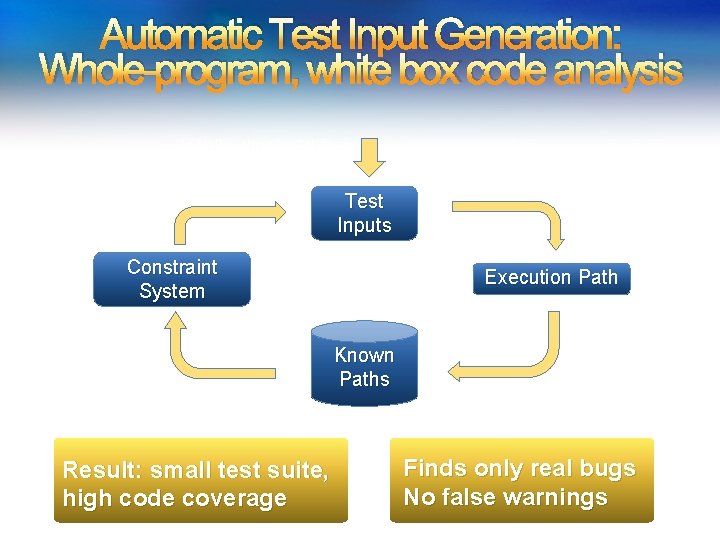
Automatic Test Input Generation: Whole-program, white box code analysis Initially, choose Arbitrary Solve Test Inputs Constraint System Choose an Uncovered Path Result: small test suite, high code coverage Run Test and Monitor Execution Path Known Paths Record Path Condition Finds only real bugs No false warnings
Demo: Pex
Application: The Static Driver Verifier SLAM [Ball & Rajamani 2001] http: //www. microsoft. com/whdc/devtools/sdv. mspx
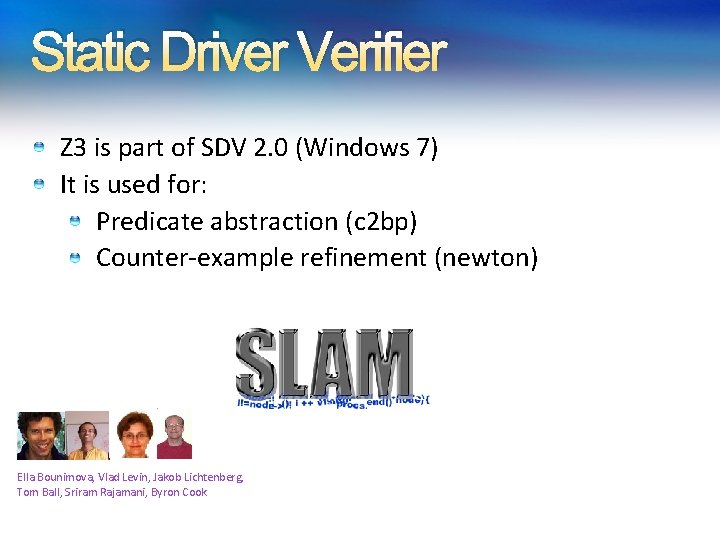
Static Driver Verifier Z 3 is part of SDV 2. 0 (Windows 7) It is used for: Predicate abstraction (c 2 bp) Counter-example refinement (newton) Ella Bounimova, Vlad Levin, Jakob Lichtenberg, Tom Ball, Sriram Rajamani, Byron Cook
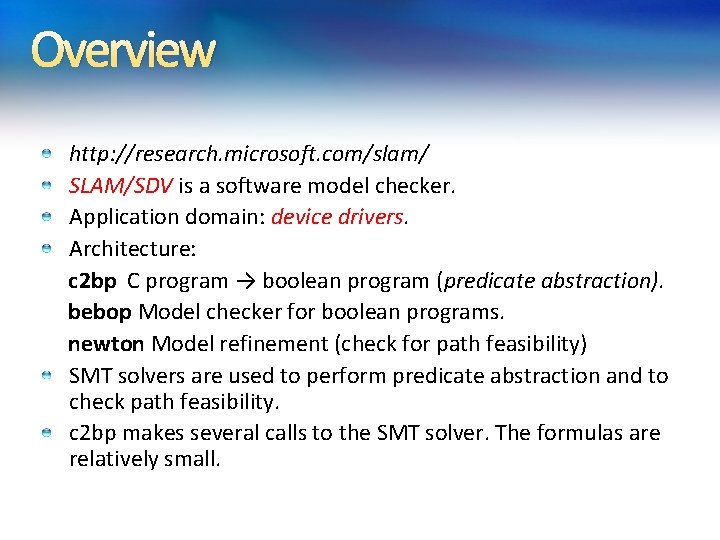
Overview http: //research. microsoft. com/slam/ SLAM/SDV is a software model checker. Application domain: device drivers. Architecture: c 2 bp C program → boolean program (predicate abstraction). bebop Model checker for boolean programs. newton Model refinement (check for path feasibility) SMT solvers are used to perform predicate abstraction and to check path feasibility. c 2 bp makes several calls to the SMT solver. The formulas are relatively small.
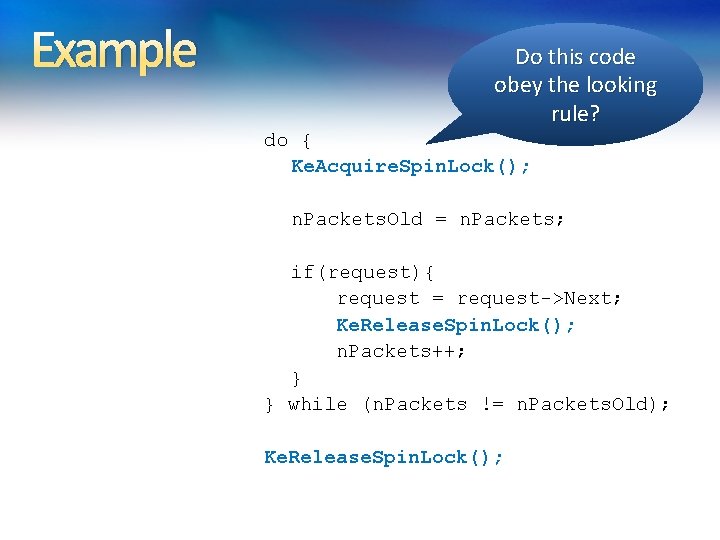
Example Do this code obey the looking rule? do { Ke. Acquire. Spin. Lock(); n. Packets. Old = n. Packets; if(request){ request = request->Next; Ke. Release. Spin. Lock(); n. Packets++; } } while (n. Packets != n. Packets. Old); Ke. Release. Spin. Lock();
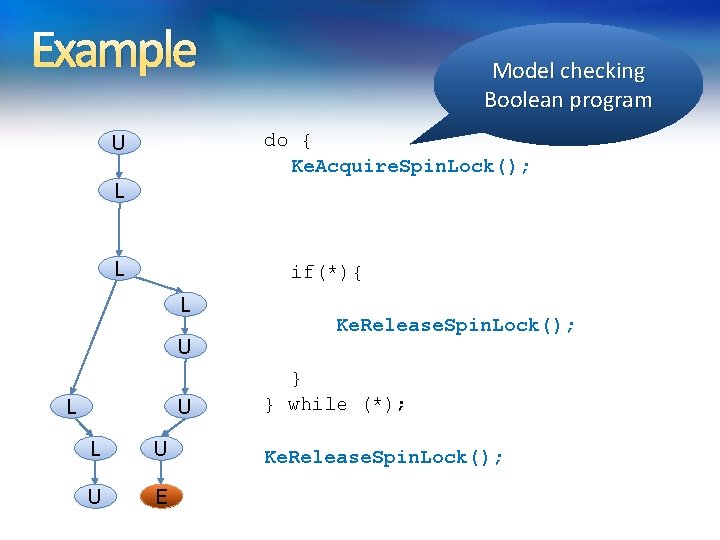
Example Model checking Boolean program do { Ke. Acquire. Spin. Lock(); U L L if(*){ L Ke. Release. Spin. Lock(); U L U U E } } while (*); Ke. Release. Spin. Lock();
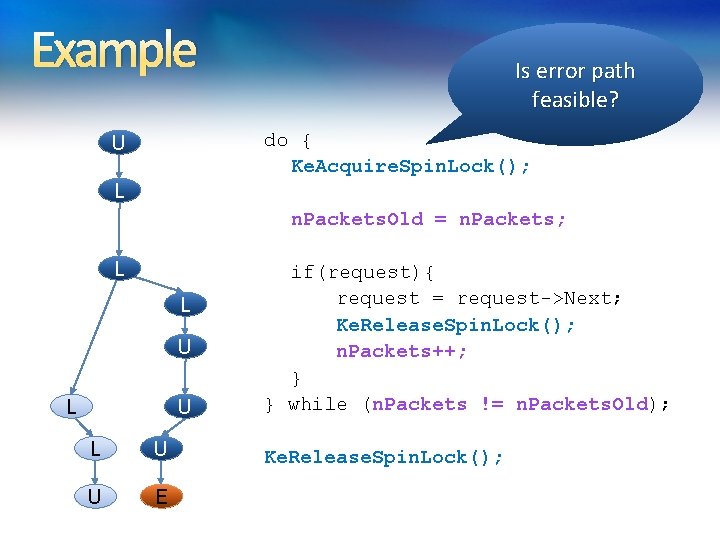
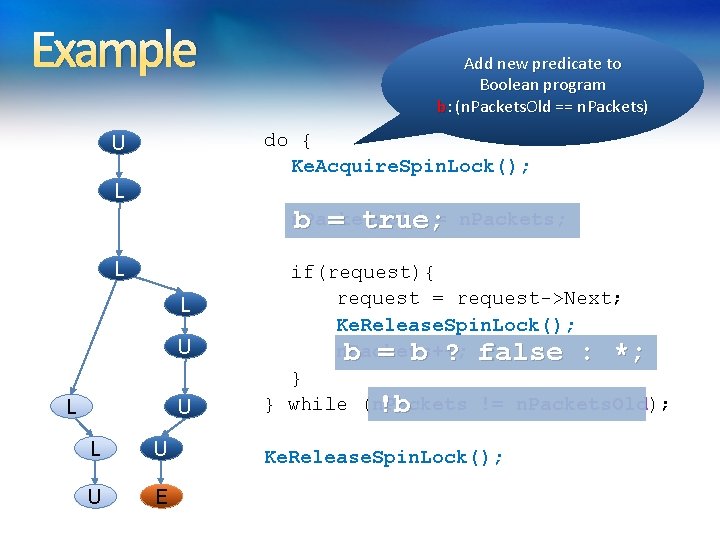
Example Is error path feasible? do { Ke. Acquire. Spin. Lock(); U L n. Packets. Old = n. Packets; L L U L U U E if(request){ request = request->Next; Ke. Release. Spin. Lock(); n. Packets++; } } while (n. Packets != n. Packets. Old); Ke. Release. Spin. Lock();
Example Add new predicate to Boolean program b: (n. Packets. Old == n. Packets) do { Ke. Acquire. Spin. Lock(); U L n. Packets. Old b = true; = n. Packets; L L U L U U E if(request){ request = request->Next; Ke. Release. Spin. Lock(); n. Packets++; b = b ? false : *; } } while (n. Packets != n. Packets. Old); !b Ke. Release. Spin. Lock();
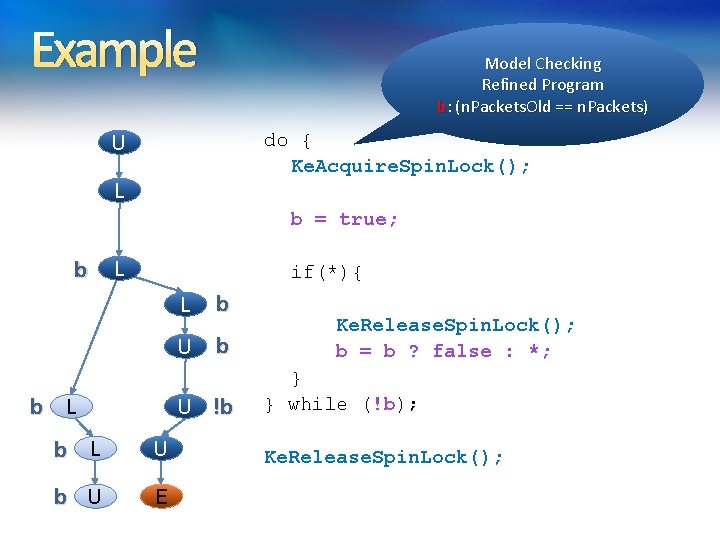
Example Model Checking Refined Program b: (n. Packets. Old == n. Packets) do { Ke. Acquire. Spin. Lock(); U L b = true; b L if(*){ b L b U U E !b Ke. Release. Spin. Lock(); b = b ? false : *; } } while (!b); Ke. Release. Spin. Lock();
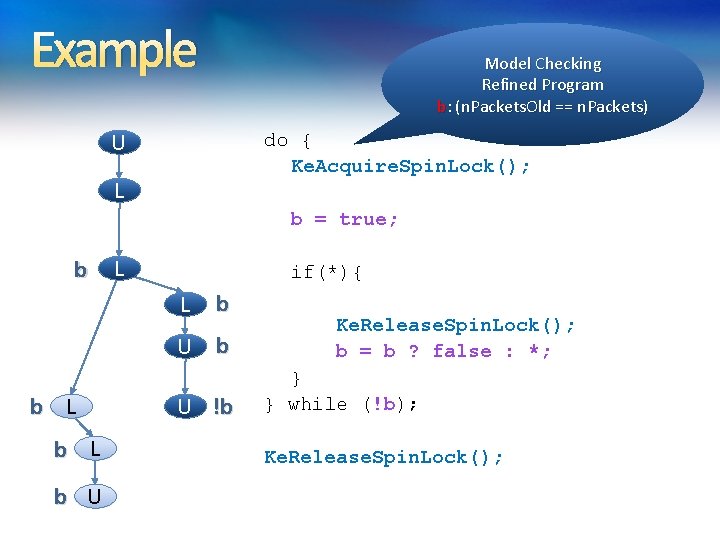
Example Model Checking Refined Program b: (n. Packets. Old == n. Packets) do { Ke. Acquire. Spin. Lock(); U L b = true; b b L b U L if(*){ L b U !b Ke. Release. Spin. Lock(); b = b ? false : *; } } while (!b); Ke. Release. Spin. Lock();
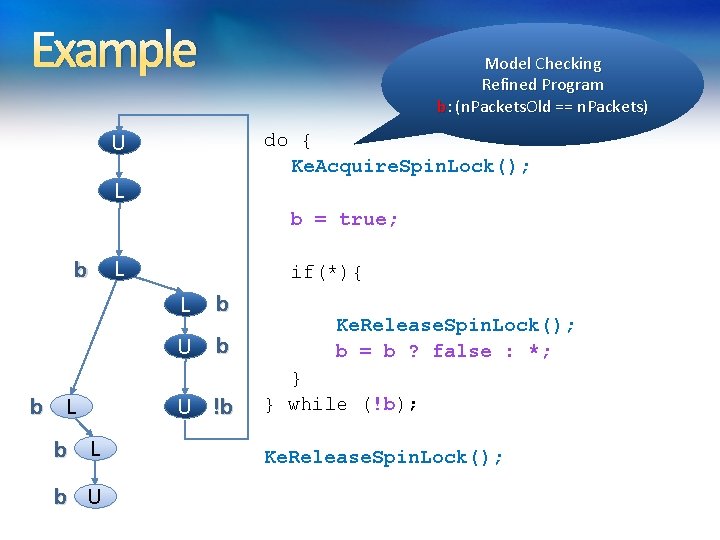
Example Model Checking Refined Program b: (n. Packets. Old == n. Packets) do { Ke. Acquire. Spin. Lock(); U L b = true; b b L b U L if(*){ L b U !b Ke. Release. Spin. Lock(); b = b ? false : *; } } while (!b); Ke. Release. Spin. Lock();
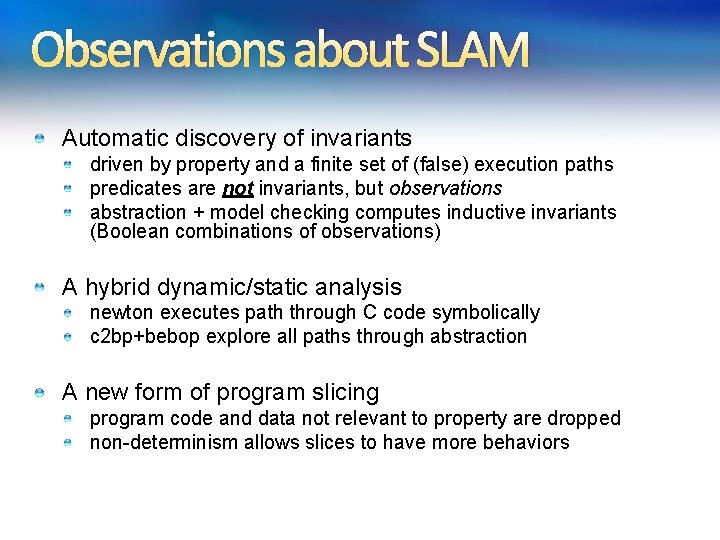
Observations about SLAM Automatic discovery of invariants driven by property and a finite set of (false) execution paths predicates are not invariants, but observations abstraction + model checking computes inductive invariants (Boolean combinations of observations) A hybrid dynamic/static analysis newton executes path through C code symbolically c 2 bp+bebop explore all paths through abstraction A new form of program slicing program code and data not relevant to property are dropped non-determinism allows slices to have more behaviors
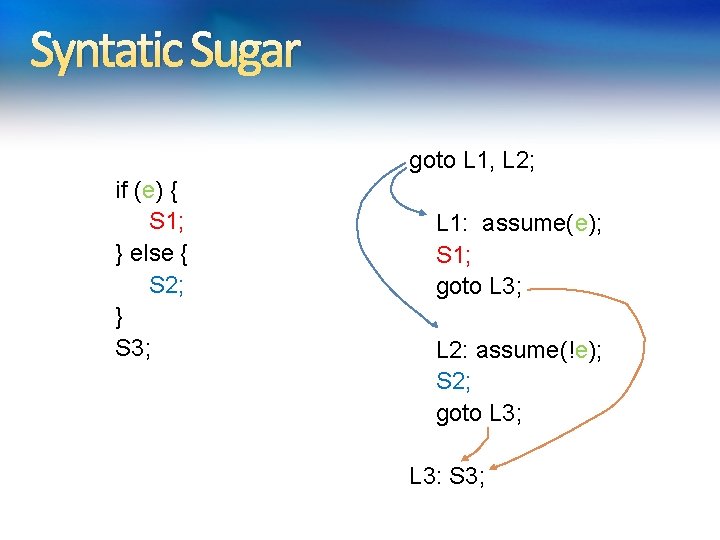
Syntatic Sugar goto L 1, L 2; if (e) { S 1; } else { S 2; } S 3; L 1: assume(e); S 1; goto L 3; L 2: assume(!e); S 2; goto L 3; L 3: S 3;
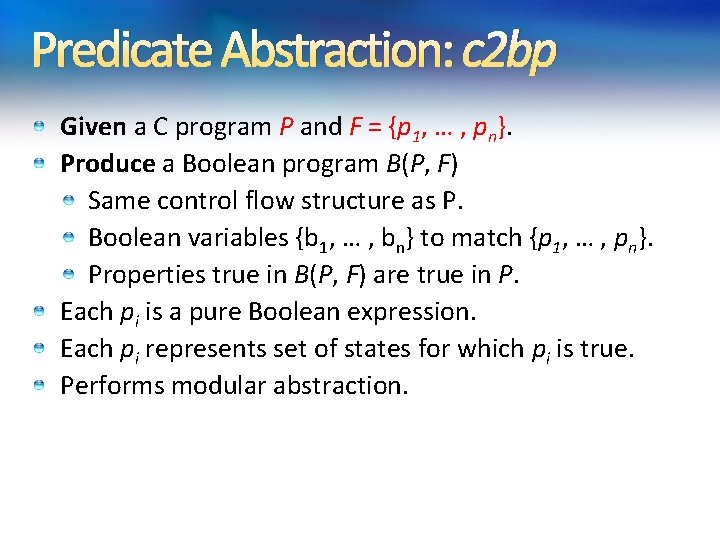
Predicate Abstraction: c 2 bp Given a C program P and F = {p 1, … , pn}. Produce a Boolean program B(P, F) Same control flow structure as P. Boolean variables {b 1, … , bn} to match {p 1, … , pn}. Properties true in B(P, F) are true in P. Each pi is a pure Boolean expression. Each pi represents set of states for which pi is true. Performs modular abstraction.
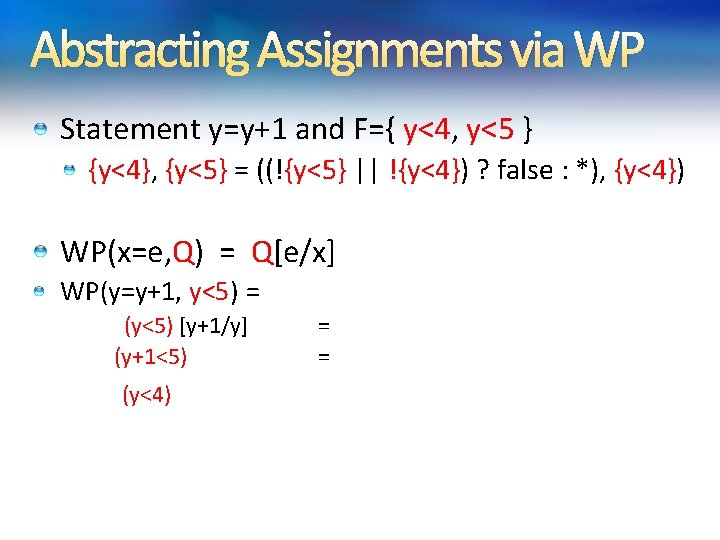
Abstracting Assignments via WP Statement y=y+1 and F={ y<4, y<5 } {y<4}, {y<5} = ((!{y<5} || !{y<4}) ? false : *), {y<4}) WP(x=e, Q) = Q[e/x] WP(y=y+1, y<5) = (y<5) [y+1/y] (y+1<5) (y<4) = =
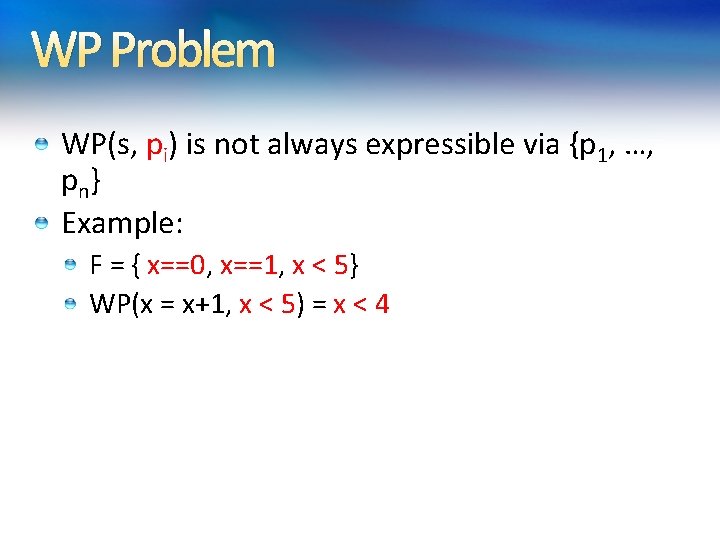
WP Problem WP(s, pi) is not always expressible via {p 1, …, p n} Example: F = { x==0, x==1, x < 5} WP(x = x+1, x < 5) = x < 4
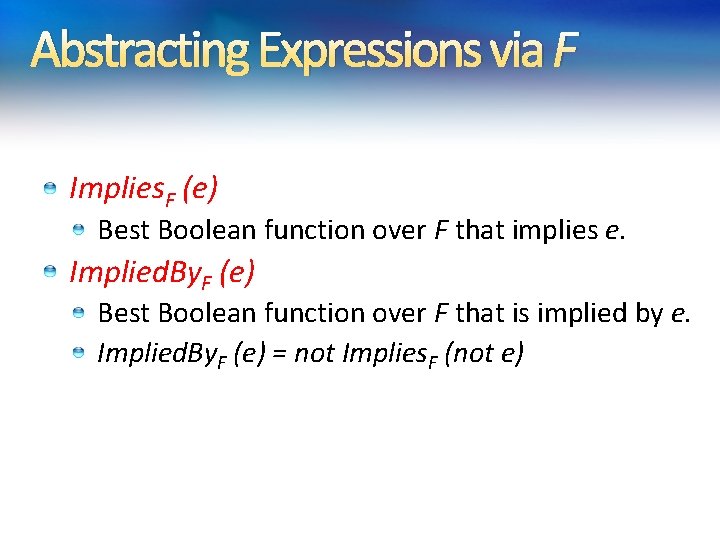
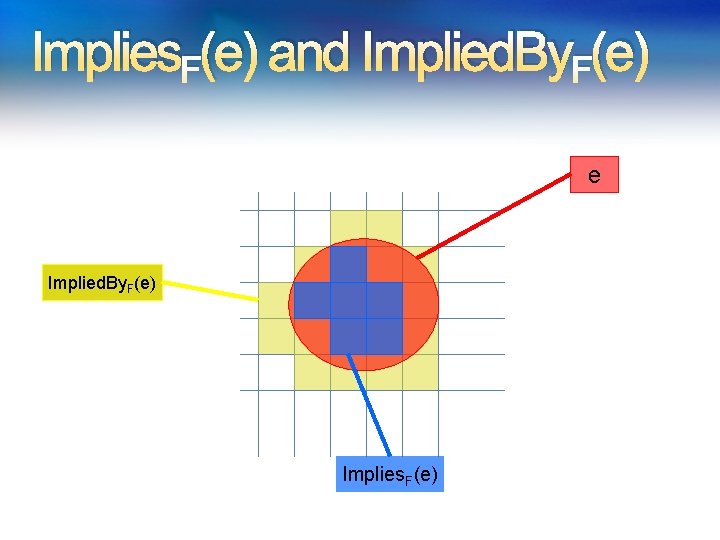
Abstracting Expressions via F Implies. F (e) Best Boolean function over F that implies e. Implied. By. F (e) Best Boolean function over F that is implied by e. Implied. By. F (e) = not Implies. F (not e)
Implies. F(e) and Implied. By. F(e) e Implied. By. F(e) Implies. F(e)
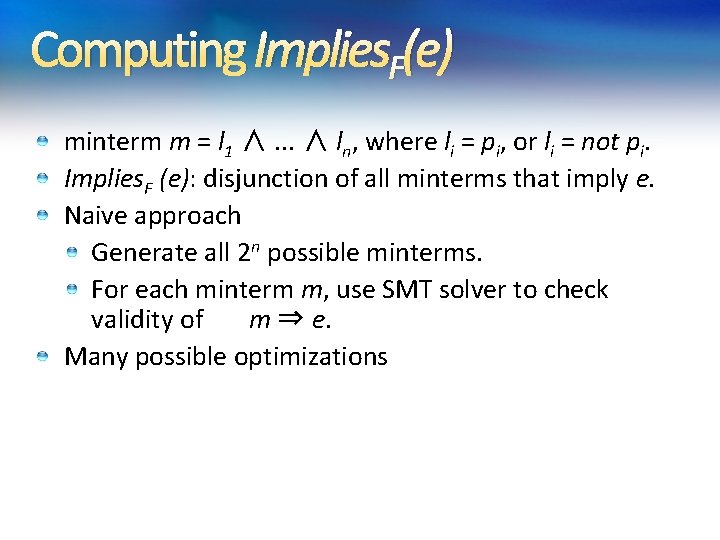
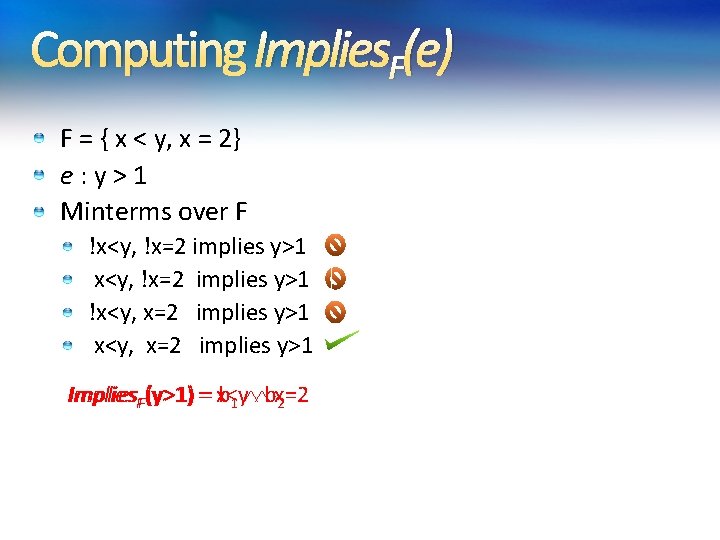
Computing Implies. F(e) minterm m = l 1 ∧. . . ∧ ln, where li = pi, or li = not pi. Implies. F (e): disjunction of all minterms that imply e. Naive approach Generate all 2 n possible minterms. For each minterm m, use SMT solver to check validity of m ⇒ e. Many possible optimizations
Computing Implies. F(e) F = { x < y, x = 2} e: y>1 Minterms over F !x<y, !x=2 implies y>1 !x<y, x=2 implies y>1 Implies. FF(y>1) = x<y b 1 bx=2 2
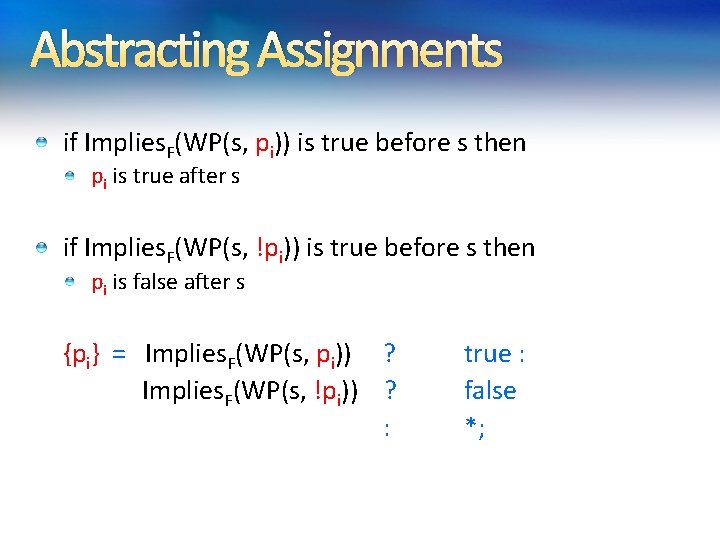
Abstracting Assignments if Implies. F(WP(s, pi)) is true before s then pi is true after s if Implies. F(WP(s, !pi)) is true before s then pi is false after s {pi} = Implies. F(WP(s, pi)) ? Implies. F(WP(s, !pi)) ? : true : false *;
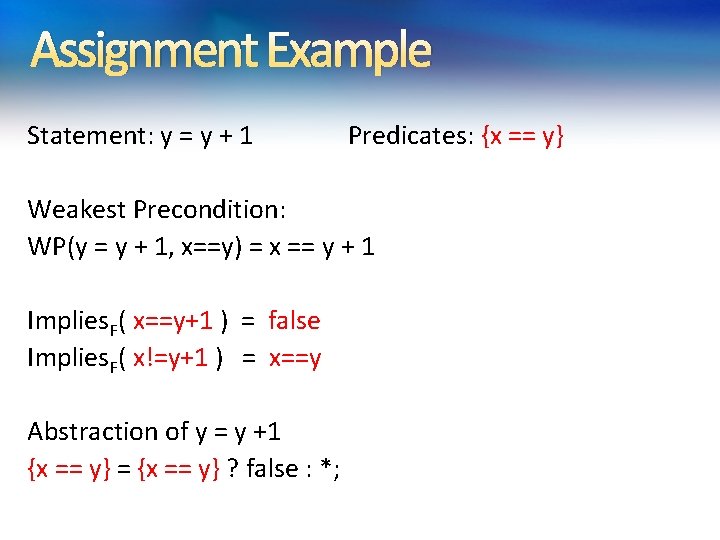
Assignment Example Statement: y = y + 1 Predicates: {x == y} Weakest Precondition: WP(y = y + 1, x==y) = x == y + 1 Implies. F( x==y+1 ) = false Implies. F( x!=y+1 ) = x==y Abstraction of y = y +1 {x == y} = {x == y} ? false : *;
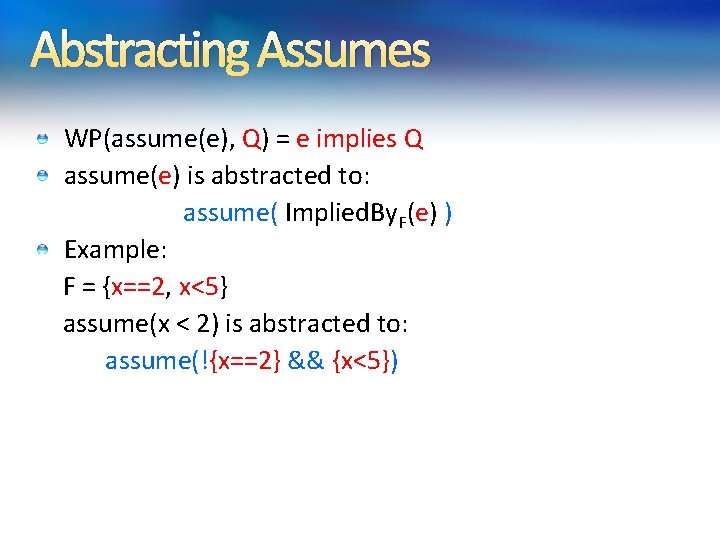
Abstracting Assumes WP(assume(e), Q) = e implies Q assume(e) is abstracted to: assume( Implied. By. F(e) ) Example: F = {x==2, x<5} assume(x < 2) is abstracted to: assume(!{x==2} && {x<5})
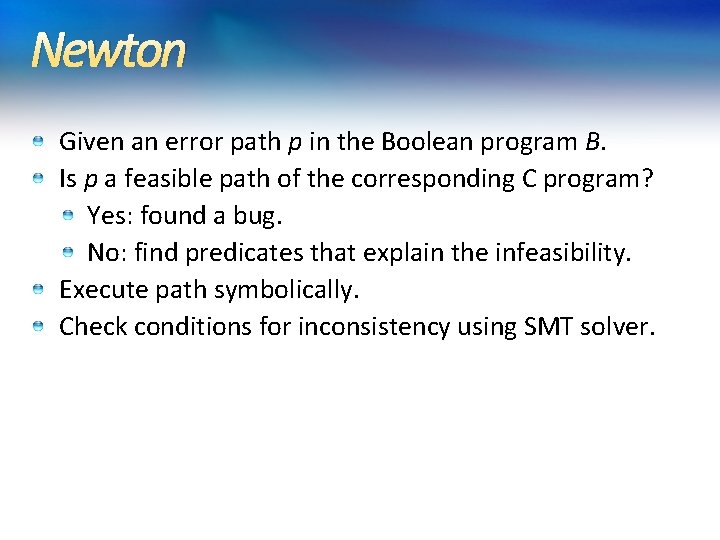
Newton Given an error path p in the Boolean program B. Is p a feasible path of the corresponding C program? Yes: found a bug. No: find predicates that explain the infeasibility. Execute path symbolically. Check conditions for inconsistency using SMT solver.
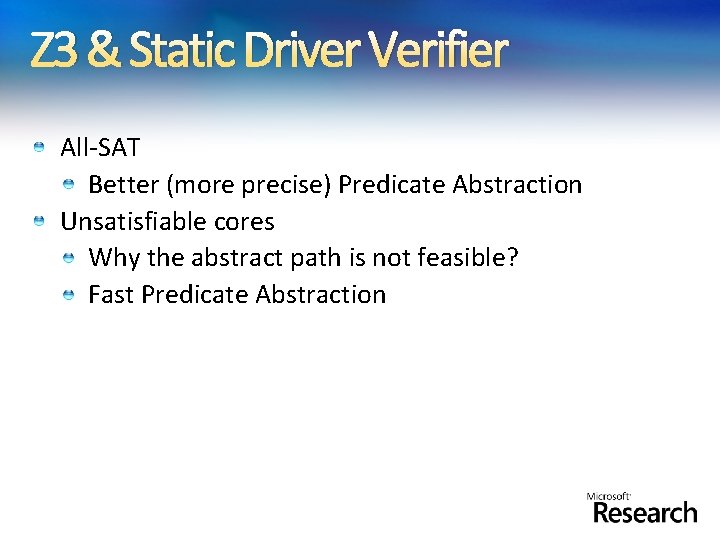
Z 3 & Static Driver Verifier All-SAT Better (more precise) Predicate Abstraction Unsatisfiable cores Why the abstract path is not feasible? Fast Predicate Abstraction
Application: Bit-precise Scalable Static Analysis PREfix [Moy, B. , Sielaff 2009]
What is wrong here? -INT_MIN= INT_MIN 3(INT_MAX+1)/4 + (INT_MAX+1)/4 int binary_search(int[] arr, int low, = INT_MIN int high, int key) while (low <= high) { // Find middle value int mid = (low + high) / 2; int val = arr[mid]; if (val == key) return mid; if (val < key) low = mid+1; else high = mid-1; } return -1; } Package: java. util. Arrays Function: binary_search void itoa(int n, char* s) { if (n < 0) { *s++ = ‘-’; n = -n; } // Add digits to s …. Book: Kernighan and Ritchie Function: itoa (integer to ascii)
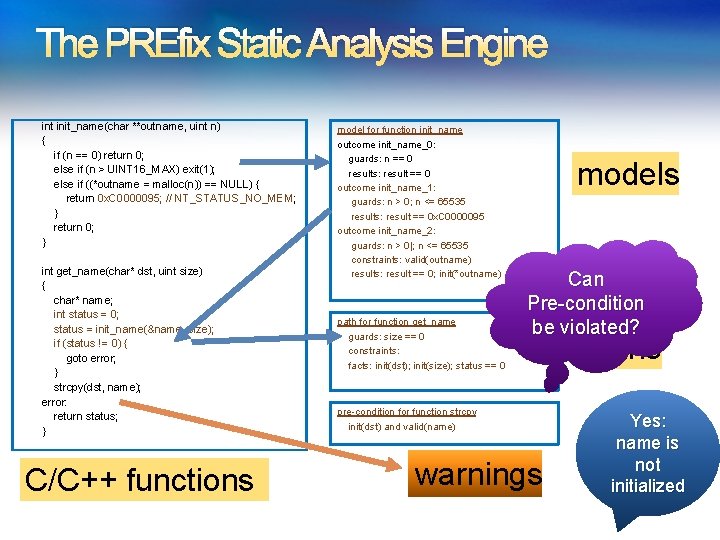
The PREfix Static Analysis Engine int init_name(char **outname, uint n) { if (n == 0) return 0; else if (n > UINT 16_MAX) exit(1); else if ((*outname = malloc(n)) == NULL) { return 0 x. C 0000095; // NT_STATUS_NO_MEM; } return 0; } int get_name(char* dst, uint size) { char* name; int status = 0; status = init_name(&name, size); if (status != 0) { goto error; } strcpy(dst, name); error: return status; } C/C++ functions 6/26/2009 model for function init_name outcome init_name_0: guards: n == 0 results: result == 0 outcome init_name_1: guards: n > 0; n <= 65535 results: result == 0 x. C 0000095 outcome init_name_2: guards: n > 0|; n <= 65535 constraints: valid(outname) results: result == 0; init(*outname) path for function get_name guards: size == 0 constraints: facts: init(dst); init(size); status == 0 models Can Pre-condition be violated? pre-condition for function strcpy init(dst) and valid(name) warnings paths Yes: name is not initialized
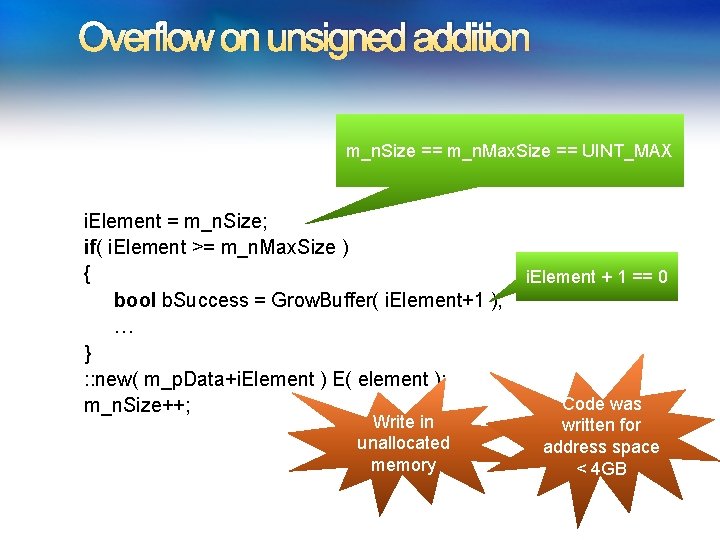
Overflow on unsigned addition m_n. Size == m_n. Max. Size == UINT_MAX i. Element = m_n. Size; if( i. Element >= m_n. Max. Size ) { bool b. Success = Grow. Buffer( i. Element+1 ); … } : : new( m_p. Data+i. Element ) E( element ); m_n. Size++; Write in unallocated memory 6/26/2009 Constraints in Formal i. Element + 1 == 0 Code was written for address space < 4 GB 71
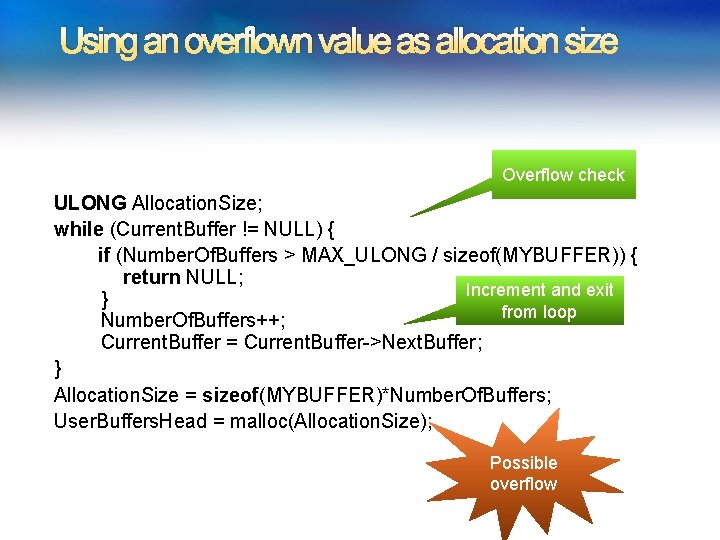
Using an overflown value as allocation size Overflow check ULONG Allocation. Size; while (Current. Buffer != NULL) { if (Number. Of. Buffers > MAX_ULONG / sizeof(MYBUFFER)) { return NULL; Increment and exit } from loop Number. Of. Buffers++; Current. Buffer = Current. Buffer->Next. Buffer; } Allocation. Size = sizeof(MYBUFFER)*Number. Of. Buffers; User. Buffers. Head = malloc(Allocation. Size); Possible overflow 6/26/2009 Constraints in Formal 72
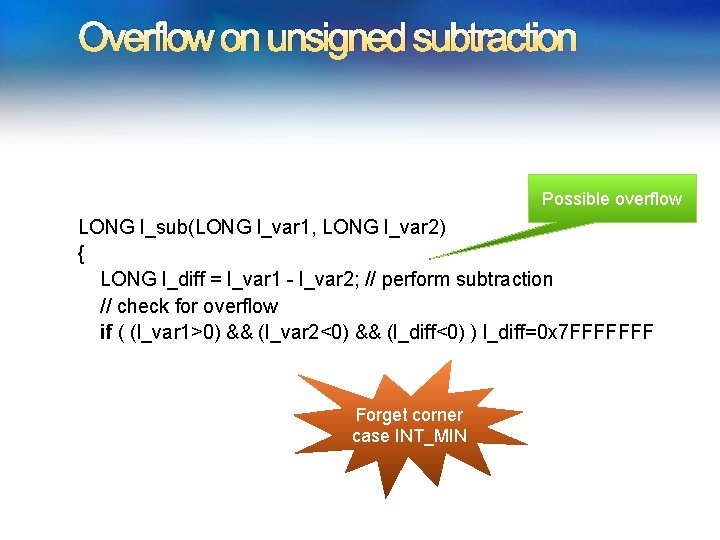
Overflow on unsigned subtraction Possible overflow LONG l_sub(LONG l_var 1, LONG l_var 2) { LONG l_diff = l_var 1 - l_var 2; // perform subtraction // check for overflow if ( (l_var 1>0) && (l_var 2<0) && (l_diff<0) ) l_diff=0 x 7 FFFFFFF … Forget corner case INT_MIN 6/26/2009 Constraints in Formal 73
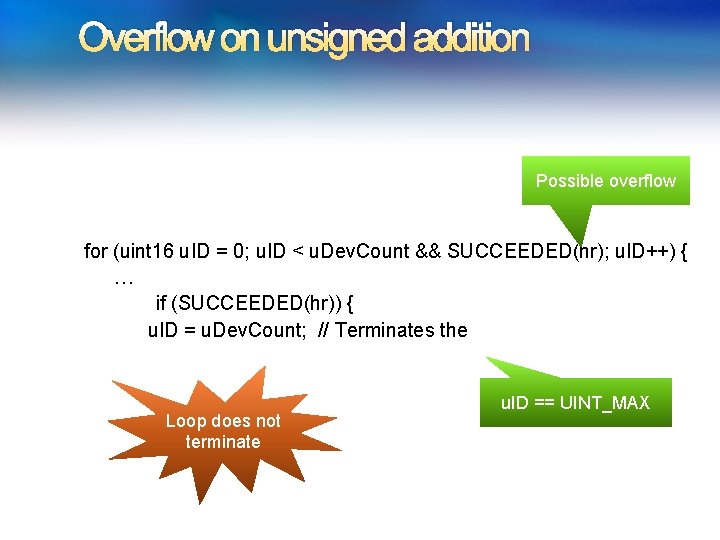
Overflow on unsigned addition Possible overflow for (uint 16 u. ID = 0; u. ID < u. Dev. Count && SUCCEEDED(hr); u. ID++) { … if (SUCCEEDED(hr)) { u. ID = u. Dev. Count; // Terminates the loop Loop does not terminate 6/26/2009 Constraints in Formal u. ID == UINT_MAX 74
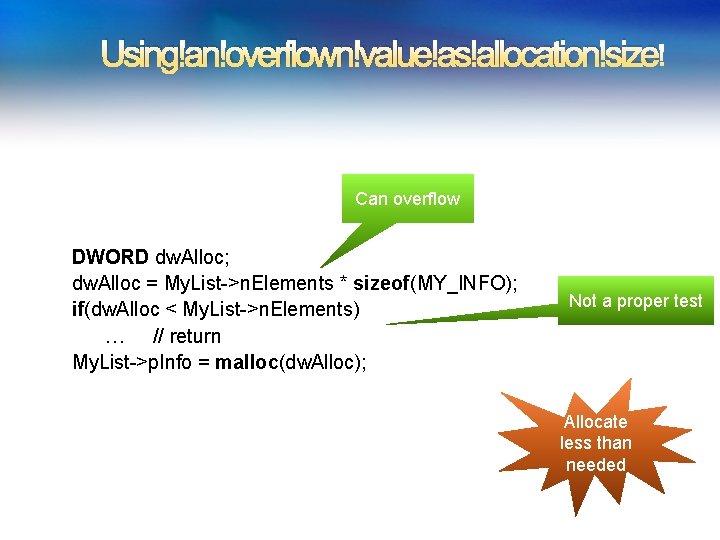
Using an overflown value as allocation size Can overflow DWORD dw. Alloc; dw. Alloc = My. List->n. Elements * sizeof(MY_INFO); if(dw. Alloc < My. List->n. Elements) … // return My. List->p. Info = malloc(dw. Alloc); Not a proper test Allocate less than needed 6/26/2009 Constraints in Formal 75
Demo: Z 3 & F# bit-fiddling
Application: Spec# and Boogie Rustan Leino & Mike Barnett http: //specharp. codeplex. com
Verifying Compilers A verifying compiler uses automated reasoning to check the correctness of a program that is compiles. Correctness is specified by types, assertions, . . . and other redundant annotations that accompany the program. Tony Hoare 2004
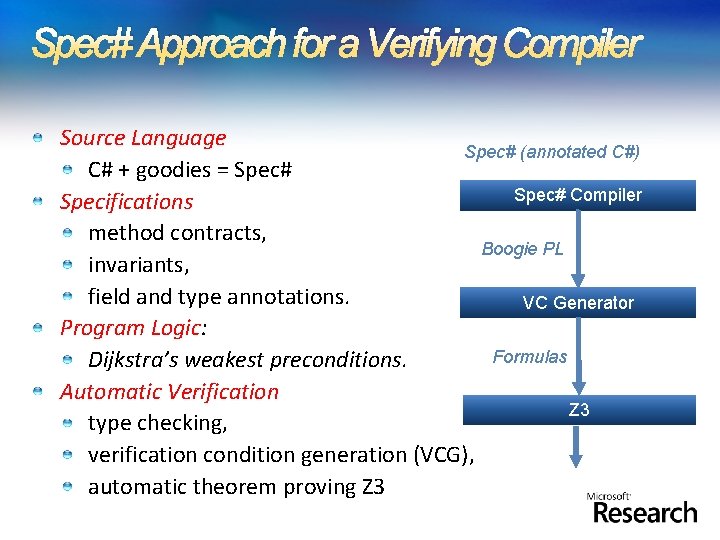
Spec# Approach for a Verifying Compiler Source Language Spec# (annotated C#) C# + goodies = Spec# Compiler Specifications method contracts, Boogie PL invariants, field and type annotations. VC Generator Program Logic: Formulas Dijkstra’s weakest preconditions. Automatic Verification Z 3 type checking, verification condition generation (VCG), automatic theorem proving Z 3
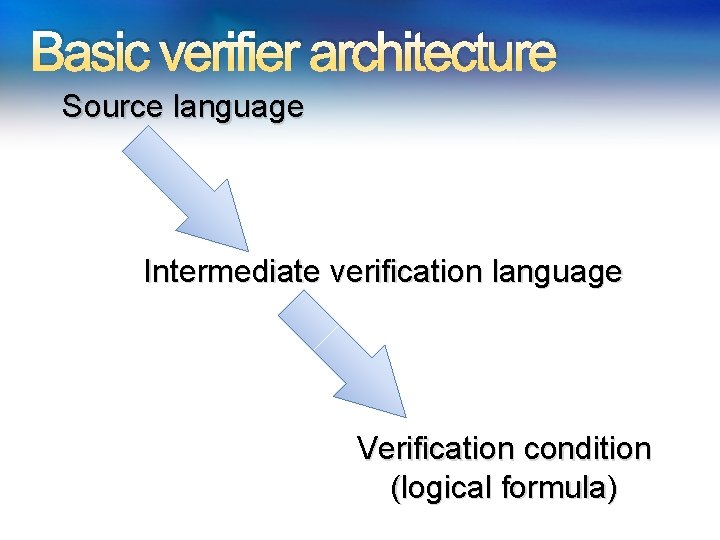
Basic verifier architecture Source language Intermediate verification language Verification condition (logical formula)
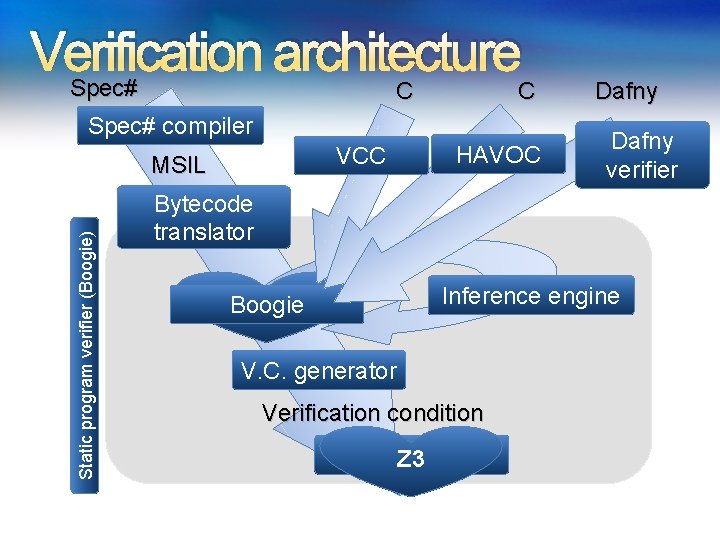
Verification architecture Spec# C C V Spec# compiler Dafny VCC MSIL Static program verifier (Boogie) HAVOC Dafny verifier Bytecode translator Inference engine Boogie V. C. generator Verification condition Z 3 “correct” or list of errors
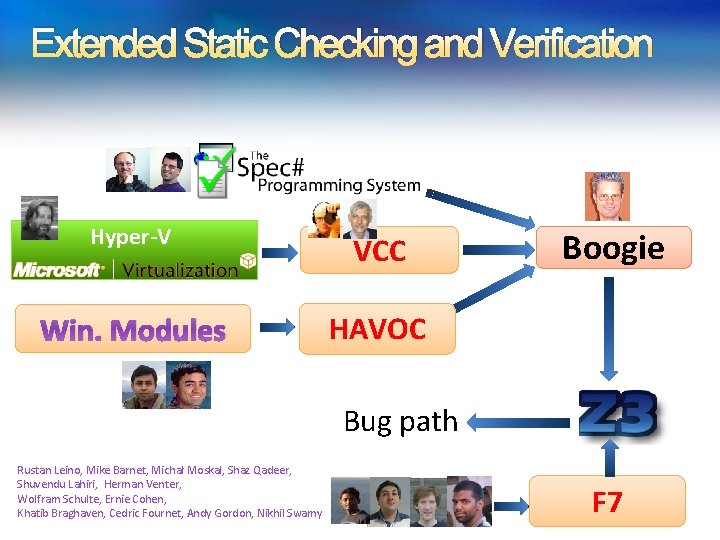
Extended Static Checking and Verification Hyper-V VCC Win. Modules HAVOC Boogie Verification condition Bug path Rustan Leino, Mike Barnet, Michał Moskal, Shaz Qadeer, Shuvendu Lahiri, Herman Venter, Wolfram Schulte, Ernie Cohen, Khatib Braghaven, Cedric Fournet, Andy Gordon, Nikhil Swamy F 7
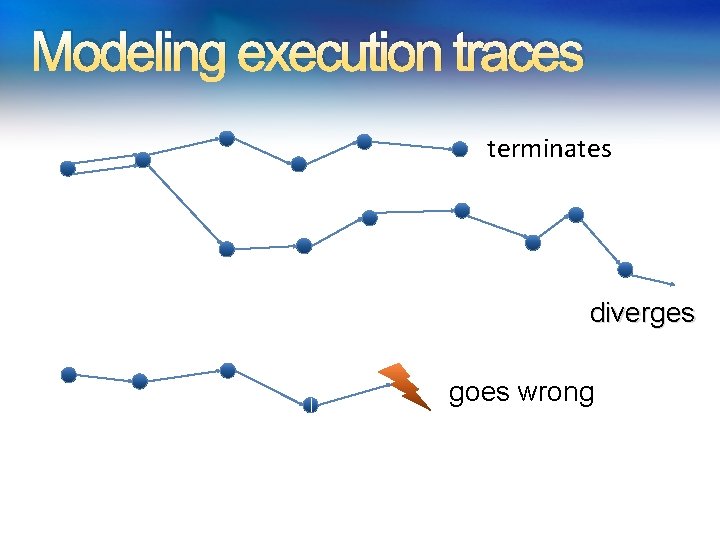
Modeling execution traces terminates … diverges goes wrong
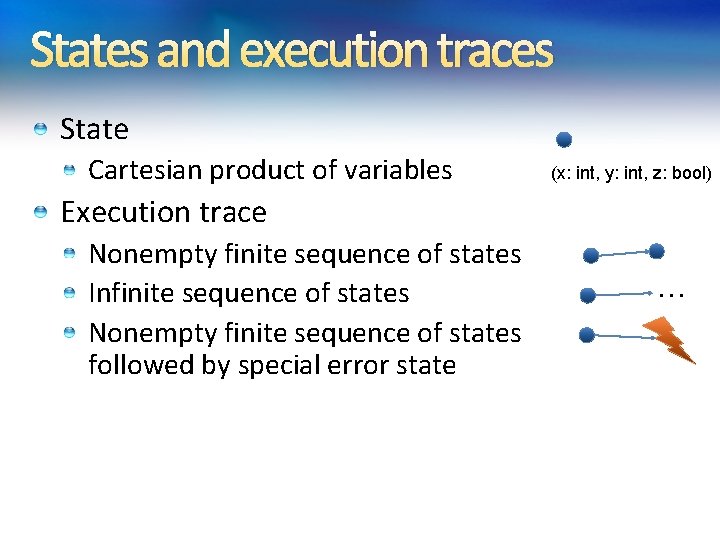
States and execution traces State Cartesian product of variables (x: int, y: int, z: bool) Execution trace Nonempty finite sequence of states Infinite sequence of states Nonempty finite sequence of states followed by special error state …
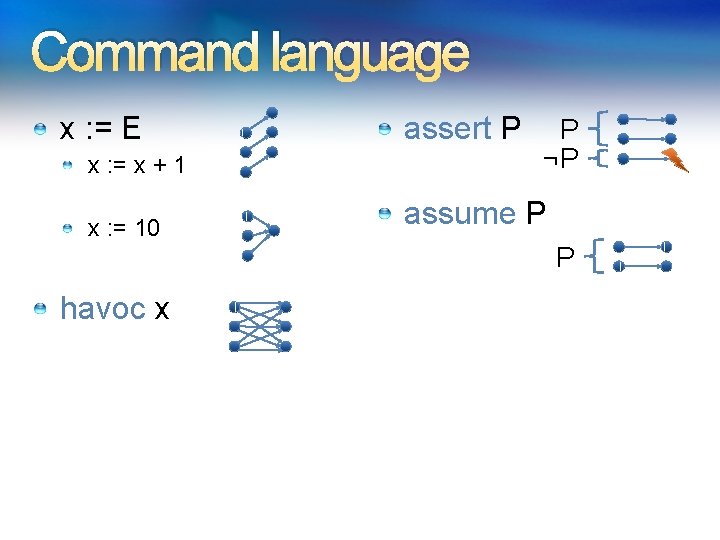
Command language x : = E x : = x + 1 x : = 10 assert P P ¬P assume P P havoc x
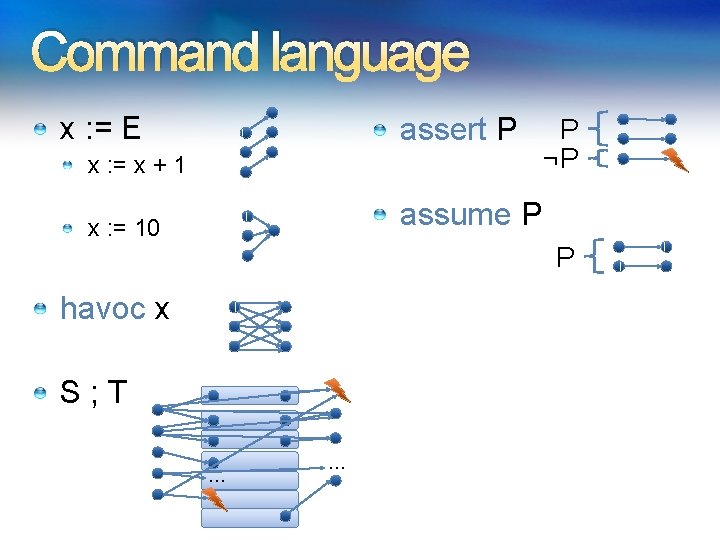
Command language x : = E assert P x : = x + 1 P ¬P assume P x : = 10 P havoc x S ; T …
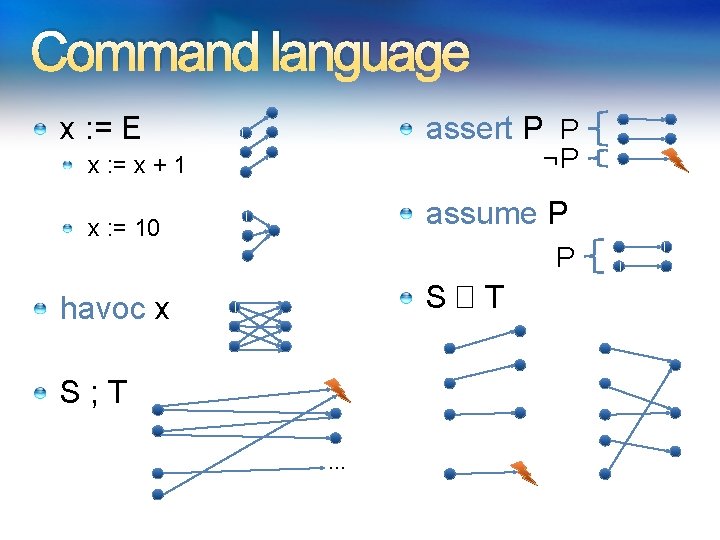
Command language assert P P x : = E ¬P x : = x + 1 assume P x : = 10 P S � T havoc x S ; T …
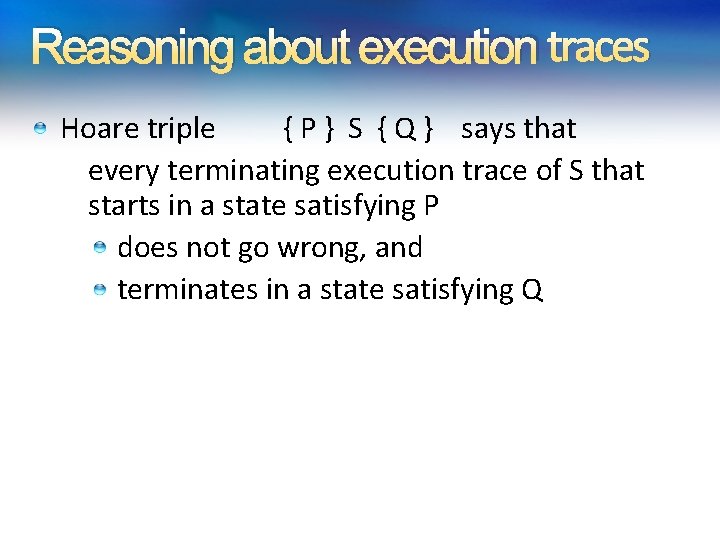
Reasoning about execution traces Hoare triple { P } S { Q } says that every terminating execution trace of S that starts in a state satisfying P does not go wrong, and terminates in a state satisfying Q
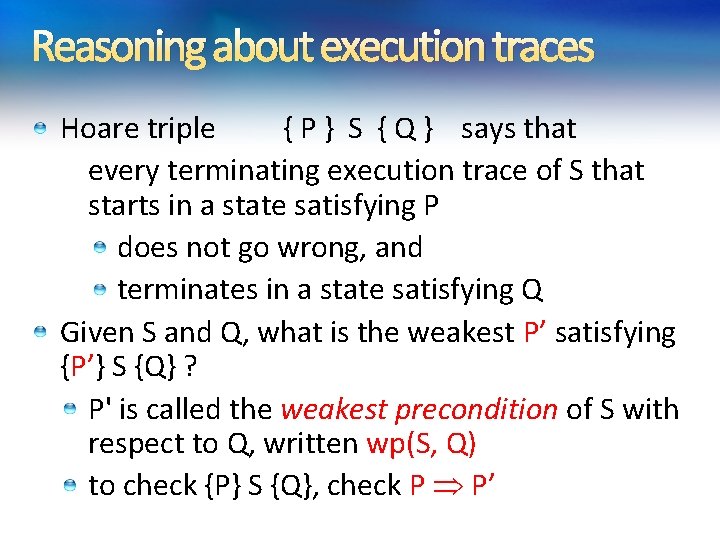
Reasoning about execution traces Hoare triple { P } S { Q } says that every terminating execution trace of S that starts in a state satisfying P does not go wrong, and terminates in a state satisfying Q Given S and Q, what is the weakest P’ satisfying {P’} S {Q} ? P' is called the weakest precondition of S with respect to Q, written wp(S, Q) to check {P} S {Q}, check P P’
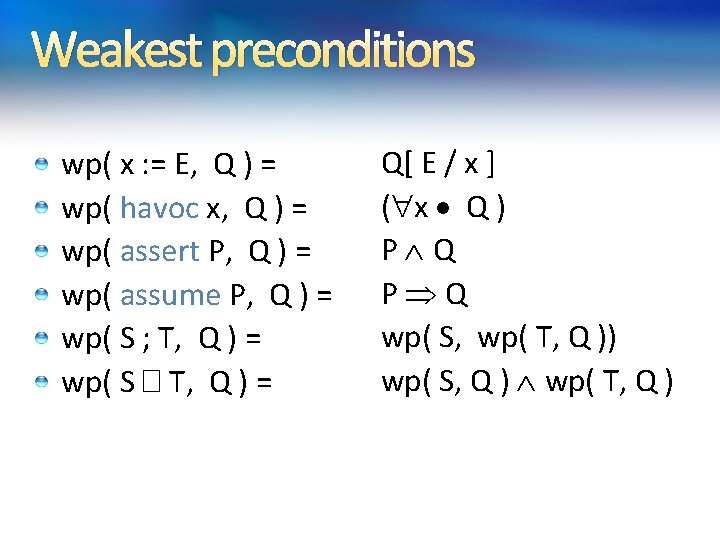
Weakest preconditions wp( x : = E, Q ) = wp( havoc x, Q ) = wp( assert P, Q ) = wp( assume P, Q ) = wp( S ; T, Q ) = wp( S � T, Q ) = Q[ E / x ] ( x Q ) P Q wp( S, wp( T, Q )) wp( S, Q ) wp( T, Q )
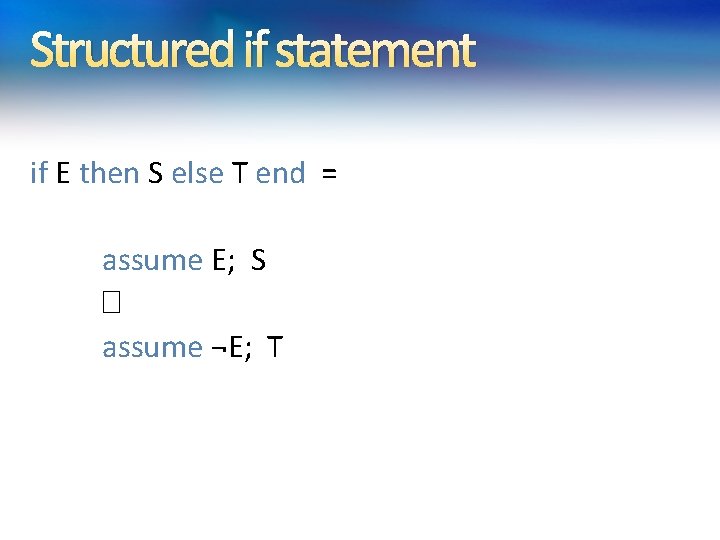
Structured if statement if E then S else T end = assume E; S � assume ¬E; T
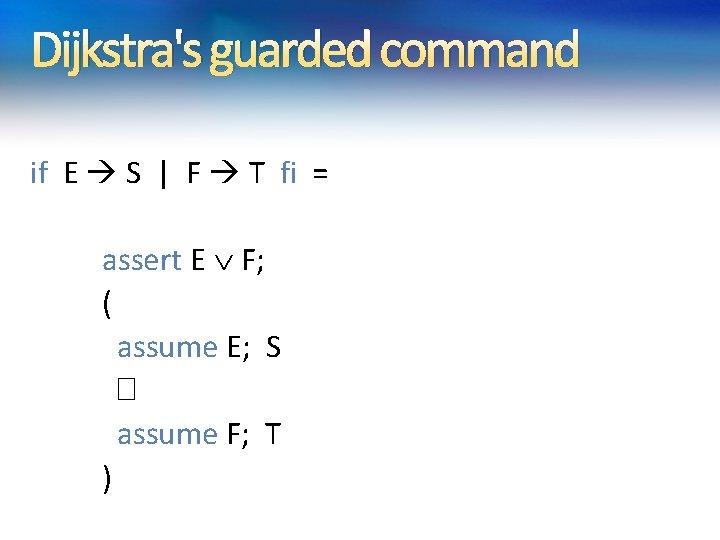
Dijkstra's guarded command if E S | F T fi = assert E F; ( assume E; S � assume F; T )
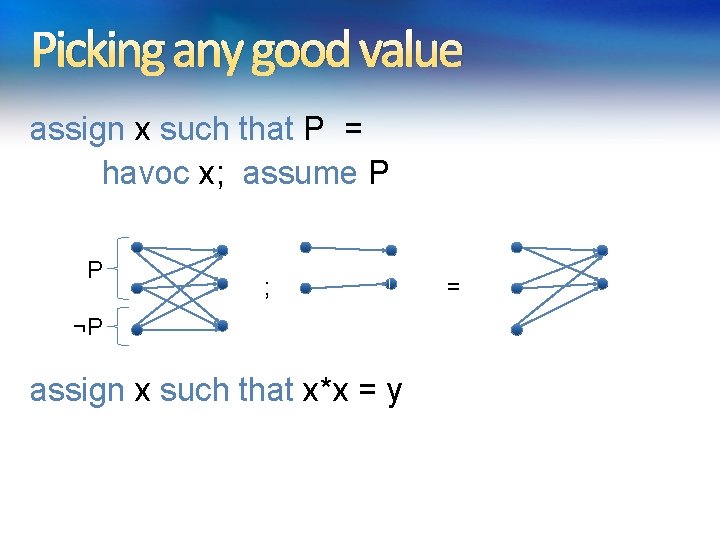
Picking any good value assign x such that P = havoc x; assume P P ; ¬P assign x such that x*x = y =
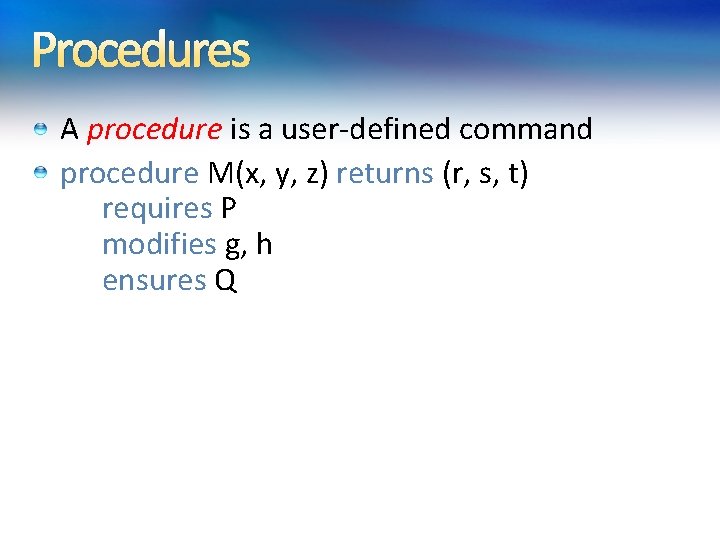
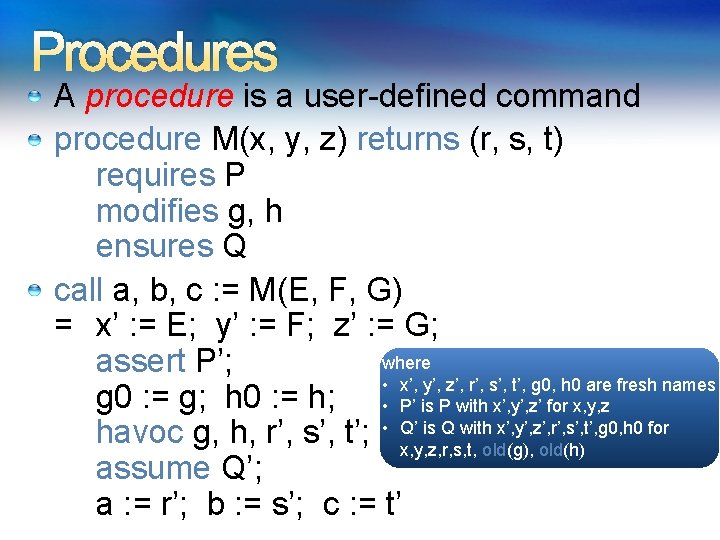
Procedures A procedure is a user-defined command procedure M(x, y, z) returns (r, s, t) requires P modifies g, h ensures Q
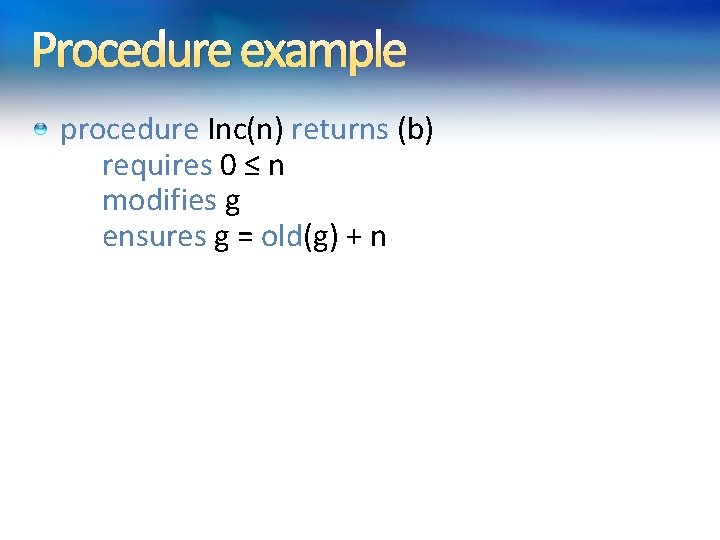
Procedure example procedure Inc(n) returns (b) requires 0 ≤ n modifies g ensures g = old(g) + n
Procedures A procedure is a user-defined command procedure M(x, y, z) returns (r, s, t) requires P modifies g, h ensures Q call a, b, c : = M(E, F, G) = x’ : = E; y’ : = F; z’ : = G; where assert P’; • x’, y’, z’, r’, s’, t’, g 0, h 0 are fresh names g 0 : = g; h 0 : = h; • P’ is P with x’, y’, z’ for x, y, z havoc g, h, r’, s’, t’; • Q’ is Q with x’, y’, z’, r’, s’, t’, g 0, h 0 for x, y, z, r, s, t, old(g), old(h) assume Q’; a : = r’; b : = s’; c : = t’
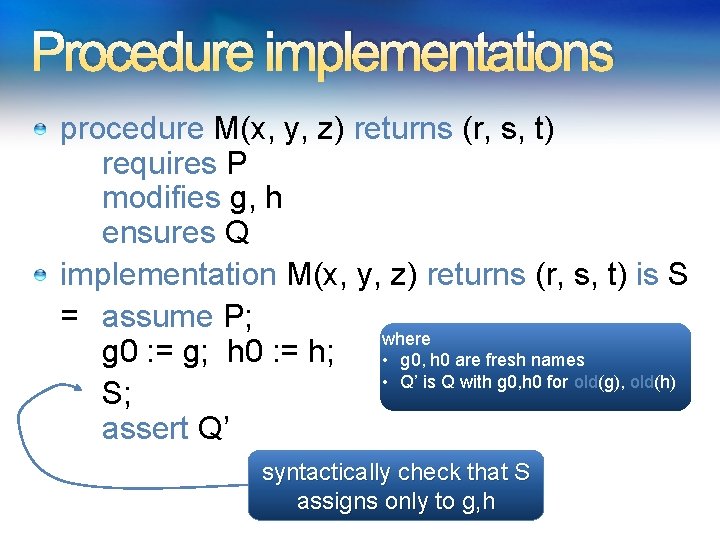
Procedure implementations procedure M(x, y, z) returns (r, s, t) requires P modifies g, h ensures Q implementation M(x, y, z) returns (r, s, t) is S = assume P; where g 0 : = g; h 0 : = h; • g 0, h 0 are fresh names • Q’ is Q with g 0, h 0 for old(g), old(h) S; assert Q’ syntactically check that S assigns only to g, h
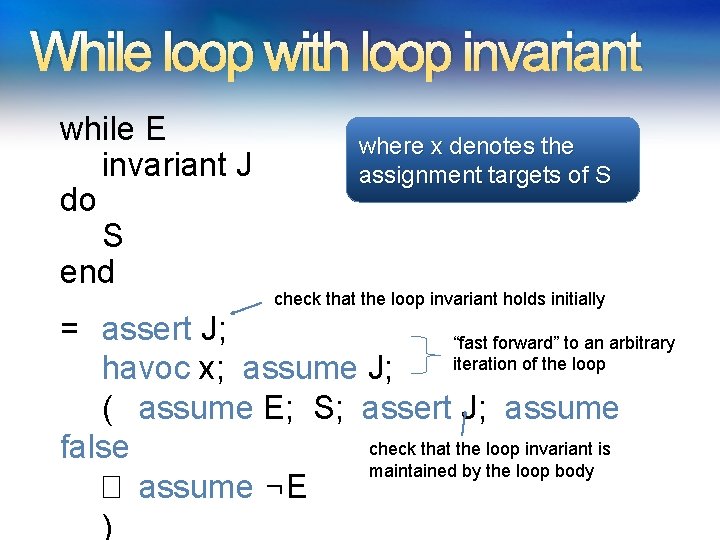
While loop with loop invariant while E invariant J do S end where x denotes the assignment targets of S check that the loop invariant holds initially = assert J; “fast forward” to an arbitrary iteration of the loop havoc x; assume J; ( assume E; S; assert J; assume check that the loop invariant is false maintained by the loop body � assume ¬E )
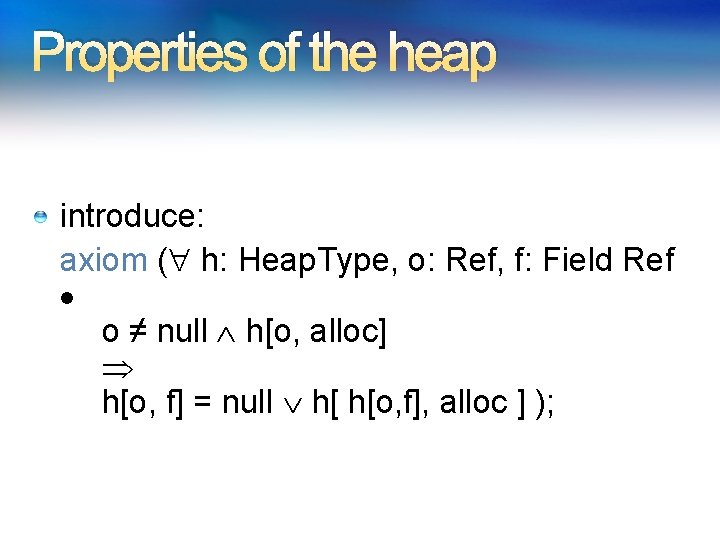
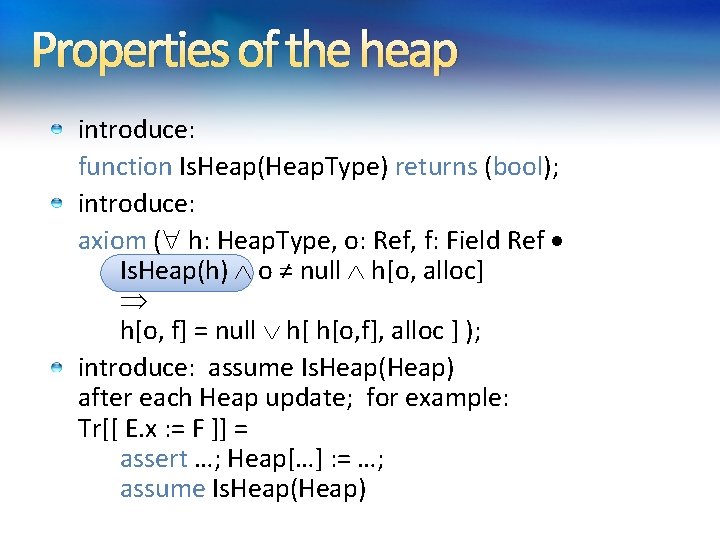
Properties of the heap introduce: axiom ( h: Heap. Type, o: Ref, f: Field Ref o ≠ null h[o, alloc] h[o, f] = null h[ h[o, f], alloc ] );
Properties of the heap introduce: function Is. Heap(Heap. Type) returns (bool); introduce: axiom ( h: Heap. Type, o: Ref, f: Field Ref Is. Heap(h) o ≠ null h[o, alloc] h[o, f] = null h[ h[o, f], alloc ] ); introduce: assume Is. Heap(Heap) after each Heap update; for example: Tr[[ E. x : = F ]] = assert …; Heap[…] : = …; assume Is. Heap(Heap)
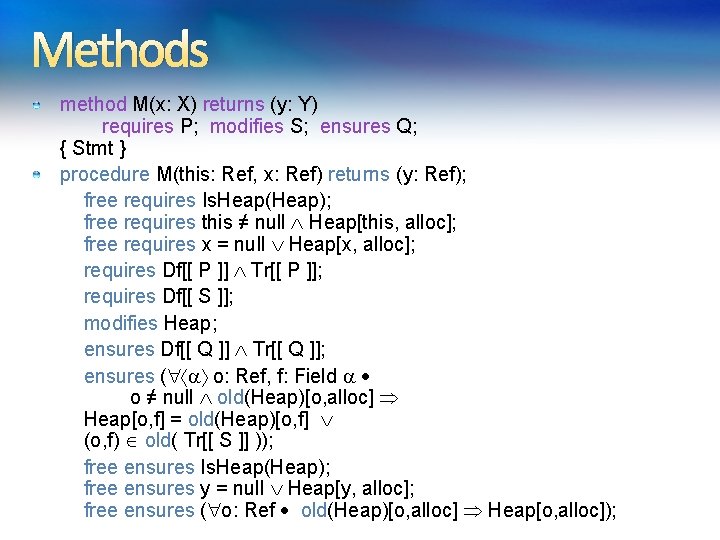
Methods method M(x: X) returns (y: Y) requires P; modifies S; ensures Q; { Stmt } procedure M(this: Ref, x: Ref) returns (y: Ref); free requires Is. Heap(Heap); free requires this ≠ null Heap[this, alloc]; free requires x = null Heap[x, alloc]; requires Df[[ P ]] Tr[[ P ]]; requires Df[[ S ]]; modifies Heap; ensures Df[[ Q ]] Tr[[ Q ]]; ensures ( o: Ref, f: Field o ≠ null old(Heap)[o, alloc] Heap[o, f] = old(Heap)[o, f] (o, f) old( Tr[[ S ]] )); free ensures Is. Heap(Heap); free ensures y = null Heap[y, alloc]; free ensures ( o: Ref old(Heap)[o, alloc] Heap[o, alloc]);
Spec# Chunker. Next. Chunk translation procedure Chunker. Next. Chunk(this: ref where $Is. Not. Null(this, Chunker)) returns ($result: ref where $Is. Not. Null($result, System. String)); // in-parameter: target object free requires $Heap[this, $allocated]; requires ($Heap[this, $owner. Frame] == $Peer. Group. Placeholder || !($Heap[this, $owner. Ref], $inv] <: $Heap[this, $owner. Frame]) || $Heap[this, $owner. Ref], $localinv] == $Base. Class($Heap[this, $owner. Frame])) && (forall $pc: ref : : $pc != null && $Heap[$pc, $allocated] && $Heap[$pc, $owner. Ref] == $Heap[this, $owner. Ref] && $Heap[$pc, $owner. Frame] == $Heap[this, $owner. Frame] ==> $Heap[$pc, $inv] == $typeof($pc) && $Heap[$pc, $localinv] == $typeof($pc)); // out-parameter: return value free ensures $Heap[$result, $allocated]; ensures ($Heap[$result, $owner. Frame] == $Peer. Group. Placeholder || !($Heap[$result, $owner. Ref], $inv] <: $Heap[$result, $owner. Frame]) || $Heap[$result, $owner. Ref], $localinv] == $Base. Class($Heap[$result, $owner. Frame])) && (forall $pc: ref : : $pc != null && $Heap[$pc, $allocated] && $Heap[$pc, $owner. Ref] == $Heap[$result, $owner. Ref] && $Heap[$pc, $owner. Frame] == $Heap[$result, $owner. Frame] ==> $Heap[$pc, $inv] == $typeof($pc) && $Heap[$pc, $localinv] == $typeof($pc)); // user-declared postconditions ensures $String. Length($result) <= $Heap[this, Chunker. Chunk. Size]; // frame condition modifies $Heap; free ensures (forall $o: ref, $f: name : : { $Heap[$o, $f] } $f != $inv && $f != $localinv && $f != $First. Consistent. Owner && (!Is. Static. Field($f) || !Is. Directly. Modifiable. Field($f)) && $o != null && old($Heap)[$o, $allocated] && (old($Heap)[$o, $owner. Frame] == $Peer. Group. Placeholder || !(old($Heap)[$o, $owner. Ref], $inv] <: old($Heap)[$o, $owner. Frame]) || old($Heap)[$o, $owner. Ref], $localinv] == $Base. Class(old($Heap)[$o, $owner. Frame])) && old($o != this || !(Chunker <: Decl. Type($f)) || !$Included. In. Modifies. Star($f)) && old($o != this || $f != $expose. Version) ==> old($Heap)[$o, $f] == $Heap[$o, $f]); // boilerplate free requires $Being. Constructed == null; free ensures (forall $o: ref : : { $Heap[$o, $localinv] } { $Heap[$o, $inv] } $o != null && !old($Heap)[$o, $allocated] && $Heap[$o, $allocated] ==> $Heap[$o, $inv] == $typeof($o) && $Heap[$o, $localinv] == $typeof($o)); free ensures (forall $o: ref : : { $Heap[$o, $First. Consistent. Owner] } old($Heap)[$o, $First. Consistent. Owner], $expose. Version] == $Heap[old($Heap)[$o, $First. Consistent. Owner], $expose. Version] ==> old($Heap)[$o, $First. Consistent. Owner] == $Heap[$o, $First. Consistent. Owner]); free ensures (forall $o: ref : : { $Heap[$o, $localinv] } { $Heap[$o, $inv] } old($Heap)[$o, $allocated] ==> old($Heap)[$o, $inv] == $Heap[$o, $inv] && old($Heap)[$o, $localinv] == $Heap[$o, $localinv]); free ensures (forall $o: ref : : { $Heap[$o, $allocated] } old($Heap)[$o, $allocated] ==> $Heap[$o, $allocated]) && (forall $ot: ref : : { $Heap[$ot, $owner. Frame] } { $Heap[$ot, $owner. Ref] } old($Heap)[$ot, $allocated] && old($Heap)[$ot, $owner. Frame] != $Peer. Group. Placeholder ==> old($Heap)[$ot, $owner. Ref] == $Heap[$ot, $owner. Ref] && old($Heap)[$ot, $owner. Frame] == $Heap[$ot, $owner. Frame]) && old($Heap)[$Being. Constructed, $Non. Null. Fields. Are. Initialized] == $Heap[$Being. Constructed, $Non. Null. Fields. Are. Initialized];
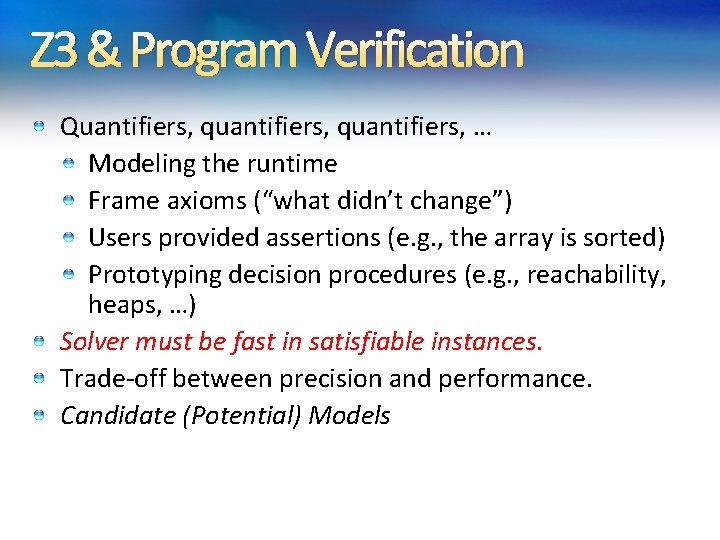
Z 3 & Program Verification Quantifiers, quantifiers, … Modeling the runtime Frame axioms (“what didn’t change”) Users provided assertions (e. g. , the array is sorted) Prototyping decision procedures (e. g. , reachability, heaps, …) Solver must be fast in satisfiable instances. Trade-off between precision and performance. Candidate (Potential) Models
Demo: Spec#
Application: A Verifying C Compiler Ernie Cohen, Markus Dahlweid, Michał Moskal, Wolfram Schulte, Thomas Santen, Stephan Tobies
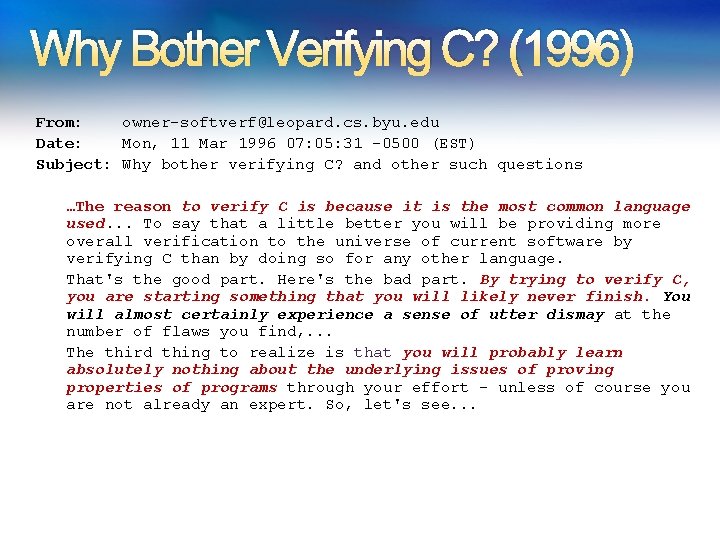
Why Bother Verifying C? (1996) From: owner-softverf@leopard. cs. byu. edu Date: Mon, 11 Mar 1996 07: 05: 31 -0500 (EST) Subject: Why bother verifying C? and other such questions …The reason to verify C is because it is the most common language used. . . To say that a little better you will be providing more overall verification to the universe of current software by verifying C than by doing so for any other language. That's the good part. Here's the bad part. By trying to verify C, you are starting something that you will likely never finish. You will almost certainly experience a sense of utter dismay at the number of flaws you find, . . . The third thing to realize is that you will probably learn absolutely nothing about the underlying issues of proving properties of programs through your effort - unless of course you are not already an expert. So, let's see. . .
Why Bother Verifying System C? Useful to human kind: • most system-level code is still written in C: operating systems, device drivers • kernel crash is much worse than a web browser crash • relevant in embedded software (airplanes, washing machines, medical devices, factory robots, etc. )
Why Bother Verifying System C? Challenging: • low-level concurrency: operating systems stopped being single-threaded 20 years ago • large systems need good abstraction methods • byte-level memory is somewhat difficult to work with
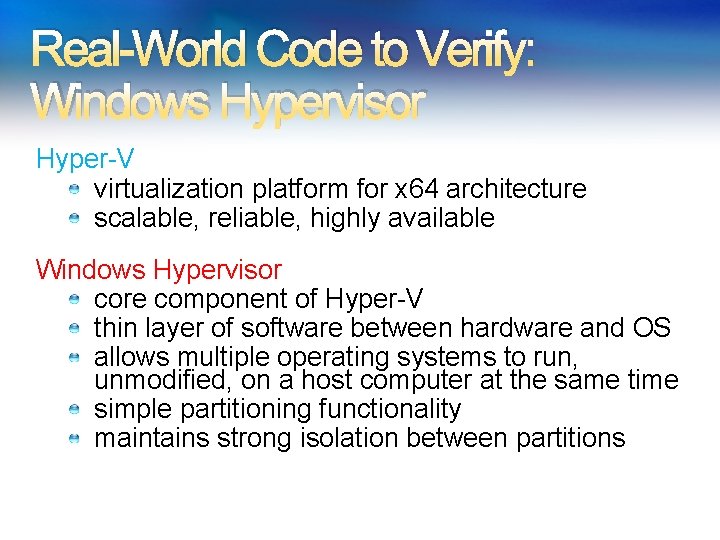
Real-World Code to Verify: Windows Hypervisor Hyper-V virtualization platform for x 64 architecture scalable, reliable, highly available Windows Hypervisor core component of Hyper-V thin layer of software between hardware and OS allows multiple operating systems to run, unmodified, on a host computer at the same time simple partitioning functionality maintains strong isolation between partitions
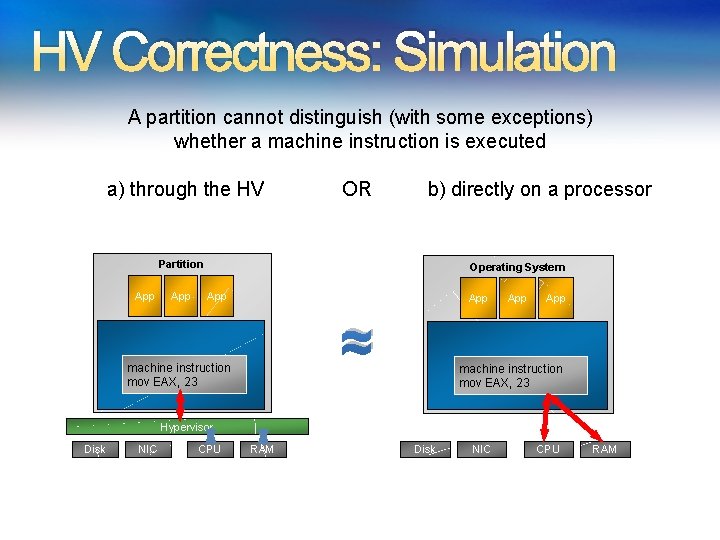
HV Correctness: Simulation A partition cannot distinguish (with some exceptions) whether a machine instruction is executed a) through the HV OR b) directly on a processor Partition App Operating System App ≈ machine instruction mov EAX, 23 App machine instruction mov EAX, 23 Hypervisor Disk NIC CPU RAM
Hypervisor Implementation real code, as shipped with Windows Server 2008 ca. 100 000 lines of C, 5 000 lines of x 64 assembly concurrency spin locks, r/w locks, rundowns, turnstiles lock-free accesses to volatile data and hardware covered by implicit protocols scheduler, memory allocator, etc. access to hardware registers (memory management, virtualization support)
Hypervisor Verification (2007 – 2010) Partners: European Microsoft Innovation Center Microsoft Research Microsoft’s Windows Div. Universität des Saarlandes co-funded by the German Ministry of Education and Research http: //www. verisoftxt. de
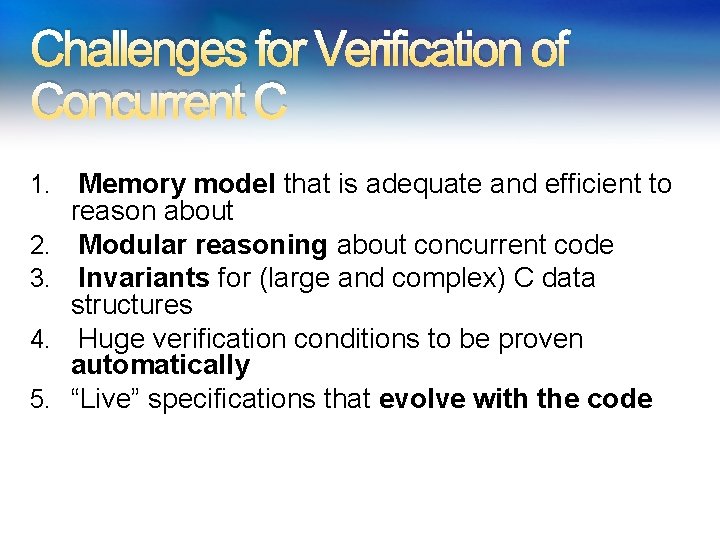
Challenges for Verification of Concurrent C 1. Memory model that is adequate and efficient to 2. 3. 4. 5. reason about Modular reasoning about concurrent code Invariants for (large and complex) C data structures Huge verification conditions to be proven automatically “Live” specifications that evolve with the code
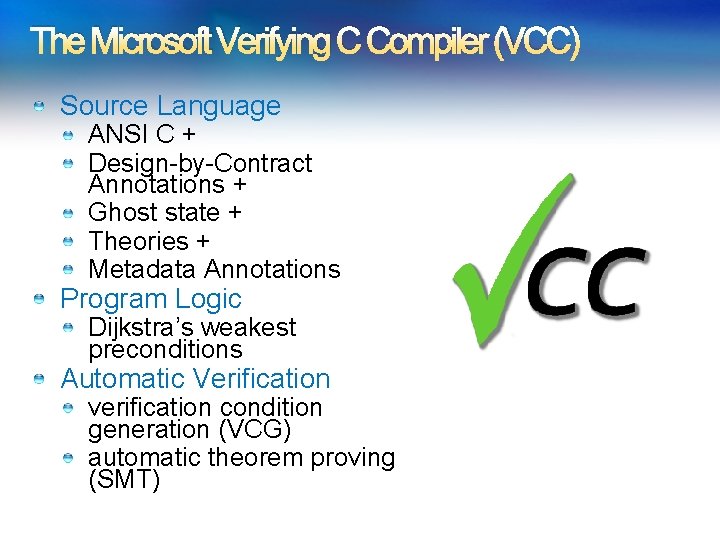
The Microsoft Verifying C Compiler (VCC) Source Language ANSI C + Design-by-Contract Annotations + Ghost state + Theories + Metadata Annotations Program Logic Dijkstra’s weakest preconditions Automatic Verification verification condition generation (VCG) automatic theorem proving (SMT)
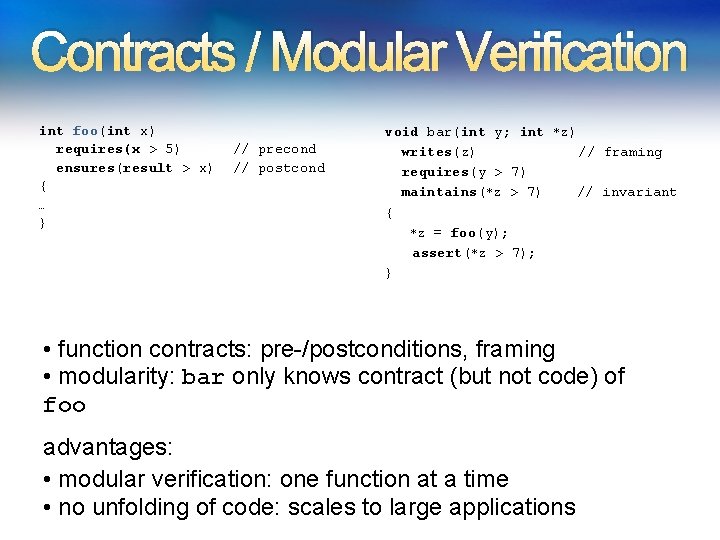
Contracts / Modular Verification int foo(int x) requires(x > 5) // precond ensures(result > x) // postcond { … } void bar(int y; int z) writes(z) // framing requires(y > 7) maintains( z > 7) // invariant { z = foo(y); assert( z > 7); } • function contracts: pre-/postconditions, framing • modularity: bar only knows contract (but not code) of foo advantages: • modular verification: one function at a time • no unfolding of code: scales to large applications
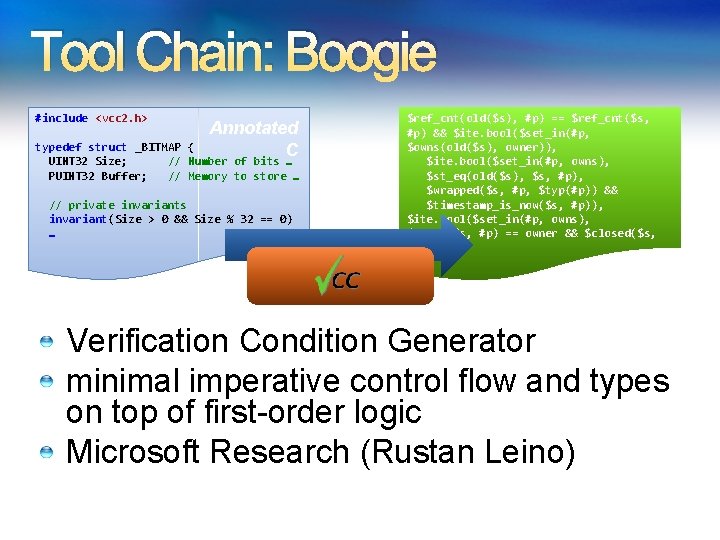
Tool Chain: Boogie #include <vcc 2. h> Annotated typedef struct _BITMAP { C UINT 32 Size; // Number of bits … PUINT 32 Buffer; // Memory to store … // private invariants invariant(Size > 0 && Size % 32 == 0) … $ref_cnt(old($s), #p) == $ref_cnt($s, #p) && $ite. bool($set_in(#p, $owns(old($s), owner)), $ite. bool($set_in(#p, owns), $st_eq(old($s), $s, #p), $wrapped($s, #p, $typ(#p)) && $timestamp_is_now($s, #p)), $ite. bool($set_in(#p, owns), $owner($s, #p) == owner && $closed($s, Boogie Verification Condition Generator minimal imperative control flow and types on top of first-order logic Microsoft Research (Rustan Leino)
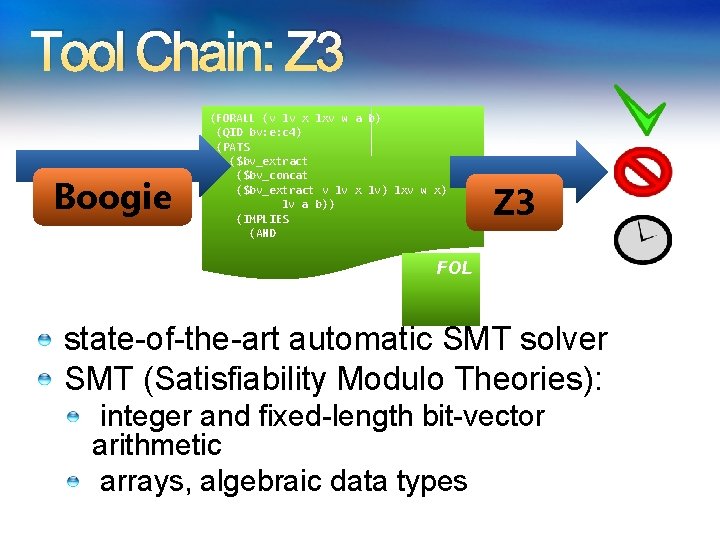
Tool Chain: Z 3 Boogie (FORALL (v lv x lxv w a b) (QID bv: e: c 4) (PATS ($bv_extract ($bv_concat ($bv_extract v lv x lv) lxv w x) lv a b)) (IMPLIES (AND Z 3 FOL state-of-the-art automatic SMT solver SMT (Satisfiability Modulo Theories): integer and fixed-length bit-vector arithmetic arrays, algebraic data types
MODELING C MEMORY
C Memory Model stack and ‘heap’ memory is organized into disjoint, fixed-size allocation regions heap is really only chunks of memory obtained via a system call types ‘suggest’ how to interpret regions allocation status is tracked per region type status is not tracked at all
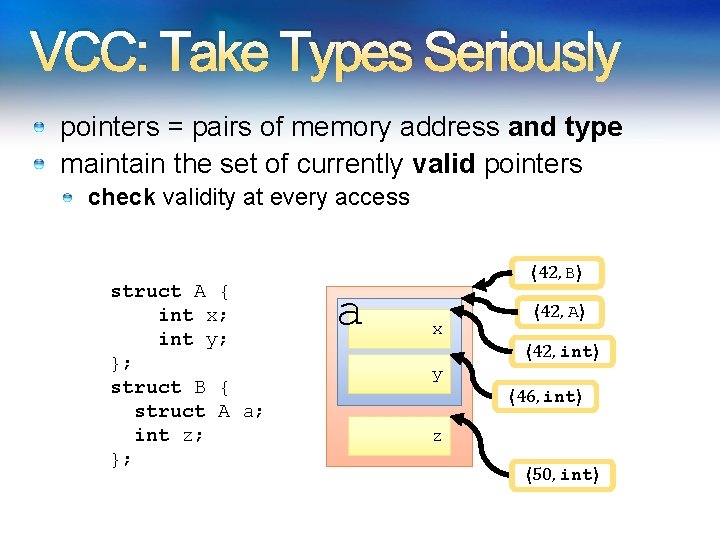
VCC: Take Types Seriously pointers = pairs of memory address and type maintain the set of currently valid pointers check validity at every access struct A { int x; int y; }; struct B { struct A a; int z; }; ⟨ 42, B⟩ a x ⟨ 42, A⟩ ⟨ 42, int⟩ y ⟨ 46, int⟩ z ⟨ 50, int⟩
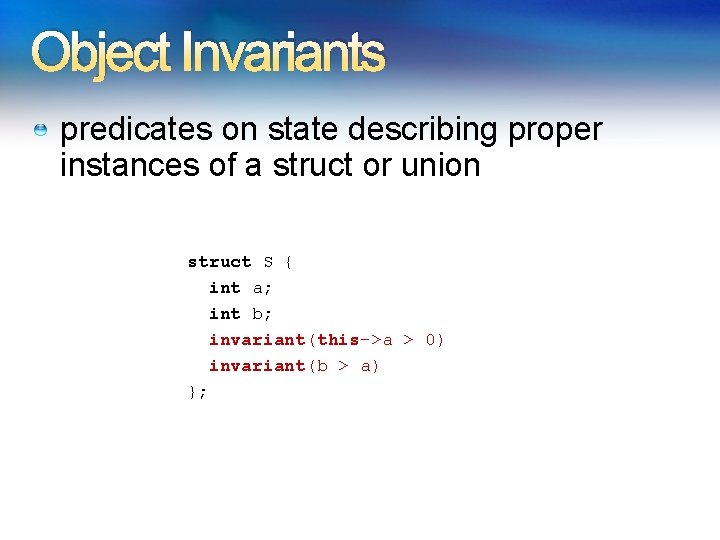
Object Invariants predicates on state describing proper instances of a struct or union struct S { int a; int b; invariant(this->a > 0) invariant(b > a) };
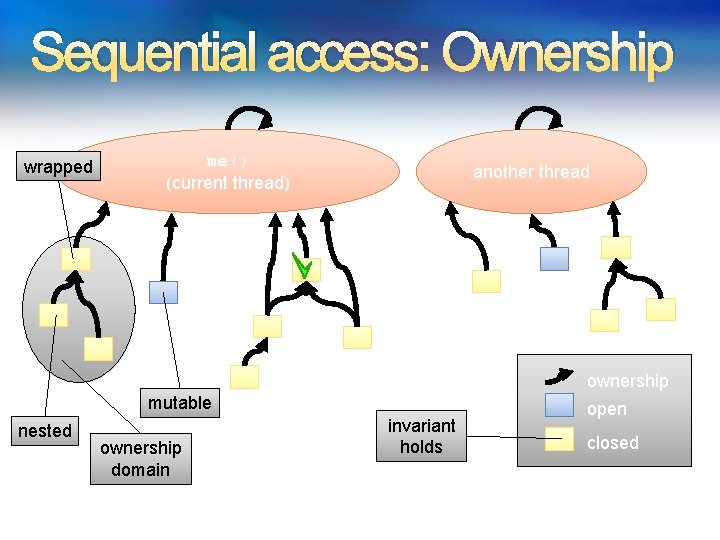
Sequential access: Ownership wrapped me() (current thread) another thread ownership mutable nested ownership domain invariant holds open closed
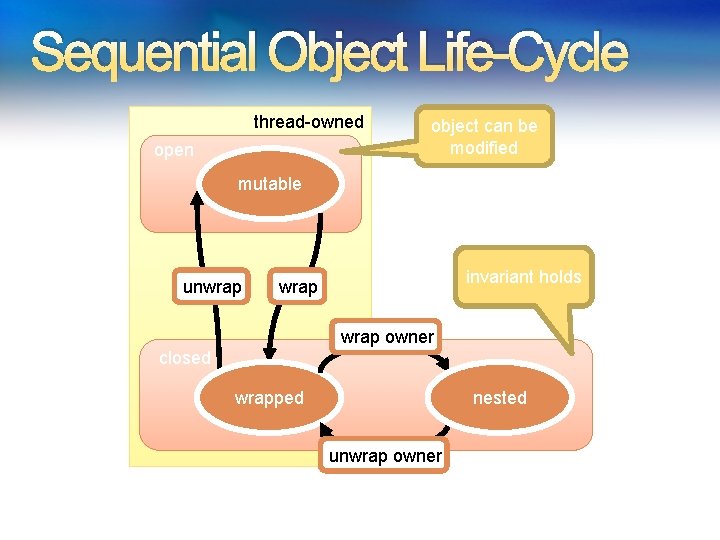
Sequential Object Life-Cycle thread-owned open object can be modified mutable unwrap invariant holds wrap owner closed wrapped nested unwrap owner
Demo: VCC
Application: Model-based Design A preview
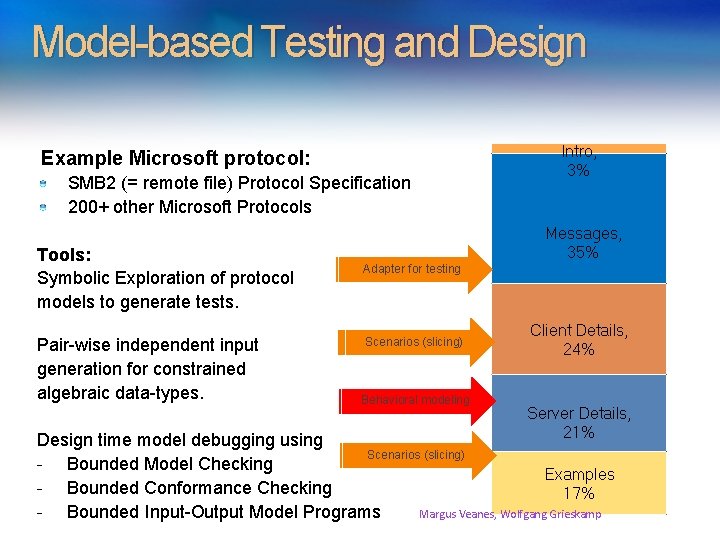
Model-based Testing and Design Example Microsoft protocol: SMB 2 (= remote file) Protocol Specification 200+ other Microsoft Protocols Tools: Symbolic Exploration of protocol models to generate tests. Pair-wise independent input generation for constrained algebraic data-types. Intro, 3% Messages, 35% Adapter for testing Scenarios (slicing) Behavioral modeling Client Details, 24% Server Details, 21% Design time model debugging using Scenarios (slicing) - Bounded Model Checking Examples - Bounded Conformance Checking 17% - Bounded Input-Output Model Programs Margus Veanes, Wolfgang Grieskamp
Demo: Bounded Model-Checking
Demo: FORMULA
Additional applications
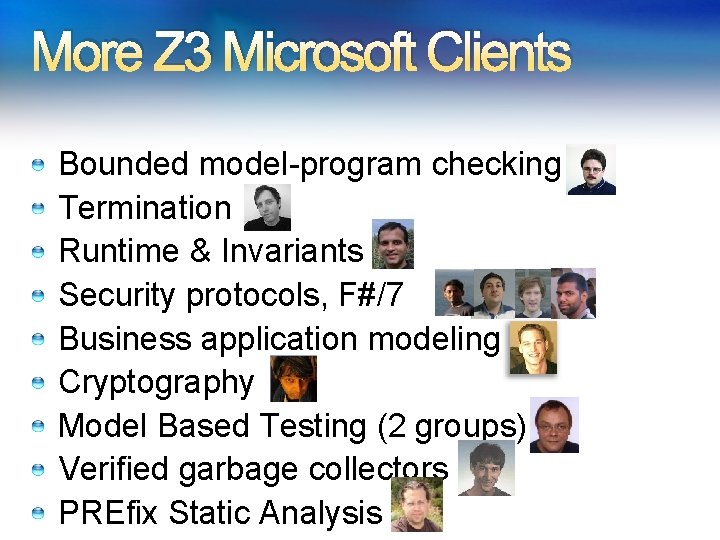
More Z 3 Microsoft Clients Bounded model-program checking Termination Runtime & Invariants Security protocols, F#/7 Business application modeling Cryptography Model Based Testing (2 groups) Verified garbage collectors PREfix Static Analysis
Summary Several program analysis, verification and test-generation tools use logic as the calculus of computation. Z 3 is a state-of-the-art SMT solver that can be used for solving several problems related to logic. You should use Z 3 too!