
SMSC New Woodlands School Incorporating SMSC in Maths
- Slides: 14
SMSC New Woodlands School
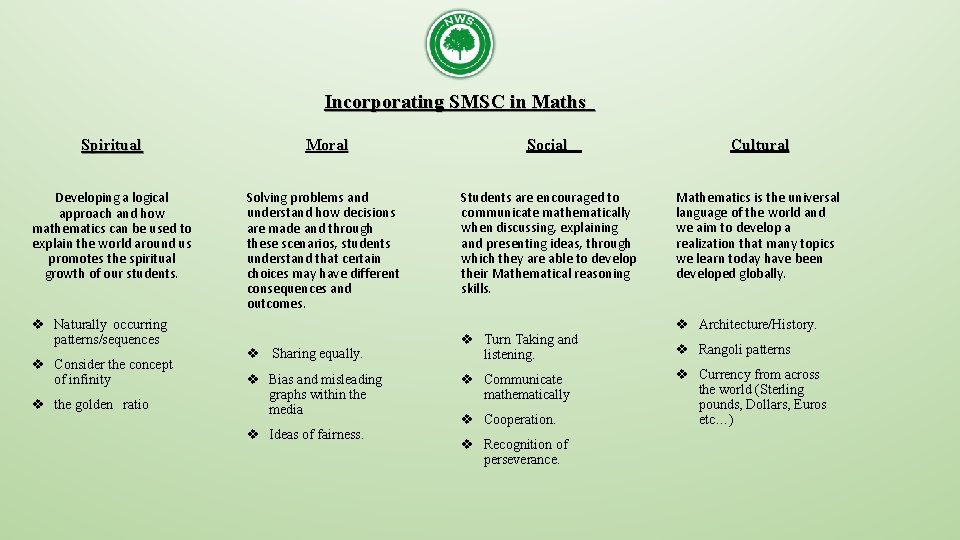
Incorporating SMSC in Maths Spiritual Developing a logical approach and how mathematics can be used to explain the world around us promotes the spiritual growth of our students. v Naturally occurring patterns/sequences v Consider the concept of infinity v the golden ratio Moral Solving problems and understand how decisions are made and through these scenarios, students understand that certain choices may have different consequences and outcomes. v Sharing equally. v Bias and misleading graphs within the media v Ideas of fairness. Social Students are encouraged to communicate mathematically when discussing, explaining and presenting ideas, through which they are able to develop their Mathematical reasoning skills. v Turn Taking and listening. v Communicate mathematically v Cooperation. v Recognition of perseverance. Cultural Mathematics is the universal language of the world and we aim to develop a realization that many topics we learn today have been developed globally. v Architecture/History. v Rangoli patterns v Currency from across the world (Sterling pounds, Dollars, Euros etc…)
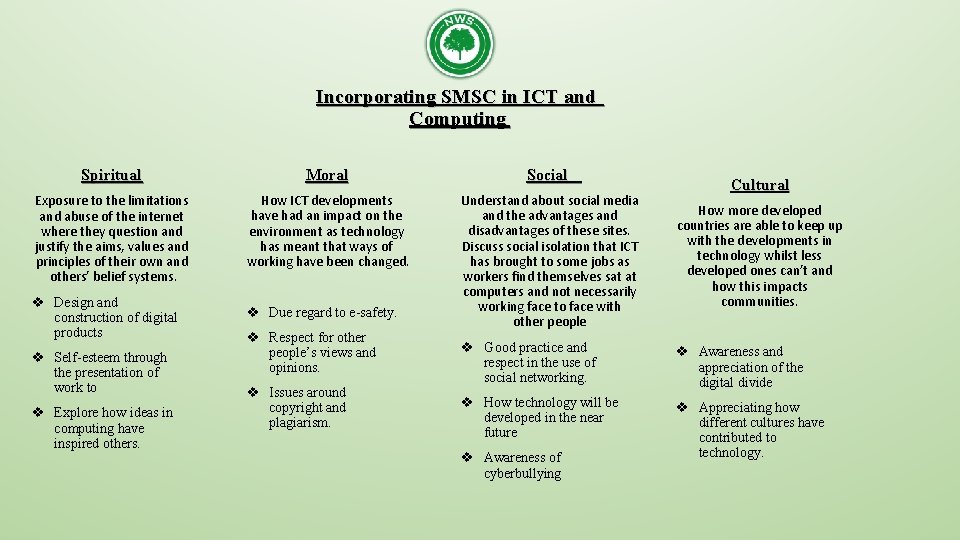
Incorporating SMSC in ICT and Computing Spiritual Moral Social Exposure to the limitations and abuse of the internet where they question and justify the aims, values and principles of their own and others’ belief systems. How ICT developments have had an impact on the environment as technology has meant that ways of working have been changed. Understand about social media and the advantages and disadvantages of these sites. Discuss social isolation that ICT has brought to some jobs as workers find themselves sat at computers and not necessarily working face to face with other people How more developed countries are able to keep up with the developments in technology whilst less developed ones can’t and how this impacts communities. v Good practice and respect in the use of social networking. v Awareness and appreciation of the digital divide v How technology will be developed in the near future v Appreciating how different cultures have contributed to technology. v Design and construction of digital products v Self-esteem through the presentation of work to v Explore how ideas in computing have inspired others. v Due regard to e-safety. v Respect for other people’s views and opinions. v Issues around copyright and plagiarism. v Awareness of cyberbullying Cultural
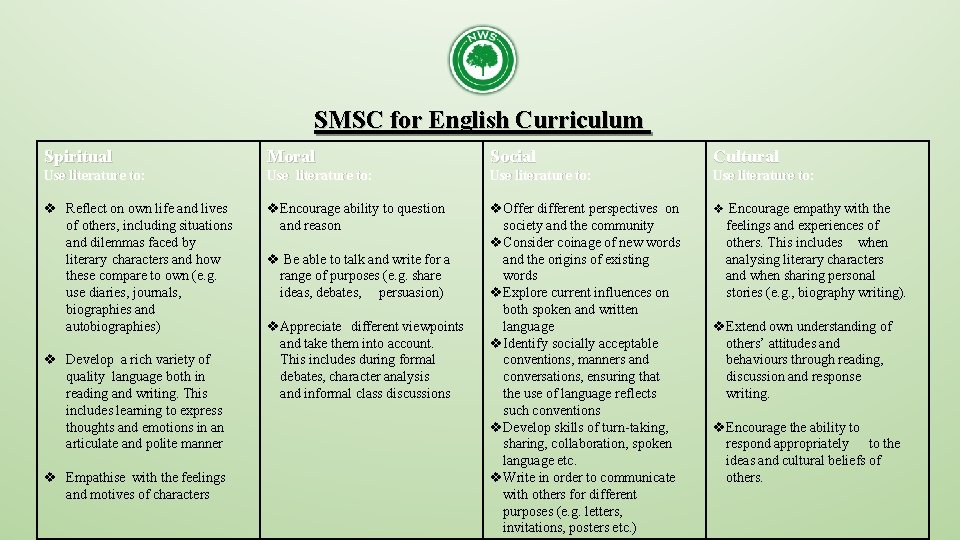
SMSC for English Curriculum Spiritual Moral Social Cultural Use literature to: v Reflect on own life and lives of others, including situations and dilemmas faced by literary characters and how these compare to own (e. g. use diaries, journals, biographies and autobiographies) v Encourage ability to question and reason v Offer different perspectives on society and the community v Consider coinage of new words and the origins of existing words v Explore current influences on both spoken and written language v Identify socially acceptable conventions, manners and conversations, ensuring that the use of language reflects such conventions v Develop skills of turn-taking, sharing, collaboration, spoken language etc. v Write in order to communicate with others for different purposes (e. g. letters, invitations, posters etc. ) v Encourage empathy with the v Develop a rich variety of quality language both in reading and writing. This includes learning to express thoughts and emotions in an articulate and polite manner v Empathise with the feelings and motives of characters v Be able to talk and write for a range of purposes (e. g. share ideas, debates, persuasion) v Appreciate different viewpoints and take them into account. This includes during formal debates, character analysis and informal class discussions feelings and experiences of others. This includes when analysing literary characters and when sharing personal stories (e. g. , biography writing). v Extend own understanding of others’ attitudes and behaviours through reading, discussion and response writing. v Encourage the ability to respond appropriately to the ideas and cultural beliefs of others.
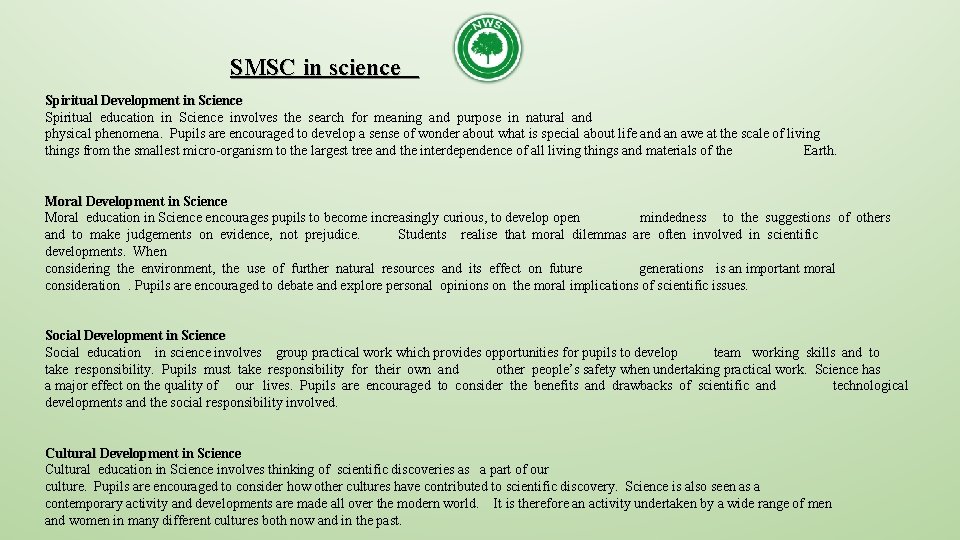
SMSC in science Spiritual Development in Science Spiritual education in Science involves the search for meaning and purpose in natural and physical phenomena. Pupils are encouraged to develop a sense of wonder about what is special about life and an awe at the scale of living things from the smallest micro-organism to the largest tree and the interdependence of all living things and materials of the Earth. Moral Development in Science Moral education in Science encourages pupils to become increasingly curious, to develop open mindedness to the suggestions of others and to make judgements on evidence, not prejudice. Students realise that moral dilemmas are often involved in scientific developments. When considering the environment, the use of further natural resources and its effect on future generations is an important moral consideration. Pupils are encouraged to debate and explore personal opinions on the moral implications of scientific issues. Social Development in Science Social education in science involves group practical work which provides opportunities for pupils to develop team working skills and to take responsibility. Pupils must take responsibility for their own and other people’s safety when undertaking practical work. Science has a major effect on the quality of our lives. Pupils are encouraged to consider the benefits and drawbacks of scientific and technological developments and the social responsibility involved. Cultural Development in Science Cultural education in Science involves thinking of scientific discoveries as a part of our culture. Pupils are encouraged to consider how other cultures have contributed to scientific discovery. Science is also seen as a contemporary activity and developments are made all over the modern world. It is therefore an activity undertaken by a wide range of men and women in many different cultures both now and in the past.
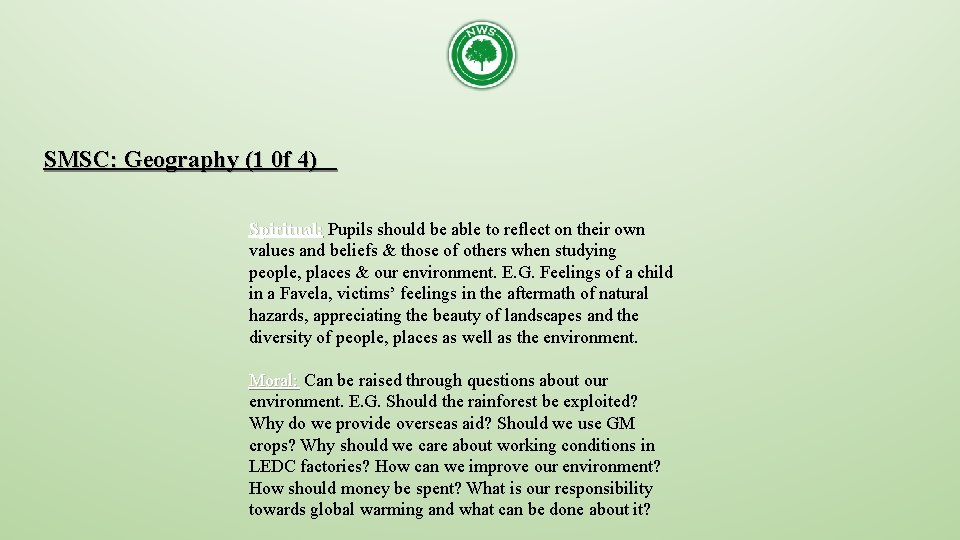
SMSC: Geography (1 0 f 4) Spiritual: Pupils should be able to reflect on their own Spiritual: values and beliefs & those of others when studying people, places & our environment. E. G. Feelings of a child in a Favela, victims’ feelings in the aftermath of natural hazards, appreciating the beauty of landscapes and the diversity of people, places as well as the environment. Moral: Can be raised through questions about our environment. E. G. Should the rainforest be exploited? Why do we provide overseas aid? Should we use GM crops? Why should we care about working conditions in LEDC factories? How can we improve our environment? How should money be spent? What is our responsibility towards global warming and what can be done about it?
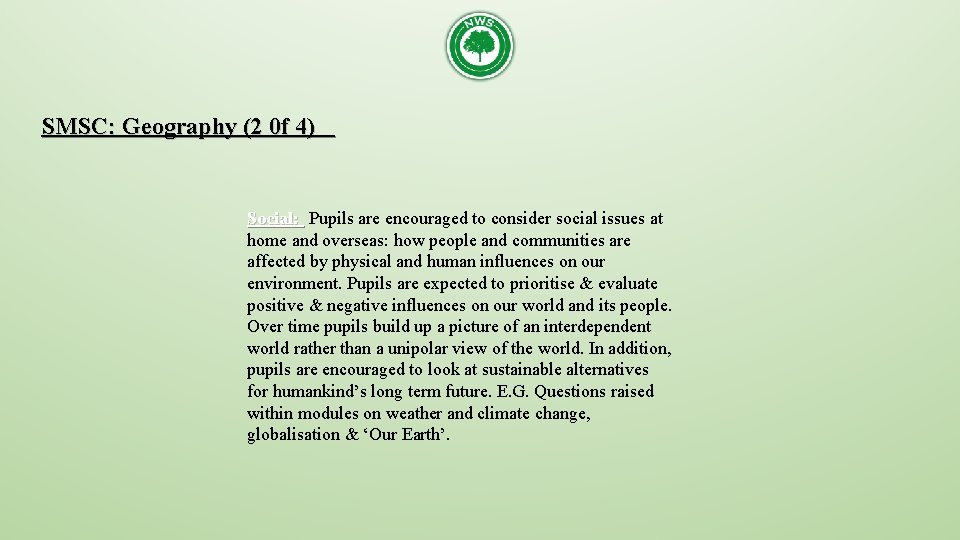
SMSC: Geography (2 0 f 4) Social: Pupils are encouraged to consider social issues at home and overseas: how people and communities are affected by physical and human influences on our environment. Pupils are expected to prioritise & evaluate positive & negative influences on our world and its people. Over time pupils build up a picture of an interdependent world rather than a unipolar view of the world. In addition, pupils are encouraged to look at sustainable alternatives for humankind’s long term future. E. G. Questions raised within modules on weather and climate change, globalisation & ‘Our Earth’.
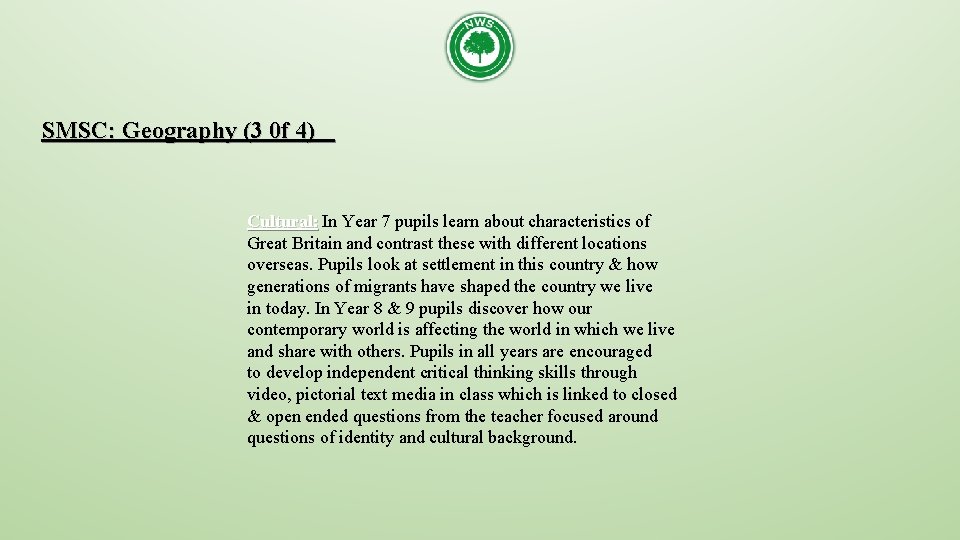
SMSC: Geography (3 0 f 4) Cultural: In Year 7 pupils learn about characteristics of Great Britain and contrast these with different locations overseas. Pupils look at settlement in this country & how generations of migrants have shaped the country we live in today. In Year 8 & 9 pupils discover how our contemporary world is affecting the world in which we live and share with others. Pupils in all years are encouraged to develop independent critical thinking skills through video, pictorial text media in class which is linked to closed & open ended questions from the teacher focused around questions of identity and cultural background.
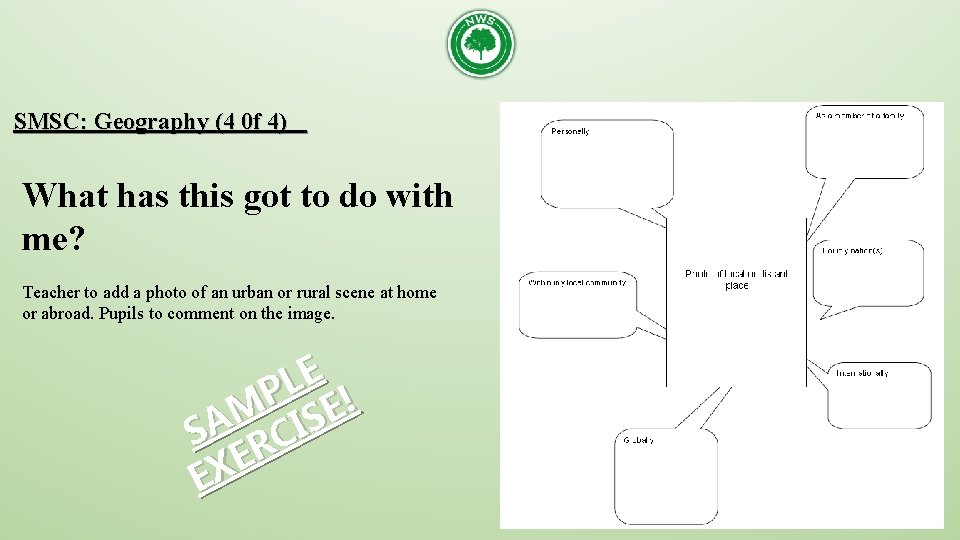
SMSC: Geography (4 0 f 4) What has this got to do with me? Teacher to add a photo of an urban or rural scene at home or abroad. Pupils to comment on the image. E L P ! E M SA RCIS E X E
SMSC in Art ‘I understand that an artist is someone who, in the midst of others’ silence, uses his own voice to say something and to make sure that what he says is not useless, but something that is useful to mankind’ Miro We embody this quote in the Art curriculum at New Woodlands, as an understanding for art for social change and how the pupils’ can use art as a voice, a means of expression and individuality. The Art curriculum lends itself to a wide range of Spiritual, Moral, Cultural and Social studies. Students will analyse, engage with and question their own and others work, identify how beliefs, values and meanings are expressed and shared. Students are encouraged to express themselves through their art, which is supported by research and on-going independent projects. The department undertakes a number of extra-curricular activities that enhance the students’ experience of the arts and its context in the world.
SMSC IN HISTORY Spiritual Development – The How? - Reflection on topics such as slavery, imperialism, war and the holocaust. Also the plight of refugees after war - encouraging students to consider migration and the experiences of migrants. Students to compare and contrast beliefs and values from past societies with their own. Moral Development – The How? - Pupils are encouraged to comment on moral questions and dilemmas within History and develop the ability to empathise with the decisions which historical figures made at the time. History innately provides opportunities for pupils to learn the difference between right and wrong and to challenge the decisions made by people and governments e. g. Hitler and the Nazi state, slave trade and the current war on terror. Pupils learn to reflect on decisions from the past and learn reasons why we forgive but do not forget evil actions in the past. Developing this area enables pupils to reflect on their own decisions and make informed moral choices in their future. Social Development – The How? - Social issues and the needs of different groups of people are common themes that are explicitly recognised on a regular basis e. g. The Study of the Suffragettes. Pupils will examine how other cultures have had a major impact on ‘British culture’. Students will be encouraged to build up their own social development through collaborative and team working activities. Social issues can be th century and immigration from the commonwealth. covered by looking at the experiences of women in Britain in the 20 Cultural Development – The How? - Pupils explore the beliefs and values of past societies and from different cultures. Understanding and appreciating the wide range of cultural influences that have shaped their own heritage. Pupils study empire, democracy, republic, government, parliament, monarchy, fascism, class, communism, imperialism and industrialisation etc. Pupils learn to understand the world around them and what makes us different by studying the past. Pupils are made aware of their own cultural roots and shared inheritance.
SMSC in KS 1/2/3 Physical Education Spiritual Development in Physical Education During the range of activities that students can participate in, students can develop a sense of enjoyment and fascination in learning about themselves, others and the world around them. Students are consistently encouraged to use their imagination and creativity in their learning, and showcase a willingness to reflect on their own and others experiences. Moral Development in Physical Education PE in general teaches students about a code of conduct, etiquette, handshake before and after matches, applauding the opposition, fair play, unwritten rules and sportsmanship. Students abide by the rules and regulations, gaining a good understanding of the rules of sport and the importance of infringements to allow students to understand the consequences of their actions, which in turn helps students apply this understanding to their own lives. Social Development in Physical Education Students in PE can use of a range of social skills in different contexts, including working and socialising with students from different religious, ethnic and socio-economic backgrounds. They show a willingness to participate in a variety of social settings, cooperate with others and resolve conflicts effectively. Students also develop their friendships and social mixing through involvement in inter, intra school competition and extra-curricular competitions. Cultural Development in Physical Education Students are encouraged to participate in sporting opportunities that help to develop positive attitudes towards different religious, ethnic and socio-economic groups in the local community.
SMSC in PSHCE Examples of Spiritual, Moral, Social and Cultural Education in PSHCE include: • Pupils learning about their rights, for instance, what are political, legal and human rights? • Positive relationships are modelled and discussed. • Pupils understanding ‘identity’ and ‘diversity’, as well as why there is diversity in the UK, and the impact of migration and integration on identities and communities. • Pupils discussing how the media informs and influences the public. • Circle time activities are central to the Teaching and Learning in PSHCE lessons, i. e. valuing contributions from ALL students, identifying & celebrating commonalities and differences. • Pupils learning about ‘Right and Wrong’, the law and justice system and how it affects them as individuals and the communities they live in. • Staff use standard phrases which include: ‘we are mindful that…’/’You may or may not believe that…’
SMSC- SPRITITUAL DEVELOPMENT IN RE RE provides opportunities for: • Spiritual development , through helping pupils to consider and respond to questions of meaning and purpose in life, and questions about the nature of values in human society • Moral development , through helping pupils to consider and respond to areas of morality using their knowledge and understanding of religious and ethical teaching. This enables them to make reasoned and informed judgements on religious and moral issues; • Social development , through helping pupils to develop their sense of identity and belonging, preparing them for life as citizens in a plural society; • Cultural development , through fostering pupils’ awareness and understanding of a range of beliefs, practices and values in their own society and in the wider world. Pupils explore issues within and between faiths, developing their understanding of the cultural contexts within which they live. RE deals with religious and moral beliefs and values that underpin personal choices and behaviour (e. g. relationships), social policies and practices (e. g. crime and punishment), and concepts and patterns of health (e. g. use of drugs) . RE looks at the voluntary and charitable activities that help to make up a healthy society and provide opportunities for the development of active citizenship and involvement in society. Beliefs about the nature of humanity and the world influence how we organise ourselves and relate to others locally, nationally and globally. Issues in RE therefore contribute to social and political awareness (e. g. rights and responsibilities). RE also contributes to pupils’ understanding of Europe and the world. Religious and moral issues in RE are worldwide. It is not possible to understand the nature and significance of European identity without studying religion. RE promotes the values and attitudes needed for citizenship in a democratic society by helping pupils to understand respect people of different beliefs, practices, races and cultures. Similarities and differences in commitment, self-understanding and the search for