
Smooth and Cardiac Muscle Introduction The cells of
- Slides: 5
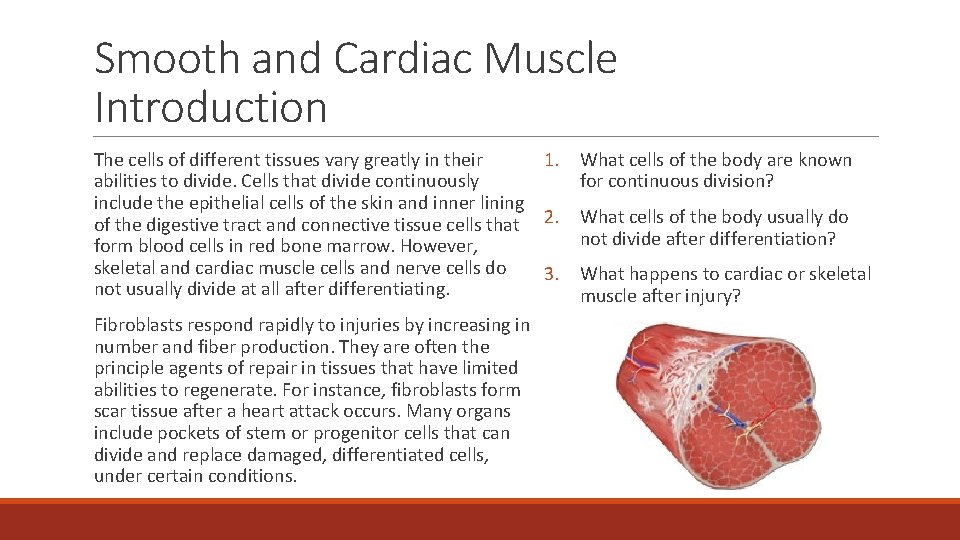
Smooth and Cardiac Muscle Introduction The cells of different tissues vary greatly in their 1. abilities to divide. Cells that divide continuously include the epithelial cells of the skin and inner lining of the digestive tract and connective tissue cells that 2. form blood cells in red bone marrow. However, skeletal and cardiac muscle cells and nerve cells do 3. not usually divide at all after differentiating. Fibroblasts respond rapidly to injuries by increasing in number and fiber production. They are often the principle agents of repair in tissues that have limited abilities to regenerate. For instance, fibroblasts form scar tissue after a heart attack occurs. Many organs include pockets of stem or progenitor cells that can divide and replace damaged, differentiated cells, under certain conditions. What cells of the body are known for continuous division? What cells of the body usually do not divide after differentiation? What happens to cardiac or skeletal muscle after injury?
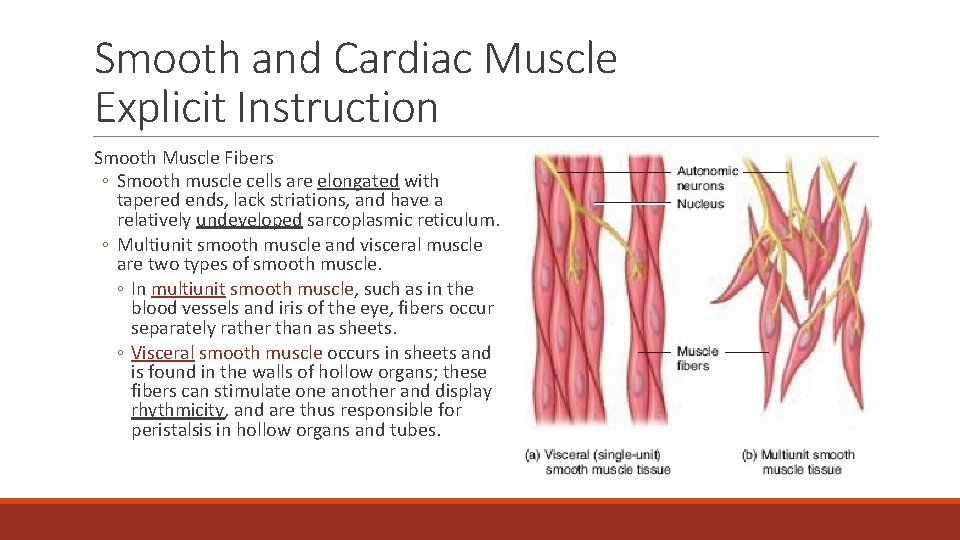
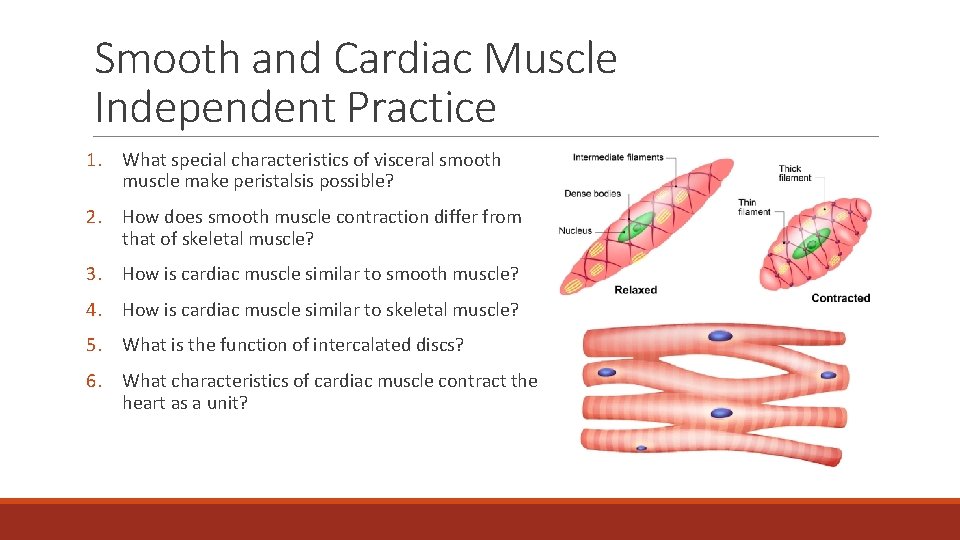
Smooth and Cardiac Muscle Explicit Instruction Smooth Muscle Fibers ◦ Smooth muscle cells are elongated with tapered ends, lack striations, and have a relatively undeveloped sarcoplasmic reticulum. ◦ Multiunit smooth muscle and visceral muscle are two types of smooth muscle. ◦ In multiunit smooth muscle, such as in the blood vessels and iris of the eye, fibers occur separately rather than as sheets. ◦ Visceral smooth muscle occurs in sheets and is found in the walls of hollow organs; these fibers can stimulate one another and display rhythmicity, and are thus responsible for peristalsis in hollow organs and tubes.
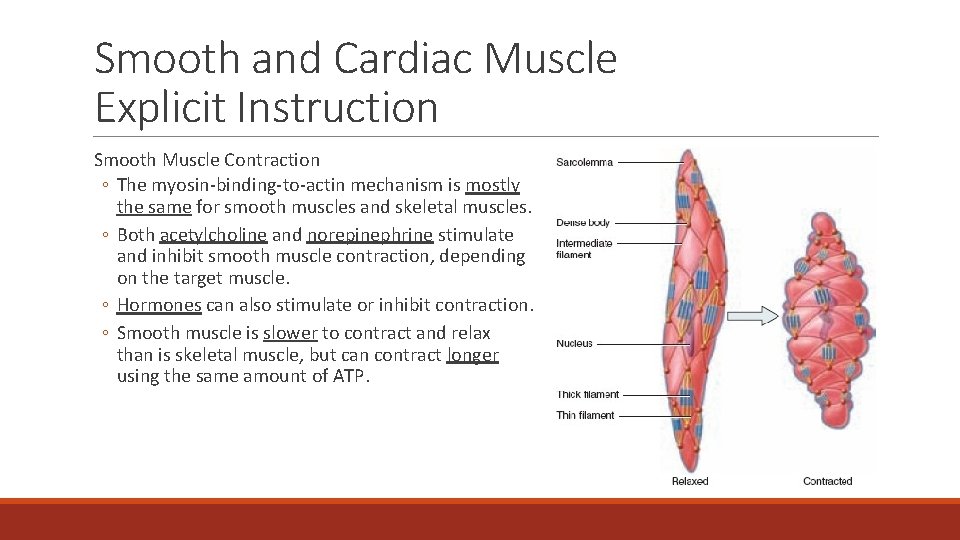
Smooth and Cardiac Muscle Explicit Instruction Smooth Muscle Contraction ◦ The myosin-binding-to-actin mechanism is mostly the same for smooth muscles and skeletal muscles. ◦ Both acetylcholine and norepinephrine stimulate and inhibit smooth muscle contraction, depending on the target muscle. ◦ Hormones can also stimulate or inhibit contraction. ◦ Smooth muscle is slower to contract and relax than is skeletal muscle, but can contract longer using the same amount of ATP.
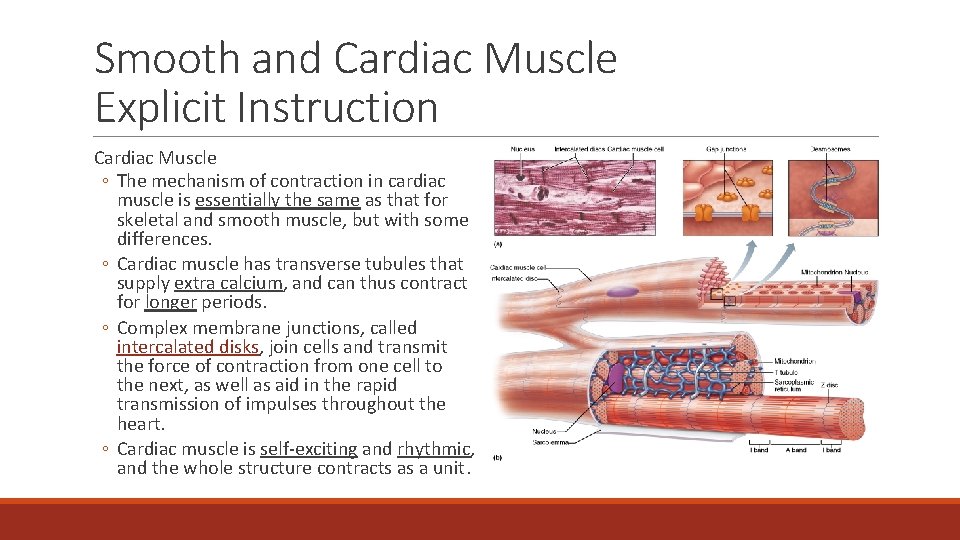
Smooth and Cardiac Muscle Explicit Instruction Cardiac Muscle ◦ The mechanism of contraction in cardiac muscle is essentially the same as that for skeletal and smooth muscle, but with some differences. ◦ Cardiac muscle has transverse tubules that supply extra calcium, and can thus contract for longer periods. ◦ Complex membrane junctions, called intercalated disks, join cells and transmit the force of contraction from one cell to the next, as well as aid in the rapid transmission of impulses throughout the heart. ◦ Cardiac muscle is self-exciting and rhythmic, and the whole structure contracts as a unit.
Smooth and Cardiac Muscle Independent Practice 1. What special characteristics of visceral smooth muscle make peristalsis possible? 2. How does smooth muscle contraction differ from that of skeletal muscle? 3. How is cardiac muscle similar to smooth muscle? 4. How is cardiac muscle similar to skeletal muscle? 5. What is the function of intercalated discs? 6. What characteristics of cardiac muscle contract the heart as a unit?