
SMOKING HABITS Past and Present Before the 1950s
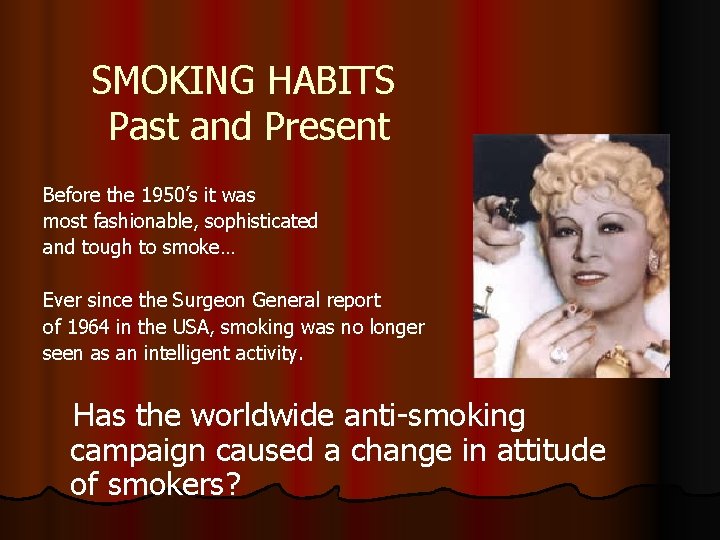
SMOKING HABITS Past and Present Before the 1950’s it was most fashionable, sophisticated and tough to smoke… Ever since the Surgeon General report of 1964 in the USA, smoking was no longer seen as an intelligent activity. Has the worldwide anti-smoking campaign caused a change in attitude of smokers?
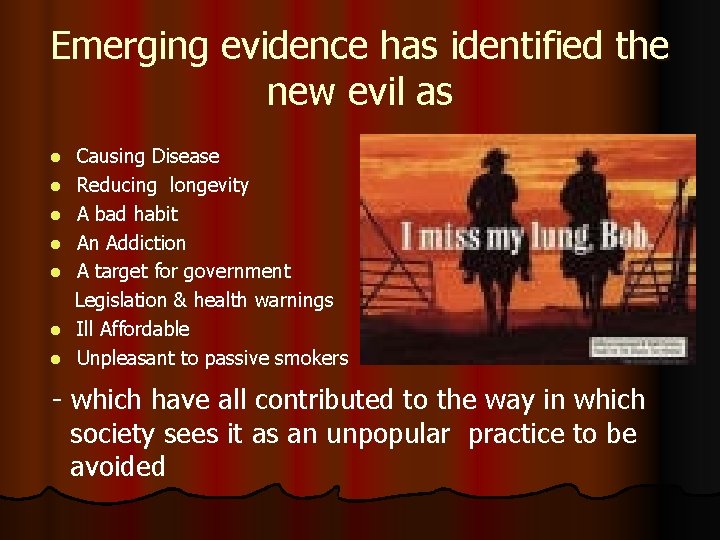
Emerging evidence has identified the new evil as l l l l Causing Disease Reducing longevity A bad habit An Addiction A target for government Legislation & health warnings Ill Affordable Unpleasant to passive smokers - which have all contributed to the way in which society sees it as an unpopular practice to be avoided
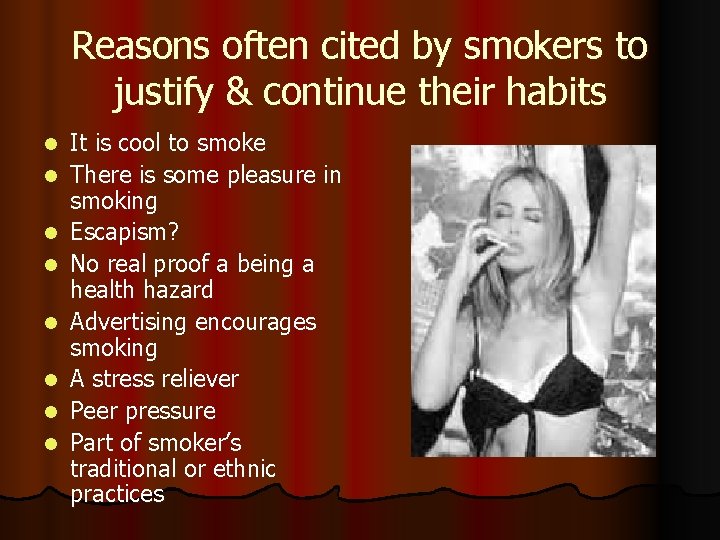
Reasons often cited by smokers to justify & continue their habits l l l l It is cool to smoke There is some pleasure in smoking Escapism? No real proof a being a health hazard Advertising encourages smoking A stress reliever Peer pressure Part of smoker’s traditional or ethnic practices
So is smoking really An Evil in disguise? In 1950 the first Evidence of a link between lung cancer and smoking was published in the British Medical Journal. - Research by Professor (now Sir) Richard Doll and A Bradford Hill. Ref: The history of smoking - http: //www. forestonline. org/output/page 34. asp
Is an anti-smoking campaign necessary? WHAT GOOD REASONS WOULD THERE BE FOR SMOKERS TO QUIT? Unhealthy –Within 12 hours of quitting your lungs work better. –Within 2 days, your sense of smell and taste improves. –After 3 weeks exercising is easier – You have more energy –Smoking can affect sexual performance by causing impotency in men. – 1/2 of all smokers die from tobacco related illnesses, such as heart disease, cancer and emphysema. –Smoking affects fertility: men who smoke have a lower sperm count and more abnormal sperm; Women who smoke may take longer to get pregnant and are more likely to miscarry.
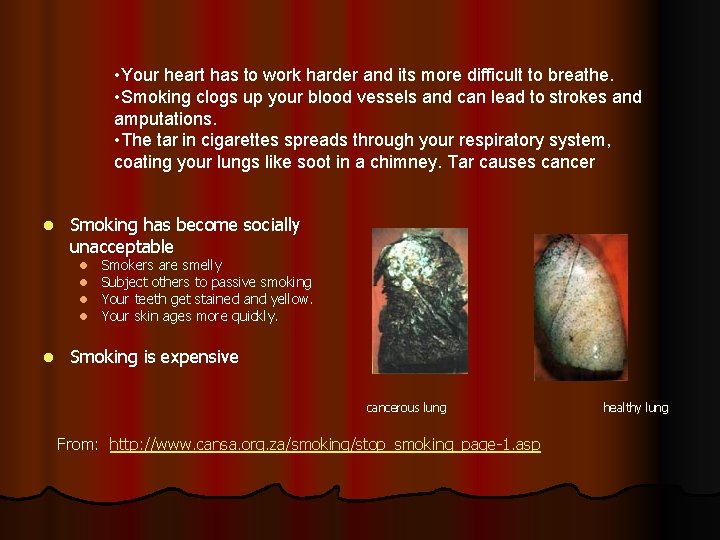
• Your heart has to work harder and its more difficult to breathe. • Smoking clogs up your blood vessels and can lead to strokes and amputations. • The tar in cigarettes spreads through your respiratory system, coating your lungs like soot in a chimney. Tar causes cancer l Smoking has become socially unacceptable l l l Smokers are smelly Subject others to passive smoking Your teeth get stained and yellow. Your skin ages more quickly. Smoking is expensive cancerous lung From: http: //www. cansa. org. za/smoking/stop_smoking_page-1. asp healthy lung
Why were these facts denied for so long? l health risks are largely driven by the epidemiological studies. Epidemiology is a statistically based science, dealing with risks among large groups of people, rather than with individuals l Science is still to determine which smokers will get a smoking related disease and which will not. Nor can science tell whether any individual became ill solely because they smoked. This is, in part, because all of the diseases that have been associated with smoking also occur in life-long non-smokers.
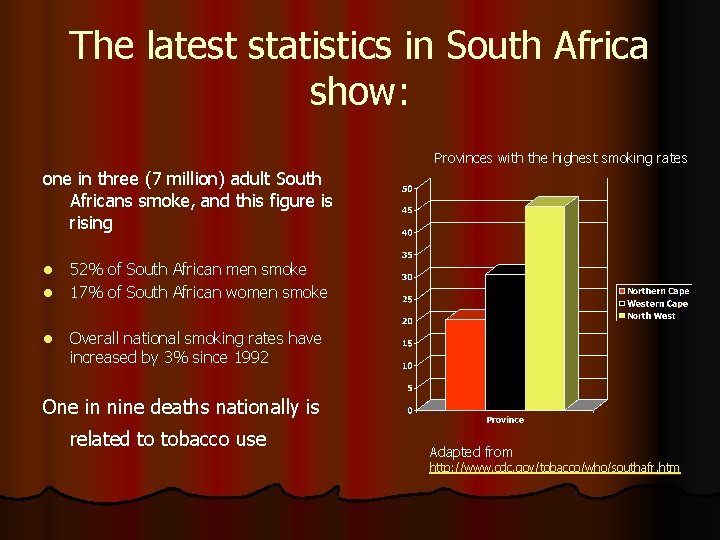
The latest statistics in South Africa show: Provinces with the highest smoking rates one in three (7 million) adult South Africans smoke, and this figure is rising l l l 52% of South African men smoke 17% of South African women smoke Overall national smoking rates have increased by 3% since 1992 One in nine deaths nationally is related to tobacco use Adapted from http: //www. cdc. gov/tobacco/who/southafr. htm
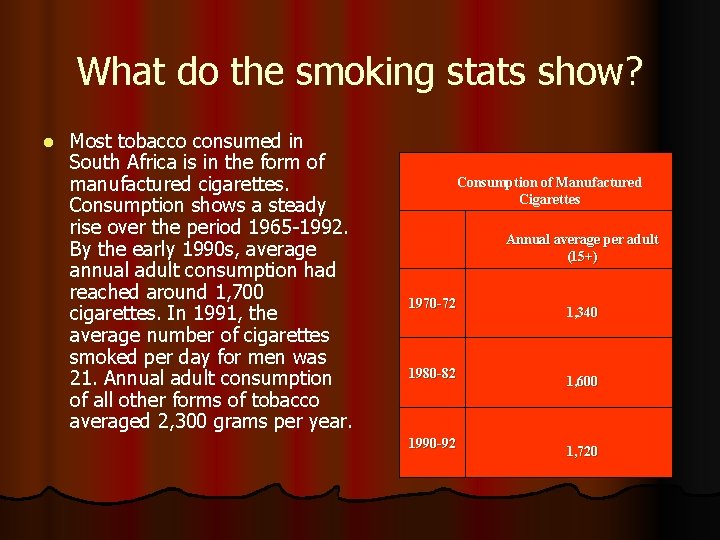
What do the smoking stats show? l Most tobacco consumed in South Africa is in the form of manufactured cigarettes. Consumption shows a steady rise over the period 1965 -1992. By the early 1990 s, average annual adult consumption had reached around 1, 700 cigarettes. In 1991, the average number of cigarettes smoked per day for men was 21. Annual adult consumption of all other forms of tobacco averaged 2, 300 grams per year. Consumption of Manufactured Cigarettes Annual average per adult (15+) 1970 -72 1980 -82 1990 -92 1, 340 1, 600 1, 720
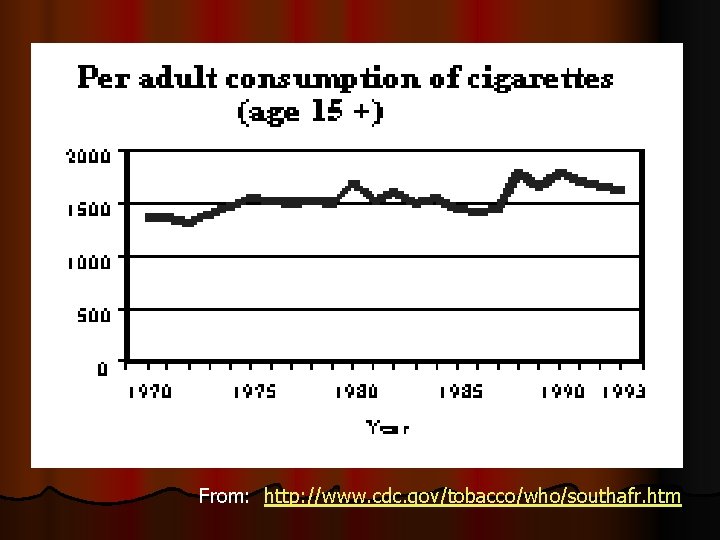
From: http: //www. cdc. gov/tobacco/who/southafr. htm
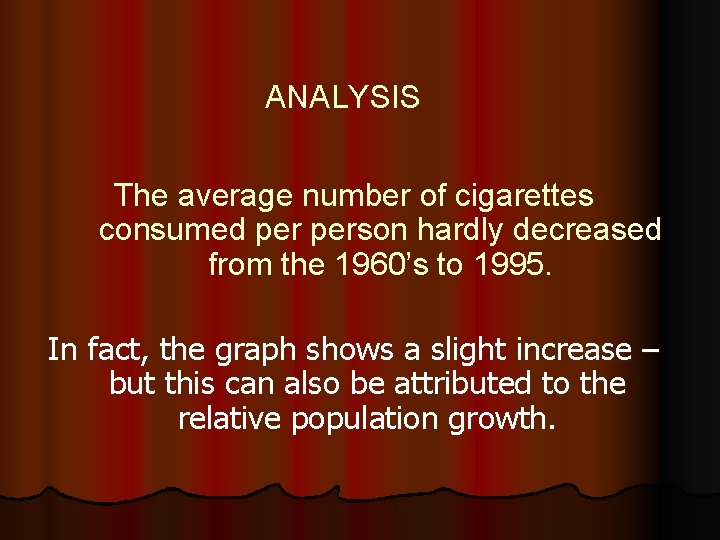
ANALYSIS The average number of cigarettes consumed person hardly decreased from the 1960’s to 1995. In fact, the graph shows a slight increase – but this can also be attributed to the relative population growth.
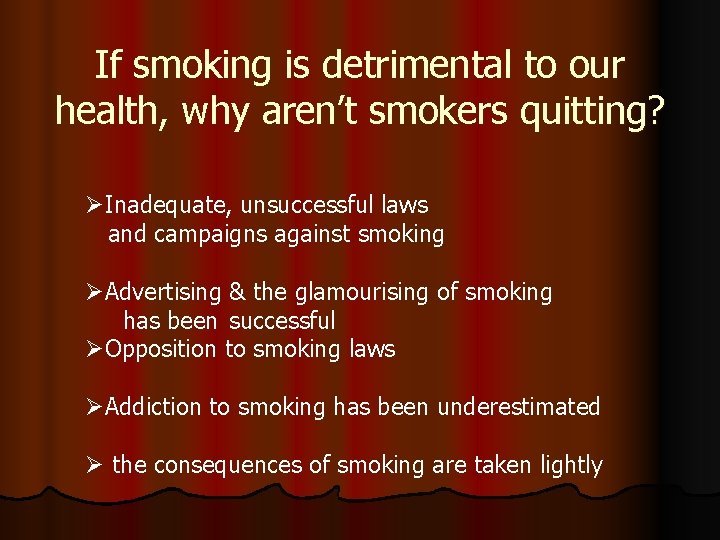
If smoking is detrimental to our health, why aren’t smokers quitting? ØInadequate, unsuccessful laws and campaigns against smoking ØAdvertising & the glamourising of smoking has been successful ØOpposition to smoking laws ØAddiction to smoking has been underestimated Ø the consequences of smoking are taken lightly
Conclusion • Anti-smoking campaigns have little effect – if any on the mindset of smokers. • Smoking is a personal choice and we need to find reasons for the reluctance among smokers to quit. (We need to interview individual smokers) • We are faced with a greater challenge to reduce smoking in our country. • (We need to run our own campaigns through e. g. fliers and brochures)

REFERENCES l http: //kidshealth. org/teen/drug_alcohol/to bacco/quit_smoking. html l http: //www. cansa. org. za/smoking/stop_s moking_page-1. asp
- Slides: 14