
Smoking Cessation in Malaysia by MR CHANDRAN KANNIAH

Smoking Cessation in Malaysia by MR CHANDRAN KANNIAH AMP HEALTH EDUCATION OFFICER HOSPITAL IPOH CHANDRAN KANNIAH AMP HEO IPOH HOSPITAL

5 principal causes of all medically certified deaths (Govt. Hosp. 1998) 1. 2. 3. 4. 5. Heart diseases & diseases of pulmonary circulation Septicaemia External causes Cerebrovascular diseases Malignant Neoplasm CHANDRAN KANNIAH AMP HEO IPOH HOSPITAL 14. 09% 12. 54% 9. 67% 9. 36% 8. 91%
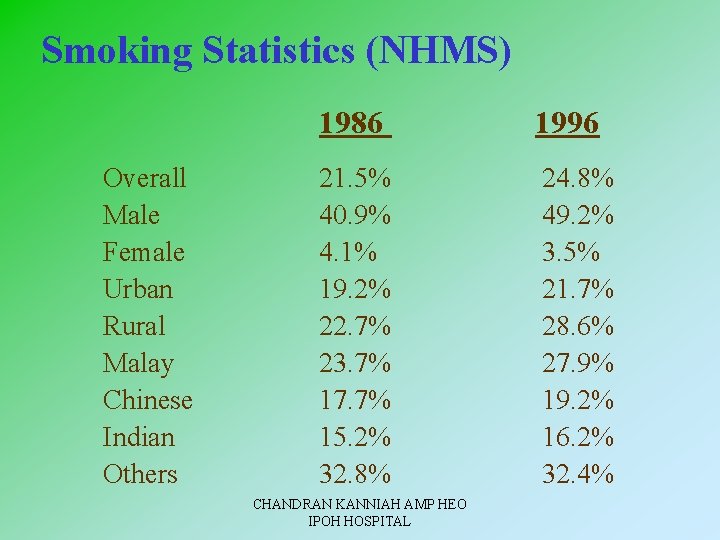
Smoking Statistics (NHMS) Overall Male Female Urban Rural Malay Chinese Indian Others 1986 1996 21. 5% 40. 9% 4. 1% 19. 2% 22. 7% 23. 7% 17. 7% 15. 2% 32. 8% 24. 8% 49. 2% 3. 5% 21. 7% 28. 6% 27. 9% 19. 2% 16. 2% 32. 4% CHANDRAN KANNIAH AMP HEO IPOH HOSPITAL
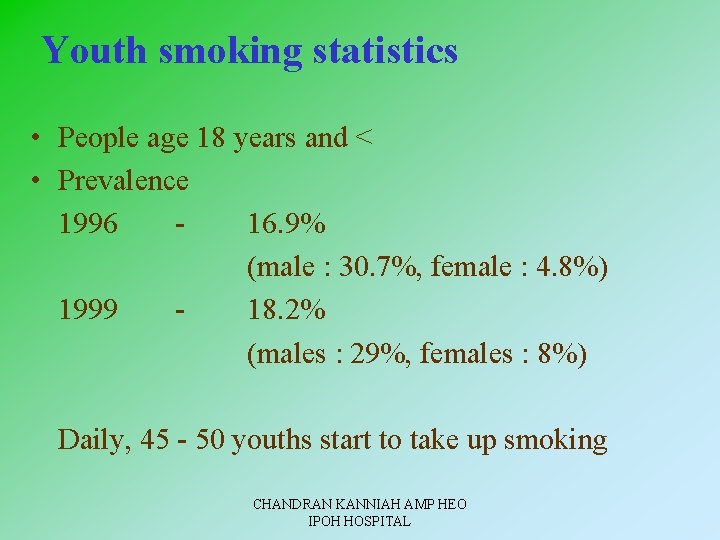
Youth smoking statistics • People age 18 years and < • Prevalence 1996 16. 9% (male : 30. 7%, female : 4. 8%) 1999 18. 2% (males : 29%, females : 8%) Daily, 45 - 50 youths start to take up smoking CHANDRAN KANNIAH AMP HEO IPOH HOSPITAL

Number of smokers – Estimates Population ( < 15 years) Population ( > 15 years) Prev. adult smokers : Male smokers Female smokers Overall adult prev. 2000 2025 22 m 7. 5 m (34%) 14. 5 m (66%) 30 m 7. 2 m (24%) 22. 8 m (76%) 49% 4% 25% 30% 10% 20% Number of adult smokers 3. 6 m CHANDRAN KANNIAH AMP HEO IPOH HOSPITAL 4. 6 m
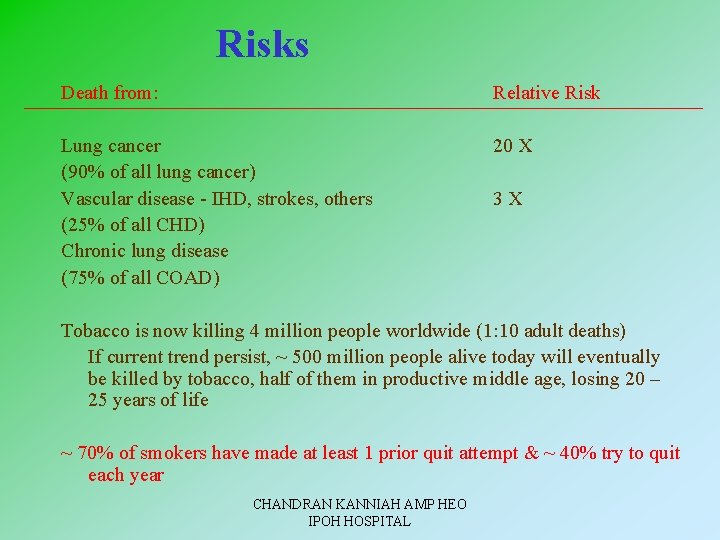
Risks Death from: Relative Risk Lung cancer (90% of all lung cancer) Vascular disease - IHD, strokes, others (25% of all CHD) Chronic lung disease (75% of all COAD) 20 X 3 X Tobacco is now killing 4 million people worldwide (1: 10 adult deaths) If current trend persist, ~ 500 million people alive today will eventually be killed by tobacco, half of them in productive middle age, losing 20 – 25 years of life ~ 70% of smokers have made at least 1 prior quit attempt & ~ 40% try to quit each year CHANDRAN KANNIAH AMP HEO IPOH HOSPITAL

Will Quit Smoking Modify One’s Risks? Duration of Quit 20 minutes 8 hours 24 hours 48 hours 14 days 1 month 3 months 9 months 1 year 5 years 10 years 15 years Benefits BP, PR, T° return to normal CO level in blood return to normal immediate risk of heart attack starts to fall nerve ending starts to regrow circulation improves, lung fn increase 30% most nicotine withdrawal symp. Disappear lung fn improve, nagging cough disappear, cilia regrow in the lungs risk in pregnancy cx reduced excess risk of CHD halfed risk of lung ca halfed, stroke risk = non-smoker, risk of mouth, throat & oesoph. ca halfed lung cancer death rate = non-smoker, pre-cancerous cells replaced CHANDRAN KANNIAH AMP HEO IPOH HOSPITAL risk of CHD= non-smoker
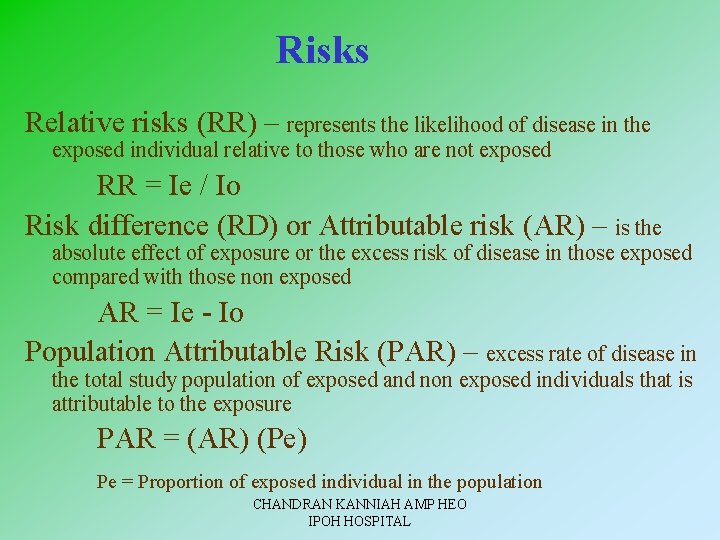
Risks Relative risks (RR) – represents the likelihood of disease in the exposed individual relative to those who are not exposed RR = Ie / Io Risk difference (RD) or Attributable risk (AR) – is the absolute effect of exposure or the excess risk of disease in those exposed compared with those non exposed AR = Ie - Io Population Attributable Risk (PAR) – excess rate of disease in the total study population of exposed and non exposed individuals that is attributable to the exposure PAR = (AR) (Pe) Pe = Proportion of exposed individual in the population CHANDRAN KANNIAH AMP HEO IPOH HOSPITAL

Is Tobacco Control Worth Paying For? Cost-effectiveness of any health intervention can be evaluated by estimating the expected gains in years of healthy life that each will achieve in return for the requisite public costs needed to implement that intervention. 1993 WORLD DEVELOPMENT REPORT - “Investing in Health” Tobacco control policies are considered cost-effective and worthy of inclusion in a minimal package of healthcare. Policy based programmes cost about US$ 20 – 80 per discounted year of healthy life saved (1 disability-adjusted life year – DALY) CHANDRAN KANNIAH AMP HEO IPOH HOSPITAL
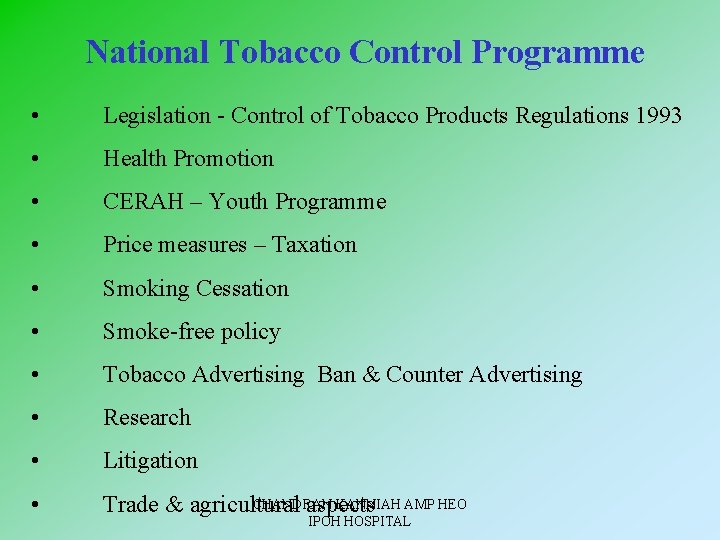
National Tobacco Control Programme • • Legislation - Control of Tobacco Products Regulations 1993 Health Promotion • CERAH – Youth Programme • Price measures – Taxation • Smoking Cessation • Smoke-free policy • Tobacco Advertising Ban & Counter Advertising • Research • Litigation • CHANDRAN KANNIAH AMP HEO Trade & agricultural aspects IPOH HOSPITAL
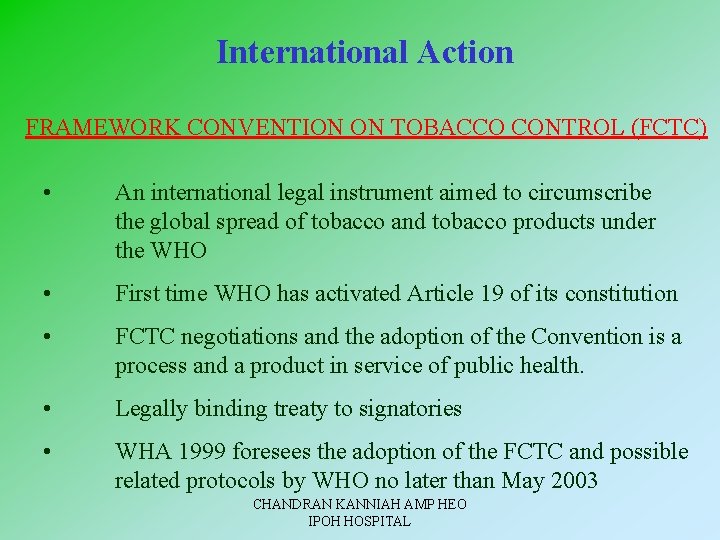
International Action FRAMEWORK CONVENTION ON TOBACCO CONTROL (FCTC) • An international legal instrument aimed to circumscribe the global spread of tobacco and tobacco products under the WHO • First time WHO has activated Article 19 of its constitution • FCTC negotiations and the adoption of the Convention is a process and a product in service of public health. • Legally binding treaty to signatories • WHA 1999 foresees the adoption of the FCTC and possible related protocols by WHO no later than May 2003 CHANDRAN KANNIAH AMP HEO IPOH HOSPITAL
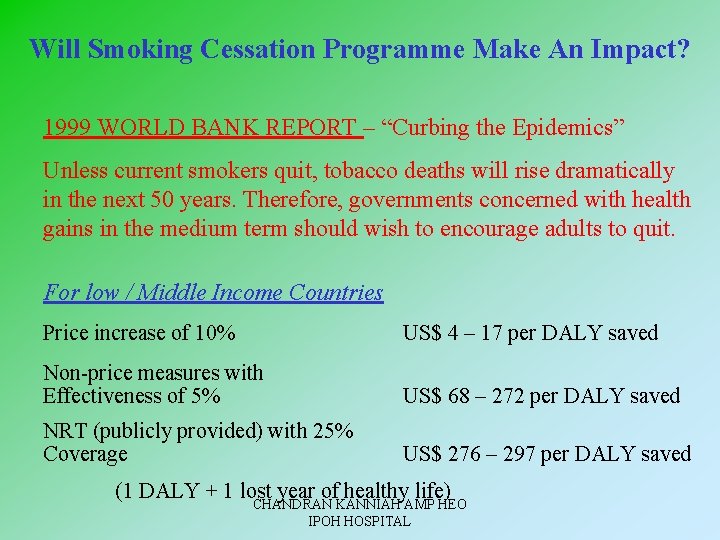
Will Smoking Cessation Programme Make An Impact? 1999 WORLD BANK REPORT – “Curbing the Epidemics” Unless current smokers quit, tobacco deaths will rise dramatically in the next 50 years. Therefore, governments concerned with health gains in the medium term should wish to encourage adults to quit. For low / Middle Income Countries Price increase of 10% US$ 4 – 17 per DALY saved Non-price measures with Effectiveness of 5% US$ 68 – 272 per DALY saved NRT (publicly provided) with 25% Coverage US$ 276 – 297 per DALY saved (1 DALY + 1 lost year of healthy life) CHANDRAN KANNIAH AMP HEO IPOH HOSPITAL
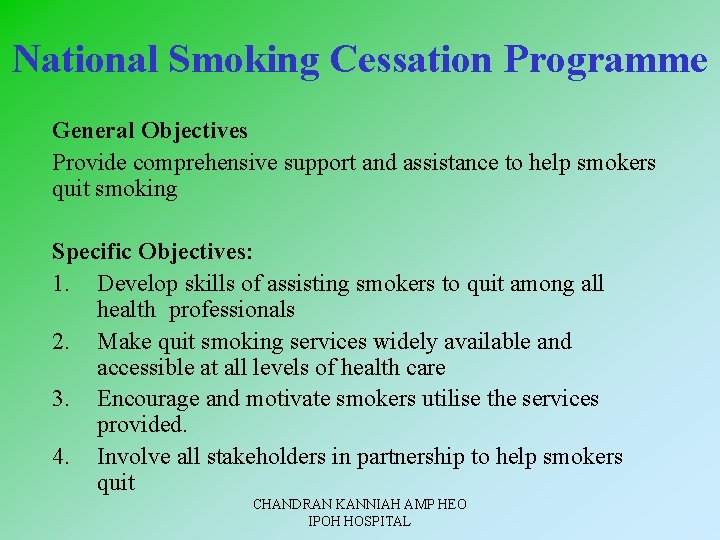
National Smoking Cessation Programme General Objectives Provide comprehensive support and assistance to help smokers quit smoking Specific Objectives: 1. Develop skills of assisting smokers to quit among all health professionals 2. Make quit smoking services widely available and accessible at all levels of health care 3. Encourage and motivate smokers utilise the services provided. 4. Involve all stakeholders in partnership to help smokers quit CHANDRAN KANNIAH AMP HEO IPOH HOSPITAL
National Smoking Cessation Programme STRATEGIES 1. Improve capacity building in area of expertise and infrastructure that will facilitate the establishment of comprehensive and effective quit smoking programme 2. Promote and advertise the availability of quit smoking services to the public and specific groups 3. Make all available all evidence-based treatment modalities 4. Inform and educate smokers about the benefits of quitting smoking CHANDRAN KANNIAH AMP HEO IPOH HOSPITAL

National Smoking Cessation Programme STRATEGIES 5. Promote community outreach quit smoking programmes 6. Integrating quit smoking programme (QSP) into all relevant health programmes. 7. Establish QSP Task Force at national, state and district 8. Networking and collaborative with other agencies nationally and globally levels. 9. Establish smokers anonymous groups CHANDRAN KANNIAH AMP HEO IPOH HOSPITAL
Problems Related To Smoking Cessation Clinicians are reluctant to address the smoking problem because: – it is believed that tobacco dependence is a habit and not a dependent disorder(chronic relapsing illness) – lacks adequate knowledge and skills to treat tobacco use and dependence – most do not realise that brief intervention can increase the quit rate among smokers. – most thought that pharmacotherapy is only to be used in intensive cessation treatment. CHANDRAN KANNIAH AMP HEO IPOH HOSPITAL

National Smoking Cessation Programme 1. Quit Smoking Manual – Dedicated Quit Clinics 2. Training Module 3. Clinical Practice Guideline – All health care providers (doctors, dentists, pharmacists, paramedics & allied health – in an integrated scheme of service provision at the private or public sector) CHANDRAN KANNIAH AMP HEO IPOH HOSPITAL
Clinical Practice Guideline • Assessment of tobacco Use • Clinical interventions – Brief Clinical Intervention – Intensive Clinical Intervention – Pharmacotherapy • Special Population CHANDRAN KANNIAH AMP HEO IPOH HOSPITAL
Assessment of Tobacco Use • All patients should be asked if they use tobacco and should have their tobaccouse status documented on a regular basis. • Evidence has shown that this significantly increases rates of clinician intervention • Guideline in assessing tobacco use. CHANDRAN KANNIAH AMP HEO IPOH HOSPITAL
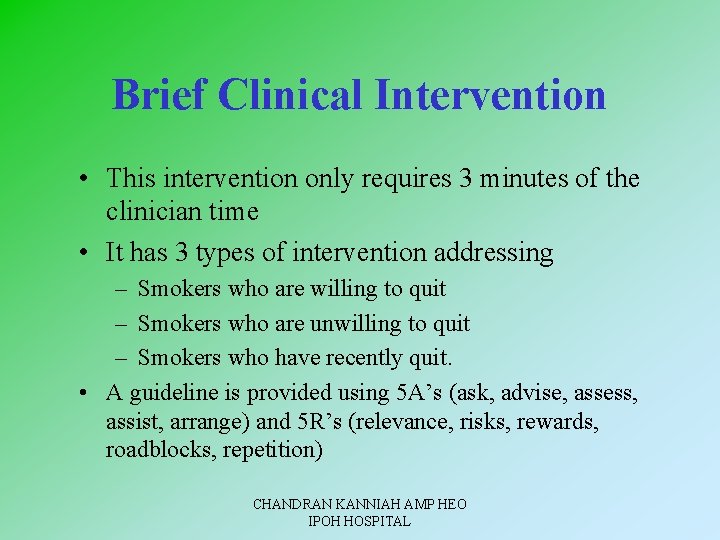
Brief Clinical Intervention • This intervention only requires 3 minutes of the clinician time • It has 3 types of intervention addressing – Smokers who are willing to quit – Smokers who are unwilling to quit – Smokers who have recently quit. • A guideline is provided using 5 A’s (ask, advise, assess, assist, arrange) and 5 R’s (relevance, risks, rewards, roadblocks, repetition) CHANDRAN KANNIAH AMP HEO IPOH HOSPITAL
Intensive Clinical Intervention • Evidence shows that more intensive tobacco dependence treatment is more effective than brief treatment. • This could be achieved by increasing – the length of individual treatment sessions – the number of treatment sessions – specialized behavioural therapies. CHANDRAN KANNIAH AMP HEO IPOH HOSPITAL
Dedicated Quit Smoking Clinics • • Counseling (smoking, diet, stress) Individual / Group Pharmacotherapy Motivation (dental care, CO analyser, lung function, blood analyses) • Referrals • Close monitoring & F/U CHANDRAN KANNIAH AMP HEO IPOH HOSPITAL
Pharmacotherapy • In addition to counseling, all smokers should receive pharmacotherapy if they fulfill the criteria below: – with scores from Fagerstrom’s questionnaire of > 4 – smoking > 10 cigarettes per day CHANDRAN KANNIAH AMP HEO IPOH HOSPITAL
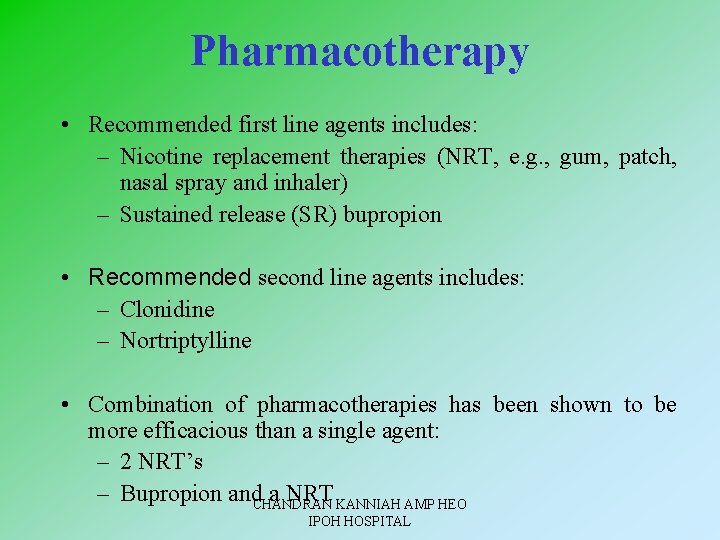
Pharmacotherapy • Recommended first line agents includes: – Nicotine replacement therapies (NRT, e. g. , gum, patch, nasal spray and inhaler) – Sustained release (SR) bupropion • Recommended second line agents includes: – Clonidine – Nortriptylline • Combination of pharmacotherapies has been shown to be more efficacious than a single agent: – 2 NRT’s – Bupropion and a NRT CHANDRAN KANNIAH AMP HEO IPOH HOSPITAL
Special Population • • • Gender: women. Pregnancy Hospitalized smokers Psychiatric population. Children and adolescents. Elderly. CHANDRAN KANNIAH AMP HEO IPOH HOSPITAL
THANK YOU CHANDRAN KANNIAH AMP HEO IPOH HOSPITAL
- Slides: 26