
SMOKE DETECTOR A fire detector designed to operate








- Slides: 41
SMOKE DETECTOR – A fire detector designed to operate when the concentration of airborne combustion products exceed a predetermined level. SMOKE DETECTOR SENSITIVITY – The relative degree of response of a smoke detector expressed in %/foot obscuration. A high sensitivity detector responds to a lower concentration of smoke while a low sensitivity detector responds to a high concentration of smoke under identical fire test conditions. OBSCURATION – The unit of measurement where smoke has an effect on visibility. Expressed in %/foot.
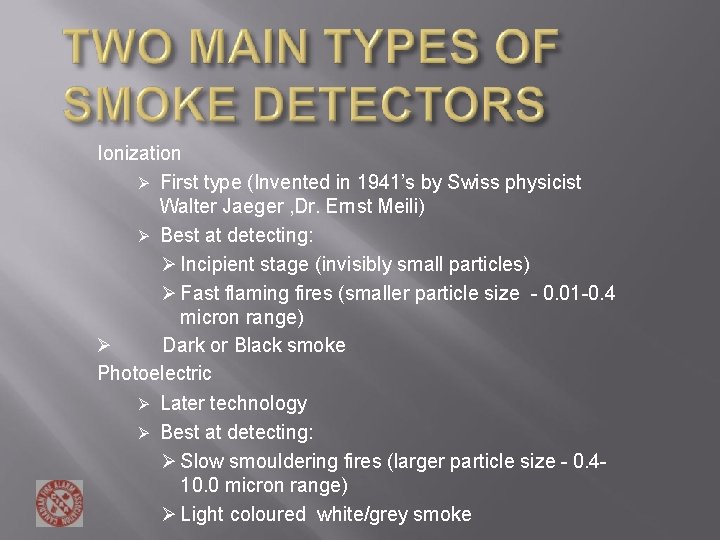
Ionization First type (Invented in 1941’s by Swiss physicist Walter Jaeger , Dr. Ernst Meili) Best at detecting: Incipient stage (invisibly small particles) Fast flaming fires (smaller particle size - 0. 01 -0. 4 micron range) Dark or Black smoke Photoelectric Later technology Best at detecting: Slow smouldering fires (larger particle size - 0. 410. 0 micron range) Light coloured white/grey smoke
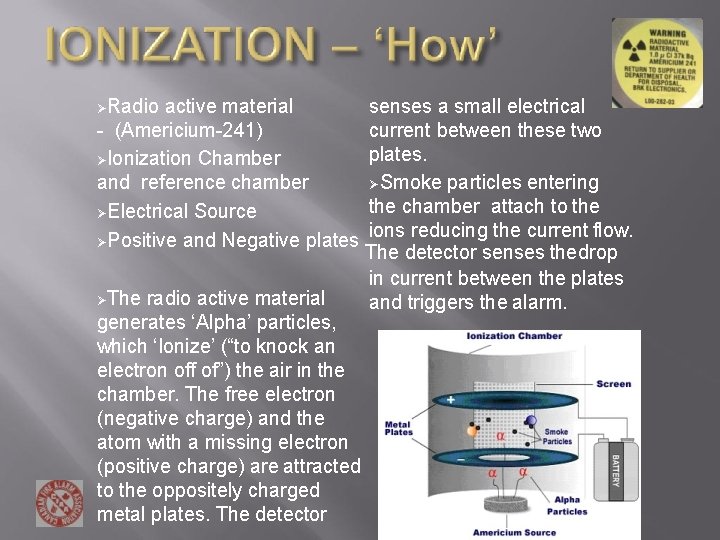
Radio active material - (Americium-241) Ionization Chamber and reference chamber Electrical Source Positive and Negative plates The radio active material generates ‘Alpha’ particles, which ‘Ionize’ (“to knock an electron off of”) the air in the chamber. The free electron (negative charge) and the atom with a missing electron (positive charge) are attracted to the oppositely charged metal plates. The detector senses a small electrical current between these two plates. Smoke particles entering the chamber attach to the ions reducing the current flow. The detector senses thedrop in current between the plates and triggers the alarm.
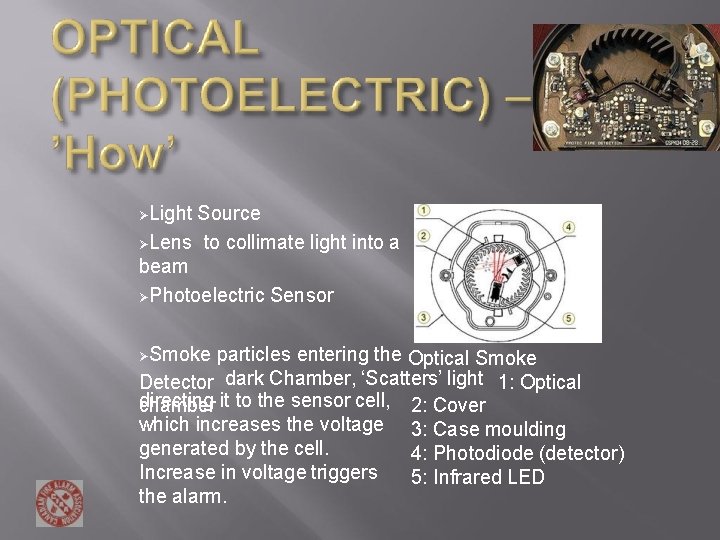
Light Source Lens to collimate light into a beam Photoelectric Sensor Smoke particles entering the Optical Smoke Detector dark Chamber, ‘Scatters’ light 1: Optical directing it to the sensor cell, 2: Cover chamber which increases the voltage 3: Case moulding generated by the cell. 4: Photodiode (detector) Increase in voltage triggers 5: Infrared LED the alarm.
Smoke detectors where installed properly and maintained within their listed sensitivity ranges have proven to be effective in saving lives and property. However, smoke detectors become less reliable with time, due to aging of their electronic components and environmental conditions, making it even more important to test the detectors in accordance with the CAN/UL-S 536 -04 ” Inspection and Testing of Fire Alarm Systems”.
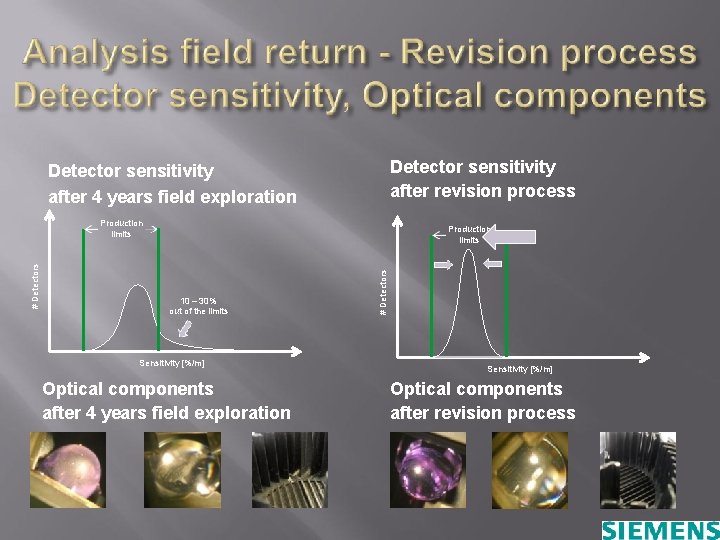
Detector sensitivity after revision process Detector sensitivity after 4 years field exploration Production limits 10 – 30% out of the limits Sensitivity [%/m] Optical components after 4 years field exploration # Detectors Production limits Sensitivity [%/m] Optical components after revision process
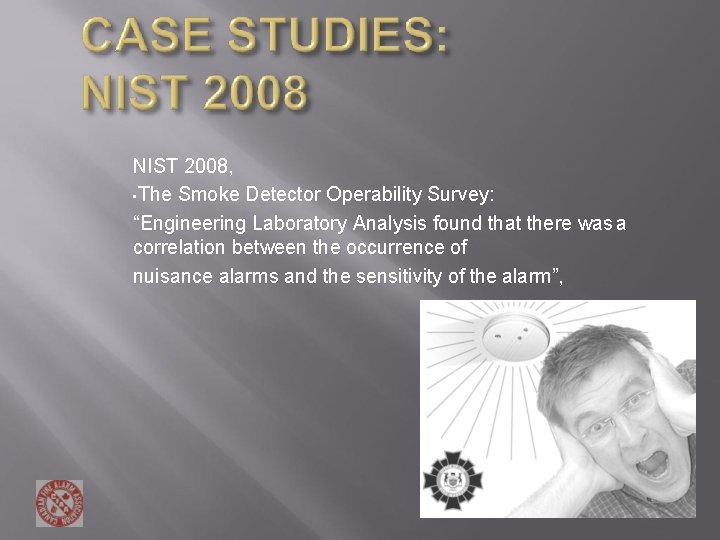
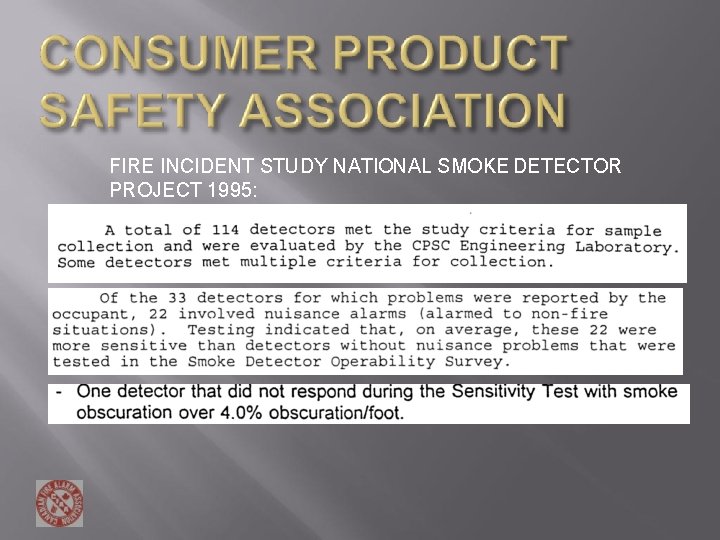
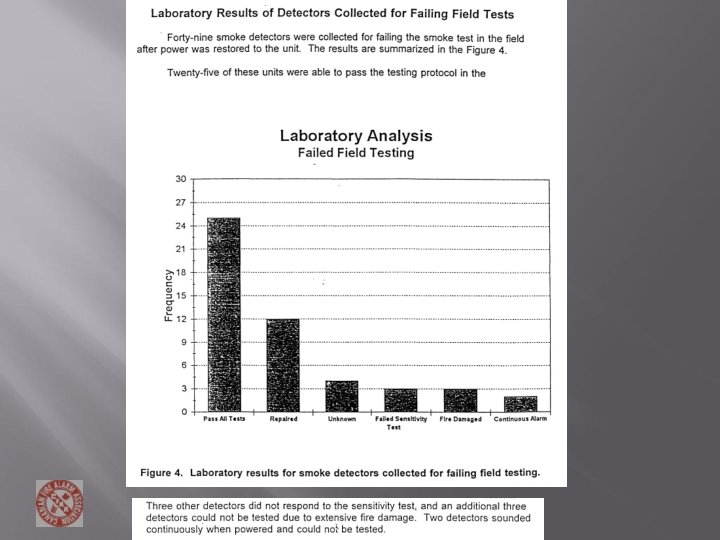
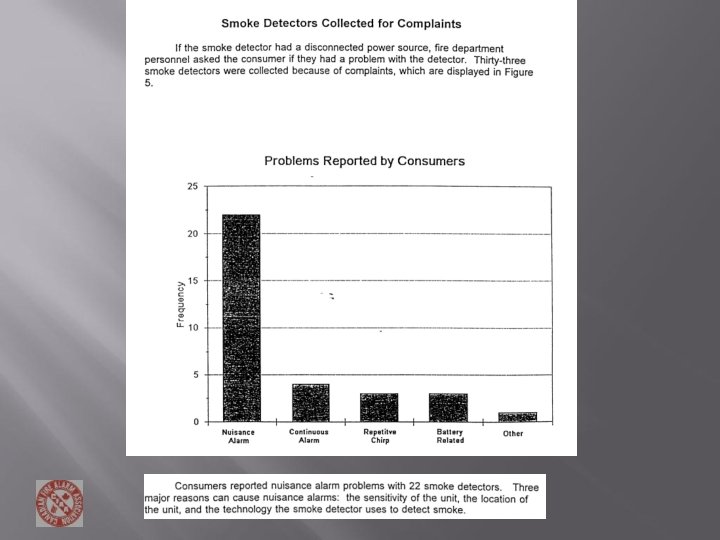
NIST 2008, • The Smoke Detector Operability Survey: “Engineering Laboratory Analysis found that there was a correlation between the occurrence of nuisance alarms and the sensitivity of the alarm”,
FIRE INCIDENT STUDY NATIONAL SMOKE DETECTOR PROJECT 1995:
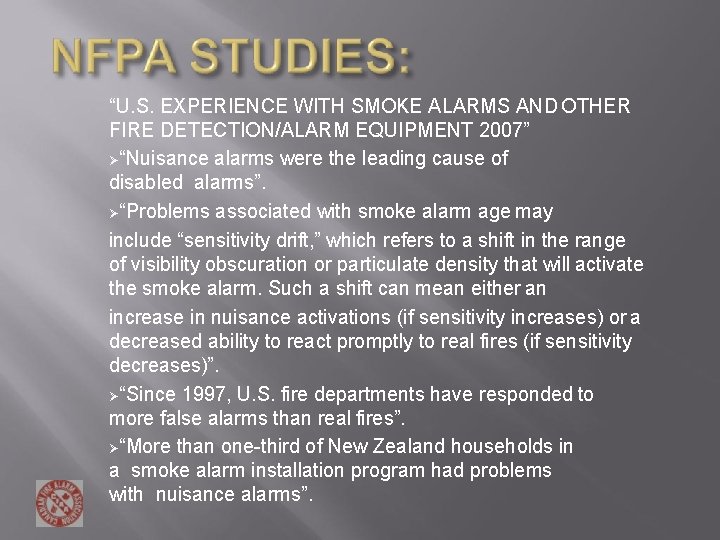
“U. S. EXPERIENCE WITH SMOKE ALARMS AND OTHER FIRE DETECTION/ALARM EQUIPMENT 2007” “Nuisance alarms were the leading cause of disabled alarms”. “Problems associated with smoke alarm age may include “sensitivity drift, ” which refers to a shift in the range of visibility obscuration or particulate density that will activate the smoke alarm. Such a shift can mean either an increase in nuisance activations (if sensitivity increases) or a decreased ability to react promptly to real fires (if sensitivity decreases)”. “Since 1997, U. S. fire departments have responded to more false alarms than real fires”. “More than one-third of New Zealand households in a smoke alarm installation program had problems with nuisance alarms”.
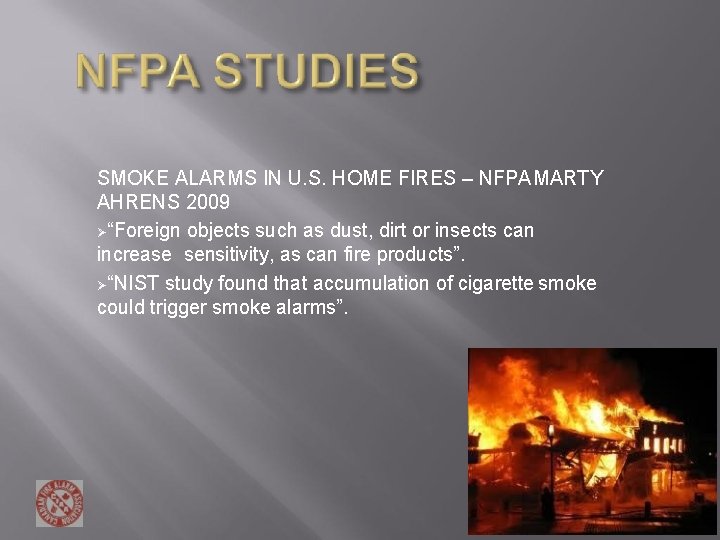
SMOKE ALARMS IN U. S. HOME FIRES – NFPA MARTY AHRENS 2009 “Foreign objects such as dust, dirt or insects can increase sensitivity, as can fire products”. “NIST study found that accumulation of cigarette smoke could trigger smoke alarms”.
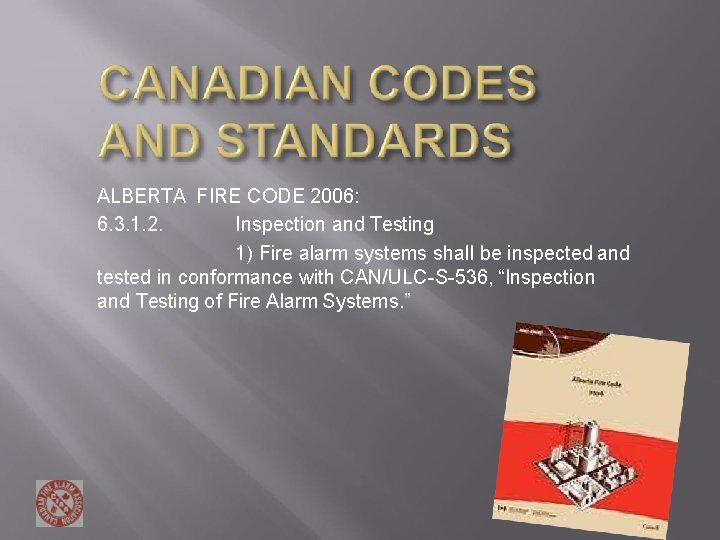
ALBERTA FIRE CODE 2006: Inspection and Testing 6. 3. 1. 2. 1) Fire alarm systems shall be inspected and tested in conformance with CAN/ULC-S-536, “Inspection and Testing of Fire Alarm Systems. ”
Testing Evolution - CAN/ULC-S 536 -82 4. 4 – Yearly Testing 4. 4. 1 Every year the following tests shall be conducted and if a fault is established appropriate corrective action shall be taken: 4. 4. 1 A – Every reasonable effort shall be made to test all components required in this subsection. In the event that some components cannot reasonable be made accessible, a list of such components and their location shall be included in the report. However, all such components shall be tested at least once every three years. F – Each automatic alarm initiating device shall be tested for its intended function in accordance with the manufacturer’s instructions;
Testing Evolution - CAN/ULC-S 536 -86 5. Inspect and test the smoke detectors in accordance with the manufacturer’s recommendations. 6. Smoke detectors shall be tested for operability and the required sensitivity. NOTE: A cleaning schedule for smoke detectors, based on the environmental conditions prevailing and the results of clause 5. 3. 6. 6, should be established and maintained.
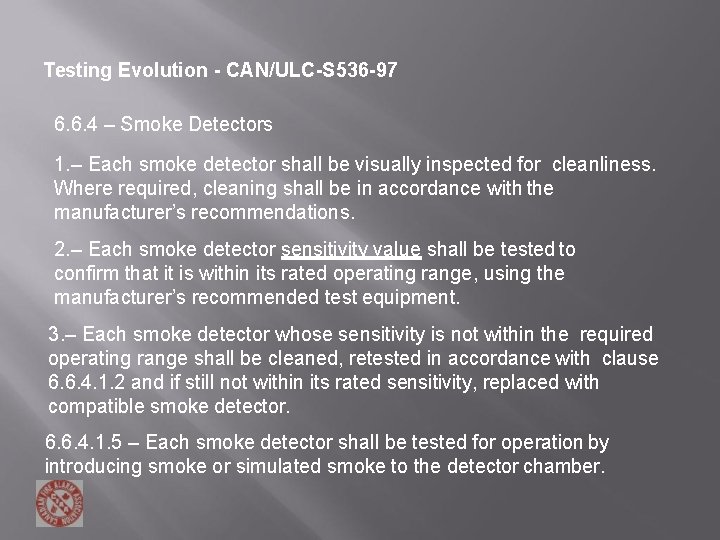
Testing Evolution - CAN/ULC-S 536 -97 6. 6. 4 – Smoke Detectors 1. – Each smoke detector shall be visually inspected for cleanliness. Where required, cleaning shall be in accordance with the manufacturer’s recommendations. 2. – Each smoke detector sensitivity value shall be tested to confirm that it is within its rated operating range, using the manufacturer’s recommended test equipment. 3. – Each smoke detector whose sensitivity is not within the required operating range shall be cleaned, retested in accordance with clause 6. 6. 4. 1. 2 and if still not within its rated sensitivity, replaced with compatible smoke detector. 6. 6. 4. 1. 5 – Each smoke detector shall be tested for operation by introducing smoke or simulated smoke to the detector chamber.
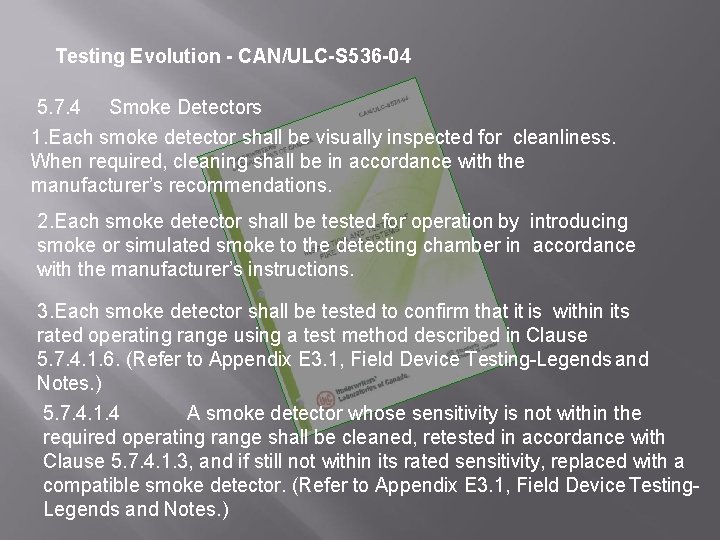
Testing Evolution - CAN/ULC-S 536 -04 5. 7. 4 Smoke Detectors 1. Each smoke detector shall be visually inspected for cleanliness. When required, cleaning shall be in accordance with the manufacturer’s recommendations. 2. Each smoke detector shall be tested for operation by introducing smoke or simulated smoke to the detecting chamber in accordance with the manufacturer’s instructions. 3. Each smoke detector shall be tested to confirm that it is within its rated operating range using a test method described in Clause 5. 7. 4. 1. 6. (Refer to Appendix E 3. 1, Field Device Testing-Legends and Notes. ) 5. 7. 4. 1. 4 A smoke detector whose sensitivity is not within the required operating range shall be cleaned, retested in accordance with Clause 5. 7. 4. 1. 3, and if still not within its rated sensitivity, replaced with a compatible smoke detector. (Refer to Appendix E 3. 1, Field Device Testing. Legends and Notes. )
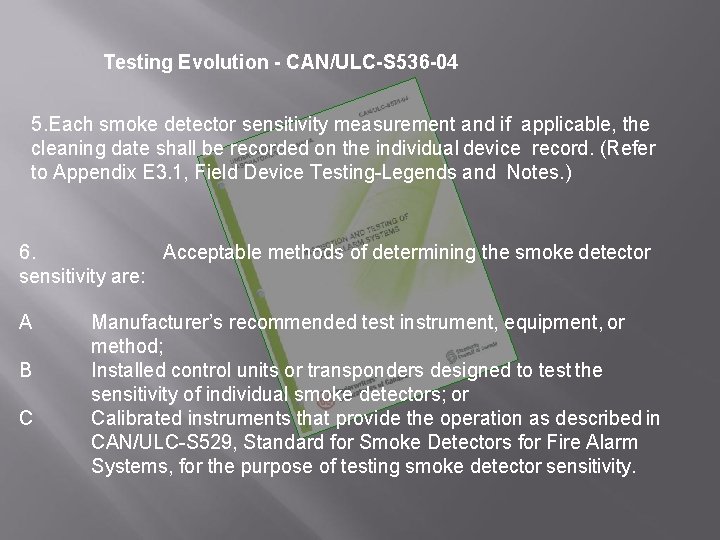
Testing Evolution - CAN/ULC-S 536 -04 5. Each smoke detector sensitivity measurement and if applicable, the cleaning date shall be recorded on the individual device record. (Refer to Appendix E 3. 1, Field Device Testing-Legends and Notes. ) 6. Acceptable methods of determining the smoke detector sensitivity are: A B C Manufacturer’s recommended test instrument, equipment, or method; Installed control units or transponders designed to test the sensitivity of individual smoke detectors; or Calibrated instruments that provide the operation as described in CAN/ULC-S 529, Standard for Smoke Detectors for Fire Alarm Systems, for the purpose of testing smoke detector sensitivity.
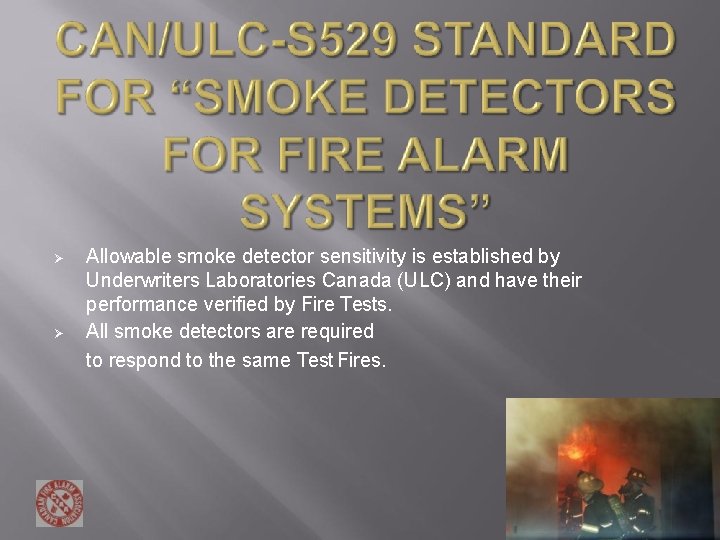
Allowable smoke detector sensitivity is established by Underwriters Laboratories Canada (ULC) and have their performance verified by Fire Tests. All smoke detectors are required to respond to the same Test Fires.
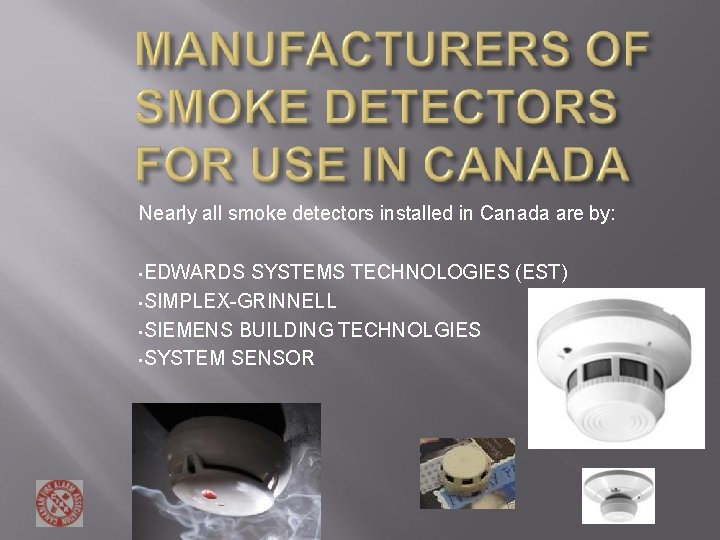
Nearly all smoke detectors installed in Canada are by: EDWARDS SYSTEMS TECHNOLOGIES (EST) • SIMPLEX-GRINNELL • SIEMENS BUILDING TECHNOLGIES • SYSTEM SENSOR •
Why test detector function and sensitivity? Detector sensitivity can, and does, drift. Over-sensitivity leads to false alarms, under-sensitivity to late alarms - or no alarms. The need for functional testing through introducing a smoke type stimulus is well recognised: “Since stimulus of the sensing element through introduction of the phenomena or surrogate phenomena which the detectors are designed to detect forms part of the test(s), use of a test button or a test magnet (for example) or compliance with 45(i) (confirmation of analogue values) does not satisfy the recommendations. . ” BS 5839 1: 2002 45. 3 (Note 4)
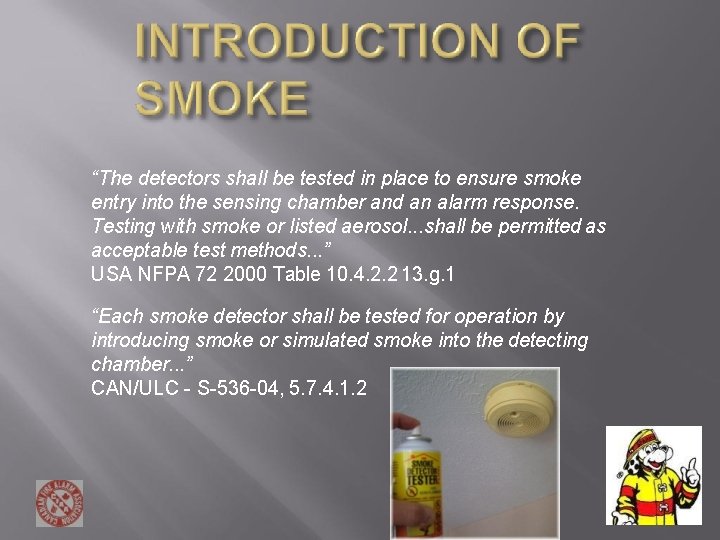
“The detectors shall be tested in place to ensure smoke entry into the sensing chamber and an alarm response. Testing with smoke or listed aerosol. . . shall be permitted as acceptable test methods. . . ” USA NFPA 72 2000 Table 10. 4. 2. 2 13. g. 1 “Each smoke detector shall be tested for operation by introducing smoke or simulated smoke into the detecting chamber. . . ” CAN/ULC - S-536 -04, 5. 7. 4. 1. 2
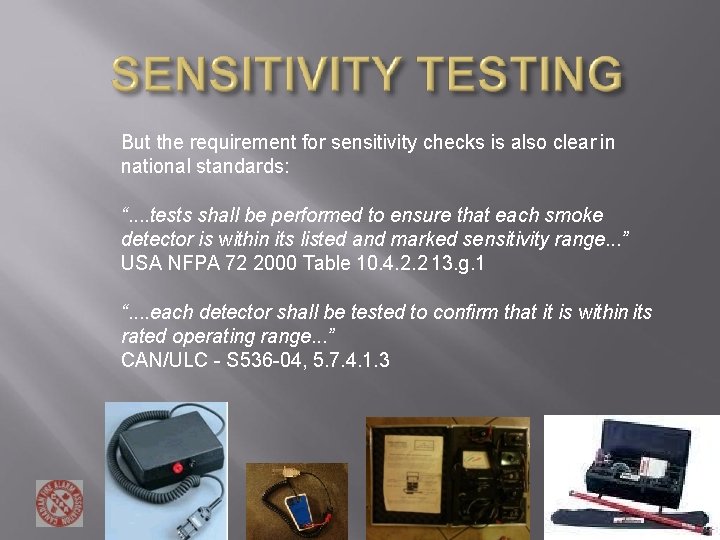
But the requirement for sensitivity checks is also clear in national standards: “. . tests shall be performed to ensure that each smoke detector is within its listed and marked sensitivity range. . . ” USA NFPA 72 2000 Table 10. 4. 2. 2 13. g. 1 “. . each detector shall be tested to confirm that it is within its rated operating range. . . ” CAN/ULC - S 536 -04, 5. 7. 4. 1. 3
Soiling Level vs. Sensitivity Level Contrary to North America, the European approach is to evaluate the level of soiling in the detector, which is nothing more than the inverse of testing remaining sensitivity
Standard = DIN 14675/A 1 + VDE 0833 -1 DIN 14675/A 1: 2006 Paragraph 11. 5. 3 (see notes) Fire detectors are to be exchanged or overhauled according to the manufacturer’s specifications. This must be documented in the operation log book. w/o Drift Compensation – test with gas every year and replace on failure or after 5 years with new or factory refurbished unit. with Drift Compensation – test with gas every year and replace on failure or after 8 years with new or factory refurbished unit.
Non-monitored – test with gas every year and replace on failure or after 6 years with new or factory refurbished unit. Monitored – test with gas every year and replace on failure or after 8 years with new or factory refurbished unit.
Standard = NF / CNPP Non-monitored or Monitored – test with gas every year and replace on failure or after 4 years with new or factory refurbished unit.
Standard = BS 5839 Part 1 Non-monitored or Monitored – test with gas and measure sensitivity every year replace on failure with new unit. Testing can involve using complex testing equipment, whereby the detector is exposed to a defined smoke concentration. The concentration is slowly increased, until the device goes into alarm, thereby establishing the sensitivity. Testing must in some cases even be witnessed!
Non-monitored or Monitored – test with gas and measure sensitivity every year replace on failure with new unit.
KNOWLEDGE Education limited within Alberta Information can be difficult to source EQUIPMENT Specialized COST Increases time required when done in conformance with CAN/ULC Standards.
NEWER SMOKE DETECTORS Addressable: real time monitoring/diagnostics reporting directly to the fire alarm control panel. Some detectors look for fire signature, not just smoke, can require specialized knowledge to test correctly. Can utilize drift compensation technology Conventional: easier testing with information available. Variety of methods: Obscuration Voltage Diagnostic LED’S Can utilize drift compensation technology
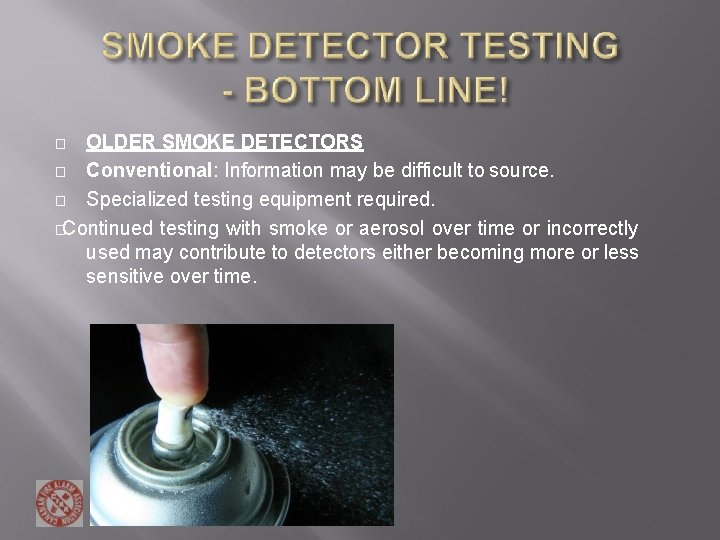
OLDER SMOKE DETECTORS � Conventional: Information may be difficult to source. � Specialized testing equipment required. �Continued testing with smoke or aerosol over time or incorrectly used may contribute to detectors either becoming more or less sensitive over time. �
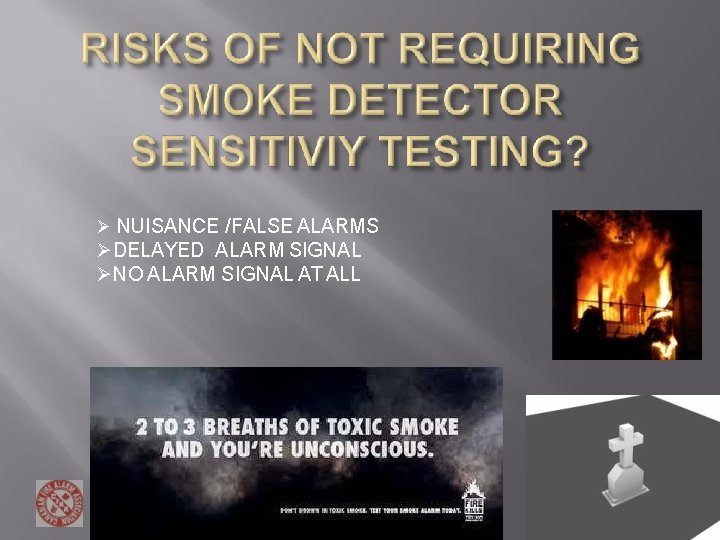
NUISANCE /FALSE ALARMS DELAYED ALARM SIGNAL NO ALARM SIGNAL AT ALL
Require better education for those qualified under the AFC, IE CFAA Fire Alarm Technology Program. Require fire alarm Testing and Inspections in conformance with the CAN/ULC-S 536 -04 ‘Inspection and Testing of Fire Alarm Systems’. Including smoke detector sensitivity testing, Where smoke detector sensitivity testing is not done in conformance with Clause 5. 7. 4. 1. 6. A – C, that smoke detector shall be replaced with a new smoke detector within 5 years. WHY? Smoke detectors do drift outside of their listed smoke detector sensitivity range, introducing smoke into the chamber and seeing the detector alarm, does not prove that it is still operating within it’s designed parameters and will work in a real fire condition to detect the products of combustion when required!
QUESTIONS?