
Smoke Density and Toxicity Analysis of different classification
- Slides: 6
Smoke Density and Toxicity Analysis of different classification and test methods used in transport modes C. Vinson - GERFLOR - Strictly Confidential -
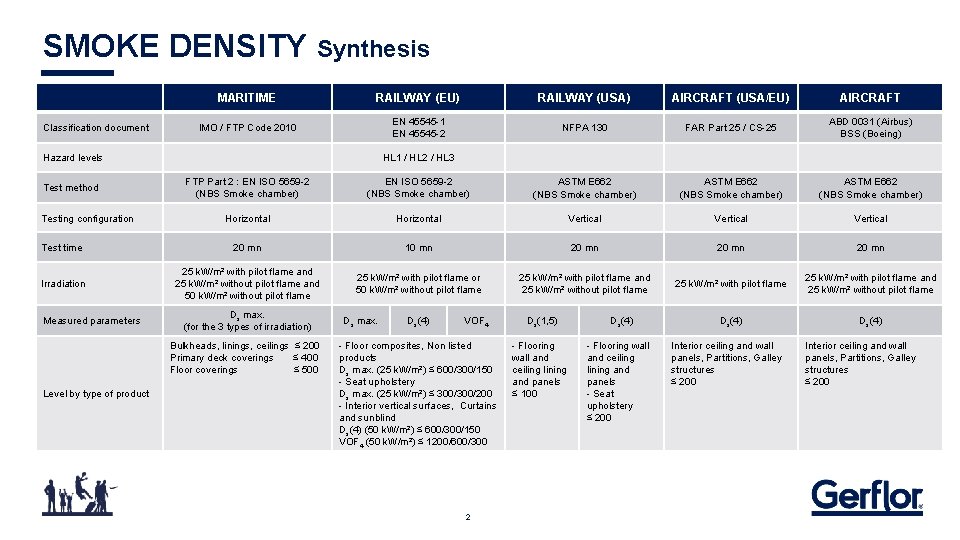
SMOKE DENSITY Synthesis Classification document MARITIME RAILWAY (EU) RAILWAY (USA) AIRCRAFT (USA/EU) AIRCRAFT IMO / FTP Code 2010 EN 45545 -1 EN 45545 -2 NFPA 130 FAR Part 25 / CS-25 ABD 0031 (Airbus) BSS (Boeing) Hazard levels HL 1 / HL 2 / HL 3 FTP Part 2 : EN ISO 5659 -2 (NBS Smoke chamber) ASTM E 662 (NBS Smoke chamber) Horizontal Vertical Test time 20 mn 10 mn 20 mn Irradiation 25 k. W/m² with pilot flame and 25 k. W/m² without pilot flame and 50 k. W/m² without pilot flame 25 k. W/m² with pilot flame or 50 k. W/m² without pilot flame 25 k. W/m² with pilot flame and 25 k. W/m² without pilot flame Ds(4) Test method Testing configuration Measured parameters Ds max. (for the 3 types of irradiation) Bulkheads, linings, ceilings ≤ 200 Primary deck coverings ≤ 400 Floor coverings ≤ 500 Level by type of product Ds max. Ds(4) VOF 4 - Floor composites, Non listed products Ds max. (25 k. W/m²) ≤ 600/300/150 - Seat upholstery Ds max. (25 k. W/m²) ≤ 300/200 - Interior vertical surfaces, Curtains and sunblind Ds(4) (50 k. W/m²) ≤ 600/300/150 VOF 4 (50 k. W/m²) ≤ 1200/600/300 2 Ds(1, 5) - Flooring wall and ceiling lining and panels ≤ 100 Ds(4) - Flooring wall and ceiling lining and panels - Seat upholstery ≤ 200 Interior ceiling and wall panels, Partitions, Galley structures ≤ 200
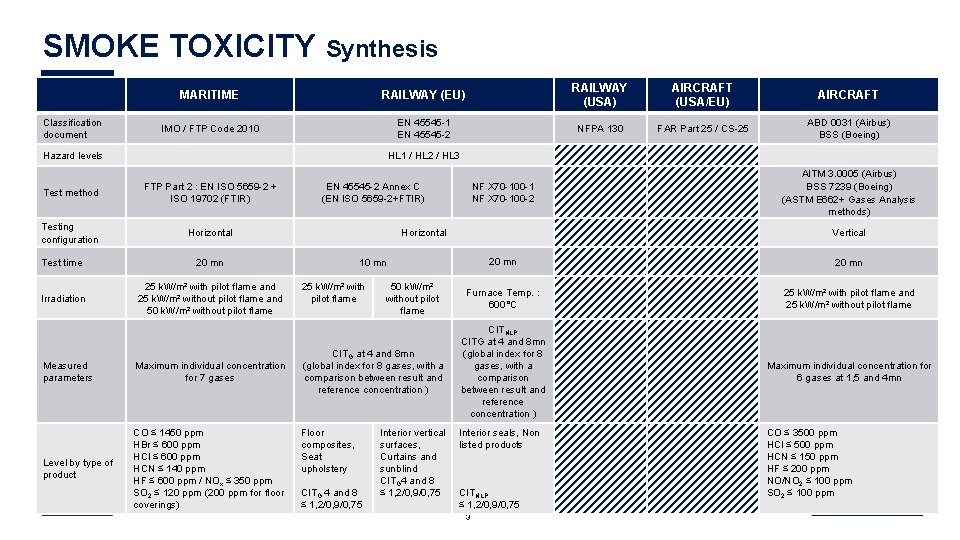
SMOKE TOXICITY Synthesis Classification document MARITIME RAILWAY (EU) RAILWAY (USA) AIRCRAFT (USA/EU) AIRCRAFT IMO / FTP Code 2010 EN 45545 -1 EN 45545 -2 NFPA 130 FAR Part 25 / CS-25 ABD 0031 (Airbus) BSS (Boeing) Hazard levels HL 1 / HL 2 / HL 3 Test method FTP Part 2 : EN ISO 5659 -2 + ISO 19702 (FTIR) Testing configuration Horizontal Test time 20 mn Irradiation 25 k. W/m² with pilot flame and 25 k. W/m² without pilot flame and 50 k. W/m² without pilot flame Measured parameters Maximum individual concentration for 7 gases Level by type of product CO ≤ 1450 ppm HBr ≤ 600 ppm HCl ≤ 600 ppm HCN ≤ 140 ppm HF ≤ 600 ppm / NOx ≤ 350 ppm SO 2 ≤ 120 ppm (200 ppm for floor coverings) EN 45545 -2 Annex C (EN ISO 5659 -2+FTIR) NF X 70 -100 -1 NF X 70 -100 -2 Horizontal Vertical 20 mn Furnace Temp. : 600°C 25 k. W/m² with pilot flame and 25 k. W/m² without pilot flame CITNLP CITG at 4 and 8 mn (global index for 8 gases, with a comparison between result and reference concentration ) Maximum individual concentration for 6 gases at 1, 5 and 4 mn 10 mn 25 k. W/m² with pilot flame 50 k. W/m² without pilot flame CITG at 4 and 8 mn (global index for 8 gases, with a comparison between result and reference concentration ) Floor composites, Seat upholstery CITG 4 and 8 ≤ 1, 2/0, 9/0, 75 Interior vertical surfaces, Curtains and sunblind CITG 4 and 8 ≤ 1, 2/0, 9/0, 75 AITM 3. 0005 (Airbus) BSS 7239 (Boeing) (ASTM E 662+ Gases Analysis methods) Interior seals, Non listed products CITNLP ≤ 1, 2/0, 9/0, 75 3 CO ≤ 3500 ppm HCl ≤ 500 ppm HCN ≤ 150 ppm HF ≤ 200 ppm NO/NO 2 ≤ 100 ppm SO 2 ≤ 100 ppm
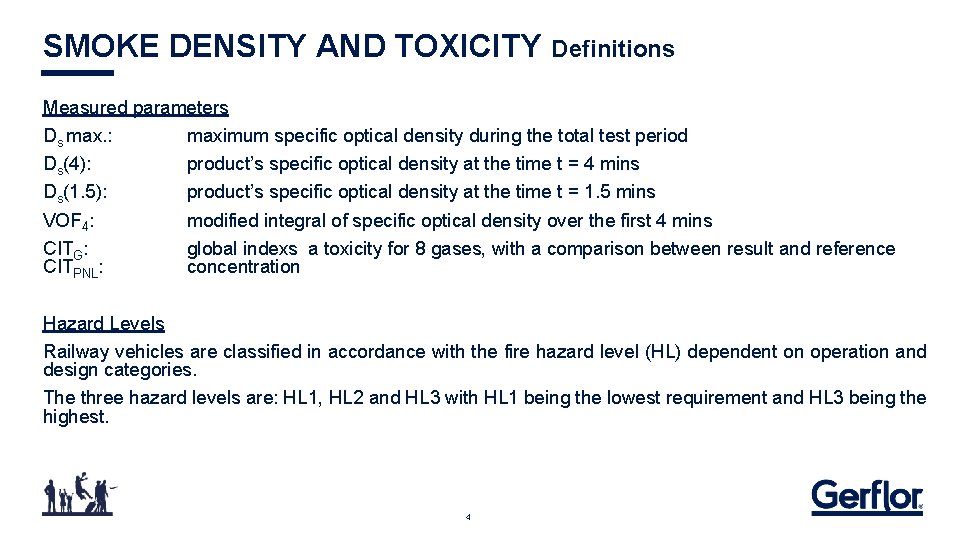
SMOKE DENSITY AND TOXICITY Definitions Measured parameters Ds max. : maximum specific optical density during the total test period Ds(4): product’s specific optical density at the time t = 4 mins Ds(1. 5): product’s specific optical density at the time t = 1. 5 mins VOF 4: modified integral of specific optical density over the first 4 mins CITG: global indexs a toxicity for 8 gases, with a comparison between result and reference CITPNL: concentration Hazard Levels Railway vehicles are classified in accordance with the fire hazard level (HL) dependent on operation and design categories. The three hazard levels are: HL 1, HL 2 and HL 3 with HL 1 being the lowest requirement and HL 3 being the highest. 4
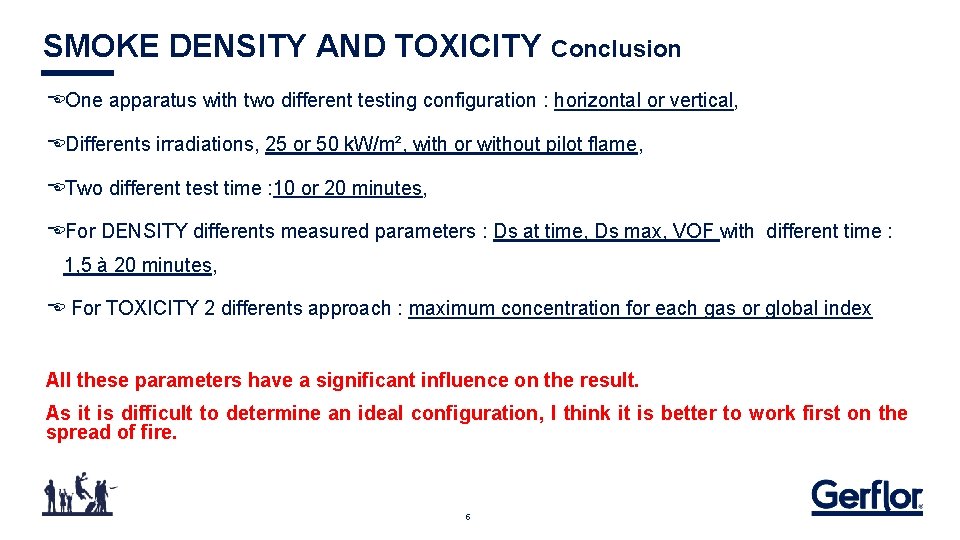
SMOKE DENSITY AND TOXICITY Conclusion EOne apparatus with two different testing configuration : horizontal or vertical, EDifferents irradiations, 25 or 50 k. W/m², with or without pilot flame, ETwo different test time : 10 or 20 minutes, EFor DENSITY differents measured parameters : Ds at time, Ds max, VOF with different time : 1, 5 à 20 minutes, E For TOXICITY 2 differents approach : maximum concentration for each gas or global index All these parameters have a significant influence on the result. As it is difficult to determine an ideal configuration, I think it is better to work first on the spread of fire. 5