
Smithsonian Institution Neutrinos Dark Matter and the Cosmological
- Slides: 85
Smithsonian Institution Neutrinos, Dark Matter and the Cosmological Constant The Dark Side of the Universe Jordan Goodman University of Maryland Smithsonian Institution J. Goodman – Jan 2005
Outline • The Cosmological Question – the fate of the Universe • How do we know what the Universe is made of: – From atoms to quarks and leptons • • • Why do we think there is Dark Matter The Neutrino’s role in the Universe Data on the accelerating Universe – Type Ia supernova – Cosmic Microwave Background • Dark Energy Smithsonian Institution J. Goodman – Jan 2005
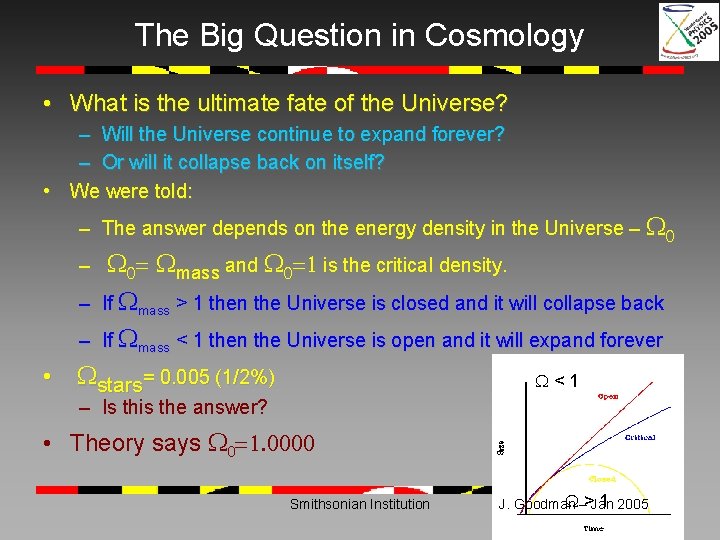
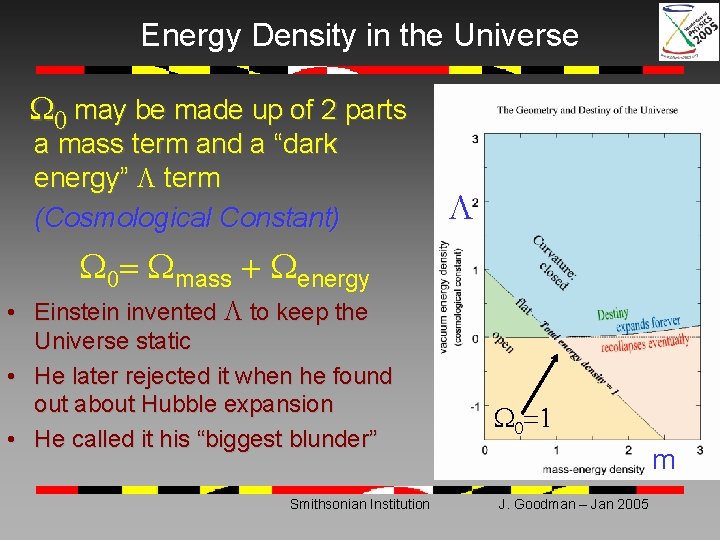
The Big Question in Cosmology • What is the ultimate fate of the Universe? – Will the Universe continue to expand forever? – Or will it collapse back on itself? • We were told: – The answer depends on the energy density in the Universe – W 0 – – – W 0= Wmass and W 0=1 is the critical density. If Wmass > 1 then the Universe is closed and it will collapse back If Wmass < 1 then the Universe is open and it will expand forever • Wstars= 0. 005 (1/2%) W<1 – Is this the answer? • Theory says W 0=1. 0000 Smithsonian Institution W–>Jan 1 2005 J. Goodman
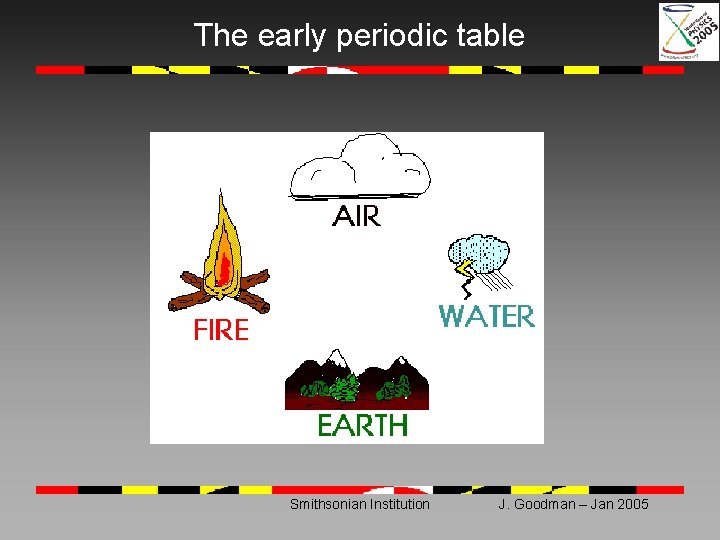
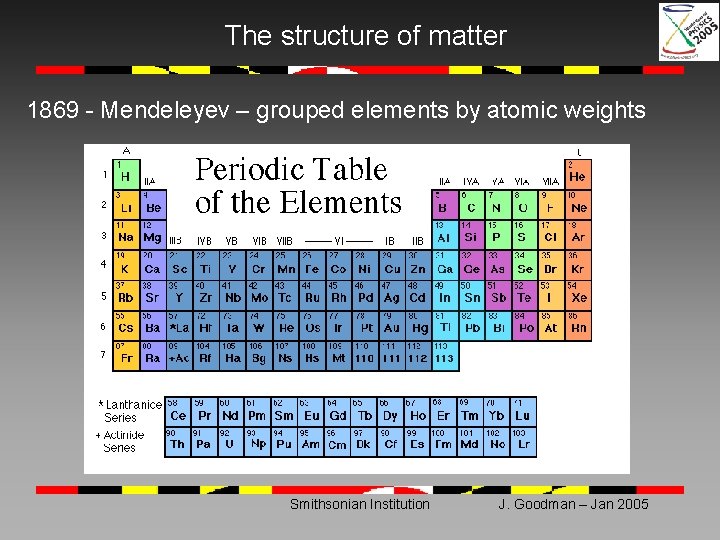
The early periodic table Smithsonian Institution J. Goodman – Jan 2005
The structure of matter 1869 - Mendeleyev – grouped elements by atomic weights Smithsonian Institution J. Goodman – Jan 2005
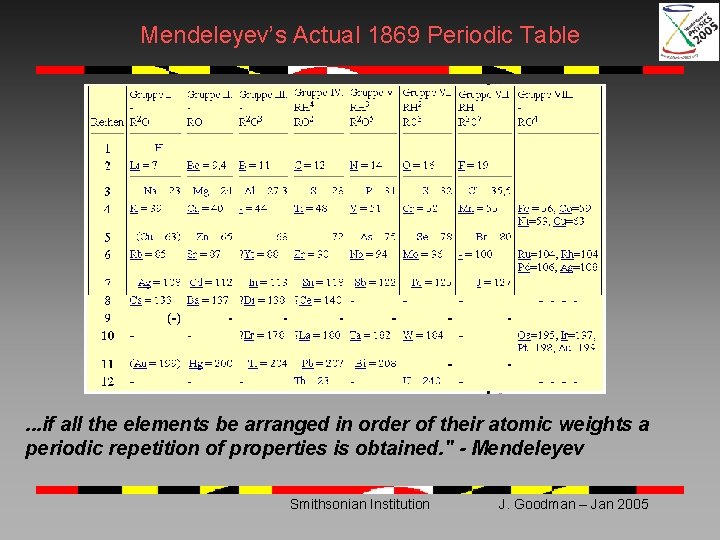
Mendeleyev’s Actual 1869 Periodic Table . . . if all the elements be arranged in order of their atomic weights a periodic repetition of properties is obtained. " - Mendeleyev Smithsonian Institution J. Goodman – Jan 2005
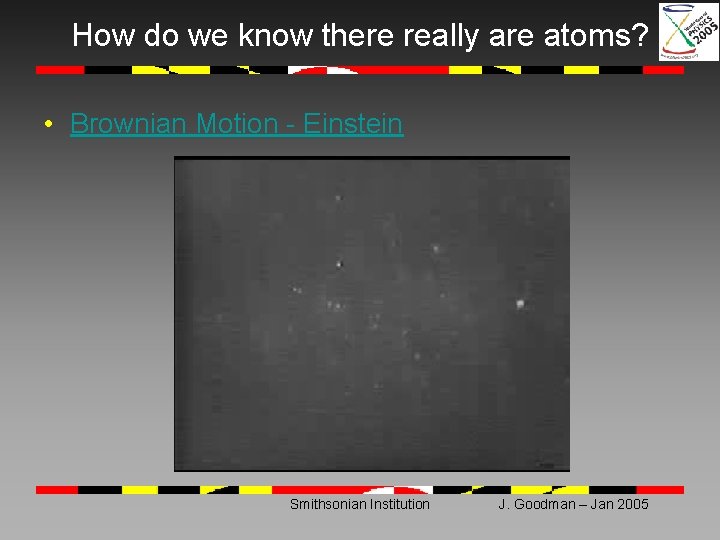
How do we know there really are atoms? • Brownian Motion - Einstein Smithsonian Institution J. Goodman – Jan 2005
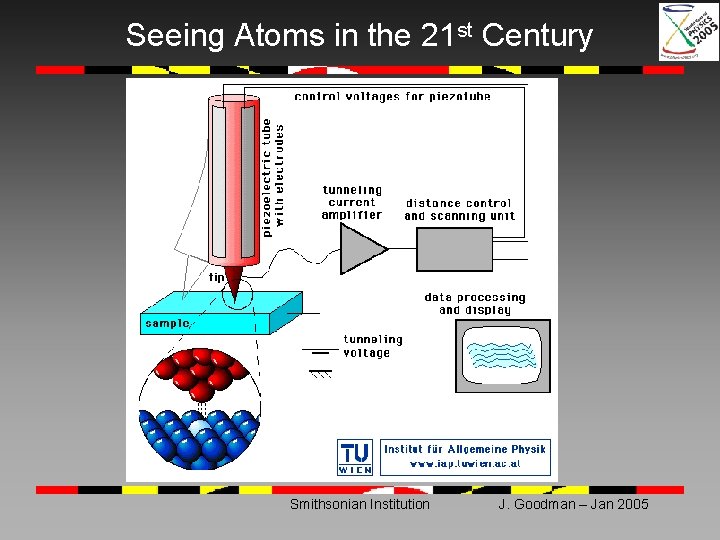
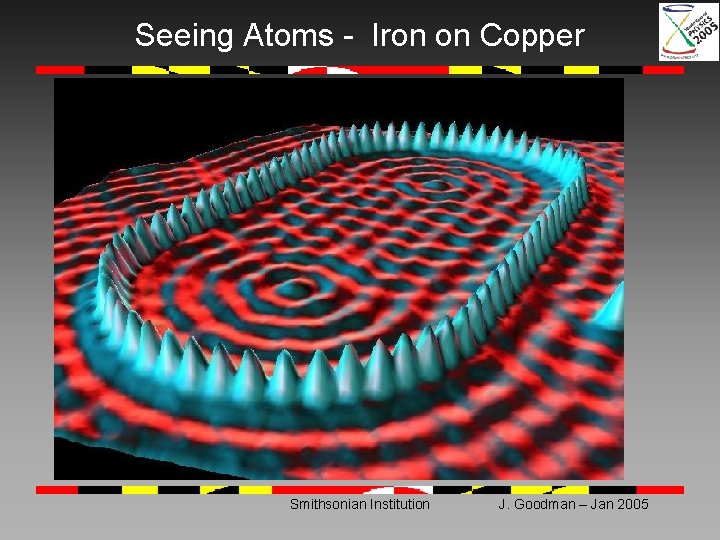
Seeing Atoms in the 21 st Century Smithsonian Institution J. Goodman – Jan 2005
Seeing Atoms - Iron on Copper Smithsonian Institution J. Goodman – Jan 2005
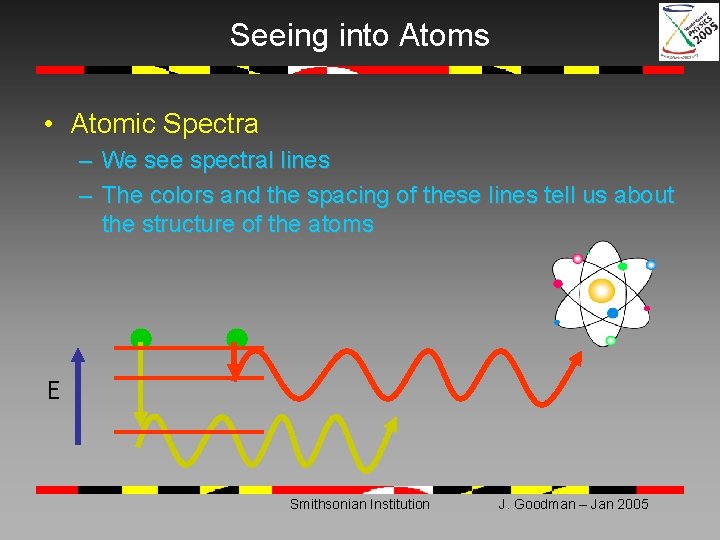
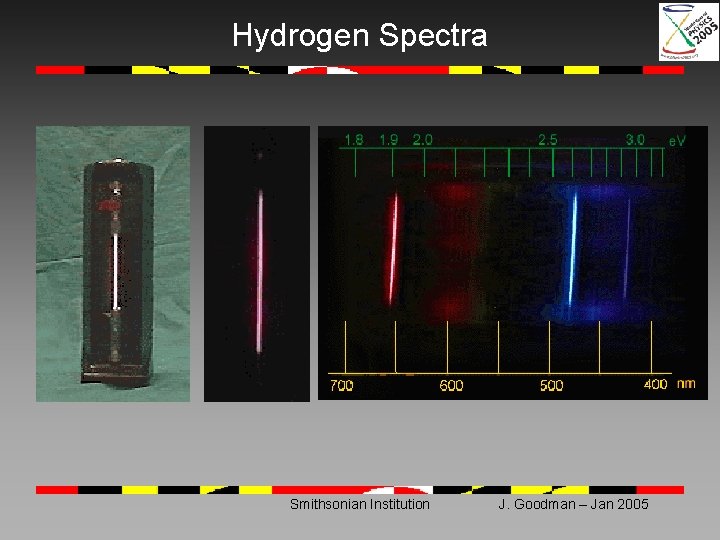
Seeing into Atoms • Atomic Spectra – We see spectral lines – The colors and the spacing of these lines tell us about the structure of the atoms E Smithsonian Institution J. Goodman – Jan 2005
Hydrogen Spectra Smithsonian Institution J. Goodman – Jan 2005
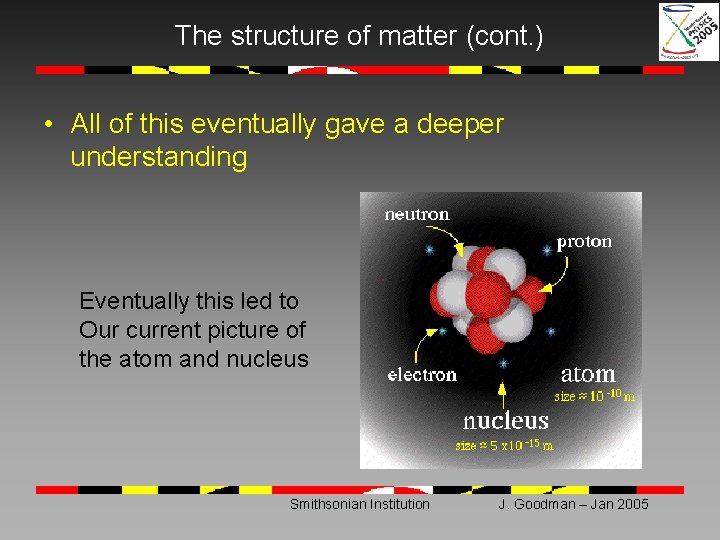
The structure of matter (cont. ) • All of this eventually gave a deeper understanding Eventually this led to Our current picture of the atom and nucleus Smithsonian Institution J. Goodman – Jan 2005
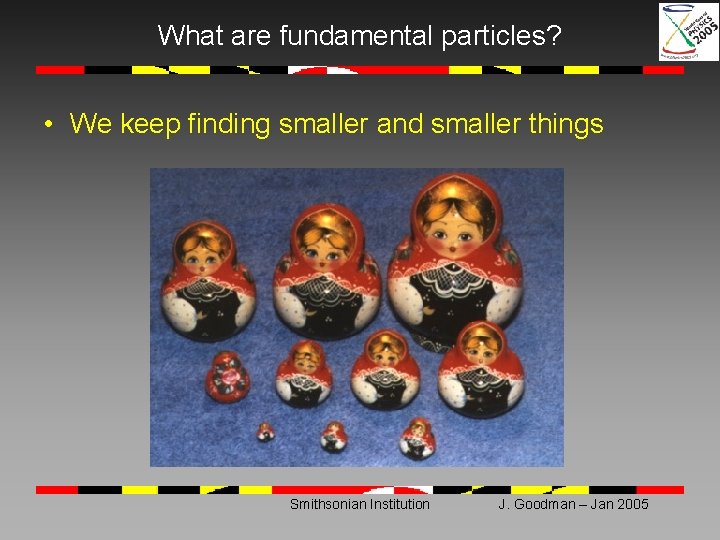
What are fundamental particles? • We keep finding smaller and smaller things Smithsonian Institution J. Goodman – Jan 2005
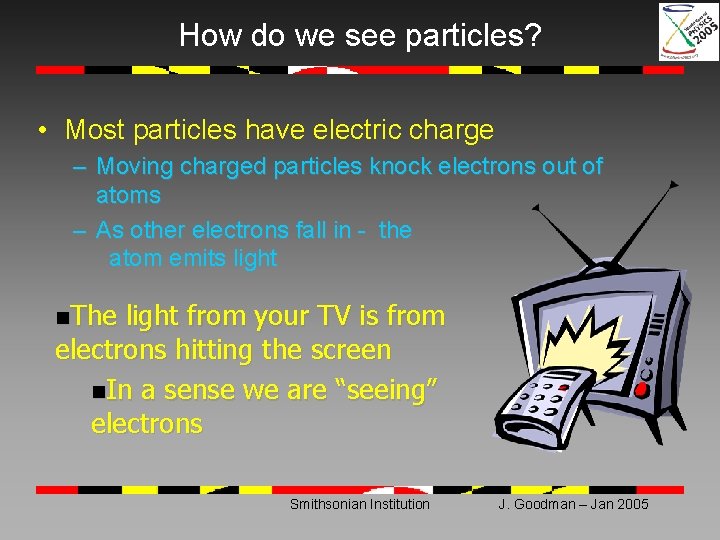
How do we see particles? • Most particles have electric charge – Moving charged particles knock electrons out of atoms – As other electrons fall in - the atom emits light n. The light from your TV is from electrons hitting the screen n. In a sense we are “seeing” electrons Smithsonian Institution J. Goodman – Jan 2005
The search for fundamental particles • Proton and electron – These were known to make up the atom • The neutron was discovered • Free neutrons were found to decay – They decayed into protons and electrons – But it looked like something was missing • In 1930 Pauli postulated a unseen neutral particle • In 1933 Fermi named it the “neutrino” (little neutron) Smithsonian Institution J. Goodman – Jan 2005
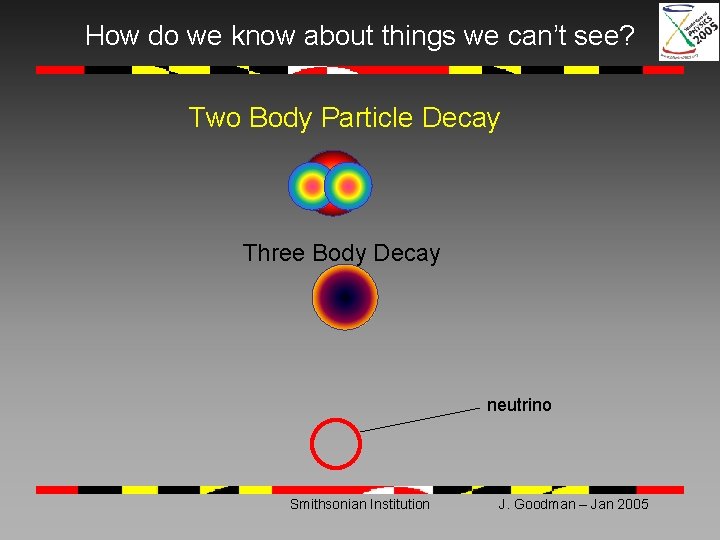
How do we know about things we can’t see? Two Body Particle Decay Three Body Decay neutrino Smithsonian Institution J. Goodman – Jan 2005
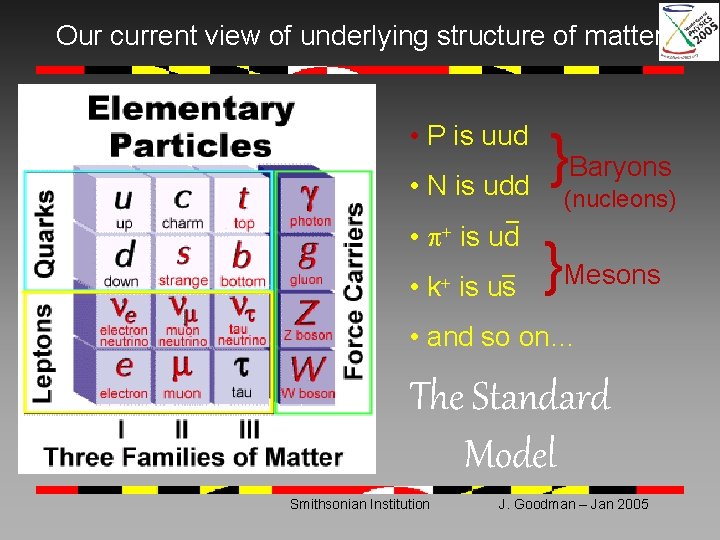
Our current view of underlying structure of matter • P is uud • N is udd • p+ is ud • k+ is us }Baryons (nucleons) }Mesons • and so on… The Standard Model Smithsonian Institution J. Goodman – Jan 2005
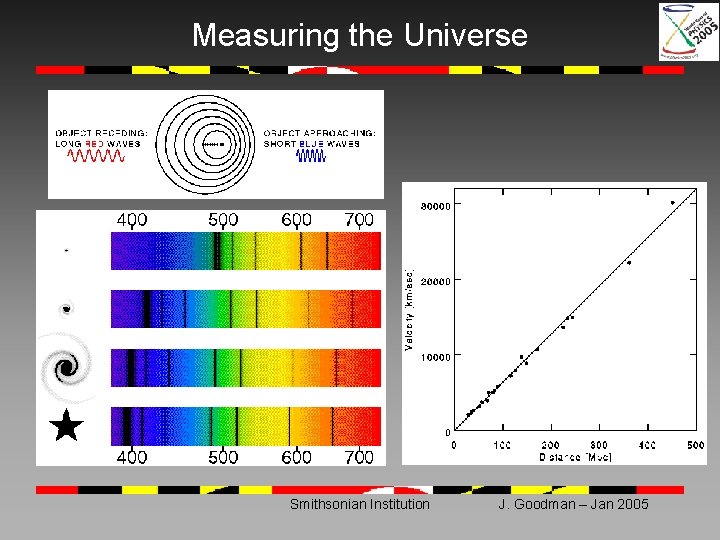
Measuring the Universe Smithsonian Institution J. Goodman – Jan 2005
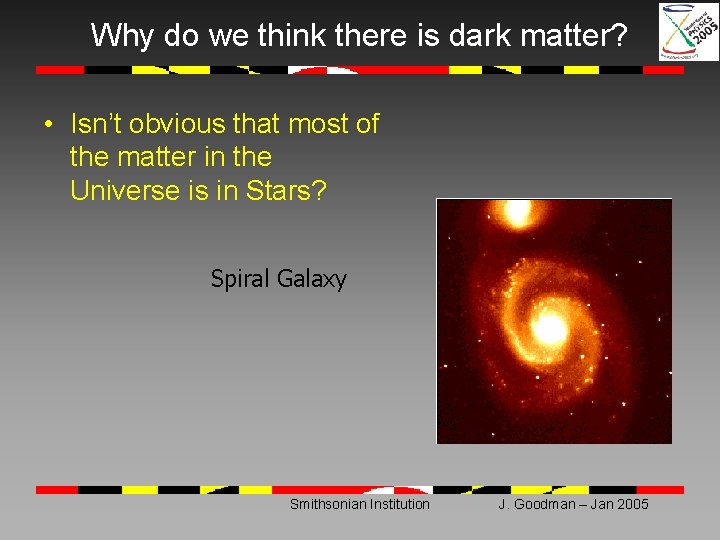
Why do we think there is dark matter? • Isn’t obvious that most of the matter in the Universe is in Stars? Spiral Galaxy Smithsonian Institution J. Goodman – Jan 2005
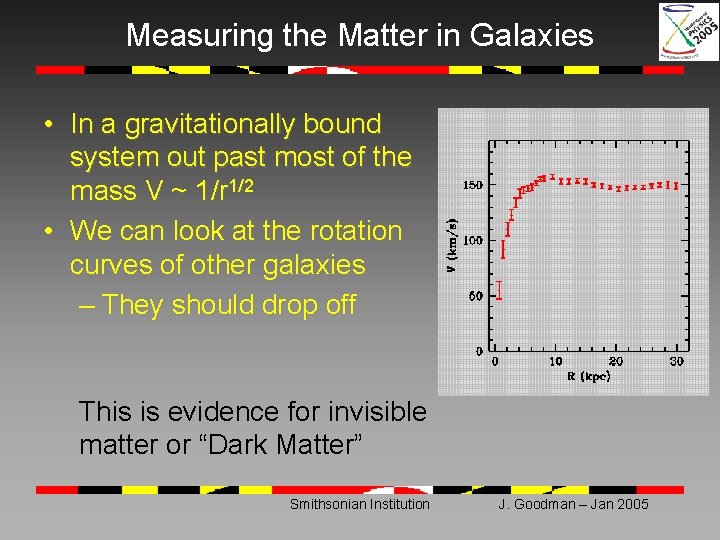
Measuring the Matter in Galaxies • In a gravitationally bound system out past most of the mass V ~ 1/r 1/2 • We can look at the rotation curves of other galaxies – They should drop off This is evidence for invisible matter or “Dark Matter” Smithsonian Institution J. Goodman – Jan 2005
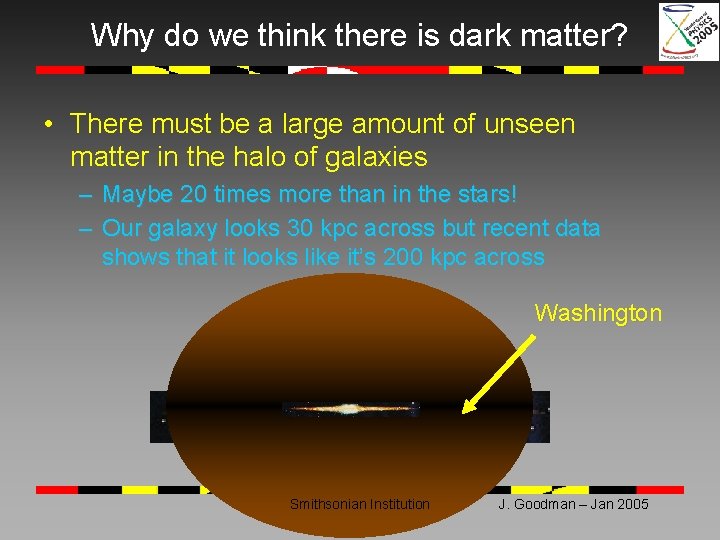
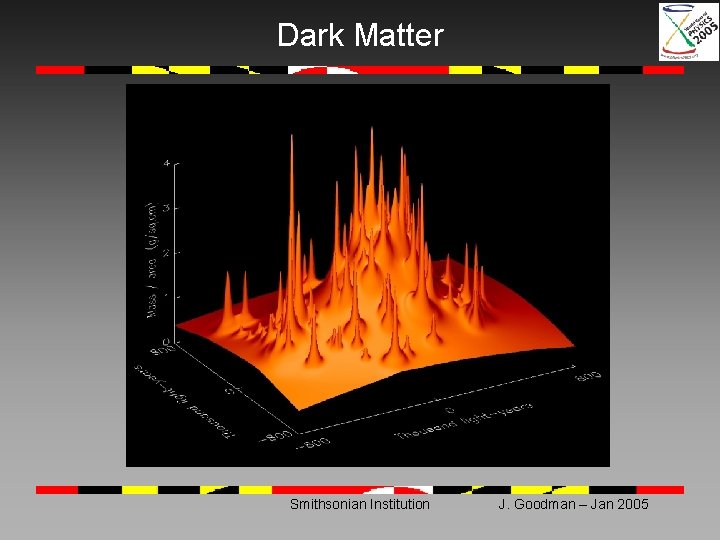
Why do we think there is dark matter? • There must be a large amount of unseen matter in the halo of galaxies – Maybe 20 times more than in the stars! – Our galaxy looks 30 kpc across but recent data shows that it looks like it’s 200 kpc across Washington Smithsonian Institution J. Goodman – Jan 2005
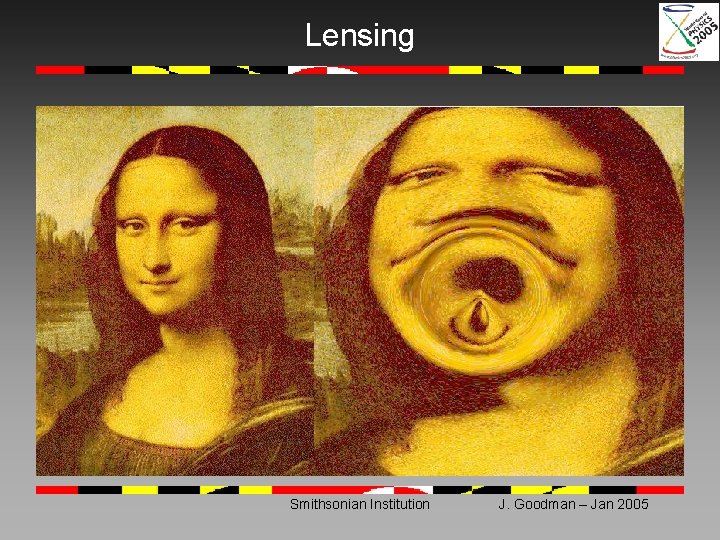
Lensing Smithsonian Institution J. Goodman – Jan 2005
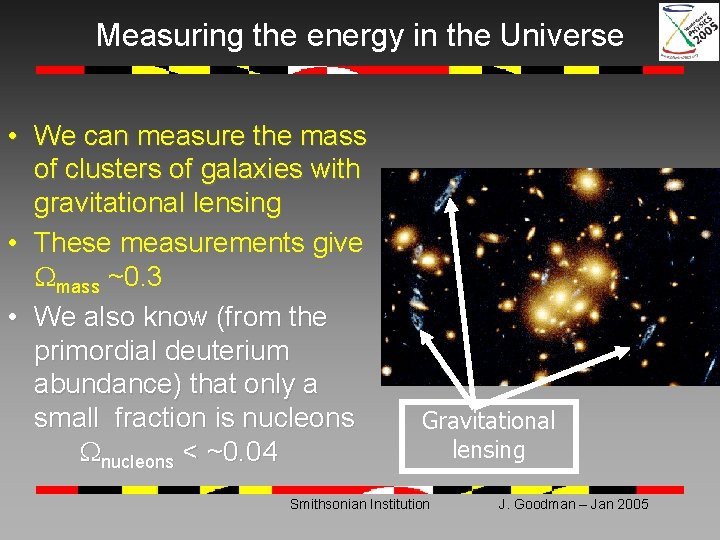
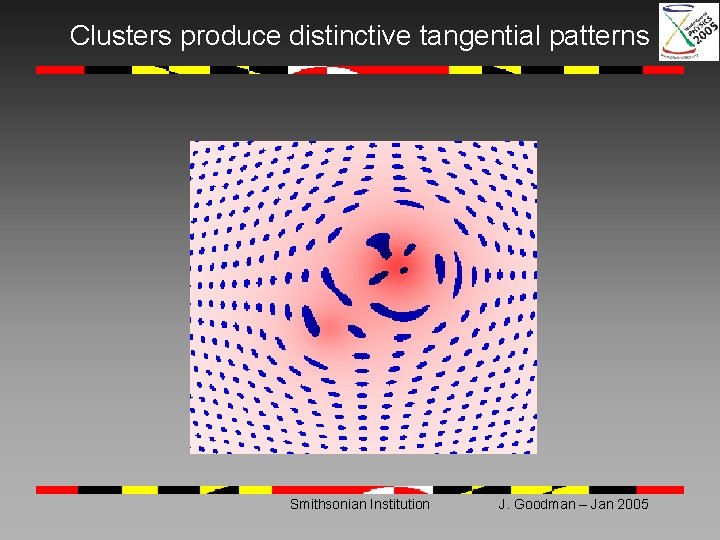
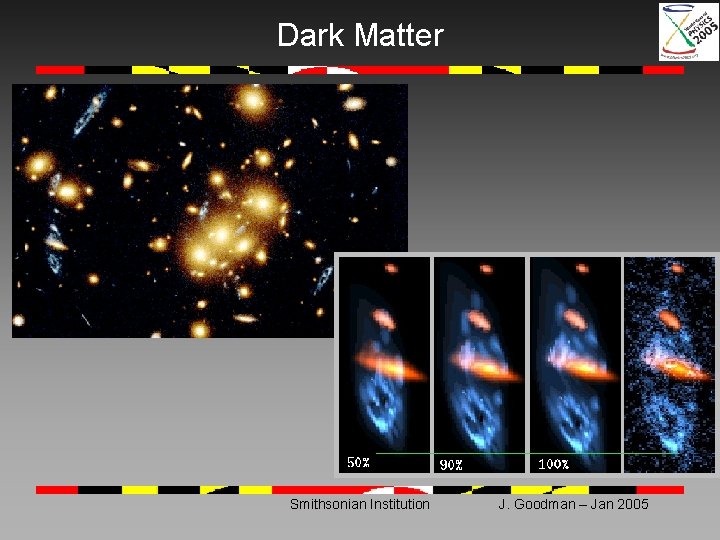
Measuring the energy in the Universe • We can measure the mass of clusters of galaxies with gravitational lensing • These measurements give Wmass ~0. 3 • We also know (from the primordial deuterium abundance) that only a small fraction is nucleons Wnucleons < ~0. 04 Gravitational lensing Smithsonian Institution J. Goodman – Jan 2005
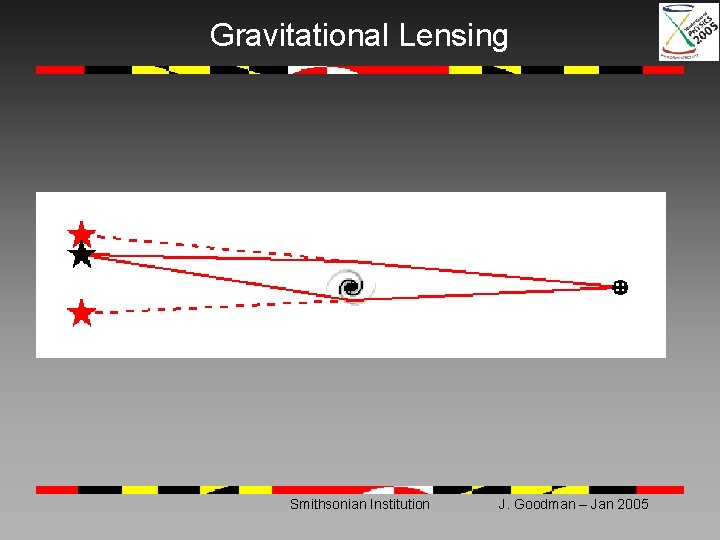
Gravitational Lensing Smithsonian Institution J. Goodman – Jan 2005
Clusters produce distinctive tangential patterns Smithsonian Institution J. Goodman – Jan 2005
Movies Smithsonian Institution J. Goodman – Jan 2005
Dark Matter Smithsonian Institution J. Goodman – Jan 2005
Dark Matter Smithsonian Institution J. Goodman – Jan 2005
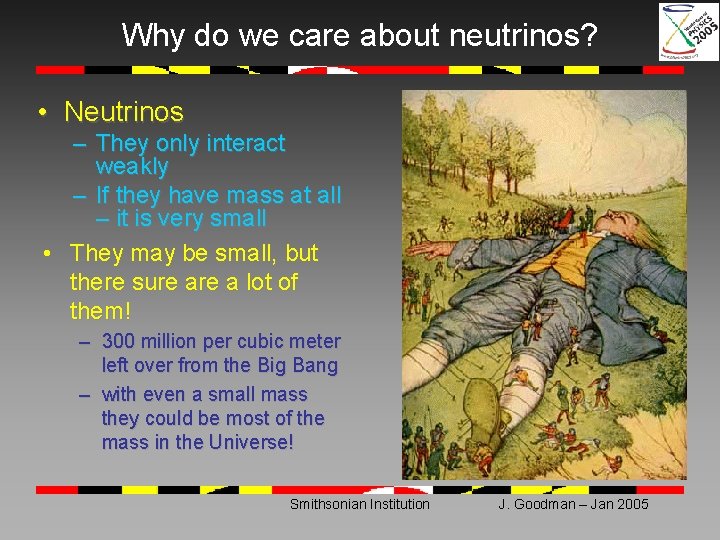
Why do we care about neutrinos? • Neutrinos – They only interact weakly – If they have mass at all – it is very small • They may be small, but there sure a lot of them! – 300 million per cubic meter left over from the Big Bang – with even a small mass they could be most of the mass in the Universe! Smithsonian Institution J. Goodman – Jan 2005
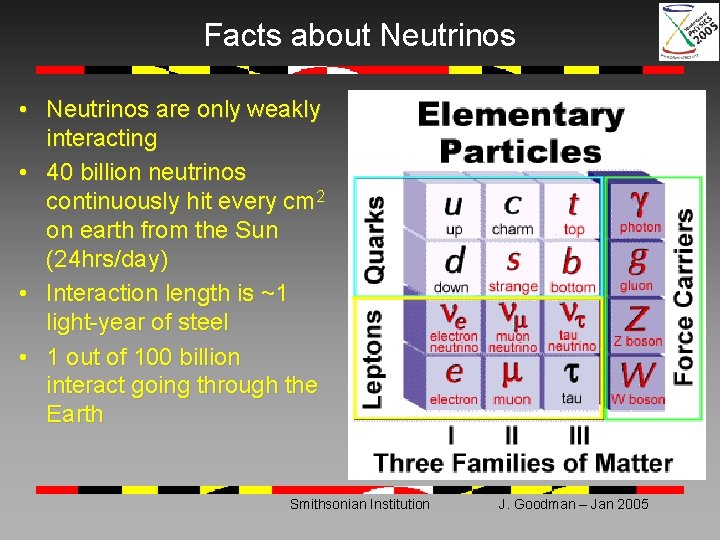
Facts about Neutrinos • Neutrinos are only weakly interacting • 40 billion neutrinos continuously hit every cm 2 on earth from the Sun (24 hrs/day) • Interaction length is ~1 light-year of steel • 1 out of 100 billion interact going through the Earth Smithsonian Institution J. Goodman – Jan 2005
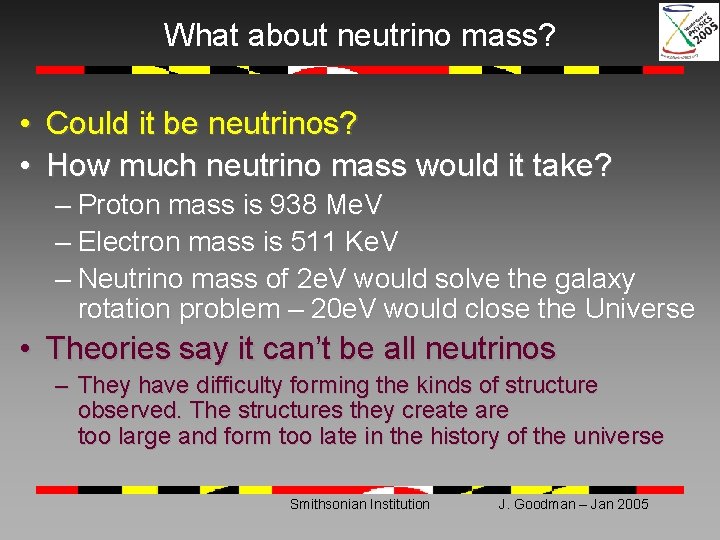
What about neutrino mass? • Could it be neutrinos? • How much neutrino mass would it take? – Proton mass is 938 Me. V – Electron mass is 511 Ke. V – Neutrino mass of 2 e. V would solve the galaxy rotation problem – 20 e. V would close the Universe • Theories say it can’t be all neutrinos – They have difficulty forming the kinds of structure observed. The structures they create are too large and form too late in the history of the universe Smithsonian Institution J. Goodman – Jan 2005
Does the neutrino have mass? n Smithsonian Institution J. Goodman – Jan 2005
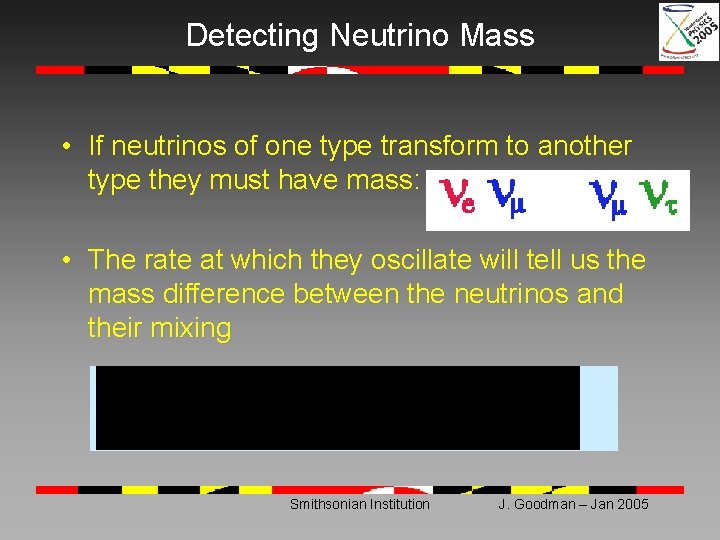
Detecting Neutrino Mass • If neutrinos of one type transform to another type they must have mass: • The rate at which they oscillate will tell us the mass difference between the neutrinos and their mixing Smithsonian Institution J. Goodman – Jan 2005
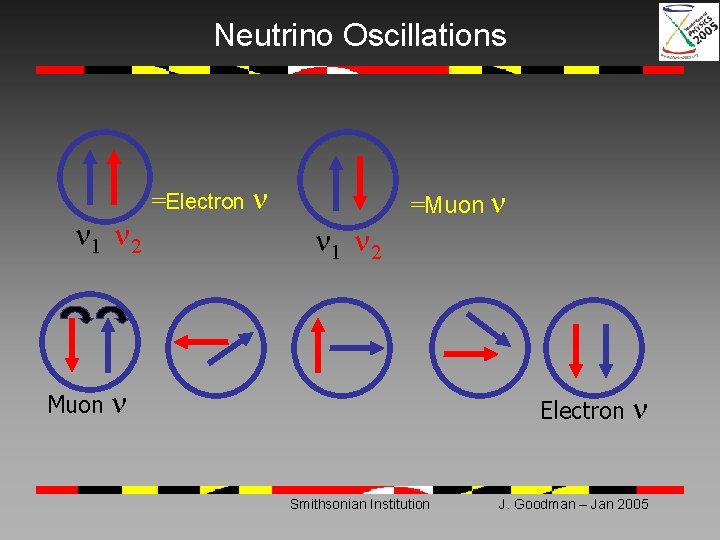
Neutrino Oscillations n 1 n 2 =Electron n n 1 n 2 =Muon n Electron n Smithsonian Institution J. Goodman – Jan 2005
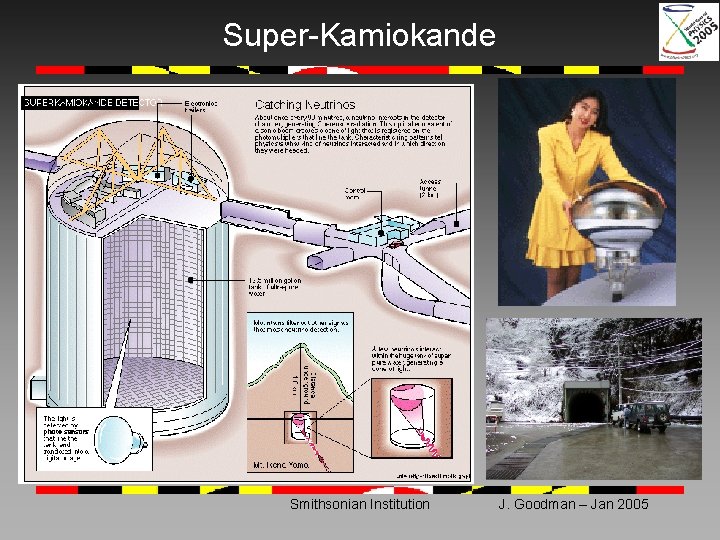
Super-Kamiokande Smithsonian Institution J. Goodman – Jan 2005
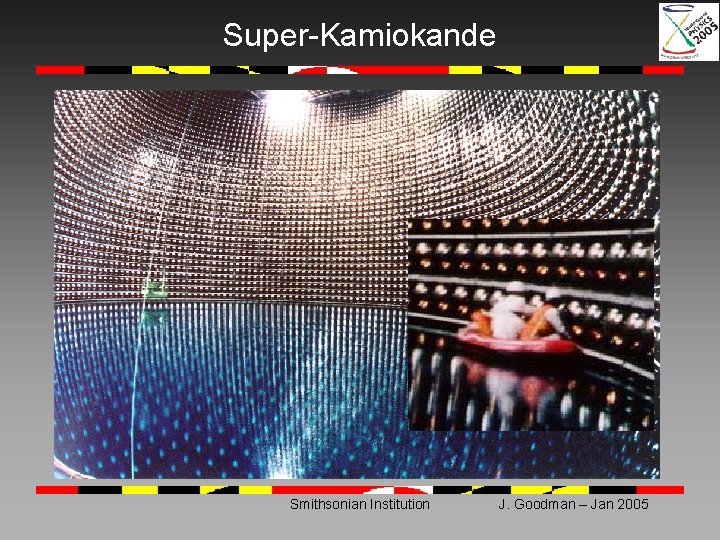
Super-Kamiokande Smithsonian Institution J. Goodman – Jan 2005
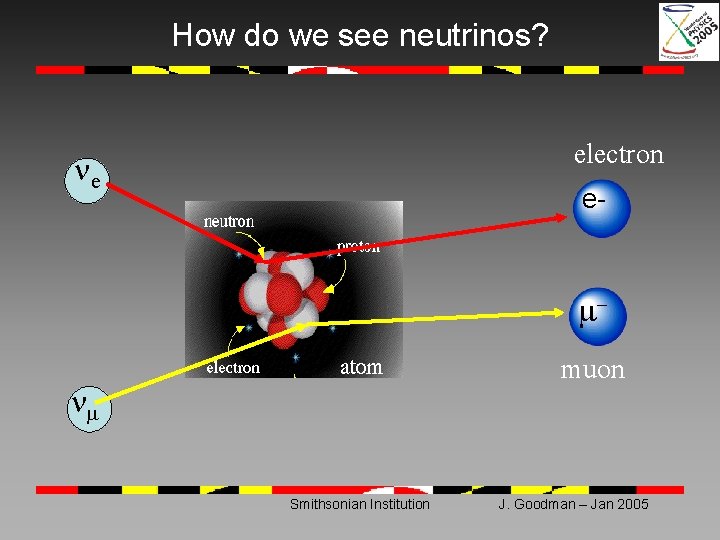
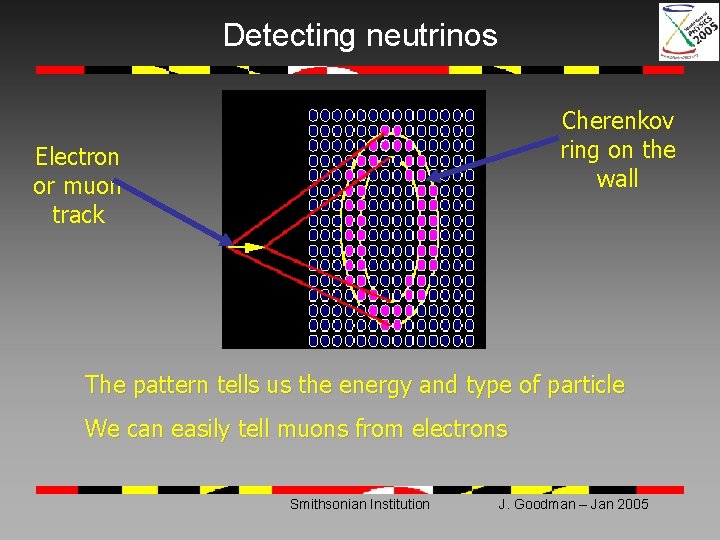
How do we see neutrinos? electron ne e- mmuon nm Smithsonian Institution J. Goodman – Jan 2005
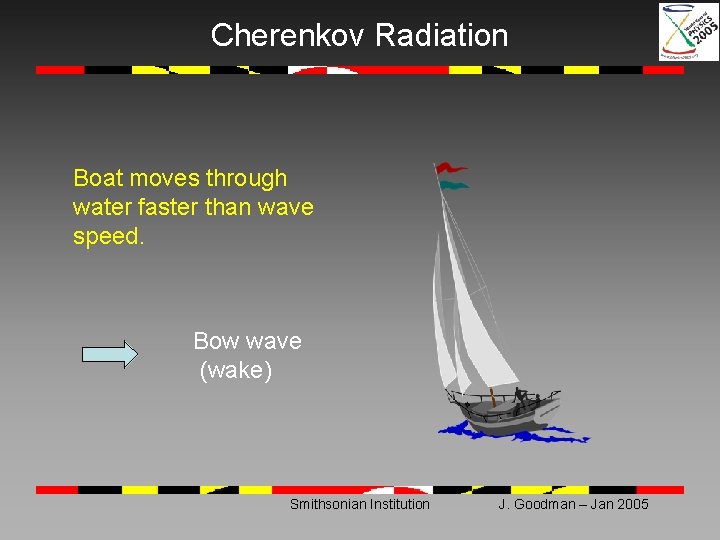
Cherenkov Radiation Boat moves through water faster than wave speed. Bow wave (wake) Smithsonian Institution J. Goodman – Jan 2005
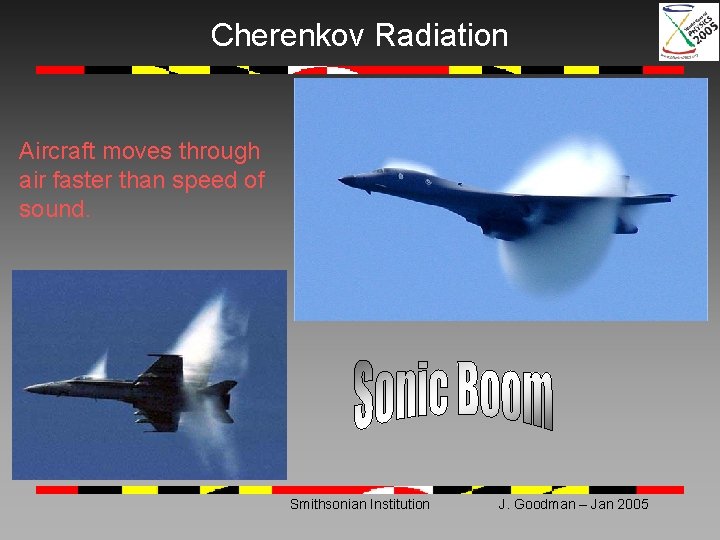
Cherenkov Radiation Aircraft moves through air faster than speed of sound. Sonic boom Smithsonian Institution J. Goodman – Jan 2005
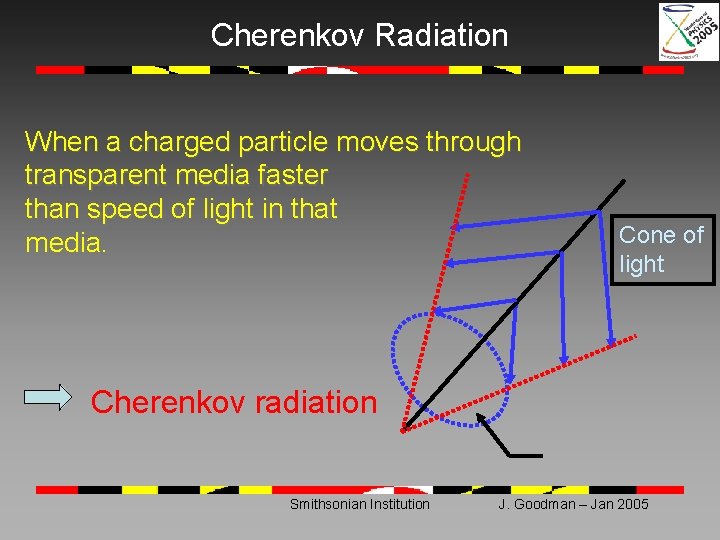
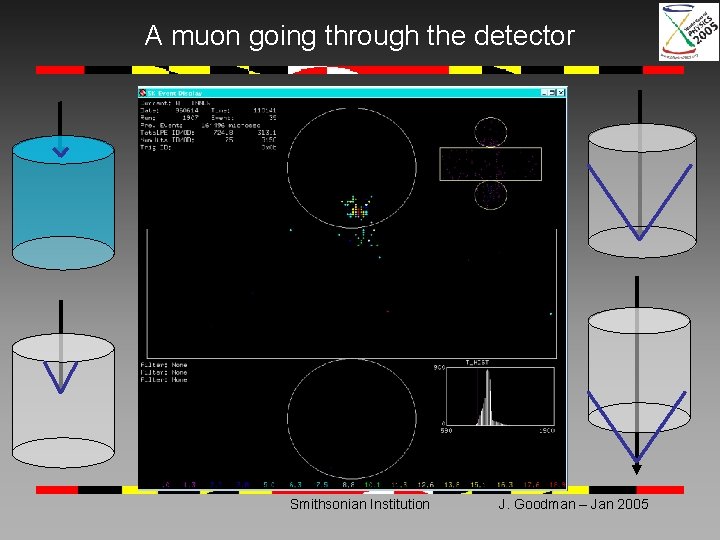
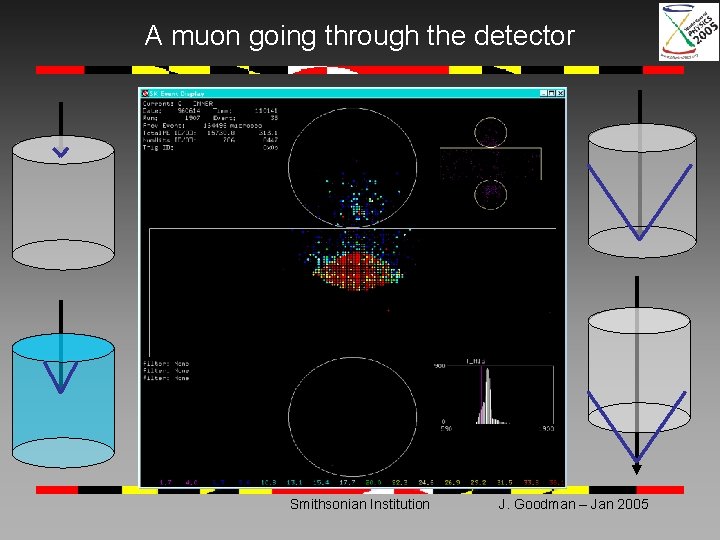
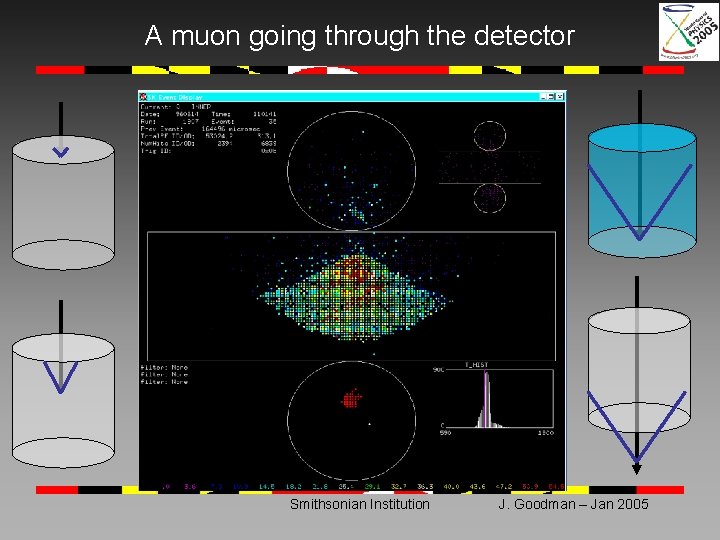
Cherenkov Radiation When a charged particle moves through transparent media faster than speed of light in that media. Cone of light Cherenkov radiation Smithsonian Institution J. Goodman – Jan 2005
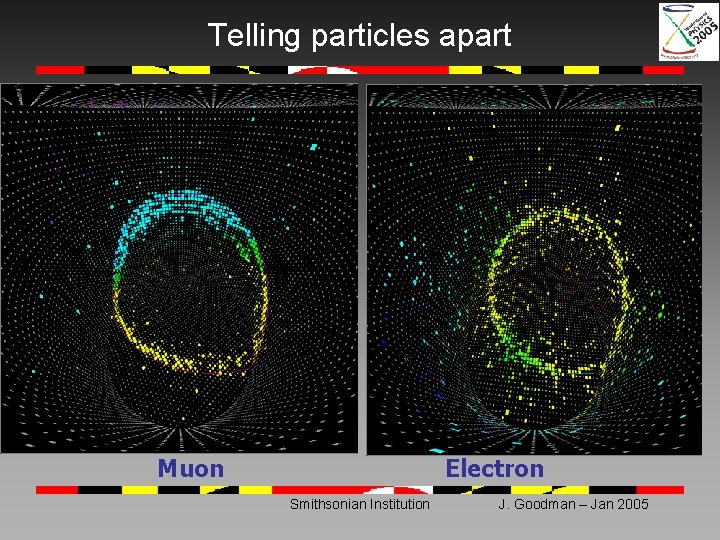
Detecting neutrinos Cherenkov ring on the wall Electron or muon track The pattern tells us the energy and type of particle We can easily tell muons from electrons Smithsonian Institution J. Goodman – Jan 2005
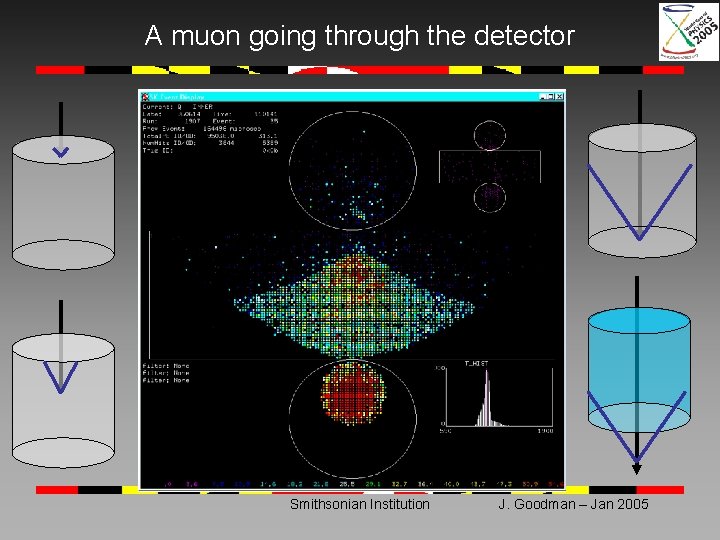
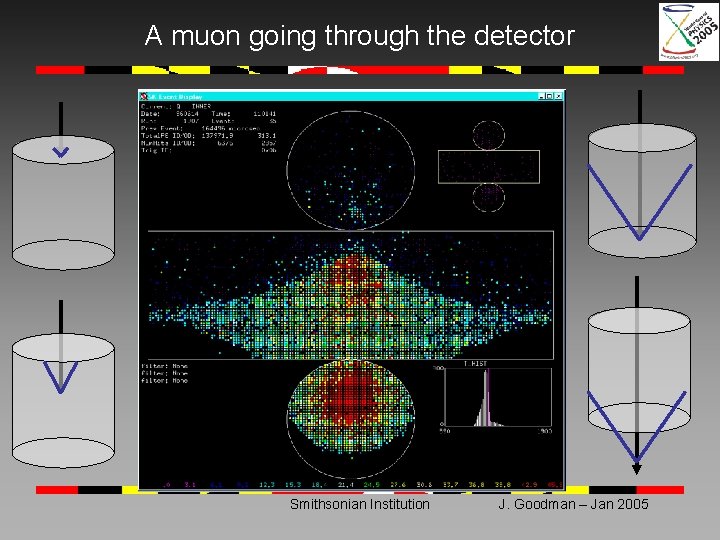
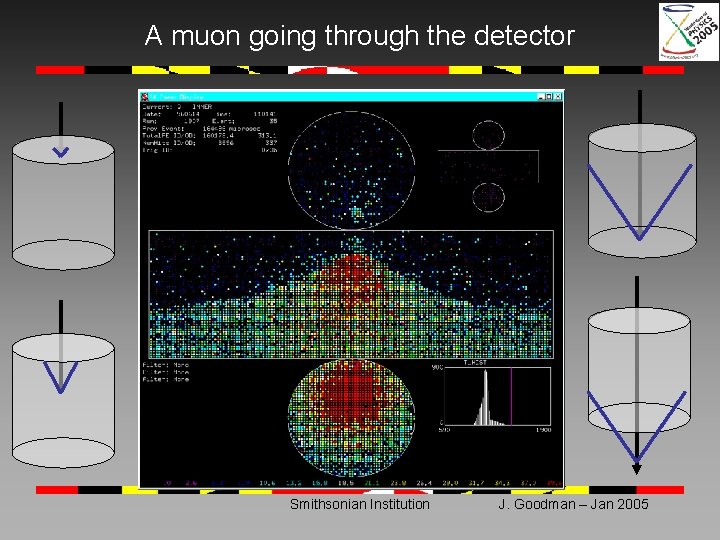
A muon going through the detector Smithsonian Institution J. Goodman – Jan 2005
A muon going through the detector Smithsonian Institution J. Goodman – Jan 2005
A muon going through the detector Smithsonian Institution J. Goodman – Jan 2005
A muon going through the detector Smithsonian Institution J. Goodman – Jan 2005
A muon going through the detector Smithsonian Institution J. Goodman – Jan 2005
A muon going through the detector Smithsonian Institution J. Goodman – Jan 2005
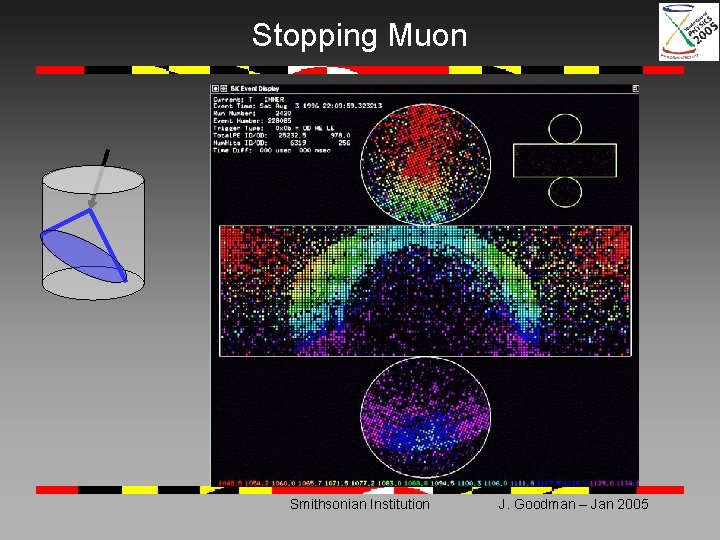
Stopping Muon Smithsonian Institution J. Goodman – Jan 2005
Stopping Muon – Decay Electron Smithsonian Institution J. Goodman – Jan 2005
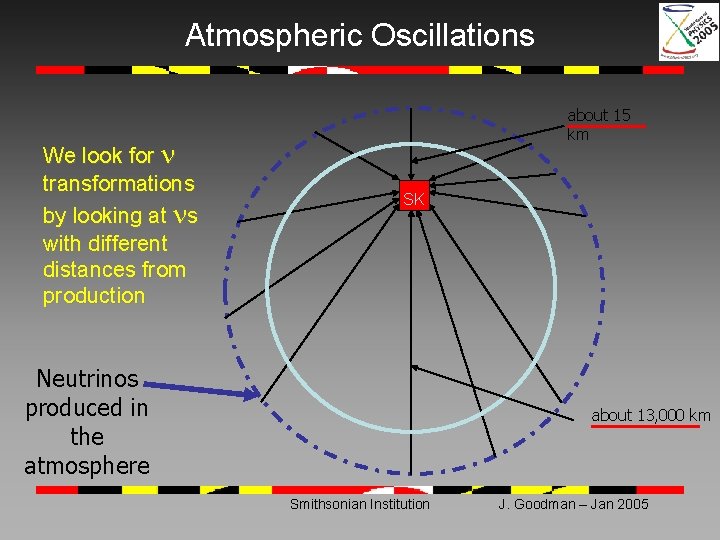
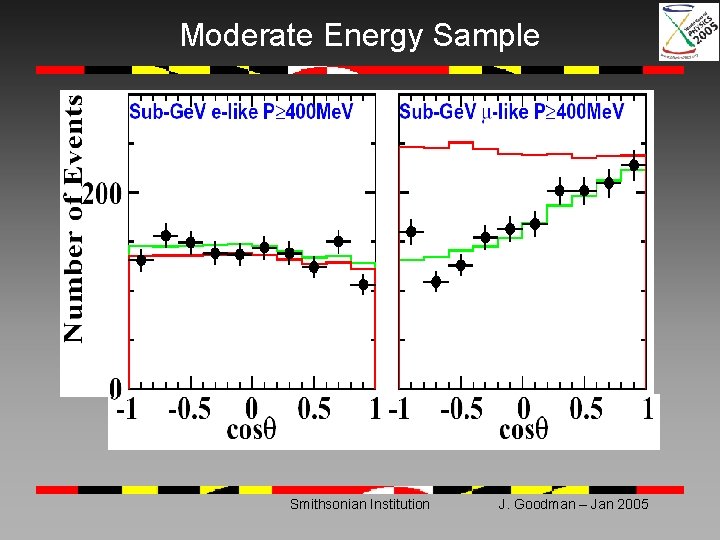
Atmospheric Oscillations We look for n transformations by looking at ns with different distances from production about 15 km SK Neutrinos produced in the atmosphere about 13, 000 km Smithsonian Institution J. Goodman – Jan 2005
Telling particles apart Muon Electron Smithsonian Institution J. Goodman – Jan 2005
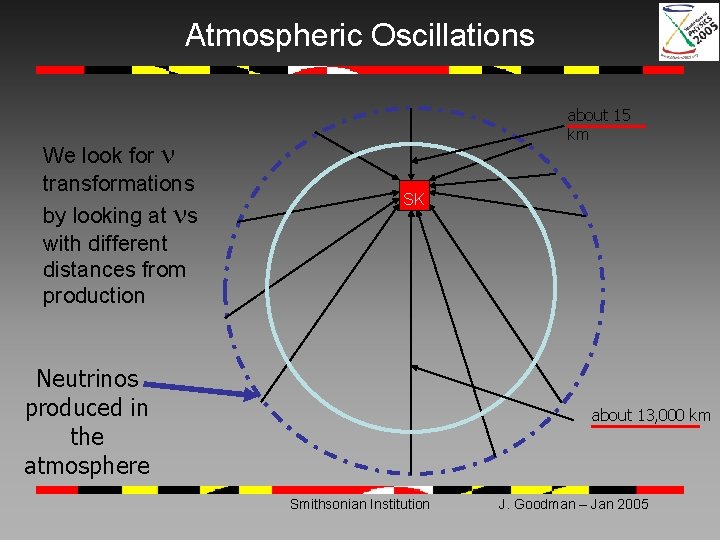
Atmospheric Oscillations We look for n transformations by looking at ns with different distances from production about 15 km SK Neutrinos produced in the atmosphere about 13, 000 km Smithsonian Institution J. Goodman – Jan 2005
Moderate Energy Sample Smithsonian Institution J. Goodman – Jan 2005
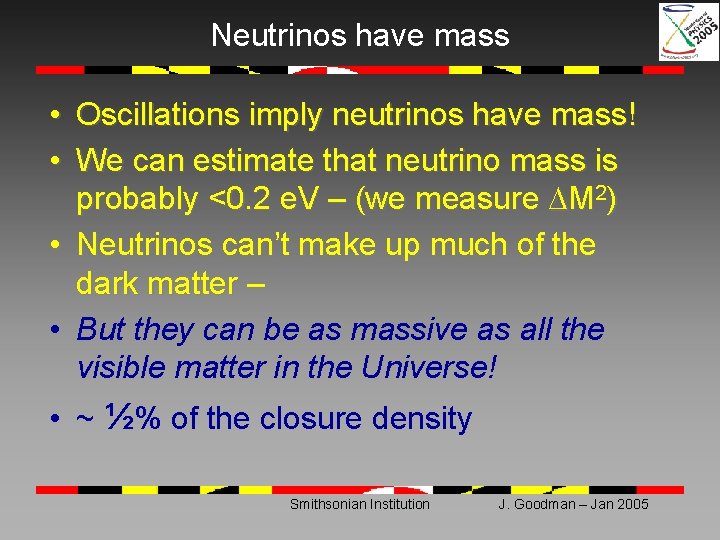
Neutrinos have mass • Oscillations imply neutrinos have mass! • We can estimate that neutrino mass is probably <0. 2 e. V – (we measure DM 2) • Neutrinos can’t make up much of the dark matter – • But they can be as massive as all the visible matter in the Universe! • ~ ½% of the closure density Smithsonian Institution J. Goodman – Jan 2005
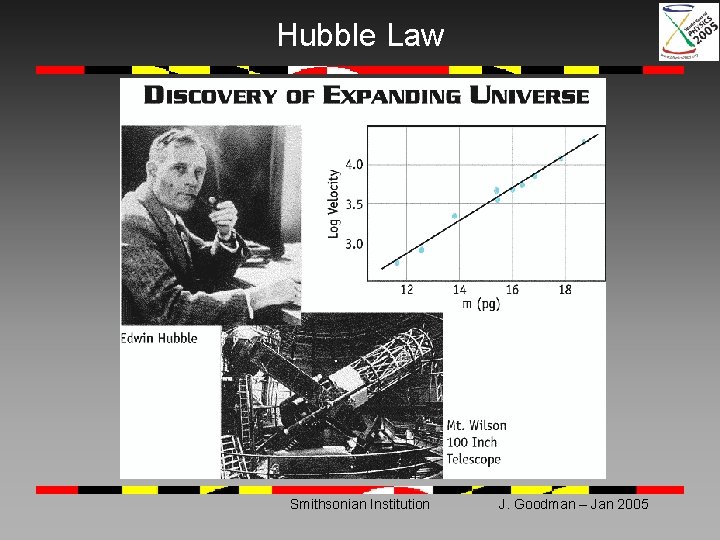
Hubble Law Smithsonian Institution J. Goodman – Jan 2005
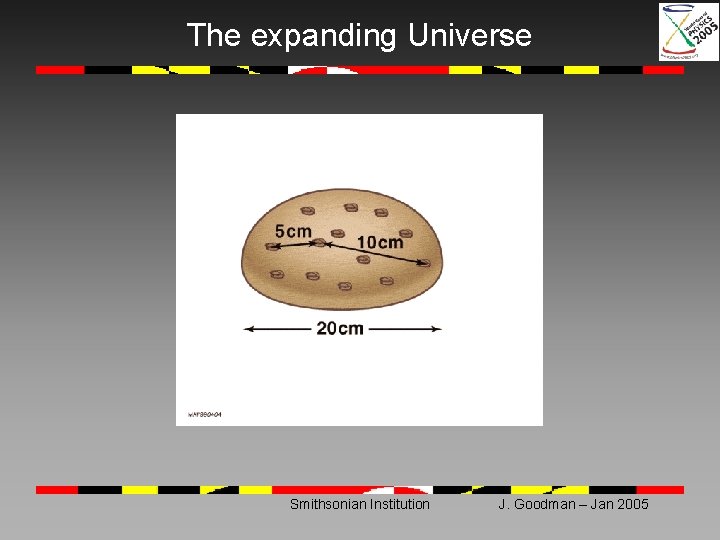
The expanding Universe Smithsonian Institution J. Goodman – Jan 2005
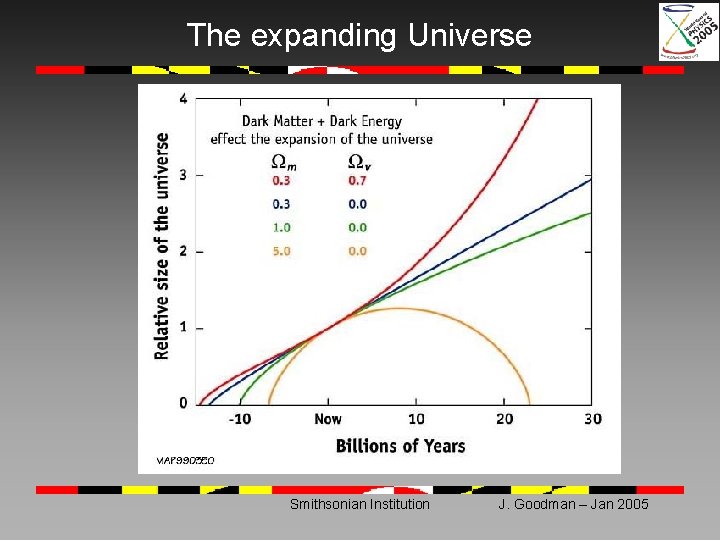
The expanding Universe • The Universe is expanding • Everything is moving away from everything • Hubble’s law says the faster things are moving away the further they are away Smithsonian Institution J. Goodman – Jan 2005
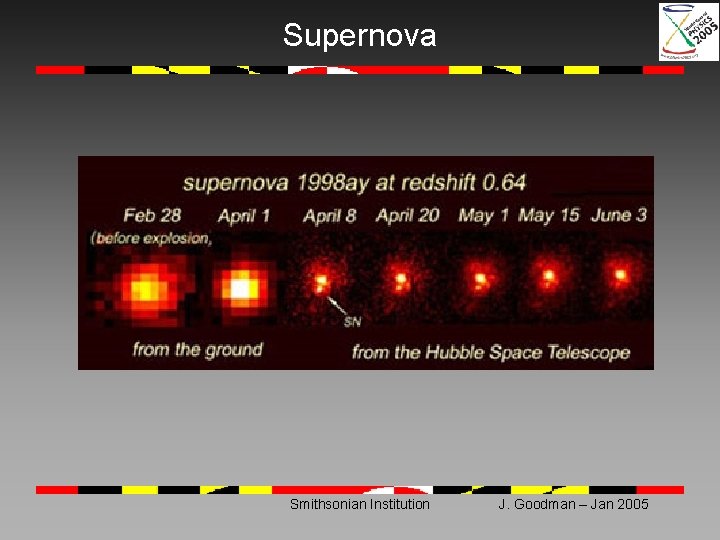
Supernova Smithsonian Institution J. Goodman – Jan 2005
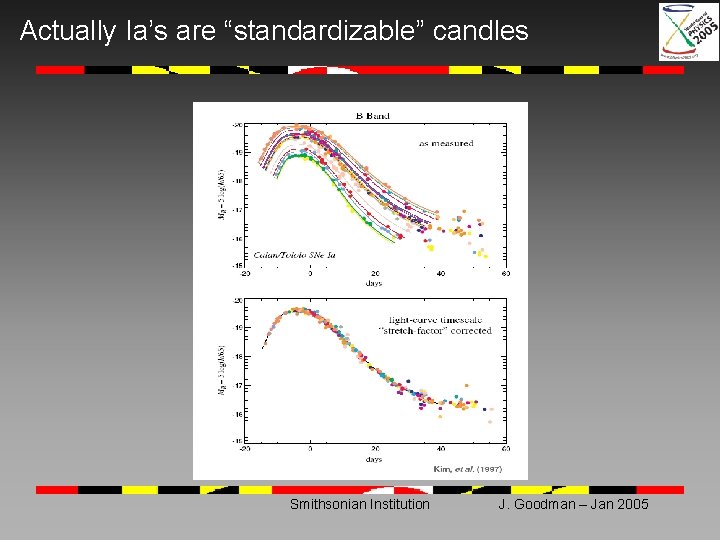
Actually Ia’s are “standardizable” candles Smithsonian Institution J. Goodman – Jan 2005
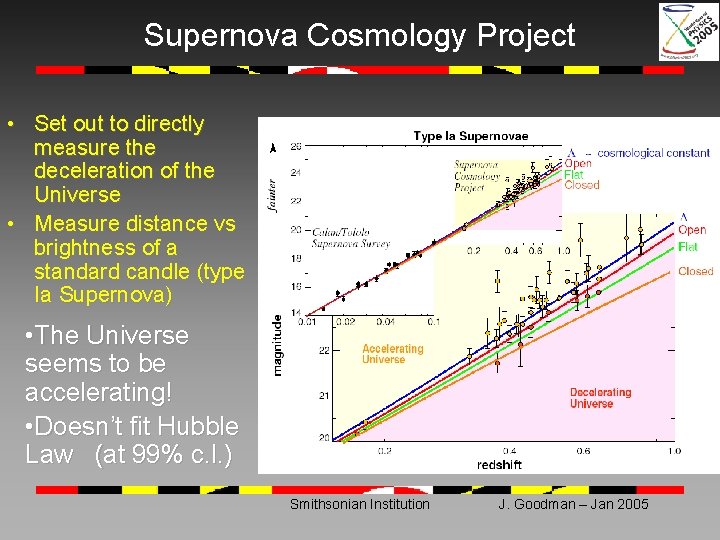
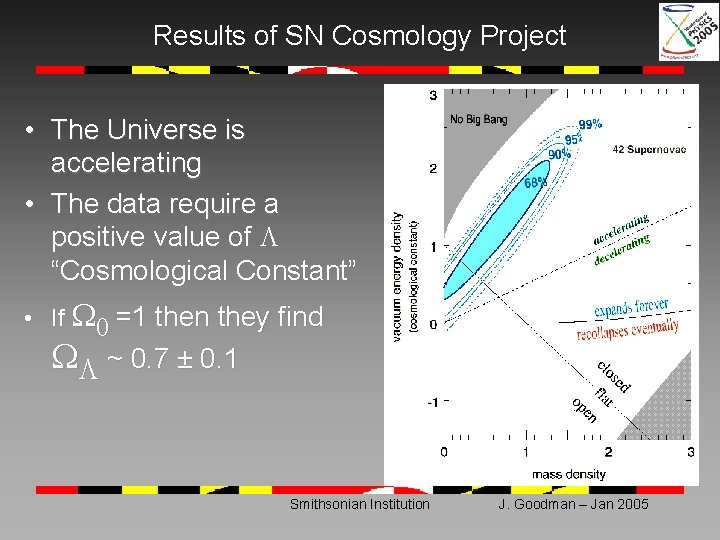
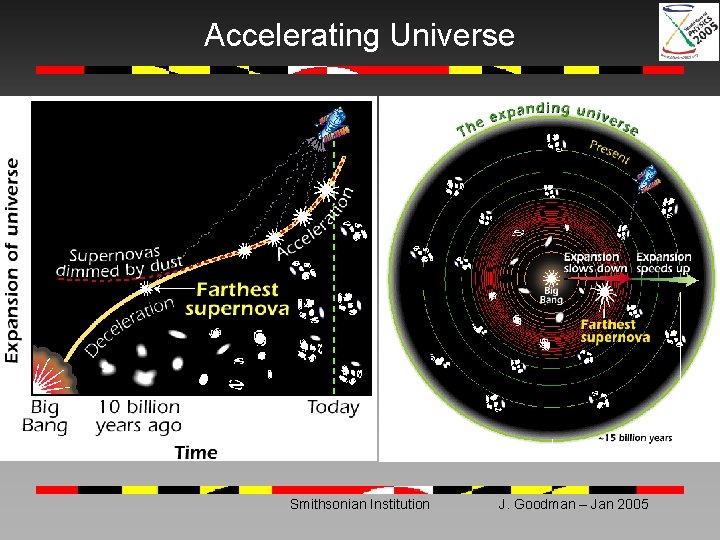
Supernova Cosmology Project • Set out to directly measure the deceleration of the Universe • Measure distance vs brightness of a standard candle (type Ia Supernova) • The Universe seems to be accelerating! • Doesn’t fit Hubble Law (at 99% c. l. ) Smithsonian Institution J. Goodman – Jan 2005
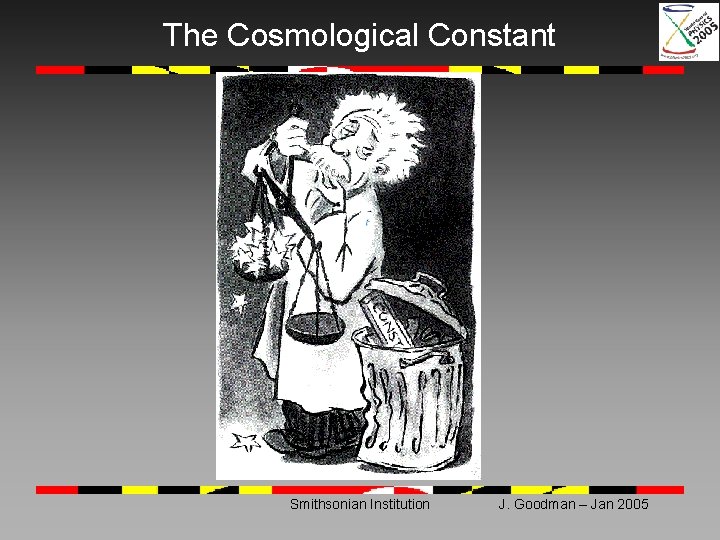
Energy Density in the Universe W 0 may be made up of 2 parts a mass term and a “dark energy” term (Cosmological Constant) W 0= Wmass + Wenergy • Einstein invented to keep the Universe static • He later rejected it when he found out about Hubble expansion • He called it his “biggest blunder” Smithsonian Institution W 0=1 m J. Goodman – Jan 2005
The expanding Universe Smithsonian Institution J. Goodman – Jan 2005
The Cosmological Constant Smithsonian Institution J. Goodman – Jan 2005
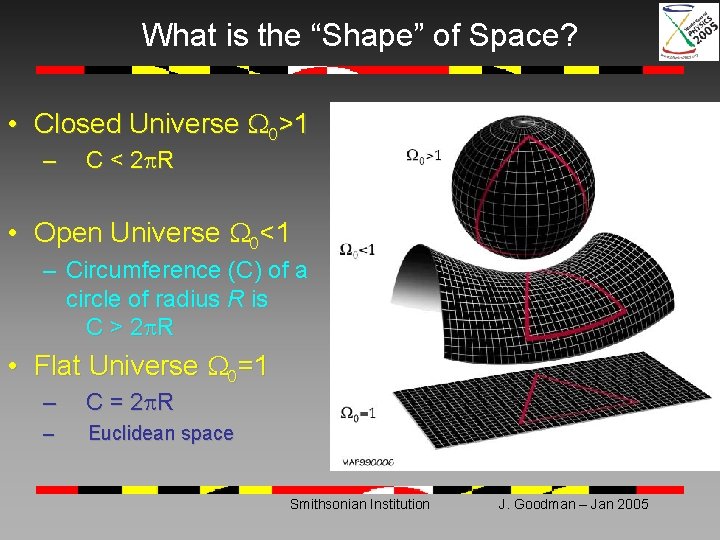
What is the “Shape” of Space? • Closed Universe W 0>1 – C < 2 p. R • Open Universe W 0<1 – Circumference (C) of a circle of radius R is C > 2 p. R • Flat Universe W 0=1 – C = 2 p. R – Euclidean space Smithsonian Institution J. Goodman – Jan 2005
Results of SN Cosmology Project • The Universe is accelerating • The data require a positive value of “Cosmological Constant” • If W 0 =1 then they find W ~ 0. 7 ± 0. 1 Smithsonian Institution J. Goodman – Jan 2005
Accelerating Universe Smithsonian Institution J. Goodman – Jan 2005
Accelerating Universe Smithsonian Institution J. Goodman – Jan 2005
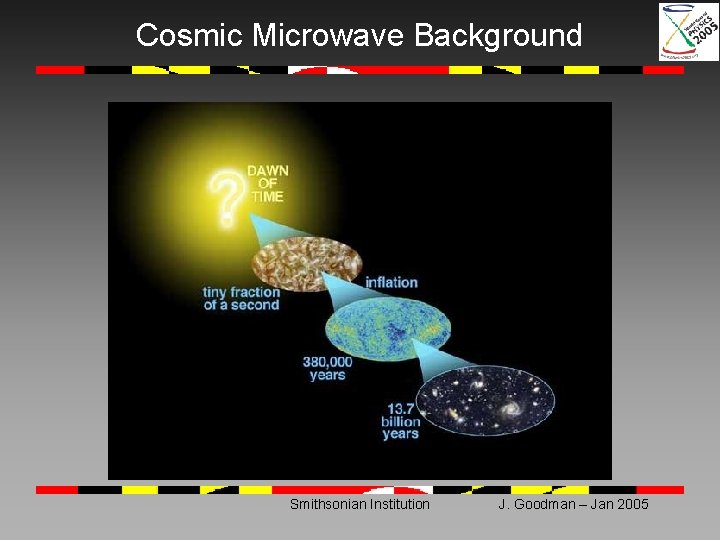
Cosmic Microwave Background Smithsonian Institution J. Goodman – Jan 2005
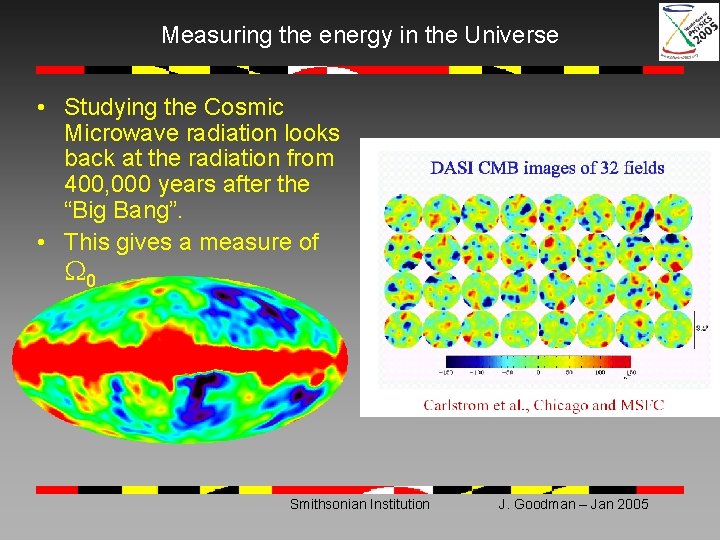
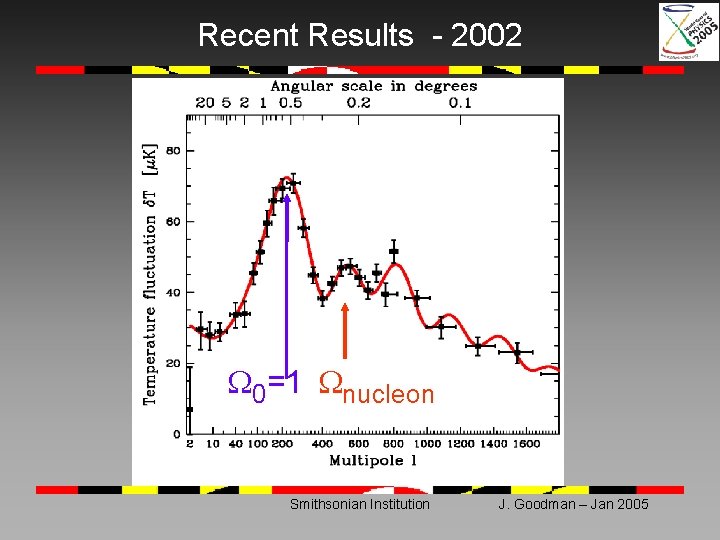
Measuring the energy in the Universe • Studying the Cosmic Microwave radiation looks back at the radiation from 400, 000 years after the “Big Bang”. • This gives a measure of W 0 Smithsonian Institution J. Goodman – Jan 2005
Recent Results - 2002 W 0=1 Wnucleon Smithsonian Institution J. Goodman – Jan 2005
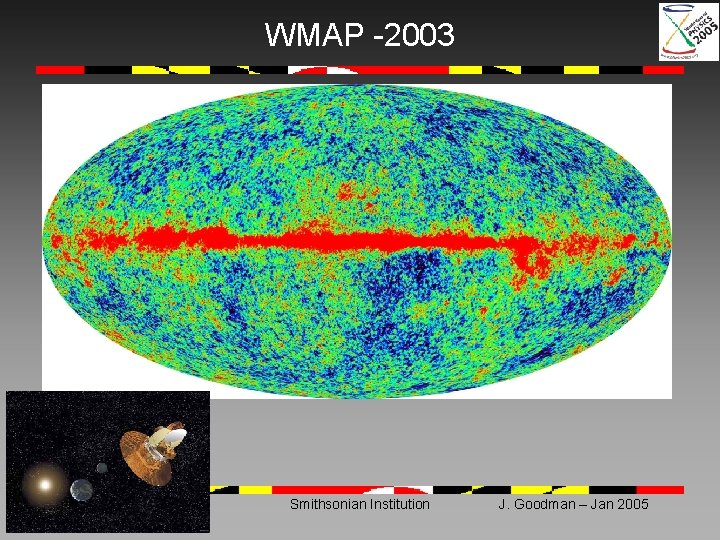
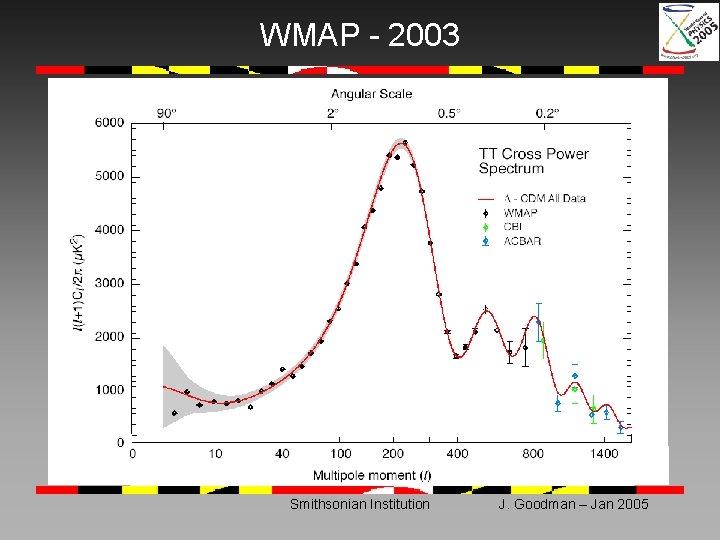
WMAP -2003 Smithsonian Institution J. Goodman – Jan 2005
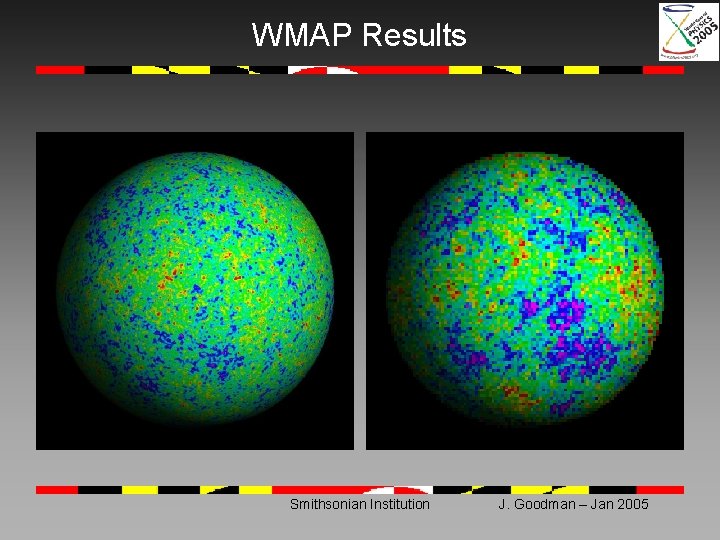
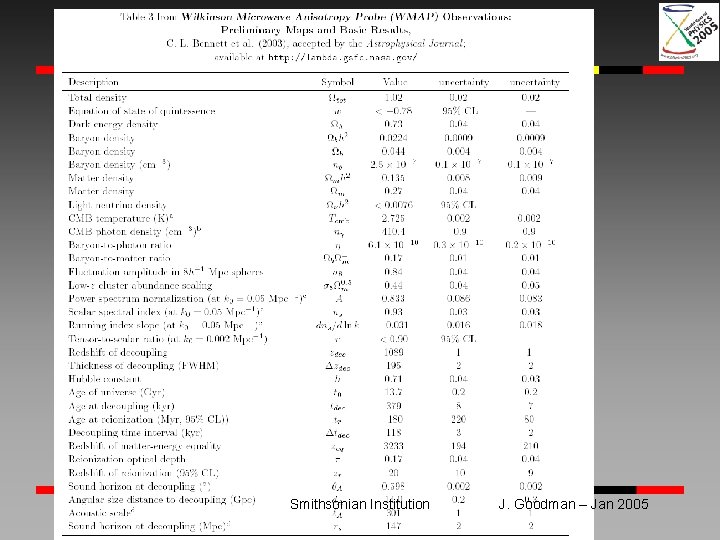
WMAP Results Smithsonian Institution J. Goodman – Jan 2005
WMAP - 2003 Smithsonian Institution J. Goodman – Jan 2005
Smithsonian Institution J. Goodman – Jan 2005
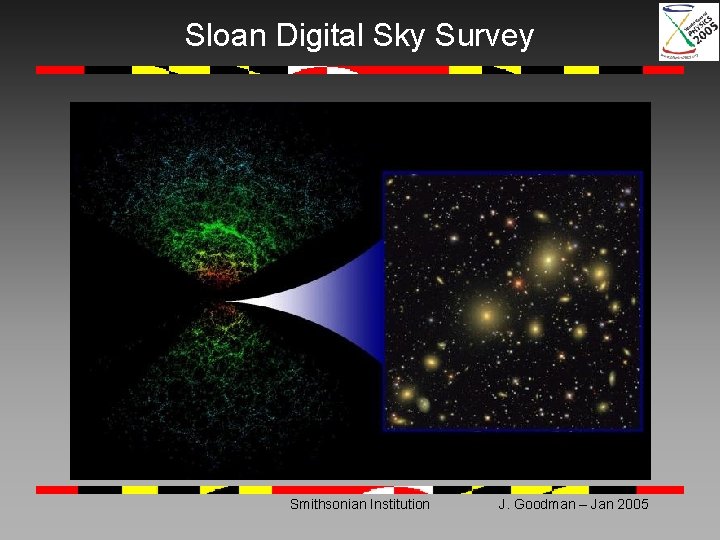
Sloan Digital Sky Survey Smithsonian Institution J. Goodman – Jan 2005
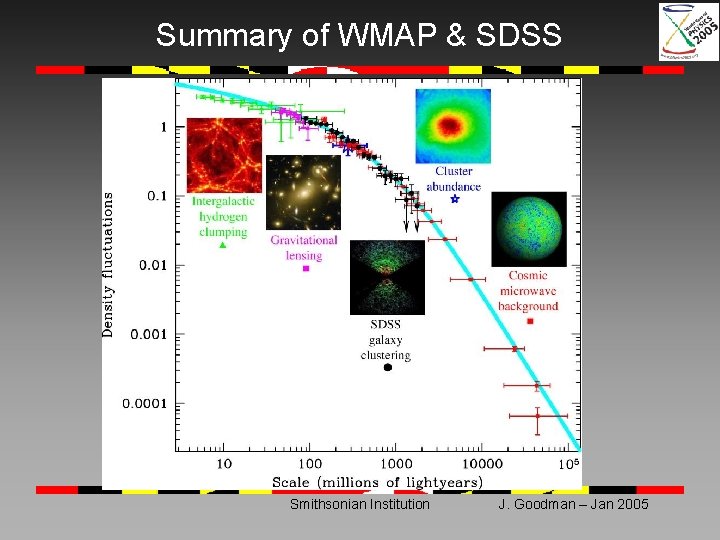
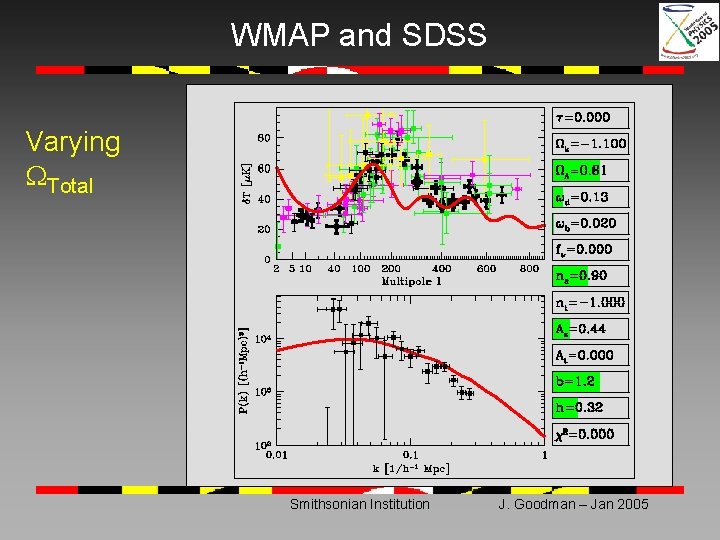
Summary of WMAP & SDSS Smithsonian Institution J. Goodman – Jan 2005
WMAP and SDSS Varying WTotal Smithsonian Institution J. Goodman – Jan 2005
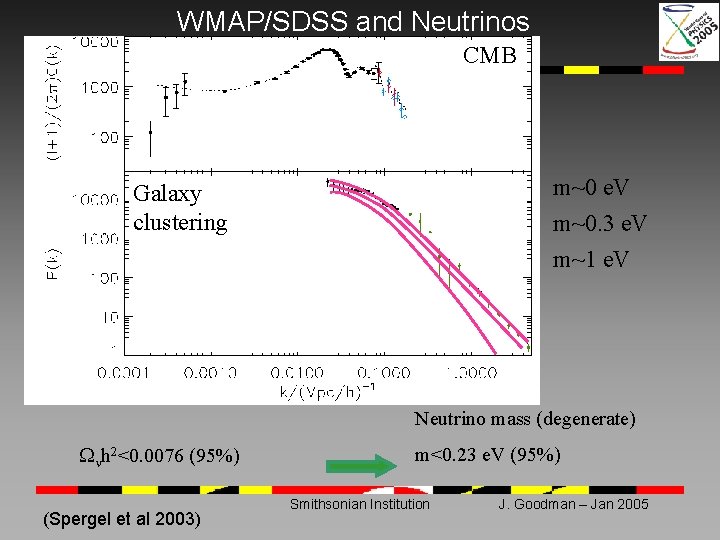
WMAP/SDSS and Neutrinos CMB Varying Neutrinos m~0 e. V m~0. 3 e. V Galaxy clustering m~1 e. V Neutrino mass (degenerate) Wnh 2<0. 0076 (95%) (Spergel et al 2003) m<0. 23 e. V (95%) Smithsonian Institution J. Goodman – Jan 2005
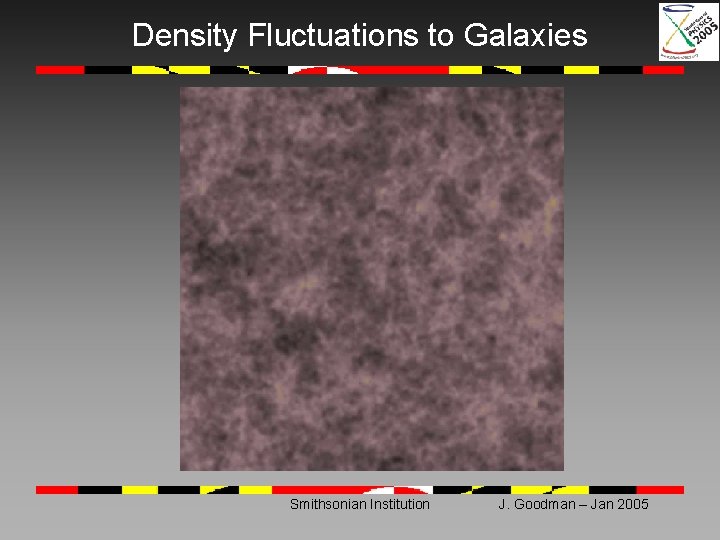
Density Fluctuations to Galaxies Smithsonian Institution J. Goodman – Jan 2005
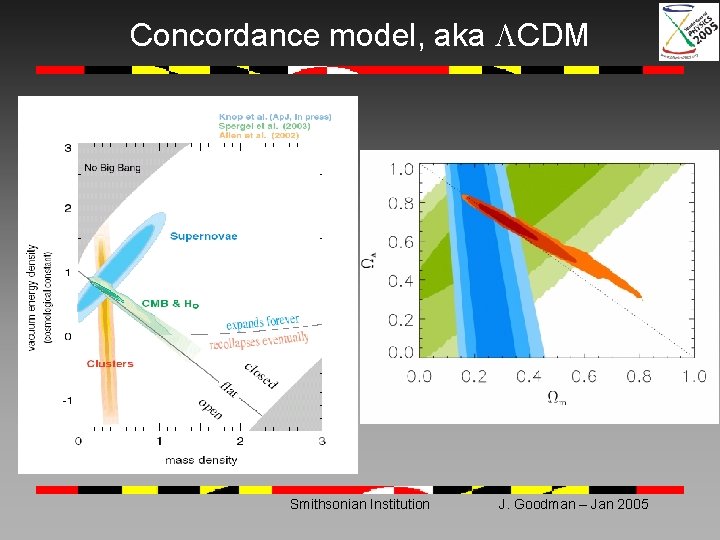
Concordance model, aka CDM Smithsonian Institution J. Goodman – Jan 2005
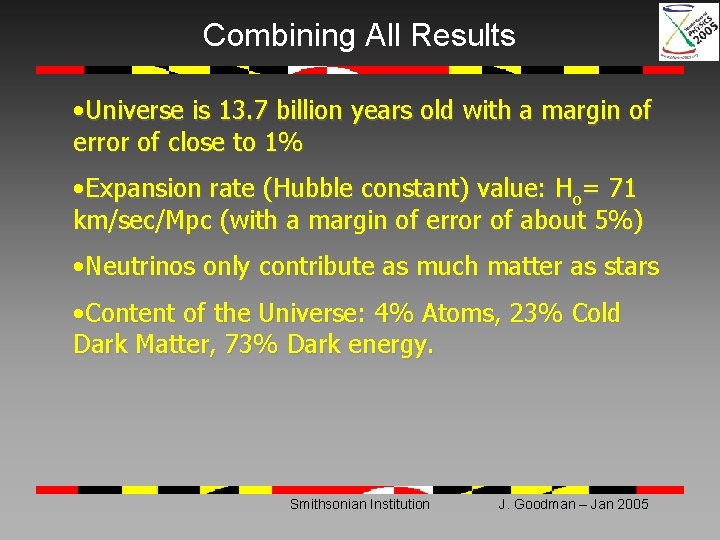
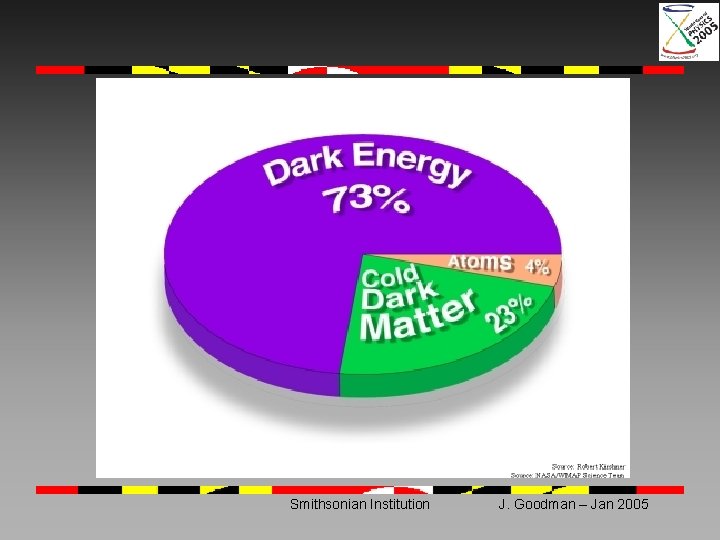
Combining All Results • Universe is 13. 7 billion years old with a margin of error of close to 1% • Expansion rate (Hubble constant) value: Ho= 71 km/sec/Mpc (with a margin of error of about 5%) • Neutrinos only contribute as much matter as stars • Content of the Universe: 4% Atoms, 23% Cold Dark Matter, 73% Dark energy. Smithsonian Institution J. Goodman – Jan 2005
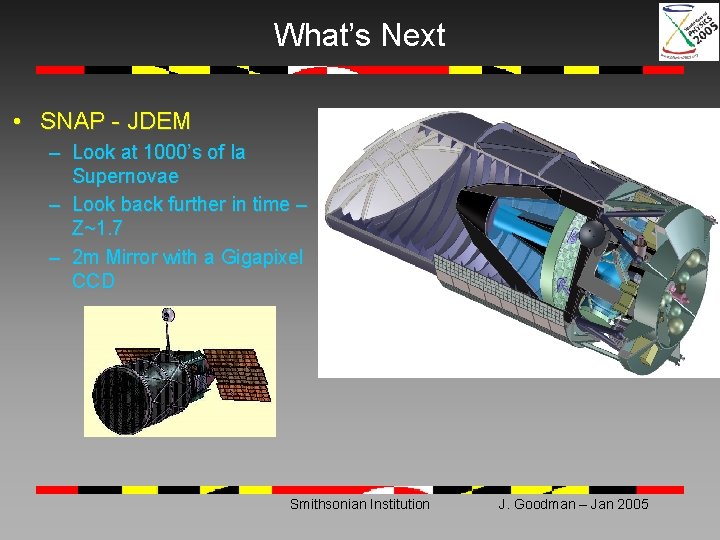
What’s Next • SNAP - JDEM – Look at 1000’s of Ia Supernovae – Look back further in time – Z~1. 7 – 2 m Mirror with a Gigapixel CCD Smithsonian Institution J. Goodman – Jan 2005
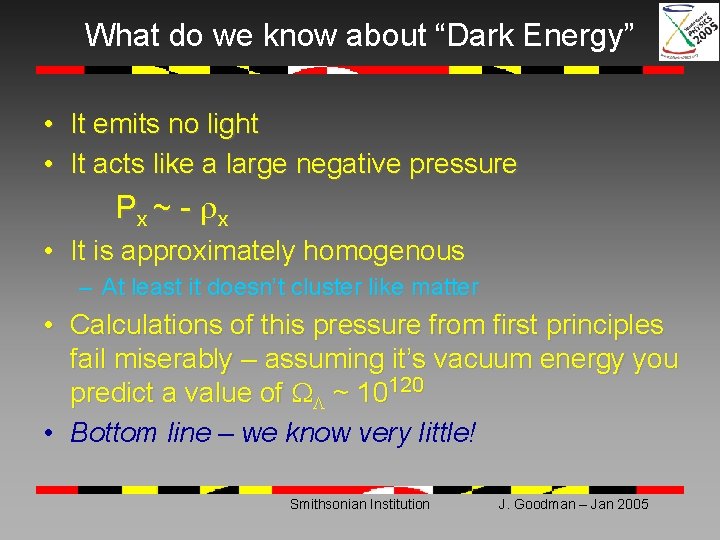
What do we know about “Dark Energy” • It emits no light • It acts like a large negative pressure Px ~ - rx • It is approximately homogenous – At least it doesn’t cluster like matter • Calculations of this pressure from first principles fail miserably – assuming it’s vacuum energy you predict a value of W ~ 10120 • Bottom line – we know very little! Smithsonian Institution J. Goodman – Jan 2005
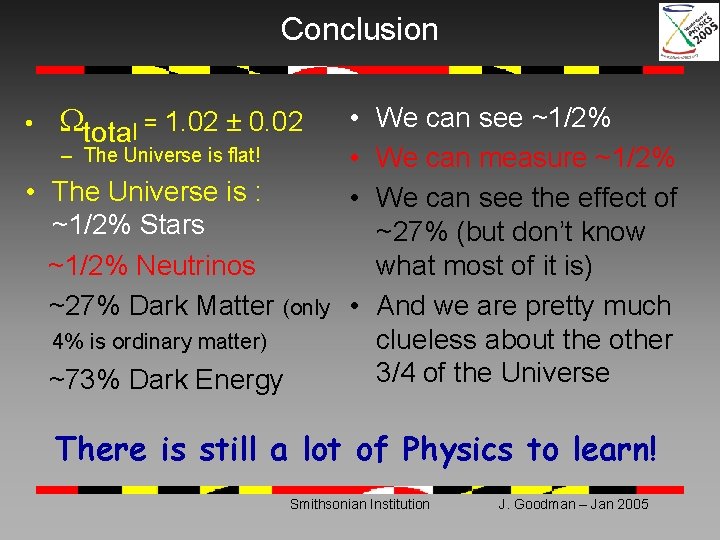
Conclusion • Wtotal = 1. 02 ± 0. 02 – The Universe is flat! • The Universe is : ~1/2% Stars ~1/2% Neutrinos ~27% Dark Matter (only 4% is ordinary matter) ~73% Dark Energy • We can see ~1/2% • We can measure ~1/2% • We can see the effect of ~27% (but don’t know what most of it is) • And we are pretty much clueless about the other 3/4 of the Universe There is still a lot of Physics to learn! Smithsonian Institution J. Goodman – Jan 2005
Smithsonian Institution J. Goodman – Jan 2005