
SMILE Exploring Identities in Museums Gavin Baldwin Middlesex
SMILE: Exploring Identities in Museums Gavin Baldwin Middlesex University
Key Questions n n n Why is it important to teach about Identity? How can Museums help us do this? What is Identity? What is the relationship between History and identity? How do Museums work?
The Key Ideas n n n To use museums as sites of identity exploration To consider ways in which the historical environment of a city can be seen as a museum for identity exploration To consider the identity of Lisbon To develop and understanding of museums as interpretations To raise questions that enable a critical reading of museums
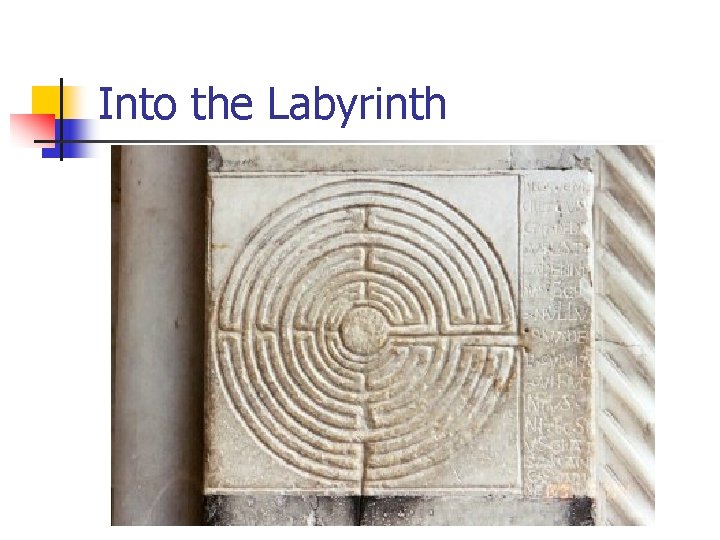
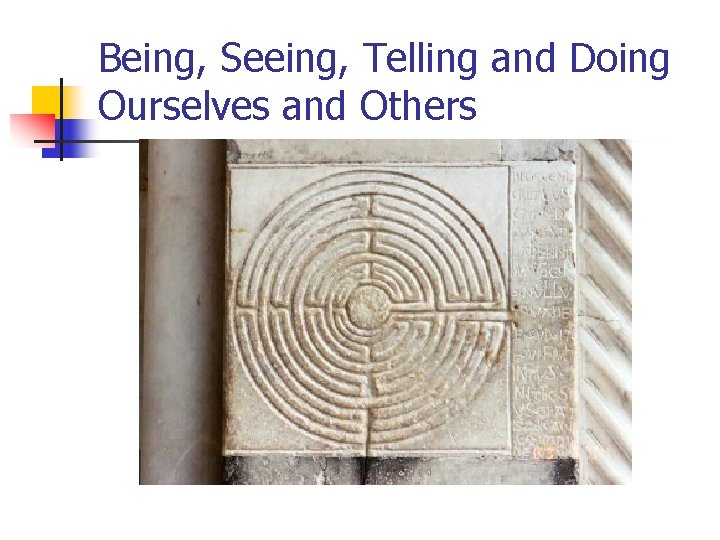
Into the Labyrinth
Why Teach Identity n n To increase our understanding of ourselves and others To develop a greater understanding of the communities in which we live- local to global To improve equality of opportunity, social inclusion and social justice To increase access to high quality Human Rights provison for ourselves and others throughout the world
Am I recognised and do I count? Race Gender Class Disability Sexuality and sexual orientation
Identity
What is identity ? n n a fluid and complex phenomenon which can vary depending on the context in which it is explored. In this sense it may be akin to ‘role’. Identity is not only concerned with how you see and present yourself but is also about how others see and interpret you. It is also, therefore, about how you see others. n Offered Identities and Given Identities Espoused and Ascribed n Insider and outsider perspectives n
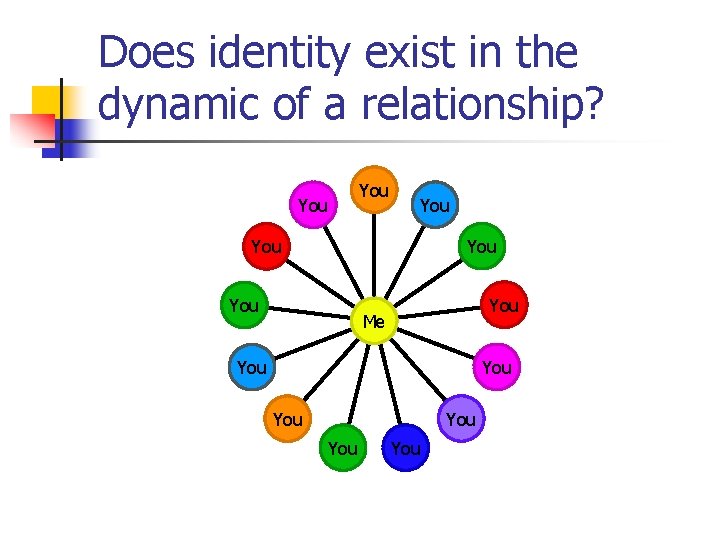
Does identity exist in the dynamic of a relationship? You You Me You You You
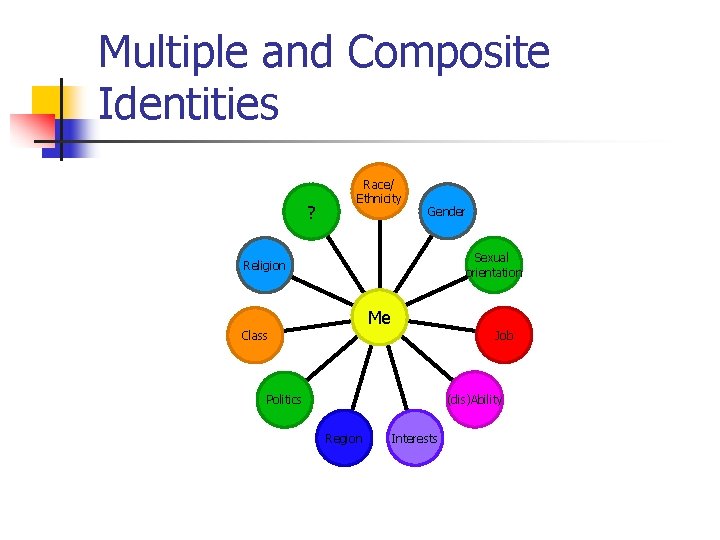
Multiple and Composite Identities ? Race/ Ethnicity Gender Sexual orientation Religion Me Class Job (dis)Ability Politics Region Interests
Identities are socially constructed n n There are social, cultural and political pressures that may limit our choice, or subconsciously influence our espoused identity and the identities we ascribe to others. Identities do not exist outside their making and are socially created in specific historical contexts (Macdonald, S. Inside European Identities 1993) n identities are not n “legacies passively received but representations socially produced and -in this sense- matters of social dispute” (Mato D “On the making of transnational identities in the age of globalisation: The US Latina/o-Latin American case: Cultural Studies 12(4) pp 598 -620 1998)
Group Identities Socio-political and Cultural Identity Groups by choice Groups by tradition Groups by attribution Assumptions and prejudice Moral Identity
National Identities What is a Nation? A geographical fact? A group of people? an ethnic group? What does a Nation have in common? territory? belief? language? laws? Can a Nation be whatever you want it to be? inclusive or exclusive?
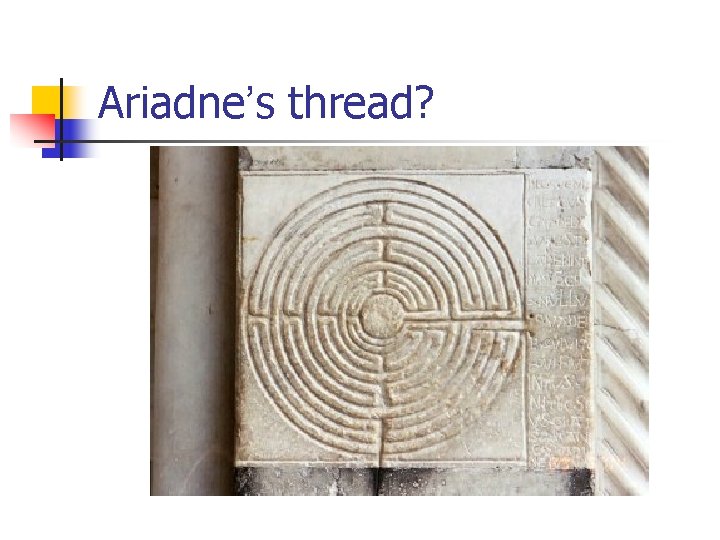
Ariadne’s thread?
History and Identity
History: the formation of ourselves in time n n Many of these influences on our identity formation are historical A Metaphor: Identity is a narrative “How I, as a finite, concrete, embodied individual, shape and fashion the circumstances of my birth and family, linguistic, cultural and gender identity into a coherent narrative that stands as my life’s story” (Benhabib, S ‘The generalised and concrete other: the Kohlberg. Gilligan controversy and feminist theory’ in Kittay, E. F and Meyers, D. T. eds Women and Moral Theory, new Jersey, Rowman and Littlefield 1987 p 166)
Exploring Historical Influences on Identity Formation § n n n Living with the past Developing a critical relationship with the past through the ‘historical environment’ History as Truth History as construction
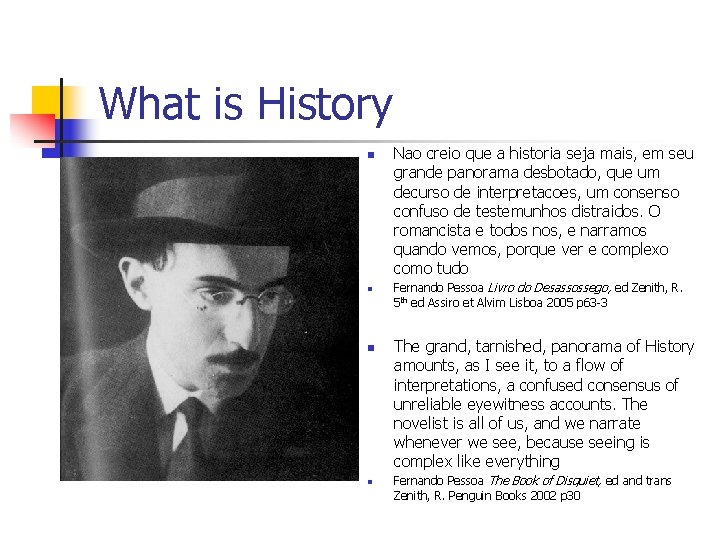
What is History n n Nao creio que a historia seja mais, em seu grande panorama desbotado, que um decurso de interpretacoes, um consenso confuso de testemunhos distraidos. O romancista e todos nos, e narramos quando vemos, porque ver e complexo como tudo Fernando Pessoa Livro do Desassossego, ed Zenith, R. 5 th ed Assiro et Alvim Lisboa 2005 p 63 -3 The grand, tarnished, panorama of History amounts, as I see it, to a flow of interpretations, a confused consensus of unreliable eyewitness accounts. The novelist is all of us, and we narrate whenever we see, because seeing is complex like everything Fernando Pessoa The Book of Disquiet, ed and trans Zenith, R. Penguin Books 2002 p 30
History, Memory and Identity Les Lieux de Memoire (Pierre Nora) ‘there is no such thing as spontaneous memory, hence we must create archives, mark anniversaries, organise celebrations, pronounce eulogies and authenticate documents because such things no longer happen as a matter of course…These bastions buttress our identity, but if what they defended were not threatened, there would be no need for them. ’ Nora, P. 1992/6 Les Lieux de Memoire, Editions Gallimard, Paris 1992. English Edition: Realms of Memory Kritzman, L. D. and Goldhammer, A. trans Columbia University Press 1996
…and myth Robert Hewison: Heritage an Interpretation (1989) ‘You will appreciate that if I describe something as a myth. that does not necessarily mean that it is untrue. Simply that it is true in a special sense, in that it has truth for a great many people, and this general belief gives it a contemporary validity. It may contain elements that are unhistorical, or ahistorical, but it adds up to a cultural truth. It may indeed contain a great deal of historically accurate and factually testable material but this is transformed into a touchstone of national, local, even individual identity. ’ In Uzzell, D. (ed). Heritage Interpretation Vol 1 The natural and built environment’ pp 15 -23 London Routledge
Identity Explorartion
Being, Seeing, Telling and Doing Ourselves and Others
Telling and Doing Constructing your own histories as an expression of identity Making and exploring museums of yourselves Identity exploration and questioning Critically reading museums
Identity Exploration self identity: n n group identity: n n Which groups do I belong to? My family, my ethnic group, my religion, my class (both social and at school!), the area in which I live. Which societies do I choose to join that represent my interests? national identity: n n How do I see myself and choose to present myself to others? How do I identify with ‘my country’? How do I see the countries of others? the identities expressed in Europe? n How do my identities compare with others that I can find out about?
Developing New Identities Are we too focused on the past and the present? Is it enough to explore through history and museums who we are? Ways of doing; a challenge Using our present knowledge and understanding of ourselves and others how can we develop society to ensure equality for all with which we began?
- Slides: 26