
SMGCS Oct 2014 Overview What is SMGCS SMGCS
- Slides: 26
SMGCS Oct 2014
Overview ► What is SMGCS? ► SMGCS ► FAI airfield features SMGCS Plan ► SMGCS initiation and termination ► SMGCS procedures ► Your role as a ground vehicle operator during SMGCS ► What is CAT II/III?
The Basics Surface ► Initiated by the ATCT during very poor visibility conditions Movement ► West Ramp becomes “controlled” by Airport Operations Guidance ► Vehicle movement limited to vehicles in direct support of aircraft operations ► All drivers require an escort on, or adjacent to the West Ramp Call 474 -2530 and Control System
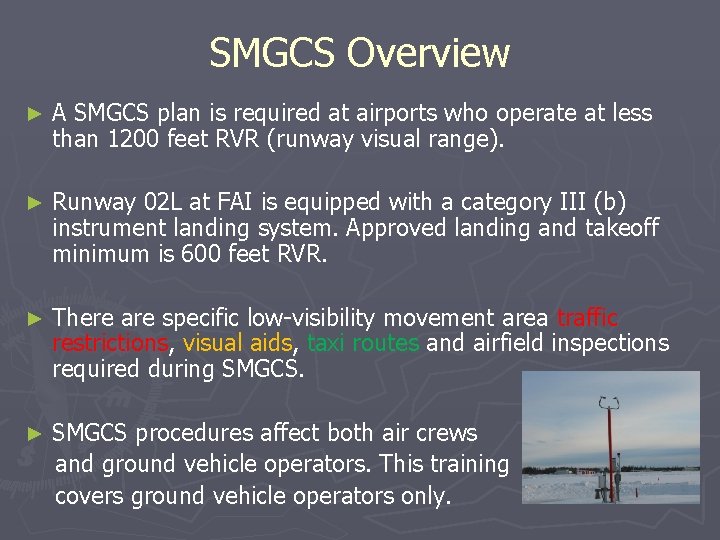
SMGCS Overview ► A SMGCS plan is required at airports who operate at less than 1200 feet RVR (runway visual range). ► Runway 02 L at FAI is equipped with a category III (b) instrument landing system. Approved landing and takeoff minimum is 600 feet RVR. ► There are specific low-visibility movement area traffic restrictions, visual aids, taxi routes and airfield inspections required during SMGCS. ► SMGCS procedures affect both air crews and ground vehicle operators. This training covers ground vehicle operators only.
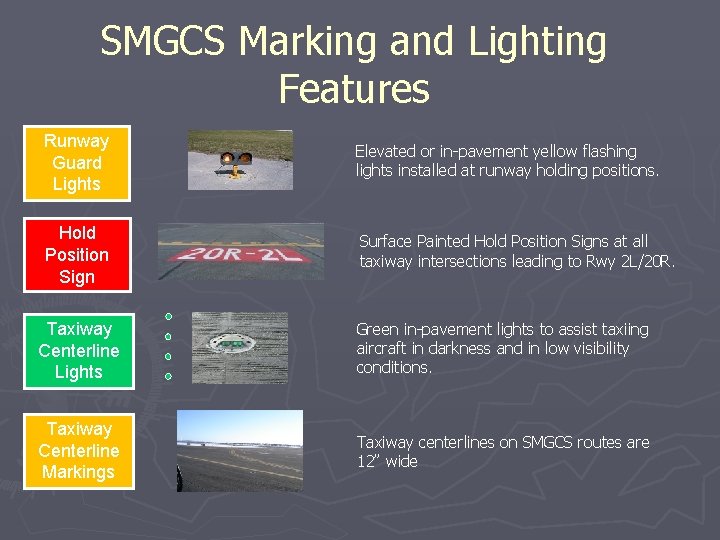
SMGCS Marking and Lighting Features Runway Guard Lights Elevated or in-pavement yellow flashing lights installed at runway holding positions. Hold Position Sign Surface Painted Hold Position Signs at all taxiway intersections leading to Rwy 2 L/20 R. Taxiway Centerline Lights Green in-pavement lights to assist taxiing aircraft in darkness and in low visibility conditions. Taxiway Centerline Markings Taxiway centerlines on SMGCS routes are 12” wide
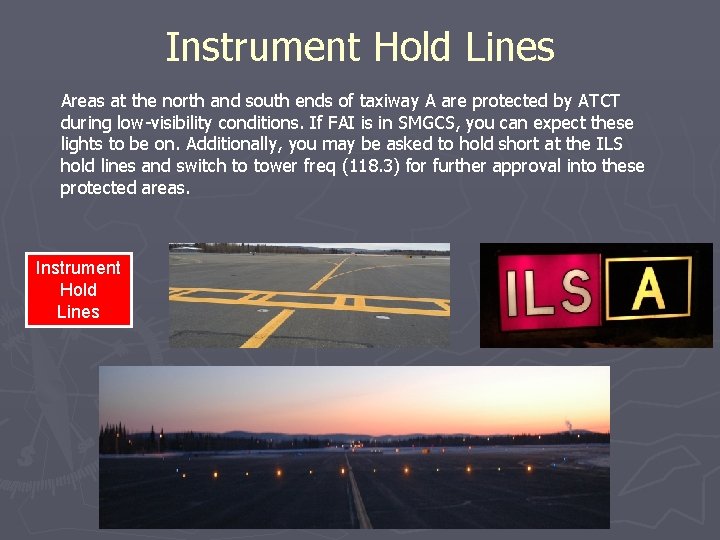
Instrument Hold Lines Areas at the north and south ends of taxiway A are protected by ATCT during low-visibility conditions. If FAI is in SMGCS, you can expect these lights to be on. Additionally, you may be asked to hold short at the ILS hold lines and switch to tower freq (118. 3) for further approval into these protected areas. Instrument Hold Lines
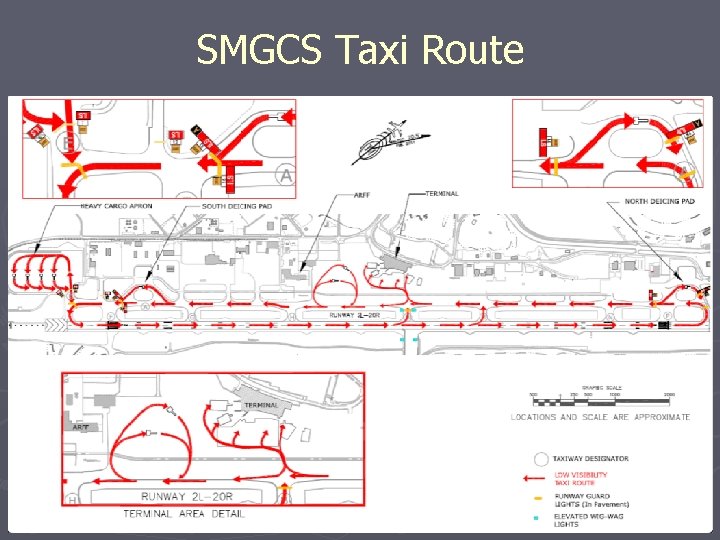
SMGCS Taxi Route
FAI SMGCS Implementation ► When ATCT has one Runway Visual Range (RVR) below 1200 feet.
RESPONSIBILITIES During SMGCS Conditions
Air Traffic Control Tower (ATCT) ► Notify the Airport Communications Center (ACC) when weather conditions fall below an RVR of 1400. SMGCS procedures must be in effect when the RVR is 1200 or less. Notify the ACC when no longer in SMGCS. ► Broadcast SMGCS advisement and taxiway closures on the ATIS. ► Route taxiing aircraft utilizing the current FAI low visibility taxi route chart. ► Coordinate aircraft follow me requests with Airport Operations.
Airport Communications Center ► Notify Airport Operations. If not on the field, initiate recall procedures and notify Watch Commander. ► Utilize the SMGCS notification list to advise personnel that SMGCS procedures are in effect. Below is an abbreviated notification list. § § § Airport Manager/department heads ARFF Station & on-duty officers Field Maintenance Foreman TSA Airlines etc. ► Communicate escort and follow-me requests from tenants or ATCT to Airport Operations. ► Notify agencies again, once out of SMGCS.
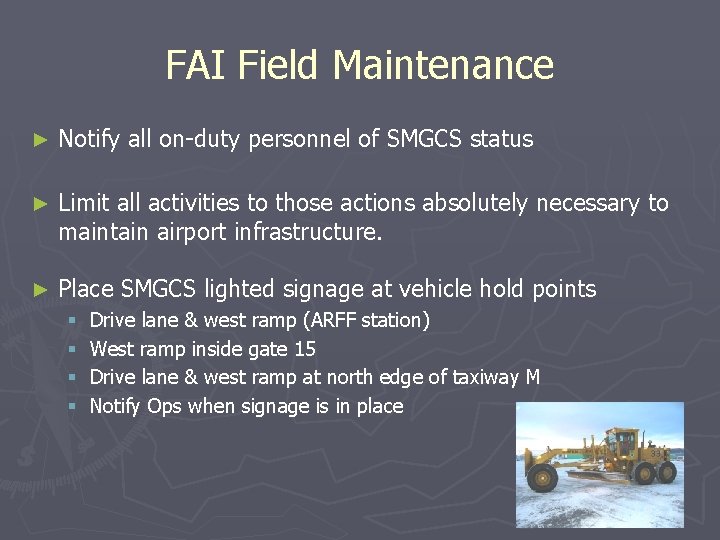
FAI Field Maintenance ► Notify all on-duty personnel of SMGCS status ► Limit all activities to those actions absolutely necessary to maintain airport infrastructure. ► Place SMGCS lighted signage at vehicle hold points § § Drive lane & west ramp (ARFF station) West ramp inside gate 15 Drive lane & west ramp at north edge of taxiway M Notify Ops when signage is in place
Airport Operations ► Establish radio contact with ATCT & assure signage is up. ► Perform Cat II/III field checks every two hours. ► NOTAM close intersections F, G, H, N & P. ► Resolve vehicle and aircraft conflicts in the non-movement area of the apron. Disseminate information on alternate vehicle routing, if available. ► Provide escort or follow-me service upon request. ► Monitor adherence to SMCGS plan and take action to correct deficiencies.
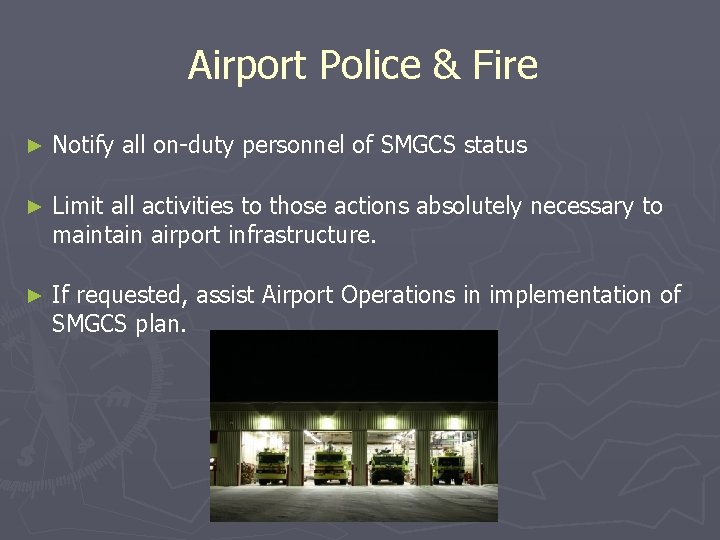
Airport Police & Fire ► Notify all on-duty personnel of SMGCS status ► Limit all activities to those actions absolutely necessary to maintain airport infrastructure. ► If requested, assist Airport Operations in implementation of SMGCS plan.
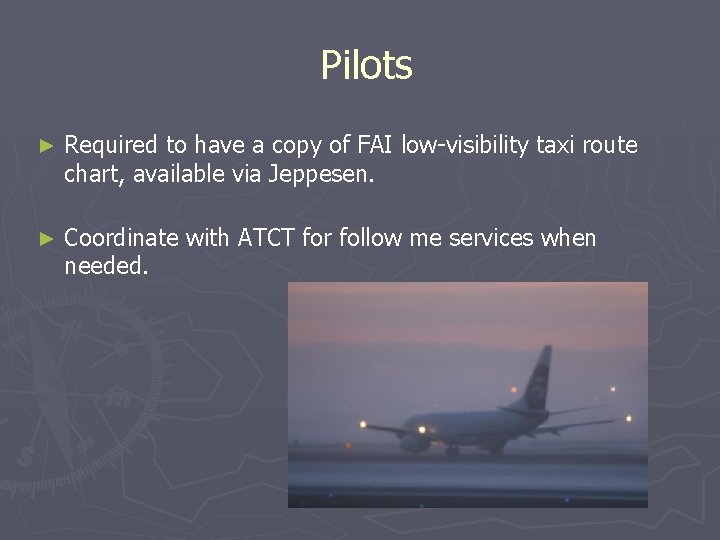
Pilots ► Required to have a copy of FAI low-visibility taxi route chart, available via Jeppesen. ► Coordinate with ATCT for follow me services when needed.
Tenants ► Notify all on-duty personnel (including contractors) that SMGCS is in effect. ► Limit all ramp movement and operations to those necessary to support flight operations. ► Required to contact Airport Operations through ACC for an escort before movement to/from or across the west ramp. ► Escorts available to/from de-ice pads if needed.
Unescorted Vehicle Operations During SMGCS ●●● (Airport Ops, SOA Maintenance, AP&F only) ► Limit all activities to those actions absolutely necessary to maintain airport infrastructure. ► Vehicle must be properly lit and marked, with a flashing beacon and functioning ground radio, whether on a controlled surface or not. ► Drive slowly and cautiously, with lights on and beacon flashing.
P Some Do’s and Don’ts ► DO the task if otherwise left undone would create a hazard to life, property, or is critical to flight operations. § For example: snow removal to keep aircraft operating § Or responding to emergencies where your presence is crucial to save lives or property. ► DON’T perform routine tasks not critical to airport operations. § For example: routine vehicle refueling § Or accessing other facilities via routes on ramps & taxiways During poor visibility, drivers should consider avoiding all unnecessary driving on FAI, not just the West Ramp
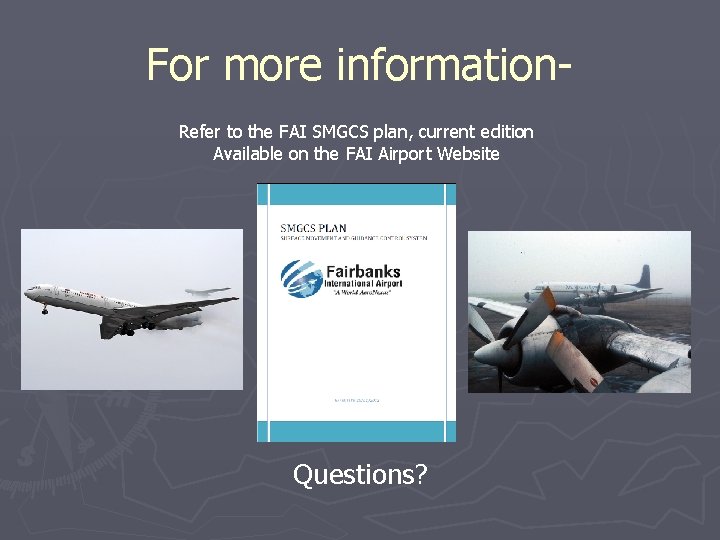
For more information. Refer to the FAI SMGCS plan, current edition Available on the FAI Airport Website Questions?
CAT II/III What does this mean? ► CAT II/III refers to aircraft approach minimums and certain aircrew and aircraft certification requirements. ► Being in CAT II/III does not necessarily mean we are in SMGCS. ► CAT III would be a SMGCS condition.
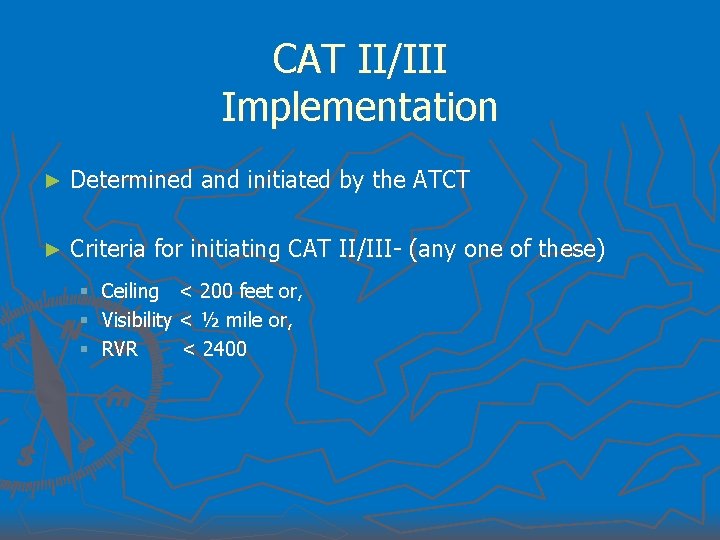
CAT II/III Implementation ► Determined and initiated by the ATCT ► Criteria for initiating CAT II/III- (any one of these) § § § Ceiling < 200 feet or, Visibility < ½ mile or, RVR < 2400
RESPONSIBILITIES During CAT II/III Conditions
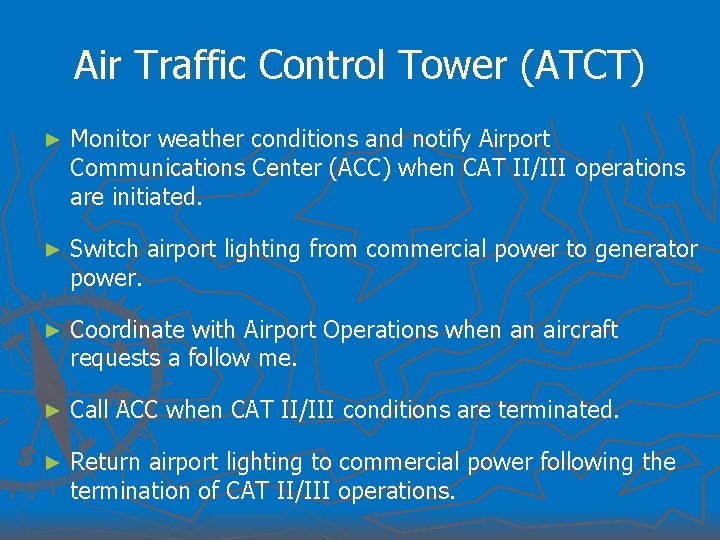
Air Traffic Control Tower (ATCT) ► Monitor weather conditions and notify Airport Communications Center (ACC) when CAT II/III operations are initiated. ► Switch airport lighting from commercial power to generator power. ► Coordinate with Airport Operations when an aircraft requests a follow me. ► Call ACC when CAT II/III conditions are terminated. ► Return airport lighting to commercial power following the termination of CAT II/III operations.
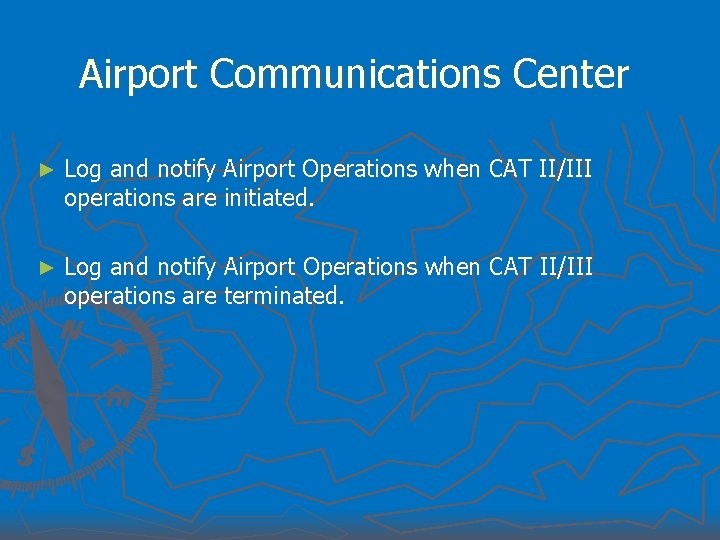
Airport Communications Center ► Log and notify Airport Operations when CAT II/III operations are initiated. ► Log and notify Airport Operations when CAT II/III operations are terminated.
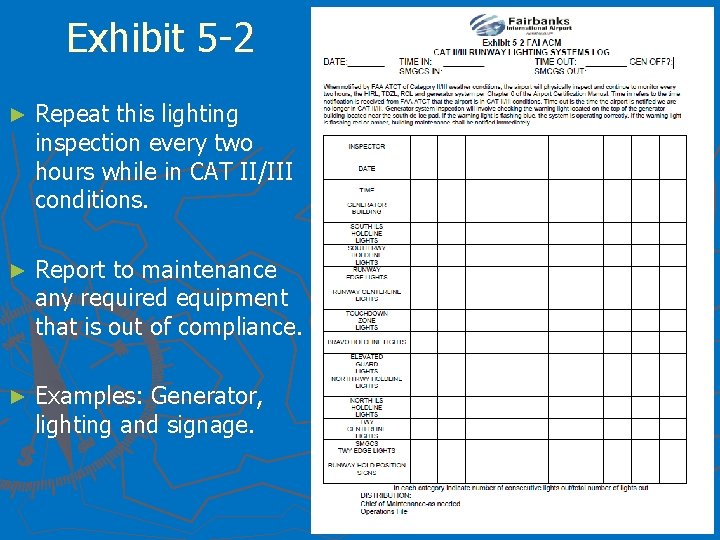
Airport Operations ► Once notified, will perform a CAT II/III light check as soon as possible in accordance with Exhibit 5 -2 of the Airport Certification Manual (ACM). ► Noting times in and out, equipment operation and failures per Exhibit 5 -2 of the ACM, located on the next slide. ► Make notifications and issue NOTAMs as necessary.
Exhibit 5 -2 ► Repeat this lighting inspection every two hours while in CAT II/III conditions. ► Report to maintenance any required equipment that is out of compliance. ► Examples: Generator, lighting and signage.