
Smetana Vltava Ma Vlast no 2 Bedich Smetana
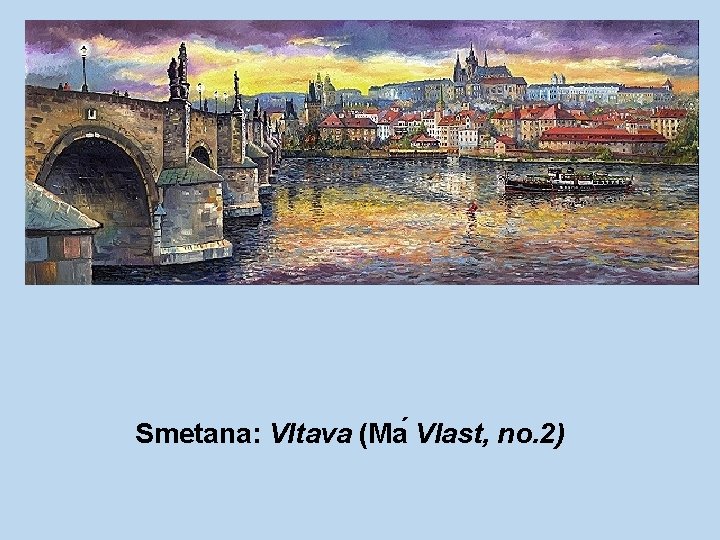
Smetana: Vltava (Ma Vlast, no. 2)
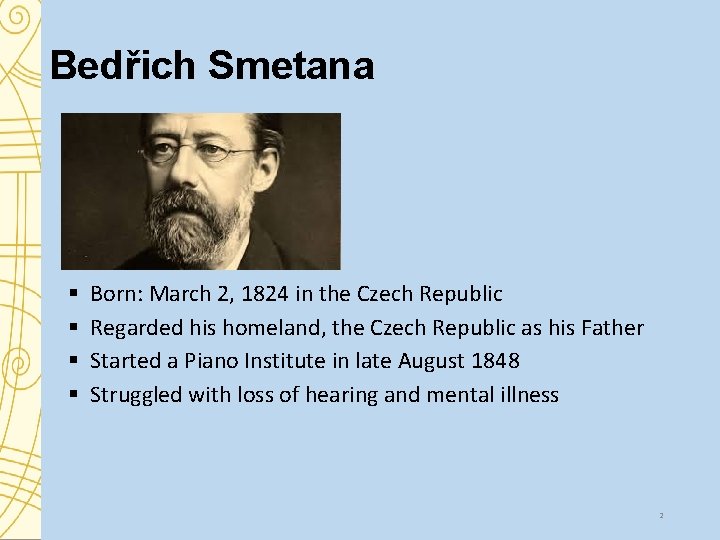
Bedřich Smetana § § Born: March 2, 1824 in the Czech Republic Regarded his homeland, the Czech Republic as his Father Started a Piano Institute in late August 1848 Struggled with loss of hearing and mental illness 2
How did he die? § In 1879, Smetana had written to a friend, revealing fears of the onset of madness. § By the winter of 1882– 83 he was experiencing depression, insomnia, and hallucinations, together with giddiness, cramp and a temporary loss of speech § Died in 1884 - The hospital registered the cause of death as senile dementia. 3
Ma Vlast - Highlights GENRE: Symphonic poem • Composed Má Vlast, (My Country) between 1874 -1879 • Romantic Period • Cycle of six symphonic poems • Six pieces were conceived as individual works • Symphonic Poem - A symphonic poem or tone poem is a piece of orchestral music, usually in a single continuous movement, which illustrates or evokes the content of a poem, short story, novel, painting, landscape, or other (non -musical) source. • Each poem depicts some aspect of the countryside, history, or legends of Bohemia 4
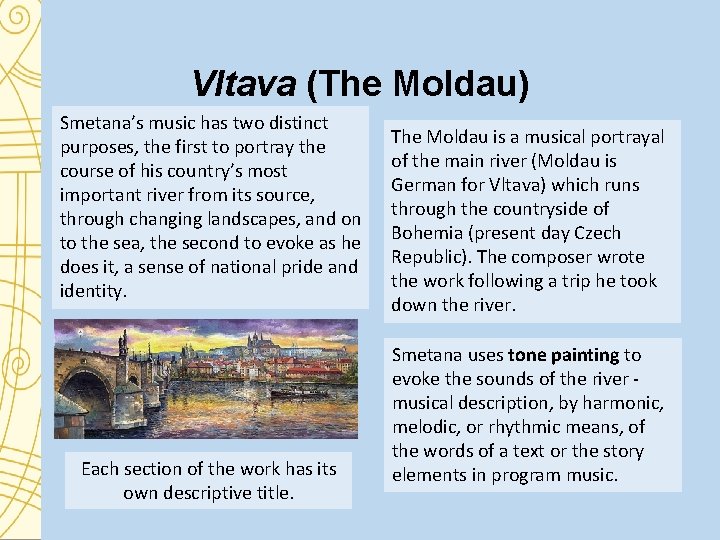
Vltava (The Moldau) Smetana’s music has two distinct purposes, the first to portray the course of his country’s most important river from its source, through changing landscapes, and on to the sea, the second to evoke as he does it, a sense of national pride and identity. Each section of the work has its own descriptive title. The Moldau is a musical portrayal of the main river (Moldau is German for Vltava) which runs through the countryside of Bohemia (present day Czech Republic). The composer wrote the work following a trip he took down the river. Smetana uses tone painting to evoke the sounds of the river musical description, by harmonic, melodic, or. The rhythmic Vltava inmeans, Prague of the words of a text or the story elements in program music.
Orchestration Smetana employs the rich color of a large orchestra: Note the use of harp, tuba, piccolo, bass drum, cymbals, and triangle. With this vivid palette he creates scenes of contrasting atmosphere.
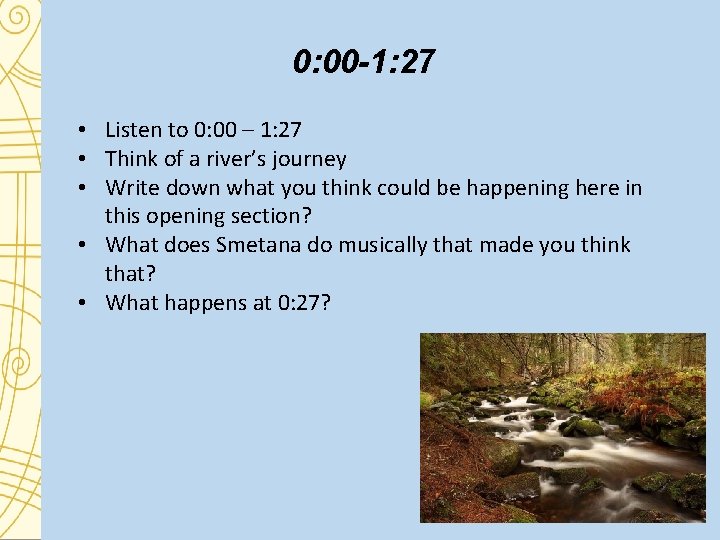
0: 00 -1: 27 • Listen to 0: 00 – 1: 27 • Think of a river’s journey • Write down what you think could be happening here in this opening section? • What does Smetana do musically that made you think that? • What happens at 0: 27?
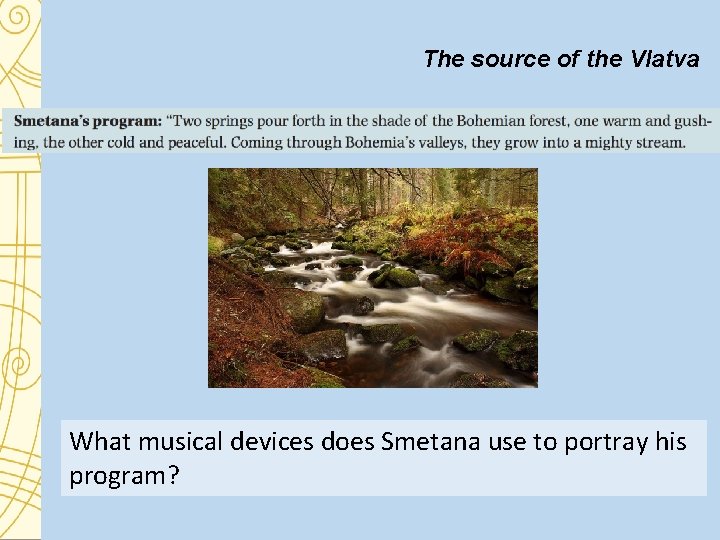
The source of the Vlatva What musical devices does Smetana use to portray his program?
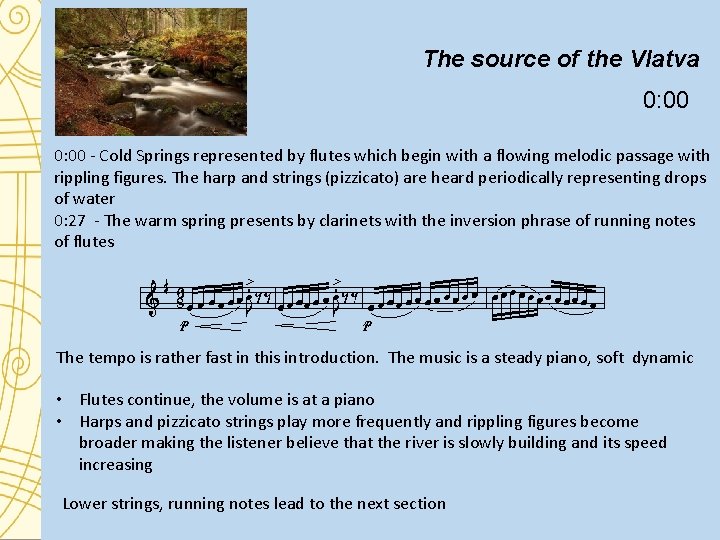
The source of the Vlatva 0: 00 - Cold Springs represented by flutes which begin with a flowing melodic passage with rippling figures. The harp and strings (pizzicato) are heard periodically representing drops of water 0: 27 - The warm spring presents by clarinets with the inversion phrase of running notes of flutes The tempo is rather fast in this introduction. The music is a steady piano, soft dynamic • Flutes continue, the volume is at a piano • Harps and pizzicato strings play more frequently and rippling figures become broader making the listener believe that the river is slowly building and its speed increasing Lower strings, running notes lead to the next section
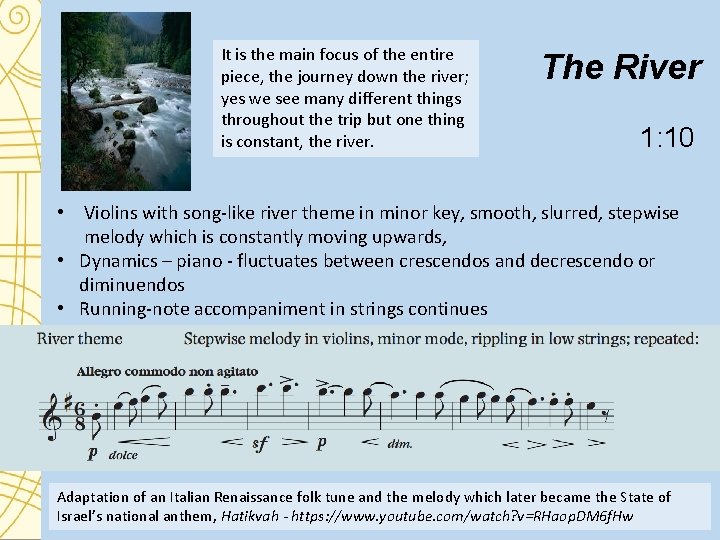
It is the main focus of the entire piece, the journey down the river; yes we see many different things throughout the trip but one thing is constant, the river. The River 1: 10 • Violins with song-like river theme in minor key, smooth, slurred, stepwise melody which is constantly moving upwards, • Dynamics – piano - fluctuates between crescendos and decrescendo or diminuendos • Running-note accompaniment in strings continues Adaptation of an Italian Renaissance folk tune and the melody which later became the State of Israel’s national anthem, Hatikvah - https: //www. youtube. com/watch? v=RHaop. DM 6 f. Hw
The River 1: 10 How does Smetana represent the river growing/ increasing in flow? 11
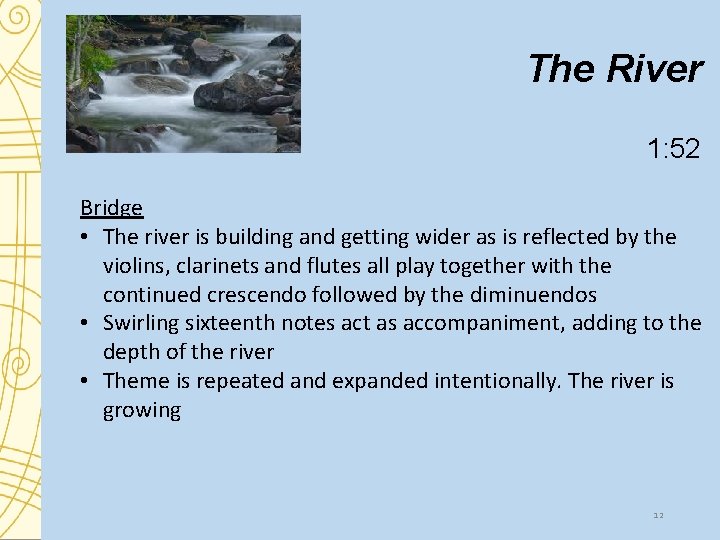
The River 1: 52 Bridge • The river is building and getting wider as is reflected by the violins, clarinets and flutes all play together with the continued crescendo followed by the diminuendos • Swirling sixteenth notes act as accompaniment, adding to the depth of the river • Theme is repeated and expanded intentionally. The river is growing 12
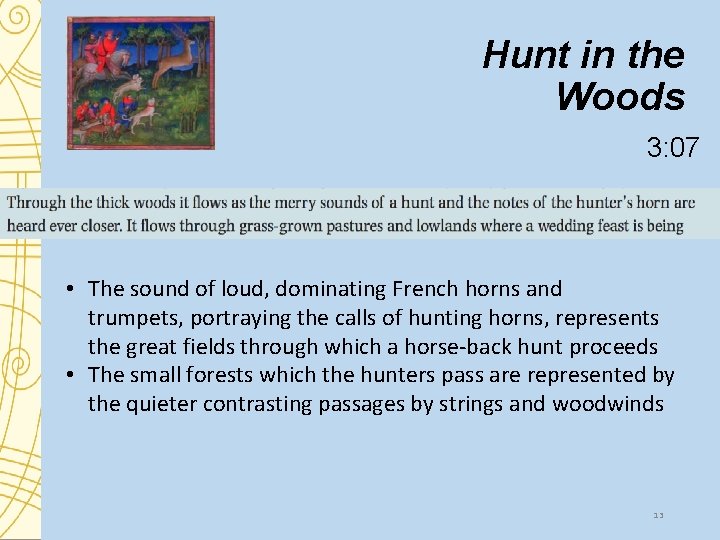
Hunt in the Woods 3: 07 • The sound of loud, dominating French horns and trumpets, portraying the calls of hunting horns, represents the great fields through which a horse-back hunt proceeds • The small forests which the hunters pass are represented by the quieter contrasting passages by strings and woodwinds 13
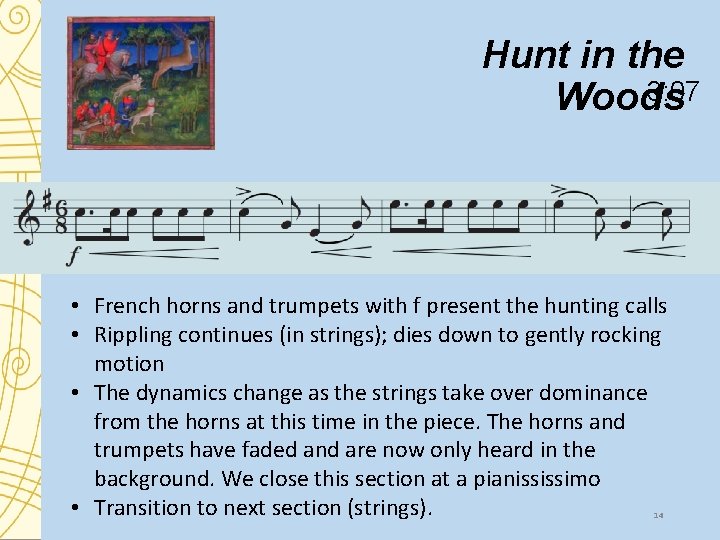
Hunt in the 3: 07 Woods • French horns and trumpets with f present the hunting calls • Rippling continues (in strings); dies down to gently rocking motion • The dynamics change as the strings take over dominance from the horns at this time in the piece. The horns and trumpets have faded and are now only heard in the background. We close this section at a pianississimo • Transition to next section (strings). 14
4: 18 How does the music change in character at this point? What might be happening?
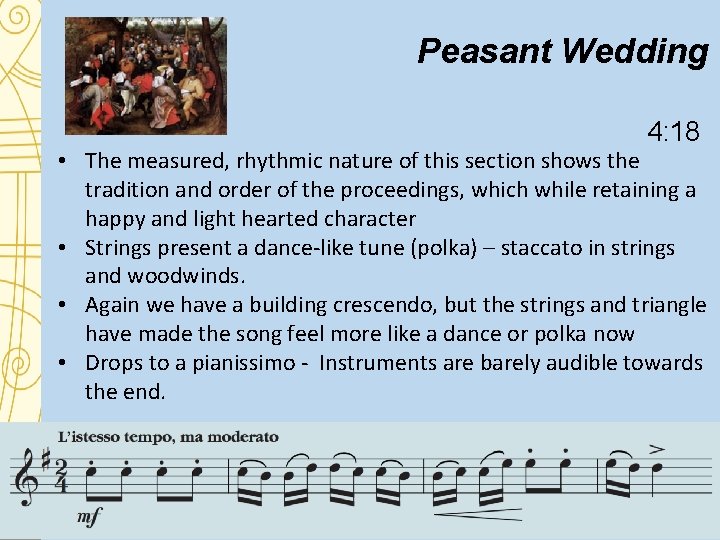
Peasant Wedding 4: 18 • The measured, rhythmic nature of this section shows the tradition and order of the proceedings, which while retaining a happy and light hearted character • Strings present a dance-like tune (polka) – staccato in strings and woodwinds. • Again we have a building crescendo, but the strings and triangle have made the song feel more like a dance or polka now • Drops to a pianissimo - Instruments are barely audible towards the end. 16
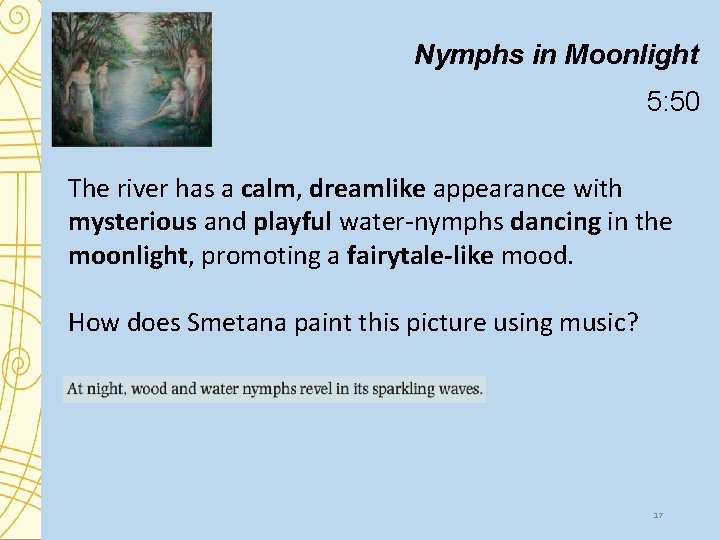
Nymphs in Moonlight 5: 50 The river has a calm, dreamlike appearance with mysterious and playful water-nymphs dancing in the moonlight, promoting a fairytale-like mood. How does Smetana paint this picture using music? 17
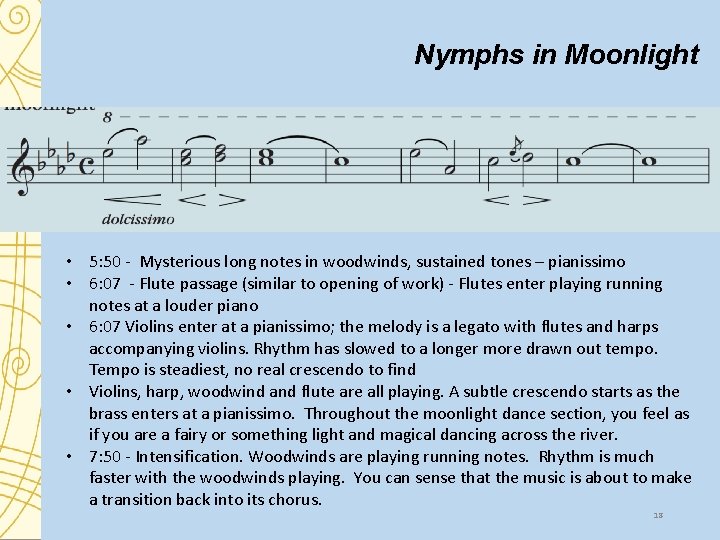
Nymphs in Moonlight • 5: 50 - Mysterious long notes in woodwinds, sustained tones – pianissimo • 6: 07 - Flute passage (similar to opening of work) - Flutes enter playing running notes at a louder piano • 6: 07 Violins enter at a pianissimo; the melody is a legato with flutes and harps accompanying violins. Rhythm has slowed to a longer more drawn out tempo. Tempo is steadiest, no real crescendo to find • Violins, harp, woodwind and flute are all playing. A subtle crescendo starts as the brass enters at a pianissimo. Throughout the moonlight dance section, you feel as if you are a fairy or something light and magical dancing across the river. • 7: 50 - Intensification. Woodwinds are playing running notes. Rhythm is much faster with the woodwinds playing. You can sense that the music is about to make a transition back into its chorus. 18
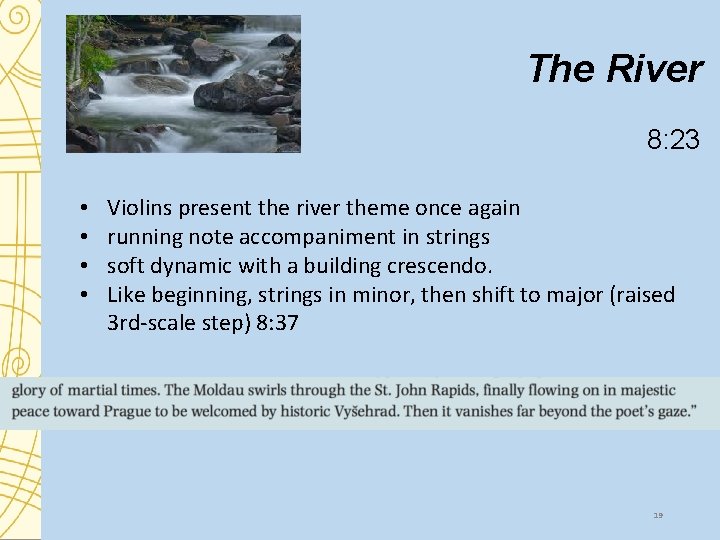
The River 8: 23 • • Violins present the river theme once again running note accompaniment in strings soft dynamic with a building crescendo. Like beginning, strings in minor, then shift to major (raised 3 rd-scale step) 8: 37 19
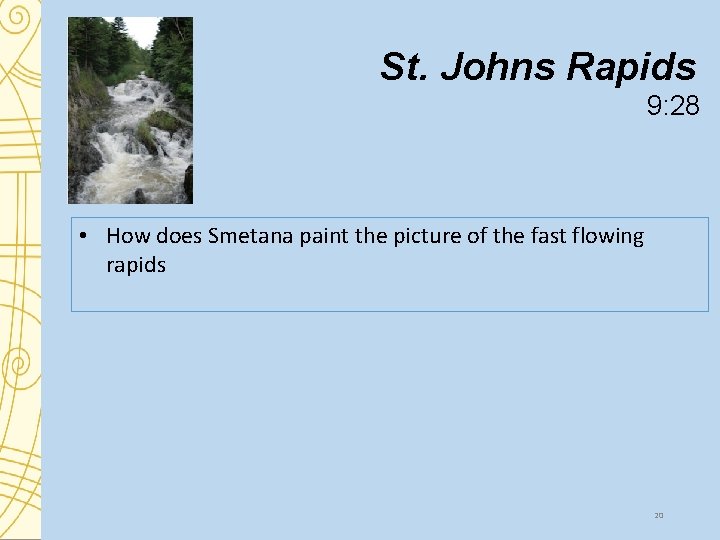
St. Johns Rapids 9: 28 • How does Smetana paint the picture of the fast flowing rapids 20
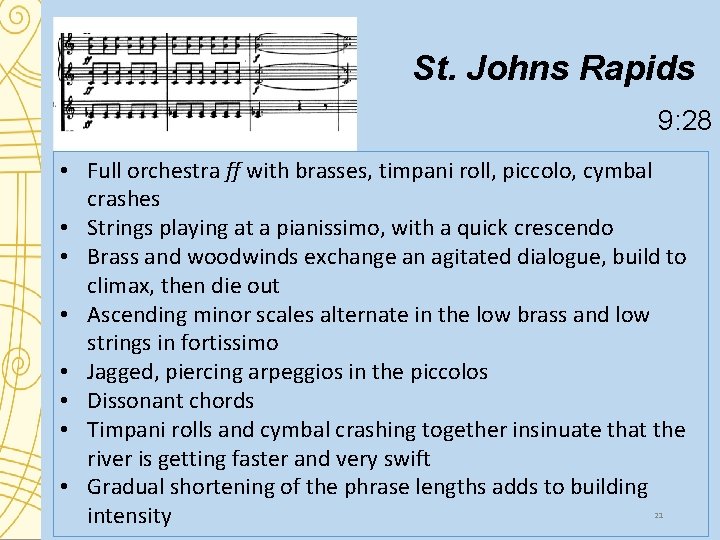
St. Johns Rapids 9: 28 • Full orchestra ff with brasses, timpani roll, piccolo, cymbal crashes • Strings playing at a pianissimo, with a quick crescendo • Brass and woodwinds exchange an agitated dialogue, build to climax, then die out • Ascending minor scales alternate in the low brass and low strings in fortissimo • Jagged, piercing arpeggios in the piccolos • Dissonant chords • Timpani rolls and cymbal crashing together insinuate that the river is getting faster and very swift • Gradual shortening of the phrase lengths adds to building intensity 21

• Compare this section to Berlioz
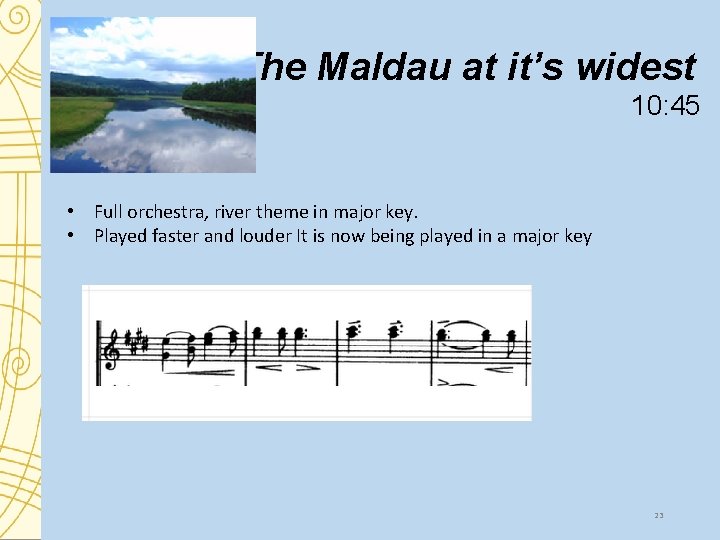
The Maldau at it’s widest 10: 45 • Full orchestra, river theme in major key. • Played faster and louder It is now being played in a major key 23
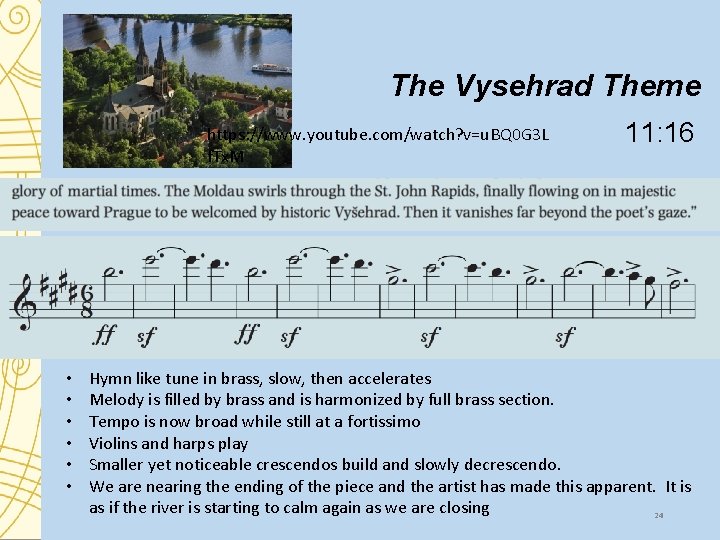
The Vysehrad Theme https: //www. youtube. com/watch? v=u. BQ 0 G 3 L f. Tx. M • • • 11: 16 Hymn like tune in brass, slow, then accelerates Melody is filled by brass and is harmonized by full brass section. Tempo is now broad while still at a fortissimo Violins and harps play Smaller yet noticeable crescendos build and slowly decrescendo. We are nearing the ending of the piece and the artist has made this apparent. It is as if the river is starting to calm again as we are closing 24
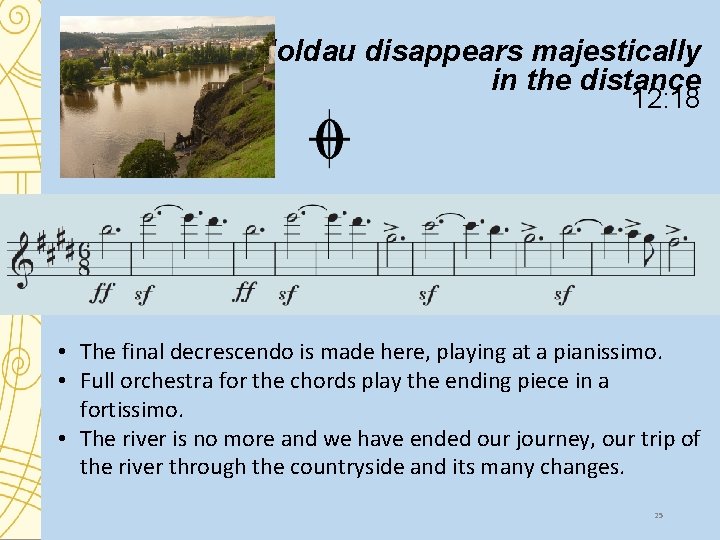
Moldau disappears majestically in the distance 12: 18 • The final decrescendo is made here, playing at a pianissimo. • Full orchestra for the chords play the ending piece in a fortissimo. • The river is no more and we have ended our journey, our trip of the river through the countryside and its many changes. 25
Useful Sites • Piano Arrangement – https: //au. pinterest. com/pin/225531893817547366/ Other listening • Danube Waltz • Yellow River Concerto – Xian • Beethoven’s picturesque Symphony No. 6, the “Pastoral, ” with it’s flowing stream and mighty thunderstorm. • Water Music – Handel • Song of the Volga Boatmen 26
- Slides: 26