
SMEs Division National IP Action Plan for Entrepreneurs
- Slides: 18
SMEs Division National IP Action Plan for Entrepreneurs and SMEs July 2008 Small and Medium-Sized Enterprises Division World Intellectual Property Organization Won-kil. yoon@wipo. int www. wipo. int/sme
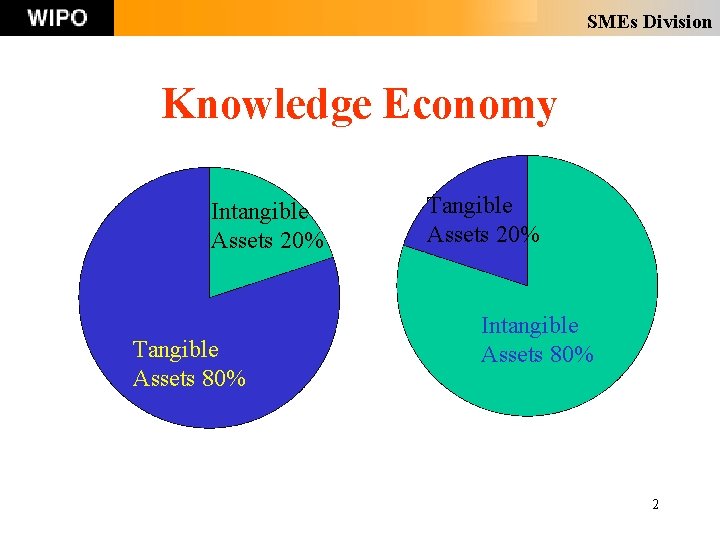
SMEs Division Knowledge Economy Intangible Assets 20% Tangible Assets 80% Tangible Assets 20% Intangible Assets 80% 2
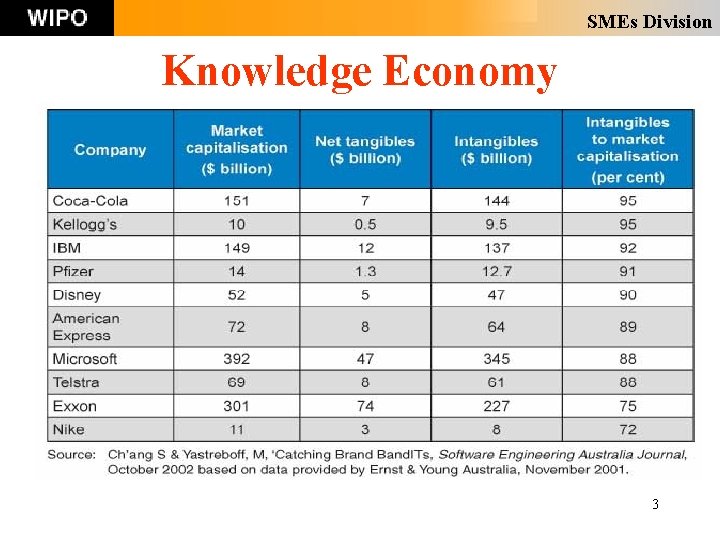
SMEs Division Knowledge Economy 3
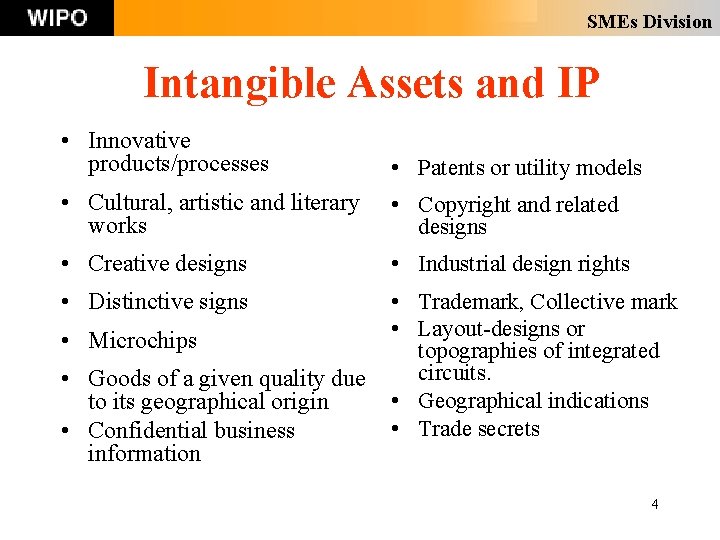
SMEs Division Intangible Assets and IP • Innovative products/processes • Patents or utility models • Cultural, artistic and literary works • Copyright and related designs • Creative designs • Industrial design rights • Distinctive signs • Trademark, Collective mark • Layout-designs or topographies of integrated circuits. • Geographical indications • Trade secrets • Microchips • Goods of a given quality due to its geographical origin • Confidential business information 4
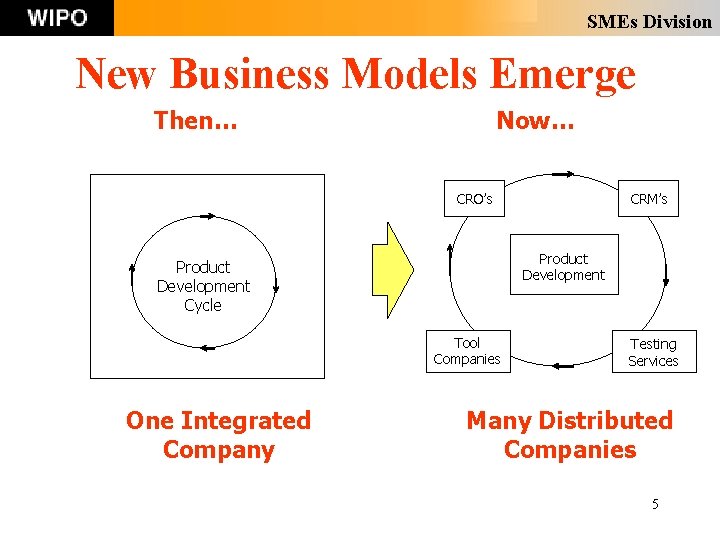
SMEs Division New Business Models Emerge Then… Now… CRM’s CRO’s Product Development Cycle Tool Companies One Integrated Company Testing Services Many Distributed Companies 5
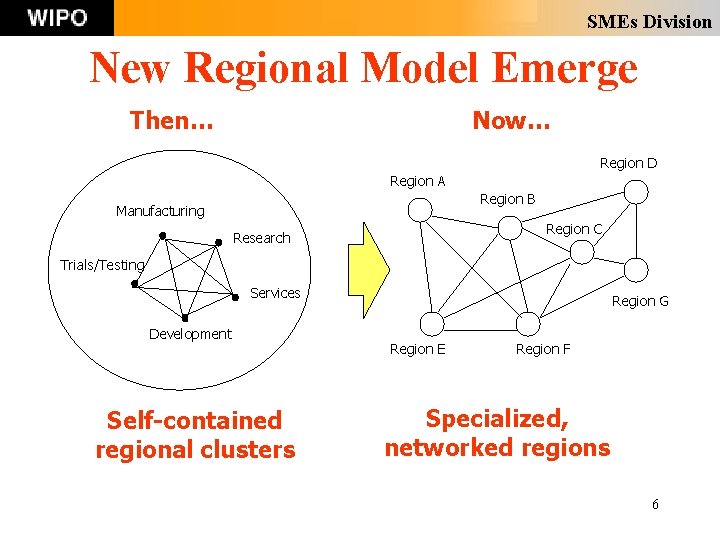
SMEs Division New Regional Model Emerge Then… Now… Region D Region A Region B Manufacturing Region C Research Trials/Testing Services Development Self-contained regional clusters Region G Region E Region F Specialized, networked regions 6
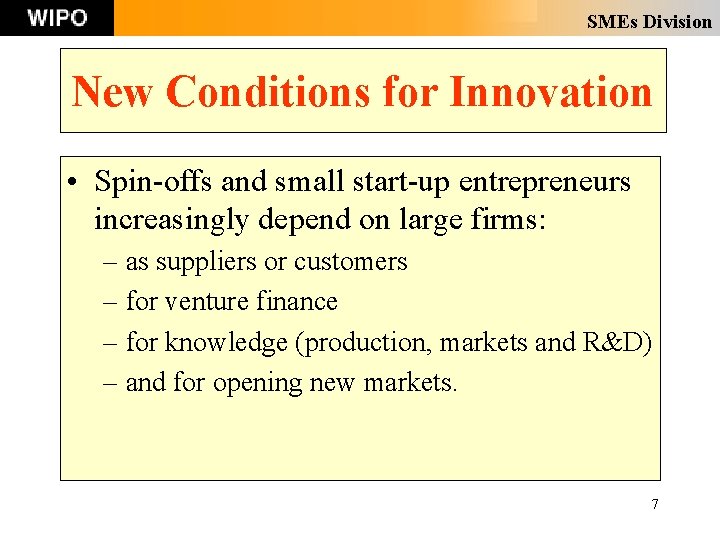
SMEs Division New Conditions for Innovation • Spin-offs and small start-up entrepreneurs increasingly depend on large firms: – as suppliers or customers – for venture finance – for knowledge (production, markets and R&D) – and for opening new markets. 7
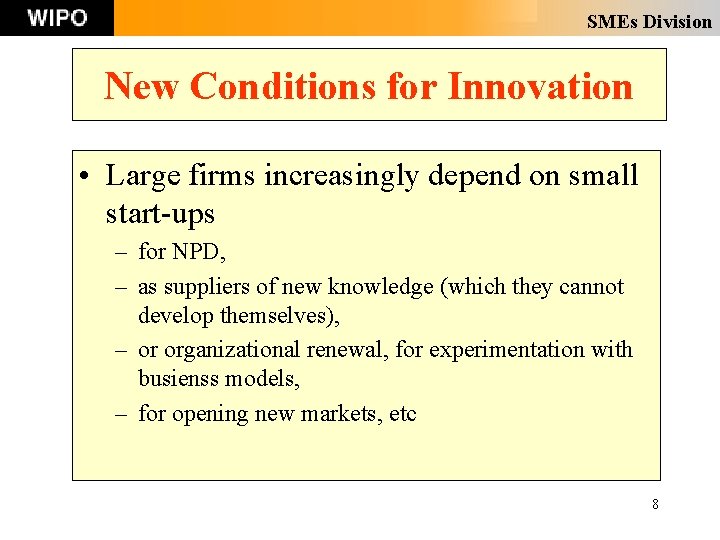
SMEs Division New Conditions for Innovation • Large firms increasingly depend on small start-ups – for NPD, – as suppliers of new knowledge (which they cannot develop themselves), – or organizational renewal, for experimentation with busienss models, – for opening new markets, etc 8
SMEs Division New developments in innovation raises new issues and problems • Speed and potential value of scientific progress leads to emphasis on solid and well-designed portfolios of research projects • Universites as active drivers of innovation: Academic entrepreneurship and the entrepreneurial university • University-industry partnerships • Increased search for radical innovation and top-line growth. 9
SMEs Division The Key Objectives of a National IP Action Plan • To build the capacity of SME Development Institutions and SME Finance institutions to enhance the competitiveness of SMEs by using the tools of IP system • To facilitate SMEs to take part in public funded R&D programs and to promote R&D activities that respond to the needs of SMEs • To encourage private sector investment by using the tools of IPRs for protection of innovation and creativity • To enhance the development of national and international branding strategies of SMEs • To improve access to value-added patent information services 10
SMEs Division Developing an National Strategy on IP for Internationally Competitive SMEs • Identification and evaluation of gaps in the Current IPR Services for SMEs • Resource mobilization and project planning • Creating products and activities to fill the gaps for creating internationally competitive SMEs • “Training the Teachers/Trainers” in SME Development Institutions, SME Finance Institutions, SME Consultants in the private sector, IP Strategy consulting firms, etc • Monitoring and ongoing support (expert missions; online support) • Evaluation phase; indicators of success ; benchmarking • Follow-up project 11
SMEs Division Elements of the National System of Innovation • Identify key industry and business sectors • Identify key universities, research institutes and other institutional SME stakeholders • Strategic coordination and cooperation • Role of IP Office • Role of SME Development Institutions, SME Training Institutions, SME Financing Institutions, etc • WIPO and other international partners 12
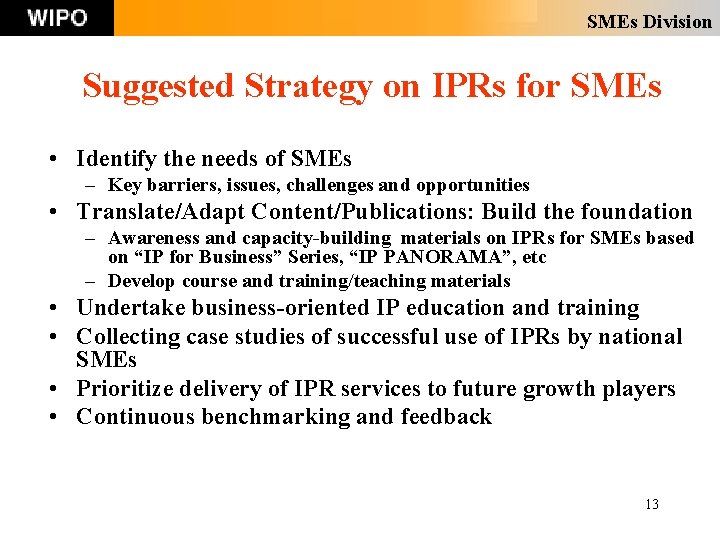
SMEs Division Suggested Strategy on IPRs for SMEs • Identify the needs of SMEs – Key barriers, issues, challenges and opportunities • Translate/Adapt Content/Publications: Build the foundation – Awareness and capacity-building materials on IPRs for SMEs based on “IP for Business” Series, “IP PANORAMA”, etc – Develop course and training/teaching materials • Undertake business-oriented IP education and training • Collecting case studies of successful use of IPRs by national SMEs • Prioritize delivery of IPR services to future growth players • Continuous benchmarking and feedback 13
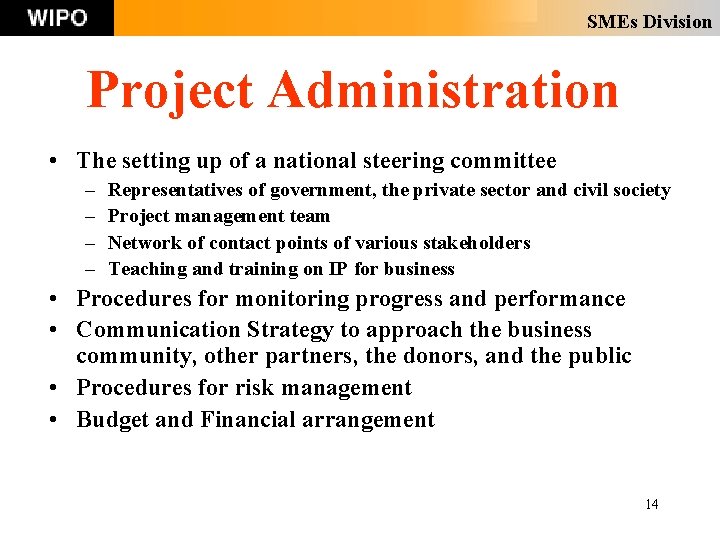
SMEs Division Project Administration • The setting up of a national steering committee – – Representatives of government, the private sector and civil society Project management team Network of contact points of various stakeholders Teaching and training on IP for business • Procedures for monitoring progress and performance • Communication Strategy to approach the business community, other partners, the donors, and the public • Procedures for risk management • Budget and Financial arrangement 14
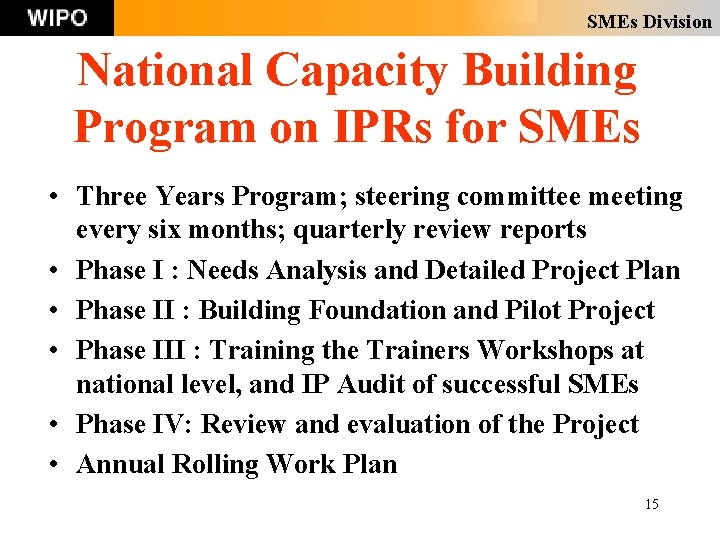
SMEs Division National Capacity Building Program on IPRs for SMEs • Three Years Program; steering committee meeting every six months; quarterly review reports • Phase I : Needs Analysis and Detailed Project Plan • Phase II : Building Foundation and Pilot Project • Phase III : Training the Trainers Workshops at national level, and IP Audit of successful SMEs • Phase IV: Review and evaluation of the Project • Annual Rolling Work Plan 15
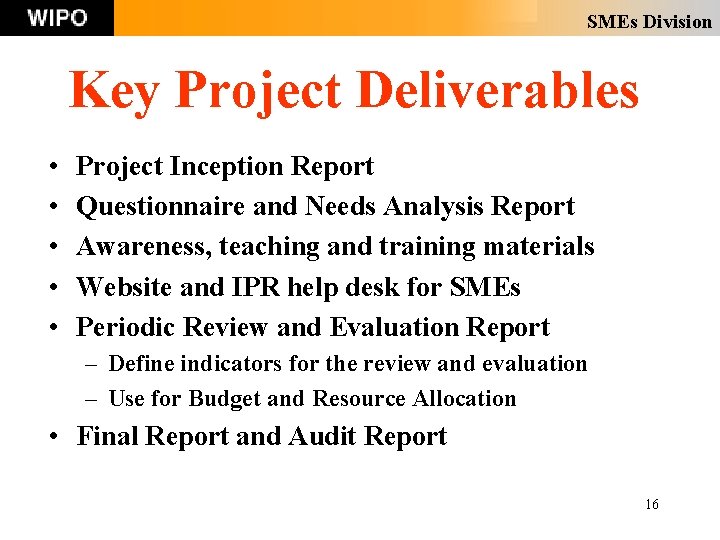
SMEs Division Key Project Deliverables • • • Project Inception Report Questionnaire and Needs Analysis Report Awareness, teaching and training materials Website and IPR help desk for SMEs Periodic Review and Evaluation Report – Define indicators for the review and evaluation – Use for Budget and Resource Allocation • Final Report and Audit Report 16
SMEs Division Recommendation for National IP Action Plan • Holistic Approach - Business and IP – Patent, Marks, Trade Secrets, Copyrights, , R&D, Spin-offs, etc. – IP Office, SMEs Development Agency, Chamber of Commerce, other SME Stake Holders • Periodic IP Report – Strategic IP Plan, National IP Audit 17
SMEs Division WIPO SMEs Web-Site “www. wipo. int/sme” “IP for Business” Series in Publications “IP PANORAMA” in Multimedia “E-NEWSLETTER” Won-Kil YOON yoon@wipo. int Tel)+41 -22 -338 -8159 Fax)+41 -22 -338 -8760