
SMED Continuous improvement project to reduce turnaround time

- Slides: 27
SMED Continuous improvement project to reduce turnaround time Process and method 08/03/2012 µicro. MEGAS Formation 213, chemin du grand torrent 38 330 ST ISMIER Michel Jouanneaux Tel: +33 (0)6 14 15 65 40 Email: mijouanneaux@hotmail. fr
SMED pressed transfer Platarg 612 Background Economic reasons 1. Market changes Need for smaller runs and therefore more frequent changes 2. Need to optimize operating costs Deteriorated productivity ratios and difficulty to meet budget requirements Training-Action SMED - © March 2012 2 / 23
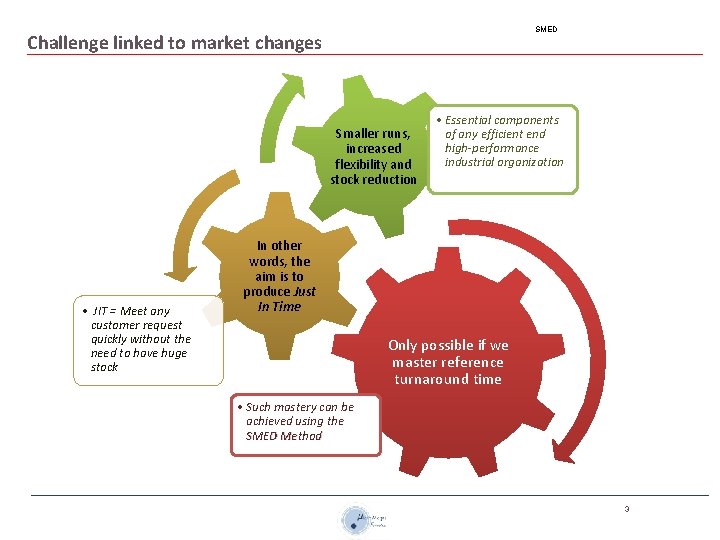
SMED Challenge linked to market changes Smaller runs, increased flexibility and stock reduction • JIT = Meet any customer request quickly without the need to have huge stock • Essential components of any efficient end high-performance industrial organization In other words, the aim is to produce Just In Time Only possible if we master reference turnaround time • Such mastery can be achieved using the SMED Method 3
What is the SMED Method? SMED is a Japanese-English acronym that stands for ‘Single Minute Exchange of Die’ Literally speaking it means changing die under one minute Can also be translated by ‘quick tool change’ This method was developed by Shigeo Shingo for TOYOTA in the 1970’s MAIN OBJECTIVES: - 1: Reduced stock (less immobilized capital, treasury gain) - 2: Productivity gain (increased OEE) - 3: Easier changes for operators (safety, ergonomics…) 4
SMED Method DEFINITION: Actions planned to speed up and simplify manufacturing changes on a same production line SMED is an acronym that stands for: "Single Minute Exchange of Die" STAKES: PRINCIPLES: • First part good • Eliminate unnecessary operations • Right first time • Plan operations ahead and in concurrent operation time • Every time • In a minimum time. . . • Reduce downtime required per operation • Distribute actions to be performed over all workstations Training-Action SMED - © March 2012 5 / 23
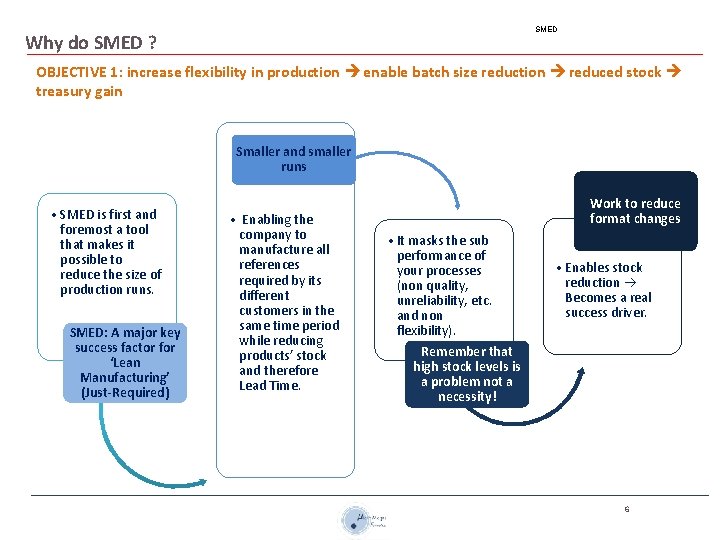
SMED Why do SMED ? OBJECTIVE 1: increase flexibility in production enable batch size reduction reduced stock treasury gain Smaller and smaller runs • SMED is first and foremost a tool that makes it possible to reduce the size of production runs. SMED: A major key success factor for ‘Lean Manufacturing’ (Just-Required) • Enabling the company to manufacture all references required by its different customers in the same time period while reducing products’ stock and therefore Lead Time. Work to reduce format changes • It masks the sub performance of your processes (non quality, unreliability, etc. and non flexibility). Remember that high stock levels is a problem not a necessity! • Enables stock reduction Becomes a real success driver. 6
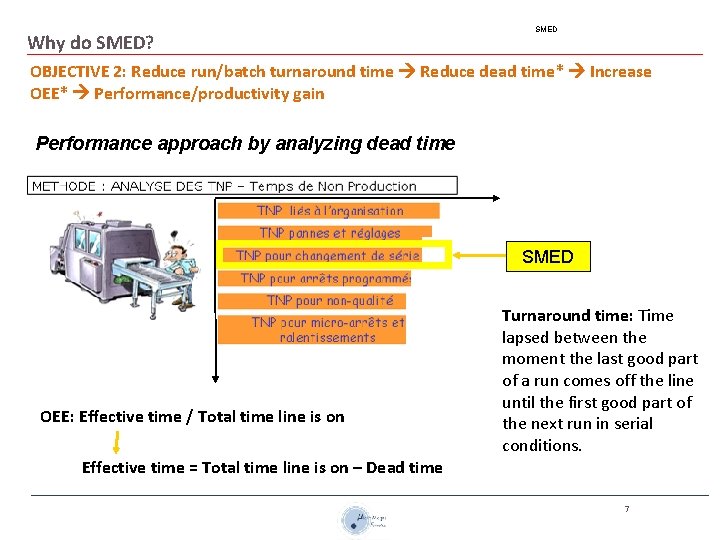
Why do SMED? SMED OBJECTIVE 2: Reduce run/batch turnaround time Reduce dead time* Increase OEE* Performance/productivity gain Performance approach by analyzing dead time SMED OEE: Effective time / Total time line is on Turnaround time: Time lapsed between the moment the last good part of a run comes off the line until the first good part of the next run in serial conditions. Effective time = Total time line is on – Dead time 7
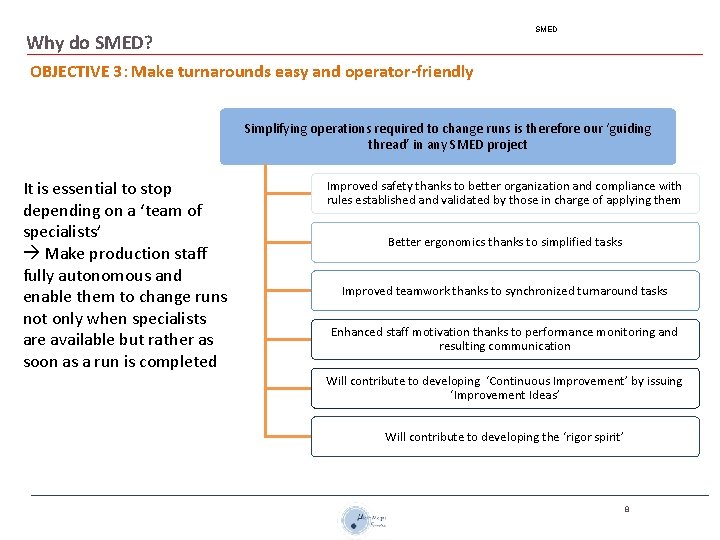
SMED Why do SMED? OBJECTIVE 3: Make turnarounds easy and operator-friendly Simplifying operations required to change runs is therefore our ‘guiding thread’ in any SMED project It is essential to stop depending on a ‘team of specialists’ Make production staff fully autonomous and enable them to change runs not only when specialists are available but rather as soon as a run is completed Improved safety thanks to better organization and compliance with rules established and validated by those in charge of applying them Better ergonomics thanks to simplified tasks Improved teamwork thanks to synchronized turnaround tasks Enhanced staff motivation thanks to performance monitoring and resulting communication Will contribute to developing ‘Continuous Improvement’ by issuing ‘Improvement Ideas’ Will contribute to developing the ‘rigor spirit’ 8
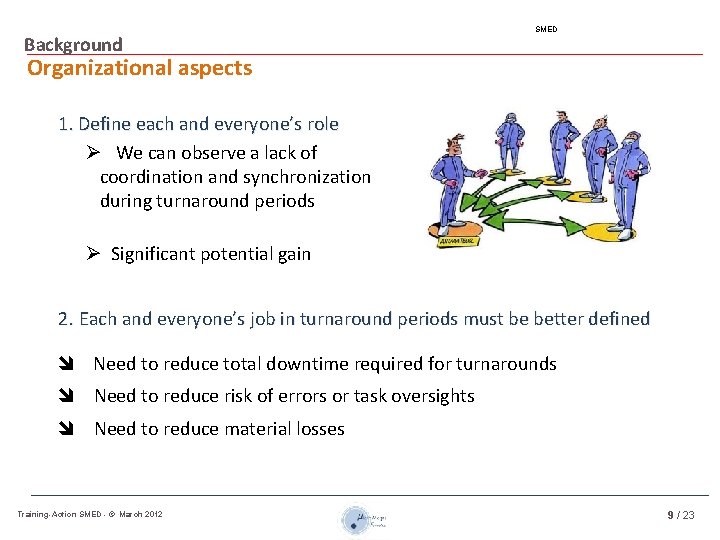
Background SMED Organizational aspects 1. Define each and everyone’s role Ø We can observe a lack of coordination and synchronization during turnaround periods Ø Significant potential gain 2. Each and everyone’s job in turnaround periods must be better defined Need to reduce total downtime required for turnarounds Need to reduce risk of errors or task oversights Need to reduce material losses Training-Action SMED - © March 2012 9 / 23
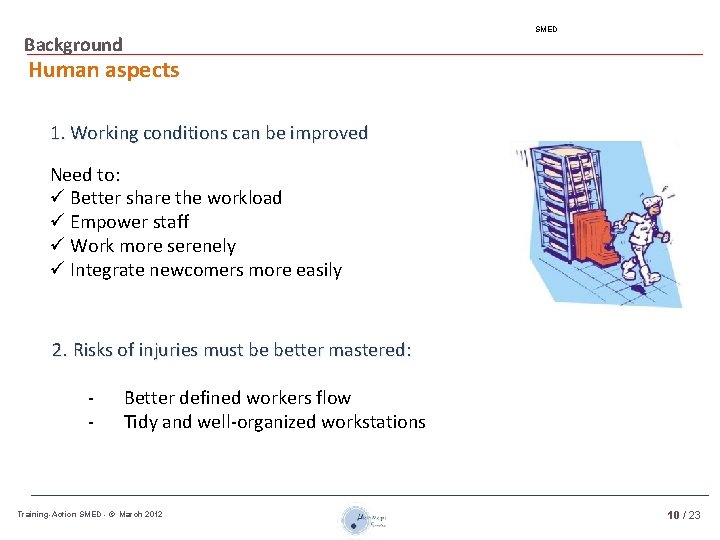
SMED Background Human aspects 1. Working conditions can be improved Need to: ü Better share the workload ü Empower staff ü Work more serenely ü Integrate newcomers more easily 2. Risks of injuries must be better mastered: - Better defined workers flow Tidy and well-organized workstations Training-Action SMED - © March 2012 10 / 23
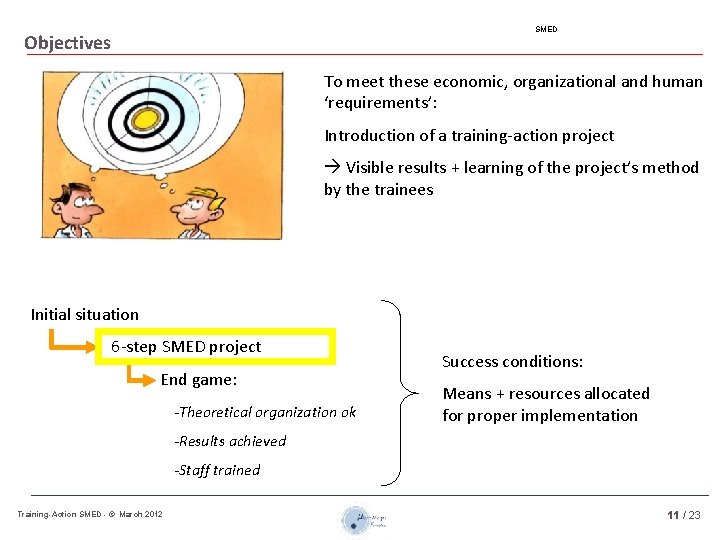
SMED Objectives To meet these economic, organizational and human ‘requirements’: Introduction of a training-action project Visible results + learning of the project’s method by the trainees Initial situation 6 -step SMED project End game: -Theoretical organization ok Success conditions: Means + resources allocated for proper implementation -Results achieved -Staff trained Training-Action SMED - © March 2012 11 / 23
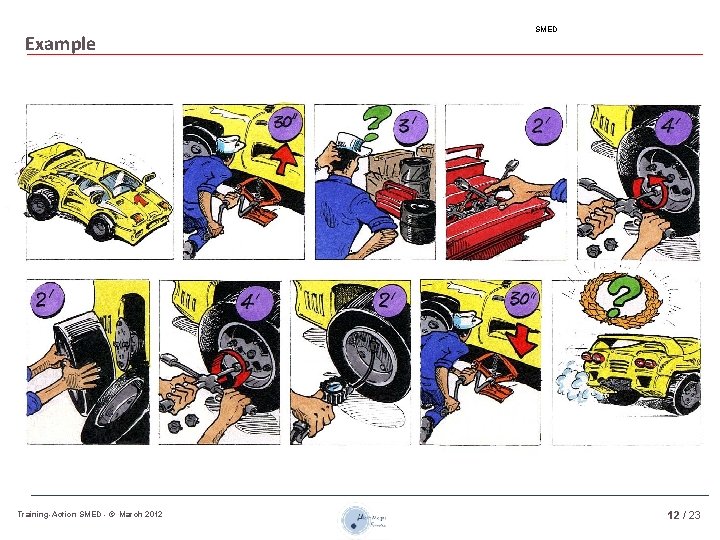
Example Training-Action SMED - © March 2012 SMED 12 / 23
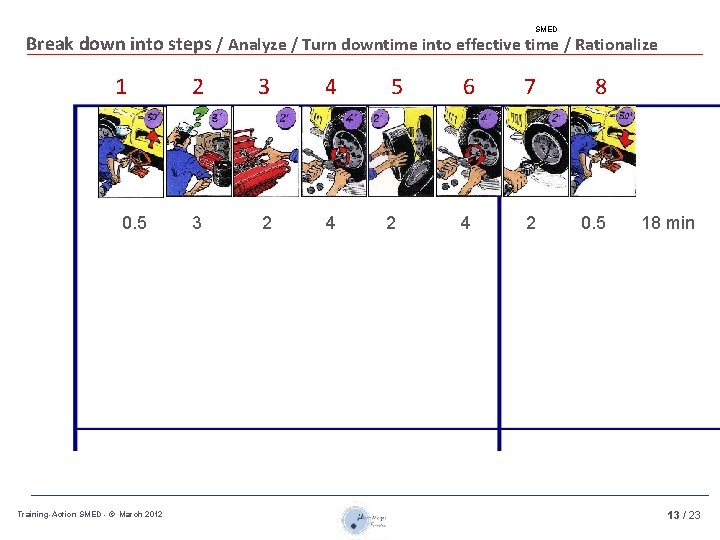
SMED Break down into steps / Analyze / Turn downtime into effective time / Rationalize 1 0. 5 Training-Action SMED - © March 2012 2 3 4 5 6 7 8 3 2 4 2 0. 5 18 min 13 / 23
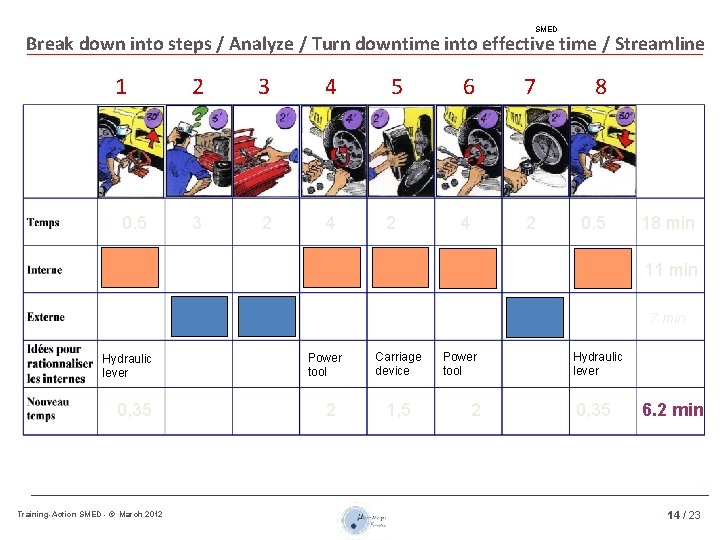
SMED Break down into steps / Analyze / Turn downtime into effective time / Streamline 1 0. 5 2 3 4 5 6 7 8 3 2 4 2 0. 5 18 min 11 min 7 min Hydraulic lever 0, 35 Training-Action SMED - © March 2012 Power tool 2 Carriage device 1, 5 Power tool 2 Hydraulic lever 0, 35 6. 2 min 14 / 23
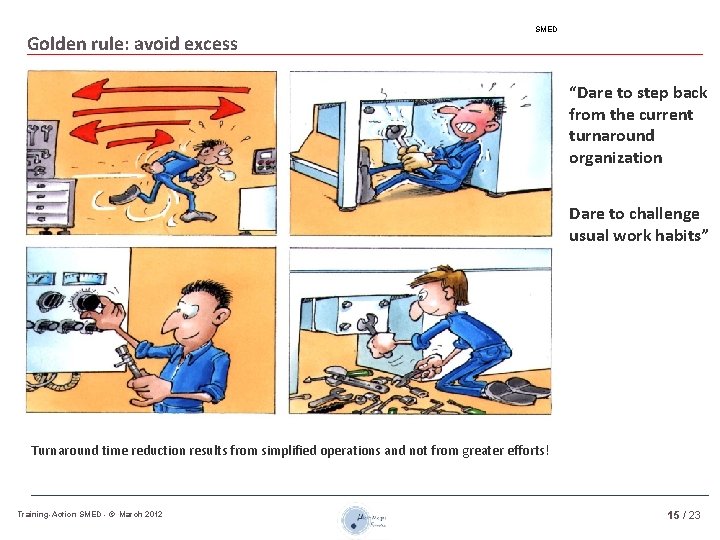
Golden rule: avoid excess SMED “Dare to step back from the current turnaround organization Dare to challenge usual work habits” Turnaround time reduction results from simplified operations and not from greater efforts! Training-Action SMED - © March 2012 15 / 23
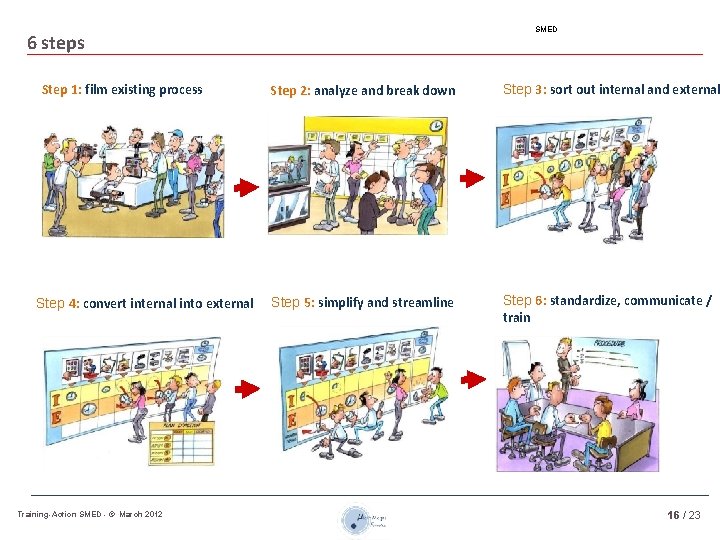
SMED 6 steps Step 1: film existing process Step 4: convert internal into external Training-Action SMED - © March 2012 Step 2: analyze and break down Step 3: sort out internal and external Step 5: simplify and streamline Step 6: standardize, communicate / train 16 / 23
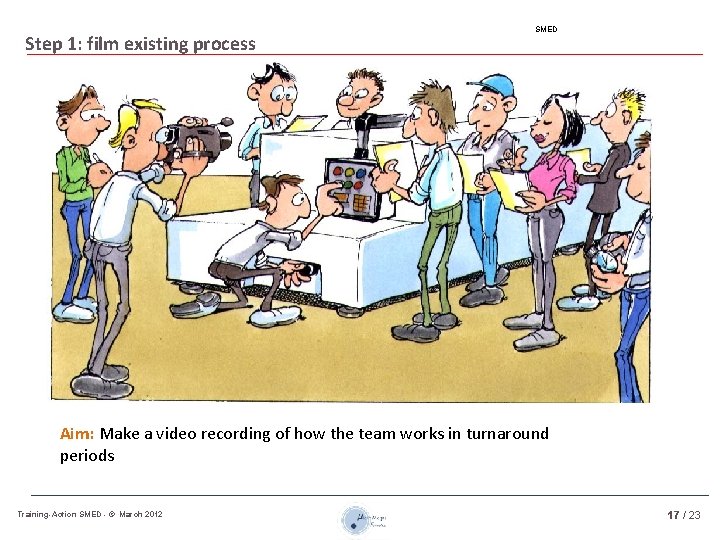
Step 1: film existing process SMED Aim: Make a video recording of how the team works in turnaround periods Training-Action SMED - © March 2012 17 / 23
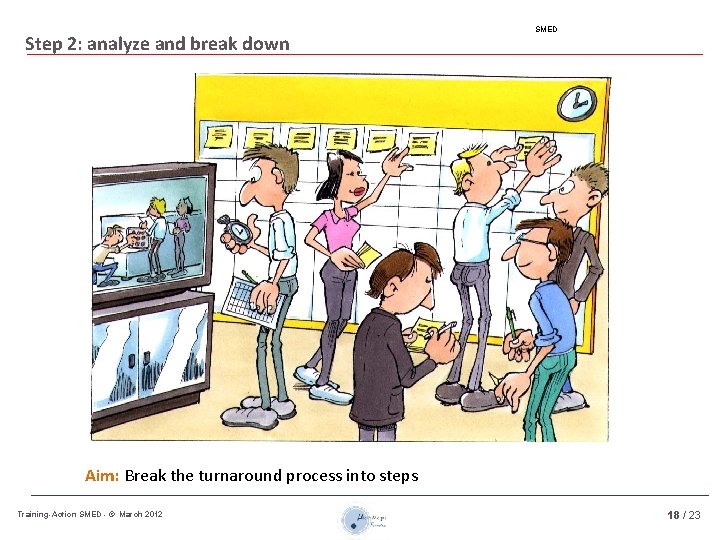
Step 2: analyze and break down SMED Aim: Break the turnaround process into steps Training-Action SMED - © March 2012 18 / 23
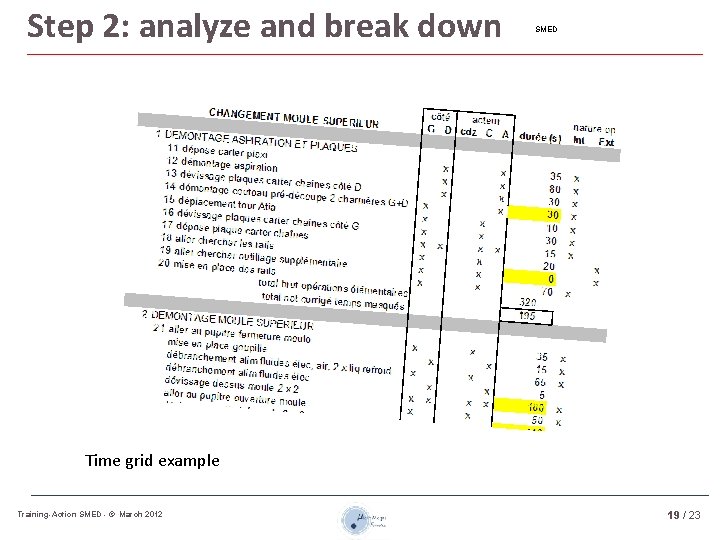
Step 2: analyze and break down SMED Time grid example Training-Action SMED - © March 2012 19 / 23
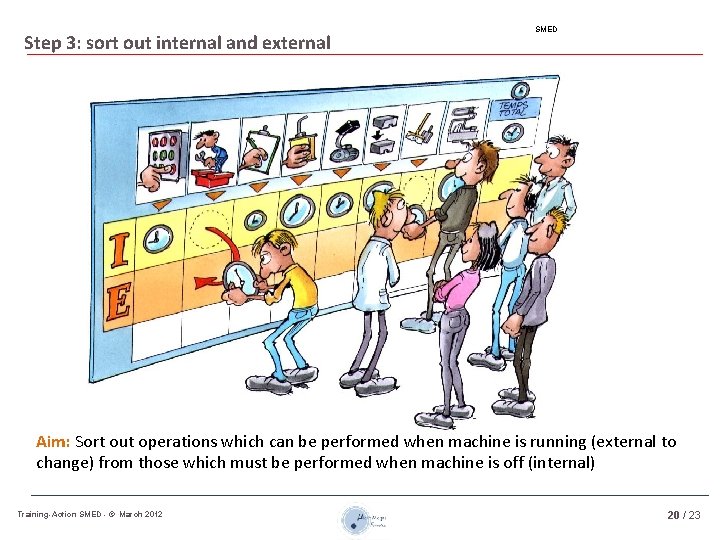
Step 3: sort out internal and external SMED Aim: Sort out operations which can be performed when machine is running (external to change) from those which must be performed when machine is off (internal) Training-Action SMED - © March 2012 20 / 23
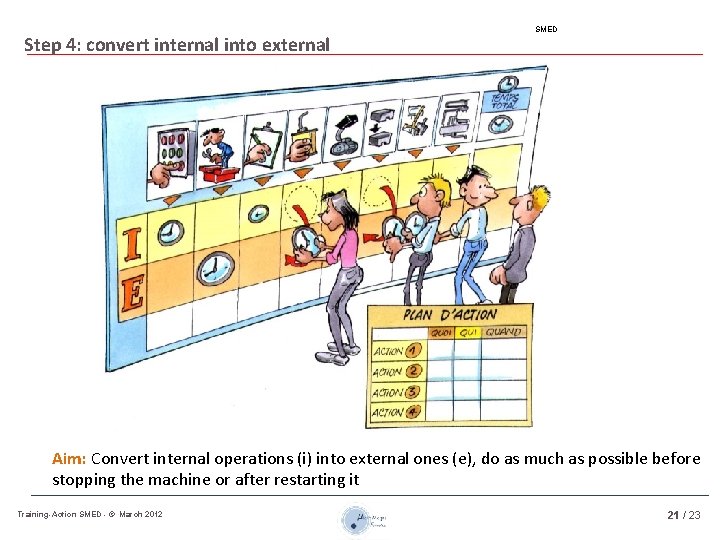
Step 4: convert internal into external SMED Aim: Convert internal operations (i) into external ones (e), do as much as possible before stopping the machine or after restarting it Training-Action SMED - © March 2012 21 / 23
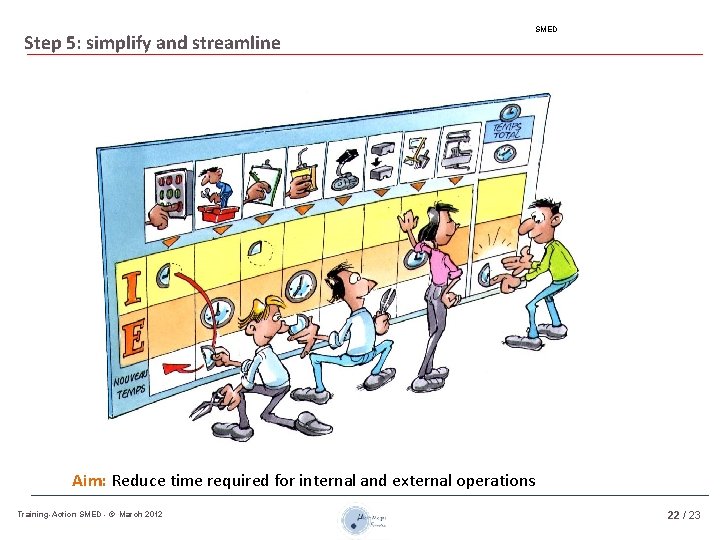
Step 5: simplify and streamline SMED Aim: Reduce time required for internal and external operations Training-Action SMED - © March 2012 22 / 23
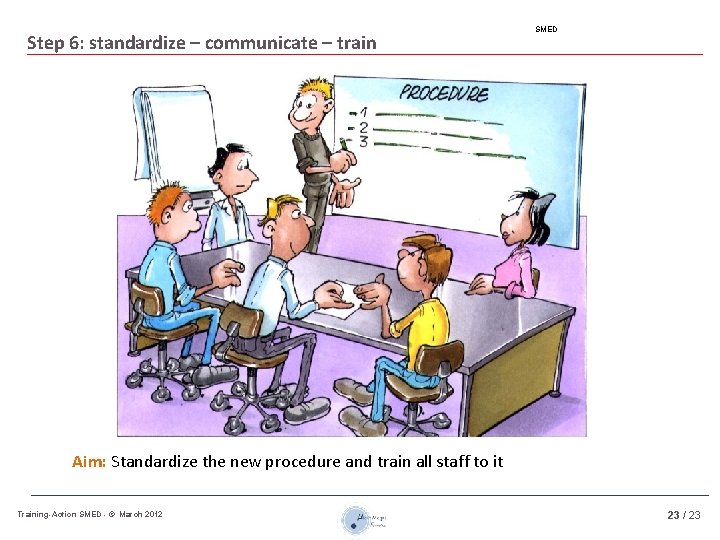
Step 6: standardize – communicate – train SMED Aim: Standardize the new procedure and train all staff to it Training-Action SMED - © March 2012 23 / 23
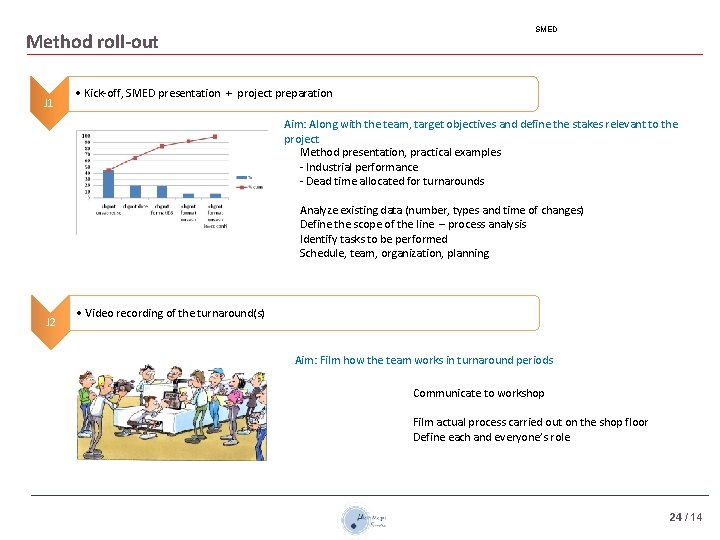
SMED Method roll-out J 1 • Kick-off, SMED presentation + project preparation Aim: Along with the team, target objectives and define the stakes relevant to the project Method presentation, practical examples - Industrial performance - Dead time allocated for turnarounds Analyze existing data (number, types and time of changes) Define the scope of the line – process analysis Identify tasks to be performed Schedule, team, organization, planning J 2 • Video recording of the turnaround(s) Aim: Film how the team works in turnaround periods Communicate to workshop Film actual process carried out on the shop floor Define each and everyone’s role 24 / 14
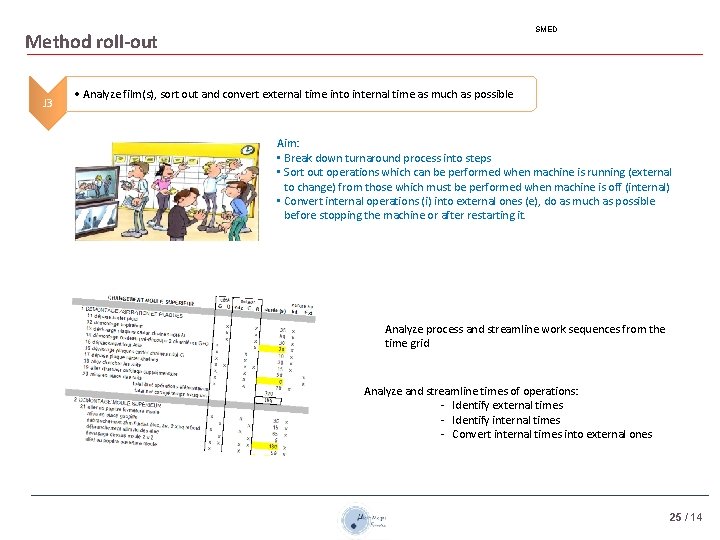
SMED Method roll-out J 3 • Analyze film(s), sort out and convert external time into internal time as much as possible Aim: • Break down turnaround process into steps • Sort out operations which can be performed when machine is running (external to change) from those which must be performed when machine is off (internal) • Convert internal operations (i) into external ones (e), do as much as possible before stopping the machine or after restarting it. J 4 Analyze process and streamline work sequences from the time grid Analyze and streamline times of operations: - Identify external times - Identify internal times - Convert internal times into external ones 25 / 14
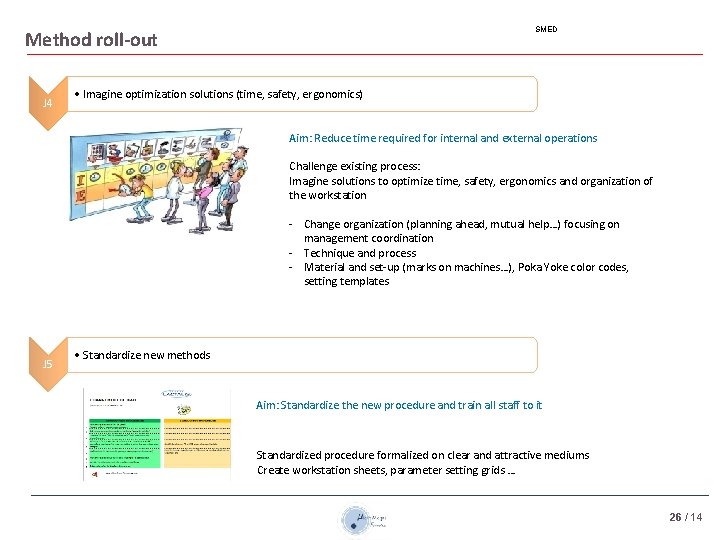
SMED Method roll-out J 4 • Imagine optimization solutions (time, safety, ergonomics) Aim: Reduce time required for internal and external operations Challenge existing process: Imagine solutions to optimize time, safety, ergonomics and organization of the workstation - Change organization (planning ahead, mutual help…) focusing on management coordination - Technique and process - Material and set-up (marks on machines…), Poka Yoke color codes, setting templates J 5 • Standardize new methods Aim: Standardize the new procedure and train all staff to it Standardized procedure formalized on clear and attractive mediums Create workstation sheets, parameter setting grids … 26 / 14
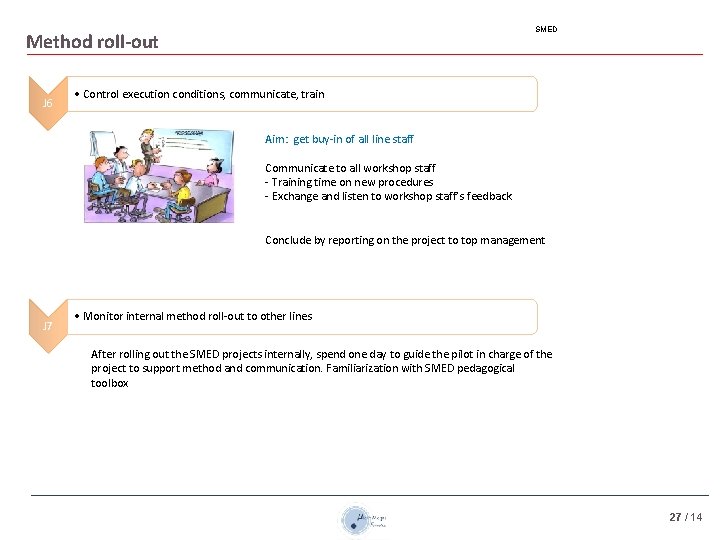
SMED Method roll-out J 6 • Control execution conditions, communicate, train Aim: get buy-in of all line staff Communicate to all workshop staff - Training time on new procedures - Exchange and listen to workshop staff’s feedback Conclude by reporting on the project to top management J 7 • Monitor internal method roll-out to other lines After rolling out the SMED projects internally, spend one day to guide the pilot in charge of the project to support method and communication. Familiarization with SMED pedagogical toolbox 27 / 14