
SMDEP Physics Waves Superposition Standing Waves Webpage updated
SMDEP Physics Waves, Superposition, Standing Waves Webpage updated: http: //www. astro. yale. edu/krines/smdep
Quiz Results • Pre-quiz and Post-quiz to measure change • Pre-quiz mean: 8. 6 (max: 24) • Post-quiz mean: 15. 7 (max: 29) – This change is larger than most semester-long, lecture-based courses – You all did it in 11 days! • Office Hours M, Tu 5 -7 pm – Answer sheets available, blank quiz for inspection
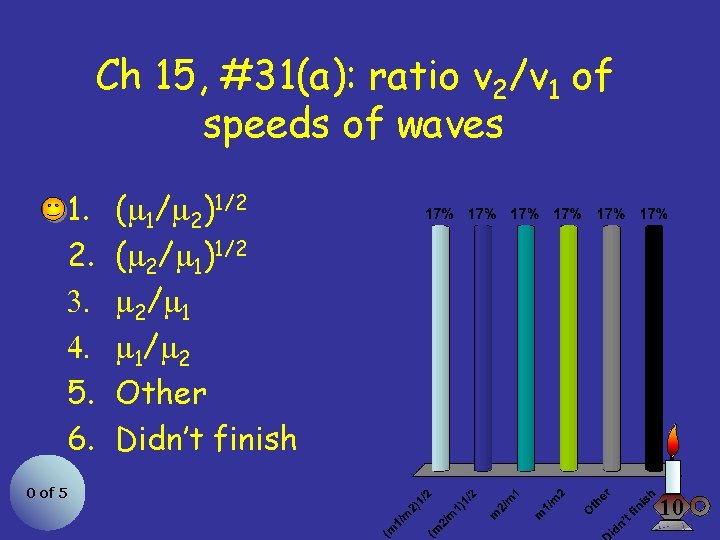
Ch 15, #31(a): ratio v 2/v 1 of speeds of waves 1. 2. 3. 4. 5. 6. 0 of 5 (m 1/m 2)1/2 (m 2/m 1)1/2 m 2/m 1 m 1/m 2 Other Didn’t finish 10
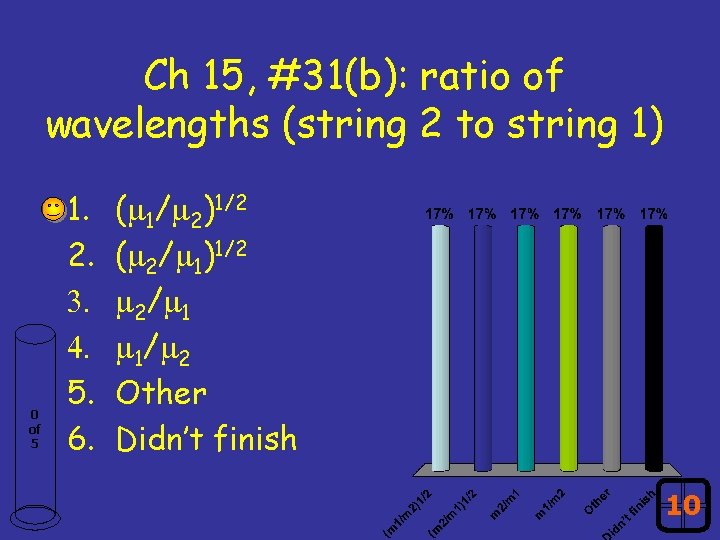
Ch 15, #31(b): ratio of wavelengths (string 2 to string 1) 0 of 5 1. 2. 3. 4. 5. 6. (m 1/m 2)1/2 (m 2/m 1)1/2 m 2/m 1 m 1/m 2 Other Didn’t finish 10
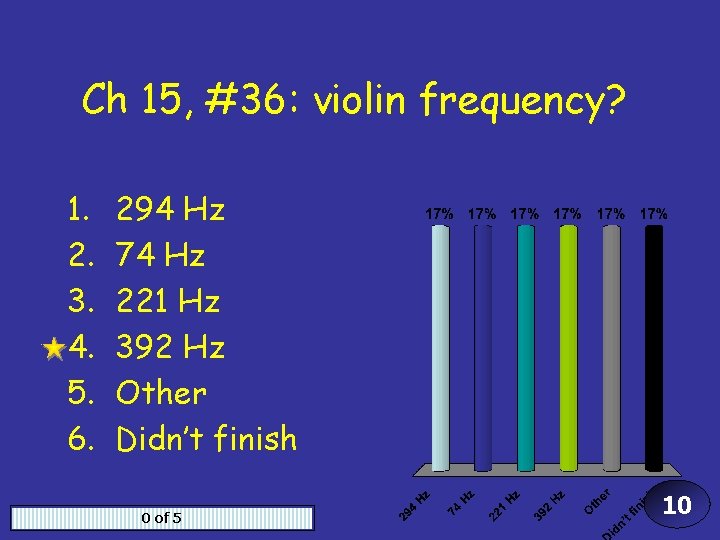
Ch 15, #36: violin frequency? 1. 2. 3. 4. 5. 6. 294 Hz 74 Hz 221 Hz 392 Hz Other Didn’t finish 0 of 5 10
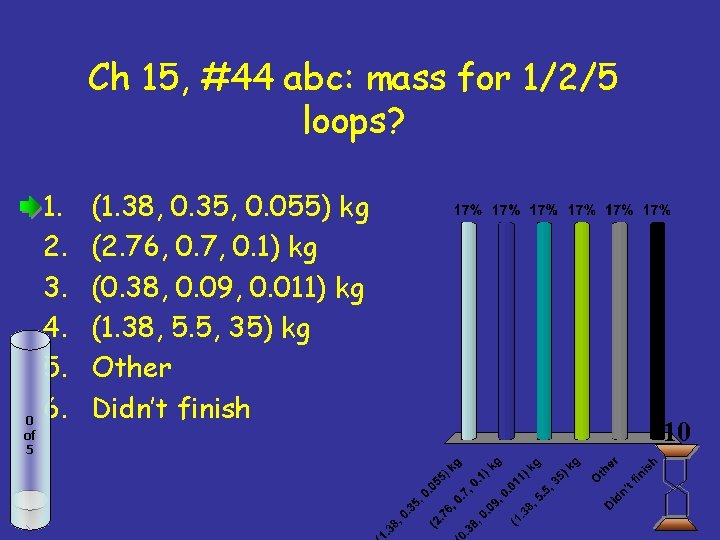
Ch 15, #44 abc: mass for 1/2/5 loops? 0 of 5 1. 2. 3. 4. 5. 6. (1. 38, 0. 35, 0. 055) kg (2. 76, 0. 7, 0. 1) kg (0. 38, 0. 09, 0. 011) kg (1. 38, 5. 5, 35) kg Other Didn’t finish 10
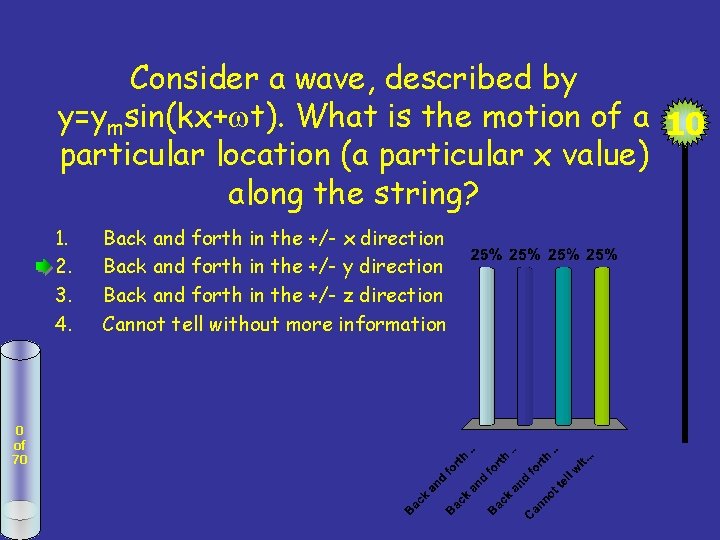
Consider a wave, described by y=ymsin(kx+ t). What is the motion of a 10 particular location (a particular x value) along the string? 1. 2. 3. 4. 0 of 70 Back and forth in the +/- x direction Back and forth in the +/- y direction Back and forth in the +/- z direction Cannot tell without more information
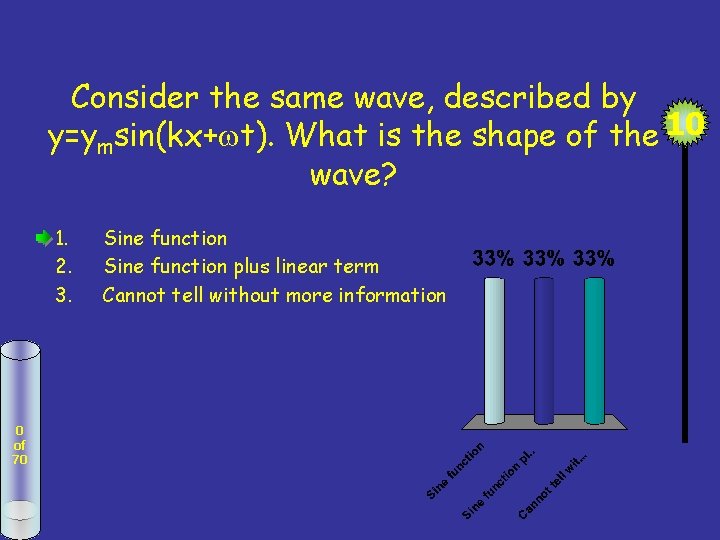
Consider the same wave, described by y=ymsin(kx+ t). What is the shape of the 10 wave? 1. 2. 3. 0 of 70 Sine function plus linear term Cannot tell without more information
Consider the same wave, described by y=ymsin(kx+ t). What is the velocity of 10 propagation of the wave? 1. /k 2. k/ 3. 4. 0 of 70 dym/dt Cannot tell without knowing the properties of the string
Consider the same wave, described by y=ymsin(kx+ t). What direction is the 10 wave traveling? 1. 2. 3. 4. 5. 0 of 70 In the +x direction In the –x direction In the +y direction In the –y direction Cannot tell without knowing the properties of the string
Consider the sum of two identical waves (same amplitude, wavelength, frequency, 10 phase, propagation direction). What is the amplitude of the sum? 0 of 70 1. Same as either wave 2. Twice the amplitude of either wave 3. Half the amplitude of either wave 4. Zero 5. None of the above
Consider the sum of two similar waves (same amplitude, wavelength, frequency, propagation direction), but with phase 10 different by p radians. What is the amplitude of the sum? 0 of 70 1. Same as either wave 2. Twice the amplitude of either wave 3. Half the amplitude of either wave 4. Zero 5. None of the above
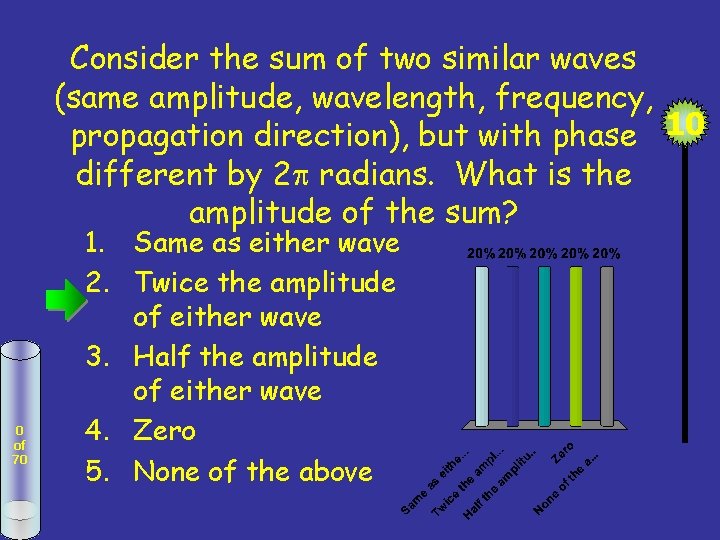
Consider the sum of two similar waves (same amplitude, wavelength, frequency, propagation direction), but with phase 10 different by 2 p radians. What is the amplitude of the sum? 0 of 70 1. Same as either wave 2. Twice the amplitude of either wave 3. Half the amplitude of either wave 4. Zero 5. None of the above
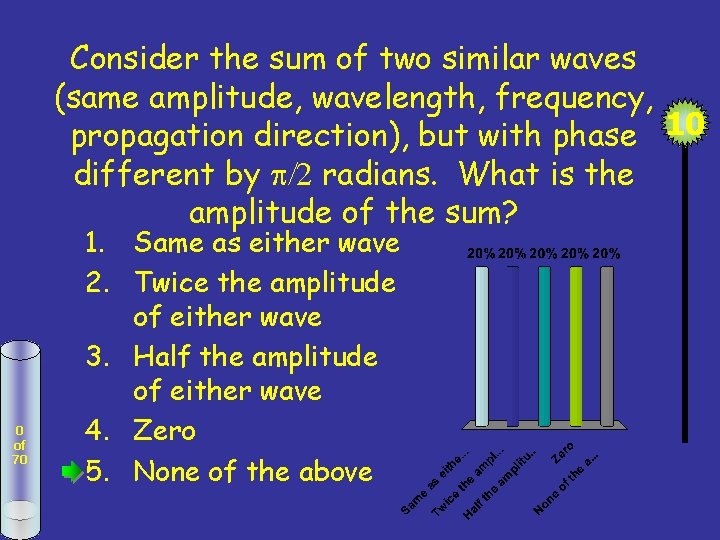
Consider the sum of two similar waves (same amplitude, wavelength, frequency, propagation direction), but with phase 10 different by p/2 radians. What is the amplitude of the sum? 0 of 70 1. Same as either wave 2. Twice the amplitude of either wave 3. Half the amplitude of either wave 4. Zero 5. None of the above
- Slides: 14