
SMAW Stick Welding SMAW Principles Students will be

SMAW (Stick Welding)

SMAW Principles Students will be able to know and understand the process of arc welding by watching a video, taking a safety test, and demonstrating arc welding in the shop. 2
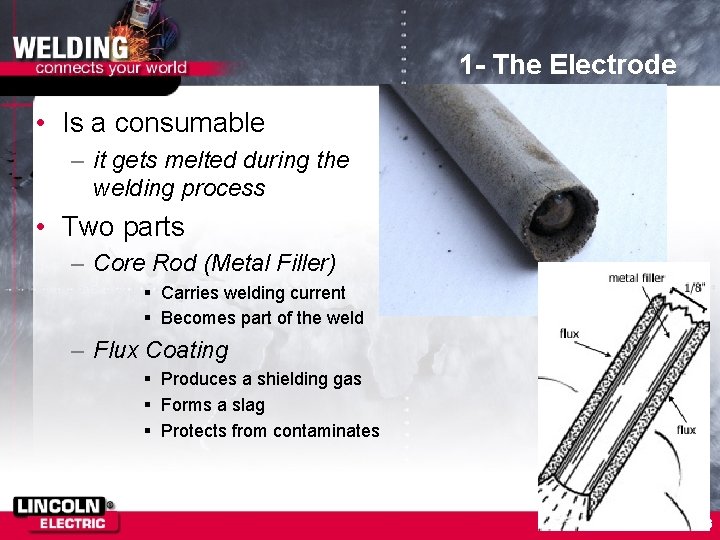
1 - The Electrode • Is a consumable – it gets melted during the welding process • Two parts – Core Rod (Metal Filler) § Carries welding current § Becomes part of the weld – Flux Coating § Produces a shielding gas § Forms a slag § Protects from contaminates 3
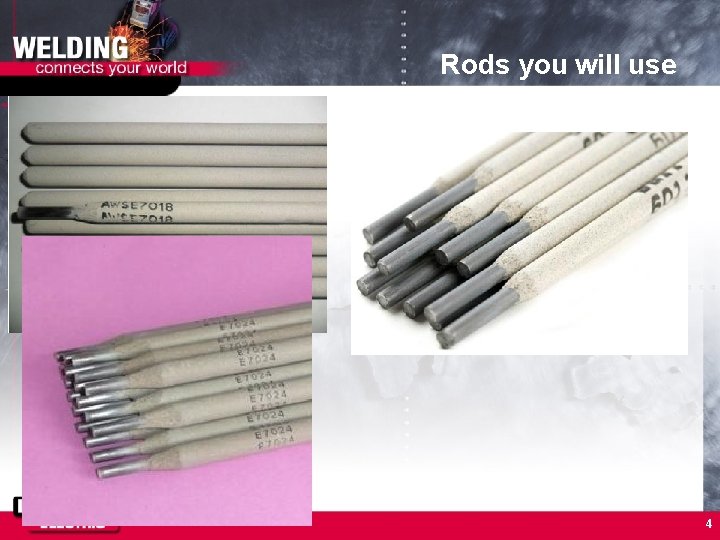
Rods you will use 4
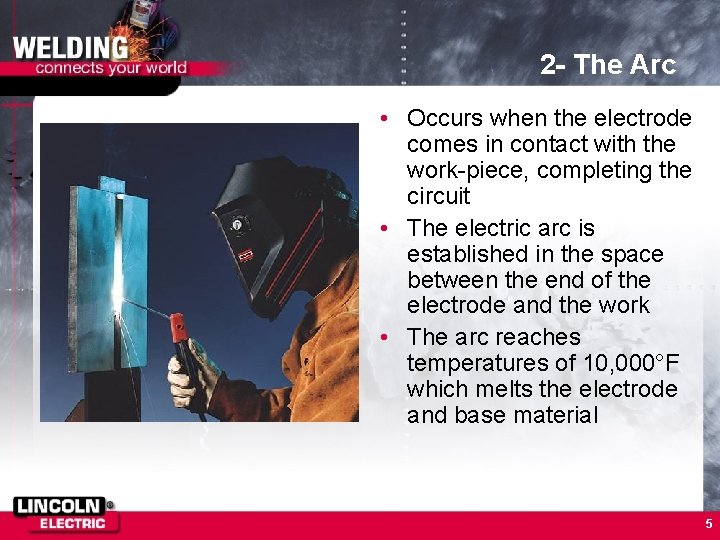
2 - The Arc • Occurs when the electrode comes in contact with the work-piece, completing the circuit • The electric arc is established in the space between the end of the electrode and the work • The arc reaches temperatures of 10, 000°F which melts the electrode and base material 5
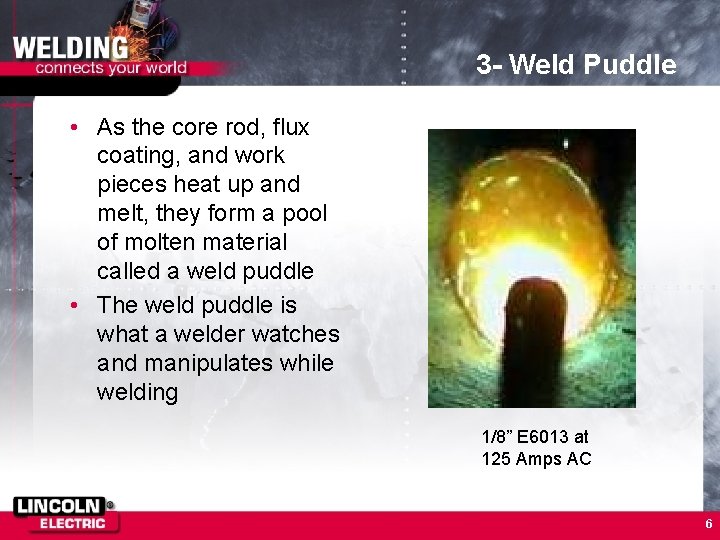
3 - Weld Puddle • As the core rod, flux coating, and work pieces heat up and melt, they form a pool of molten material called a weld puddle • The weld puddle is what a welder watches and manipulates while welding 1/8” E 6013 at 125 Amps AC 6
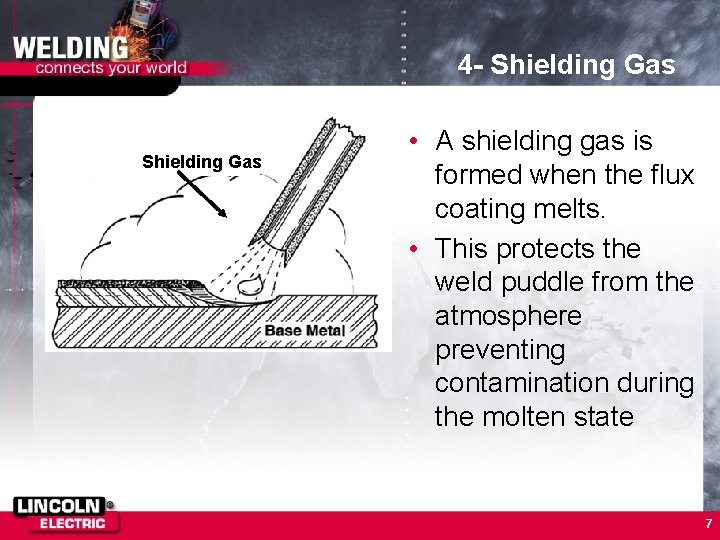
4 - Shielding Gas 4 3 2 • A shielding gas is formed when the flux coating melts. • This protects the weld puddle from the atmosphere preventing contamination during the molten state 7
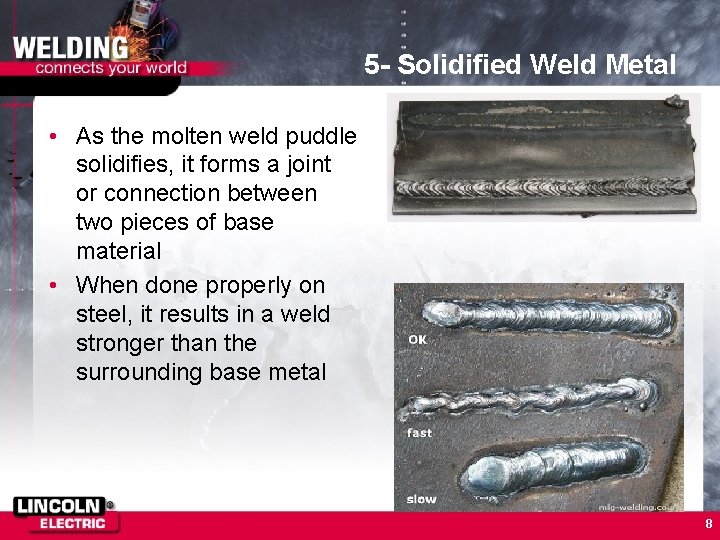
5 - Solidified Weld Metal • As the molten weld puddle solidifies, it forms a joint or connection between two pieces of base material • When done properly on steel, it results in a weld stronger than the surrounding base metal 8
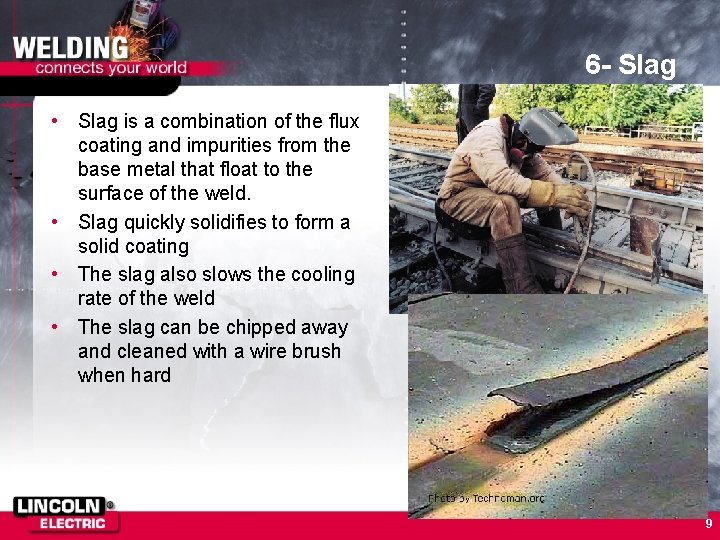
6 - Slag • Slag is a combination of the flux coating and impurities from the base metal that float to the surface of the weld. • Slag quickly solidifies to form a solid coating • The slag also slows the cooling rate of the weld • The slag can be chipped away and cleaned with a wire brush when hard 9

Application Activity 10

Application Activity Let’s review the SMW process … • 1 = _____ • 2 = _____ • 3 = _____ • 4 = _____ • 5 = _____ • 6 = _____ 11

Equipment Set Up 12
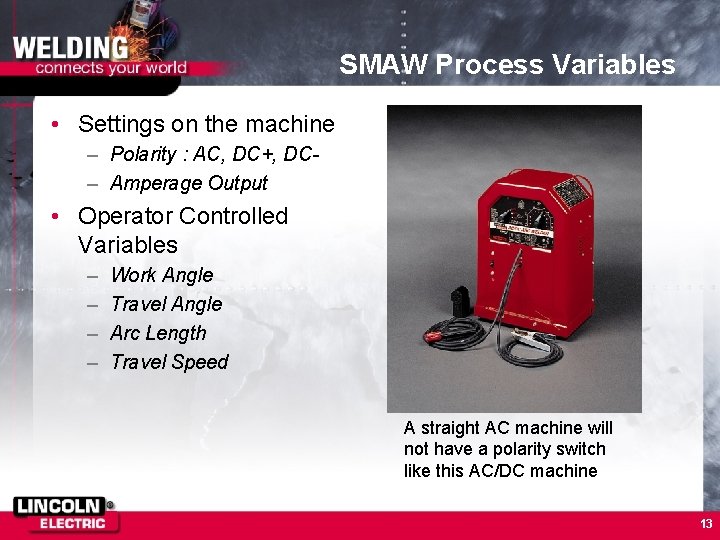
SMAW Process Variables • Settings on the machine – Polarity : AC, DC+, DC– Amperage Output • Operator Controlled Variables – – Work Angle Travel Angle Arc Length Travel Speed A straight AC machine will not have a polarity switch like this AC/DC machine 13

Striking an Arc and Making a Weld 14
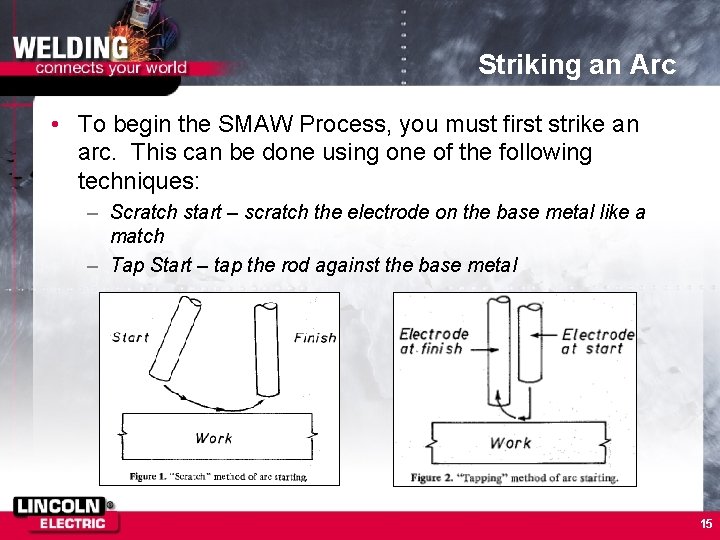
Striking an Arc • To begin the SMAW Process, you must first strike an arc. This can be done using one of the following techniques: – Scratch start – scratch the electrode on the base metal like a match – Tap Start – tap the rod against the base metal 15
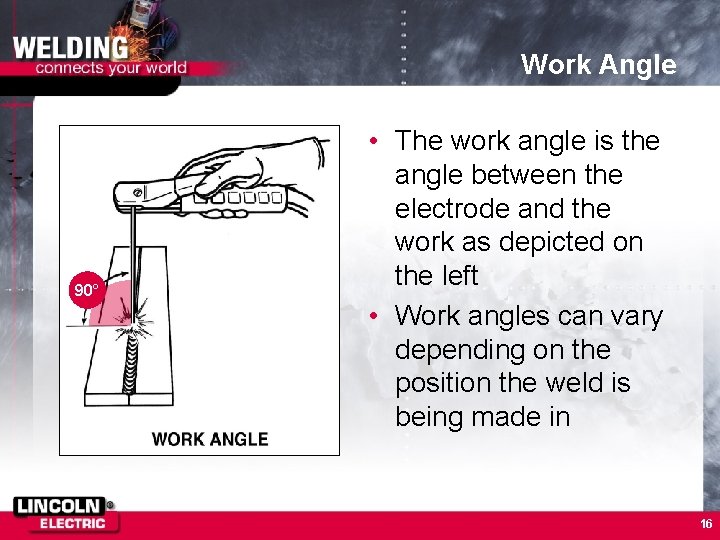
Work Angle 90° • The work angle is the angle between the electrode and the work as depicted on the left • Work angles can vary depending on the position the weld is being made in 16
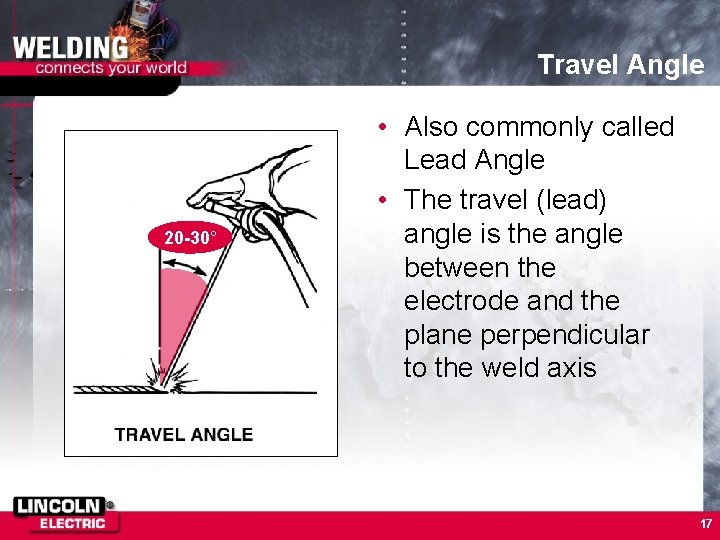
Travel Angle 20 -30° • Also commonly called Lead Angle • The travel (lead) angle is the angle between the electrode and the plane perpendicular to the weld axis 17
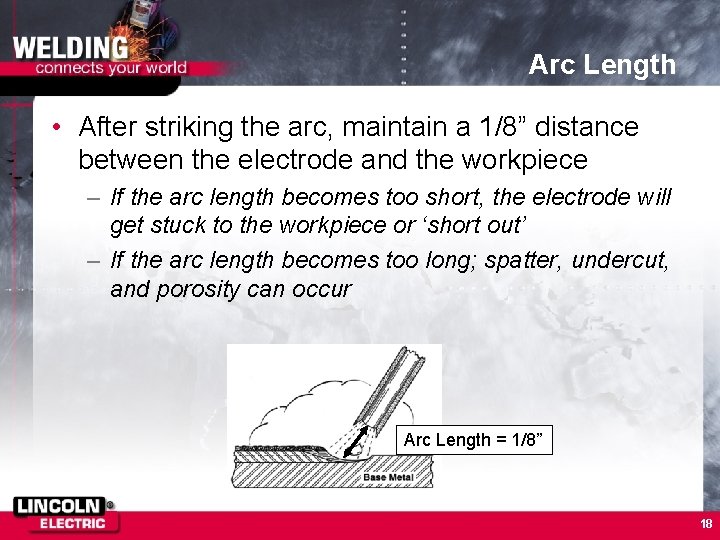
Arc Length • After striking the arc, maintain a 1/8” distance between the electrode and the workpiece – If the arc length becomes too short, the electrode will get stuck to the workpiece or ‘short out’ – If the arc length becomes too long; spatter, undercut, and porosity can occur Arc Length = 1/8” 18
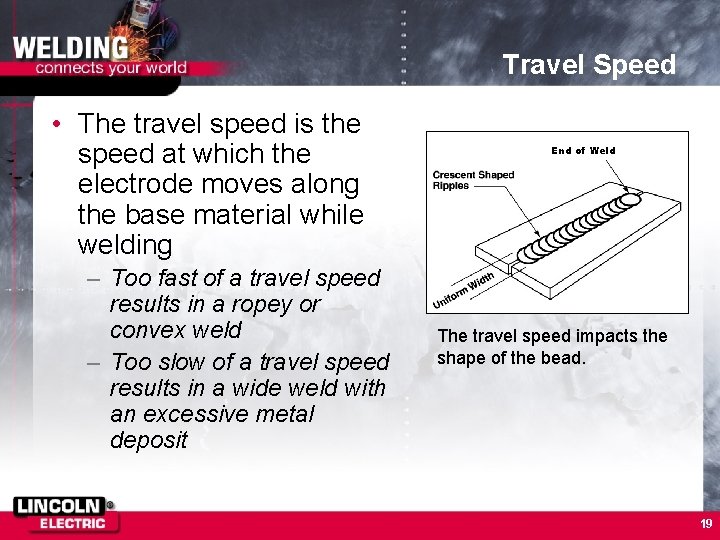
Travel Speed • The travel speed is the speed at which the electrode moves along the base material while welding – Too fast of a travel speed results in a ropey or convex weld – Too slow of a travel speed results in a wide weld with an excessive metal deposit End of Weld The travel speed impacts the shape of the bead. 19
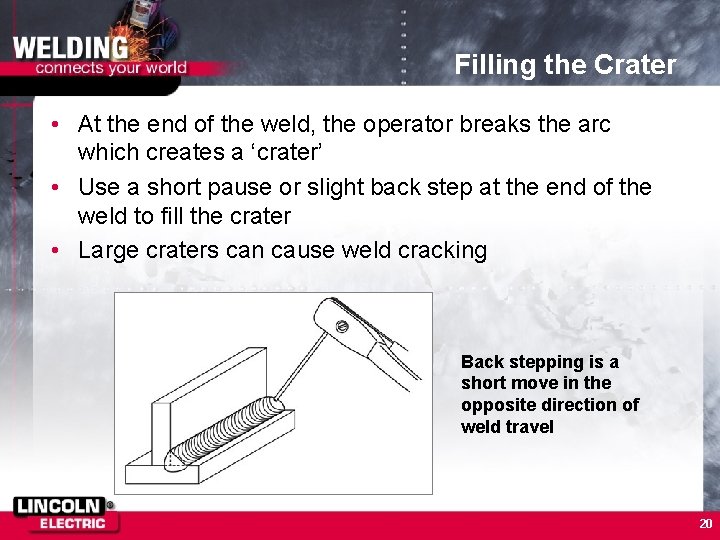
Filling the Crater • At the end of the weld, the operator breaks the arc which creates a ‘crater’ • Use a short pause or slight back step at the end of the weld to fill the crater • Large craters can cause weld cracking Back stepping is a short move in the opposite direction of weld travel 20
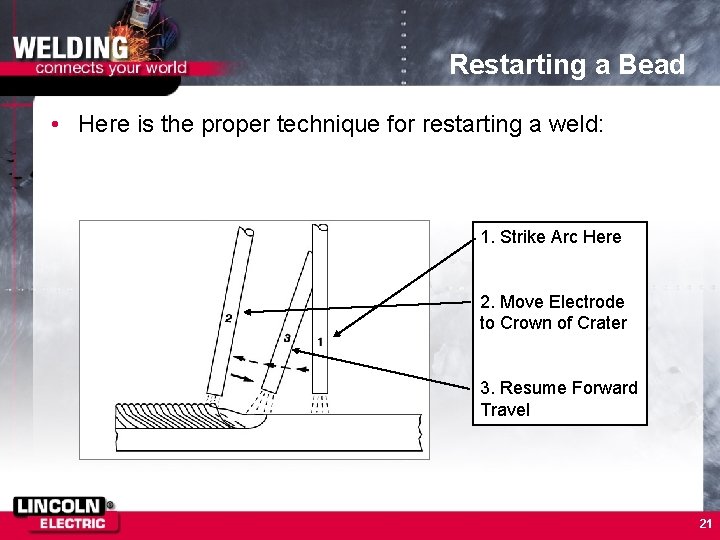
Restarting a Bead • Here is the proper technique for restarting a weld: 1. Strike Arc Here 2. Move Electrode to Crown of Crater 3. Resume Forward Travel 21

Troubleshooting Welds 22
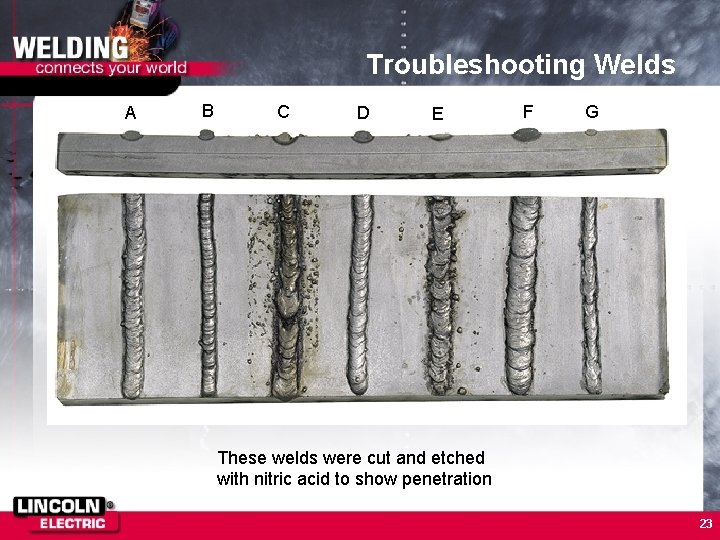
Troubleshooting Welds A B C D E F G These welds were cut and etched with nitric acid to show penetration 23

SMAW Advantages and Limitations 24
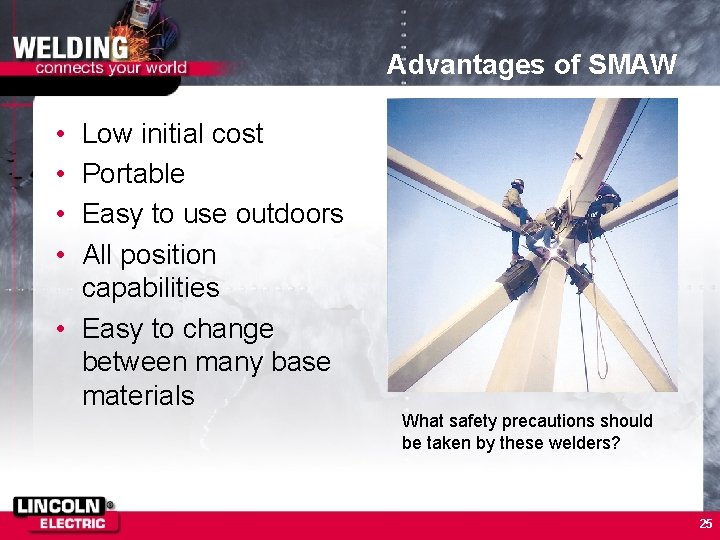
Advantages of SMAW • • Low initial cost Portable Easy to use outdoors All position capabilities • Easy to change between many base materials What safety precautions should be taken by these welders? 25
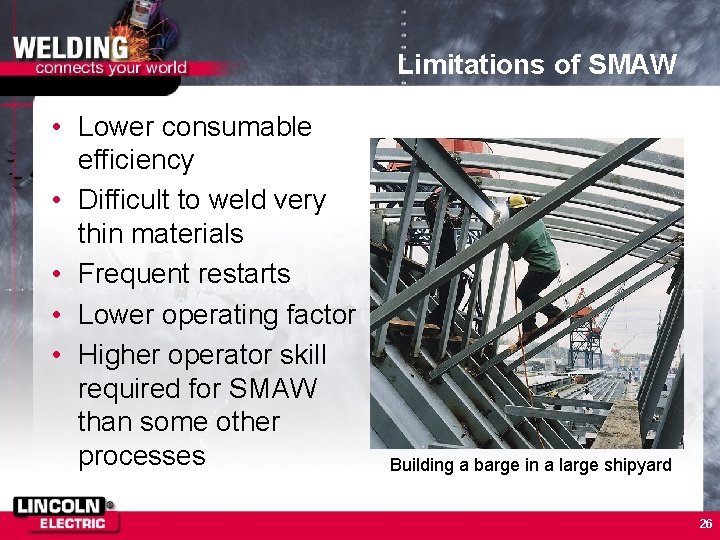
Limitations of SMAW • Lower consumable efficiency • Difficult to weld very thin materials • Frequent restarts • Lower operating factor • Higher operator skill required for SMAW than some other processes Building a barge in a large shipyard 26

AWS Classification of SMAW Electrodes 27
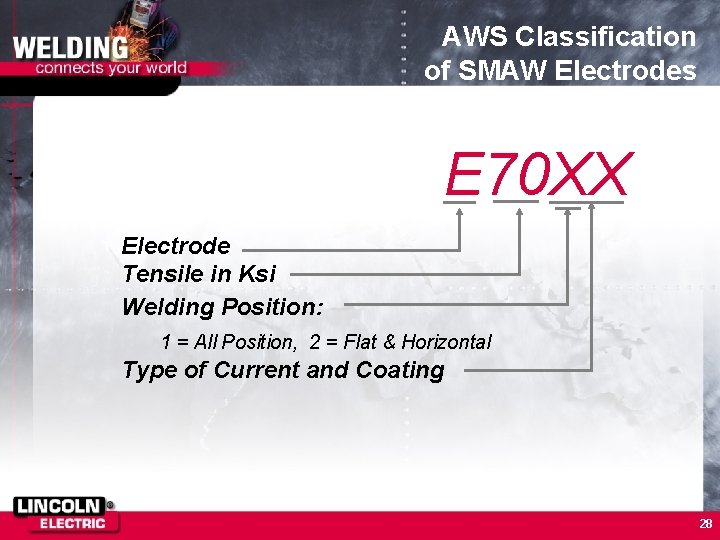
AWS Classification of SMAW Electrodes E 70 XX Electrode Tensile in Ksi Welding Position: 1 = All Position, 2 = Flat & Horizontal Type of Current and Coating 28

Lesson Plans 29
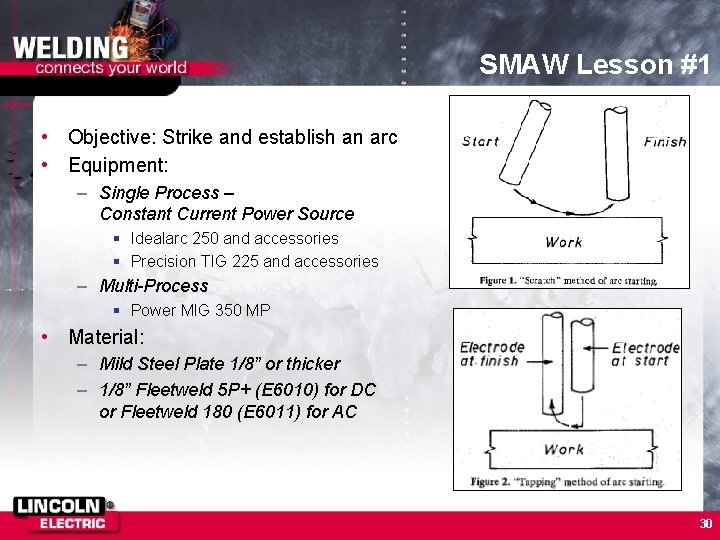
SMAW Lesson #1 • Objective: Strike and establish an arc • Equipment: – Single Process – Constant Current Power Source § Idealarc 250 and accessories § Precision TIG 225 and accessories – Multi-Process § Power MIG 350 MP • Material: – Mild Steel Plate 1/8” or thicker – 1/8” Fleetweld 5 P+ (E 6010) for DC or Fleetweld 180 (E 6011) for AC 30
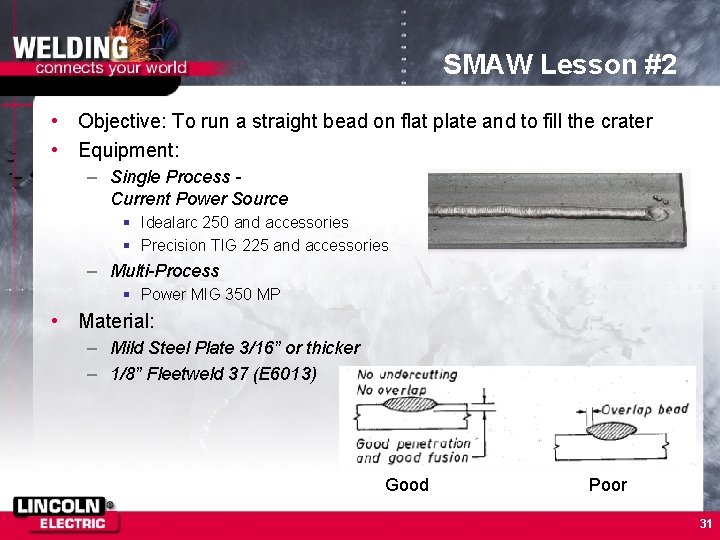
SMAW Lesson #2 • Objective: To run a straight bead on flat plate and to fill the crater • Equipment: – Single Process Current Power Source Constant § Idealarc 250 and accessories § Precision TIG 225 and accessories – Multi-Process § Power MIG 350 MP • Material: – Mild Steel Plate 3/16” or thicker – 1/8” Fleetweld 37 (E 6013) Good Poor 31
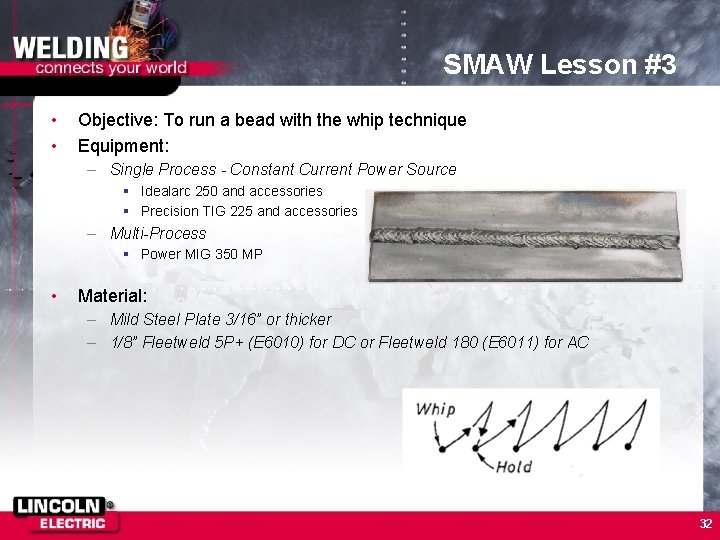
SMAW Lesson #3 • • Objective: To run a bead with the whip technique Equipment: – Single Process - Constant Current Power Source § Idealarc 250 and accessories § Precision TIG 225 and accessories – Multi-Process § Power MIG 350 MP • Material: – Mild Steel Plate 3/16” or thicker – 1/8” Fleetweld 5 P+ (E 6010) for DC or Fleetweld 180 (E 6011) for AC 32
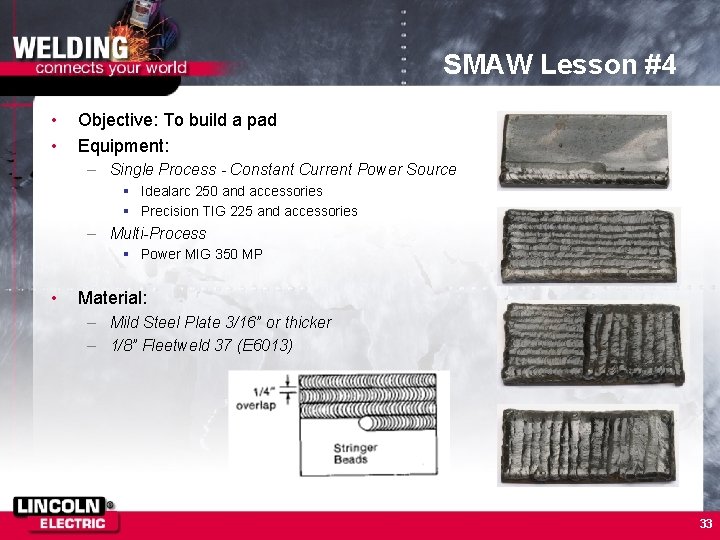
SMAW Lesson #4 • • Objective: To build a pad Equipment: – Single Process - Constant Current Power Source § Idealarc 250 and accessories § Precision TIG 225 and accessories – Multi-Process § Power MIG 350 MP • Material: – Mild Steel Plate 3/16” or thicker – 1/8” Fleetweld 37 (E 6013) 33
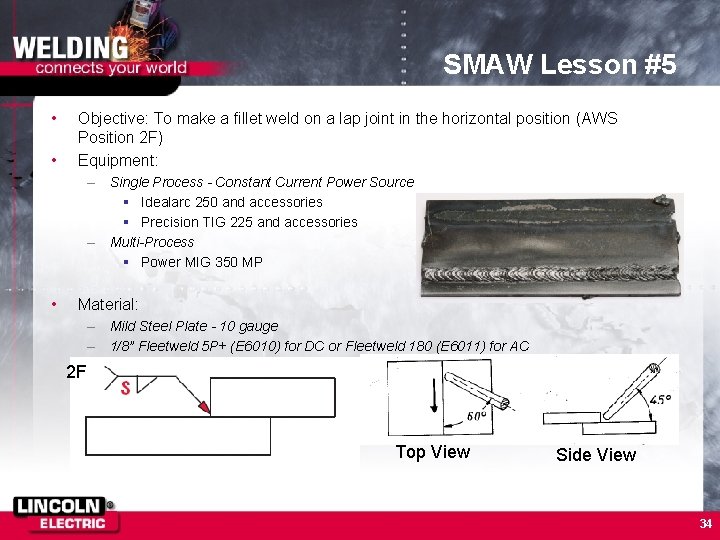
SMAW Lesson #5 • • Objective: To make a fillet weld on a lap joint in the horizontal position (AWS Position 2 F) Equipment: – Single Process - Constant Current Power Source § Idealarc 250 and accessories § Precision TIG 225 and accessories – Multi-Process § Power MIG 350 MP • Material: – Mild Steel Plate - 10 gauge – 1/8” Fleetweld 5 P+ (E 6010) for DC or Fleetweld 180 (E 6011) for AC 2 F Top View Side View 34
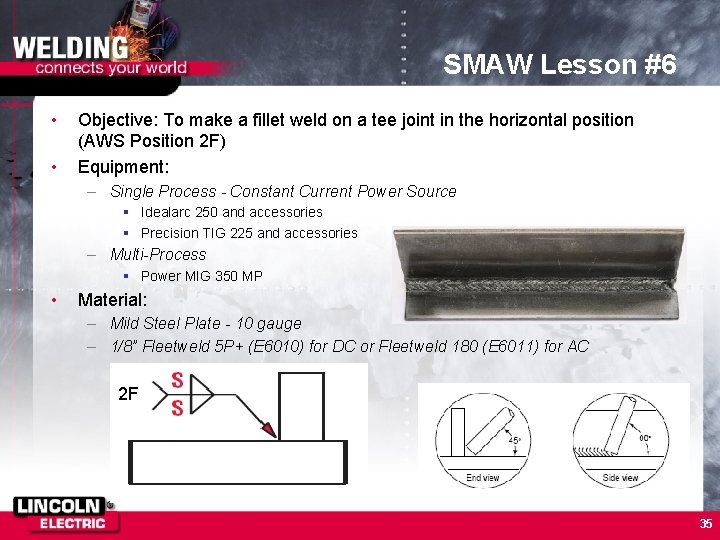
SMAW Lesson #6 • • Objective: To make a fillet weld on a tee joint in the horizontal position (AWS Position 2 F) Equipment: – Single Process - Constant Current Power Source § Idealarc 250 and accessories § Precision TIG 225 and accessories – Multi-Process § Power MIG 350 MP • Material: – Mild Steel Plate - 10 gauge – 1/8” Fleetweld 5 P+ (E 6010) for DC or Fleetweld 180 (E 6011) for AC 2 F 35
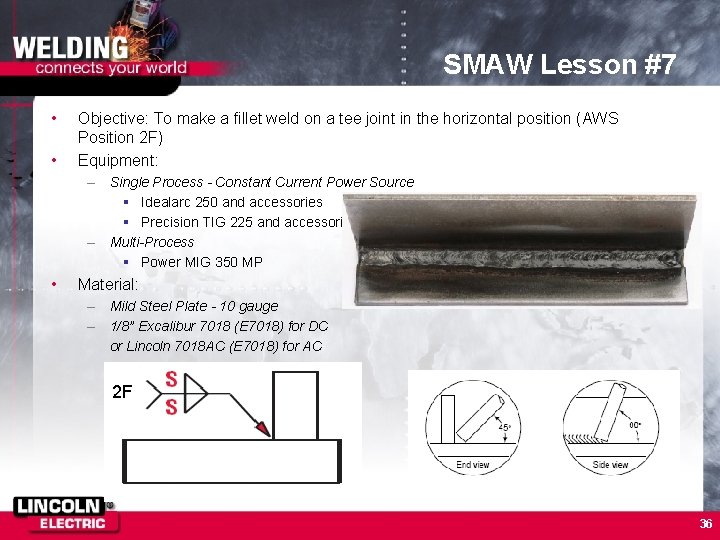
SMAW Lesson #7 • • Objective: To make a fillet weld on a tee joint in the horizontal position (AWS Position 2 F) Equipment: – Single Process - Constant Current Power Source § Idealarc 250 and accessories § Precision TIG 225 and accessories – Multi-Process § Power MIG 350 MP • Material: – Mild Steel Plate - 10 gauge – 1/8” Excalibur 7018 (E 7018) for DC or Lincoln 7018 AC (E 7018) for AC 2 F 36
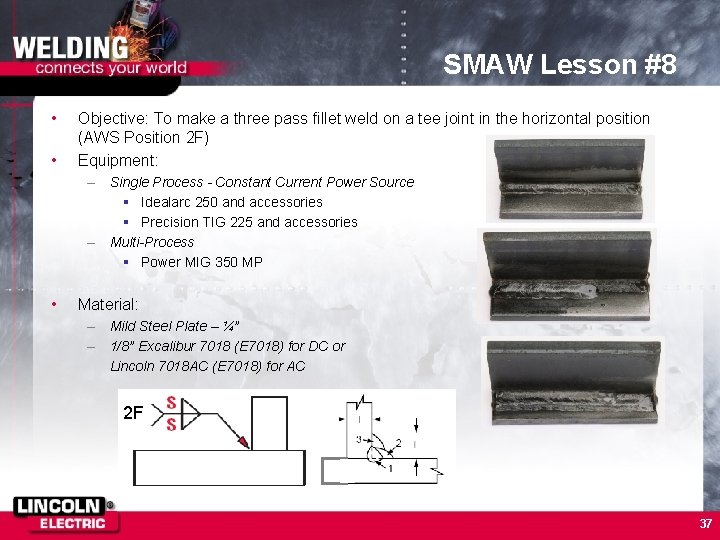
SMAW Lesson #8 • • Objective: To make a three pass fillet weld on a tee joint in the horizontal position (AWS Position 2 F) Equipment: – Single Process - Constant Current Power Source § Idealarc 250 and accessories § Precision TIG 225 and accessories – Multi-Process § Power MIG 350 MP • Material: – Mild Steel Plate – ¼” – 1/8” Excalibur 7018 (E 7018) for DC or Lincoln 7018 AC (E 7018) for AC 2 F 37
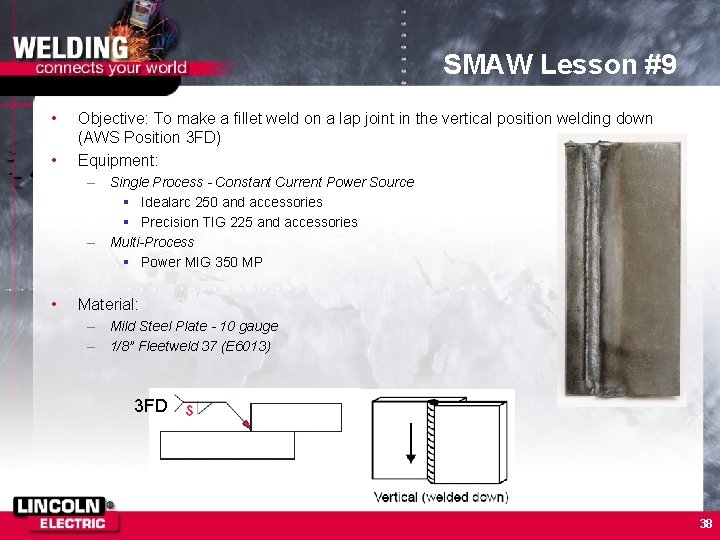
SMAW Lesson #9 • • Objective: To make a fillet weld on a lap joint in the vertical position welding down (AWS Position 3 FD) Equipment: – Single Process - Constant Current Power Source § Idealarc 250 and accessories § Precision TIG 225 and accessories – Multi-Process § Power MIG 350 MP • Material: – Mild Steel Plate - 10 gauge – 1/8” Fleetweld 37 (E 6013) 3 FD 38
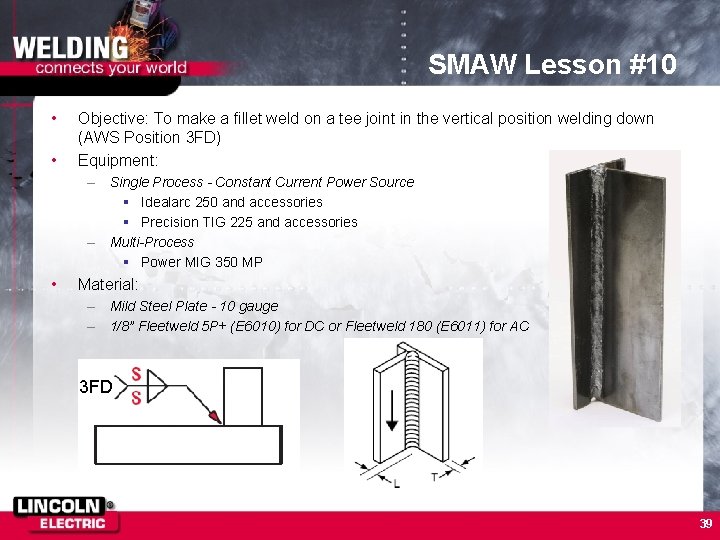
SMAW Lesson #10 • • Objective: To make a fillet weld on a tee joint in the vertical position welding down (AWS Position 3 FD) Equipment: – Single Process - Constant Current Power Source § Idealarc 250 and accessories § Precision TIG 225 and accessories – Multi-Process § Power MIG 350 MP • Material: – Mild Steel Plate - 10 gauge – 1/8” Fleetweld 5 P+ (E 6010) for DC or Fleetweld 180 (E 6011) for AC 3 FD 39
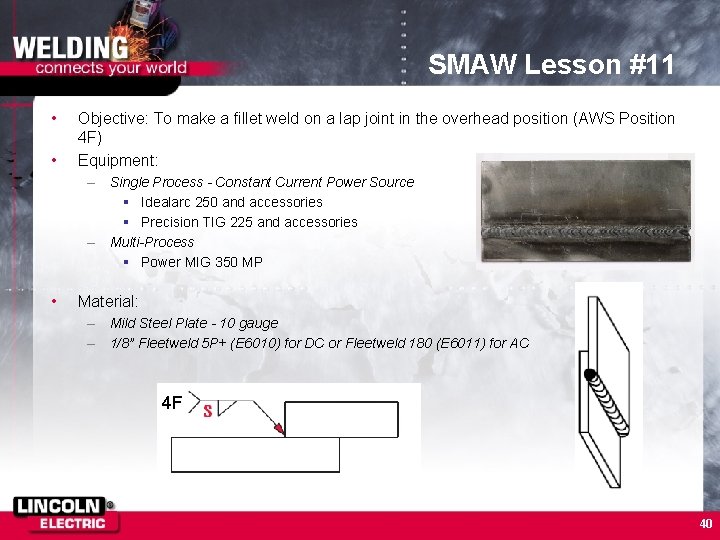
SMAW Lesson #11 • • Objective: To make a fillet weld on a lap joint in the overhead position (AWS Position 4 F) Equipment: – Single Process - Constant Current Power Source § Idealarc 250 and accessories § Precision TIG 225 and accessories – Multi-Process § Power MIG 350 MP • Material: – Mild Steel Plate - 10 gauge – 1/8” Fleetweld 5 P+ (E 6010) for DC or Fleetweld 180 (E 6011) for AC 4 F 40
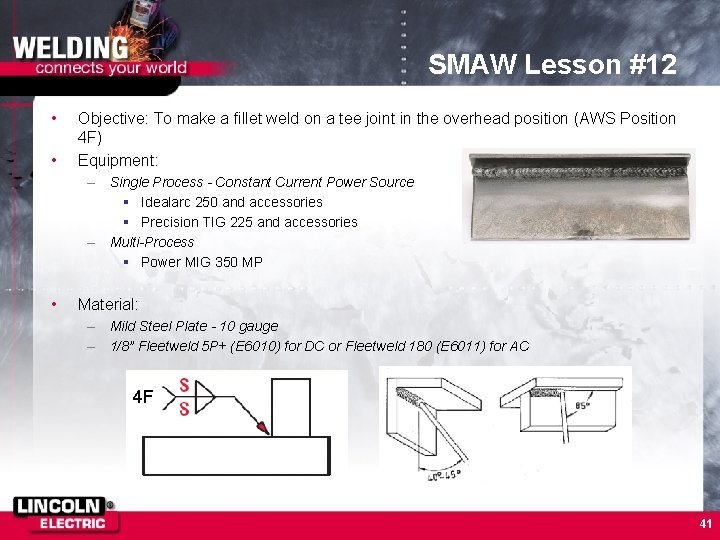
SMAW Lesson #12 • • Objective: To make a fillet weld on a tee joint in the overhead position (AWS Position 4 F) Equipment: – Single Process - Constant Current Power Source § Idealarc 250 and accessories § Precision TIG 225 and accessories – Multi-Process § Power MIG 350 MP • Material: – Mild Steel Plate - 10 gauge – 1/8” Fleetweld 5 P+ (E 6010) for DC or Fleetweld 180 (E 6011) for AC 4 F 41
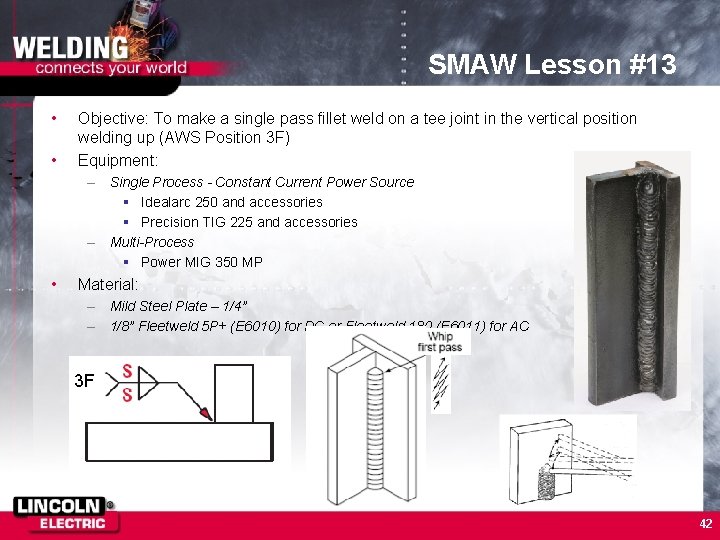
SMAW Lesson #13 • • Objective: To make a single pass fillet weld on a tee joint in the vertical position welding up (AWS Position 3 F) Equipment: – Single Process - Constant Current Power Source § Idealarc 250 and accessories § Precision TIG 225 and accessories – Multi-Process § Power MIG 350 MP • Material: – Mild Steel Plate – 1/4” – 1/8” Fleetweld 5 P+ (E 6010) for DC or Fleetweld 180 (E 6011) for AC 3 F 42

SMAW Lesson #14 • • Objective: To make a three pass fillet weld on a tee joint in the vertical position welding up (AWS Position 3 F) Equipment: – Single Process - Constant Current Power Source § Idealarc 250 and accessories § Precision TIG 225 and accessories – Multi-Process § Power MIG 350 MP • Material: – Mild Steel Plate – 1/4” – 1/8” Fleetweld 5 P+ (E 6010) for DC or Fleetweld 180 (E 6011) for AC 3 F 43
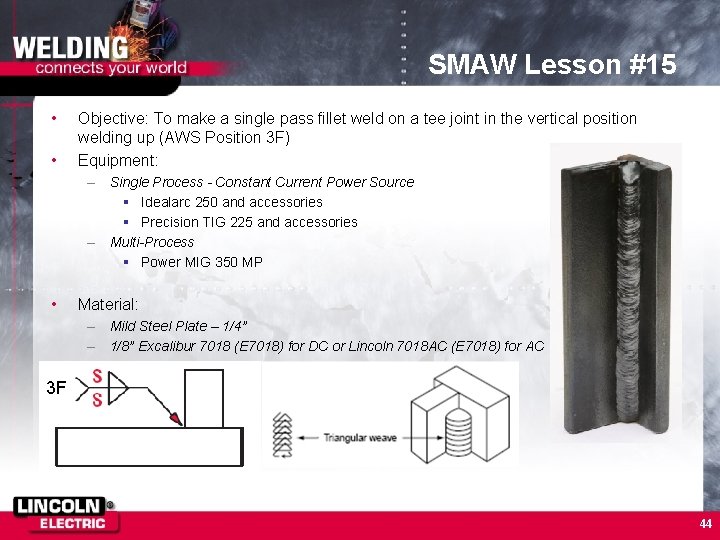
SMAW Lesson #15 • • Objective: To make a single pass fillet weld on a tee joint in the vertical position welding up (AWS Position 3 F) Equipment: – Single Process - Constant Current Power Source § Idealarc 250 and accessories § Precision TIG 225 and accessories – Multi-Process § Power MIG 350 MP • Material: – Mild Steel Plate – 1/4” – 1/8” Excalibur 7018 (E 7018) for DC or Lincoln 7018 AC (E 7018) for AC 3 F 44
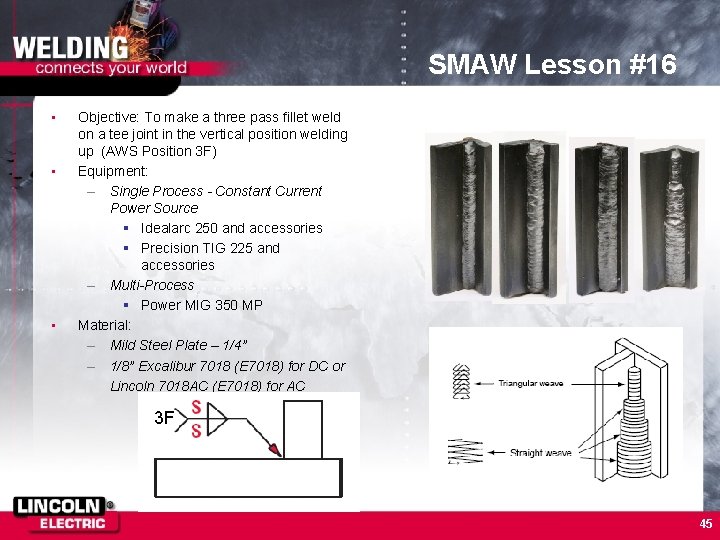
SMAW Lesson #16 • • • Objective: To make a three pass fillet weld on a tee joint in the vertical position welding up (AWS Position 3 F) Equipment: – Single Process - Constant Current Power Source § Idealarc 250 and accessories § Precision TIG 225 and accessories – Multi-Process § Power MIG 350 MP Material: – Mild Steel Plate – 1/4” – 1/8” Excalibur 7018 (E 7018) for DC or Lincoln 7018 AC (E 7018) for AC 3 F 45
- Slides: 45