
Smart Sustainable Cities in the 2030 Sustainable Development
Smart Sustainable Cities in the 2030 Sustainable Development Agenda: the way forward Gulnara Roll Head, Housing and Land Management Unit, UNECE.
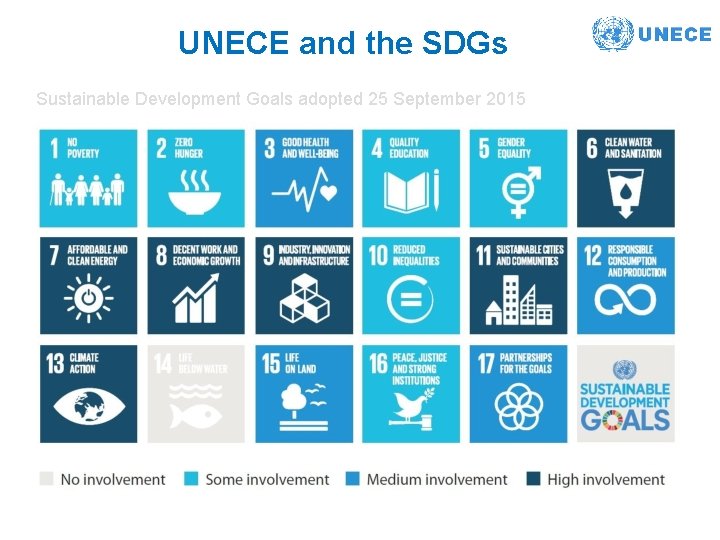
UNECE and the SDGs Sustainable Development Goals adopted 25 September 2015
Activities on SDG indicators 2016 • In December 2015, United Nations Statistical Commission (UNSC) was requested to develop a proposal for indicators to measure SDGs • UNSC established Interagency and Expert Group on SDG Indicators (IAEG-SDG) • • Country led process, 28 countries are members, all other countries and international organizations are observers Members from UNECE region: Armenia, Canada, France, Germany, Kyrgyzstan, the Netherlands, Russian Federation, Sweden, UK • Indicator list (231 indicators) finalised on 18 February, available at: http: //unstats. un. org/unsd/statcom/47 th-session/documents/2016 -2 IAEG-SDGs-E. pdf • Approved by UNSC in March 2016 • After UNSC, to be approved by ECOSOC (June 2016) and General Assembly (September 2016)
Indicators for Goal 11: Cities and human settlements 11. 1 By 2030, ensure access for all to adequate, safe and affordable housing and basic services and upgrade slums • Proportion of urban population living in slums, informal settlement, or inadequate housing 11. 2 By 2030, provide access to safe, affordable, accessible and sustainable transport systems for all, improving road safety, etc. • Proportion of the population that has convenient access to public transport, disaggregated by age, sex and persons with disabilities 11. 3 By 2030, enhance inclusive and sustainable urbanization and capacity for participatory, integrated and sustainable human settlement • • Ratio of land consumption rate to population growth rate Percentage of cities with direct participation structure of civil society in urban planning and management, which operate regularly and democratically 11. 4 Strengthen efforts to protect and safeguard the world's cultural and natural heritage • Share of national (or municipal) budget which is dedicated to preservation, protection and conservation of national cultural natural heritage including World Heritage sites 11. 5 By 2030, significantly reduce the number of deaths and people affected and substantially decrease the direct economic losses relative to global GDP caused by disasters, etc. • Number of deaths, missing people, injured, relocated or evacuated due to disasters per 100, 000 people. 11. 6 By 2030, reduce the adverse per capita environmental impact of cities, including by paying special attention to air quality and municipal and other waste management • • Percentage of urban solid waste regularly collected and with adequate final discharge with regards to the total waste generated by the city Annual mean levels of fine particulate matter (i. e. PM 2. 5 and PM 10) in cities (population weighted
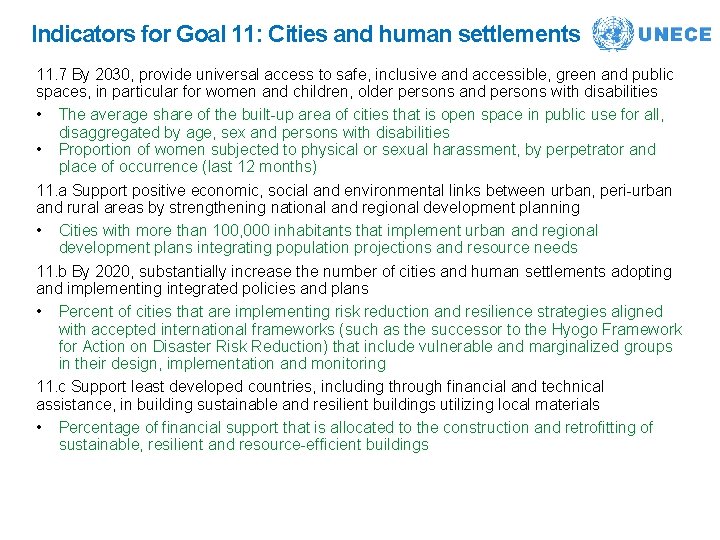
Indicators for Goal 11: Cities and human settlements 11. 7 By 2030, provide universal access to safe, inclusive and accessible, green and public spaces, in particular for women and children, older persons and persons with disabilities • The average share of the built-up area of cities that is open space in public use for all, disaggregated by age, sex and persons with disabilities • Proportion of women subjected to physical or sexual harassment, by perpetrator and place of occurrence (last 12 months) 11. a Support positive economic, social and environmental links between urban, peri-urban and rural areas by strengthening national and regional development planning • Cities with more than 100, 000 inhabitants that implement urban and regional development plans integrating population projections and resource needs 11. b By 2020, substantially increase the number of cities and human settlements adopting and implementing integrated policies and plans • Percent of cities that are implementing risk reduction and resilience strategies aligned with accepted international frameworks (such as the successor to the Hyogo Framework for Action on Disaster Risk Reduction) that include vulnerable and marginalized groups in their design, implementation and monitoring 11. c Support least developed countries, including through financial and technical assistance, in building sustainable and resilient buildings utilizing local materials • Percentage of financial support that is allocated to the construction and retrofitting of sustainable, resilient and resource-efficient buildings
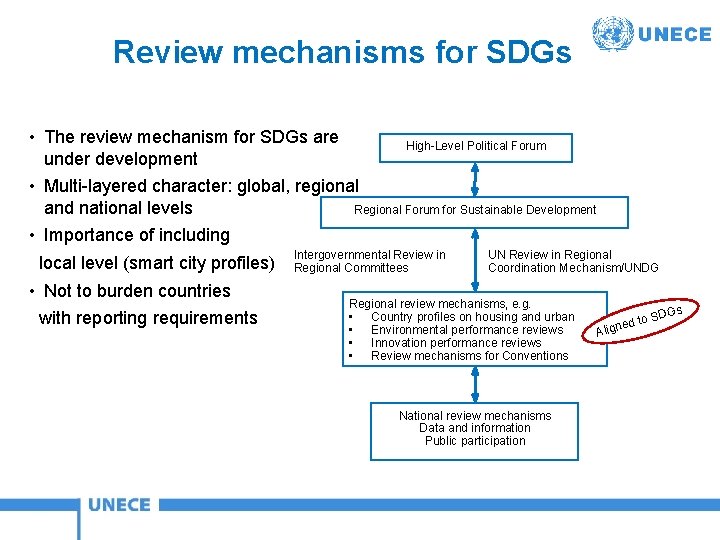
Review mechanisms for SDGs • The review mechanism for SDGs are High-Level Political Forum under development • Multi-layered character: global, regional Regional Forum for Sustainable Development and national levels • Importance of including UN Review in Regional Intergovernmental Review in local level (smart city profiles) Regional Committees Coordination Mechanism/UNDG • Not to burden countries Regional review mechanisms, e. g. s • Country profiles on housing and urban SDG o with reporting requirements t d gne • • • Environmental performance reviews Innovation performance reviews Review mechanisms for Conventions National review mechanisms Data and information Public participation Ali
Further work Ø Setting up the reporting system on SDG indicators § Links to follow-up and review at policy level – HLPF, regional, thematic reviews § Possible regional and national indicators Ø Data availability and quality, data sources § Assessment of data availability § Methodological development § Statistical capacity building Baseline data Ø Data flows • Links between national, regional, global and thematic reporting • Who will collect data and transfer to whom – at national, regional and global level § Ø In UNECE: Steering Group on Statistics for SDGs working on a road map Ø IAEG-SDG providing support for the implementation of the indicators Ø HLG for partnership, coordination and capacity building for statistics for 2030 Agenda
Next steps • Assess readiness of countries to report on SDGs • Develop national systems for reporting on SDG indicators, work on data availability • Ensure intersectoral coordination, involvement of local level for the implementation • Capacity building (UNECE/UN-Habitat project with pilots in Albania, Georgia, Kyrgyzstan and Ukraine) • Communication and dissemination
- Slides: 8