
Smart Structures Technologies and Earthquake Engineering ACADEMIC Site
- Slides: 20
Smart Structures Technologies and Earthquake Engineering ACADEMIC (Site Session and General Session) Title: Live. Design Paradigm for Intelligent Civil Infrastructure Presentation by: Gautam Dasgupta, Professor, Civil Engineering 620 Seeley W. Mudd, 500 West 120 Street Columbia University, New York, NY 10027, USA Tel: 212 -854 -3102; fax: 212 -854 -6267; email: gd 18@columbia. edu Keywords: Bayesian updating, extreme value statistics, security and sensors Prof. Gautam Dasgupta Columbia University
Live Design Conventional construction practices are governed by: 1. mechanical stress 2. cost considerations 3. not geared towards mitigating imminent threats 4. not by breach of security Prof. Gautam Dasgupta Columbia University
Live Design Information Technology (IT) has empowered engineers to develop Live. Design prototypes that I) alert civic authorities confronted with manmade disasters II) suggest optimal evacuation/rescue along the most favorable routes Prof. Gautam Dasgupta Columbia University
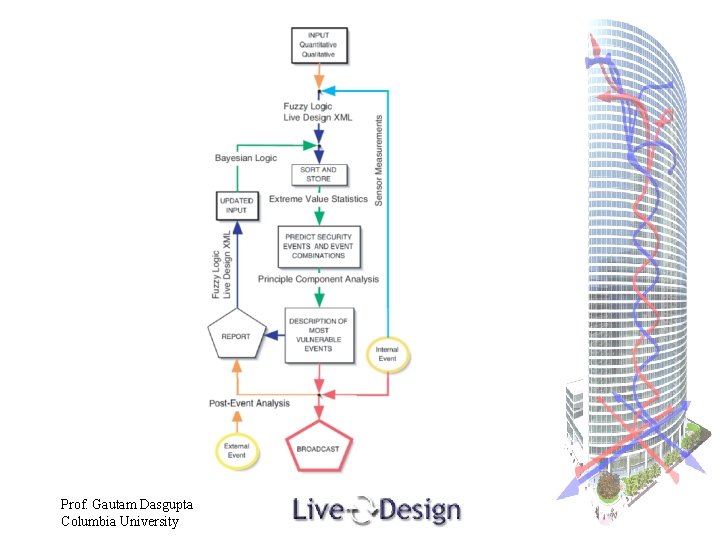
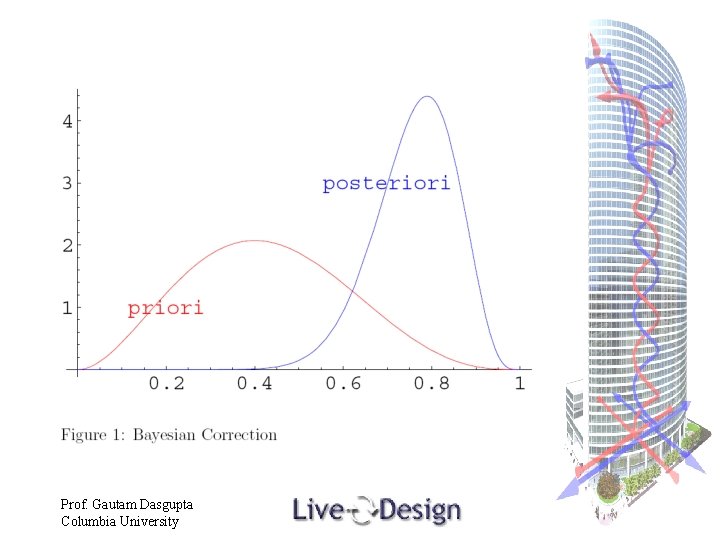
Live Design IT-based decision process 1. High-speed 2. large-scale 3. distributed statistical computation Bayesian updating is almost instantaneous Hence the paradigm is termed Live. Design. Prof. Gautam Dasgupta Columbia University
1. Background work from 2001 (a) engineers (b) architects (c) computer scientists (d) lawyers 2. Live. Design core methodology 3. Randomly selected office building models 4. Seamless information augmentation → open environment 5. Nonrestrictive extension for all civil infrastructures (a) watersheds (b) energy systems 6. Versatility of Live. Design Prof. Gautam Dasgupta Columbia University
Three principal parts to this research 1. Data acquisition 2. Statistical combination of those indicators to construct threat scenarios 3. Virtual reality-based smart signs of optimal paths in evacuation and rescue are displayed Prof. Gautam Dasgupta Columbia University
Data acquisition combines: 1. Available structural stress analysis 2. and response history 2. Building codes 3. Legal requirements 4. On-line sensor readings Prof. Gautam Dasgupta Columbia University
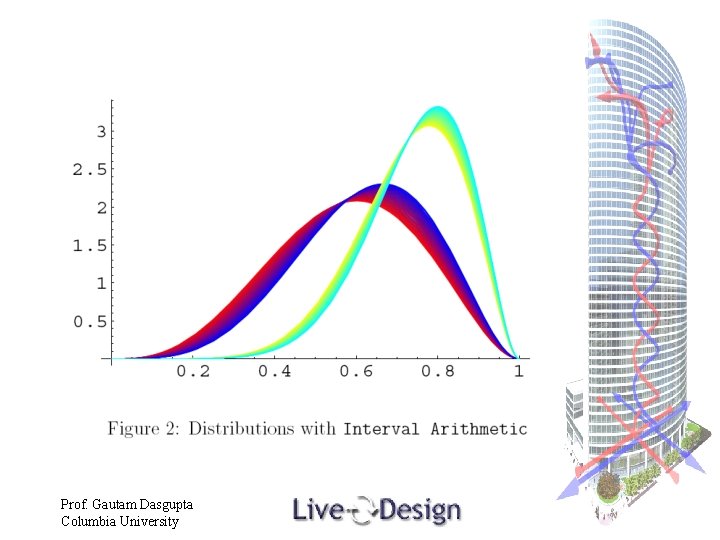
Threat scenarios constructed by statistical combination: 1. Principal component analysis 2. assesses the most fatal state 2. Interval arithmetic depicts confidence bounds 3. fuzzy logic constructs spatio-temporal threat patterns Prof. Gautam Dasgupta Columbia University
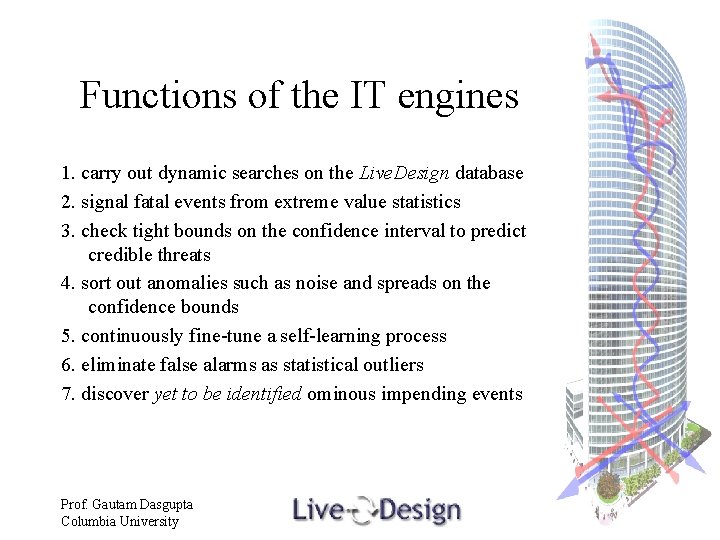
Functions of the IT engines 1. carry out dynamic searches on the Live. Design database 2. signal fatal events from extreme value statistics 3. check tight bounds on the confidence interval to predict credible threats 4. sort out anomalies such as noise and spreads on the confidence bounds 5. continuously fine-tune a self-learning process 6. eliminate false alarms as statistical outliers 7. discover yet to be identified ominous impending events Prof. Gautam Dasgupta Columbia University
Prof. Gautam Dasgupta Columbia University
Prof. Gautam Dasgupta Columbia University
Prof. Gautam Dasgupta Columbia University
Bayesian Network 1. Security costs depend 2. nonlinearly on the associated payoff 2. All indices can be assessed only in the probabilistic sense 3. Bayesian network is an elegant representation: (a) operates on joint probabilities (b) uses graphical communication language (c) is based on the semantics of causality 4. Modeling procedure is symbolic has been partially written in Mathematica 5. Current research contains Modelica: — graph theory constructs implement qualitative features Prof. Gautam Dasgupta Columbia University
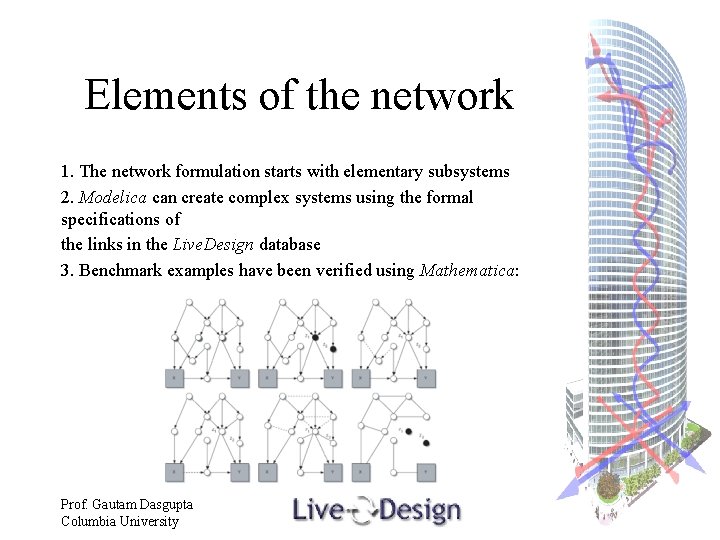
Elements of the network 1. The network formulation starts with elementary subsystems 2. Modelica can create complex systems using the formal specifications of the links in the Live. Design database 3. Benchmark examples have been verified using Mathematica: Prof. Gautam Dasgupta Columbia University
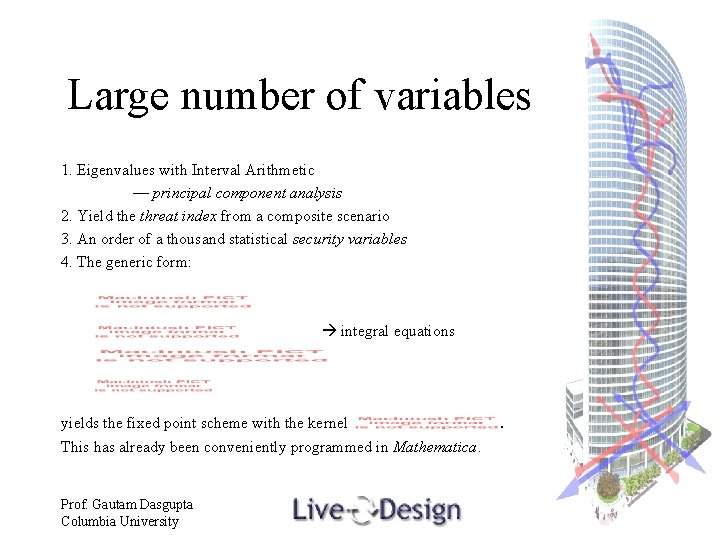
Large number of variables 1. Eigenvalues with Interval Arithmetic — principal component analysis 2. Yield the threat index from a composite scenario 3. An order of a thousand statistical security variables 4. The generic form: integral equations yields the fixed point scheme with the kernel This has already been conveniently programmed in Mathematica. Prof. Gautam Dasgupta Columbia University .
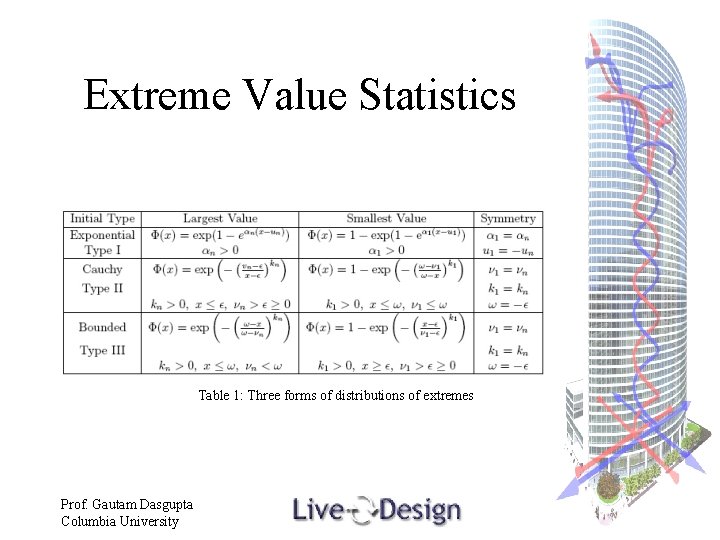
Extreme Value Statistics Table 1: Three forms of distributions of extremes Prof. Gautam Dasgupta Columbia University
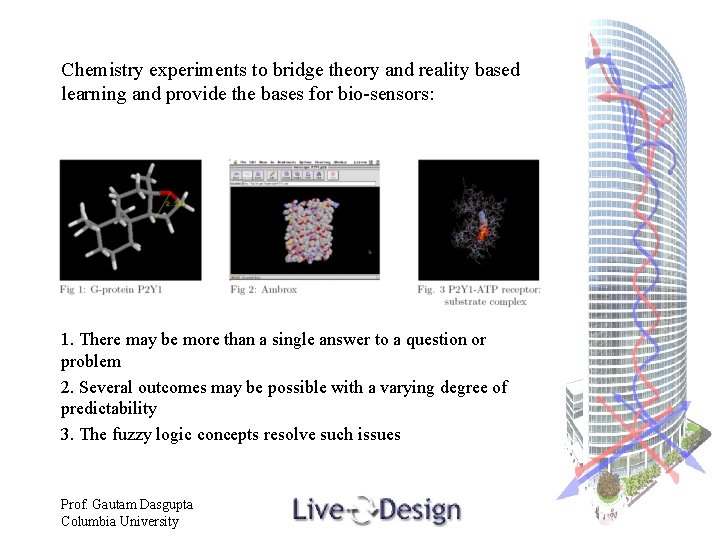
Chemistry experiments to bridge theory and reality based learning and provide the bases for bio-sensors: 1. There may be more than a single answer to a question or problem 2. Several outcomes may be possible with a varying degree of predictability 3. The fuzzy logic concepts resolve such issues Prof. Gautam Dasgupta Columbia University
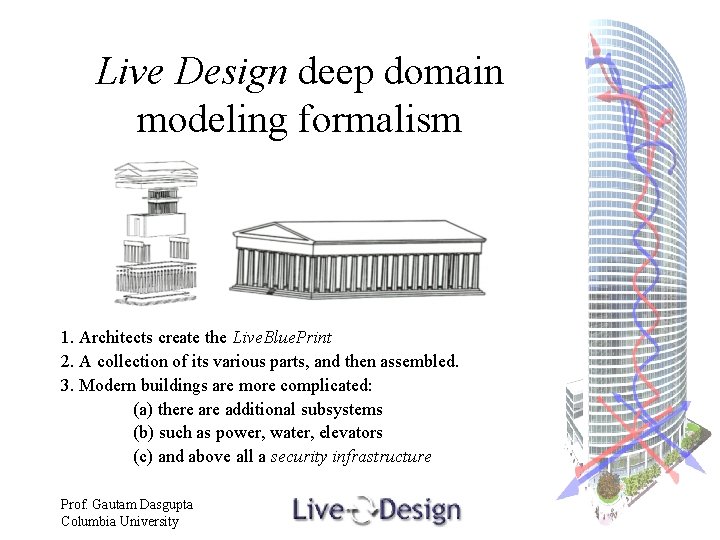
Live Design deep domain modeling formalism 1. Architects create the Live. Blue. Print 2. A collection of its various parts, and then assembled. 3. Modern buildings are more complicated: (a) there additional subsystems (b) such as power, water, elevators (c) and above all a security infrastructure Prof. Gautam Dasgupta Columbia University
Intelligent Infrastructure 1. Smart structures respond to their surroundings 2. (a) Safety (b) Thermo-mechanical inputs 2. Intelligent infrastructures (a) Security (b) Safety concerns as subsets (c) Societal policy inputs 3. Information based technology (a) Integration of quantitative and qualitative data (b) Computer understandable communications Prof. Gautam Dasgupta Columbia University
The Team 1. Universities (a) Columbia University (b) MIT (c) Carnegie Mellon University (d) University of Maine 2. Industries (a) OKG Constructions, NYC (b) Contour Graphics Architects, NYC (c) Serby Attorneys, NYC 3. Foreign collaborators (a) Kagawa University, Japan (b) Laboratoire d’Optique, Besancon, France Prof. Gautam Dasgupta Columbia University