
Smart Structures Smart Structures Most Common Definition A

- Slides: 19
Smart Structures
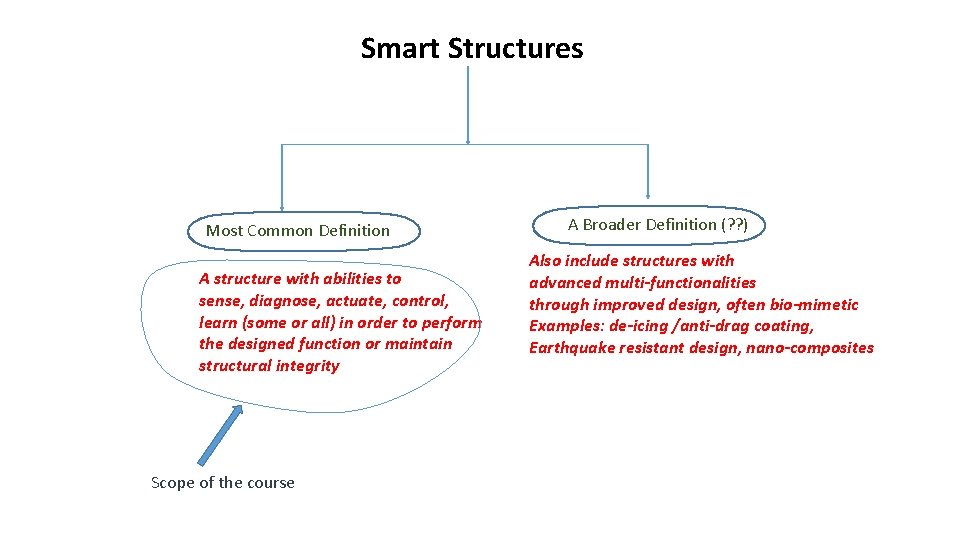
Smart Structures Most Common Definition A structure with abilities to sense, diagnose, actuate, control, learn (some or all) in order to perform the designed function or maintain structural integrity Scope of the course A Broader Definition (? ? ) Also include structures with advanced multi-functionalities through improved design, often bio-mimetic Examples: de-icing /anti-drag coating, Earthquake resistant design, nano-composites
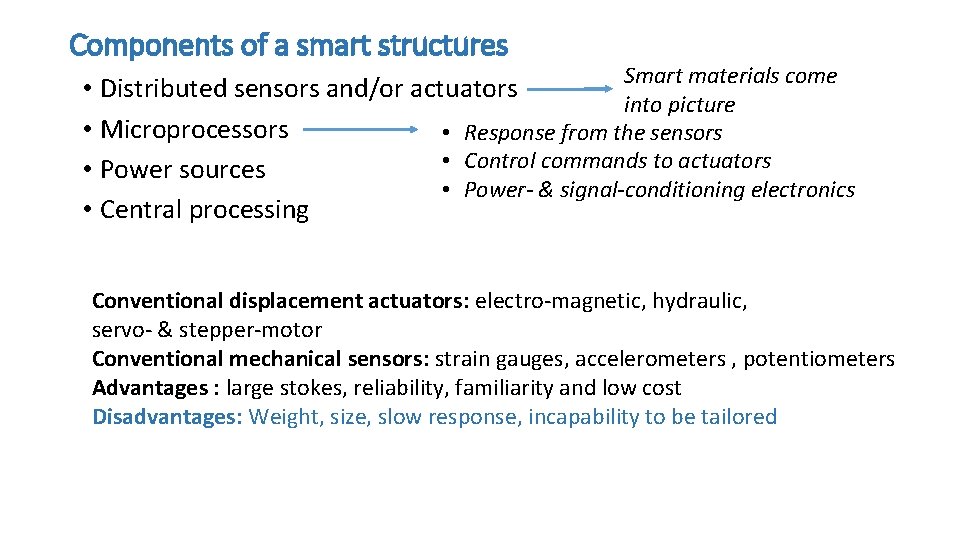
Components of a smart structures Smart materials come • Distributed sensors and/or actuators into picture • Microprocessors • Response from the sensors • Control commands to actuators • Power sources • Power- & signal-conditioning electronics • Central processing Conventional displacement actuators: electro-magnetic, hydraulic, servo- & stepper-motor Conventional mechanical sensors: strain gauges, accelerometers , potentiometers Advantages : large stokes, reliability, familiarity and low cost Disadvantages: Weight, size, slow response, incapability to be tailored
Smart Structures Applications
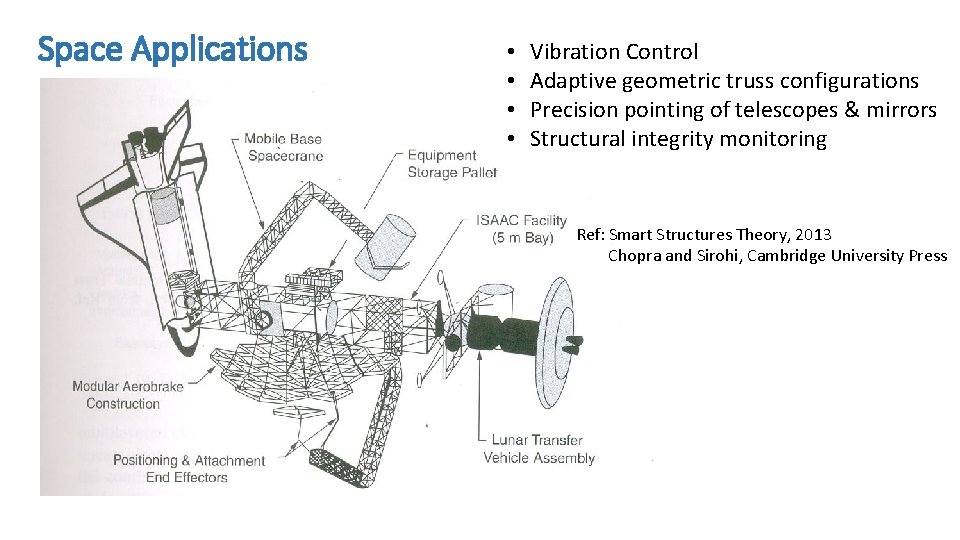
Space Applications • • Vibration Control Adaptive geometric truss configurations Precision pointing of telescopes & mirrors Structural integrity monitoring Ref: Smart Structures Theory, 2013 Chopra and Sirohi, Cambridge University Press
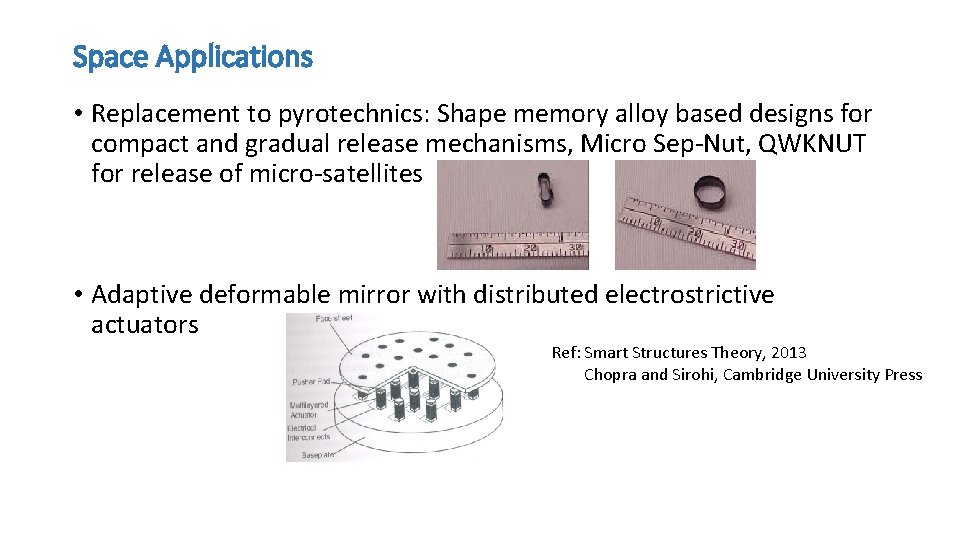
Space Applications • Replacement to pyrotechnics: Shape memory alloy based designs for compact and gradual release mechanisms, Micro Sep-Nut, QWKNUT for release of micro-satellites • Adaptive deformable mirror with distributed electrostrictive actuators Ref: Smart Structures Theory, 2013 Chopra and Sirohi, Cambridge University Press
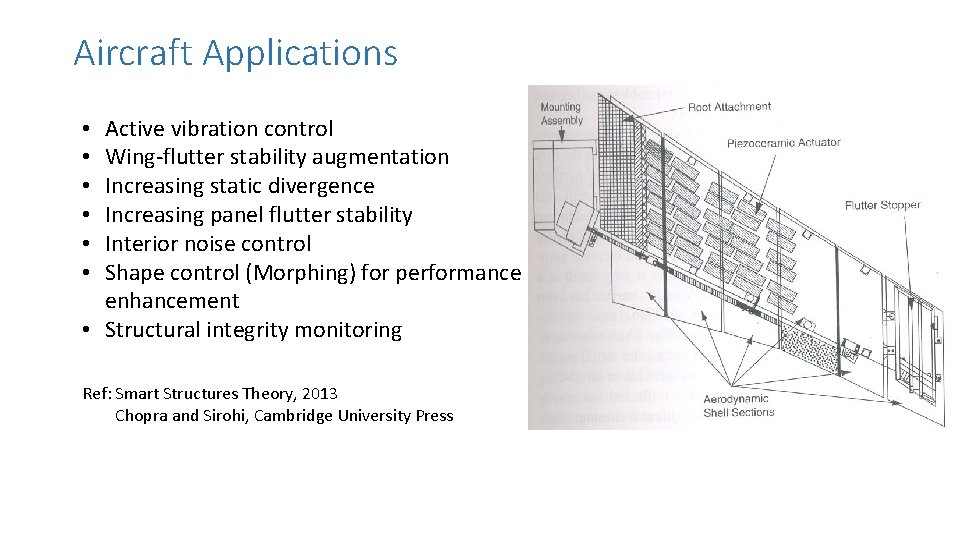
Aircraft Applications Active vibration control Wing-flutter stability augmentation Increasing static divergence Increasing panel flutter stability Interior noise control Shape control (Morphing) for performance enhancement • Structural integrity monitoring • • • Ref: Smart Structures Theory, 2013 Chopra and Sirohi, Cambridge University Press
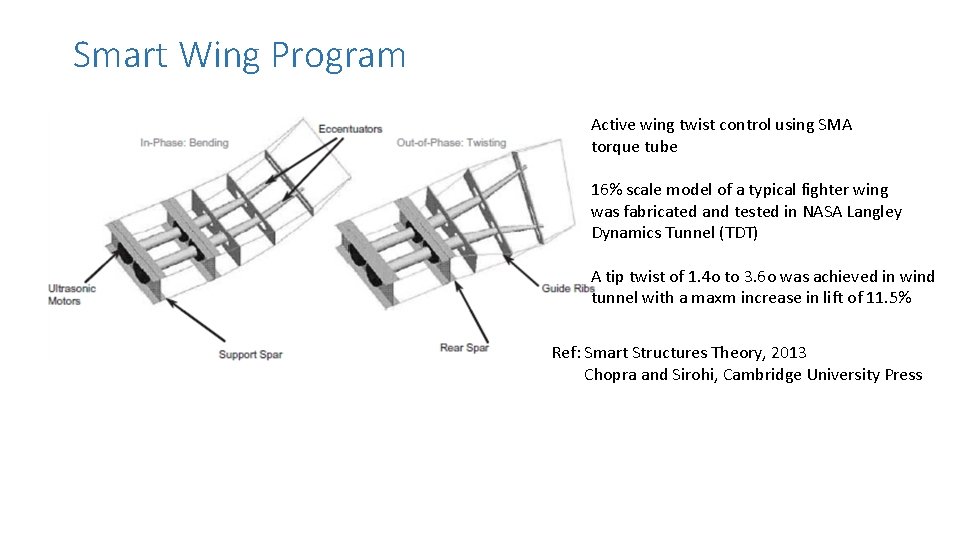
Smart Wing Program Active wing twist control using SMA torque tube 16% scale model of a typical fighter wing was fabricated and tested in NASA Langley Dynamics Tunnel (TDT) A tip twist of 1. 4 o to 3. 6 o was achieved in wind tunnel with a maxm increase in lift of 11. 5% Ref: Smart Structures Theory, 2013 Chopra and Sirohi, Cambridge University Press
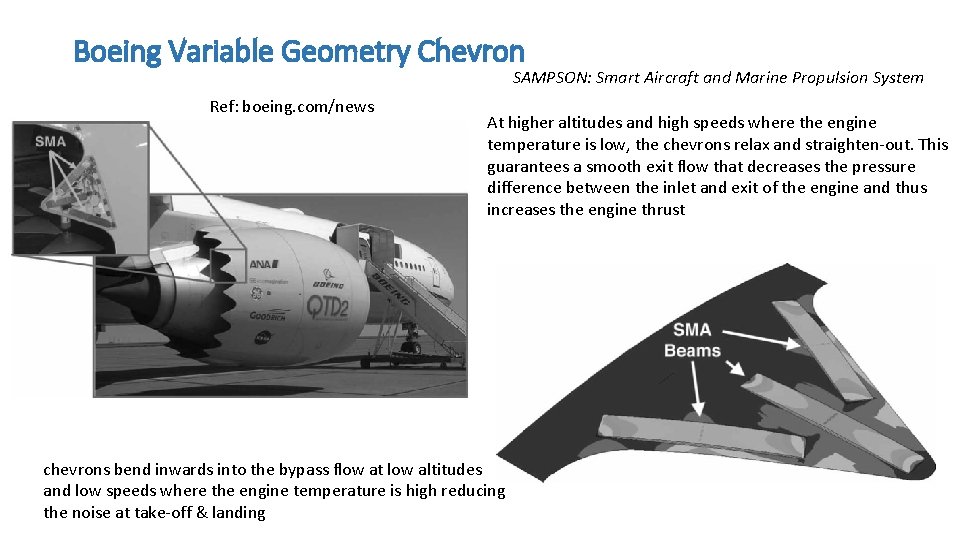
Boeing Variable Geometry Chevron SAMPSON: Smart Aircraft and Marine Propulsion System Ref: boeing. com/news At higher altitudes and high speeds where the engine temperature is low, the chevrons relax and straighten-out. This guarantees a smooth exit flow that decreases the pressure difference between the inlet and exit of the engine and thus increases the engine thrust chevrons bend inwards into the bypass flow at low altitudes and low speeds where the engine temperature is high reducing the noise at take-off & landing
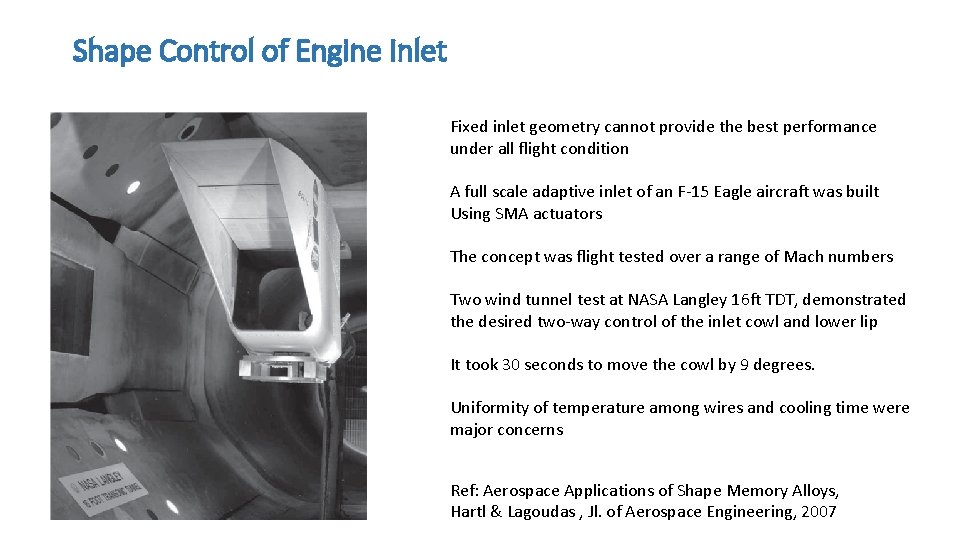
Shape Control of Engine Inlet Fixed inlet geometry cannot provide the best performance under all flight condition A full scale adaptive inlet of an F-15 Eagle aircraft was built Using SMA actuators The concept was flight tested over a range of Mach numbers Two wind tunnel test at NASA Langley 16 ft TDT, demonstrated the desired two-way control of the inlet cowl and lower lip It took 30 seconds to move the cowl by 9 degrees. Uniformity of temperature among wires and cooling time were major concerns Ref: Aerospace Applications of Shape Memory Alloys, Hartl & Lagoudas , Jl. of Aerospace Engineering, 2007
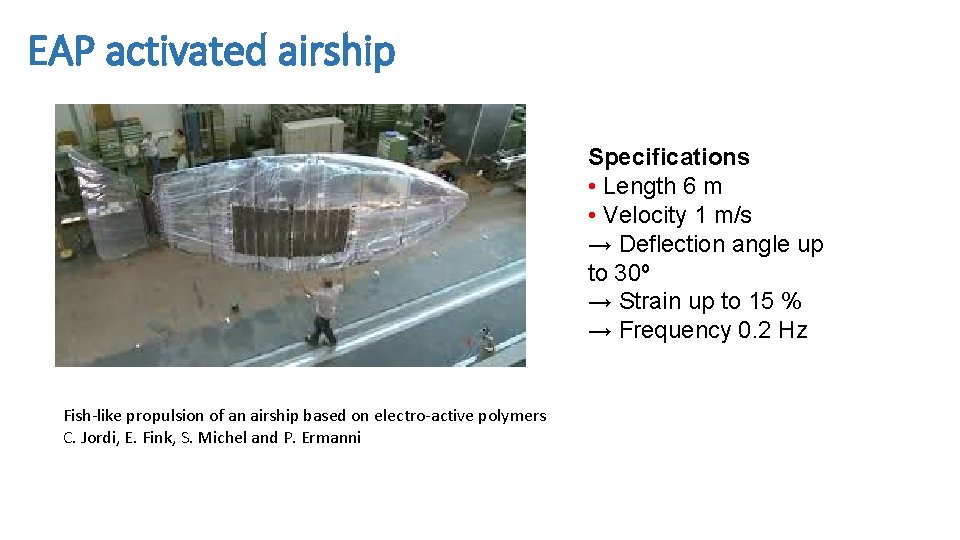
EAP activated airship Specifications • Length 6 m • Velocity 1 m/s → Deflection angle up to 30º → Strain up to 15 % → Frequency 0. 2 Hz Fish-like propulsion of an airship based on electro-active polymers C. Jordi, E. Fink, S. Michel and P. Ermanni
Smart Materials
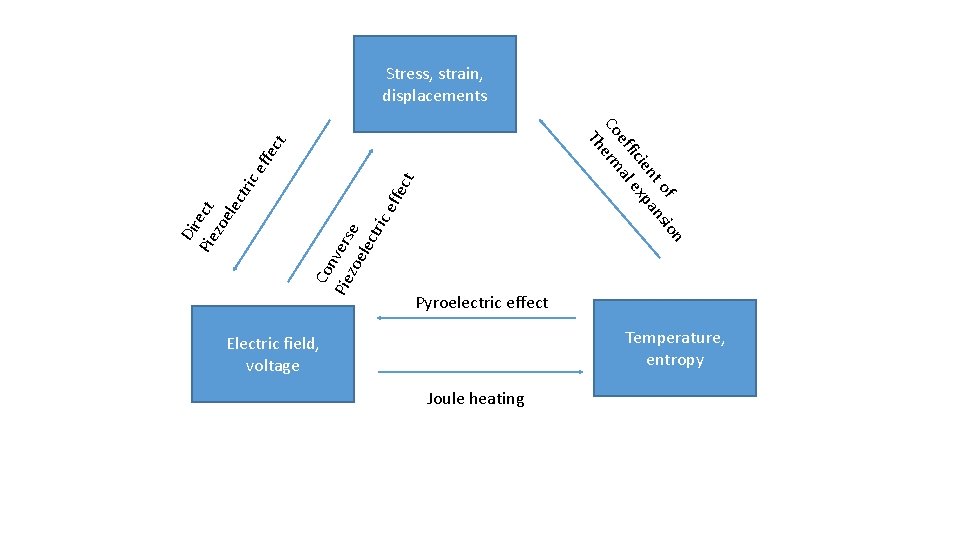
Smart Materials Definition: A smart materials can be described as a material that has a useful response to external influences or stimuli and usually convert energy between multiple physical domains Coupling effects (in context of smart materials): Change in one physical causes change in another physical domain Examples One – way coupling Thermo-mechanical coupling: Change in temperature results in change in mechanical strain Two – way coupling Electro-mechanical coupling: Coupling between electrical and mechanical domains Piezoelectric effect Electro-thermal coupling (Pyroelectric effect): Coupling between electrical and thermal domains
Stress, strain, displacements ffe c ic e Co Pie nvers zoe e lec tr n Dir Pie ect zo ele c tri c t eff ec t f io t o ans ien xp fic e ef al Co erm Th Pyroelectric effect Temperature, entropy Electric field, voltage Joule heating
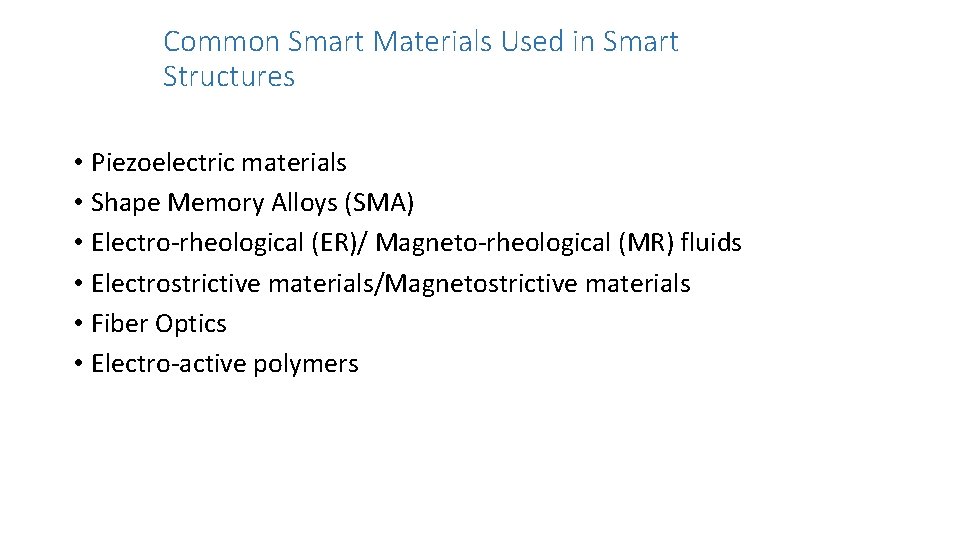
Common Smart Materials Used in Smart Structures • Piezoelectric materials • Shape Memory Alloys (SMA) • Electro-rheological (ER)/ Magneto-rheological (MR) fluids • Electrostrictive materials/Magnetostrictive materials • Fiber Optics • Electro-active polymers
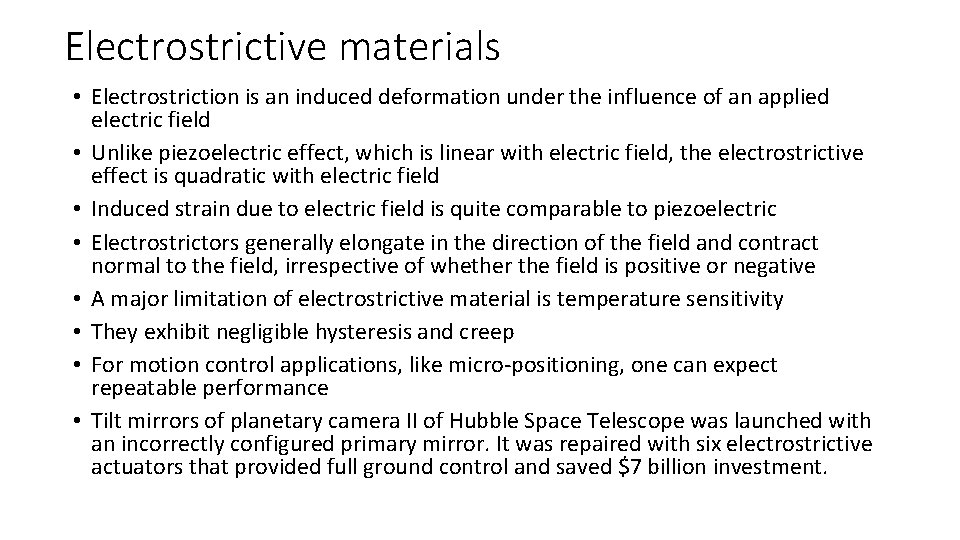
Electrostrictive materials • Electrostriction is an induced deformation under the influence of an applied electric field • Unlike piezoelectric effect, which is linear with electric field, the electrostrictive effect is quadratic with electric field • Induced strain due to electric field is quite comparable to piezoelectric • Electrostrictors generally elongate in the direction of the field and contract normal to the field, irrespective of whether the field is positive or negative • A major limitation of electrostrictive material is temperature sensitivity • They exhibit negligible hysteresis and creep • For motion control applications, like micro-positioning, one can expect repeatable performance • Tilt mirrors of planetary camera II of Hubble Space Telescope was launched with an incorrectly configured primary mirror. It was repaired with six electrostrictive actuators that provided full ground control and saved $7 billion investment.
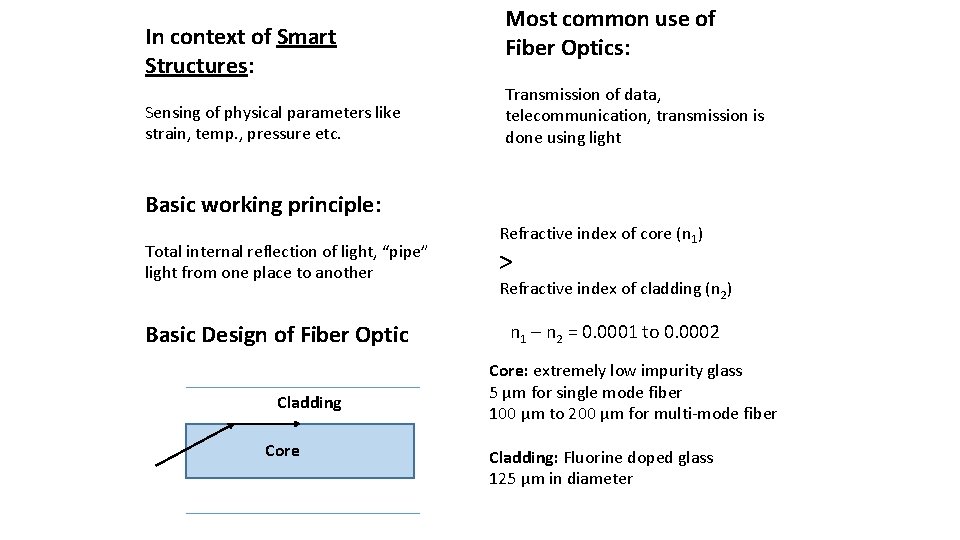
In context of Smart Structures: Sensing of physical parameters like strain, temp. , pressure etc. Most common use of Fiber Optics: Transmission of data, telecommunication, transmission is done using light Basic working principle: Total internal reflection of light, “pipe” light from one place to another Basic Design of Fiber Optic Cladding Core Refractive index of core (n 1) > Refractive index of cladding (n 2) n 1 – n 2 = 0. 0001 to 0. 0002 Core: extremely low impurity glass 5 μm for single mode fiber 100 μm to 200 μm for multi-mode fiber Cladding: Fluorine doped glass 125 μm in diameter
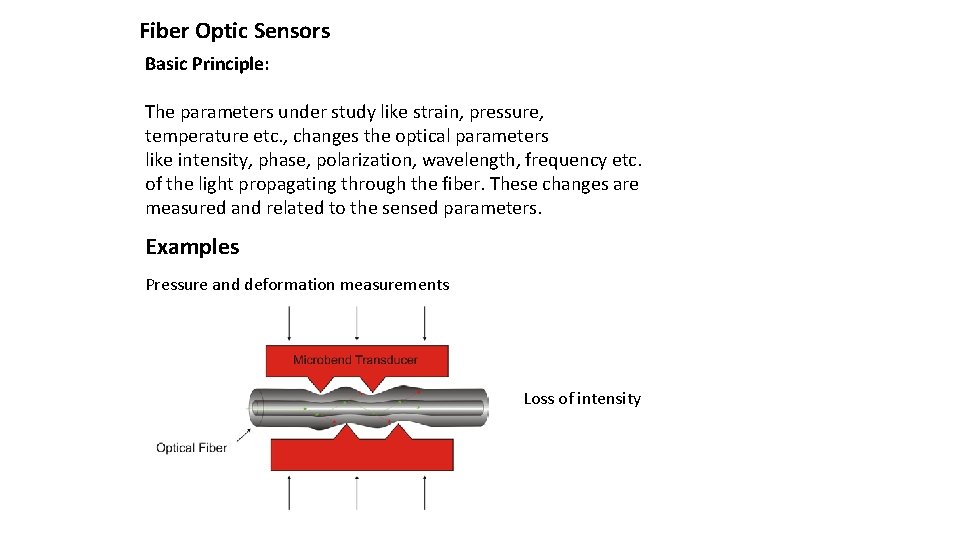
Fiber Optic Sensors Basic Principle: The parameters under study like strain, pressure, temperature etc. , changes the optical parameters like intensity, phase, polarization, wavelength, frequency etc. of the light propagating through the fiber. These changes are measured and related to the sensed parameters. Examples Pressure and deformation measurements Loss of intensity
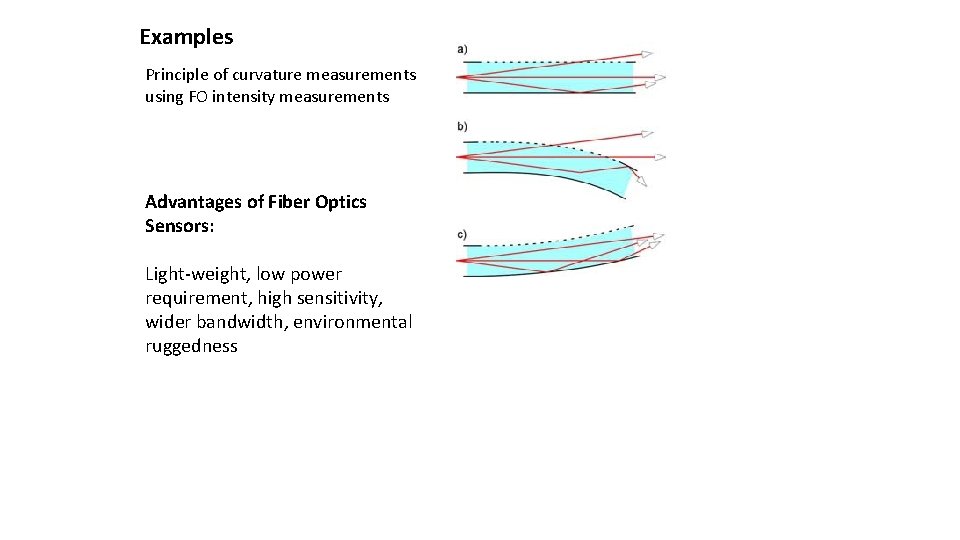
Examples Principle of curvature measurements using FO intensity measurements Advantages of Fiber Optics Sensors: Light-weight, low power requirement, high sensitivity, wider bandwidth, environmental ruggedness