
Smart Strategies for Reducing Intermittent FMLA Leave Feb
Smart Strategies for Reducing Intermittent FMLA Leave Feb. 28, 2012
About the Speaker • Jim Brown Senior Vice President, FMLASource®, Inc. , a Com. Psych® company JD and MBA from The University of Iowa Works directly with companies of all sizes to address FMLA issues Helps large corporations process, manage, track and reduce employee absences – Com. Psych is the largest EAP and provides work-life, behavioral health and absence management services – –
Agenda • • Overview Challenges of Intermittent Leave Great Moments in FMLA Risks Involved Strategies for Reducing Intermittent Leave FMLASource® Case Studies Key Considerations for Outsourcing Q&A
Overview • FMLA is now the #1 headache for HR, according to Employers Resource Assoc. 2011 poll of 8, 000 HR pros • The top question was: How do we control intermittent leave? • Intermittent leave continues to increase: among new customers, FMLASource® has seen a 10 percent increase in leave in 2010 alone
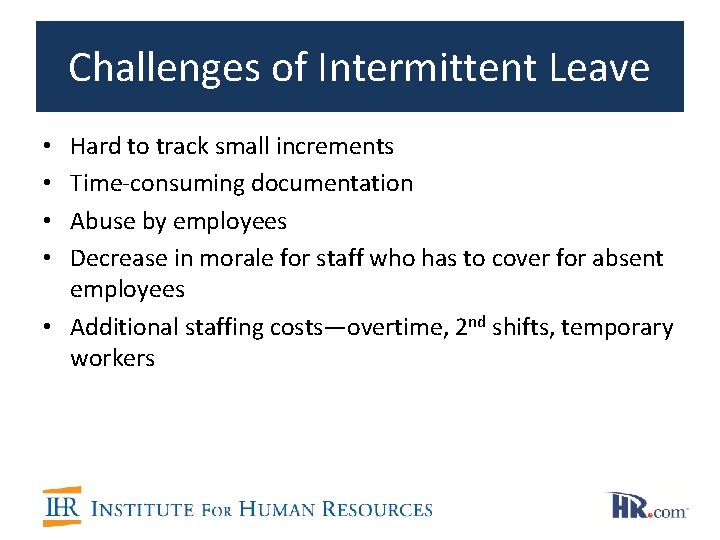
Challenges of Intermittent Leave Hard to track small increments Time-consuming documentation Abuse by employees Decrease in morale for staff who has to cover for absent employees • Additional staffing costs—overtime, 2 nd shifts, temporary workers • •
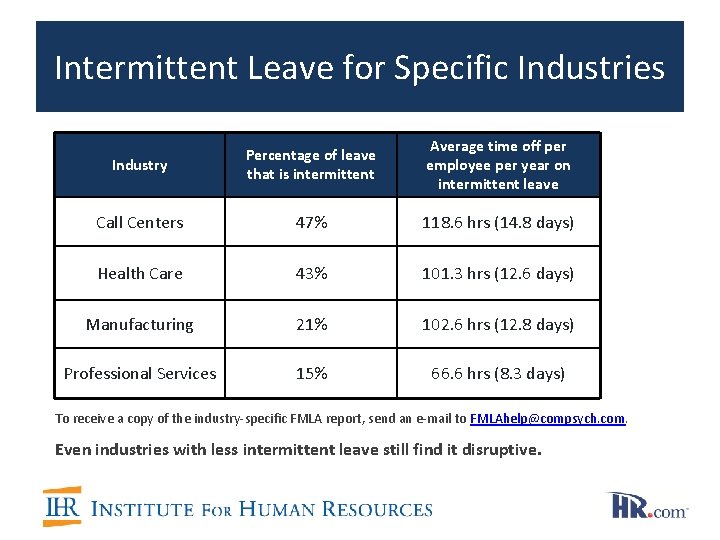
Intermittent Leave for Specific Industries Industry Percentage of leave that is intermittent Average time off per employee per year on intermittent leave Call Centers 47% 118. 6 hrs (14. 8 days) Health Care 43% 101. 3 hrs (12. 6 days) Manufacturing 21% 102. 6 hrs (12. 8 days) Professional Services 15% 66. 6 hrs (8. 3 days) To receive a copy of the industry-specific FMLA report, send an e-mail to FMLAhelp@compsych. com. Even industries with less intermittent leave still find it disruptive.
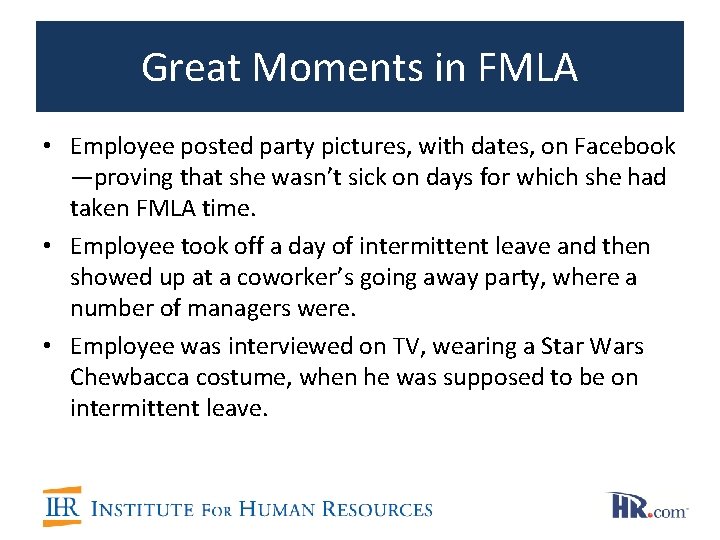
Great Moments in FMLA • Employee posted party pictures, with dates, on Facebook —proving that she wasn’t sick on days for which she had taken FMLA time. • Employee took off a day of intermittent leave and then showed up at a coworker’s going away party, where a number of managers were. • Employee was interviewed on TV, wearing a Star Wars Chewbacca costume, when he was supposed to be on intermittent leave.
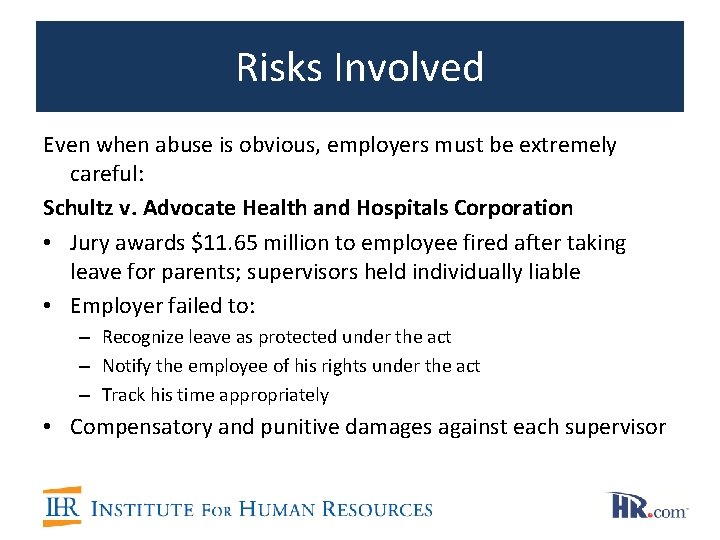
Risks Involved Even when abuse is obvious, employers must be extremely careful: Schultz v. Advocate Health and Hospitals Corporation • Jury awards $11. 65 million to employee fired after taking leave for parents; supervisors held individually liable • Employer failed to: – Recognize leave as protected under the act – Notify the employee of his rights under the act – Track his time appropriately • Compensatory and punitive damages against each supervisor
Risks Involved SBC v. State of California • Settlement awards more than $6 million in fines/penalties for employee class action suit on FMLA/CFRA, including intermittent leave • Employer: – Asked inappropriate questions on medical certification form – Denied eligibility and penalized/terminated employees
Risks Involved California Department of Fair Employment and Housing v. Verizon • Settlement awards more than $6 million in fines/penalties for employee class action suit on FMLA/CFRA, including intermittent leave • Employer: – Denied eligibility for numerous health-related claims and birth of child claims – Penalized/terminated employees
Strategies for Reducing Intermittent Leave • Set a foundation: – – First, make sure the employee is eligible Inform employees of ramifications of falsifying forms Require full medical certification form—set deadline In medical certification form, ask for frequency expected, episodes and treatment (how often see doctor, how often the condition is expected to flare up)
Strategies for Reducing Intermittent Leave • Ongoing due diligence: – Look for patterns (i. e. , employee is always out on Mondays or Fridays; frequent tardiness) – Monitor frequency and compare with what doctor prescribed – Listen to coworker complaints or reports, but be careful – Recertify—can do so anytime the validity of the leave is in question; ask doctor: employee reported appointments on these dates and flare ups on these dates, is that consistent with your diagnosis? – Get second opinion
FMLASource® Case Studies • Case Study #1 – – Health care facility with 2, 500 employees Inordinate amount of intermittent leave Tightened FMLA processes, more consistent documentation Reduced intermittent leave from 61 percent to 38 percent
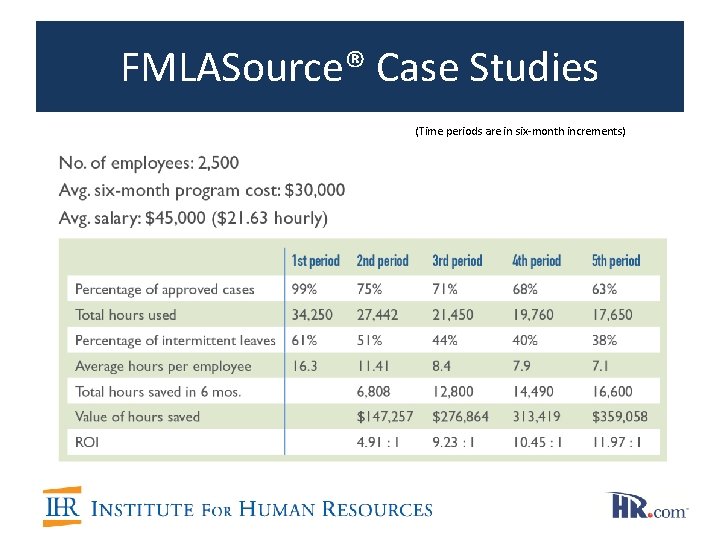
FMLASource® Case Studies (Time periods are in six-month increments)
FMLASource® Case Studies • Case Study #2 – – Small manufacturing company Intermittent leave at 34 hours per employee Closer review of leave requests; analysis of repeat requests with legal oversight In 3 years, cut the total FMLA hours in half
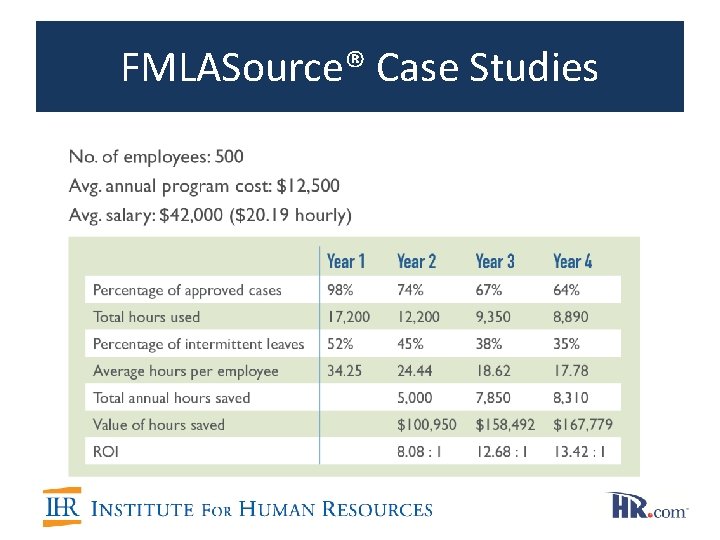
FMLASource® Case Studies
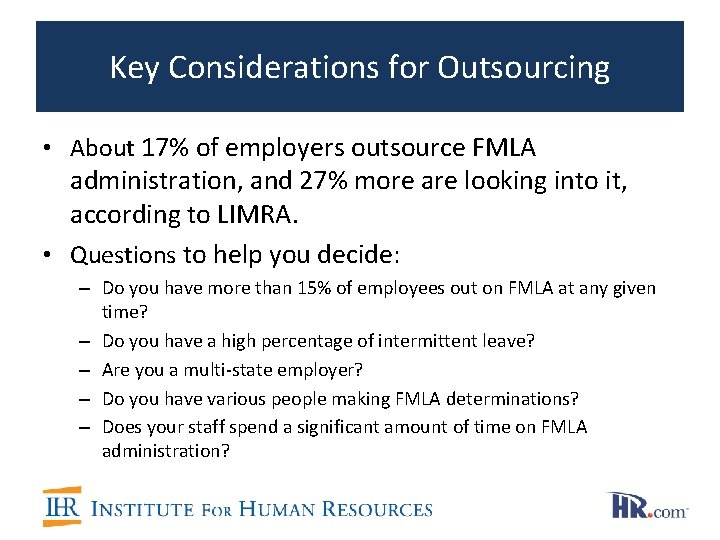
Key Considerations for Outsourcing • About 17% of employers outsource FMLA administration, and 27% more are looking into it, according to LIMRA. • Questions to help you decide: – Do you have more than 15% of employees out on FMLA at any given time? – Do you have a high percentage of intermittent leave? – Are you a multi-state employer? – Do you have various people making FMLA determinations? – Does your staff spend a significant amount of time on FMLA administration?
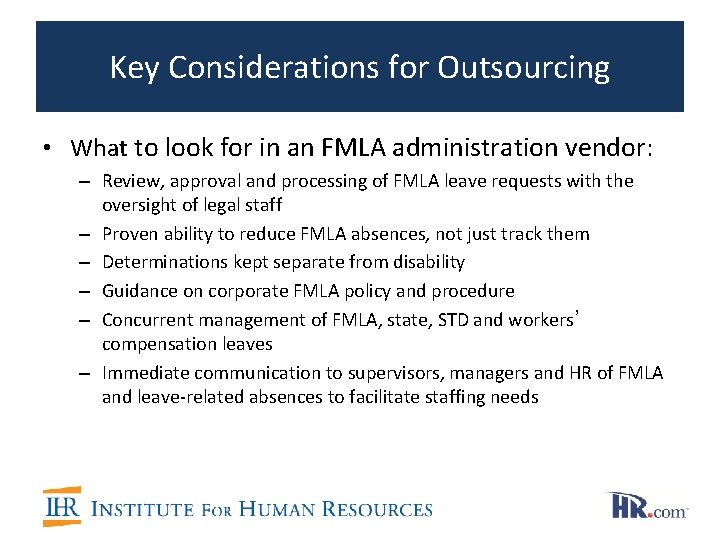
Key Considerations for Outsourcing • What to look for in an FMLA administration vendor: – Review, approval and processing of FMLA leave requests with the oversight of legal staff – Proven ability to reduce FMLA absences, not just track them – Determinations kept separate from disability – Guidance on corporate FMLA policy and procedure – Concurrent management of FMLA, state, STD and workers’ compensation leaves – Immediate communication to supervisors, managers and HR of FMLA and leave-related absences to facilitate staffing needs
Conclusion • Set a foundation—use the tools the act provides • Inform employees of penalties for falsifying claims • Due diligence—continue to ask questions • Don’t rule outsourcing—can pay for itself in terms of reduced absences and staff time
Q&A • Jim Brown, FMLASource® FMLAhelp@compsych. com 800. 851. 1714
- Slides: 20