
Smart Snacks in School June 2015 Adrienne Davenport










- Slides: 67
Smart Snacks in School June 2015 Adrienne Davenport, MPH, RDN School Nutrition Programs Office of School Support Services Michigan Department of Education
Objectives Smart Snacks in School Session Participants will: • Understand requirements of Smart Snacks in School standards (including recent updates) • Begin to determine how the Smart Snacks guidelines affect their work areas • Gain familiarity with available tools, particularly Smart Snacks in School Calculator • Gain knowledge of where and whom to contact for more information and issue reporting
Background Why Smart Snacks in School guidelines are happening now
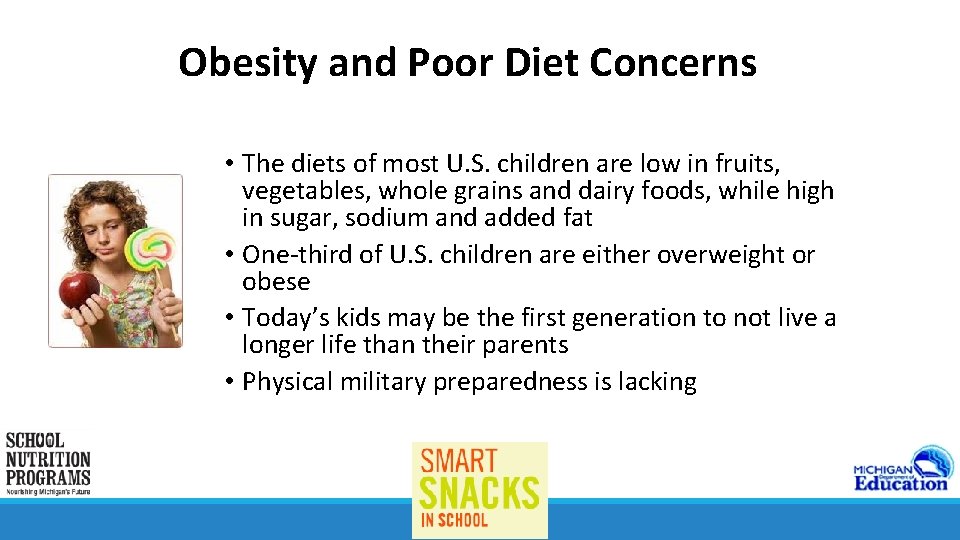
Obesity and Poor Diet Concerns • The diets of most U. S. children are low in fruits, vegetables, whole grains and dairy foods, while high in sugar, sodium and added fat • One-third of U. S. children are either overweight or obese • Today’s kids may be the first generation to not live a longer life than their parents • Physical military preparedness is lacking
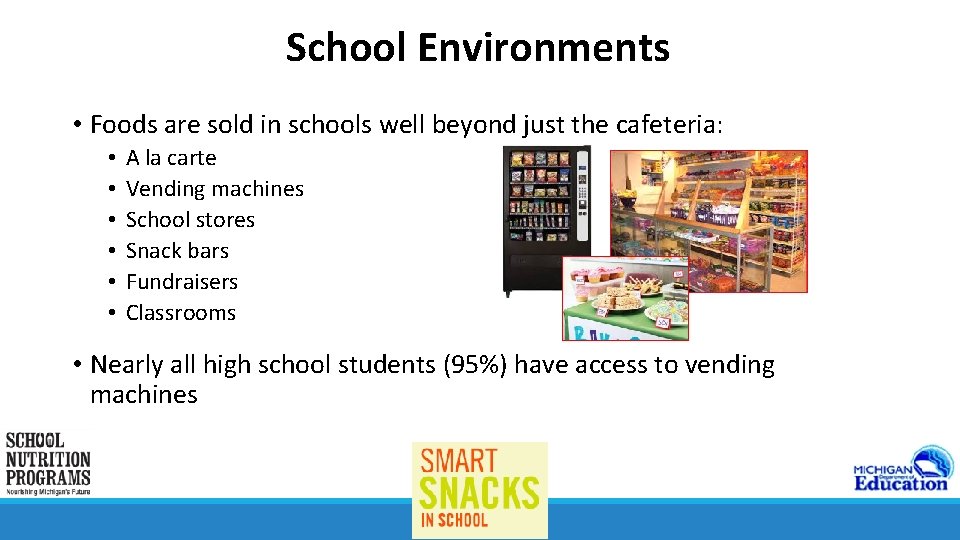
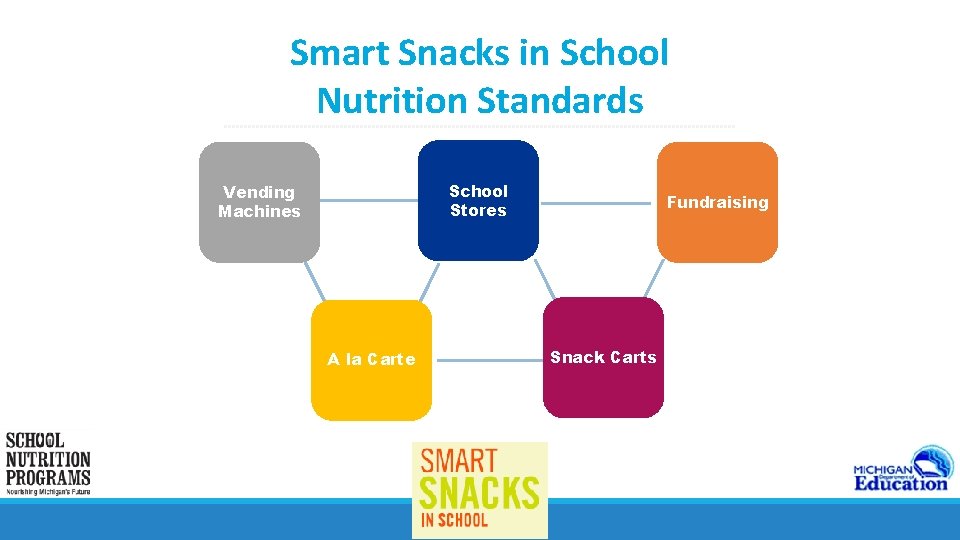
School Environments • Foods are sold in schools well beyond just the cafeteria: • • • A la carte Vending machines School stores Snack bars Fundraisers Classrooms • Nearly all high school students (95%) have access to vending machines
Restricting “Unhealthy” Foods in Schools Linked to Lower Obesity • Some research shows that policies that restrict unhealthy foods in schools are linked to fewer overweight and obese students, and lower Body Mass Index (BMI) (Robert Wood Johnson Foundation) • Students’ BMIs increase when schools allow sales of “junk food”
Foods Sold in Schools - Status • The Healthy, Hunger-Free Kids Act of 2010 directs USDA to set nutrition standards throughout the school campus to complement gains made in school meals and address the quality of foods sold outside of SNP and CACFP • Foods/beverages offered outside of School Nutrition Programs (SNP) and the Child and Adult Care Food Program (CACFP) often lack healthy options • Most students consume at least one snack food at school a day
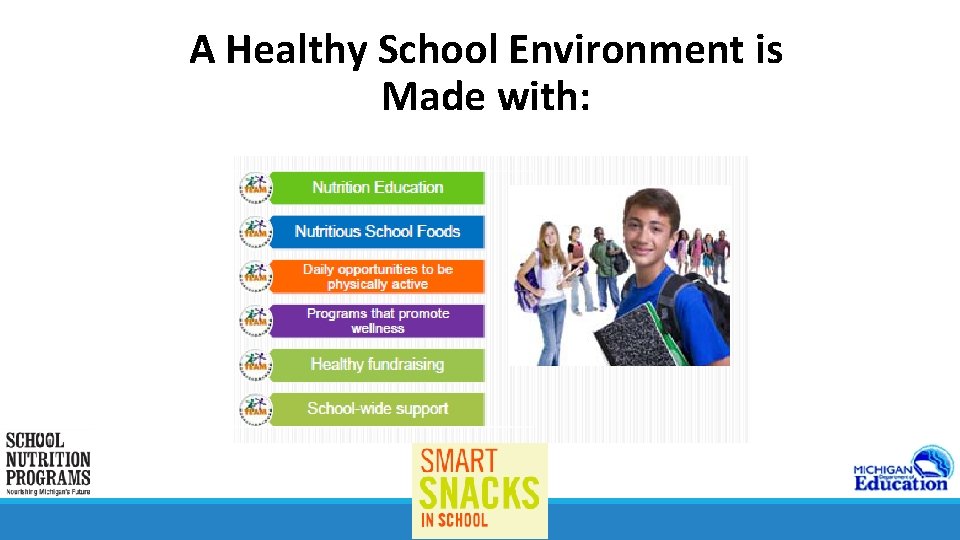
A Healthy School Environment is Made with:
Smart Snacks Guidelines Requirements became effective July 1, 2014 for all schools participating in the National School Lunch Program (NSLP) Michigan exemptions effective 2015 -16 school year
What Groups Are Subject to Smart Snack Standards? • Students in schools that participate in the National School Lunch Program (NSLP) • Only students are impacted • All grade levels
What Groups Are Subject to Smart Snack Standards? • Rules do not affect: • Foods or beverages sold more than 30 minutes after the end of the school day • Foods or beverages sold only to teachers or adults (such as in teacher’s lounges) • Pre-approved Michigan fundraiser exemptions
What Foods Are Affected by Smart Snacks standards? • Foods sold by schools participating in School Nutrition Programs during the school day are subject to Smart Snack standards • Meals served through federal programs (NSLP, SBP, Afterschool Snack, or CACFP) are NOT affected by these standards
What Foods Are Affected by Smart Snacks standards? • Only “competitive foods” are impacted by the standards • Competitive foods = All food and beverages sold to students on the school campus during the school day, other than those meals reimbursable under school meal programs.
When And Where Do The Standards Apply? • When and where standards apply in school: • School day = The period from midnight prior to the school day until 30 minutes after the end of the official school day. • School campus = All areas of the property under the jurisdiction of the school that are accessible to students during the school day.
When And Where Do The Standards Apply? • Active Dates: • Overall USDA-mandated Smart Snacks standards took effect July 1, 2014 (2014 -15 SY) • Michigan exemption standards take effect on July 1, 2015 (2015 -16 SY)
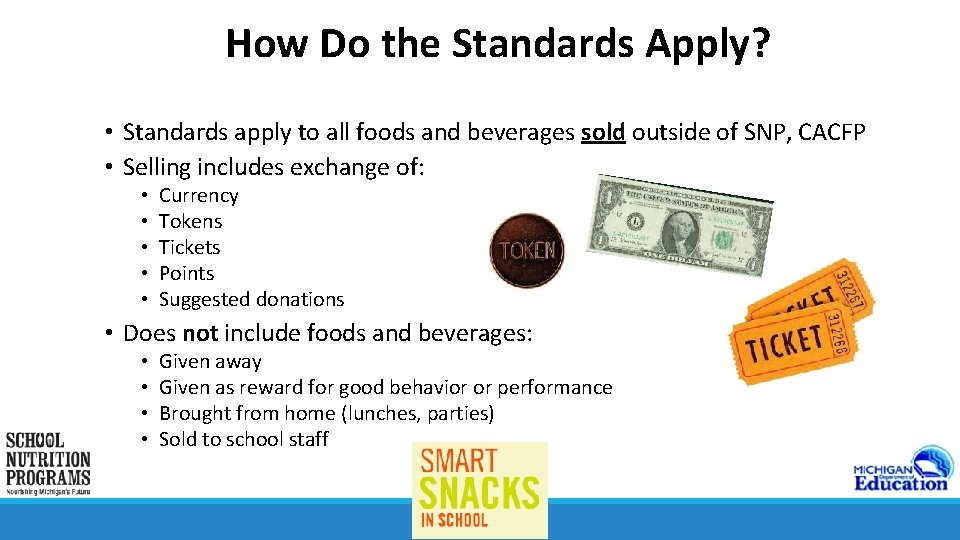
How Do the Standards Apply? • Standards apply to all foods and beverages sold outside of SNP, CACFP • Selling includes exchange of: • • • Currency Tokens Tickets Points Suggested donations • Does not include foods and beverages: • • Given away Given as reward for good behavior or performance Brought from home (lunches, parties) Sold to school staff
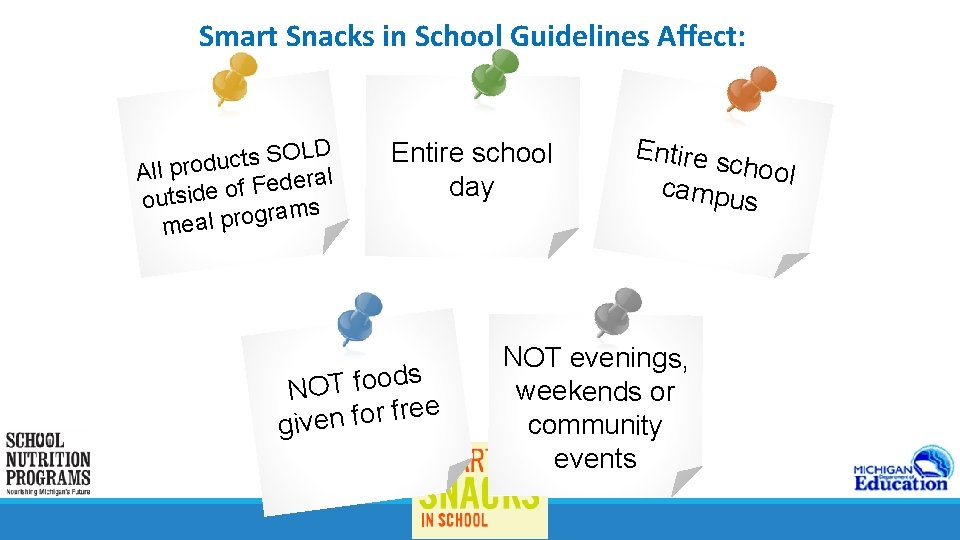
Smart Snacks in School Guidelines Affect: OLD S s t c u d All pro ral e d e F f o outside s m a r g o r p meal Entire school day s d o o f T NO e e r f r o f given Entire s chool campu s NOT evenings, weekends or community events
Smart Snacks in School Nutrition Standards School Stores Vending Machines A la Carte Fundraising Snack Carts
Culinary Programs and Smart Snacks • Program curricula or foods sold to adults not affected • Foods sold to students during the school day must meet Smart Snacks standards (unless sale is an approved exemption) • Schools can expand by selling to restaurants, offcampus and after school events • Opportunity to challenge students to develop recipes that meet standards
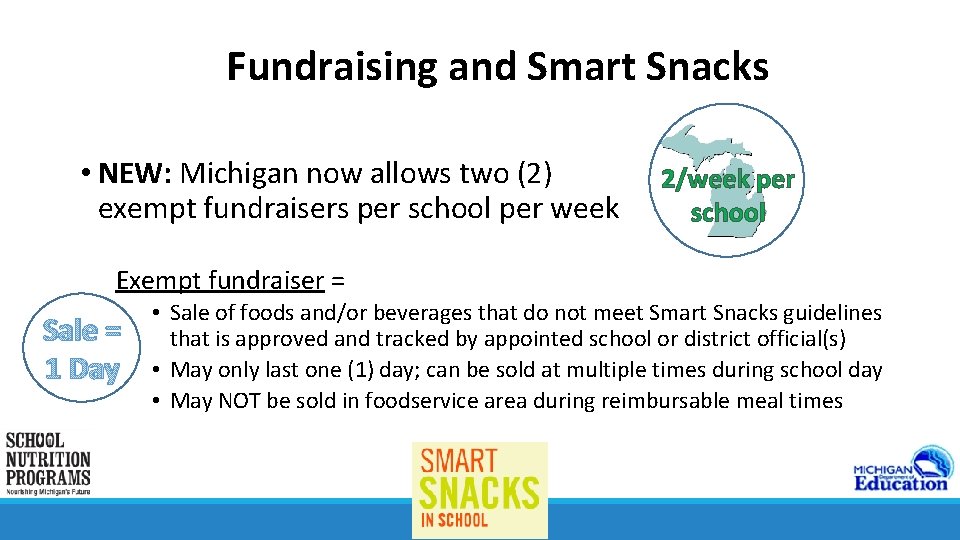
Fundraising and Smart Snacks • NEW: Michigan now allows two (2) exempt fundraisers per school per week 2/week per school Exempt fundraiser = Sale = 1 Day • Sale of foods and/or beverages that do not meet Smart Snacks guidelines that is approved and tracked by appointed school or district official(s) • May only last one (1) day; can be sold at multiple times during school day • May NOT be sold in foodservice area during reimbursable meal times
Fundraising and Smart Snacks • These school fundraisers are still allowed during the school day without time or location limit: • Selling foods that meet the guidelines • Selling non-food items • Bulk foods or foods sold during the school day not intended to be eaten immediately are exempt (e. g. , cookie dough, pizza kits, Girl Scout Cookies)
Smart Snacks Exemptions • NEW: Michigan now allows two (2) exempt fundraisers per school per week • The following items do not need to meet Smart Snacks standards: • All fresh, frozen and canned fruits and vegetables without any additives aside from water • Water • Sugar-free chewing gum (no other candy exempt) • Entrees from reimbursable breakfast or lunch meals if served in same portion size same day or day after they appear on menu • Additional foods and beverages are exempt; see upcoming slides
A Few Key Changes: Specific Items • These items are now allowed and/or do not need to meet the Smart Snacks standards: • Sugar-free chewing gum (no other candy allowed) • Diet soda (high school only) • Caffeine – coffee, tea, etc. (high school only)
A Few Key Changes: Specific Scenarios • These scenarios are now allowed and/or do not need to meet the Smart Snacks standards: • Foods sold in foodservice area during meal service times that meet Smart Snacks guidelines (exempt fundraisers not included) • Preordered bulk items not meant for immediate consumption during school day (e. g. , Girl Scout Cookies, frozen pizza kits) – as long as not sold in food service areas during mealtimes • Classroom and school parties – as long as money is collected before event • Food exchanges for good behavior or performance
Location, Location • The foodservice area during mealtimes is off-limits for: • Exempt fundraisers that do not meet the guidelines • Foods that otherwise do not meet Smart Snacks guidelines • Foods and beverages that meet the guidelines may be sold in the foodservice area during mealtimes, unless the Local Wellness Policy prohibits these sales
Hot Seat Question 1 TRUE OR FALSE: Meals served through Federal programs (NSLP, SBP, Afterschool Snack, CACFP) are NOT affected by the Smart Snacks standards.
Hot Seat Question 2 MULTIPLE CHOICE: Which of the following scenarios would count as selling a competitive food (and Smart Snacks standards would apply)? A. A pizza party that collected students’ money the day before B. Requiring suggested donations in exchange for treats at a bake sale C. Teachers rewarding students for good test scores with a piece of candy D. Selling Girl Scout Cookies in the hallway during afternoon break
Hot Seat Question 3 TRUE OR FALSE: With Michigan’s new fundraiser exemption allowance, an approved food fundraiser that does not meet the Smart Snacks standards may be sold in the food service area during meal times (e. g. , bake sales may be carried out in the cafeteria during lunchtime).
Final Hot Seat Question MULTIPLE CHOICE: Which of the following is not allowed based on current Smart Snacks guidance? A. B. C. D. Coffee and diet soda (high school only) Sugar-free chewing gum Fat-free licorice Candy given as a teacher reward for good performance on a test
Foods and Smart Snacks • Foods must meet both General Standards and Nutrient Standards • Broken down into “snack” and “entrée” foods, each with different limits • Use Smart Snacks Calculator to determine if food meets or not • Beverages must meet Beverage Standards • Broken down into elementary, middle and high school limits • Use Smart Snacks Calculator to determine if a beverage meets or not • Some exemptions apply (see upcoming slides)
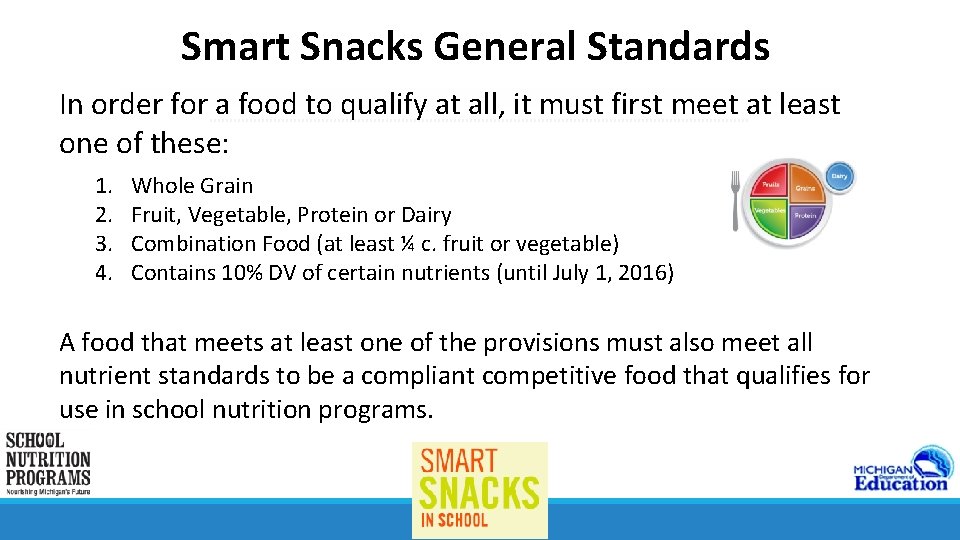
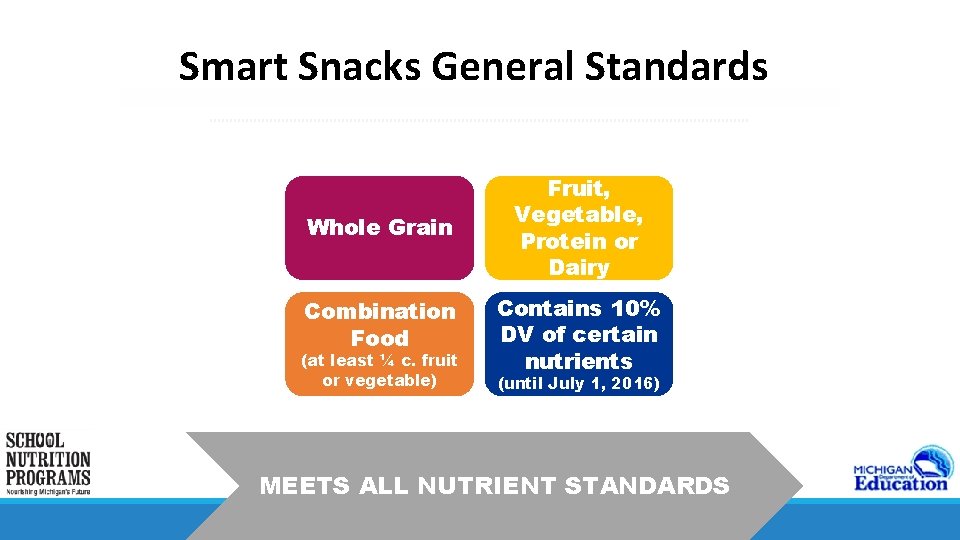
Smart Snacks General Standards a In order for a food to qualify at all, it must first meet at least one of these: 1. 2. 3. 4. Whole Grain Fruit, Vegetable, Protein or Dairy Combination Food (at least ¼ c. fruit or vegetable) Contains 10% DV of certain nutrients (until July 1, 2016) A food that meets at least one of the provisions must also meet all nutrient standards to be a compliant competitive food that qualifies for use in school nutrition programs.
a Smart Snacks General Standards Whole Grain Fruit, Vegetable, Protein or Dairy Combination Food Contains 10% DV of certain nutrients (at least ¼ c. fruit or vegetable) (until July 1, 2016) MEETS ALL NUTRIENT STANDARDS
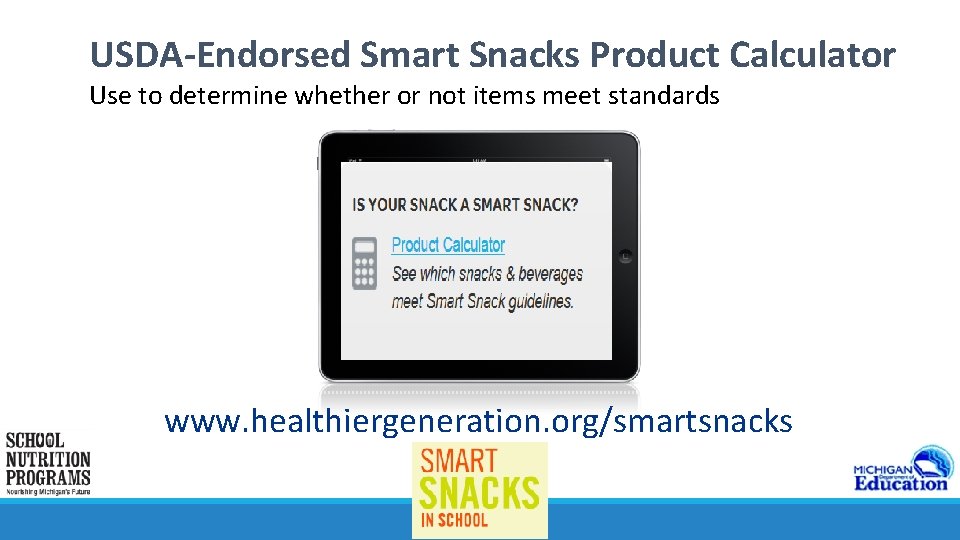
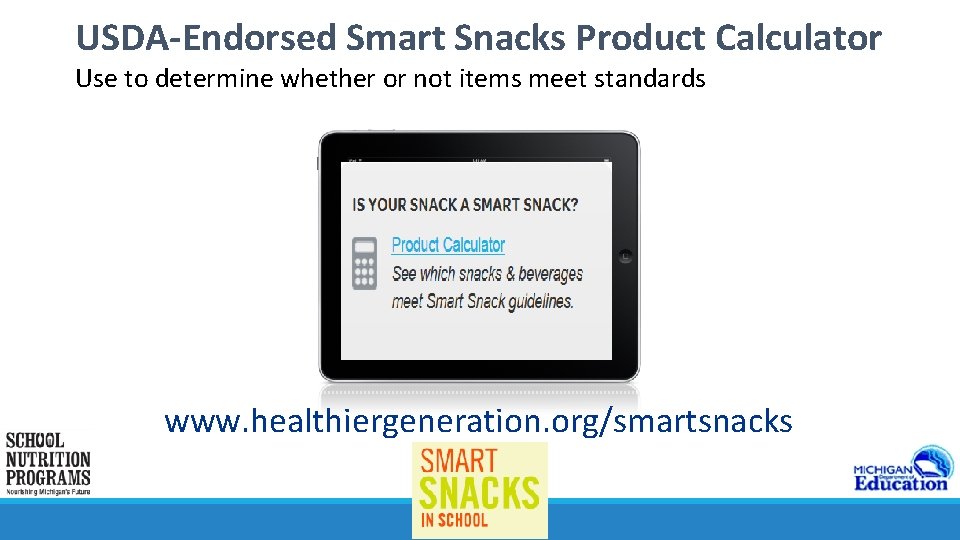
USDA-Endorsed Smart Snacks Product Calculator Use to determine whether or not items meet standards www. healthiergeneration. org/smartsnacks
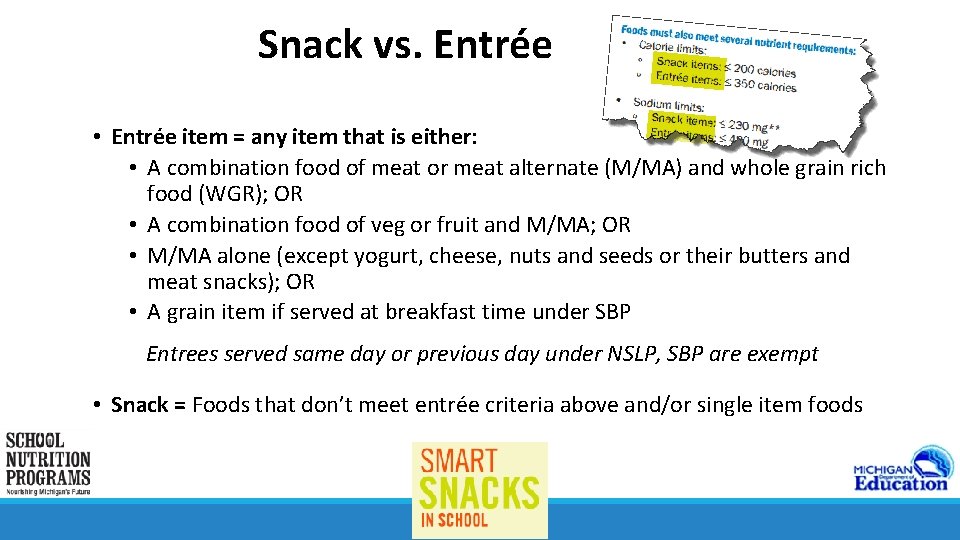
Snack vs. Entrée • Entrée item = any item that is either: • A combination food of meat or meat alternate (M/MA) and whole grain rich food (WGR); OR • A combination food of veg or fruit and M/MA; OR • M/MA alone (except yogurt, cheese, nuts and seeds or their butters and meat snacks); OR • A grain item if served at breakfast time under SBP Entrees served same day or previous day under NSLP, SBP are exempt • Snack = Foods that don’t meet entrée criteria above and/or single item foods
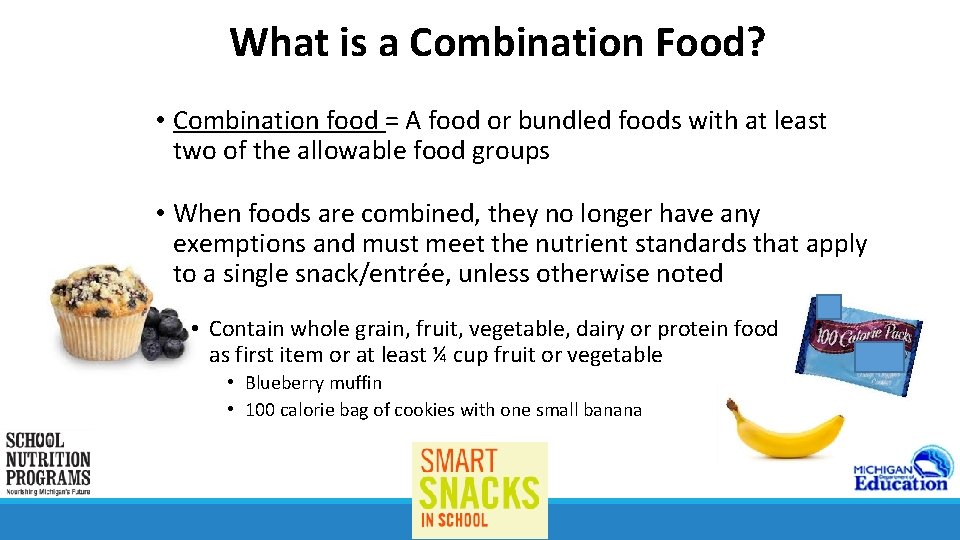
What is a Combination Food? • Combination food = A food or bundled foods with at least two of the allowable food groups • When foods are combined, they no longer have any exemptions and must meet the nutrient standards that apply to a single snack/entrée, unless otherwise noted • Contain whole grain, fruit, vegetable, dairy or protein food as first item or at least ¼ cup fruit or vegetable • Blueberry muffin • 100 calorie bag of cookies with one small banana
Smart Snacks Nutrient Standards • Total Fat • Saturated Fat • Trans Fat • Sodium • Calories • Total Sugar
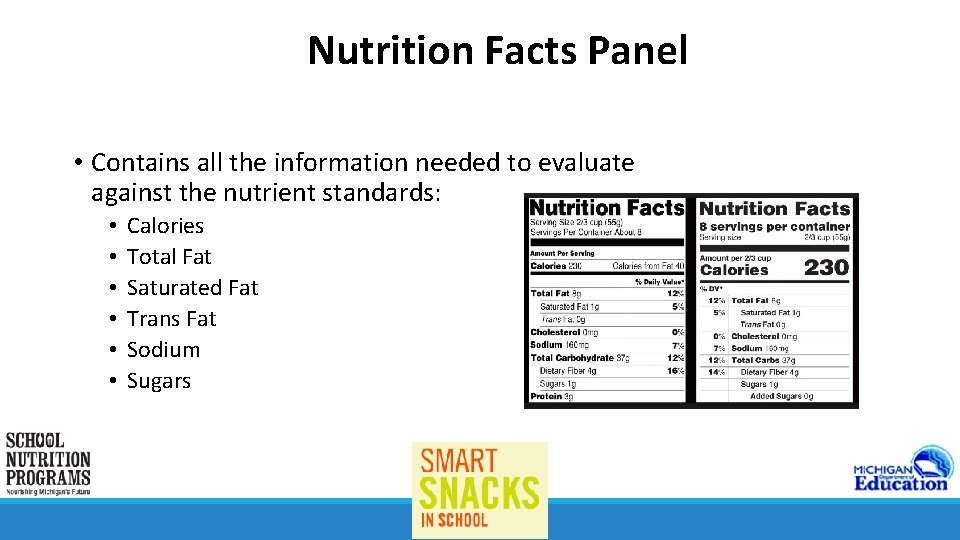
Nutrition Facts Panel • Contains all the information needed to evaluate against the nutrient standards: • • • Calories Total Fat Saturated Fat Trans Fat Sodium Sugars
Total Fat • ≤ 35% of total calories from fat per item as packaged/served • Exemptions from this limit: • • • Reduced-fat cheese Part-skim mozzarella Nuts and seeds Nut and seed butters Dried fruit with nuts or seeds, no added: • Fat • Nutritive sweeteners (sweetener OK if added for palatability only) • Seafood with no added fat
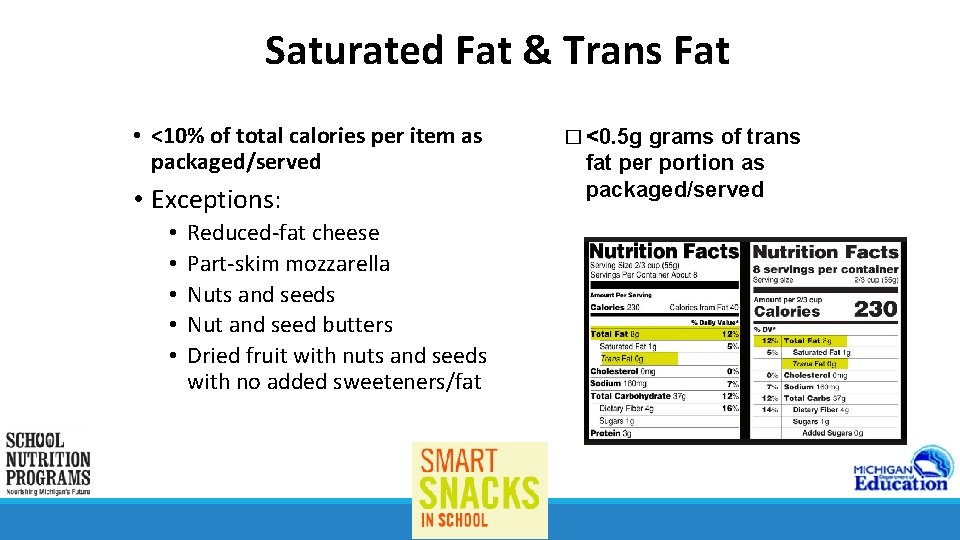
Saturated Fat & Trans Fat • <10% of total calories per item as packaged/served • Exceptions: • • • Reduced-fat cheese Part-skim mozzarella Nuts and seeds Nut and seed butters Dried fruit with nuts and seeds with no added sweeteners/fat � <0. 5 g grams of trans fat per portion as packaged/served
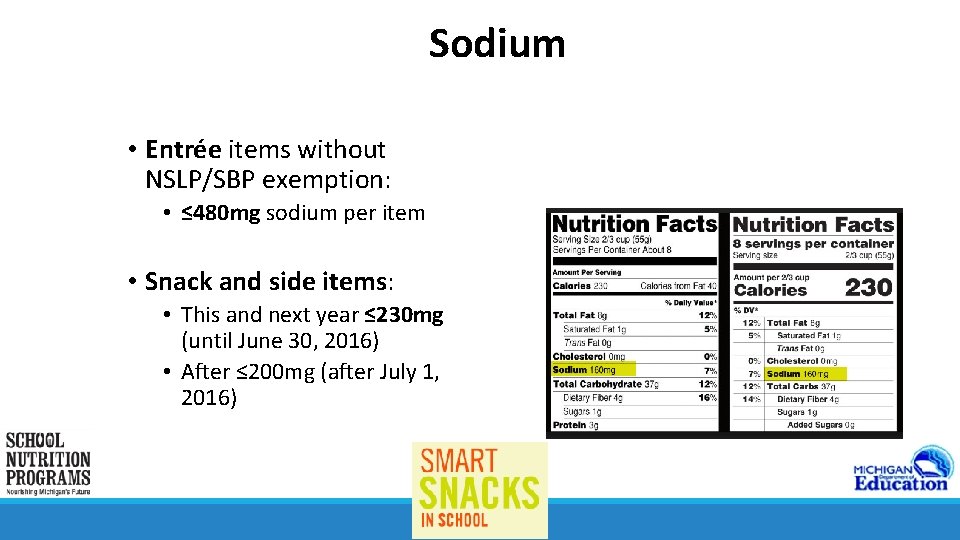
Sodium • Entrée items without NSLP/SBP exemption: • ≤ 480 mg sodium per item • Snack and side items: • This and next year ≤ 230 mg (until June 30, 2016) • After ≤ 200 mg (after July 1, 2016)
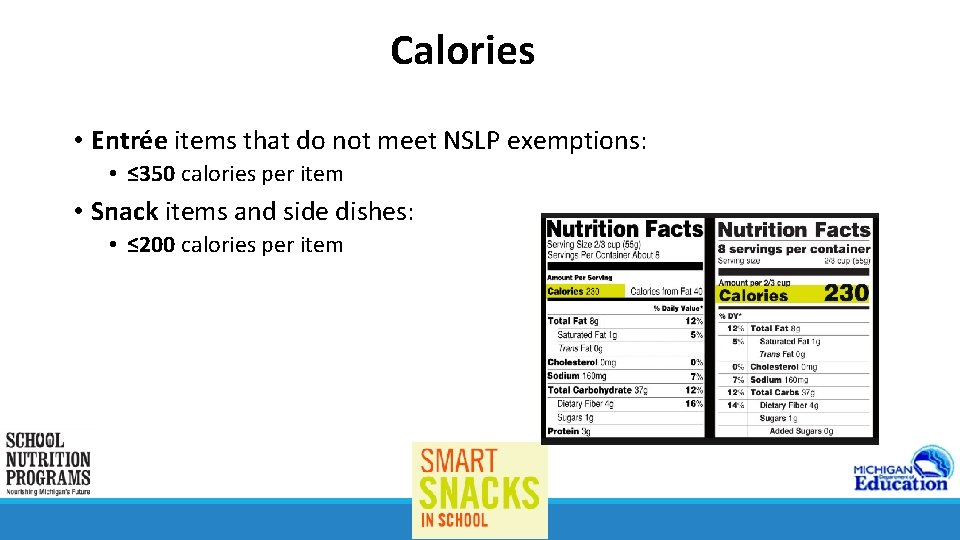
Calories • Entrée items that do not meet NSLP exemptions: • ≤ 350 calories per item • Snack items and side dishes: • ≤ 200 calories per item
Sugars • ≤ 35% of total food weight from sugars per item • To calculate % sugar by weight: Take the grams of sugar on Nutrition Facts Panel and divide that by the total weight of the food in grams. Multiply this by 100. The result is % sugar by weight. Do not round the result.
NSLP/SBP Entrée Exemption • Entrees that are part of the NSLP/SBP can be sold the day of and the next operating day after service. They are exempt from Smart Snacks standards during this time period • Entrees must be sold in same portion as offered in the School Nutrition Programs • Side dishes sold as competitive foods must meet all standards • Grain-only breakfast entrees now allowed
Dried Fruit: Sugar Exemption • Some dried fruit needs added sugar for processing or palatability; this is OK • Exempt from the sugar requirement: • Dried cranberries • Dried tart cherries • Dried blueberries
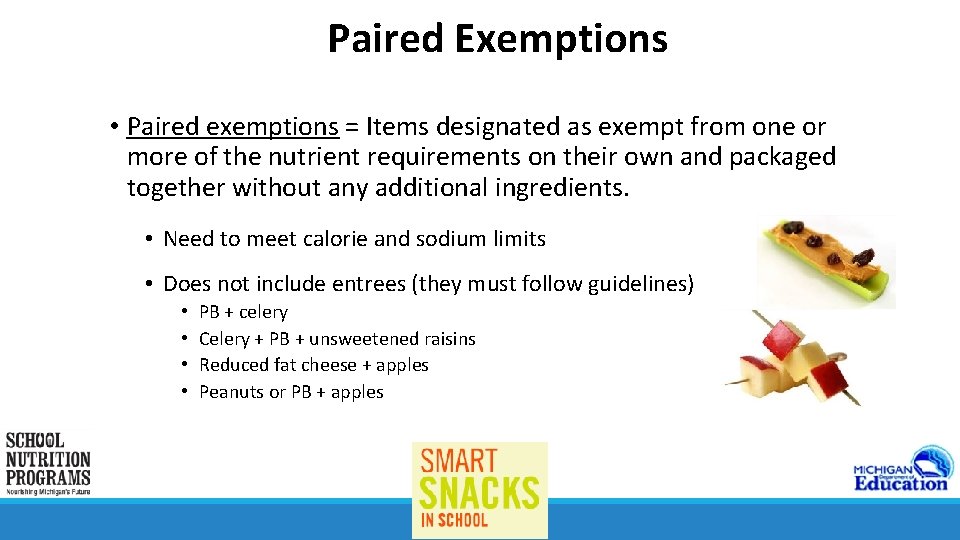
Paired Exemptions • Paired exemptions = Items designated as exempt from one or more of the nutrient requirements on their own and packaged together without any additional ingredients. • Need to meet calorie and sodium limits • Does not include entrees (they must follow guidelines) • • PB + celery Celery + PB + unsweetened raisins Reduced fat cheese + apples Peanuts or PB + apples
Smart Snacks Beverage Standards • Vary by grade level – E, M and HS • Identify specific types of beverages allowed • Include portion size limits • Allow for any size of water (either carbonated or noncarbonated)
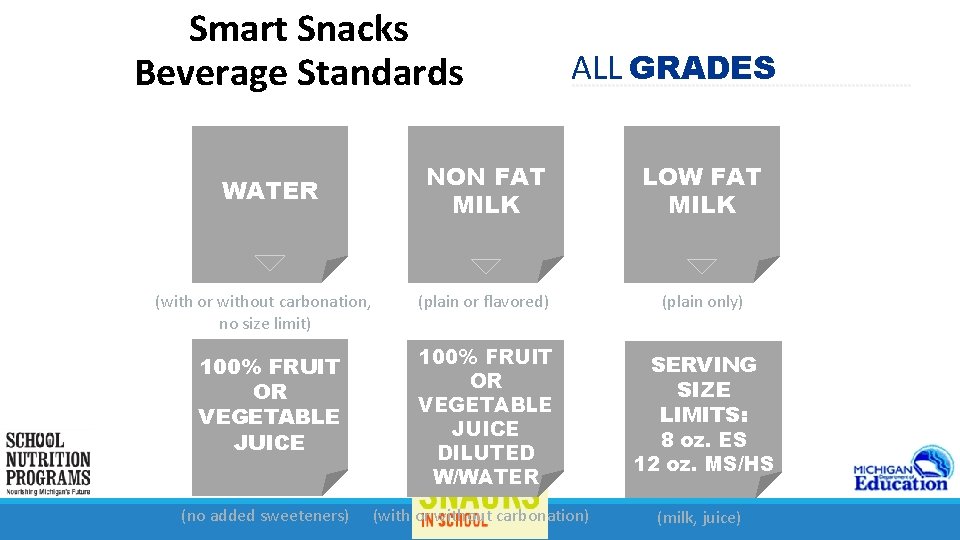
Smart Snacks Beverage Standards ALL GRADES NON FAT MILK LOW FAT MILK (plain or flavored) (plain only) 100% FRUIT OR VEGETABLE JUICE DILUTED W/WATER SERVING SIZE LIMITS: 8 oz. ES 12 oz. MS/HS (no added sweeteners) (with or without carbonation) (milk, juice) WATER (with or without carbonation, no size limit)
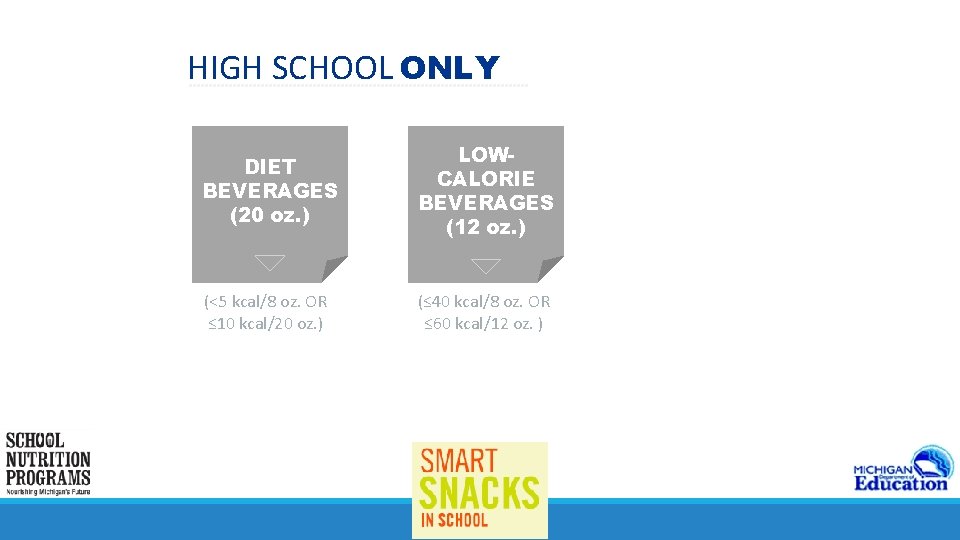
HIGH SCHOOL ONLY DIET BEVERAGES (20 oz. ) LOWCALORIE BEVERAGES (12 oz. ) (<5 kcal/8 oz. OR ≤ 10 kcal/20 oz. ) (≤ 40 kcal/8 oz. OR ≤ 60 kcal/12 oz. )
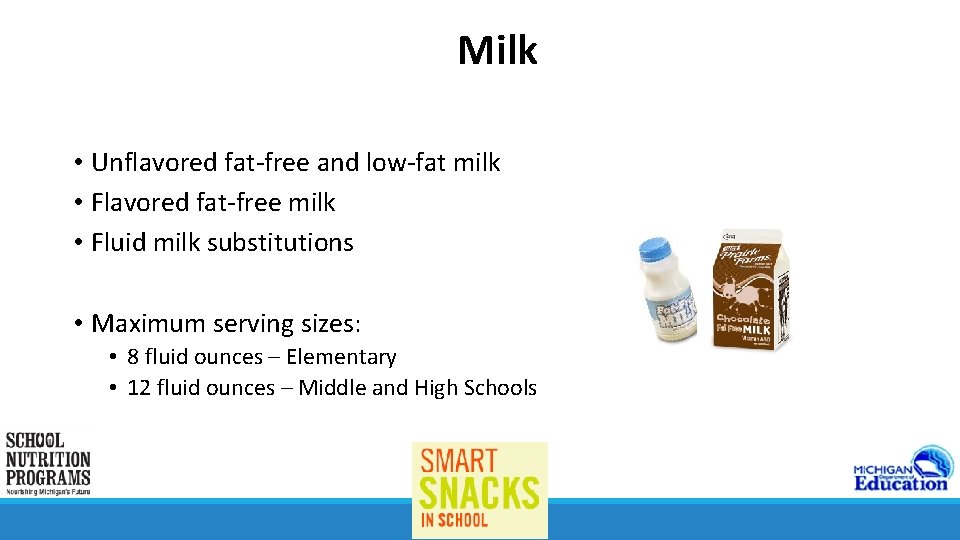
Milk • Unflavored fat-free and low-fat milk • Flavored fat-free milk • Fluid milk substitutions • Maximum serving sizes: • 8 fluid ounces – Elementary • 12 fluid ounces – Middle and High Schools
Juice The following are allowed: • 100% fruit and/or vegetable juice • 100% juice diluted with water • Either carbonated or uncarbonated • With no added sweeteners �Maximum serving sizes � 8 fluid oz – Elementary � 12 fluid oz – Middle and High Schools • “Natural flavors” allowed as long as meet portion size requirements and mixed w/ 100% juice
Lower Calorie Beverages HIGH SCHOOL ONLY • Calorie-free beverages: • Max serving size 20 fluid ounces • Calorie-free flavored water, with or without carbonation • Other “calorie-free” beverages with less than 5 calories per 8 fluid ounces, or up to 10 calories per 20 fluid ounces
Other Beverages HIGH SCHOOL ONLY • Lower-calorie beverages • Maximum serving size = 12 fluid ounces • Up to 60 calories per 12 fluid ounces; OR • Up to 40 calories per 8 fluid ounces
Caffeine HIGH SCHOOL ONLY • Elementary and Middle School = With the exception of naturallyoccurring caffeine substances, all foods and beverages must be caffeine-free • High school = No caffeine restrictions
Coffee & Tea HIGH SCHOOL ONLY • Cream and sweeteners allowed • Can limit the amount students can take • Can determine calorie and fat averages for coffee and tea “extras” – cream, milk, sugar, sweetener - based on production records (average amount used over service times) • Lattes and cappuccinos allowed • Must be made of allowable beverages (skim or low-fat milk and/or water or ice with no added flavoring) • 12 fluid ounces or less • Must meet “Other” beverage nutrient standards • ≤ 60 calories per 12 fluid ounces • ≤ 5 calories per 1 fluid ounce
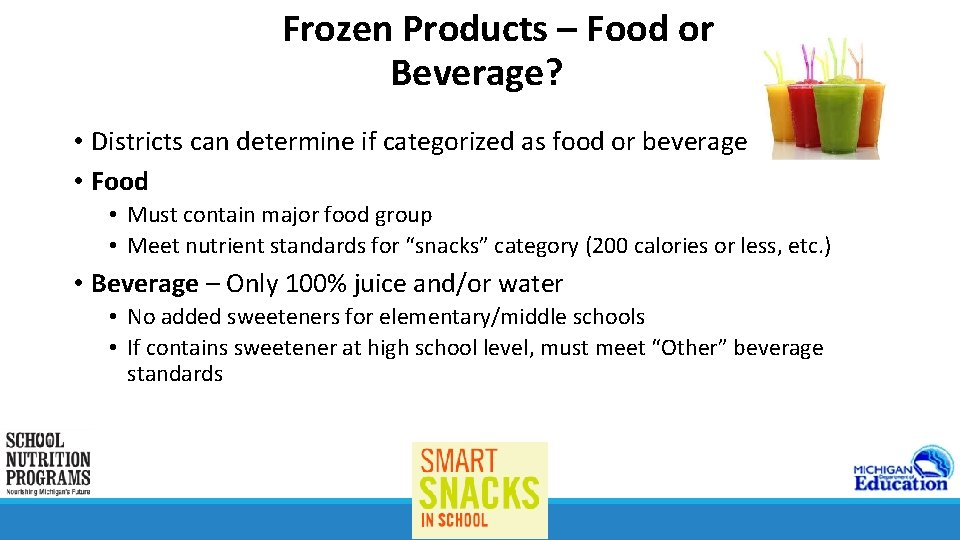
Frozen Products – Food or Beverage? • Districts can determine if categorized as food or beverage • Food • Must contain major food group • Meet nutrient standards for “snacks” category (200 calories or less, etc. ) • Beverage – Only 100% juice and/or water • No added sweeteners for elementary/middle schools • If contains sweetener at high school level, must meet “Other” beverage standards
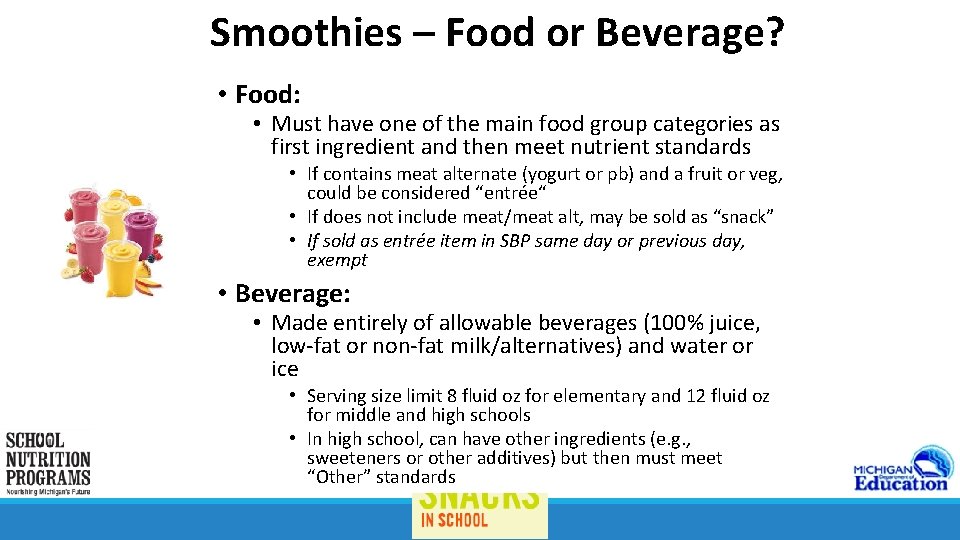
Smoothies – Food or Beverage? • Food: • Must have one of the main food group categories as first ingredient and then meet nutrient standards • If contains meat alternate (yogurt or pb) and a fruit or veg, could be considered “entrée“ • If does not include meat/meat alt, may be sold as “snack” • If sold as entrée item in SBP same day or previous day, exempt • Beverage: • Made entirely of allowable beverages (100% juice, low-fat or non-fat milk/alternatives) and water or ice • Serving size limit 8 fluid oz for elementary and 12 fluid oz for middle and high schools • In high school, can have other ingredients (e. g. , sweeteners or other additives) but then must meet “Other” standards
USDA-Endorsed Smart Snacks Product Calculator Use to determine whether or not items meet standards www. healthiergeneration. org/smartsnacks
Potable Water Requirement • Similar to what Michigan has already been looking for during Administrative Reviews • Potable drinking water should be made available without restriction during meal times where breakfast and lunch are served • Exception: When meals are served in the classroom • Examples • Nearby water fountain • Accessible water jugs, pitchers, cups of water, etc. • CDC has a new toolkit, Increasing Access to Drinking Water in Schools Toolkit
Scenario 1: What is Allowable? Your school plans to operate a school store that sells foods and drinks that do not meet Smart Snacks standards. Would this be allowable as a Michigan fundraiser exemption? If so, under what conditions?
Scenario 2: Is This Okay? A bake sale is held in the cafeteria during lunchtime.
Scenario 3: Is This Okay? This week, a bake sale is being held on Monday, Girl Scout Cookies are being sold on Wednesday and pizza that does not meet Smart Snacks standards is being sold on Friday. These are sold to students during the school day. There were no fundraisers that did not meet the Smart Snacks standards last week, so exempt fundraisers still average out to twice per week.
What Do I Do if I See Smart Snack Violations in My District? • Competitive foods will be reviewed as part of administrative review of School Nutrition Programs (once every 3 years) • Can suggest building administrator: • • Review requirements Check Local Wellness Policy Talk with superintendent Contact School Nutrition Programs team at MDE • Can contact Howard, Adrienne or other member of Michigan Dept. of Ed School Nutrition Programs team
Smart Snacks Resources • Alliance for a Healthier Generation: www. healthiergeneration. org/smartsnacks • Smart Snack Calculator • List of approved products • Other helpful info • USDA Smart Snacks site: www. fns. usda. gov/school-meals/smart-snacks-school • Summary info • Regulations and details • Michigan School Nutrition Programs Smart Snacks site: www. michigan. gov/schoolnutrition --> “Smart Snacks” • • • List of products that meet Smart Snacks guidelines Power. Point turnkey presentations Handouts Summary of standards More! • Increasing Access to Drinking Water in Schools Toolkit, from CDC: http: //www. cdc. gov/healthyyouth/npao/pdf/Water_Access_in_Schools. pdf
Healthy Fundraiser Examples • Schools are encouraged to plan fundraisers that are not foodbased • Ideas published by Alliance for a Healthier Generation and Action for Healthy Kids (see “Resources” slide) Options include: • 5 k fun run • Plant sales • Car wash • School logo clothing and swag • Holiday wreaths • Emergency kits • Haunted houses • Household supplies
Healthy Fundraiser Resources • Michigan Nutrition Standards Healthy Fundraising Ideas: http: //www. michigan. gov/documents/mdch/Healthy_Fundraisin g_369122_7. pdf • Team Nutrition List of Resources: http: //healthymeals. nal. usda. gov/local-wellness-policyresources/wellness-policy-elements/healthy-fundraising • Center for Science in the Public Interest: Successful Fundraising Stories: https: //www. cspinet. org/new/pdf/healthy-schoolfundraising-success-stories. pdf
Homework! Make Your Snacks Smarter For our final activity in this session, when you go back to your district: 1) Find our Michigan Smart Snacks page and click on at least one link 2) Point Fingers – Determine who in your district will be responsible for monitoring fundraiser exemptions and Smart Snacks compliance 3) Talk Back – Think of at least one Smart Snacks question or comment and e-mail it to: Davenport. A 1@Michigan. gov Handout will help you remember assignment and make this session more relevant
Thank you! Please contact the MDE School Nutrition Program with questions. Smart Snacks Contact: Adrienne Davenport, MPH, RDN davenporta 1@michigan. gov 517 -241 -1762 General MDE School Nutrition Contact Info: 517 -373 -3347 mde-schoolnutrition@michigan. gov