
Smart Refresh An Enhanced Memory Controller Design for


- Slides: 24
Smart Refresh: An Enhanced Memory Controller Design for Reducing Energy in Conventional and 3 D Die-Stacked DRAMs Mrinmoy Ghosh Hsien-Hsin S. Lee School of Electrical and Computer Engineering Georgia Tech
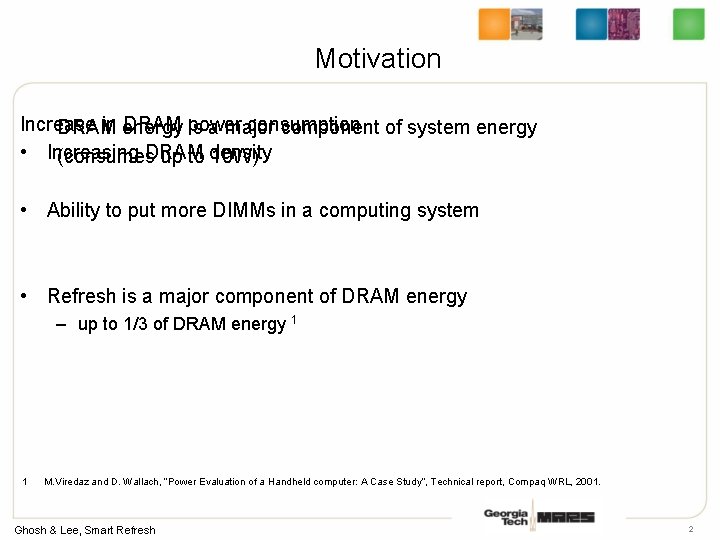
Motivation Increase in energy DRAM power consumption DRAM is a major component of system energy • Increasing DRAM (consumes up to density 10 W) • Ability to put more DIMMs in a computing system • Refresh is a major component of DRAM energy – up to 1/3 of DRAM energy 1 1 M. Viredaz and D. Wallach, “Power Evaluation of a Handheld computer: A Case Study”, Technical report, Compaq WRL, 2001. Ghosh & Lee, Smart Refresh 2
Outline • Redundancy in conventional DRAM refresh techniques • Smart Refresh architecture • Our technique for 3 D die-stacked DRAMs on processors • Results Ghosh & Lee, Smart Refresh 3
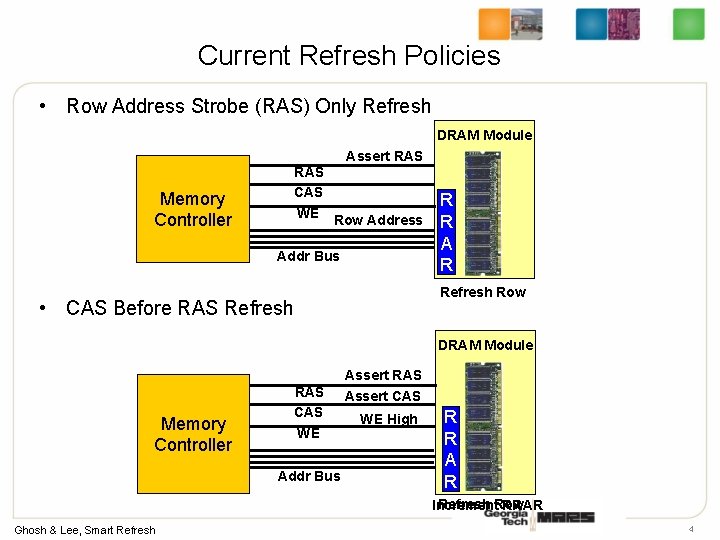
Current Refresh Policies • Row Address Strobe (RAS) Only Refresh DRAM Module Assert RAS Memory Controller RAS CAS WE Row Address Addr Bus R R A R Refresh Row • CAS Before RAS Refresh DRAM Module Assert RAS Memory Controller RAS CAS WE Addr Bus Assert CAS WE High R R A R Refresh Row Increment RRAR Ghosh & Lee, Smart Refresh 4
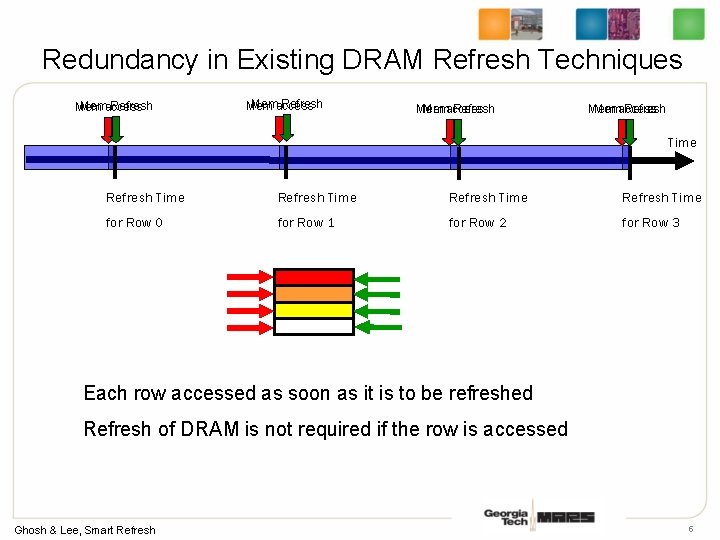
Redundancy in Existing DRAM Refresh Techniques Memaccess Refresh Mem Mem Memaccess Refresh Time Refresh Time for Row 0 for Row 1 for Row 2 for Row 3 Each row accessed as soon as it is to be refreshed Refresh of DRAM is not required if the row is accessed Ghosh & Lee, Smart Refresh 5
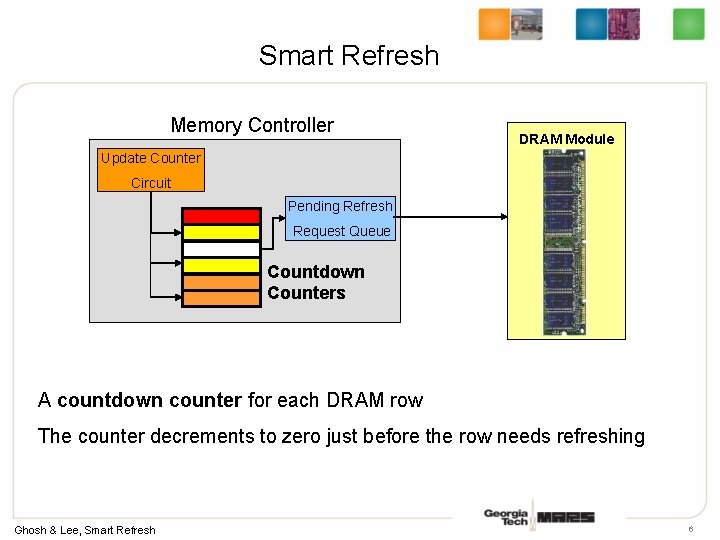
Smart Refresh Memory Controller DRAM Module Update Counter Circuit Pending Refresh Request Queue Countdown Counters A countdown counter for each DRAM row The counter decrements to zero just before the row needs refreshing Ghosh & Lee, Smart Refresh 6
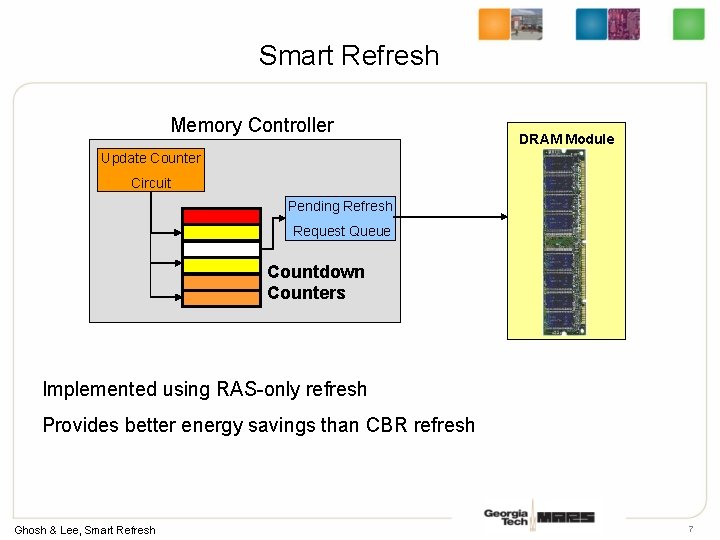
Smart Refresh Memory Controller DRAM Module Update Counter Circuit Pending Refresh Request Queue Countdown Counters Implemented using RAS-only refresh Provides better energy savings than CBR refresh Ghosh & Lee, Smart Refresh 7
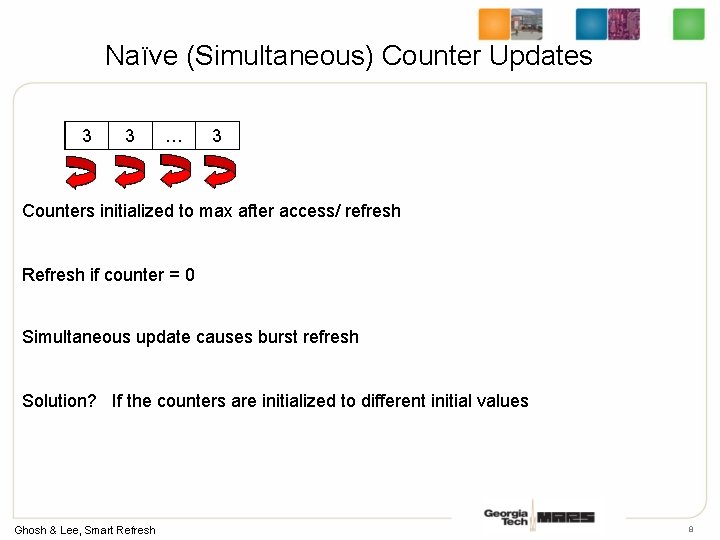
Naïve (Simultaneous) Counter Updates 3 0 1 2 3 … 3 0 1 2 Counters initialized to max after access/ refresh Refresh if counter = 0 Simultaneous update causes burst refresh Solution? If the counters are initialized to different initial values Ghosh & Lee, Smart Refresh 8
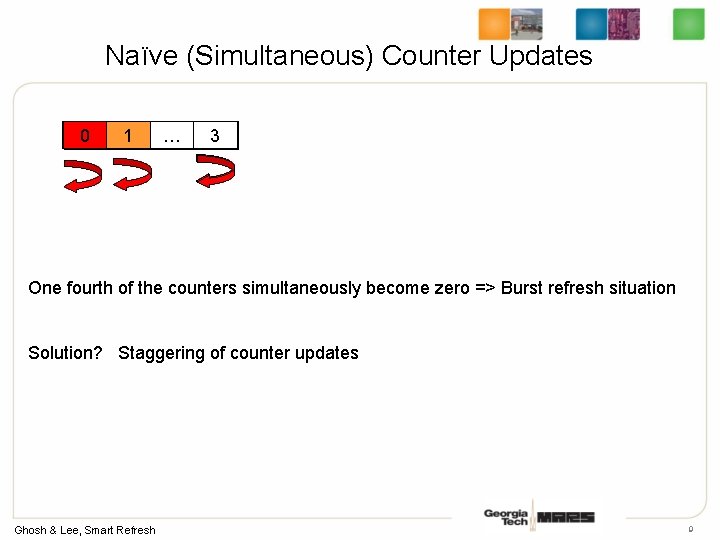
Naïve (Simultaneous) Counter Updates 2 1 0 3 3 2 1 0 … 1 0 3 2 One fourth of the counters simultaneously become zero => Burst refresh situation Solution? Staggering of counter updates Ghosh & Lee, Smart Refresh 9
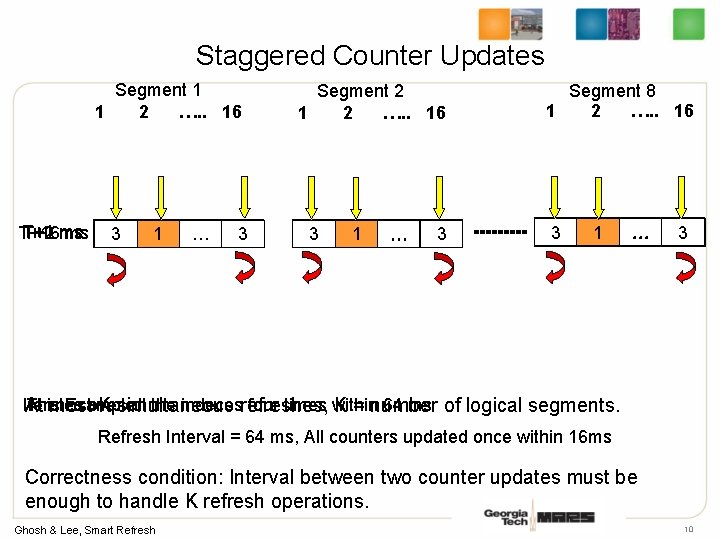
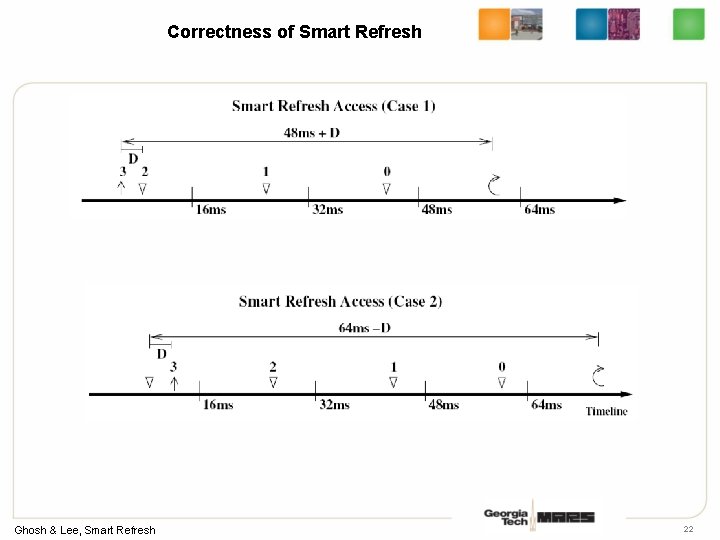
Staggered Counter Updates Segment 1 1 2 …. . 16 T+1 T+2 T+16 ms T ms 3 0 2 1 … 0 3 Segment 2 1 2 …. . 16 3 0 2 1 … 0 3 Segment 8 1 2 …. . 16 3 0 2 1 … 3 0 This Example: Iterates over all the indecesrefreshes, four times within 64 ms of logical segments. At most K simultaneous K = number Refresh Interval = 64 ms, All counters updated once within 16 ms Correctness condition: Interval between two counter updates must be enough to handle K refresh operations. Ghosh & Lee, Smart Refresh 10
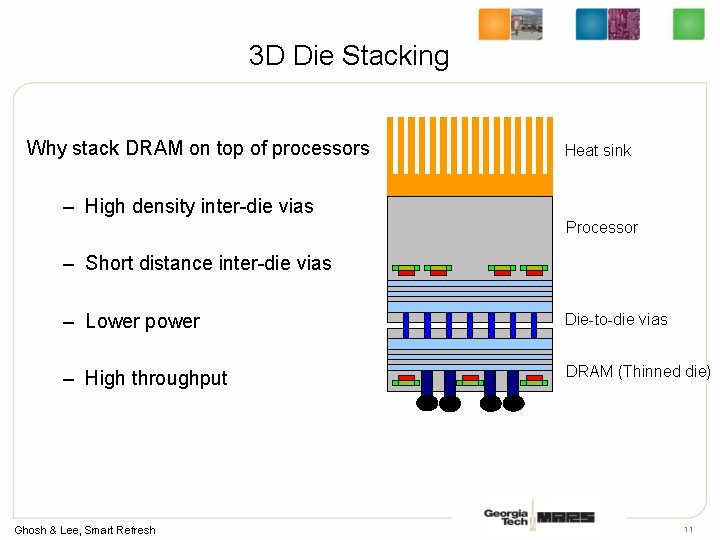
3 D Die Stacking Why stack DRAM on top of processors Heat sink – High density inter-die vias Processor – Short distance inter-die vias – Lower power Die-to-die vias – High throughput DRAM (Thinned die) Ghosh & Lee, Smart Refresh 11
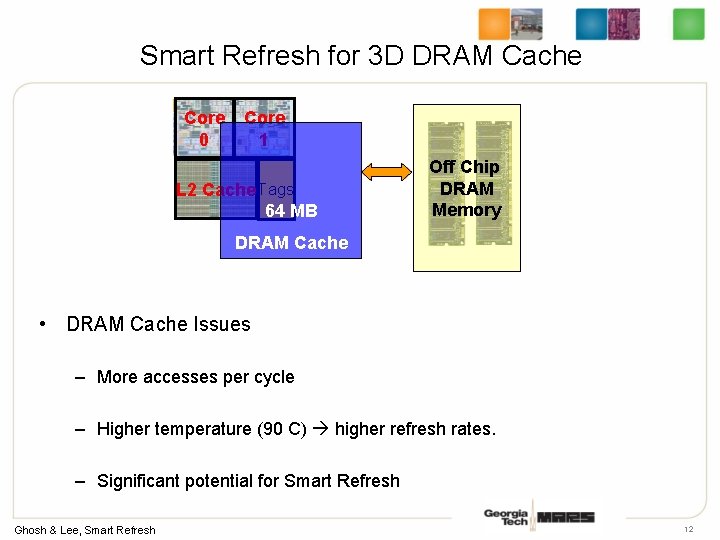
Smart Refresh for 3 D DRAM Cache Core 0 Core 1 L 2 Cache Tags 64 MB Off Chip DRAM Memory DRAM Cache • DRAM Cache Issues – More accesses per cycle – Higher temperature (90 C) higher refresh rates. – Significant potential for Smart Refresh Ghosh & Lee, Smart Refresh 12
Other Applications of Smart Refresh • Use programmable counters to keep rows off • Implement Retention-aware DRAMs [HPCA-06] • Change protocol to reduce address transmission overhead Ghosh & Lee, Smart Refresh 13
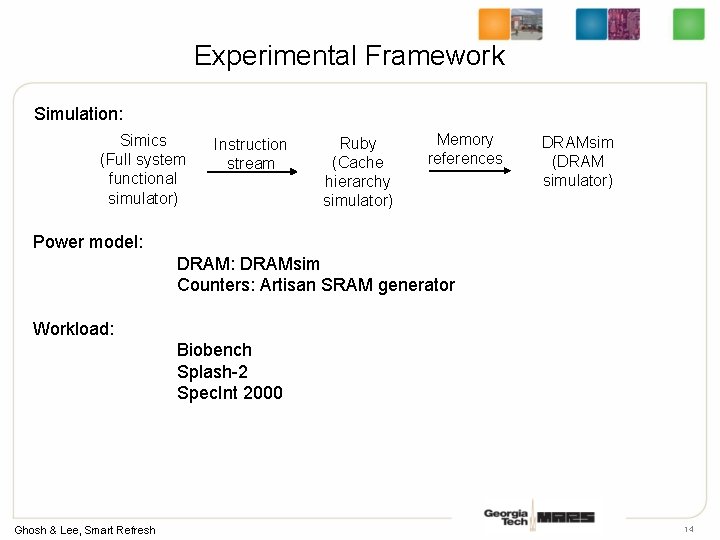
Experimental Framework Simulation: Simics (Full system functional simulator) Instruction stream Ruby (Cache hierarchy simulator) Memory references DRAMsim (DRAM simulator) Power model: DRAMsim Counters: Artisan SRAM generator Workload: Biobench Splash-2 Spec. Int 2000 Ghosh & Lee, Smart Refresh 14
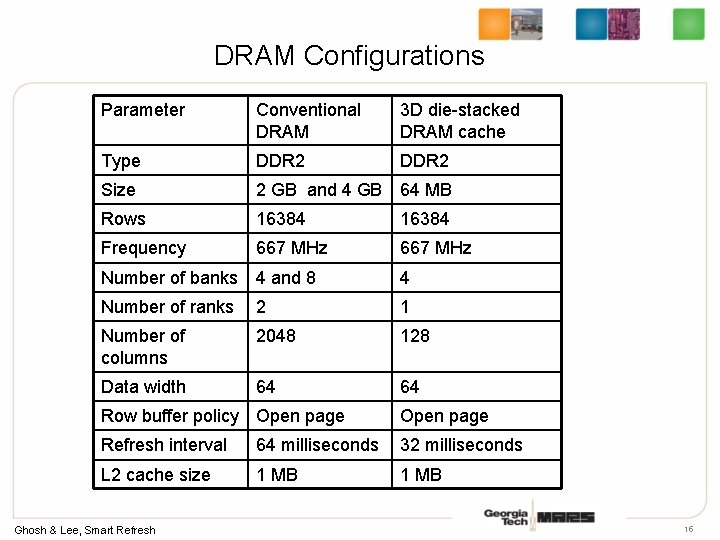
DRAM Configurations Parameter Conventional DRAM 3 D die-stacked DRAM cache Type DDR 2 Size 2 GB and 4 GB 64 MB Rows 16384 Frequency 667 MHz Number of banks 4 and 8 4 Number of ranks 2 1 Number of columns 2048 128 Data width 64 64 Row buffer policy Open page Refresh interval 64 milliseconds 32 milliseconds L 2 cache size 1 MB Ghosh & Lee, Smart Refresh 15
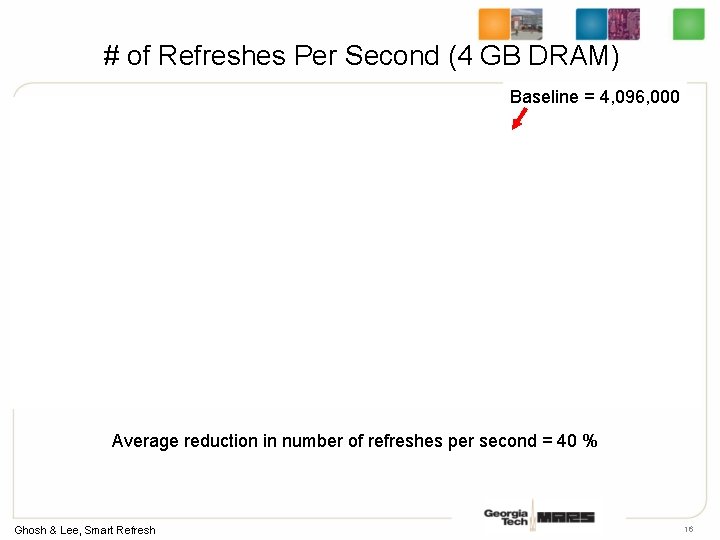
# of Refreshes Per Second (4 GB DRAM) Baseline = 4, 096, 000 Average reduction in number of refreshes per second = 40 % Ghosh & Lee, Smart Refresh 16
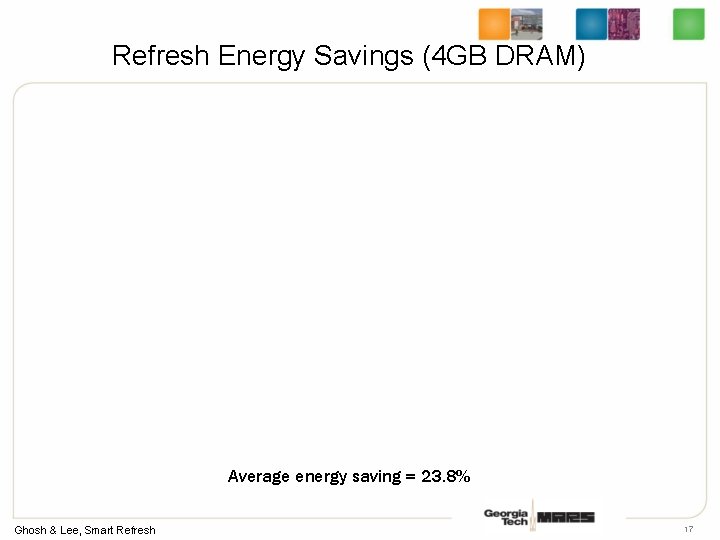
Refresh Energy Savings (4 GB DRAM) Average energy saving = 23. 8% Ghosh & Lee, Smart Refresh 17
Total DRAM Energy Savings (4 GB DRAM) Average energy saving = 9. 1% (up to 21% in perl_twolf) No performance degradation Ghosh & Lee, Smart Refresh 18
Total Energy Saving (64 MB 3 D DRAM Cache) Average energy saving = 6. 9% (up to 12% in Tiger) Ghosh & Lee, Smart Refresh 19
Conclusions • Redundant refresh operations cost significant energy • Smart refresh eliminates unnecessary periodic refreshes • 11% (up to 17%) energy savings in conventional DRAMs • 7% energy savings in 3 D DRAM caches • No performance impact Ghosh & Lee, Smart Refresh 20
Thank You! Georgia Tech ECE MARS Labs http: //arch. ece. gatech. edu
Correctness of Smart Refresh Ghosh & Lee, Smart Refresh 22
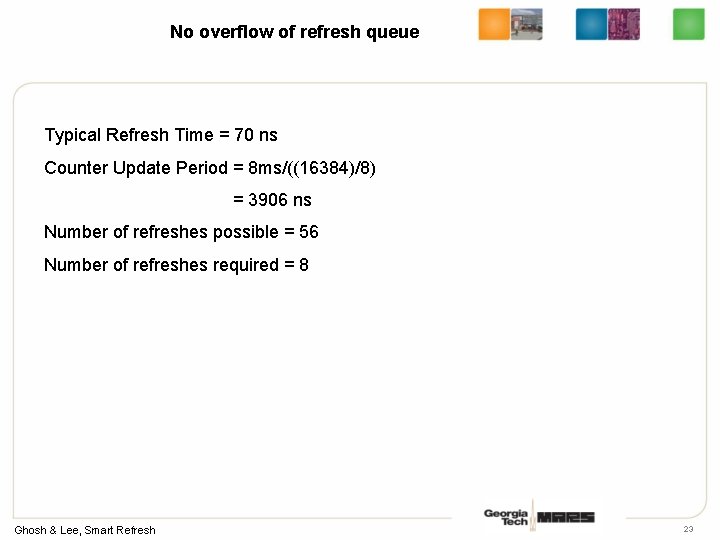
No overflow of refresh queue Typical Refresh Time = 70 ns Counter Update Period = 8 ms/((16384)/8) = 3906 ns Number of refreshes possible = 56 Number of refreshes required = 8 Ghosh & Lee, Smart Refresh 23
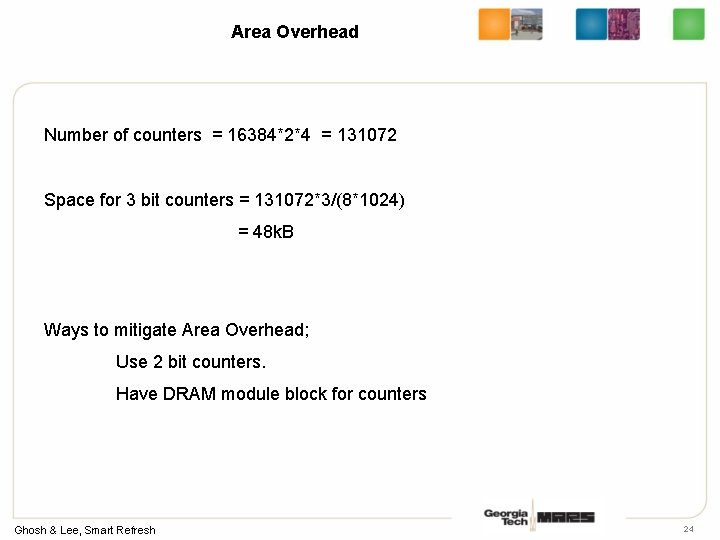
Area Overhead Number of counters = 16384*2*4 = 131072 Space for 3 bit counters = 131072*3/(8*1024) = 48 k. B Ways to mitigate Area Overhead; Use 2 bit counters. Have DRAM module block for counters Ghosh & Lee, Smart Refresh 24