
Smart Parents Safe Kids Prevention of Falls Expert

- Slides: 31
Smart Parents, Safe Kids Prevention of Falls Expert Presenter: Michelle Parker Program Specialist and Safe Kids Inland Empire Coordinator, Loma Linda University Medical Center and Hospital
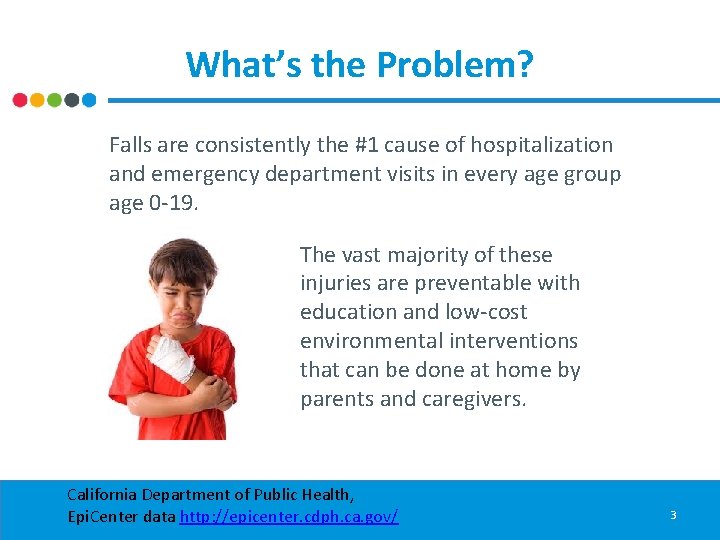
What’s the Problem? Falls are consistently the #1 cause of hospitalization and emergency department visits in every age group age 0 -19. The vast majority of these injuries are preventable with education and low-cost environmental interventions that can be done at home by parents and caregivers. California Department of Public Health, Epi. Center data http: //epicenter. cdph. ca. gov/ 3
Television and Furniture Tip-Over Safety Right click to view video. 4
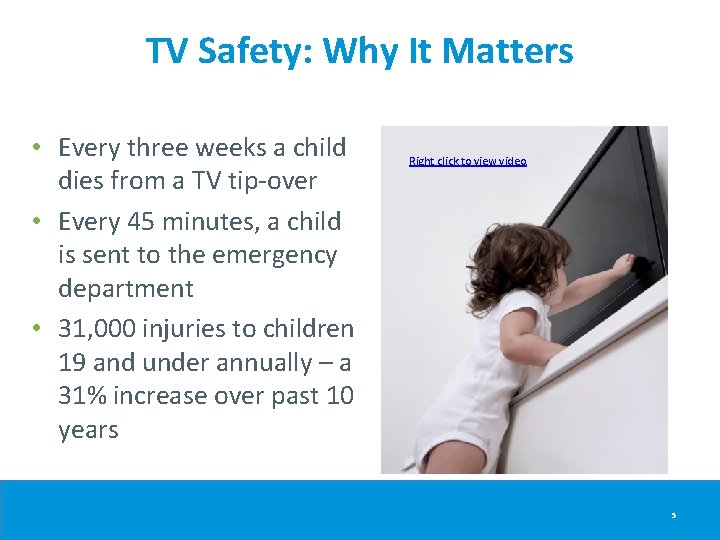
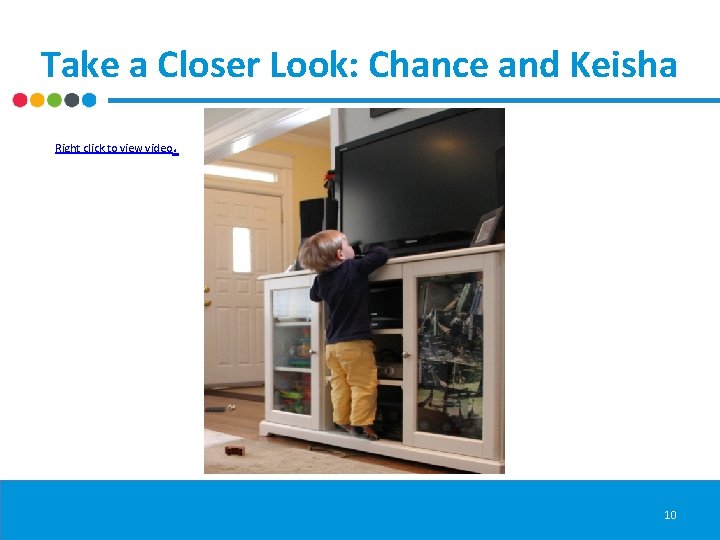
TV Safety: Why It Matters • Every three weeks a child dies from a TV tip-over • Every 45 minutes, a child is sent to the emergency department • 31, 000 injuries to children 19 and under annually – a 31% increase over past 10 years Right click to view video. 5
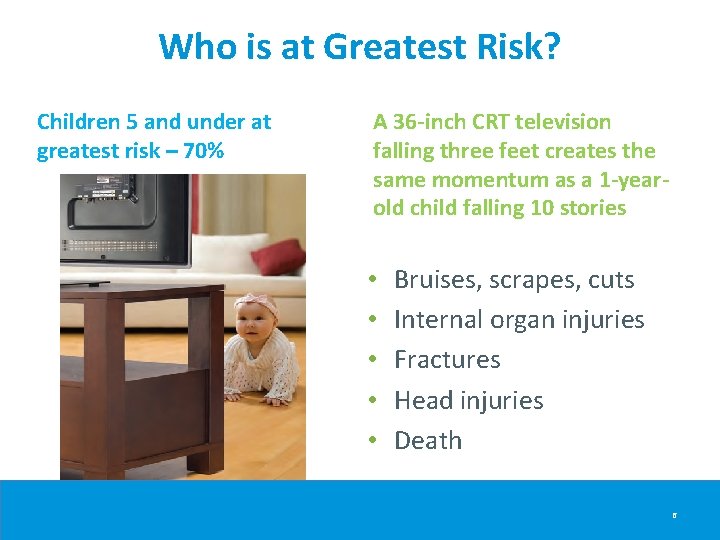
Who is at Greatest Risk? Children 5 and under at greatest risk – 70% A 36 -inch CRT television falling three feet creates the same momentum as a 1 -yearold child falling 10 stories • • • Bruises, scrapes, cuts Internal organ injuries Fractures Head injuries Death 6
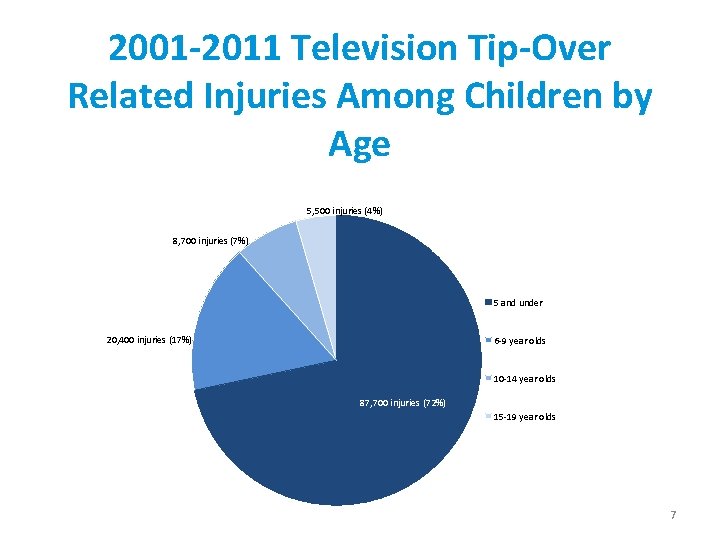
2001 -2011 Television Tip-Over Related Injuries Among Children by Age 5, 500 injuries (4%) 8, 700 injuries (7%) 5 and under 20, 400 injuries (17%) 6 -9 year olds 10 -14 year olds 87, 700 injuries (72%) 15 -19 year olds 7
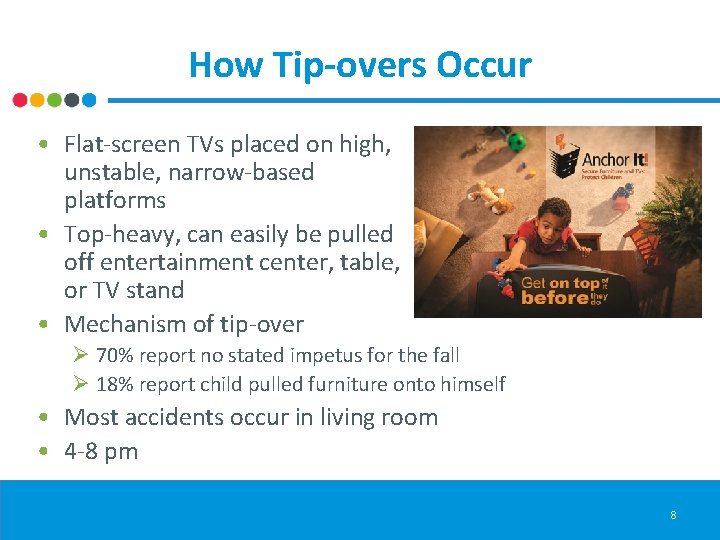
How Tip-overs Occur • Flat-screen TVs placed on high, unstable, narrow-based platforms • Top-heavy, can easily be pulled off entertainment center, table, or TV stand • Mechanism of tip-over Ø 70% report no stated impetus for the fall Ø 18% report child pulled furniture onto himself • Most accidents occur in living room • 4 -8 pm 8
Proven Interventions • Assess stability of TVs in home Ø Can kids/pets playing in room knock TV over? Ø Can children climb to reach items on or near TV? Can they pull out drawers? • Secure TVs Ø Mount flat-screen TVs to wall (follow manufacturer’s instructions) Ø Place old-style TVs on low, stable furniture • Secure top-heavy furniture to wall Ø Use brackets, braces, or wall straps to secure unstable or top-heavy furniture Ø Install stops on dresser drawers to prevent them from being pulled all the way out • Rearrange household items Ø Move heavier items to lower shelves Ø Avoid placing remote controls, toys, food, other items where kids can climb to reach them. 9
Take a Closer Look: Chance and Keisha Right click to view video . 10
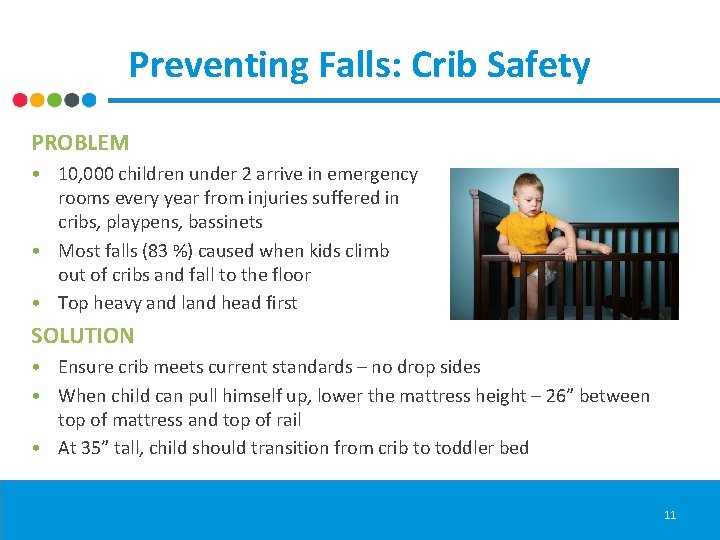
Preventing Falls: Crib Safety PROBLEM • 10, 000 children under 2 arrive in emergency rooms every year from injuries suffered in cribs, playpens, bassinets • Most falls (83 %) caused when kids climb out of cribs and fall to the floor • Top heavy and land head first SOLUTION • Ensure crib meets current standards – no drop sides • When child can pull himself up, lower the mattress height – 26” between top of mattress and top of rail • At 35” tall, child should transition from crib to toddler bed 11
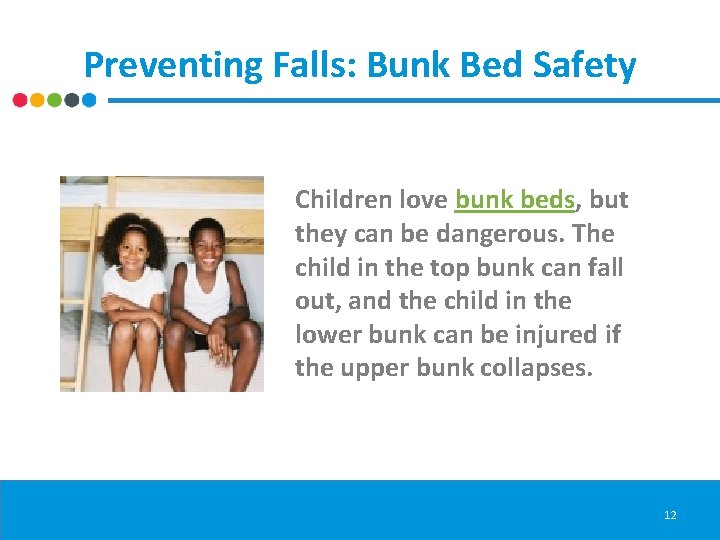
Preventing Falls: Bunk Bed Safety Children love bunk beds, but they can be dangerous. The child in the top bunk can fall out, and the child in the lower bunk can be injured if the upper bunk collapses. 12
Bunk Bed Safety: Why It Matters • Nearly 36, 000 children and adolescents are treated for bunk bed-related injuries in emergency rooms each year. • Half the injuries occurred in children under 6, but there also was a surprising jump in accidents among 18 - to 21 year-olds, who were more than twice as likely to be hurt as kids ages 14 to 17. • Nearly 3 of 4 injuries are caused by falls from bunk beds. • Half of victims suffered injuries to the head, neck or face. • 60 % of injuries occurred to boys. Source: “Journal of Pediatrics” June 2008 Source: 2008 study by the Center for Injury Research and Policy at Nationwide Children's Hospital's Research Institute 13
Bunk Bed Safety Tips • Do not allow a child younger than 6 years to sleep in the top bunk. • Place bunk beds in a corner with walls on two sides. • Make sure the top mattress fits snugly within the frame and cannot ride over the edge. • Attach ladder or stairs to top bunk, which should be surrounded by a guard rail. • Slats on guard rail should have a space no wider than 3 ½ inches between guard rail and side of mattress • Make sure mattress supported by wires/slats that run directly underneath and are fastened at both ends. • Use a night light. 14
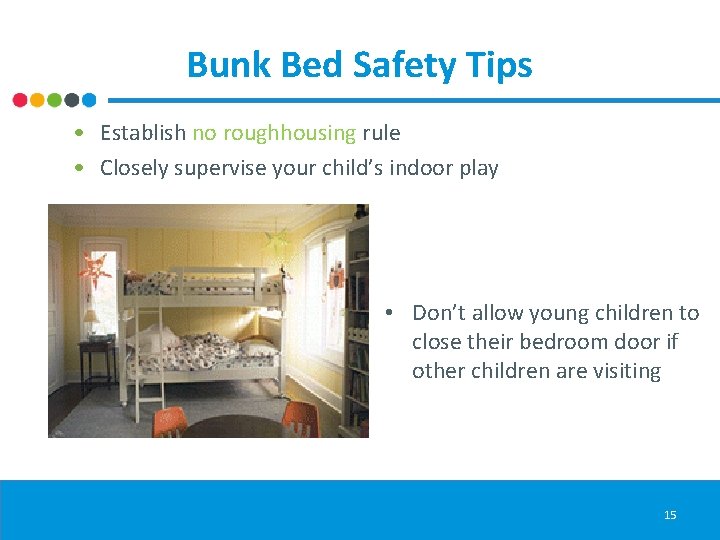
Bunk Bed Safety Tips • Establish no roughhousing rule • Closely supervise your child’s indoor play • Don’t allow young children to close their bedroom door if other children are visiting 15
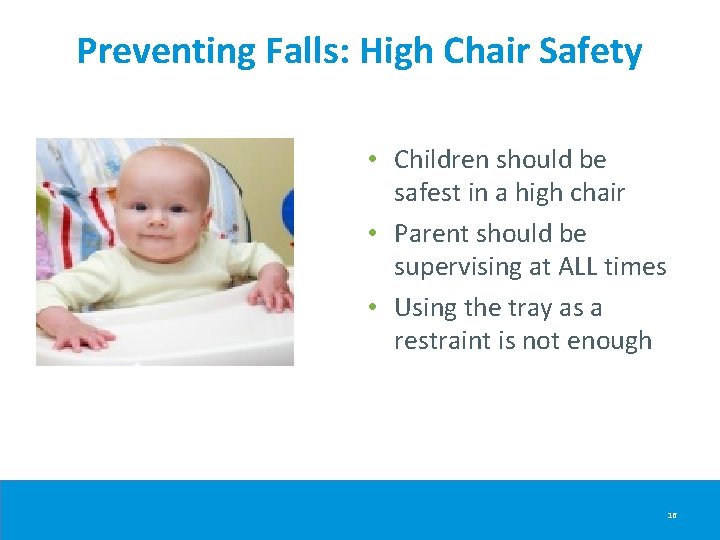
Preventing Falls: High Chair Safety • Children should be safest in a high chair • Parent should be supervising at ALL times • Using the tray as a restraint is not enough 16
High Chair Safety: Why It Matters • High chair-related injuries increased by more than 22 percent between 2003 -2010 • 9, 400 high chair-related injuries treated annually in emergency rooms • Concussions most common diagnosis as children fall onto hard surfaces such as tables, floors or counters • Two-thirds of injured children were climbing or standing in the chair Nationwide Children’s Hospital study, 2010 17
High Chair Safety Tips • Make sure the high chair you use cannot be tipped over easily and is in good repair • Make sure a folding high chair is locked in place every time you set it up • Whenever your child sits in the chair USE THE SAFETY STRAPS, INCLUDING THE CROTCH STRAP • The tray is not a restraint • Never leave a young child alone and do not allow older children to climb on the high chair 18
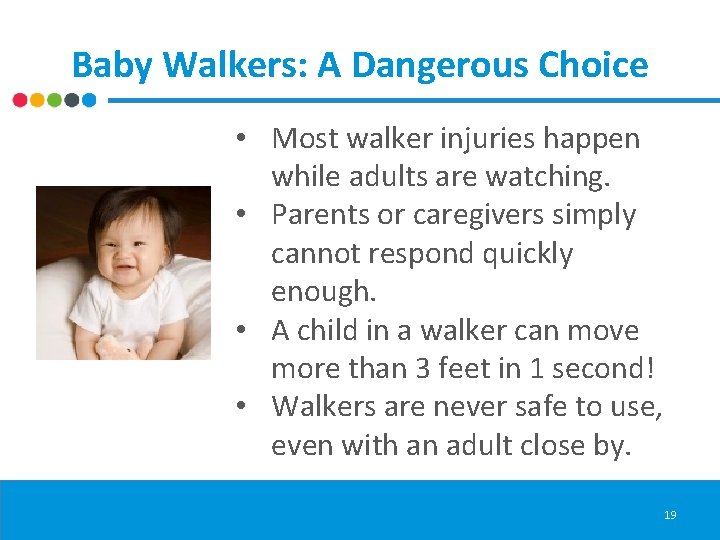
Baby Walkers: A Dangerous Choice • Most walker injuries happen while adults are watching. • Parents or caregivers simply cannot respond quickly enough. • A child in a walker can move more than 3 feet in 1 second! • Walkers are never safe to use, even with an adult close by. 19
Baby Walkers: What’s the Problem? Over 40 % of children who use baby walkers get hurt! Injuries include: • Rolling down the stairs - 96 % of injuries Ø Broken bones, severe head injuries • Burns Ø Extended reach, easier to grab table cloths, pot handles, fireplaces, radiators • Drowning Ø Easier to fall into bathtub • Poisoning Ø Easier to reach high cabinets 20
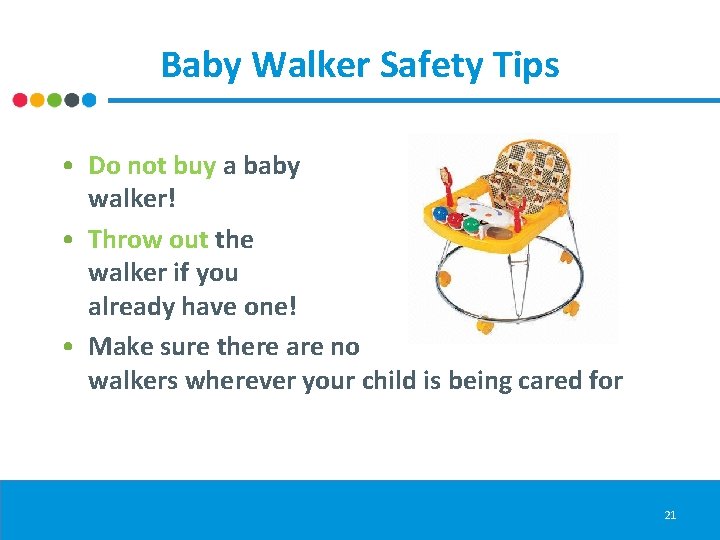
Baby Walker Safety Tips • Do not buy a baby walker! • Throw out the walker if you already have one! • Make sure there are no walkers wherever your child is being cared for 21
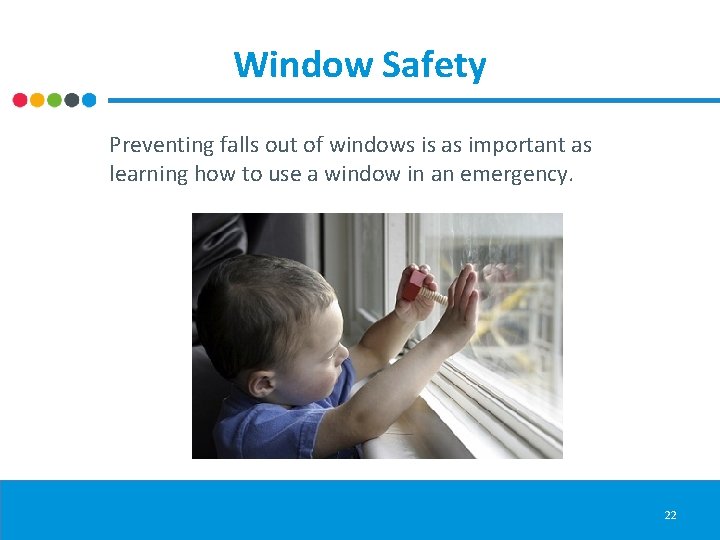
Window Safety Preventing falls out of windows is as important as learning how to use a window in an emergency. 22
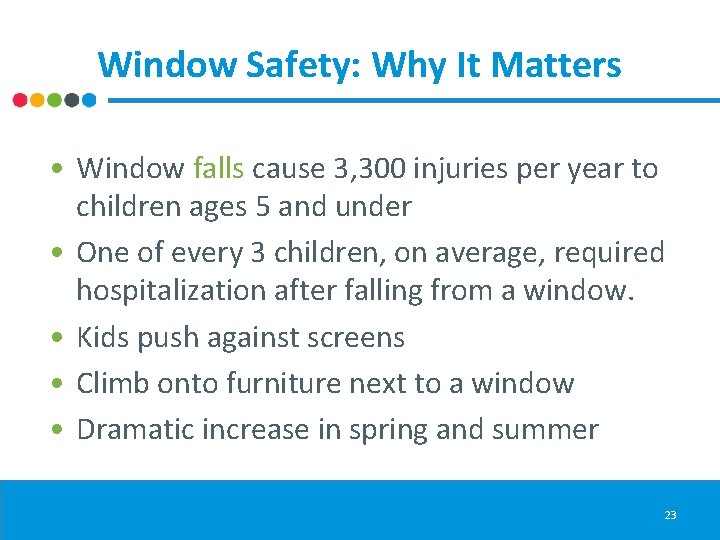
Window Safety: Why It Matters • Window falls cause 3, 300 injuries per year to children ages 5 and under • One of every 3 children, on average, required hospitalization after falling from a window. • Kids push against screens • Climb onto furniture next to a window • Dramatic increase in spring and summer 23
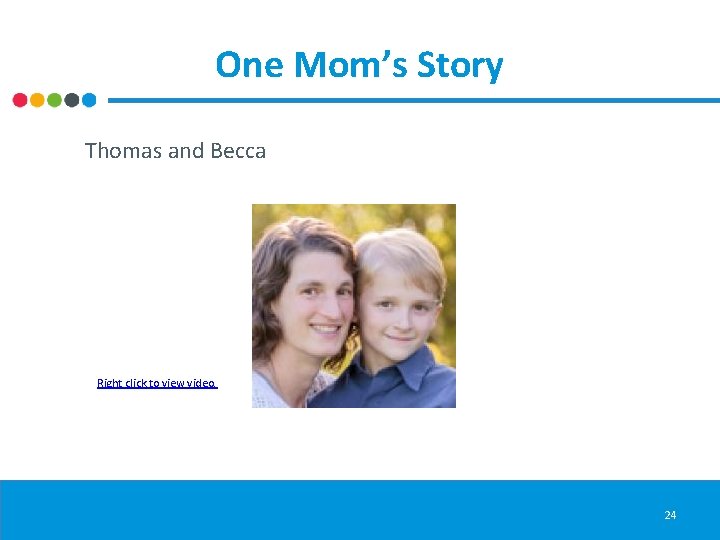
One Mom’s Story Thomas and Becca Right click to view video. 24
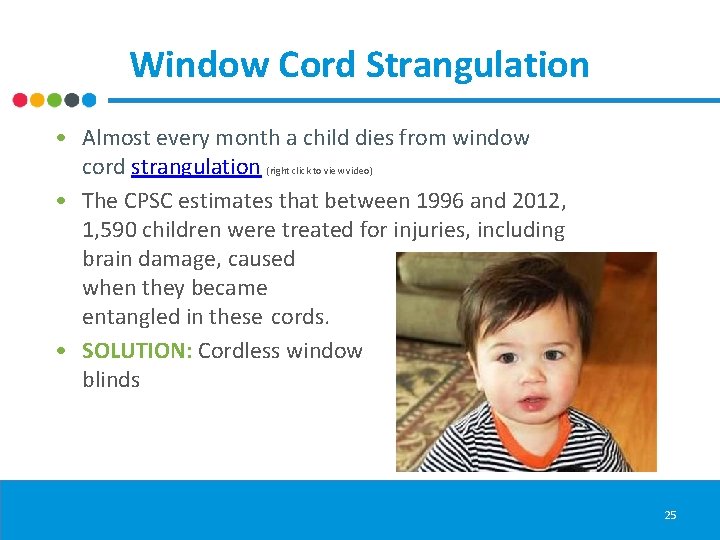
Window Cord Strangulation • Almost every month a child dies from window cord strangulation (right click to view video) • The CPSC estimates that between 1996 and 2012, 1, 590 children were treated for injuries, including brain damage, caused when they became entangled in these cords. • SOLUTION: Cordless window blinds 25
Window Safety Tips • Use window guards or window stops • Install window guards or window stops so that windows open no more than 4 inches • For windows above the 1 st floor, include an emergency release device in case of fire • Never depend on screens (or rules!) to keep kids from falling • Whenever possible, open windows from the top • Keep windows locked and closed when not being used • Move chairs, cribs and other furniture away from windows • Use cordless blinds. 26
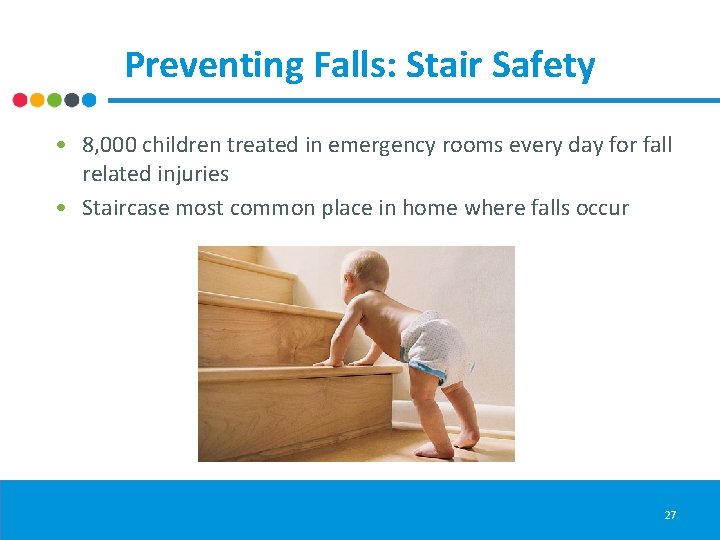
Preventing Falls: Stair Safety • 8, 000 children treated in emergency rooms every day for fall related injuries • Staircase most common place in home where falls occur 27
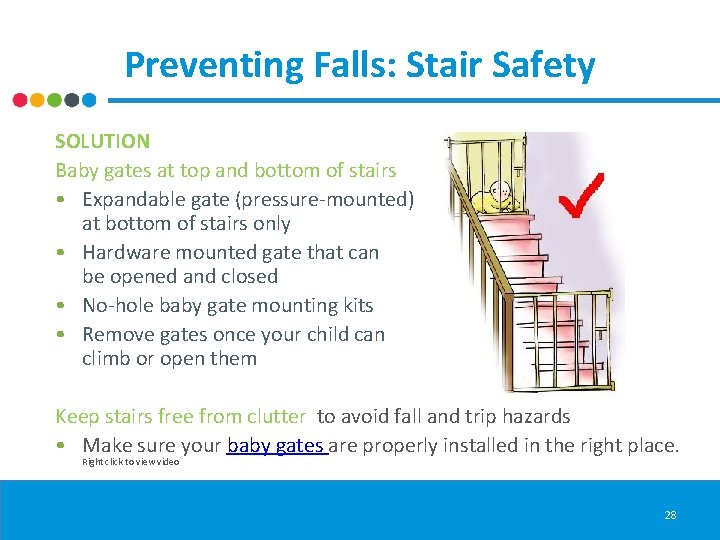
Preventing Falls: Stair Safety SOLUTION Baby gates at top and bottom of stairs • Expandable gate (pressure-mounted) at bottom of stairs only • Hardware mounted gate that can be opened and closed • No-hole baby gate mounting kits • Remove gates once your child can climb or open them Keep stairs free from clutter to avoid fall and trip hazards • Make sure your baby gates are properly installed in the right place. Right click to view video 28
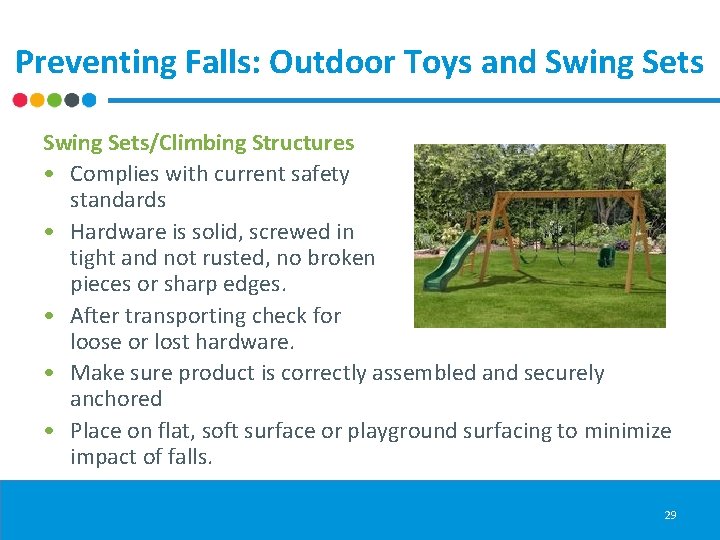
Preventing Falls: Outdoor Toys and Swing Sets/Climbing Structures • Complies with current safety standards • Hardware is solid, screwed in tight and not rusted, no broken pieces or sharp edges. • After transporting check for loose or lost hardware. • Make sure product is correctly assembled and securely anchored • Place on flat, soft surface or playground surfacing to minimize impact of falls. 29
Sources • • • National Fire Protection Association National Safety Council American Academy of Pediatrics, healthychildren. org American Academy of Pediatrics, Parent Plus American Architectural Manufacturers Association National Wood Window and Door Association Screen Manufacturers Association Parent. Guide Pediatrics, 2. 17. 11 National Electronic Injury Surveillance System, 1990 -2008 30
QUESTIONS? 31
Thank You Michelle Parker, 909 -558 -8118 mparker@llu. edu Katie Smith, 916 -244 -1964 ksmith@thecapcenter. org safekidscalifornia. org facebook. com/safekidscalifornia 32