
SMART Objectives and Action Planning Local Integrated Assessment
SMART Objectives and Action Planning Local Integrated Assessment and Planning (LIAP)
Aims of the Module 1. To increase participants’ knowledge of SMART objectives. 2. To increase participants’ confidence in identifying SMART objectives and integrating these into an agreed action plan.
SMART PLANNING What does SMART stand for?
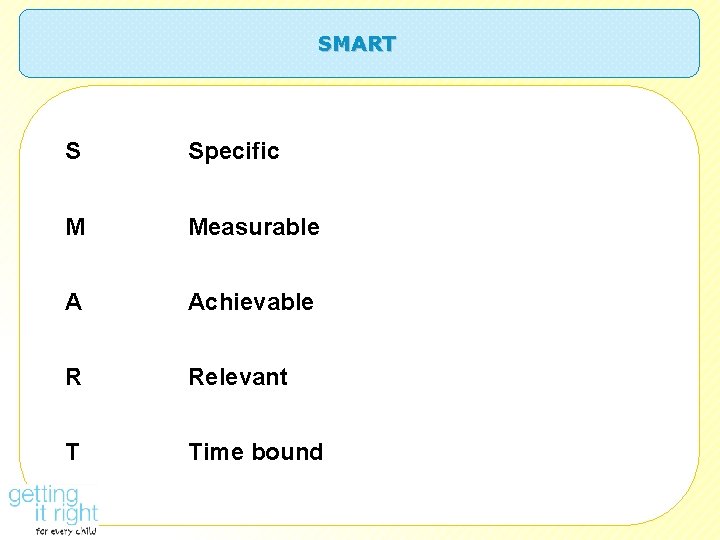
SMART S Specific M Measurable A Achievable R Relevant T Time bound
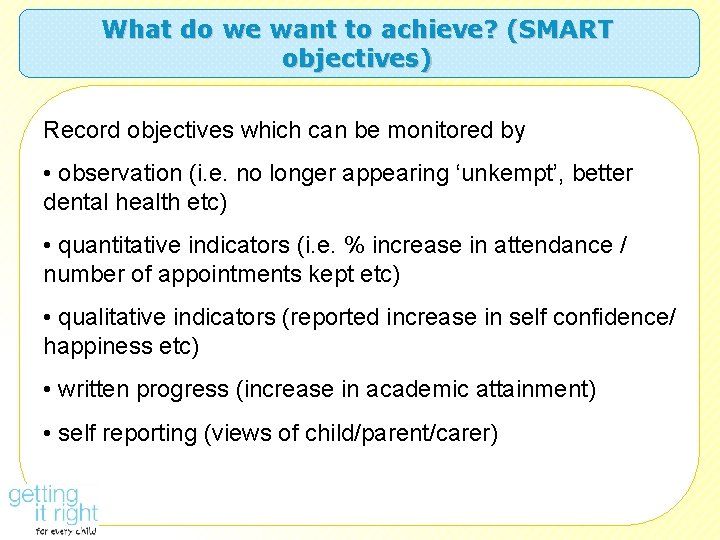
What do we want to achieve? (SMART objectives) Record objectives which can be monitored by • observation (i. e. no longer appearing ‘unkempt’, better dental health etc) • quantitative indicators (i. e. % increase in attendance / number of appointments kept etc) • qualitative indicators (reported increase in self confidence/ happiness etc) • written progress (increase in academic attainment) • self reporting (views of child/parent/carer)
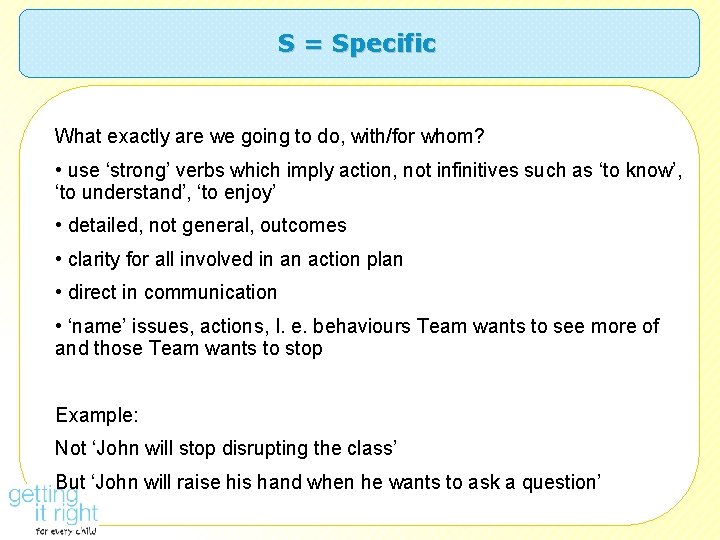
S = Specific What exactly are we going to do, with/for whom? • use ‘strong’ verbs which imply action, not infinitives such as ‘to know’, ‘to understand’, ‘to enjoy’ • detailed, not general, outcomes • clarity for all involved in an action plan • direct in communication • ‘name’ issues, actions, I. e. behaviours Team wants to see more of and those Team wants to stop Example: Not ‘John will stop disrupting the class’ But ‘John will raise his hand when he wants to ask a question’
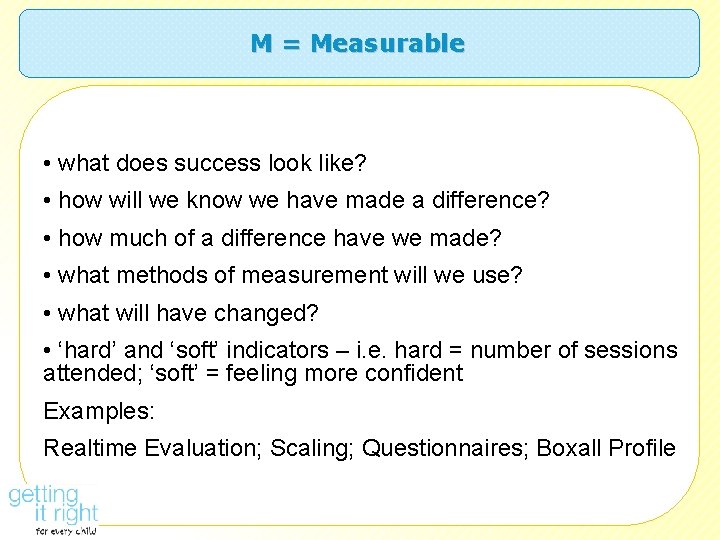
M = Measurable • what does success look like? • how will we know we have made a difference? • how much of a difference have we made? • what methods of measurement will we use? • what will have changed? • ‘hard’ and ‘soft’ indicators – i. e. hard = number of sessions attended; ‘soft’ = feeling more confident Examples: Realtime Evaluation; Scaling; Questionnaires; Boxall Profile
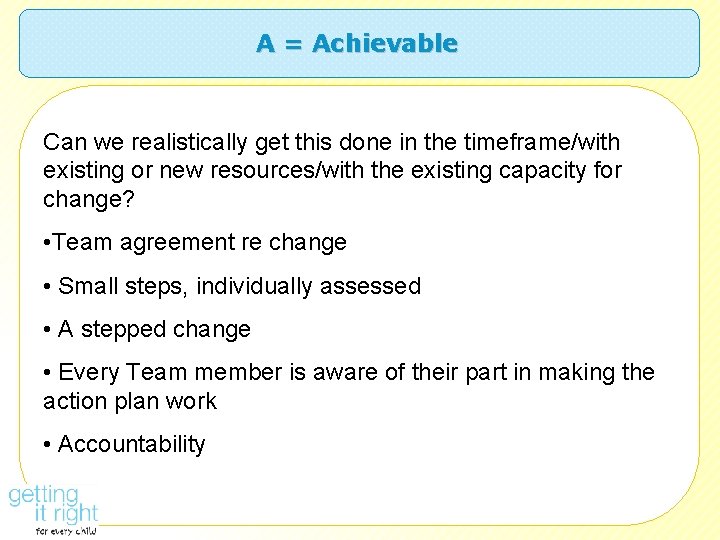
A = Achievable Can we realistically get this done in the timeframe/with existing or new resources/with the existing capacity for change? • Team agreement re change • Small steps, individually assessed • A stepped change • Every Team member is aware of their part in making the action plan work • Accountability
R = Relevant Will this objective lead to the desired results? Relevant and proportionate • to the need • to the risks • to the issues identified in the assessment It must be something which the Team is willing and able to work towards.
Time bound • by when do we want to achieve each change? • specific deadlines for each stage – not “ongoing” • linked to review of progress ( this does not necessarily involve a meeting) Example: ‘in 2 weeks’, ‘ by end December 2012’
Benefits of being SMART • solution oriented • centred on, and evidenced by, holistic assessment • clarity for all • actions planned are focussed • provides accountability • shared language and understanding • the difference a plan makes can be clearly evidenced • the Team can learn from what works and what doesn’t and review accordingly • analysis of effective ways of working (implications for future resources)
ACTION PLANNING Identify issues of concern. • name exactly what the Team sees as problematic • avoid generic language/agency specific language/emotive language • check out that everyone is clear with what is being identified
Who will do this? • be specific • name the individual who will carry out the task, not simply the agency • ensure all Team members, including the child and parent/carer, have clear actions • ensure agreement
What will be done? • address the detail of the actions necessary • say exactly what tasks/actions will be done Example: ‘Joyce will attend a 6 week parenting group delivered by the Avedon Team beginning on 1 st July’ ‘Malcolm will draw a picture for the next meeting in 2 weeks’ time to show he feels’
When will this be done? • agree a realistic time period for change • short or long term periods (dependent on issue) • not ‘ongoing’ • part of a process of change (long term) or task orientated (short term)
How will we measure progress? What specific method will the Team use? • evidence-based methods are best. • The Moray Council support Realtime Evaluation.
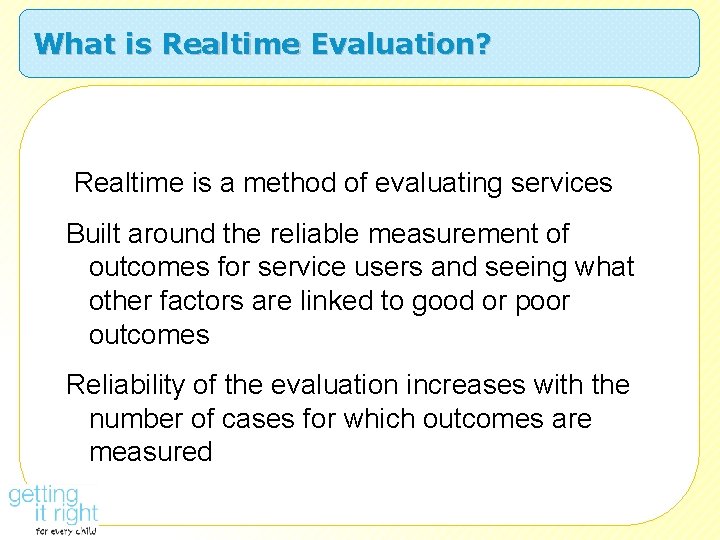
What is Realtime Evaluation? Realtime is a method of evaluating services Built around the reliable measurement of outcomes for service users and seeing what other factors are linked to good or poor outcomes Reliability of the evaluation increases with the number of cases for which outcomes are measured
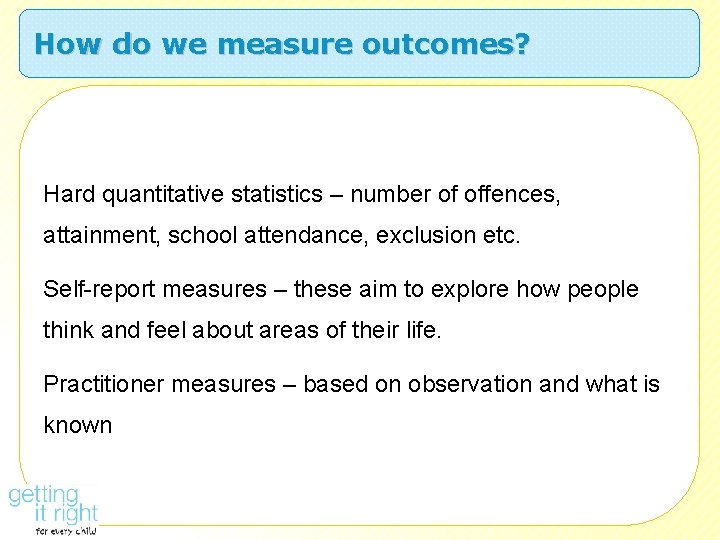
How do we measure outcomes? Hard quantitative statistics – number of offences, attainment, school attendance, exclusion etc. Self-report measures – these aim to explore how people think and feel about areas of their life. Practitioner measures – based on observation and what is known
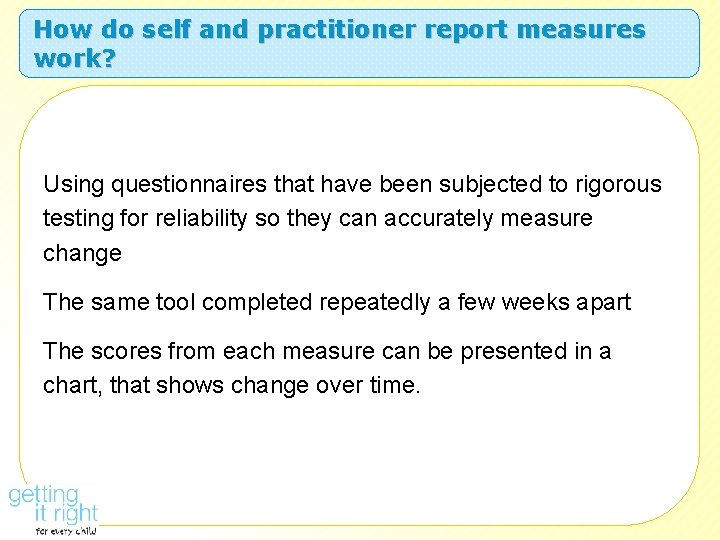
How do self and practitioner report measures work? Using questionnaires that have been subjected to rigorous testing for reliability so they can accurately measure change The same tool completed repeatedly a few weeks apart The scores from each measure can be presented in a chart, that shows change over time.
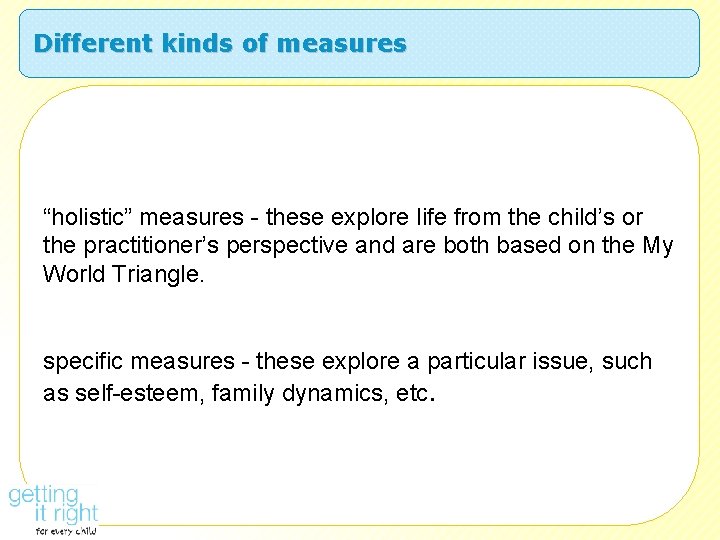
Different kinds of measures “holistic” measures - these explore life from the child’s or the practitioner’s perspective and are both based on the My World Triangle. specific measures - these explore a particular issue, such as self-esteem, family dynamics, etc.
Benefits of using reliable measures As a means of informing assessments As a means of getting the client’s perspective on their situation As a means of uncovering overlooked areas of concern As a means of reconsidering the professional approach to a case. As a visual aide to decision-making
Examples of what we are Doing in Moray Performance and Evaluation Support Officer uses data from practitioners to provide. • Individual graphs plotting progress on a case by case basis • “Needs Profile” - collective overall picture • Evaluation – evidencing which factors contribute towards positive outcomes?
How measures can inform Hearings and reports Graphically illustrating change The child’s or parent’s voice Telling a story Validating practitioner assessments or recommendations
Moving on What do we do when everything’s been tried and nothing is making a difference? What are our options? How do we move on?
Moving On…. questions to consider Are the issues of concern the same or are they new? Has the Team re-visited the assessment (child’s plan 2)? (See LIAP Flowchart) Do you know what you don’t know? (i. e. what other information does the Team need and who can provide this? ) Does another professional need to be brought into the Team (with consent)? What have the evidence-based actions told the Team of what does and doesn’t work? Do you need to escalate the plan?
Additional Resources Support from Team around the Child and Lead Professional Local Integration Support Officers Additional Resource Management Group Placement Services Group NB All of the above require evidence that everything possible has been tried locally with the child at the centre of decision-making and planning processes.
- Slides: 26