
Smart Membranes Gmb H Dresden M 3 d
Smart. Membranes Gmb. H Dresden, M 3 d Meeting 05/09/14
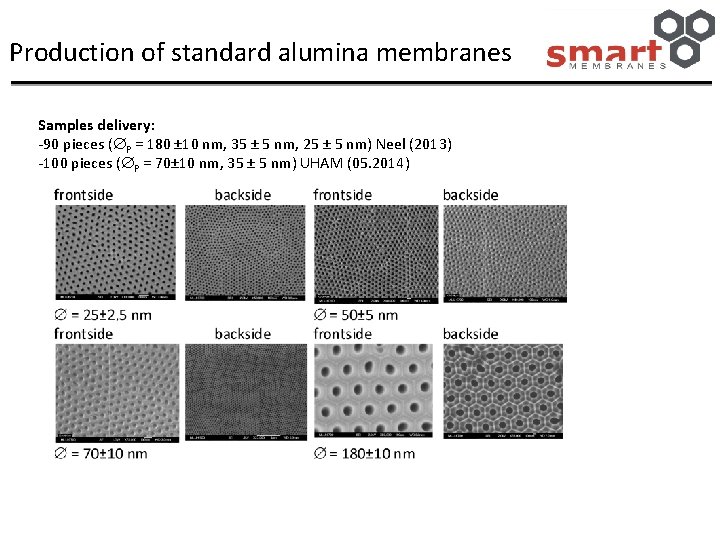
Production of standard alumina membranes Samples delivery: -90 pieces ( P = 180 ± 10 nm, 35 ± 5 nm, 25 ± 5 nm) Neel (2013) -100 pieces ( P = 70± 10 nm, 35 ± 5 nm) UHAM (05. 2014)
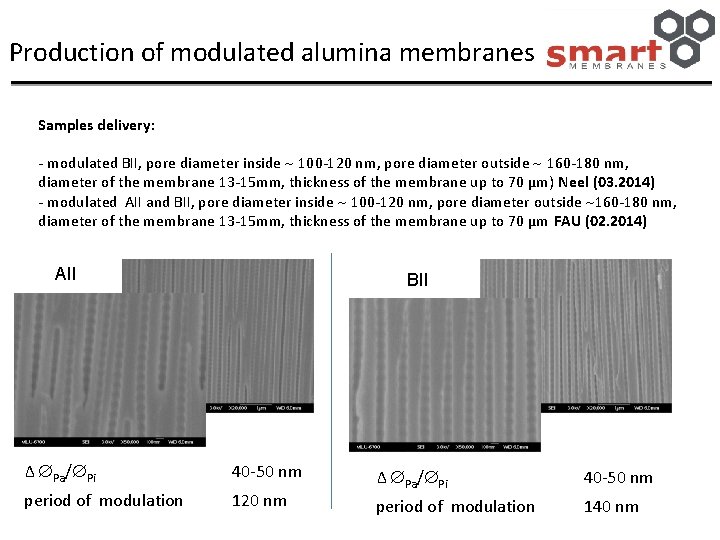
Production of modulated alumina membranes Samples delivery: - modulated BII, pore diameter inside 100 -120 nm, pore diameter outside 160 -180 nm, diameter of the membrane 13 -15 mm, thickness of the membrane up to 70 μm) Neel (03. 2014) - modulated AII and BII, pore diameter inside 100 -120 nm, pore diameter outside 160 -180 nm, diameter of the membrane 13 -15 mm, thickness of the membrane up to 70 μm FAU (02. 2014) AII BII Δ Pa/ Pi 40 -50 nm period of modulation 120 nm Δ Pa/ Pi 40 -50 nm period of modulation 140 nm
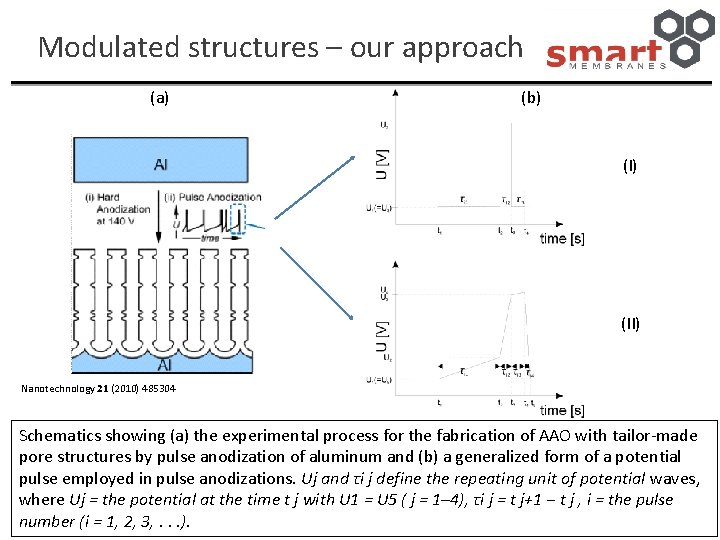
Modulated structures – our approach (a) (b) (II) Nanotechnology 21 (2010) 485304 Schematics showing (a) the experimental process for the fabrication of AAO with tailor-made pore structures by pulse anodization of aluminum and (b) a generalized form of a potential pulse employed in pulse anodizations. Uj and τi j define the repeating unit of potential waves, where Uj = the potential at the time t j with U 1 = U 5 ( j = 1– 4), τi j = t j+1 − t j , i = the pulse number (i = 1, 2, 3, . . . ).
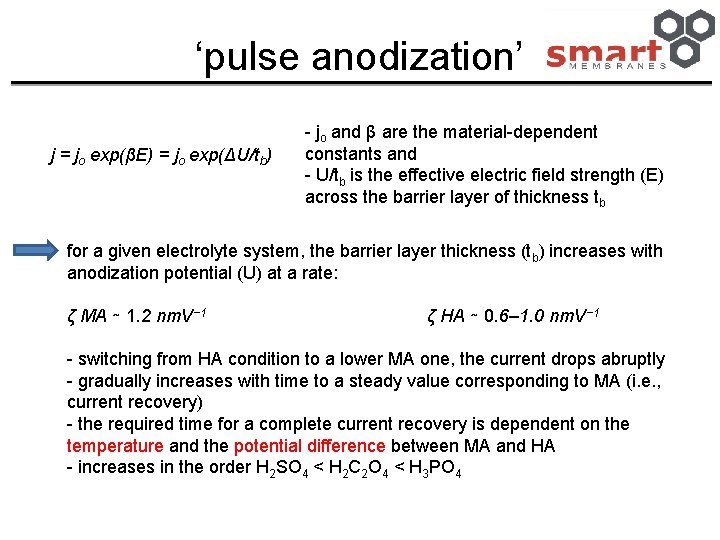
‘pulse anodization’ j = jo exp(βE) = jo exp(ΔU/tb) - jo and β are the material-dependent constants and - U/tb is the effective electric field strength (E) across the barrier layer of thickness tb for a given electrolyte system, the barrier layer thickness (tb) increases with anodization potential (U) at a rate: ζ MA ∼ 1. 2 nm. V− 1 ζ HA ∼ 0. 6– 1. 0 nm. V− 1 - switching from HA condition to a lower MA one, the current drops abruptly - gradually increases with time to a steady value corresponding to MA (i. e. , current recovery) - the required time for a complete current recovery is dependent on the temperature and the potential difference between MA and HA - increases in the order H 2 SO 4 < H 2 C 2 O 4 < H 3 PO 4
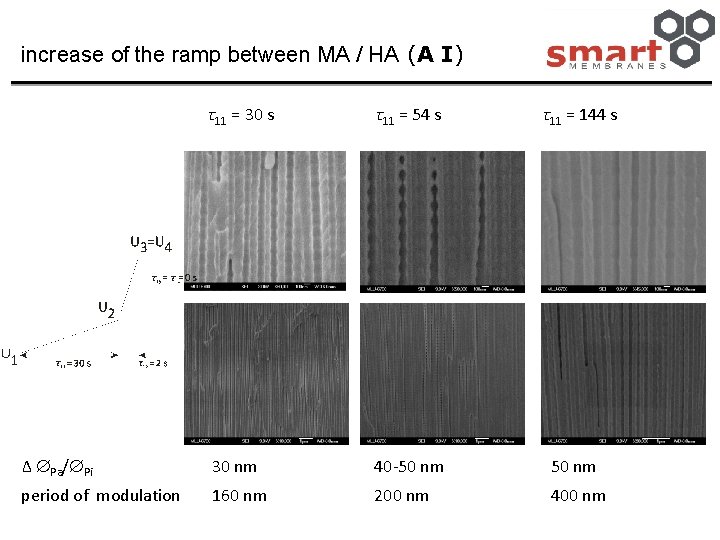
increase of the ramp between MA / HA (A I) τ11 = 30 s τ11 = 54 s τ11 = 144 s Δ Pa/ Pi 30 nm 40 -50 nm period of modulation 160 nm 200 nm 400 nm
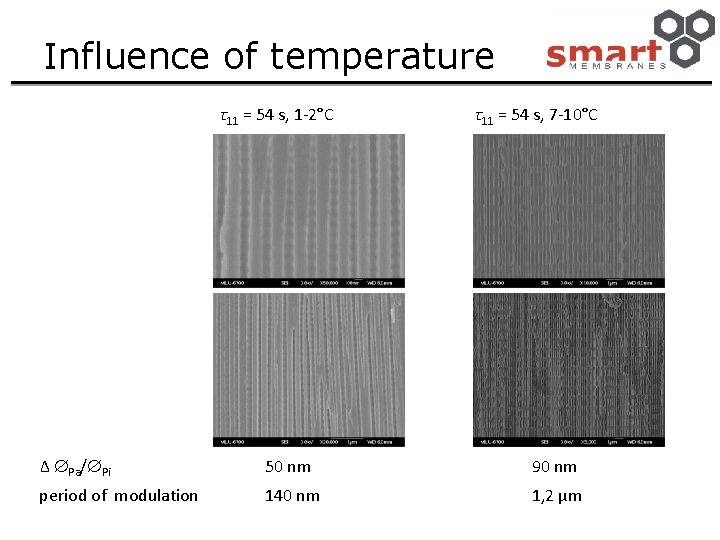
Influence of temperature τ11 = 54 s, 1 -2°C τ11 = 54 s, 7 -10°C Δ Pa/ Pi 50 nm 90 nm period of modulation 140 nm 1, 2 µm
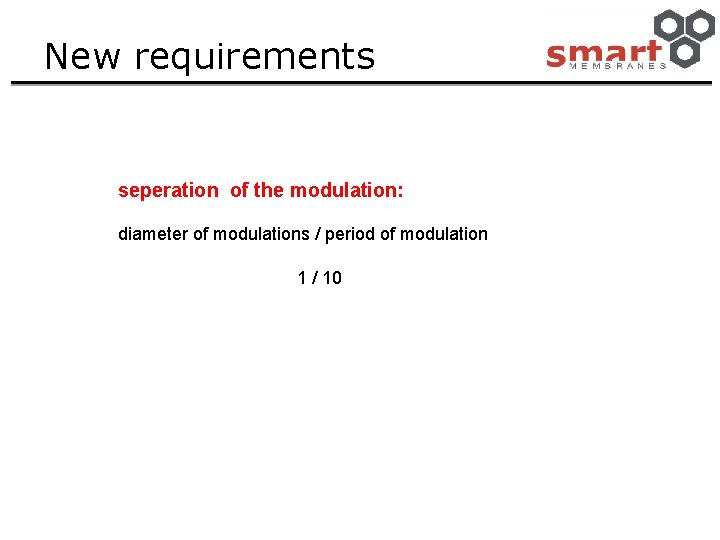
New requirements seperation of the modulation: diameter of modulations / period of modulation 1 / 10
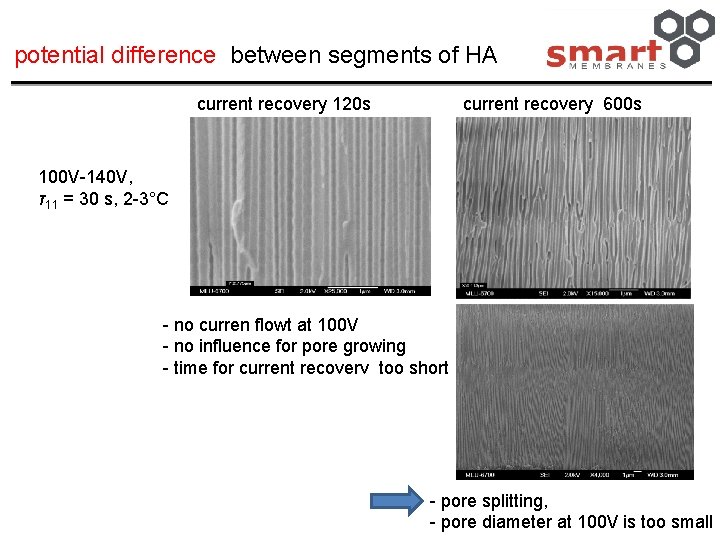
potential difference between segments of HA current recovery 120 s current recovery 600 s 100 V-140 V, τ11 = 30 s, 2 -3°C - no curren flowt at 100 V - no influence for pore growing - time for current recoverv too short - pore splitting, - pore diameter at 100 V is too small
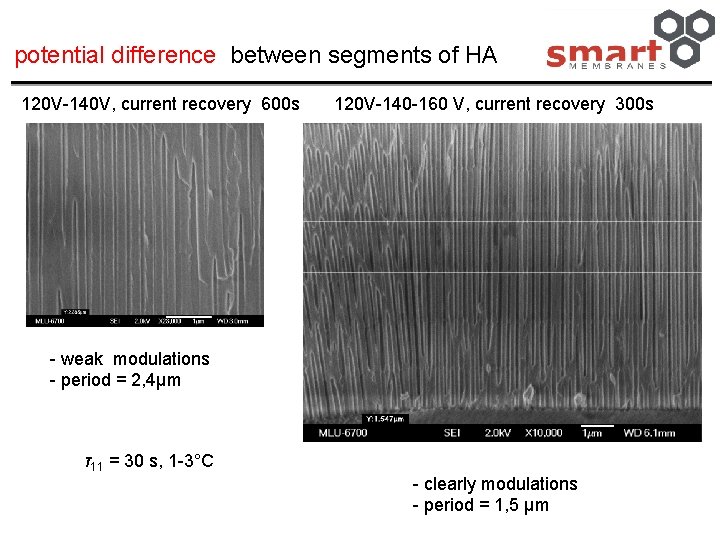
potential difference between segments of HA 120 V-140 V, current recovery 600 s 120 V-140 -160 V, current recovery 300 s - weak modulations - period = 2, 4µm τ11 = 30 s, 1 -3°C - clearly modulations - period = 1, 5 µm
- Slides: 10